
Passport
-
Ice and snow class
-
Tian-Shan, Terskey Ala-Too, Jety-Oguz gorge
-
Oguz-bashi II Western peak (5000 m) via the North face "through the icefall"
-
Proposed category of difficulty — 6A first ascent
-
Route description:
elevation gain — 750 m, length — 990 m, length of sections with 5th category of difficulty — 600 m, 6th category of difficulty — 190 m, average steepness of the main part of the route — 57° (4200–4850), including 6th category of difficulty sections: 65° (4650–4725), 85° (4770–4850), 105–120° (4830–4880)
-
Pitons used:
rock: 0, bolt: 0, chocks: 0, ice: 430* * — including 130 per rope team during independent movement and an additional 40 during interaction (130 × 3 + 40).
-
Team's total climbing hours — 18 (from the bergschrund to the summit), 1 day
-
Overnight stays — under the route on the glacier
-
Team leader — Shustrov Alexey Borisovich, Master of Sports
Team members:
- Gershtein Alexander Semenovich, Candidate Master of Sports
- Naydenyshev Alexey Alexeevich, Candidate Master of Sports
- Pozhidaev Yuri Evgenievich, Master of Sports
- Simonov Valery Pavlovich, Candidate Master of Sports
- Shustrov Nikolay Borisovich, Master of Sports
-
Coach — Razumov Yuri Mikhailovich
-
Start of the route: August 12, 1988
Summit — August 12, 1988 Return — August 12, 1988
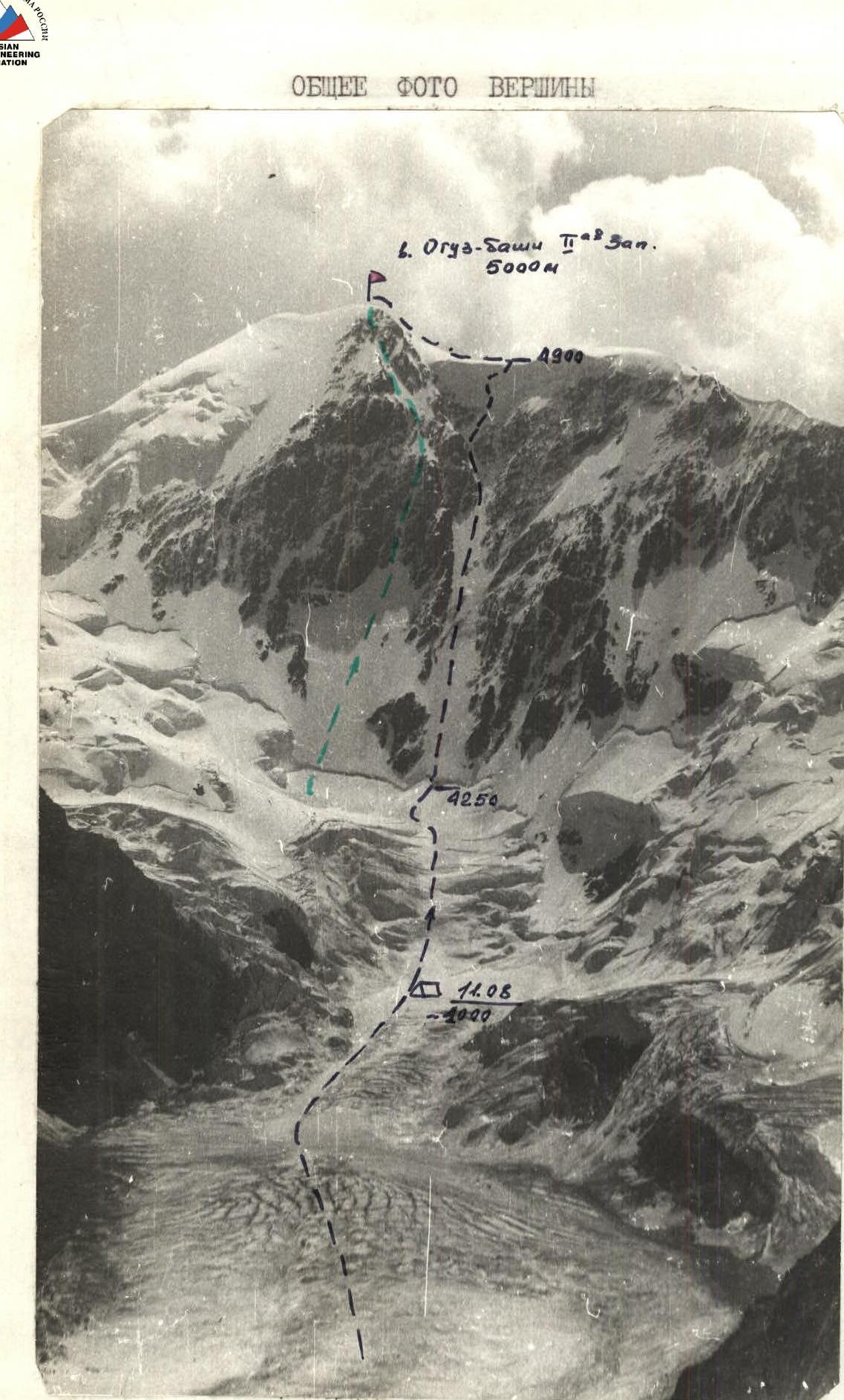
Legend:
- — — — route taken by the team
- — — — route via the North face (Odessa, 1984)
- — — — overnight stay on the glacier
Photo taken on August 11, 1988, around 13:00. Lens of camera "Smena" T-43, F = 43 mm. Distance from the shooting point (№2) is about 3 m.
Tactical actions of the team
Chronology of the ascent:
- August 12, 1988, 0:00 — departure from the assault camp on the glacier
- 1:00 — approach to the bergschrund
- 2:00 — passage of the vertical wall of the bergschrund
- 9:00 — arrival under the wall of the upper icefall (section 7)
- 18:00 — arrival at the pre-summit plateau
- 19:15 — arrival at the summit
- 21:30 — descent via the Western ridge to the Asan-tuka glacier to the assault camp
Until the upper icefall, the group followed the ascent exactly according to the tactical plan. The unforeseen increase in the complexity of the icefall (section 7-II) introduced some adjustments to the tactics and timing. The deviation from the tactical plan is explained by the impossibility of accurately determining the steepness and complexity of the upper icefall before the ascent.
Organization of belays: Throughout the entire route, all participants moved on a double rope. Before the icefall, the group moved in parallel independent rope teams. Participants in each rope team moved simultaneously on a doubled 20 m rope, so that at any moment there were at least 3 pitons between them. The lead climber in the rope team was changed as soon as they ran out of pitons. The shortened rope and parallel movement of the rope teams ensured the safety of the second climber in the team from falling ice fragments and provided good vocal communication in the dark.
All participants moved using ice axes, which significantly saved energy and ensured a high ascent speed.
Short slings with two carabiners were used on intermediate pitons to facilitate rope pulling.
On the upper icefall (section 7-II), the group moved on fixed ropes (with top belay) set by the first rope team (Shustrov A. and Simonov V.). Due to the high steepness (up to 120°), pitons were placed more frequently — every 3 m or less.
Route features: The route is characterized by a variety of ice forms:
- snow with inclusions of ice plates (R0–R1)
- firn (R10–R11)
- ice covered with a thin layer of snow (R1–R2)
- normal "viscous" ice
- thin flow ice on rocks (R5–R6)
- very hard — "glassy" ice (R7–R10)
This required special attention during movement, as the state of the ice sometimes changed very abruptly. In addition, passing the upper icefall required special technique — preliminary digging of a small pit for the ice axe using an ice hammer.
The movement regime up to section R8 was continuous. Under the icefall wall, two rope teams had to stop while the first rope team fixed the ropes, and had about 3 hours to make hot tea. There was also a half-hour stop when exiting onto the plateau.
When exiting the icefall onto the plateau through a snow cornice, the first climber in the rope team (Shustrov A.) fell and, after flying 6 m (3+3), was arrested by the nearest anchor point (ice axe hammered horizontally into the cornice). He hung on the rope, then self-arrested to the anchor point and continued the ascent. There were no injuries or bruises.
Throughout the entire route, the group maintained stable communication with the observation group every 4 hours. A "Kaktus" radio station was used.
Route diagram in symbols M 1:2000
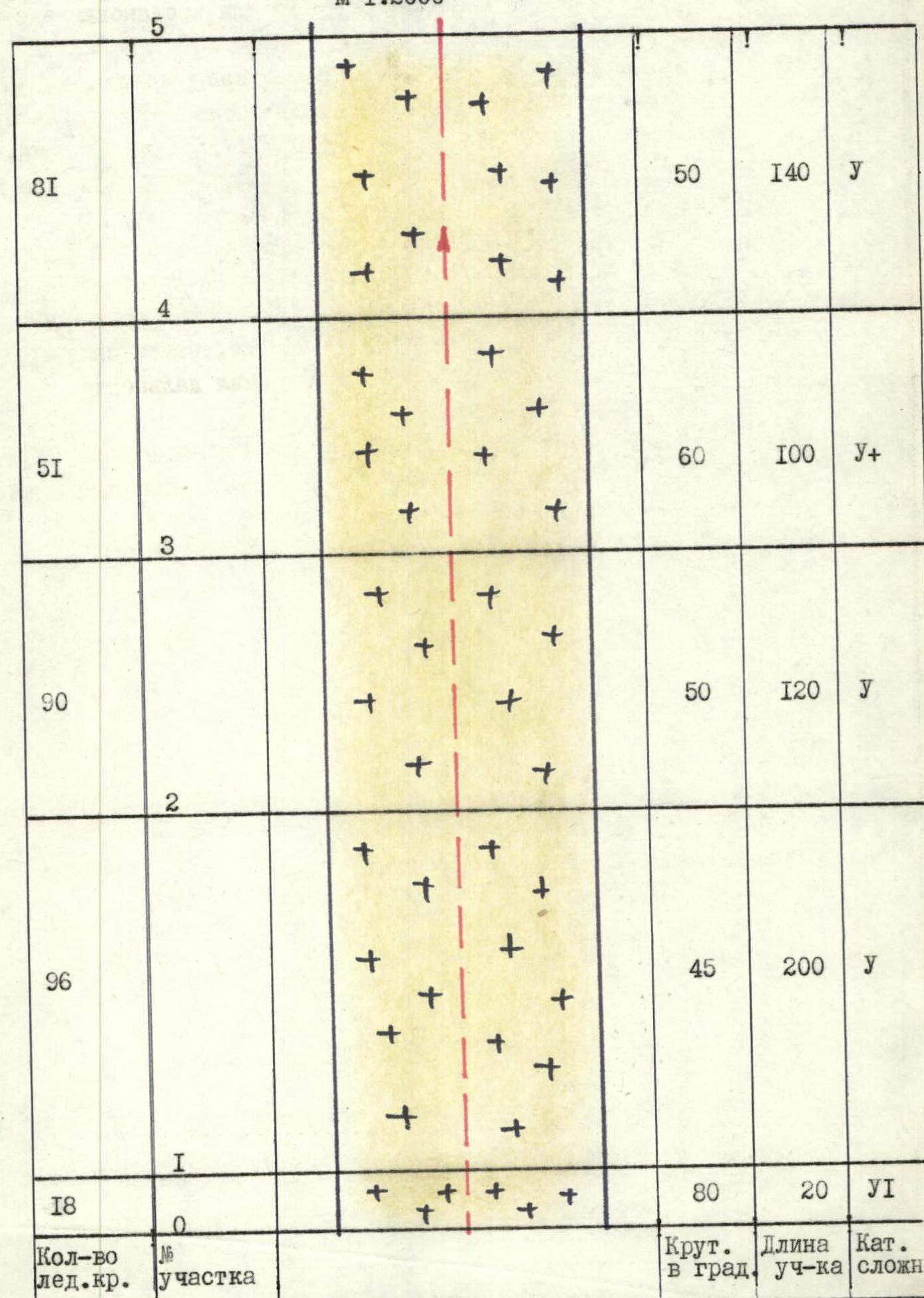
Total 18 climbing hours
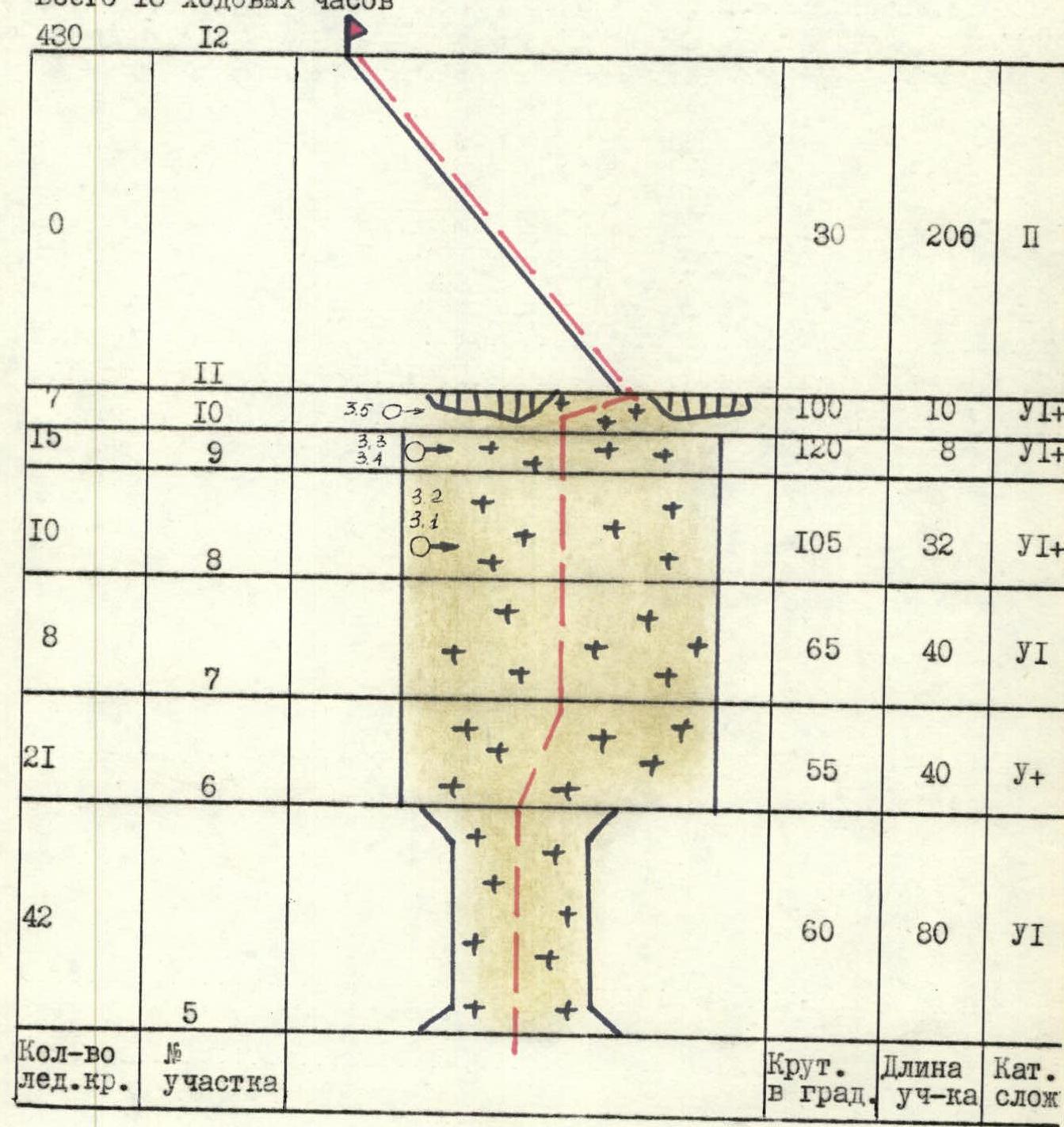
Route description by sections
Section R0–R1. The section is a wide bergschrund, traversed via a snow bridge, and further an almost sheer wall of loose snow with bands of ice. The wall is climbed directly by independent rope teams using ice axes and ice hammers, with piton belays for the first climber through ice screws. It is necessary to clear a lot of snow to find ice bands for belays.
Section R1–R2. Ice slope, lightly dusted with snow. Simultaneous movement with belays through ice screws (at least 3 per 20-meter rope).
Section R2–R3. The slope steepness gradually increases. Snow on the surface disappears. The ice is dense and viscous. Movement and belays are similar to section R1–R2.
Section R3–R4. As the steepness increases, there appear:
- sections of flow ice,
- voids with a thin upper crust.
This section requires increased attention, as ice axe placements can be pulled out, and the upper layer can be cut through by crampons. It is necessary to find sections without cavities for screwing in ice screws. Movement is in parallel rope teams.
Section R4–R5. A section of "good" — dense ice. The couloir narrows but is still wide enough for three rope teams to move.
Section R5–R6. The couloir is divided by rock outcrops into several branches, representing "ram's foreheads" covered in ice. Ice with voids. Movement on ice axes is very challenging. It is not always possible to find a spot to fully screw in an ice screw. Only two rope teams can move simultaneously (it's very narrow); the third team has to wait under the overhang of the left couloir wall (intensely falling ice fragments from the first rope team). Movement is partly alternate.
Section R6–R7. Movement is up and to the right under the wall of the upper icefall. The ice is very hard — it starts to chip off in lenses; screwing in ice screws requires significant effort. In the upper part of the section, the ice is covered with a layer of powdery snow. Movement is simultaneous by independent rope teams.
Section R7–R8. The ice is extremely hard — "glassy". It cracks and chips off in lenses. Ice axes enter very shallowly (a few mm), placement is only possible with a blow. Ice screws can be screwed in only after 2–3 attempts and preliminary warming. Movement is by independent rope teams, alternate.
Section R8–R9. The state of the ice is the same as in the previous section. The first climber moves on ice axes; the rest follow on fixed ropes. Movement is extremely challenging. Before placing an ice axe, it is necessary to create a special pit using a thin ice hammer. This is one of the key sections of the route.
Section R9–R10. The ice is initially very hard, then gradually becomes softer, and at the end of the section, it turns into firn in places. The steepness is maximum for movement on ice axes. At the end of the section, there are difficulties in organizing reliable belays — the ice is soft — it is necessary to use several linked pitons. The first climber moves on ice axes; the rest follow on fixed ropes.
Section R10–R11. Traverse under the snow cornice of the plateau to the right and up to the junction of two cornices, then directly up (about 3 m) to exit onto the plateau. The first climber moves using:
- ice axe with a shovel,
- ice axe hammered into the wall with the pick,
- forming steps and "pockets" for hands.
Belays are through ice screws (where possible) and ice axes hammered into the cornice. The entire group follows on fixed ropes.
Section R11–R12. Initially along the plateau, and then along a simple snow-rock ridge to the summit. Movement is by autonomous rope teams with simultaneous belays on outcrops.
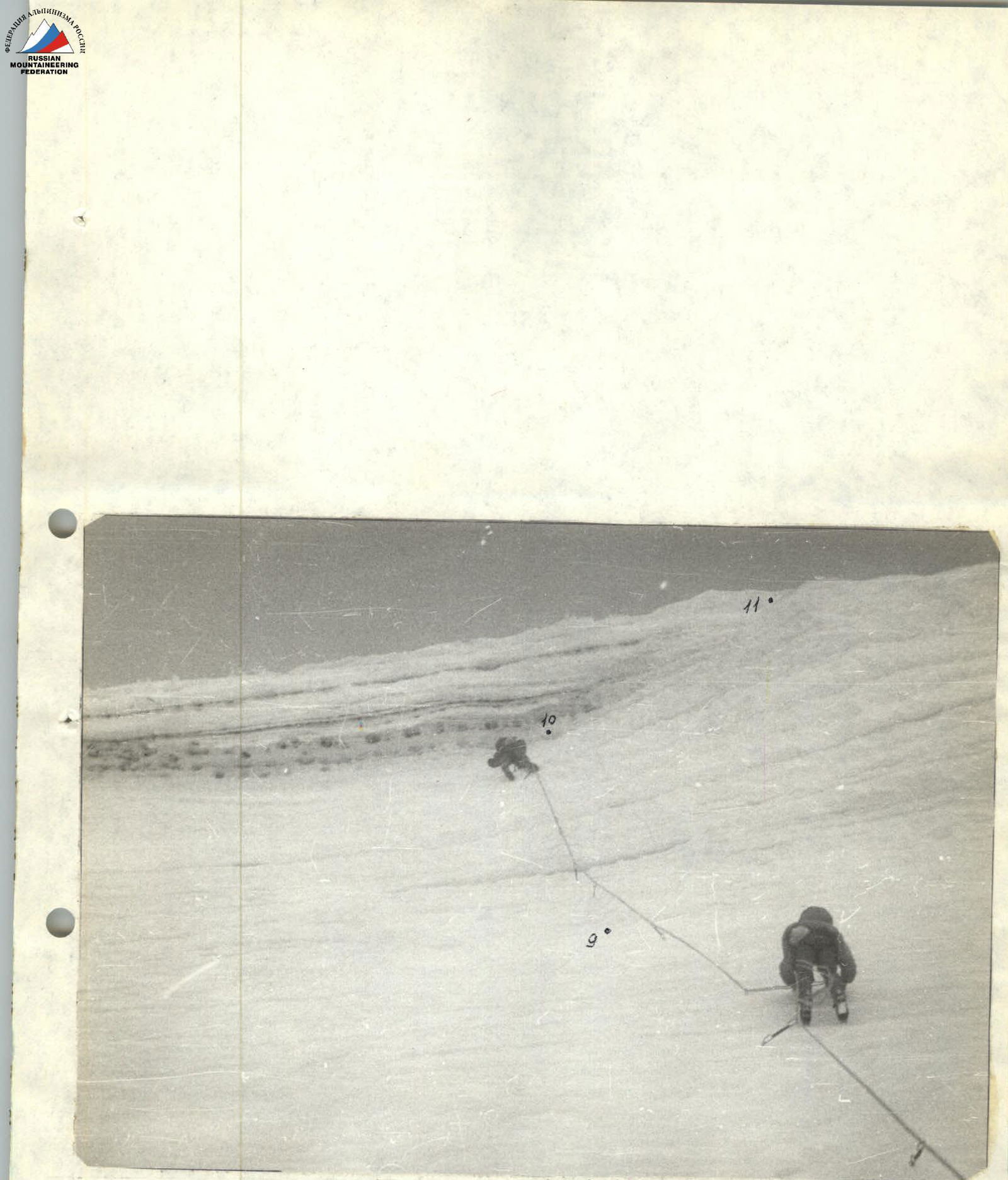
Photo 3.3. On section R9–R10, Shustrov A. is leading, Simonov V. is on belay at the end of section R8–R9.
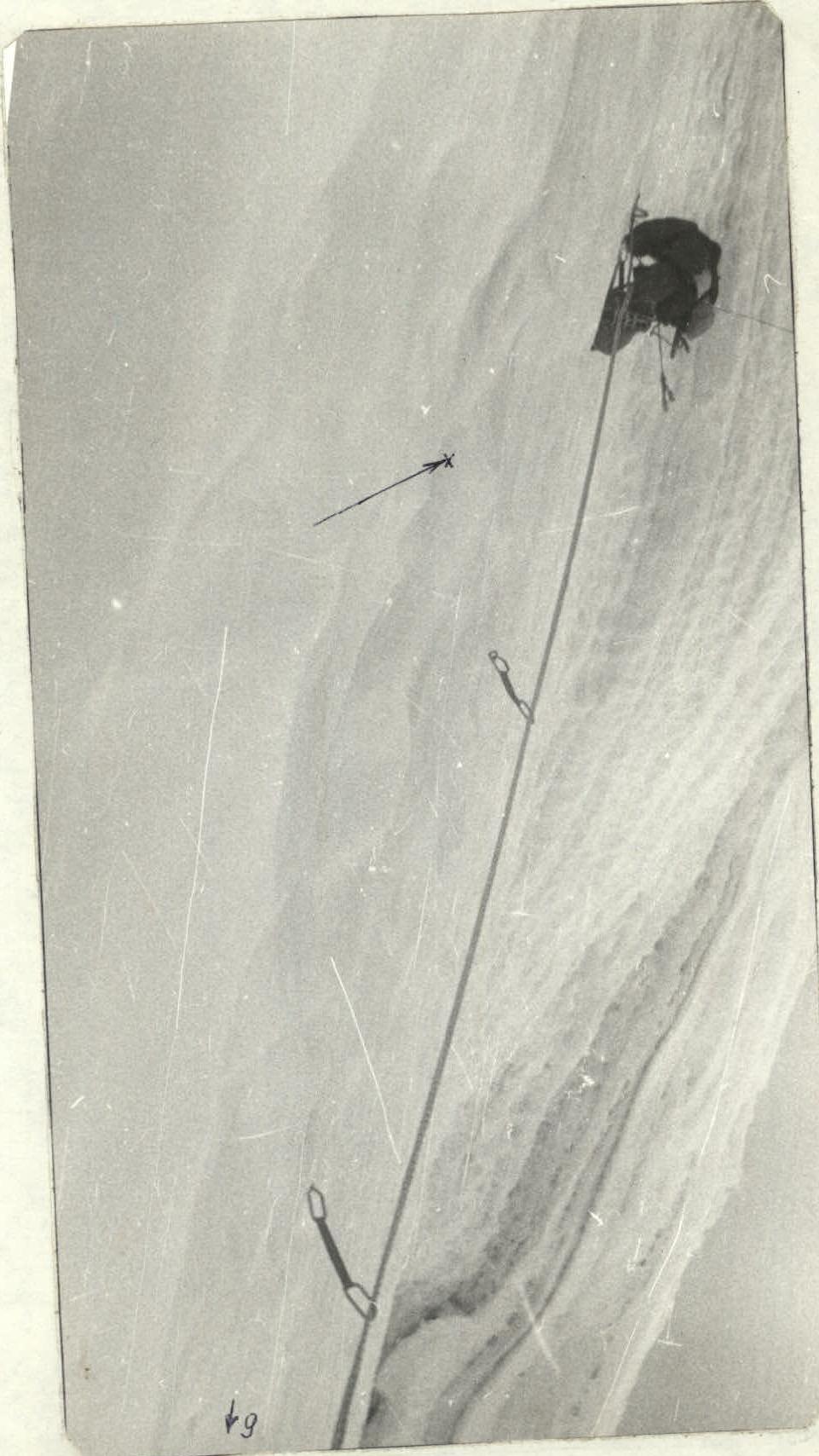
Photo 3.4. Section R9–R10. The structure of the ice is clearly visible — pits in the foreground. The distance between pitons is about 3 m.
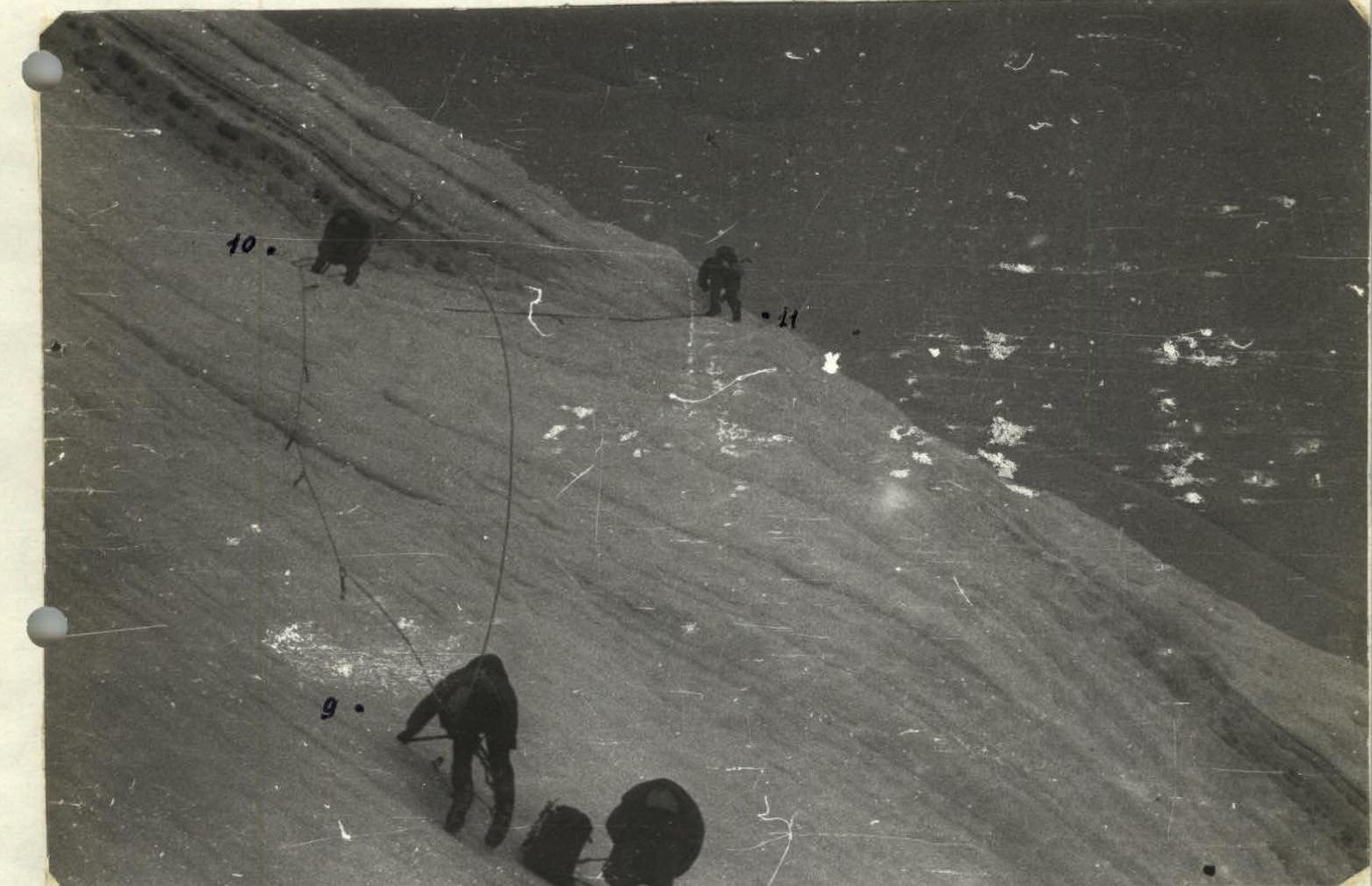
Photo 3.5. Sections R9–R10 and R10–R11. The first climber is at the edge of the plateau, exiting through the cornice. Shooting point №3, around 17:00.