
Ascent Passport
-
Ascent class: high-altitude technical.
-
Ascent area: Central Tien Shan, South Inylchek.
-
Ascent route: Peak Pobeda Main, via the northeastern counterfort.
-
Complexity category: proposed — 6A category, 2nd ascent.
-
Route characteristics:
height difference: 2989 m (by altimeter); distance: ascent — 3650 m; descent — 4160 m. Distance of sections with 5th category complexity — 580 m; 6th category complexity — 350 m. Average slope: main part of the route — 76°; entire route (from bergschrund) — 55°.
-
Pitons hammered: rock chocks ice screw 25 5 48 0
Left on the route: rock — 0; chocks — 0; ice — 0; screw — 0.
-
Team's climbing hours: 34 hours, 2.5 days.
-
Overnights: all in tents.
-
Ascent participants:
leader: Penzov Sergey Konstantinovich MSMS, Severodvinsk, Lesnaya st. 52-2 participants: Ishutin Mikhail Vasilyevich CMS, Severodvinsk, Lomonosova st. 59-9 Strelkov Mikhail Grigoryevich 1st sports category, Severodvinsk, Malaya Kudma st. 13-49
-
Team coach: Ishutin Mikhail Vasilyevich
-
Ascent calendar schedule:
departure on the route: Peak Pobeda — August 19, 1997 summit — August 21, 1997 return to base camp — August 22, 1997
-
Issuing organization's address: Sports Club "Sever", Severodvinsk, Lenin Ave., 14.
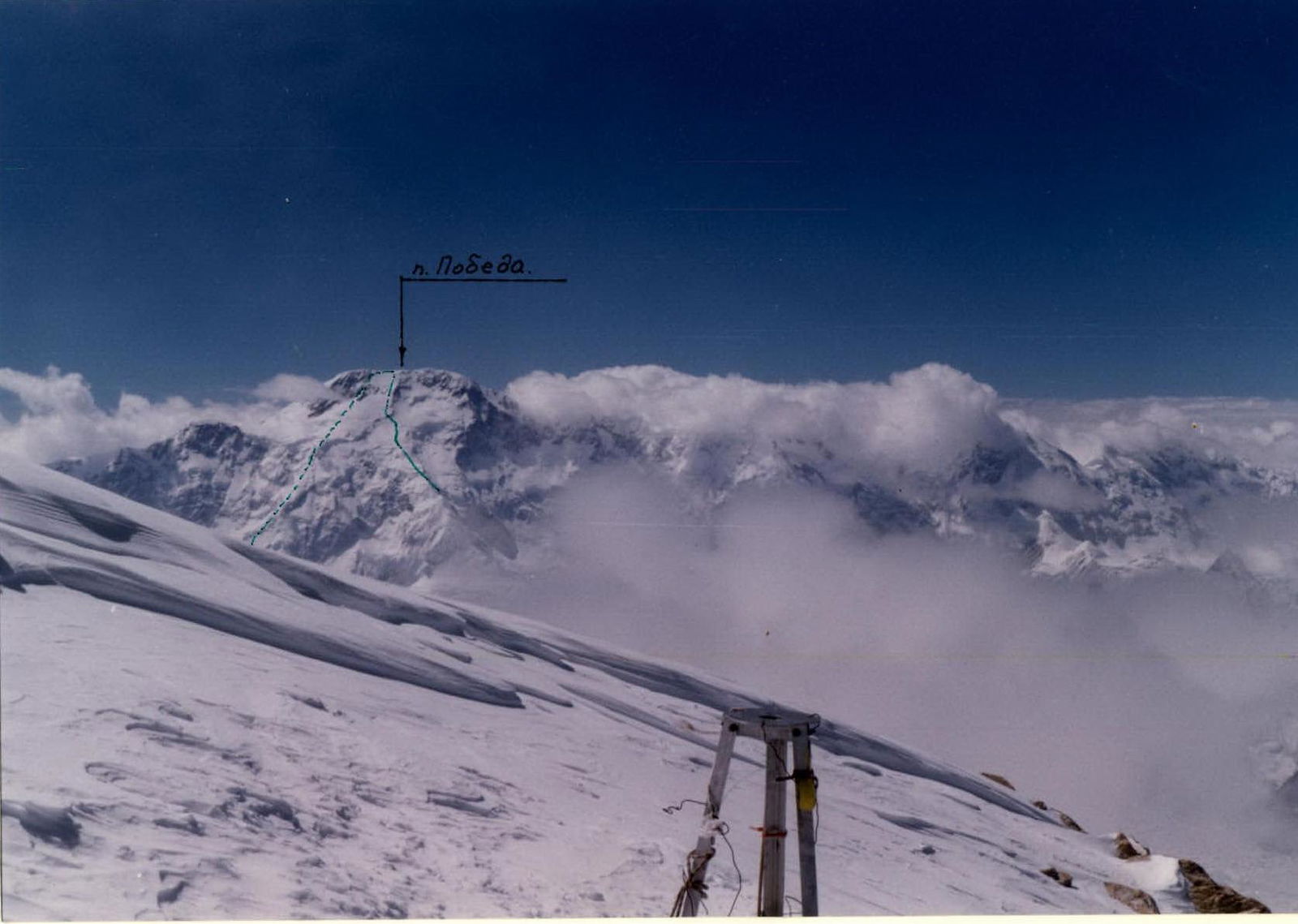
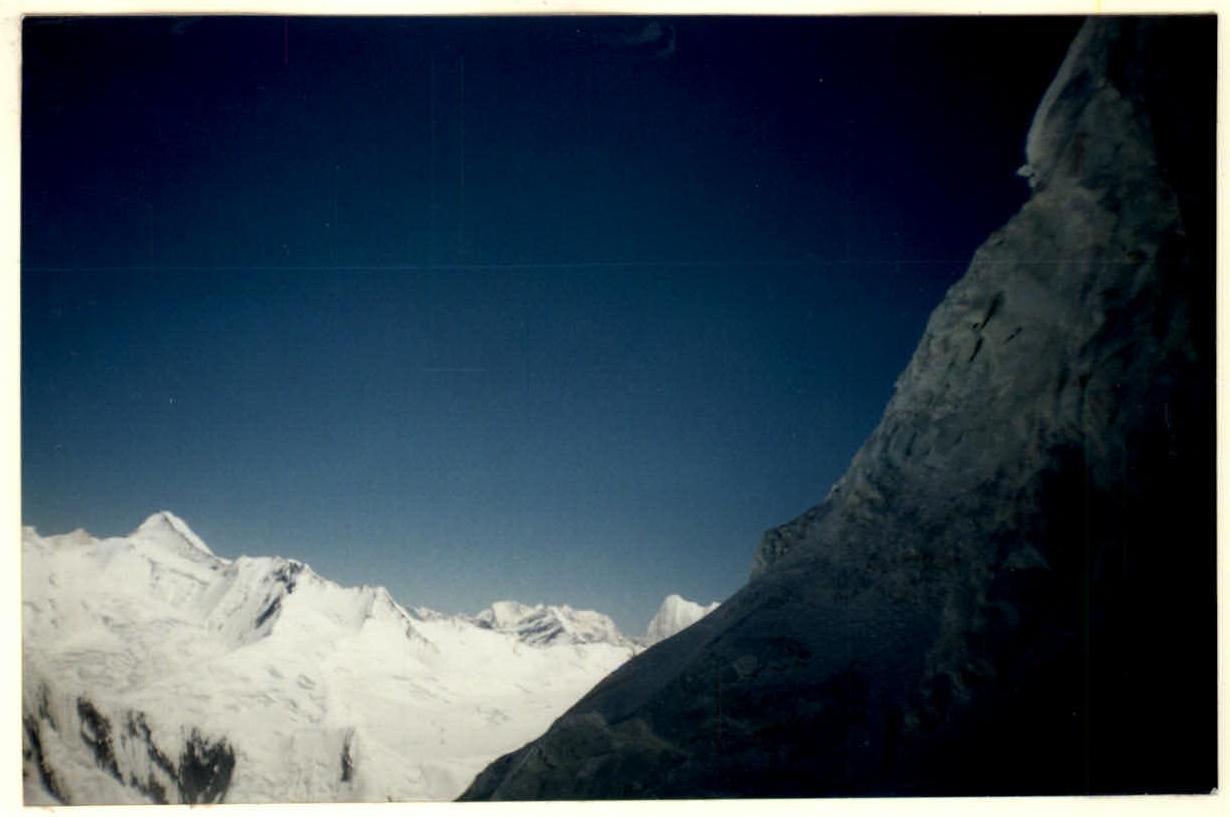
M. Strelkov's photo on August 7, 1997 from Khan-Tengri peak.
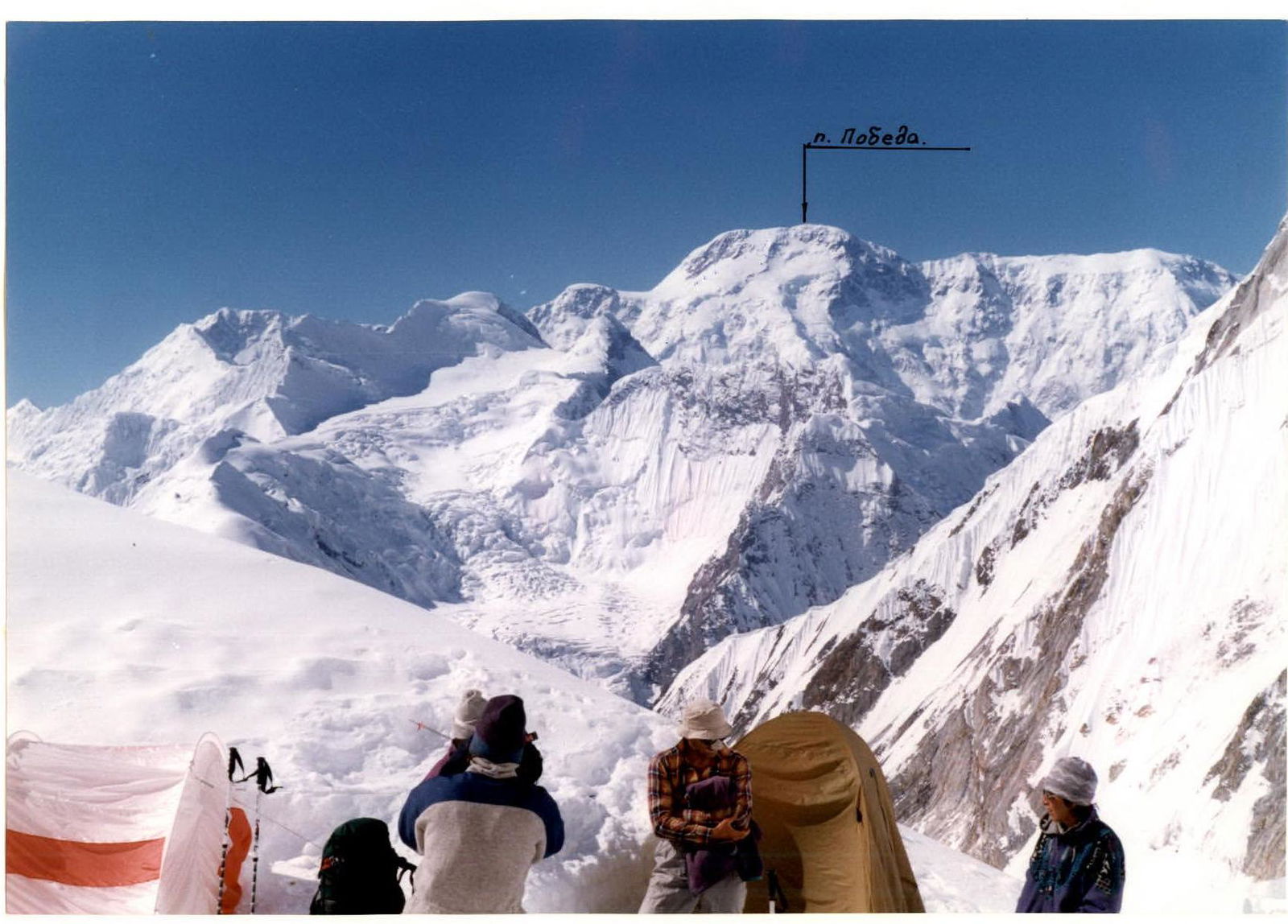
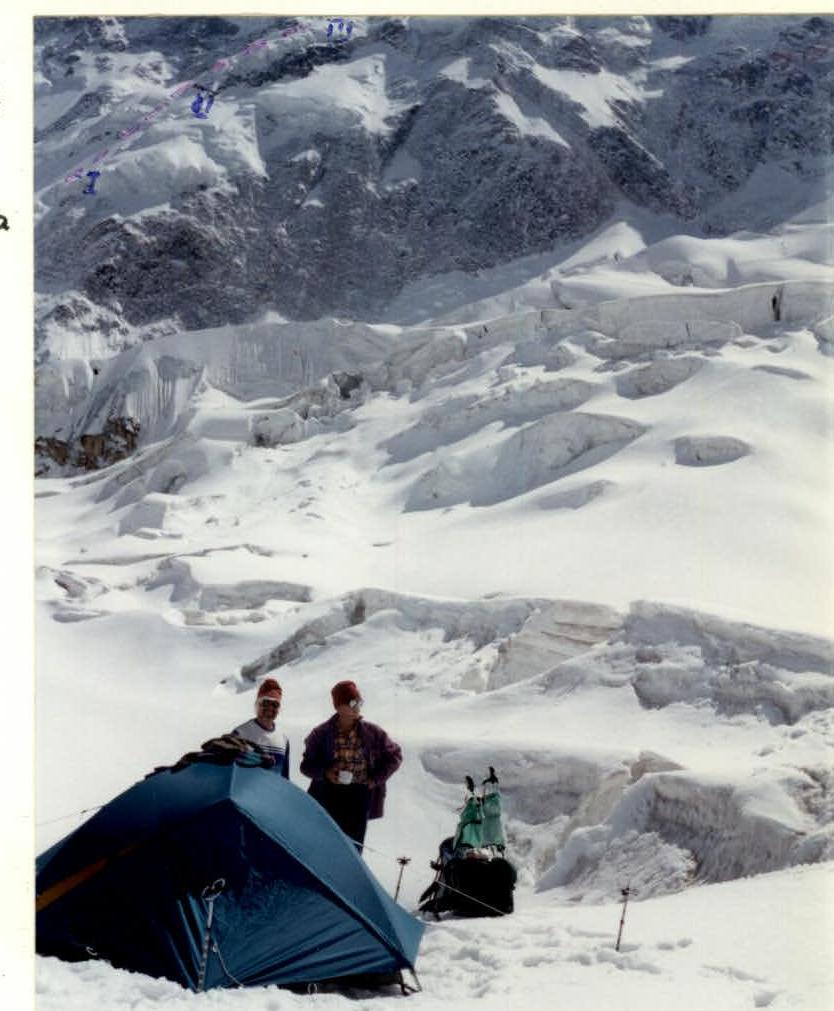
M. Strelkov's photo on August 6, 1997 5300 m, Semenovsky glacier Khan-Tengri.
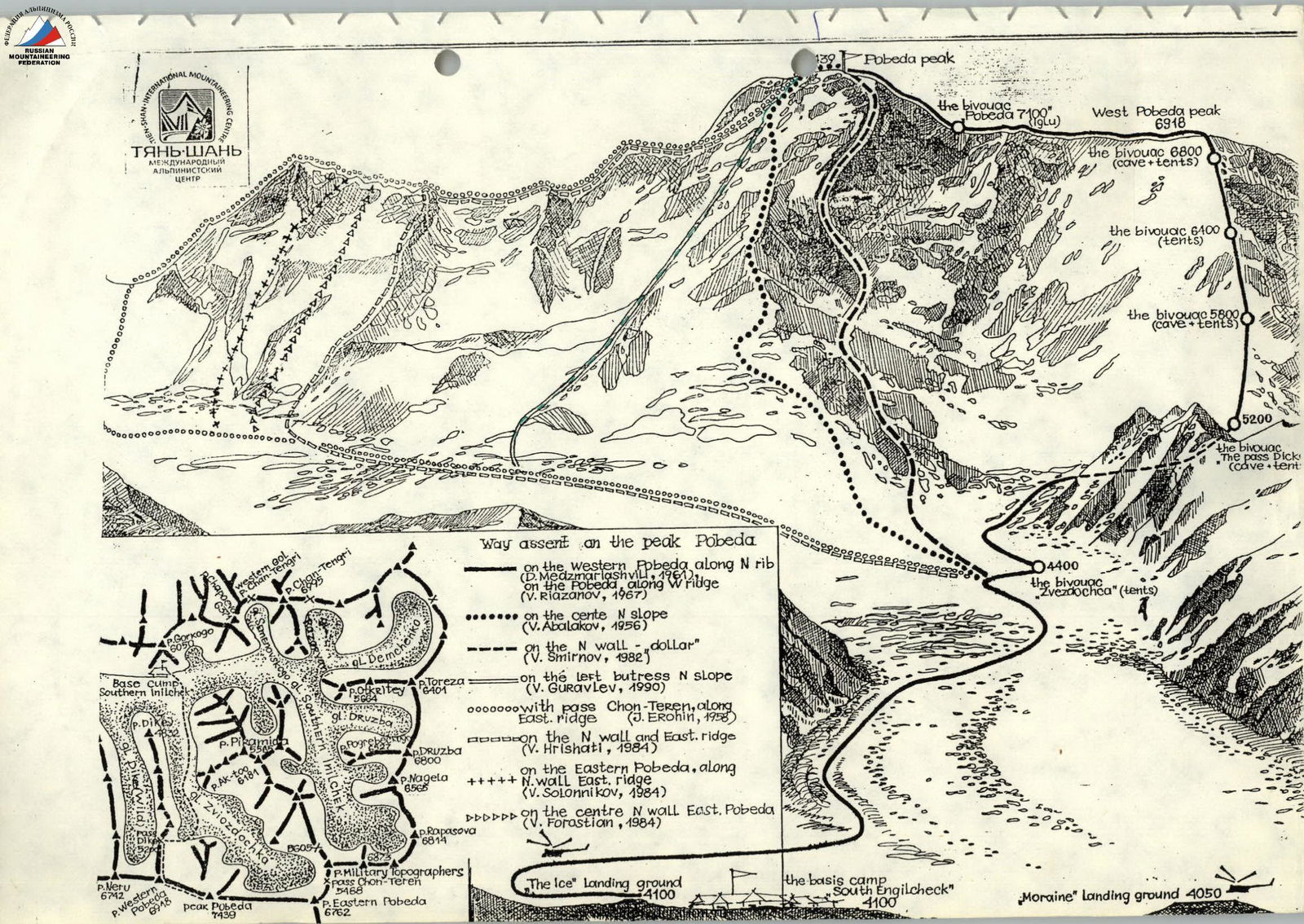
Way assent on the peak Pobeda
on the Western Pobeda along N rib (D. Medzmariashvili, 1961),
on the Pobeda, along W ridge (V. Riazanov, 1967)
на центральном северном склоне (В. Абалаков, 1956)
на северной стене — «Доллар» (В. Смирнов, 1962)
on the left buttress N slope (V. Gurav Lev, 1990)
with pass Chon-Teren, along East ridge (J. Erohin, 1958)
on the N wall and East ridge (V. Hrishati, 1984)
on the Eastern Pobeda, along N wall East ridge (V. Solonnikov, 1984)
on the centre N wall East Pobeda (V. Forostian, 1984)
«The Ice» Landing ground
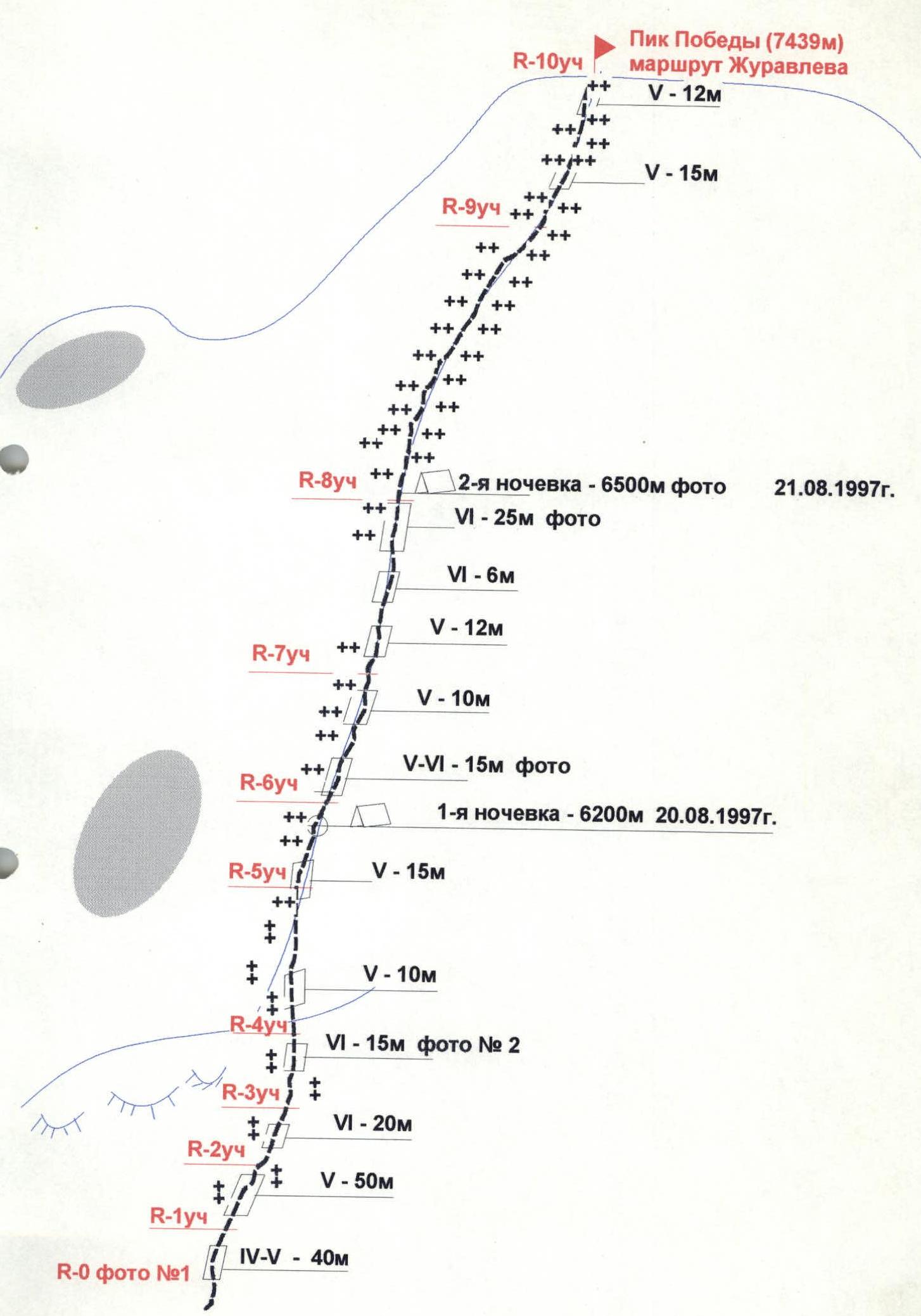
Tactical Actions
On the route, we worked as a single rope team. The lead changed after each rope length. On the first day, when exiting to the shelf that goes from the Chentaren pass, we used:
- rock pitons,
- chocking devices,
- ice screws.
The rocks and protruding stones were covered with ice. The snow was very deep and loose. When belaying on snow, we dug in very deeply. When traversing avalanche-prone sections, one of the participants acted as an observer and warned of danger.
On the second day, belays were mainly carried out on ice screws and ice axes. When passing ice walls, we used ice screws. In the upper part of the route, we also used steel pitons and ice protection, as it was easier to move on rocks than on a rocky-icy slope with a thin, poorly holding firn crust, where crampons worked extremely unreliably.
1st overnight stay (17:00) — on a snowy-icy slope, the tent was set up quite successfully, protected from wind and avalanches. We stopped for the night in daylight, which made it possible to get a good night's sleep and recover.
2nd overnight stay (16:00) — was organized in a fairly wide crevasse at the exit of the pre-summit firn plateau (see photo). We tried to set up a tent on the slope and dig in — unsuccessfully, the tent was torn and covered with snow.
We set out on the route at 2 am, under a full moon and bright stars. The wind was much calmer at this time.
Location and actions of the rescue team:
- The team from Chelyabinsk region and the team from Georgia were at that time on Vazh (making an ascent via the classic route).
- Constant communication was maintained: 7:00, 9:00, 13:00, 17:00, 20:00.
- Americans-skiers, clients of MAC "Tien Shan", who had radio communication with them, were ascending via the Abalakov route.
- The rescue team was based at the MAC, headed by the camp chief, Kolovanich S.F.
- The Belarus team was waiting for our return at the Valiev camp (there was an agreement with them in case of an emergency).
The priority during the ascent was given to sections of open ice and ice falls due to the high avalanche danger of long, steeply inclined shelves and couloirs. Two attempts to exit onto such sections in the lower part of the route in order to reduce the technical complexity of the route triggered micro-avalanches.
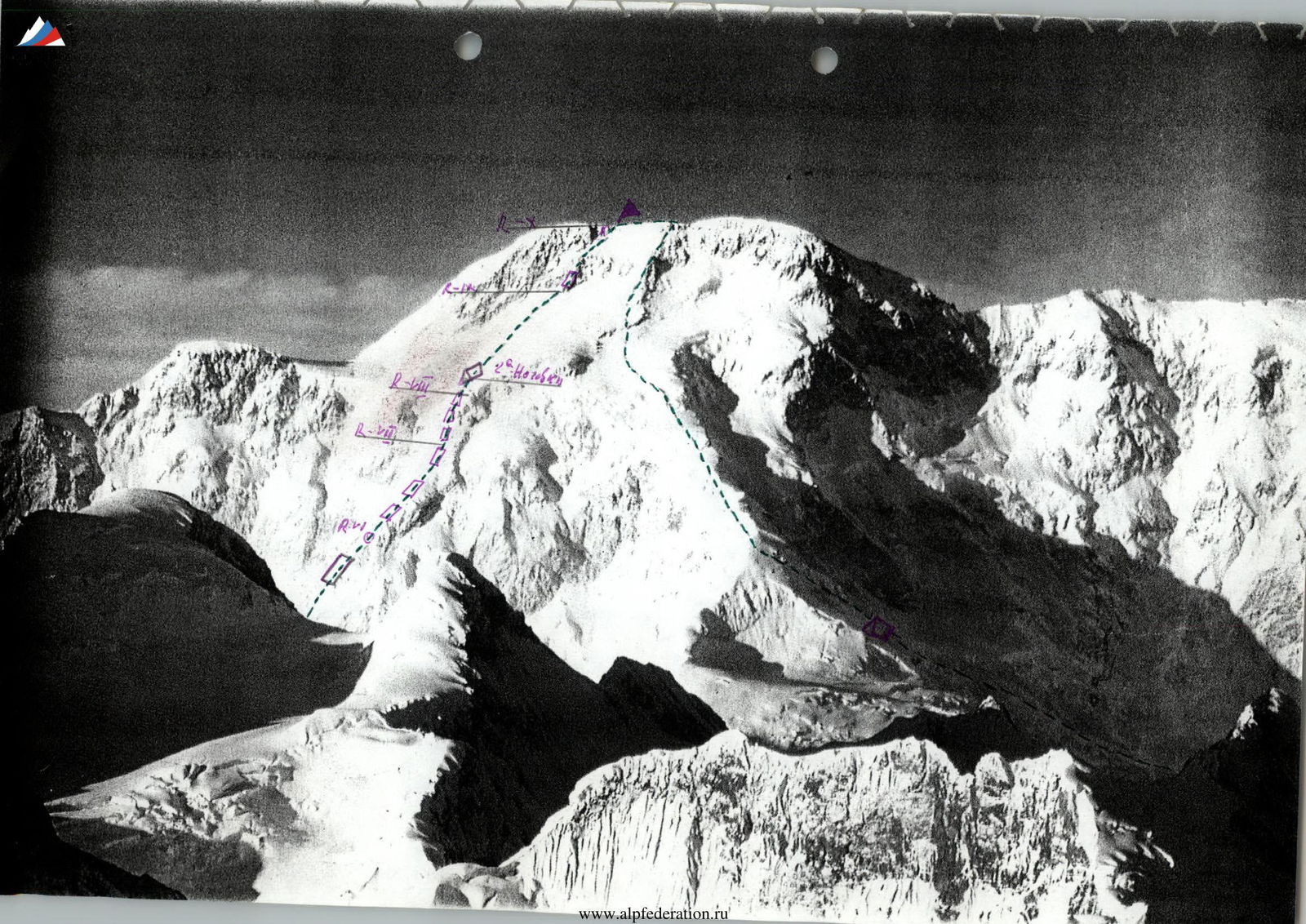

Route profile from 4500 m height on August 18, 1997.
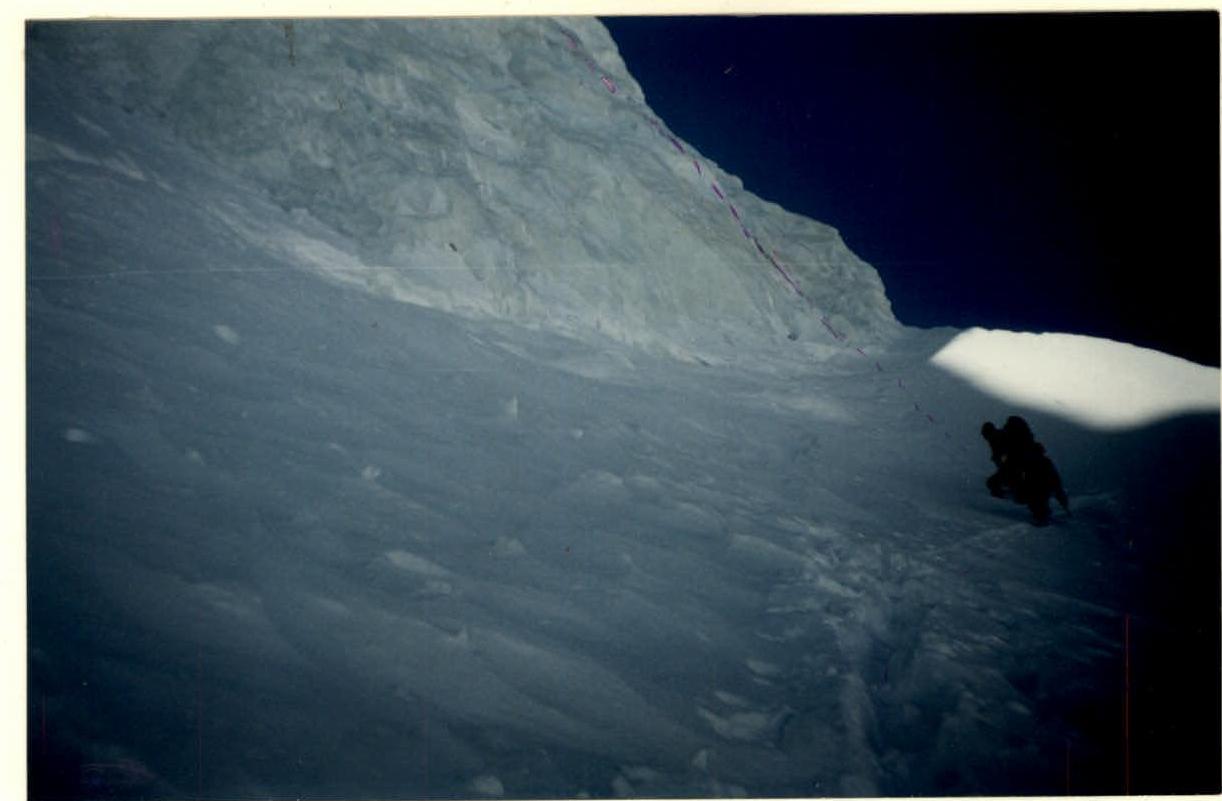
Ice wall, section R3.
August 19, 1997.
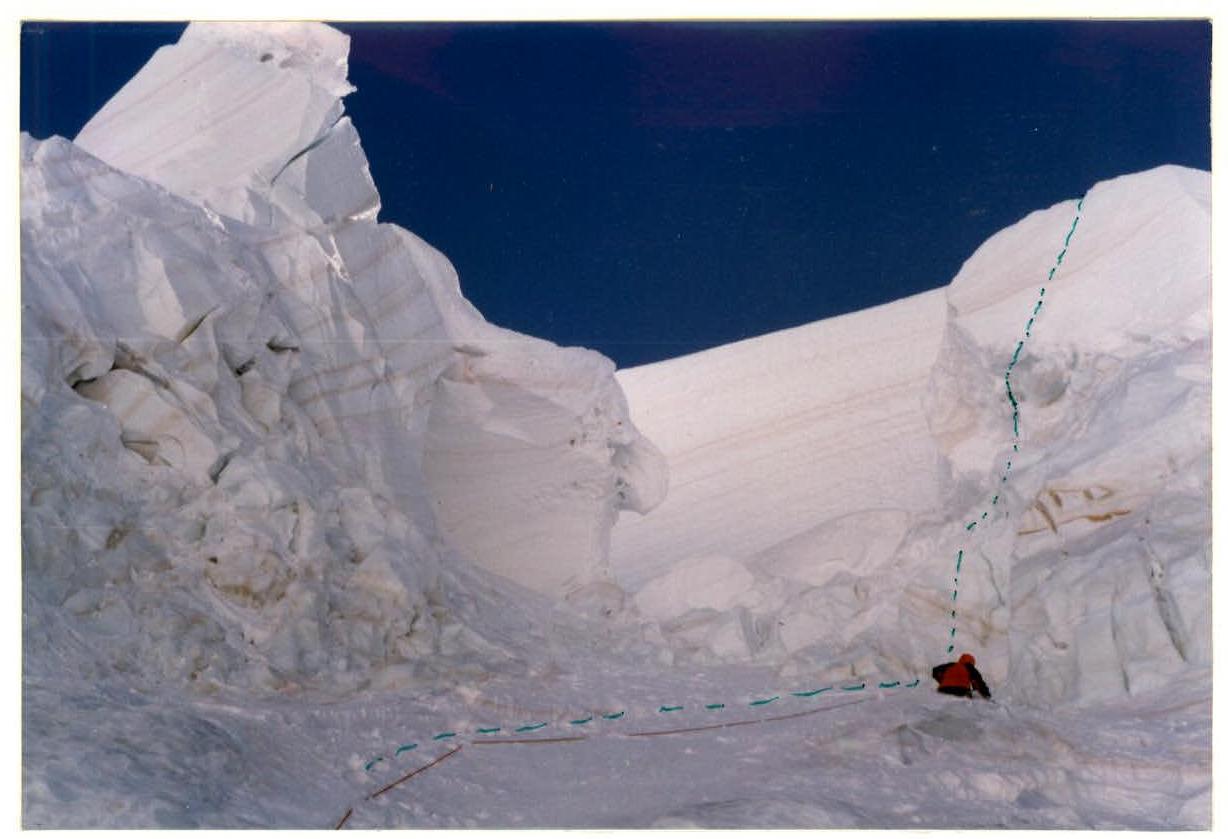
S. Penzov under the ice wall.
Searching for a path up in the icefall (M. Strelkov's photo).
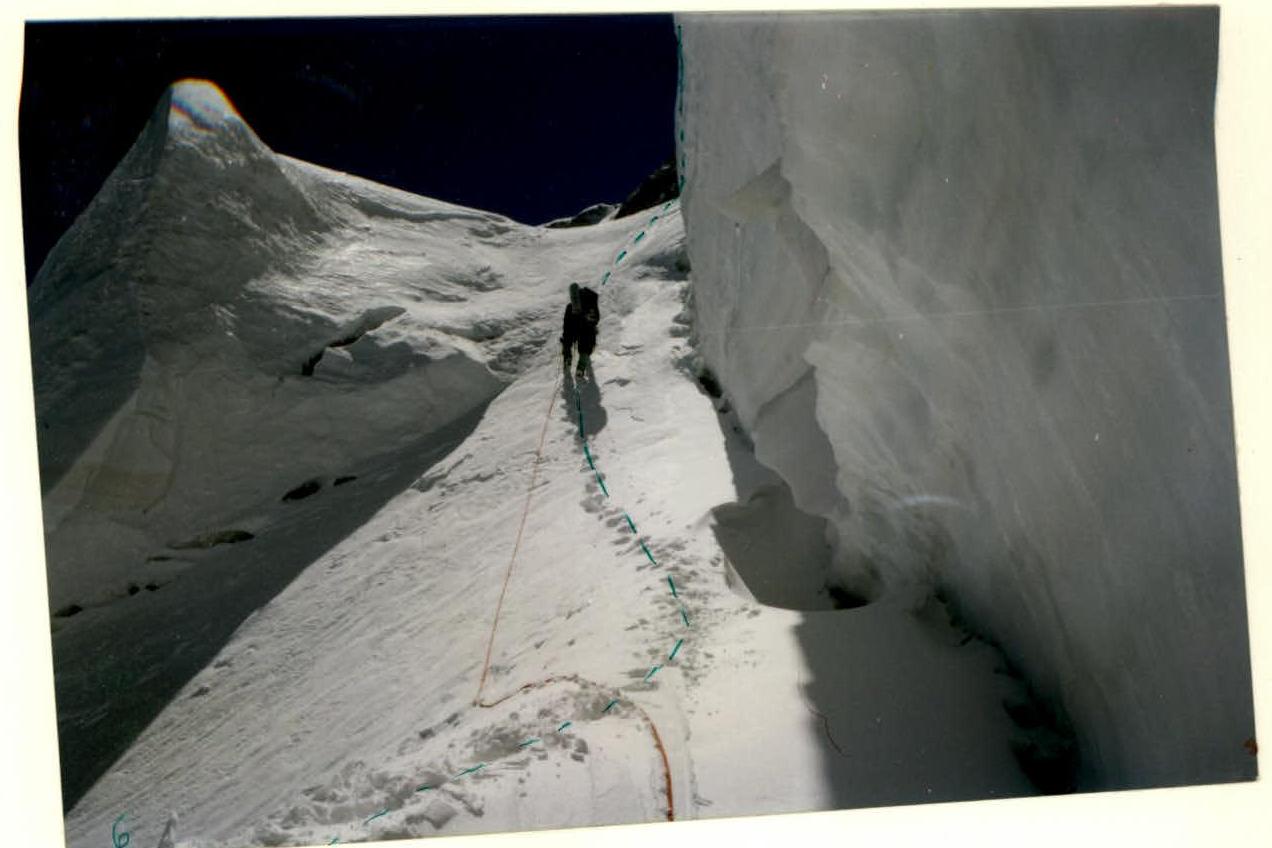
On section R7.
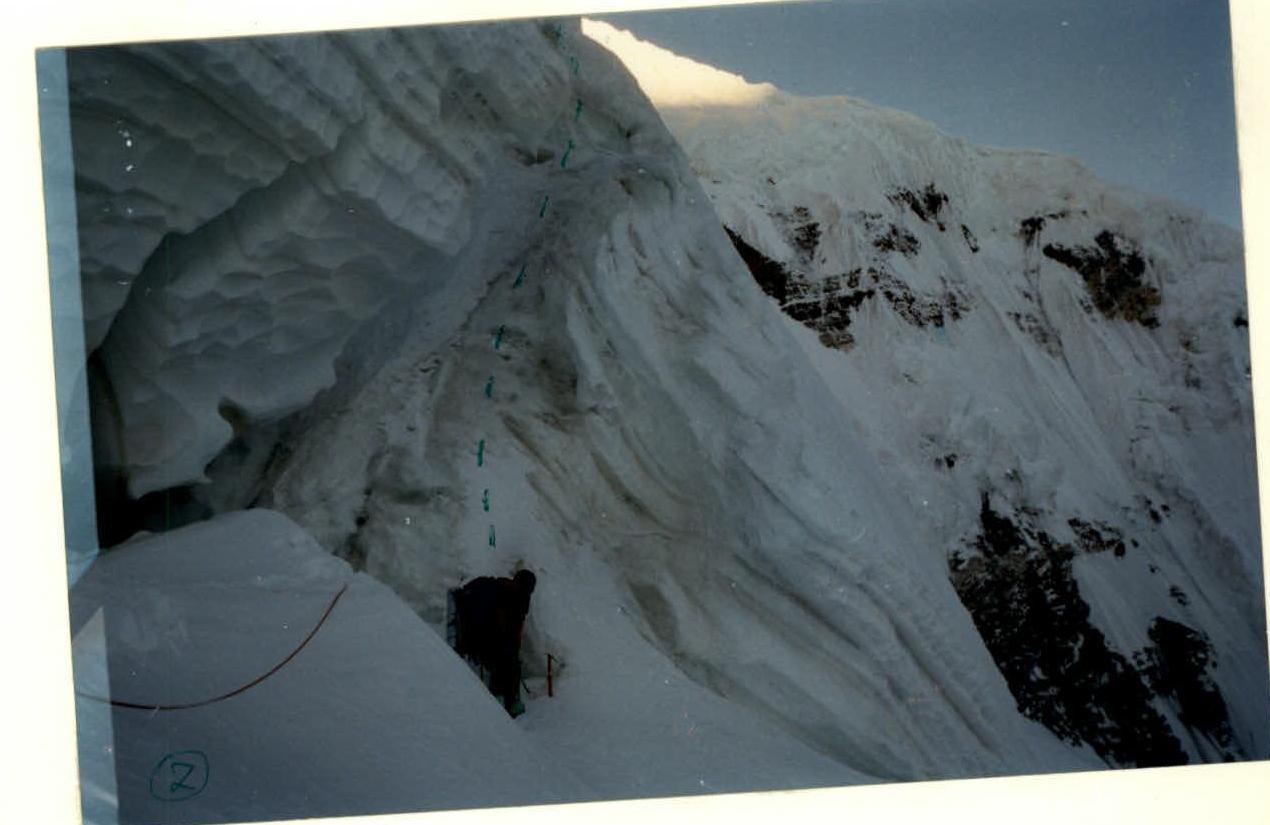
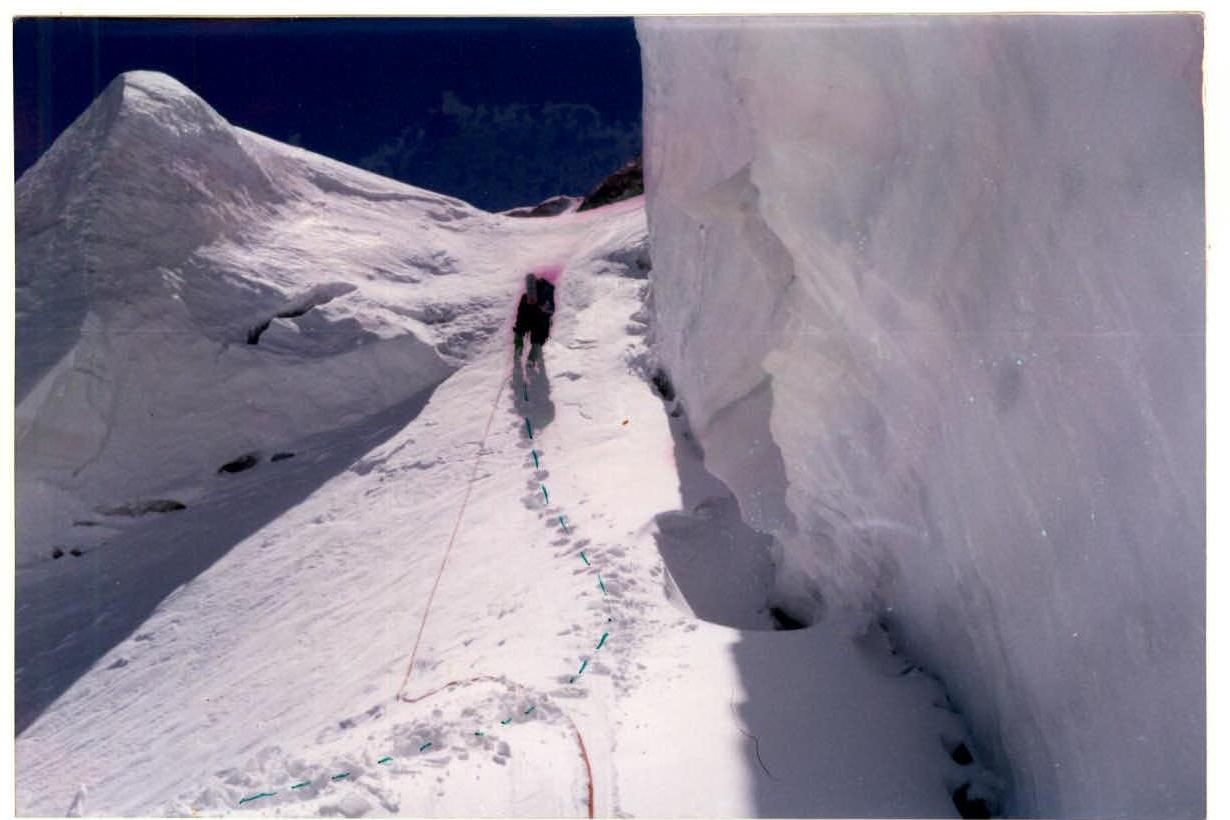
S. Penzov under the ice wall on section R8. August 20, 1997 (Strelkov's photo).
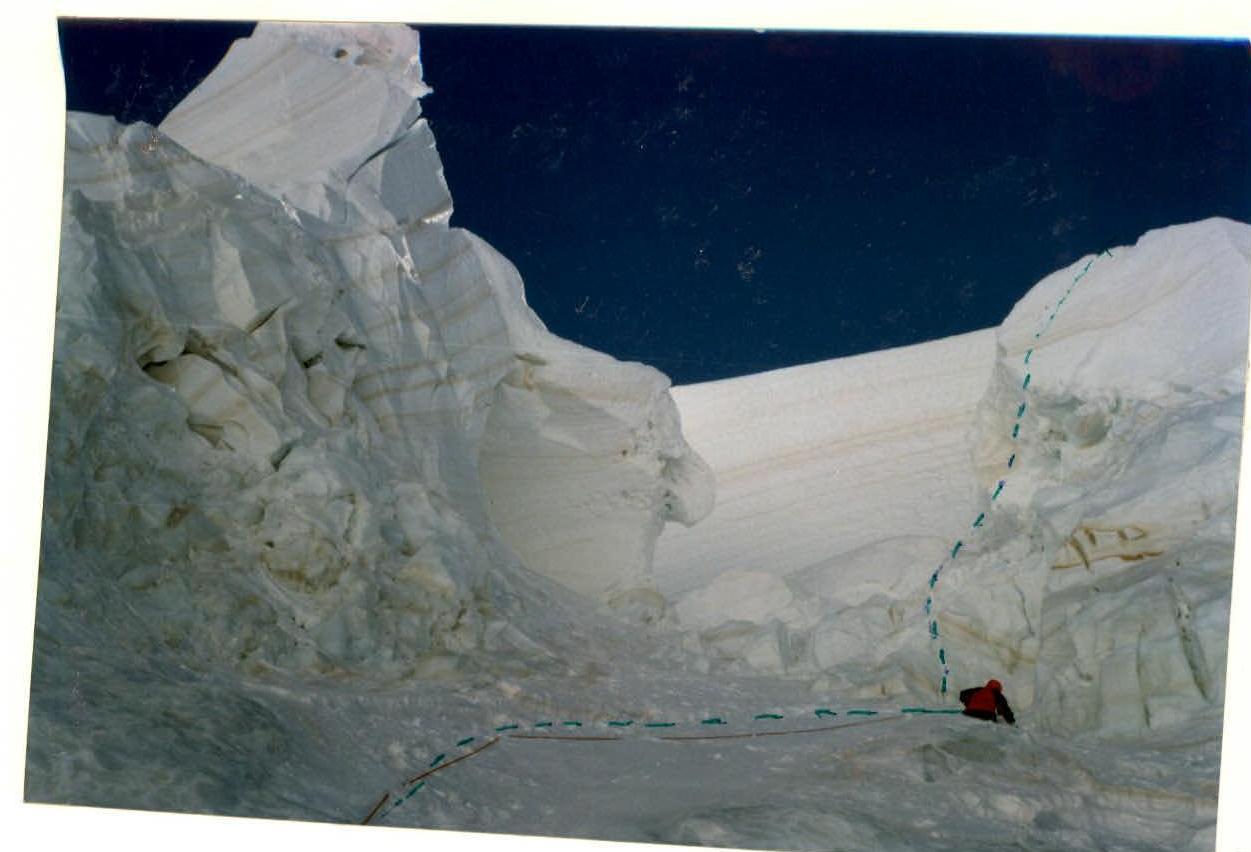
Again, a wall before exiting onto the firn plateau, section R8.
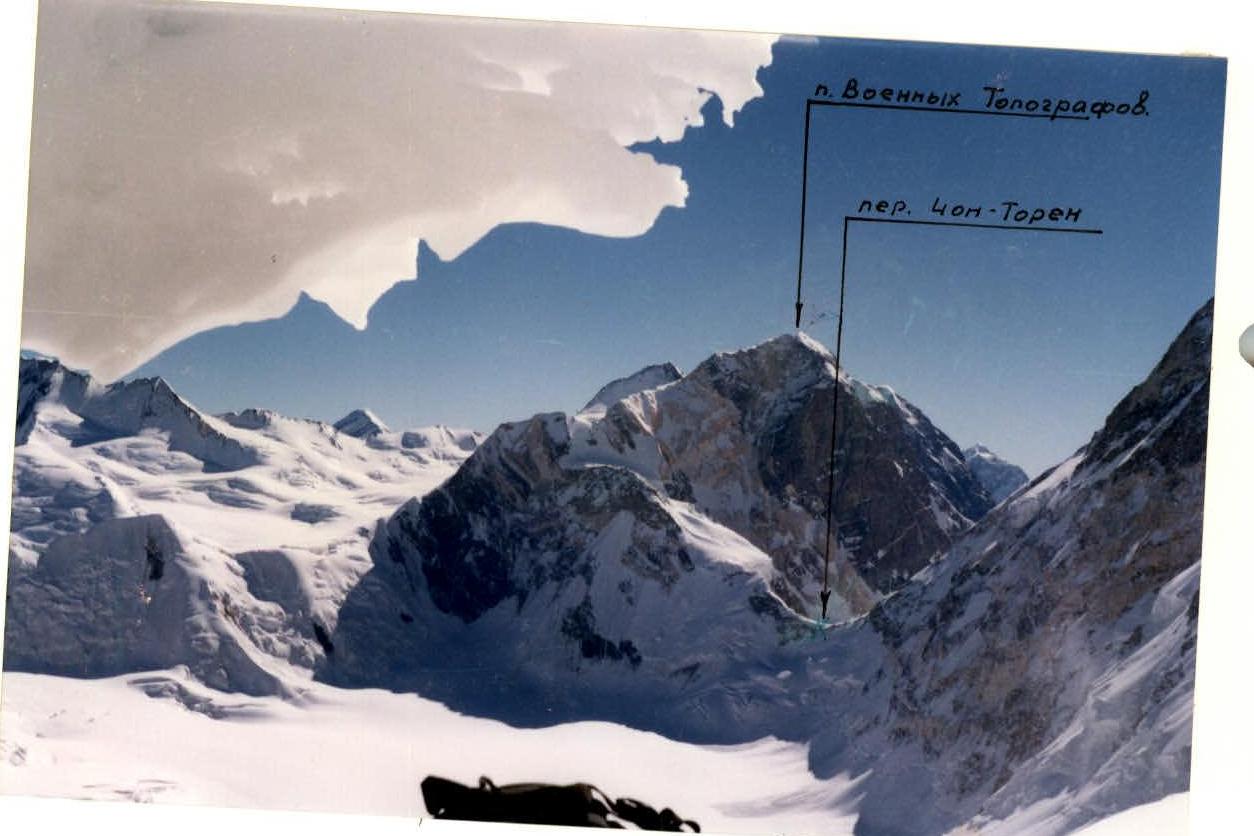
View from 6400 m height to the east, into the upper cirque, Zvezdochka glacier (peak Voennykh Topografov, Chon-Toren pass).
M. Strelkov and S. Penzov in front of the ice wall, section R3. (M. Ishutin's photo).
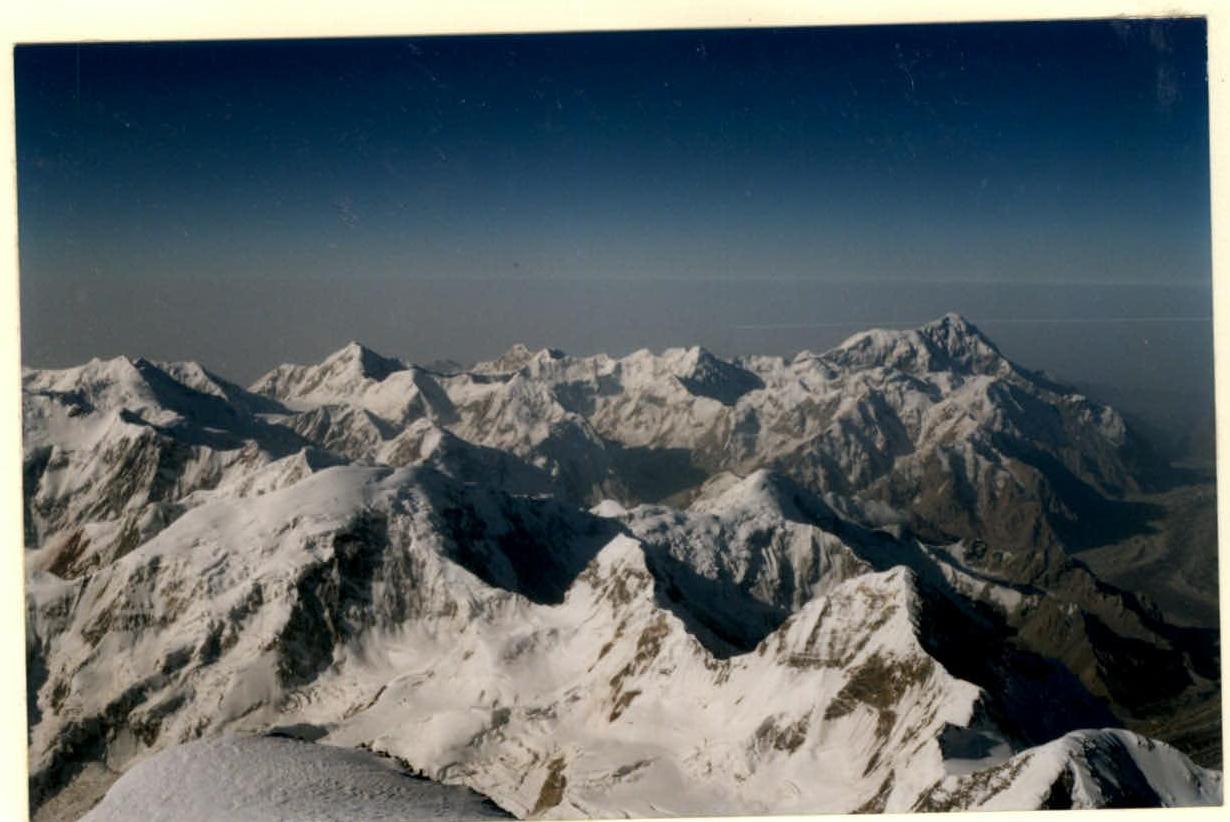
View from the summit towards China on August 21, 1997.
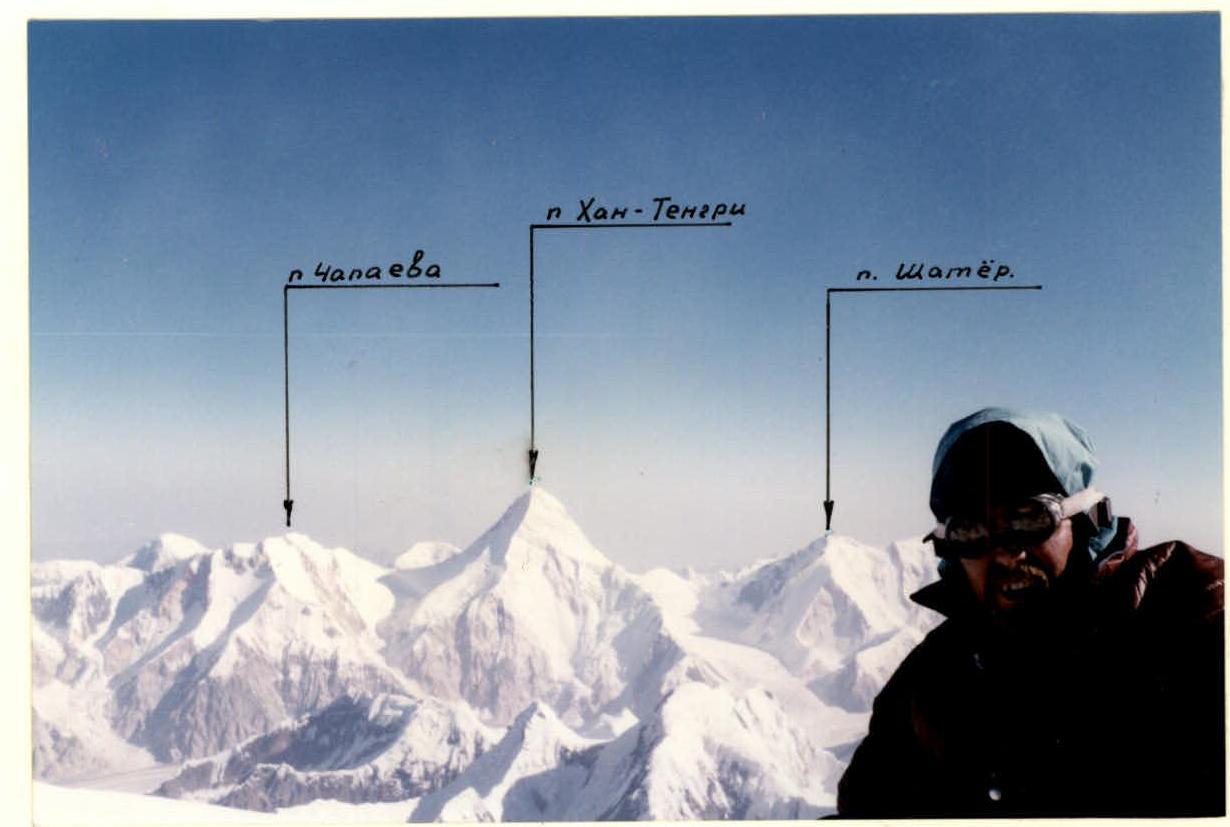
View from Peak Pobeda to the north on August 21, 1997.
In the foreground is M. Ishutin (M. Strelkov's photo).
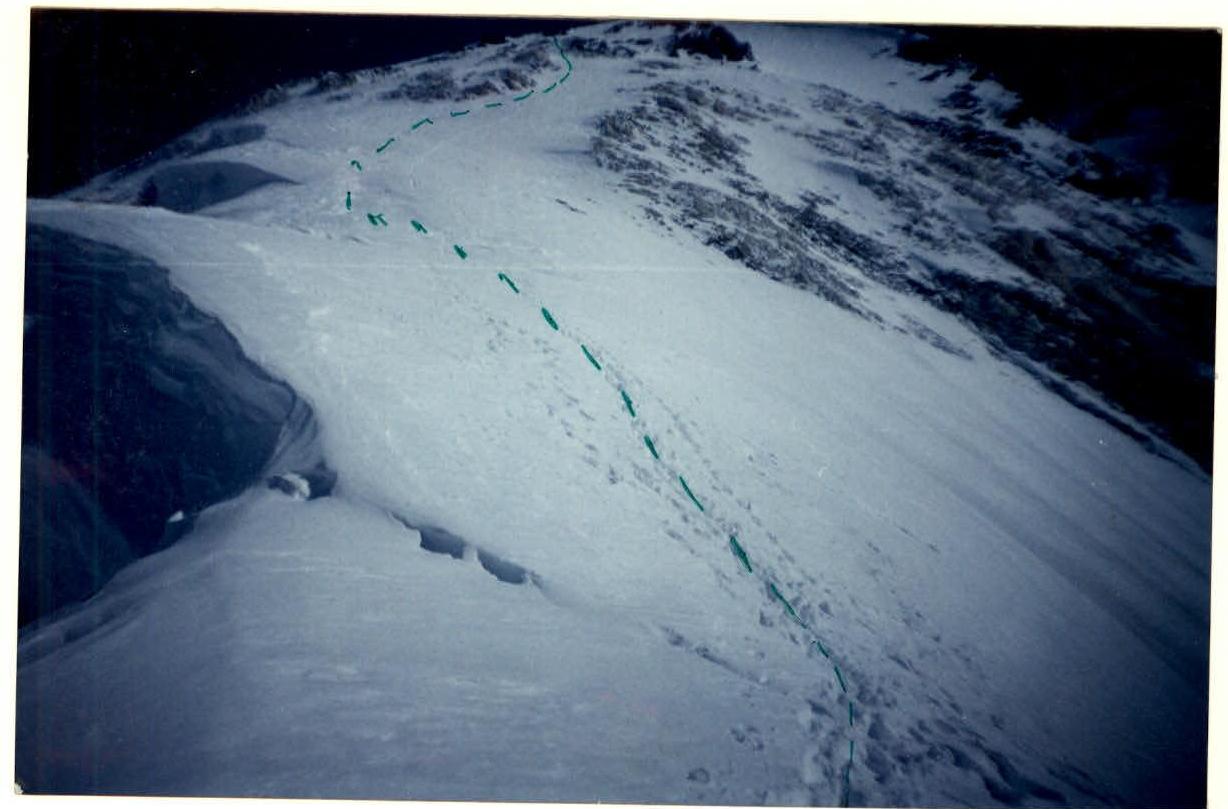
Middle section of the descent via Abalakov's route on August 21, 1997.
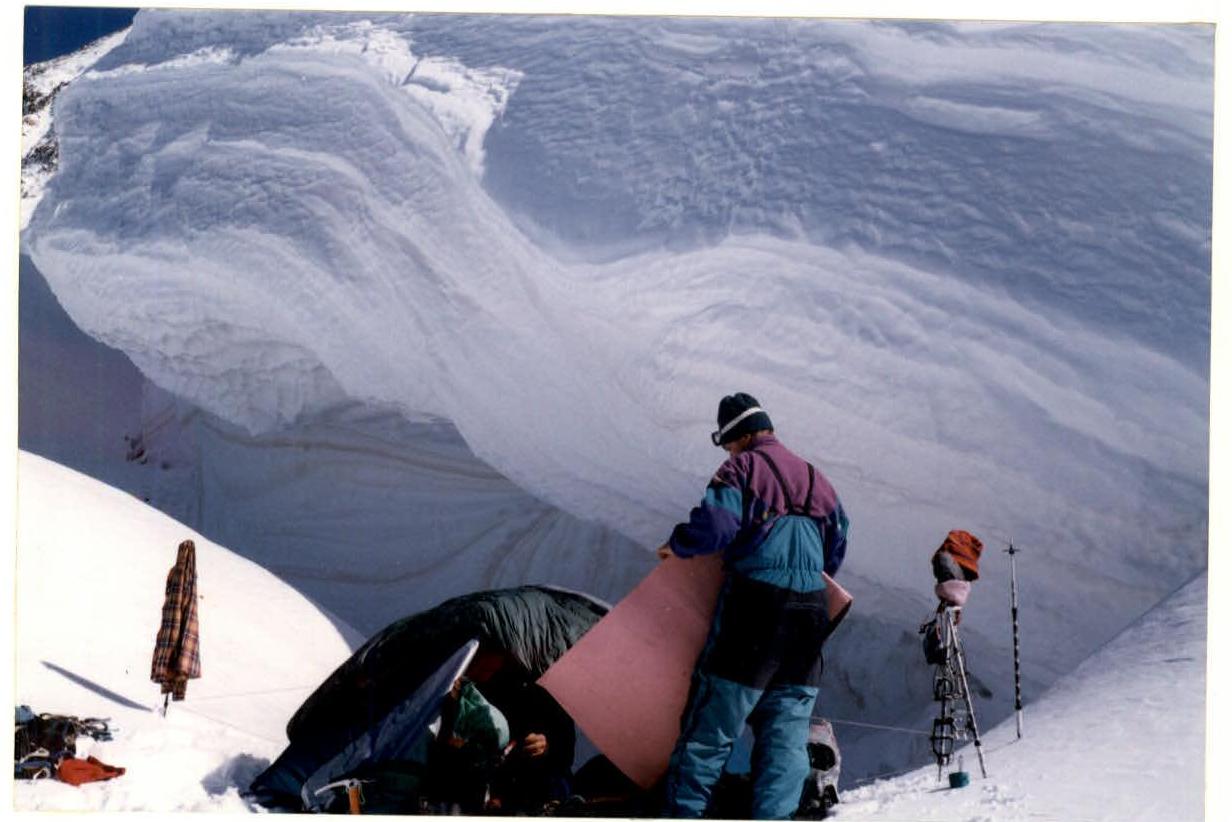
Overnight stay on the descent at 5000 m. August 21, 1997.
Protocol of the Ascent Review on Peak Pobeda, made by the team of sports club "Sever" from Severodvinsk
Present:
- Head of MAC "Tien Shan" camp Kolovanich S.F.
- Coach of the Georgian national team Sarkisov L.
- Captain of the Chelyabinsk team Nagovitskaya E.Yu.
- Coach of the team from sports club "Sever" from Severodvinsk Ishutin M.V.
- Leader of the ascent team from sports club "Sever" from Severodvinsk Penzov S.K.
- Participant of the ascent team from sports club "Sever" from Severodvinsk Strelkov M.G.
Heard:
Presentations by the ascent participants with analysis of the results.
Content of the presentations:
Strelkov M.G. — participant of the ascent:
I. I consider the following to be positive aspects:
- Successful choice of ascent dates: second half of August with a full moon phase. This guaranteed good weather.
- The adopted ascent strategy fully justified itself: movement along slopes with very deep snow is much easier at night on a nighttime crust, and most importantly — safer, especially on the first day.
- The ascent line on a multi-variant route was very well implemented. The only exception is the exit to the "shelf". In my opinion, it would have been better to bypass the ice bastion from the north. This would have increased safety, as an extremely avalanche-prone couloir leads to the upper section of the "shelf".
- Good physical and technical preparation, as well as deep acclimatization, allowed the group to work freely for 11–14 hours a day.
- The set of special equipment allowed for confident movement on rocky, icy, and firn slopes.
- The choice of campsites should be considered competent. All of them were protected from wind and located away from avalanche paths. The second campsite is particularly notable for its bold decision-making (in a crevasse).
II. The bivouac equipment was well-chosen.
The Red-Fox tent is quite comfortable for 3 people. The 2 vestibules allowed for storage and organization of a kitchen. For its repeated use, I recommend lubricating all zippers with anti-icing lubricant. Lubricating the tube frame joints (connections) with bone oil will facilitate its operation. It would be good to have a shovel in the bivouac kit.
Gas equipment: The burner with a reinforced hose for "Epigas" cylinders worked excellently. The piezo ignition does not work at altitudes above 6000 m. It is necessary to have matches. Gas consumption should be considered very economical. Practically, one 0.7 l cylinder was enough for 4 days.
When organizing nutrition, I recommend:
- replacing bread with army black crackers. This would reduce weight by 0.8 kg.
Soups should be quick-cooking. Tea on exits should be in single-serve packets. Instant coffee is very good at high altitudes. I recommend including in the ration:
- cold-smoked fish
- fatty smoked sausage.
When organizing the drinking regime, a liter metal thermos played a positive role. For preparing drinks, there was a lack of:
- citric acid
- ascorbic acid.
Gaps in photo illustrations were inevitable due to the adopted tactics (nighttime movement). The quality of photos from the "Smena Simvol" camera can be considered quite acceptable. The camera itself did not fail once during the ascent.
Sports Club "Sever"
I recommend including in the medical kit:
- more antibiotics
- streptocid powder
- ascorbic acid
Its комплектование should be more thorough.
Penzov S.K. — leader of the ascent:
I. Characteristics of the route.
This route was first climbed in 1990 by a team from sports club "Vertikal" from Samara, led by Zhuravleva, in which I also participated. I consider it to be the shortest route to Peak Pobeda.
It remains unpopular only due to the long approach (it is necessary to completely bypass the "pedestal", through which Abalakov and passes). Avalanche and ice danger are limited to only 2 sections: the exit to the "shelf" that runs almost across the entire wall of Eastern Pobeda, and the exit to the plateau next to Peak Soviet Army. However, there are safe spots for campsites under these sections. Due to the steepness of the slopes on these sections, there is a lot of ice and not as much deep snow as on Abalakov's route, as we were convinced when descending via the second route.
The route is mainly snowy-icy. On small rocky islands, the search for belay points is complicated by ice and snow. This is despite the fact that the weather was good for a whole week.
II. The chosen tactics followed the schedule of the first ascent. The presence of a full moon allowed for nighttime movement for greater safety and due to better snow conditions.
III. Participants: I've been climbing with Misha Ishutin for the past few years. He's a reliable partner. Mikhail Strelkov impressed me. His vast tourist experience fully compensated for his lack of mountaineering experience. He is physically very resilient and adapts well to high altitudes.
Ishutin M.G. — team coach, participant of the ascent:
I fully agree with the presentations of my comrades. I consider the following to be factors that determined the success of the ascent:
- Good team selection. Coordinated work, a healthy psychological climate, and good physical preparation of the participants primarily determined the safe and high-quality passage of the route.
- Full-fledged acclimatization. Prolonged active stay of the team members in high-altitude conditions played a significant role in the success of the ascent. The ascents made to Uчитель and Корона peaks in the Alarчи area, to Peak Khan-Tengri, and to Edelweiss peak allowed the ascent participants to fully acclimatize to high-altitude conditions and work together on routes under increased physical loads.
- Ascent tactics. Properly chosen ascent tactics, taking into account climatic, weather conditions, and technical features of the route, are the key to success. In our case, I consider the chosen tactics to be optimal. Undoubtedly, the time of movement initiation and load distribution on the route were correctly chosen.
In conclusion, I would like to express gratitude to the participants of our team. I sincerely hope for future joint ascents.
Team coach from sports club "Sever" from Severodvinsk Ishutin M.V. Team captain from sports club "Sever" from Severodvinsk Penzov S.K. Participant from sports club "Sever" from Severodvinsk Strelkov M.G.

Comments
Sign in to leave a comment