
Ascent Passport
I. Ascent class — technical 2. Region — Kyrgyz Ala-Too ridge, Ak-Sai gorge 3. Object — Peak Svobodnaya Korea 4. Category of difficulty — 6B, KTM 7.4.144 5. Height difference — 580 m, route length — 890 m, length of sections 5–6 category of difficulty — 480 m, average steepness of the route — 64°, steepness of the wall part of the route — 81.6° (4330–4580 m). 6. Pitons driven:
| Rock | Nuts | Bolts | Ice |
|---|---|---|---|
| 144/79 | 91/59 | 2/2 | 60/0 |
- Team's working hours: 34 hours and days — 3
- Overnights: 1st on a ledge under the "TV", under plastic. 2nd — sitting in hammocks, shelf, inner corner.
- Captain: Kolesov Alexander Petrovich, MS Team members: Nefedov Igor Viktorovich, CMS
- Coach: Borisov Sergey Viktorovich, MS
II. Departure to the route: August 22, 1995
Summit: August 24, 1995
Return: August 24, 1995
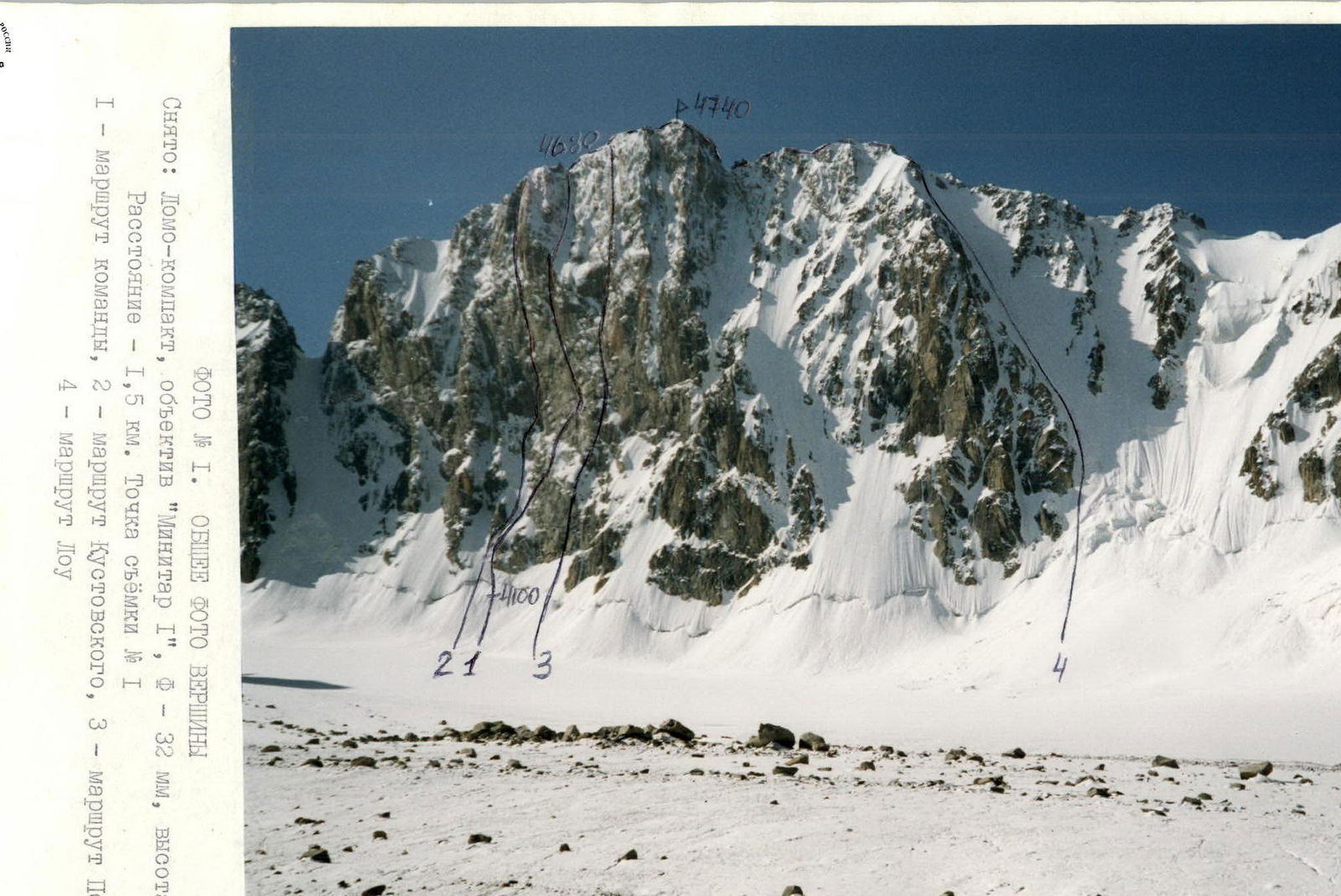
Photo #1. General photo of the summit
Taken: Lomo-compact, lens "Minitar I", F — 32 mm, height — 4000 m. Distance — 1.5 km. Shooting point #1:
- 1 — team's route,
- 2 — Kustovsky's route,
- 3 — Popenko's route,
- 4 — Lowe's route.
Tactical movement scheme
DETERMINING FACTORS IN DRAWING UP THE TACTICAL PLAN WERE:
- TECHNICAL DIFFICULTY OF THE ROUTE ALONG ITS ENTIRE LENGTH;
- LACK OF GOOD SHELVES FOR LYING OVERNIGHTS IN THE WALL PART;
- UNSTABLE WEATHER CONDITIONS.
IN ACCORDANCE WITH THESE FACTORS, A TACTICAL PLAN IS BUILT, PROVIDING FOR:
- TEAM'S ASCENT TO THE 4367 m LEDGE;
- PRELIMINARY PROCESSING OF THE MIDDLE PART OF THE ROUTE, "TV";
- OVERNIGHT STAY ON THE 4367 m LEDGE;
- PASSING THE MIDDLE PART OF THE WALL WITH ORGANIZATION OF A HANGING OVERNIGHT AT AN ALTITUDE OF 4500 m;
- PRELIMINARY PROCESSING OF THE UPPER PART OF THE WALL, OVERNIGHT STAY.
- FROM THE 4500 m BIVOUAC, PASS THE UPPER PART OF THE ROUTE TO THE RIDGE AND REACH THE 4740 m SUMMIT.
DESCENT WAS PLANNED TO BE MADE ALONG LOWE'S ROUTE, 5A category of difficulty.
LEAD IN THE ROPE:
- WORKS WITHOUT A BACKPACK.
- THE ROPE TEAM USES A DOUBLE ROPE IN THEIR WORK.
- AN ADDITIONAL ROPE WAS TAKEN FOR PRELIMINARY PROCESSING OF THE LOWER PART OF THE WALL "TV".
COMMUNICATION IS MAINTAINED BOTH WITH THE OBSERVER GROUP AND WITH THE BASE CAMP.
Team's tactical actions
August 22, 3:00
- WE LEAVE THE "KORONA" CAMP.
- USING THE EXPERIENCE OF PREVIOUS CLIMBERS, IT WAS DECIDED TO START THE ROUTE EARLY IN THE MORNING, AS THE LOWER ICE PART OF THE ROUTE ON SECTIONS R0–R6 IS "SHOT THROUGH" FROM 10:00.
4:00
- START WORK ON THE ROUTE (4100 m).
- THE LOWER PART OF THE ROUTE IS ICE.
- LEAD IN THE ROPE — NEFEDOV I.
- USES ICE SCREWS AND AXES.
- Further — "sheep's foreheads", covered with ice.
12:00
- We reach the ledge under the "TV".
- This is the only convenient and safe overnight stay (4367 m).
- According to the tactical plan, we pre-process 3 ropes of the wall.
- Kolesov A. works first.
- We pass a cornice with a 2 m overhang.
14:00
- Control tour.
- Climbing on the route — 6B category of difficulty.
- Often have to use I.T.O. (artificial climbing aids).
- The choice of handholds is limited.
- All this makes it difficult to move up.
- Having hung 3 ropes to a height of 4450 m, we descend to the ledge.
19:00
- End of work.
August 23, 9:00
- We start on the route.
- WE PASS THE HUNG FIXED ROPES AND BEGIN TO WORK HIGHER.
- THE RELIEF WITH DEAD CRACKS AND SMALL LEDGES WAS COVERED WITH ICE AND SNOW FROM THE PREVIOUS BAD WEATHER.
- HAD TO PRELIMINARILY CLEAR THE WALL.
- CLIMBING IS DIFFICULT, HAVE TO USE I.T.O.
- Having passed 5 ropes, WE CAME OUT ONTO A SMALL GENTLE LEDGE.
- ON THE LEDGE, A NOTE FROM THE KRASNOYARSK TEAM WAS FOUND (Russian Winter Championship 1995).
- DECIDED TO SET UP A BIVOUAC (4510 m).
- TO SPEED UP THE PASSAGE OF THE ROUTE, WE PROCESS 1 ROPE.
- DIFFICULT CLIMBING, MONOLITH.
- HAMMERED IN 2 BOLTS, FURTHER — SMALL CRACKS.
- From the equipment used: small "stoppers" and pitons.
We start our overnight stay (4510 m) at 20:00. Overnight stay is hanging, in hammocks.
August 24
8:00. We leave the overnight stay (4510 m) and continue moving on the route. We pass a long inner corner leading to the edge of the ice gully. Various cracks for pitons and nuts appear. "Friends" go well.
12:00. We come out onto the ice gully leading to the ridge.
15:00. We reach the ridge and then the summit.
16:00. The pair is on the summit. Descent is made along Lowe's route, 5A category of difficulty. August 24. Return to base camp.
So, the ascent was accomplished. The most difficult route was passed without deviation from the tactical plan. A lot of time and effort was spent on passing the upper part of the wall, where after bad weather, small cracks and ledges on inclined shelves were covered with ice. Climbing in a pair is also a very complex psychological process, a process of compatibility and load. Mutual understanding was the key to a successful ascent.
The ascent took 34 hours, which is 3 working days. Safety was ensured by:
- protected overnight stays,
- regular change of leader by days and during the day,
- work on a double rope (UIAA safety rope).
The pair had a set of medications, including very strong means: a gas burner, a "Lastochka" radio station. Food was prepared 2 times a day. Plus, each person had a pocket snack and a flask of water per day.
From the bivouac equipment, shortened "Noga" sleeping bags, karamats, hammocks, and a tent in case of bad weather were taken.
During the ascent, a rescue team with the right to exit on a 6B category of difficulty route was in the base camp.
There were no accidents or injuries. All waste and garbage were burned and brought down. The route was left clean. All pitons were removed.
Brief data on route sections (according to the scheme)
- R0: 80 m, 60°, 5-
- R1: 40 m, 45°, 4+
- R2: 20 m, 45°, 4
- R3: 40 m, 70°, 5
- R4: 80 m, 50°, 4+
- R5: 40 m, 60°, 5+
- R6: 40 m, 80°, 5+
- R7: 40 m, 60°, 5
- R8: 30 m, 80°, 6 A3
- R9: 15 m, 85°, 6 A4
- R10: 2 m, 180°, 6 A4
- R11: 15 m, 70°, 6 A4
- R12: 30 m, 75°, 6 A4
- R13: 20 m, 60°, 5 A3
- R14: 20 m, 90°, А4, 2I/6
- R15: 1.5 m, 6 А4, 180°
- R16: 25 m, 90°, 6 А4
- R17: 25 m, 85°, 6 А4
- R18: 0.5 m, 95°, 6 А4
- R19: 20 m, 80°, 6 А2/2I
- R20: 20 m, 90°, 6 А4/3I
- R21: 30 m, 90°, 5+
- R22: 10 m, 90°, 5+
- R23: 200 m, 60°, 5-
- R24: 240 m, 3
- R25: summit (4740 m)
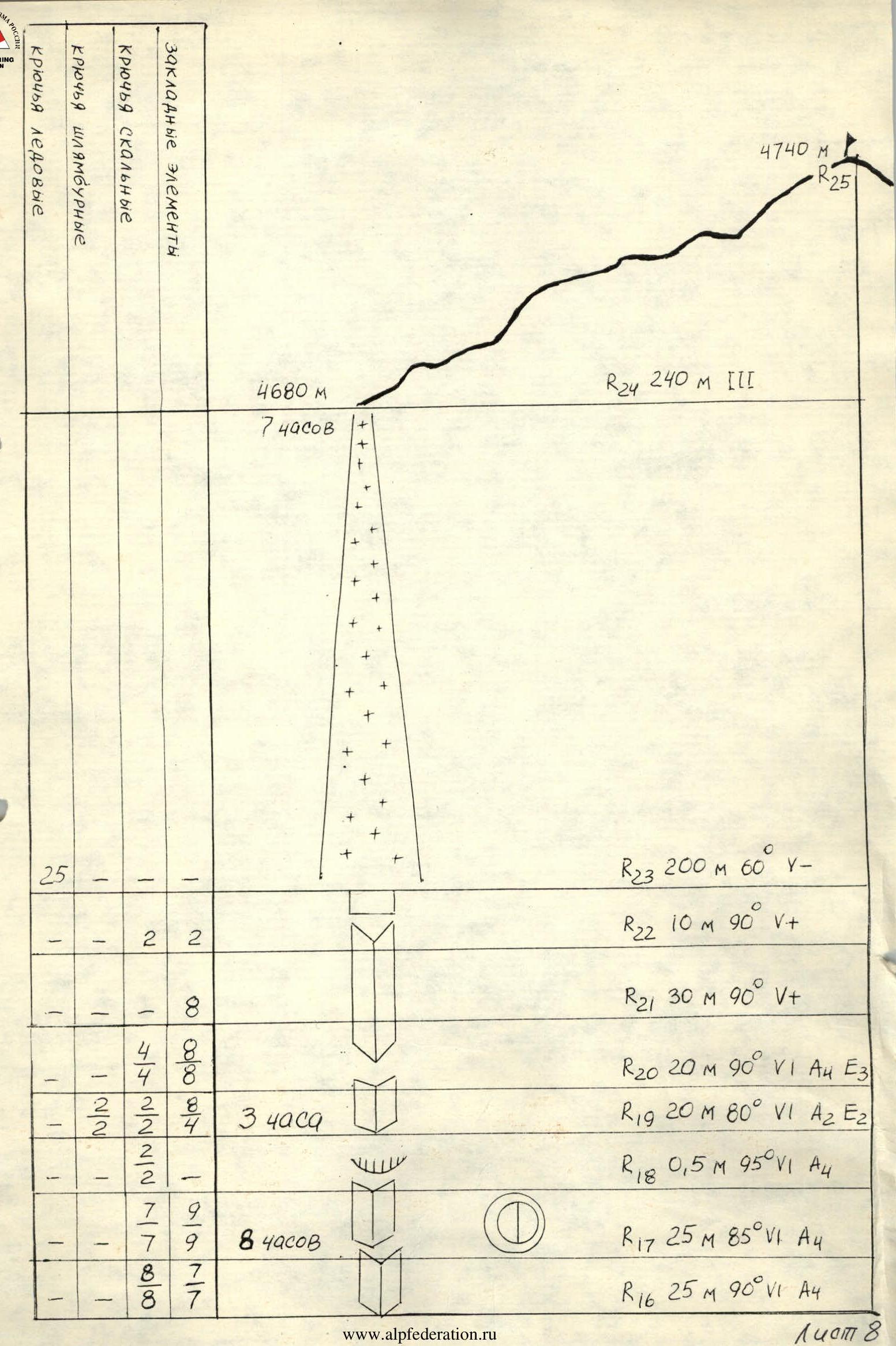

Description of the route by sections
| Section | Description |
|---|---|
| R0–R2 | Ice slope. Ice 60°. |
| R2–R3 | Ice slope, traverse to the right onto rocks. |
| R3–R5 | Inner corner, covered with ice. Character of rocks — "sheep's foreheads", unreliable pitons in shallow cracks. |
| R6–R7 | Inner corner turning into an overhanging chimney. There are convenient handholds for climbing, various cracks for pitons. |
| R8–R9 | Wall 80° consists entirely of loose slabs, from one to twenty centimeters thick. There are handholds, cracks, but climbing is risky due to loose slabs. |
| R9–R10 | Monolithic inner corner with a series of cracks for pitons and nuts. |
| R10–R11 | Cornice with a 2 m overhang. There are cracks for pitons and nuts. Control tour. |
| R11–R12 | Inner corner, practically no handholds. Crack is sometimes dead. |
| R12–R13 | Wall with small downward-facing handholds. There are cracks for pitons and small nuts. |
| R13–R14 | Inner corner, covered with ice. Can use ice screws for belay organization. |
| R14–R15 | Vertical monolithic wall, no handholds or relief. |
| R15–R16 | Cornice, overhang 1.5 m. Transition from right to left. |
| R16–R17 | Inner corner. Beginning of a series of inner corners leading to the edge. Relief appears. |
| R17–R18 | Monolithic inner corner, ends in an overhang. |
| R18–R19 | Overhang 0.5 m. For passage, a bolt was driven. |
| R19–R20 | Inner corner, a bolt was driven, further small "stopper" nuts go well. |
| R20–R21 | Long inner corner leading to the edge of the ice gully. Various cracks for pitons and nuts appear. |
| R21–R22 | Continuation of the inner corner, cracks turn into crevices, it becomes possible to climb. The upper part of the corner and wall before the exit are heavily destroyed, rockfall hazard. |
| R22–R23 | Transition from rocks to the ice gully. |
| R23–R24 | Ice gully leading to the ridge. |
Further along the ridge towards the summit. Summit.