
PASSPORT
-
Winter class.
-
Tian-Shan, Ak-Sai valley.
-
p. S. Korea 4740 via the gully left of the "triangle" from the S side. 4.55 cat. of difficulty, 2nd ascent of Barber's route.
-
Height difference — 740 m, length — 920 m.
Length of sections with 5–6 cat. of difficulty — 560 m. Average steepness of the main part of the route — 58° (4000–4740 m). Of which:
- 6 cat. of difficulty — 90° (3342–3402 m).
- Number of pitons:
Ice screws — 69 pcs. Climbing hours — 11.5 hours and days — 1 day.
- No overnight stays.
- Leader: Kuznetsov Valery Nikolayevich Master of Sports of the USSR
Team members:
- Penzov Sergey Konstantinovich Master of Sports of the USSR
- Sabelnikov Ilya Vladimirovich Master of Sports of the USSR
- Smetanin Alexander Alekseevich Candidate for Master of Sports
- Volkov Andrey Evgenievich Candidate for Master of Sports
- Temirbaev Rinat Rashidovich Candidate for Master of Sports
-
Coach: Galkin Sergey Petrovich — highest category
-
Start of the route: February 24, 1991.
Reached the summit: February 24, 1991.
Returned to "Koronskie nochyovki": February 24, 1991.
- Organization: Goskomsport RSFSR.
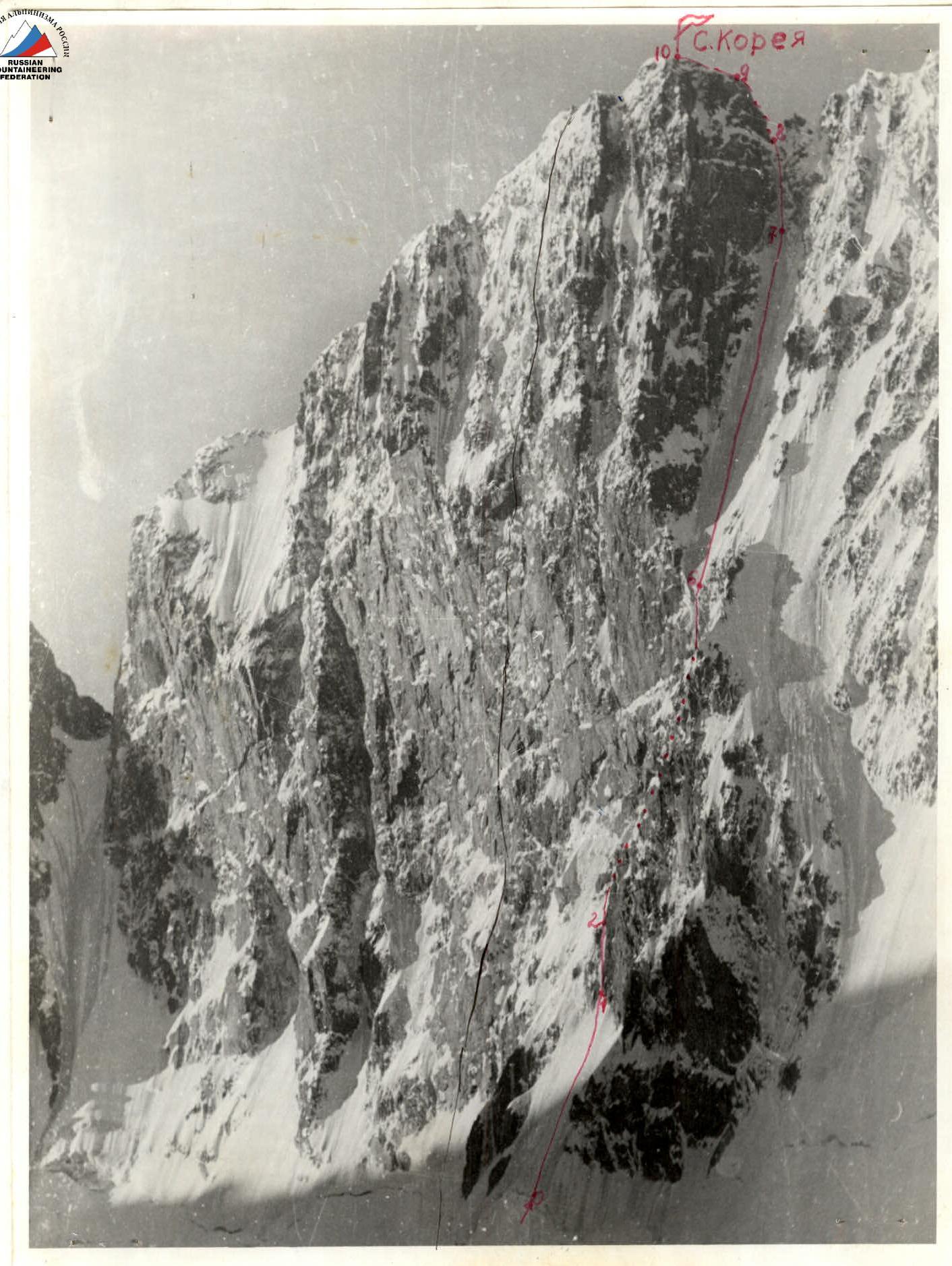
General photo of the summit. — route taken by the team. • — section numbers.
TACTICAL ACTIONS OF THE TEAM
The team's tactical actions were planned during a period of changing weather and lack of clarity on the passage of the key section. Due to this, an overnight stay above the key section was planned. Before the ascent, this section was thoroughly examined and studied, and the weather allowed for a speedy passage. Therefore, the team decided to ascend without an overnight stay and return to the observers on the same day. Nevertheless, in case of unforeseen circumstances, the team took:
- a tent,
- 3 camping mats,
- a gas burner with 2 gas cylinders,
- 3 down booties.
The rope teams worked as planned: Sabelnikov — Kuznetsov, Penzov — Smetanin, Volkov — Temirbaev. The rope teams worked autonomously in the lower part of the route and interacted on all steep sections.
All participants worked on the route first, and the key section: an overhanging ice icicle with loose and fragile ice, interspersed with snow, where organizing belay points was very challenging, was first worked on by Sabelnikov — Kuznetsov. The passage of this section was significantly complicated by the delaminated and partially destroyed ice.
Stations were organized on linked ice screws away from the possible ice fall.
On the route, the team used:
- ice axes with stirrups,
- combination hammers,
- certified rope,
- steel ice screws with handles for winter ice.
All belay points were organized on ice screws, belay stations on linked pitons.
There were no falls, injuries, or frostbite on the route.
The team used autonomous nutrition.
Communication with observers was carried out according to the approved schedule using the "Lastochka" radio set. In addition, all the team's actions were observed through a 12x binocular.
The rescue team of the Championship was at the "Koronskie" campsite.
The descent from the summit took less than 3 hours via the Lou couloir.
ROUTE SCHEME IN UIAA SYMBOLS
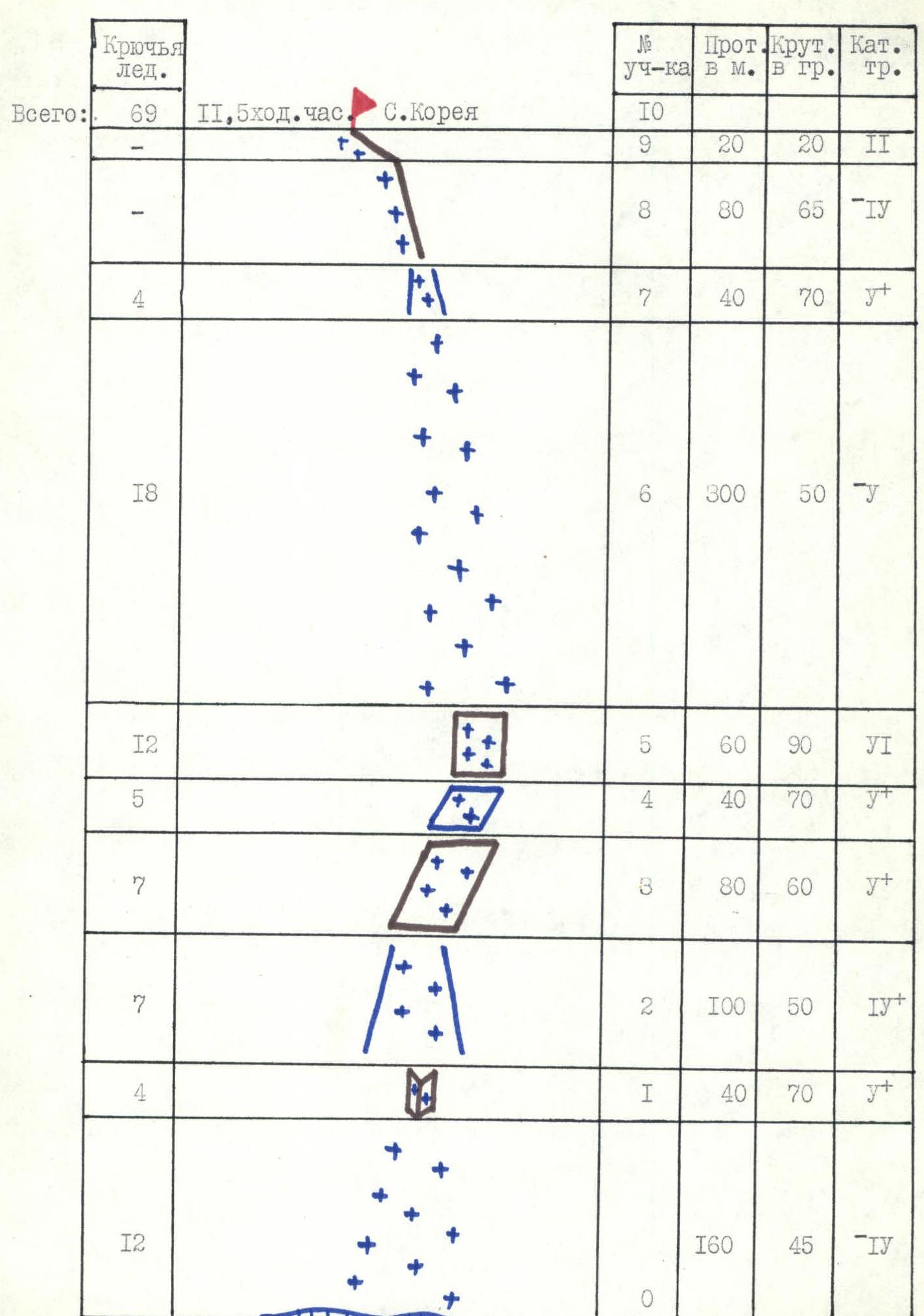
M 1:4000
DESCRIPTION OF THE ROUTE BY SECTIONS
Section R0–R1. Ice slope. Simultaneous and alternating movement, belay through ice screws.
Section R1–R2. Steep ice gully, better to pass early. Organization of fixed rope, lower station to the side and under the wall.
Section R2–R3. Ice slope with snowy sections. Simultaneous and alternating movement.
Section R3–R4. Steep ice wall, organization of fixed rope. Re-frozen ice breaks off in lenses. Organize the station away from the direction of the first climber's movement.
Section R4–R5. Diagonal traverse with height gain, twists ankles. Need to pass as quickly as possible.
Section R5–R6. Key section of the route. Sheer ice wall. Ice lies in a thin layer on a sheer rock, has delaminated and partially destroyed. Very cautious movement of the first climber on thorough piton belay. Limited number of places for organizing belay. Movement on fixed rope, station must be organized away from possible ice fall.
Section R6–R7. Extensive ice slope. Alternating movement, with organization of belay through ice screws.
Section R7–R8. Steep, narrow ice couloir with outcrops of snowy rocks. Organization of fixed rope, passage with thorough piton belay. Exit to a saddle.
Section R8–R9. Steep rocky summit ridge. Use previously hung fixed ropes.
Section R9–R10. Gentle slope on rocks and snow leads to the summit.

Comments
Sign in to leave a comment