
Passport
-
Technical Class
-
Ala-Archa, Ak-Sai gorge
-
Pik Box, 4240 m, via the left part of the North face
-
Proposed 6B category of difficulty, first ascent
-
Route height difference: 798 m Wall section height difference: 520 m Route length: 1175 m Wall section length: 545 m Length of sections with 5-6 category of difficulty: 455 m, including 275 m of 6th category Average route slope: 68°, average wall section slope: 75-77°
-
Pitons hammered in:
| Rock | Bolt | Friend | Chock | Ice |
|---|---|---|---|---|
| 125 | 4 | 62 | 106 | 10 |
| ----- | ----- | ----- | ------- | ----- |
| 47 | 4 | 40 | 39 |
- Team's total climbing hours: 48 hours; days: 5, including 3 days of preparation
- 3 overnight stays in a tent
- Team leader: Mikhailov Mikhail Mikhailovich, Master of Sports
Team members:
- Fedin Valery Vitalyevich, 1st sports category
- Chernov Alexander Vladimirovich, 1st sports category
- Molotov Andrey Nikolaevich, International Master of Sports
- Fedina Svetlana Nikolaevna, Candidate Master of Sports
- Chumakov Dmitry Vladimirovich, 1st sports category
-
Team coaches: Ilyinsky Ervand Tikhonovich, International Master of Sports, Honored Coach of the USSR Molotov Andrey Nikolaevich, International Master of Sports
-
Approach to the route: August 1, 1997 (preparation day)
Summit: August 5 Return: August 5
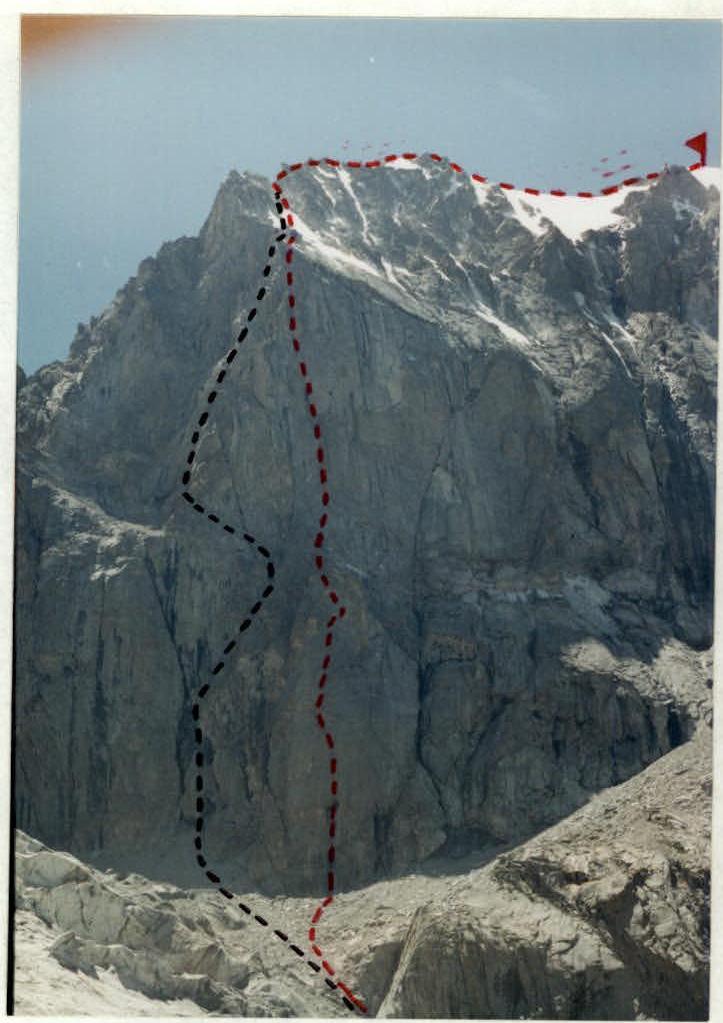
General photo of the summit
TEAM'S ROUTE: — YUGOSLAV TEAM'S ROUTE: ---
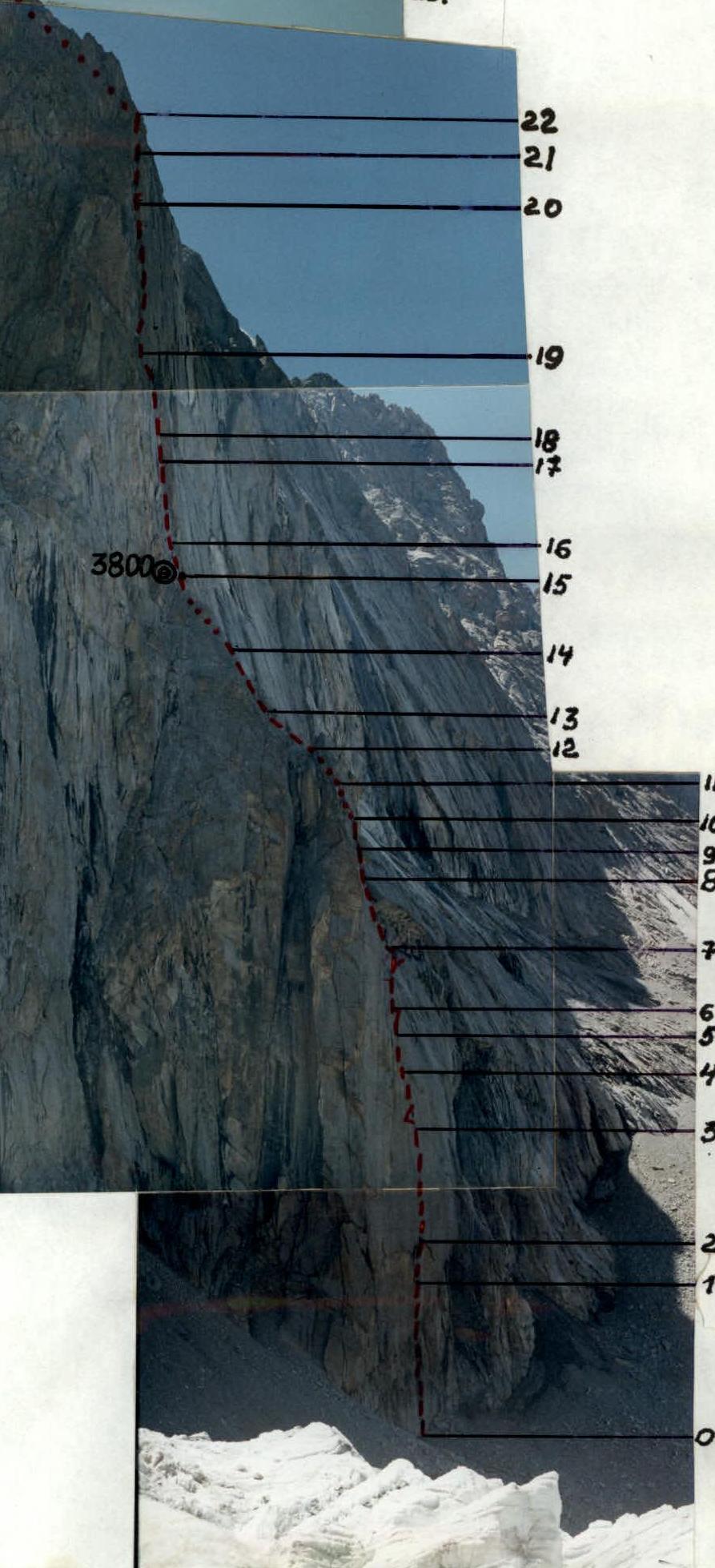
PROFILE OF THE WALL FROM THE LEFT.
Tactical actions of the team
While climbing the left part of Pik Box's North face, the team followed a pre-developed tactical plan.
The entire route was climbed with prior preparation. This tactic was justified due to the lack of suitable bivouac sites other than the one pre-planned.
The first climber in the rope team was belayed using a double rope.
The team consisted of three rope teams:
- Mikhailov—Molotov
- Fedin—Chernov
- Chumakov—Fedina
The lower part of the wall (R0–R3) was prepared by the Mikhailov—Molotov rope team, allowing the entire team to reach the planned bivouac site the next day.
On the R3–R15 section, the Fedin—Chernov rope team worked first. They bivouacked at this location, protected from rockfall, three times. Over the next two days, they prepared the complex sections of the upper part of the wall from this location.
The Mikhailov—Molotov rope team worked on sections R15–R19; Fedin—Chernov on R19–R22.
On the fifth day of the ascent, the team in full composition and with all gear:
- climbed the upper part of the wall,
- traversed the ice couloir,
- followed the ridge and reached the summit at 18:00. On this day, the Mikhailov—Molotov rope team worked first.
The descent was made:
- via a 1st category difficulty scree couloir to the Ak-Sai glacier,
- then to the "Ratsek" campsite.
The team was back at the base camp by 22:30.
There were no falls, injuries, or illnesses. Communication with the rescue team was maintained via a MOTOROLLA radio station every even hour. Visual monitoring was conducted using a 30x binocular.
Route description by sections
August 1, 1997
- 0–1: Straight up through a series of cornices, climbing is tense. Then follow a crack with free climbing to an internal corner.
- 1–2: Climb the corner to an ITO under a cornice, where there is a belay station.
- 2–3: From the belay station, move right along a crack under the cornice to a vertical crack that crosses the cornice. Then follow this crack to an ITO 30 m up, where there is a belay station.
August 2, 1997
- 3–4: Climb the crack, then a horizontal crack left, and continue up to an ITO, just before the crack widens to 50–60 cm. Make a pendulum right, 7 m up the crack.
- 4–5: Make a pendulum left, climb the crack to an ITO, transitioning to free climbing.
- 5–6: The terrain becomes less steep, climbing is tense on an inclined ledge, where there is a belay point.
- 6–7: Climb right up the inclined ledge to an internal corner, then up the corner left.
- 7–8: Cross to the wall with a crack and after 25 m, reach a ledge with a convenient belay station.
- 8–9: A small wall with tense climbing ends on an inclined slab.
- 9–10: Climb a crack on ITO.
- 10–11: Exit the crack into an internal corner ending in a wall.
- 11–12: The wall leads to "ram's foreheads," where there is a convenient belay station.
- 12–13: Climb straight up the "ram's foreheads" to a chimney.
- 13–14: Climb the chimney left up, then an inclined slab, where there is a convenient belay station.
- 14–15: Continue via the "ram's foreheads" to the wall, where the team bivouacked.
August 3, 1997
- 15–16: Overcome two walls via the left edge to a ledge under an internal corner, where there is a convenient belay station.
- 16–17: Climb the internal corner on ITO via the right wall.
- 17–18: Exit the internal corner slightly right to a crack, overcome it on ITO, and reach a ledge with a convenient belay station.
- 18–19: Continue left of the chimney via a crack on ITO, where the upper part of this wall is overcome with a cornice, also cut by a crack, and then a red smooth wall. The belay station is in an inconvenient location.
August 4, 1997
- 19–20: Continue up the wall to an inclined slab 1 m wide. Above the slab, move up a destroyed wall to the base of a small chimney.
- 20–21: Climb the chimney with free climbing; approximately halfway up, there is an inclined ledge; the chimney then transitions into a not-too-steep internal corner.
- 21–22: A short 20 m section with a series of walls climbed centrally, leading to the exit from the main wall.
August 5, 1997
- 22–23: Climb inclined slabs at 50°, with good belays, staying close to the left edge of the slabs.
- 23–24: Ice section; move towards a narrow ice couloir.
- 24–25: Narrow ice couloir, 5–6 m wide, leading to a small ridge.
- 25–30: Rocky ridge leading to the summit. Move along the right side of the ridge; there are walls of small length along the way. The final wall, 30 m long, leads to a scree slope and is heavily destroyed.
- 30–31: Long scree slope with minimal height gain leads to the summit.
UIAA SYMBOL ROUTE DIAGRAM. Pik Box. 4240
(Note: Page 6 of the PDF contains a route diagram in UIAA symbols, which is an image and not subject to text recognition, so it is not included in this text. The original document did not contain a link to this image, so it was not added.)

Comments
Sign in to leave a comment