
Location, History of Ascent, and Approach Routes
Peak named after I. V. Kurchatov is located in one of the spurs of the Left Talgar river basin and closes the Rusakova river gorge, which flows into the Left Talgar river (see map). The peak is clearly visible from the Kuldzhinsky tract on the segment between Malaya Stanitsa and Almaty tobacco farm, and has an impressive appearance. Its approximate height is 4200 m.
It is not surprising that, being unclimbed, it attracted the attention of mountaineers from the Institute of Nuclear Physics of the Academy of Sciences of the Kazakh SSR. From the scientific town of INF, its summit stands out with its strict outlines against the background of surrounding peaks (photo 1, 2).
Therefore, in August 1966, a group of mountaineers from INF consisting of:
- Saprykin V. D. — Master of Sports
- Il'inykh A. M. — 3rd sports category
- Gubanova A. M. — 3rd sports category
- Mukhamedshina D. M. — 3rd sports category
accompanied by an observation group, made the first ascent to the unnamed peak 4200 m.
Paying tribute to the achievements of the outstanding Soviet physicist I. V. Kurchatov (1903–1960), the mountaineer-physicists, as the first ascenders, named the conquered peak after I. V. Kurchatov.
There are two most acceptable paths to approach the peak. The first one is through the Talgar or Butakovsky passes, through "Alpine Rose" to the "Four" pass.
The second one is from the side of Talgar city along the Left Talgar gorge to the Big Key river gorge. Then, along the Big Key river gorge, it is necessary to ascend to the Yubileynaya peak and from here, crossing the spur that separates the Rusakova river from the Big Key river ( Edelweiss pass), to enter the Rusakova river gorge. Either of the two approach paths can be recommended, as desired.
The aforementioned group made the approach from the side of Talgar city. Almost to the very gorge of the Big Key river along the Left Talgar river; if convenient, one can drive by car. The ascent along the Big Key river gorge under the Yubileynaya peak takes about 6 hours. Crossing the Edelweiss pass and approaching the beginning of the moraine of the glacier flowing from the slopes of Peak Kurchatov requires another 2–3 hours of walking along grassy slopes and scree. At the beginning of the moraine, a base camp was set up. From here, the ascent can be made lightly.
Ascent Route to Peak Kurchatov
Category 2A route. Leaving the base camp located at the beginning of the moraine at 5:30, the group began its path to the peak, bypassing the steeply rising moraine on the right, getting closer to the northern spur of the western ridge leading to Peak Kurchatov.
After 1.5 hours, the group approached the saddle on the western ridge, later named the "Four" pass. The ascent from the glacier to the "Four" pass is initially made along an ice slope covered with snow, then along separate islands of small and medium scree. Just before reaching the pass, the route goes along destroyed easy rocks.
On the saddle, a cairn was built, in which the group left a note assigning the name "Four" to this pass.
From the pass, the path to the northwest is visible along a long, shallow scree down to the zone of alpine meadows and further along the wooded terrain to the "Alpine Rose".
The ascent to the "Four" pass took the group about 1 hour.
Further, the path to the summit goes along the western ridge to its junction with the southwestern ridge. On the way to the junction of the ridges, there are three gendarmes:
- The first one is bypassed on the right along shelves,
- The second — on the left,
- The third is taken head-on with careful belaying through separate protrusions.
The path through the third gendarme is not difficult, but care should be taken not to dislodge rocks on those below, as the rocks are heavily destroyed and there are many loose stones.
After the third gendarme, a 35° snow-ice slope begins, about 70 m long. This slope leads to the common ridge going to the summit. Here, crampons are necessary or belaying through an ice screw should be organized. Further, the path lies along the snowy ridge, resting against a rocky one. From here, it seems that this is already the summit. However, having passed three rope lengths along the rocky ridge with alternating belaying through good protrusions, one becomes convinced that the summit is further. The path along the ridge is pleasant for climbing and practicing belaying techniques. The rocks are monolithic. To the right and left — steep drops. After the "false" summit, a descent begins into a dip, initially along rocks, then along a snowy ridge. Beyond the dip, the actual summit is visible: in the form of a 50-meter rocky tower. The ascent to it is made along rock ladders of medium difficulty with the installation of one piton just before the summit. The summit itself is a sharp ridge about 20 m long with a 100-meter negative drop to the north.
The group descended along the ascent route. The ascent from the "Four" pass to the summit took the group 3 hours. Descent — 2 hours. The group descended to the base camp at 12:30. The time spent by the group from the base camp to the summit and back is 7 hours. The group leader evaluates the route as Category 2A.
Group leader, senior instructor, Master of Sports V. D. Saprykin
Group members:
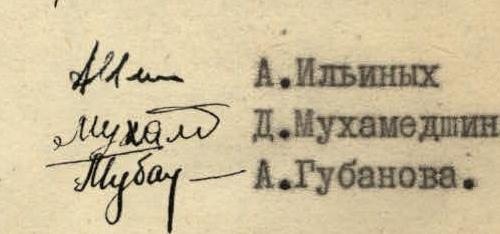 A. M. Il'inykh
D. M. Mukhamedshina
A. M. Gubanova
A. M. Il'inykh
D. M. Mukhamedshina
A. M. Gubanova
