
The Peak of Courage
Transfigured by the last rays of the sun, the Trans-Ili Alatau mountains become a fantastical sight… The departing sun's final beams slide along the ridge, painting the ice- and snow-capped peaks a fiery red. As the light fades, one peak remains aglow like a torch against the darkening sky: Pik Komsomola.
Mountains, like people, have their own biographies. Little is known about unconquered peaks beyond their altitude, while others have inspired poetic legends. Pik Komsomola belongs to the latter category of majestic mountains with an intriguing history.
The people of Almaty had attempted to conquer Pik Komsomola, looming above their city, on multiple occasions, only to be forced to retreat each time. With each failure, the peak's reputation grew, and legends about its inaccessibility were born.
Thirty-seven years ago, T. Beloglazov, I. Mysovskiy, and V. Gorbunov successfully ascended Maloalmatinskiy peak (now known as Pik Komsomola). This inaugural ascent is considered the birthdate of high-altitude mountaineering in Kazakhstan. In the summer of 1935, on the initiative of the capital's Komsomol organization, a mass Komsomol alpinada was organized to conquer Maloalmatinskiy peak1. In a single day, 250 participants reached the summit.
The public highly praised the mountaineers' feat. The Presidium of the Kazakh Central Executive Committee issued a special decree: "The Kazakh Central Executive Committee notes the brilliant victory of the Almaty Komsomol members, who, in honor of the 15th anniversary of the Kazakh SSR, conquered Maloalmatinskiy peak in a group of 250. Such an ascent has occurred for the first time in the history of mass mountaineering."
The Kazakh Central Executive Committee expressed gratitude to all participants and hoped that each of them would become an organizer of mass mountain conquests.
The Presidium of the Kazakh Central Executive Committee decreed:
-
In commemoration of the first Komsomol alpinada, to rename Maloalmatinskiy peak to Pik Komsomola.
-
To award the honorary certificate of the Kazakh SSR Central Executive Committee to the alpinada commander, Comrade Zimin V., and the commissar, Comrade Komarov K.
-
The Kazakh Central Executive Committee hopes that the Lenin Komsomol will mark the 15th anniversary of the Kazakh SSR with new victories in conquering mountain heights.
From that time on, ascents of Pik Komsomola became a tradition, repeated year after year. Fourteen mass alpinadas have since climbed the "Peak of Courage." Even according to incomplete data, the number of mountaineers who have ascended the beloved peak has reached 5,000 people.
Young people are drawn to the mountains, where, in their struggle against the harsh environment, they acquire not only healthy recreation but also develop excellent human qualities:
- courage,
- endurance,
- collectivism,
- the ability to remain composed in any conditions.
The interest in Tian Shan's Pik Komsomola has not waned over the years. Mountaineers from the republic have tackled Pik Komsomola from the north, east, south, and west, overcoming the most challenging routes to the summit.
Who are the pioneers of the new routes on the popular peak? The first ascensionists (G. Beloglazov's group) reached the summit of Pik Komsomola on July 17, 1930. They ascended from the Bogdanovich Glacier, traversing the Komosomolskiy Pass and continuing along the southeastern slope, via the "false peak" (Category 2A difficulty).
As the mass alpinada progressed, the mountaineers' skills improved. They sought out new, uncharted paths. On June 16, 1936, a group of young mountaineers successfully ascended Pik Komsomola via the northwest ridge from the right branch of the Bogdanovich Glacier:
- K. Komolov,
- Kh. Rakhimov,
- I. Tyutyunnikov,
- A. Akhmetov,
- T. Rossova,
- D. Salanov,
- D. Kuznetsov,
- I. Kenarskiy,
- V. Shirkin,
- S. Maslennikov,
- K. Protsenko,
- L. Kibardin,
- S. Khimich (Category 3B difficulty).
During the harsh years of the Great Patriotic War, in 1943, graduates of the mountain rifle school, under the guidance of instructors:
- Yu. Menzhulin,
- M. Grudzinskiy,
- V. Nearon,
- A. Ashirbekov,
- Yu. Gudkov, stormed Pik Komsomola from the eponymous pass and along the southern rocks (Category 2A difficulty).
On September 23, 1949, instructors from the Tuyuksu Alpine Camp of the Lokomotiv Sports Society — D. Gudkov, A. Goncharuk, and B. Korenev — successfully conquered the peak via the harsh northern wall (Category 3B difficulty).
One of the most challenging mountaineering problems on Pik Komsomola is the traverse of the northeastern spur, above which four sharp and difficult peaks rise like fortress towers:
- Smena (4,089 m),
- Ushbinka (3,910 m),
- Lastochkino Gnezdo (3,880 m),
- Snowy plateau (3,825 m).
Mountaineers from the Kazakh Alpine Club: K. Aleksandrov, F. Mansurov, A. Kilberg, and V. Kolodin solved this complex problem over seven days (August 15–21, 1952). They ascended from the Left Talgar Valley to the Komosomolets Glacier, traversed the spur, and descended along the southern ridge of Pik Komsomola to the eponymous pass, and then to the Bogdanovich Glacier (Category 4B difficulty).
By the summer of 1961, only the southern wall of Pik Komsomola remained unconquered. Instructors from the Tuyuksu Alpine Camp of the Enbek Sports Society:
- B. Mansurov,
- V. Fedchenko,
- F. Podufalov,
- V. Balabay,
- V. Eshtokin,
- V. Postnikov, breached this stronghold on July 22, 1961.
The route was classified as Category 4B difficulty.
The first to traverse the massif, ascending via the southern wall and subsequently conquering all the peaks of the northeastern spur, were instructors from the Tuyuksu Alpine Camp:
- V. S. Garshin,
- Yu. E. Kolokolnikov,
- V. V. Lyashenko,
- A. A. Atabaev,
- V. V. Cherkes,
- P. S. D'yachenko.
They achieved this between August 29 and 31, 1964. This route is categorized as 5A difficulty.
15th Jubilee Alpinada
The entire Soviet people are preparing to celebrate the glorious 50th anniversary of the Great October Socialist Revolution with new achievements in the national economy, culture, and sports.
In honor of this jubilee, mountaineers and young people from Kazakhstan will participate in the 15th mass alpinada, organized by the Republican Council of Trade Unions of Kazakhstan.
The alpinada will commence on May 10, 1967. The first echelon will ascend Pik Komsomola, comprising a team of veteran mountaineers, repeat ascenders to the peak, and athletes from the:
- "Burevestnik,"
- "Lokomotiv" sports societies.
The second echelon, consisting of rural athletes from the "Kairat" Sports Society, will undertake the ascent between May 18 and 23. The alpinada will conclude with an echelon of mountaineers from the "Enbek" and "Spartak" sports societies, who will ascend between May 24 and 31.
Participants will arrive at the Goryelnik tourist base in an organized manner, where they will undergo training sessions before proceeding to the tent camp at Talgar Pass, from which they will undertake:
- a training ascent to Pik Shkolnik (3,900 m),
- a qualifying ascent to Pik Komsomola.
To successfully ascend Pik Komsomola, one must:
- be in good physical health and have a good overall physical preparation;
- possess theoretical and practical knowledge equivalent to the "Alpinist of the USSR" badge program.
Those who conquer Pik Komsomola will be awarded this badge, as well as a special badge for participants in the jubilee alpinada. Additionally, each ascender can receive a commemorative badge "For the Ascent to Pik Komsomola," established by the Republican Alpine Club to encourage ascents to the peak. The names of the brave will be recorded in the book of conquerors of Pik Komsomola.
The Route to Pik Komsomola
Participants will arrive at the Goryelnik tourist base, situated 21 km from the city at an altitude of 1,930 m, by bus via the picturesque valley of the Malaya Almatinka River. This serves as the main alpinada camp. The journey continues on foot through the Chimbulak plateau, where the ski station is located at an altitude of 2,100 m, to Talgar Pass — a broad saddle between Pik Chimbulak and Pik Shkolnik. The upper camp will be established in the vicinity of Talgar Pass (at an altitude of 3,200 m).
Those with the necessary training will test their skills during a training ascent to Pik Shkolnik, which rises above the Bogdanovich Glacier. After resting and preparing, participants in the jubilee alpinada will storm Pik Komsomola. Pik Komsomola, with an elevation of 4,376 m, is situated in the northern part of the Maloalmatinskiy spur and towers above the surrounding peaks. To the south lies the dome-shaped peak of Karlytau (Snowy Mountain, 4,150 m), while to the north lies the jagged rocky ridge of Fizkulturnik (4,070 m).
Pik Komsomola features significant glaciation: the right branch of the Bogdanovich Glacier originates on the northwest slope, and the middle branch of the same glacier encircles the granite massif from the southwest. On the northeast side, the Komosomol Glacier descends into a narrow valley.
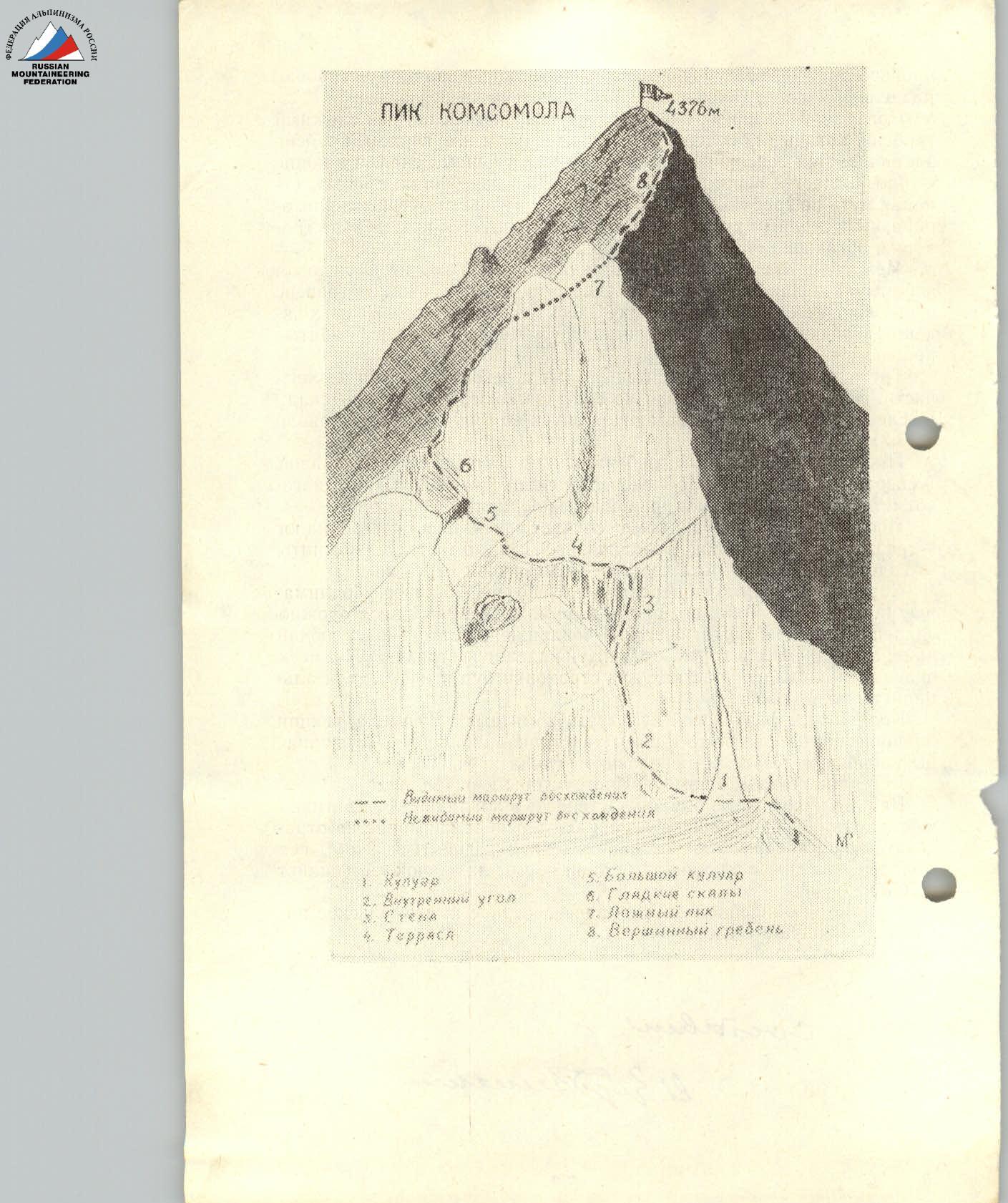
The route to Pik Komsomola from Talgar Pass proceeds via the Bogdanovich Glacier to Komosomolskiy Pass. Travelers must move in teams while traversing the glacier due to the presence of deep crevasses.
From the pass, the ascent begins up the steep scree and rocks of the southwest ridge of Pik Komsomola toward its summit. After traversing the rocks to the left and bypassing a gully, climbers reach a steep inner corner and, with careful belaying, ascend beneath a smooth rock wall. This marks the beginning of the most challenging section — traversing the wall in a northeasterly direction. Climbers must be particularly attentive and disciplined when passing this point.
By skirting the wall along a rocky slab, climbers ascend to the next steep rock face. At the top, a small platform provides access to a 100–120 m ridge walk, leading to smooth and steep rocks, 25–30 m high. Using an existing cleft in the rocks and with thorough top-rope belaying, climbers overcome this difficult section. The "false" peak is then bypassed to the west. After 20–30 m of traversing severely fragmented rocks, climbers reach the summit, where a cairn stands, holding the records of previous ascenders.
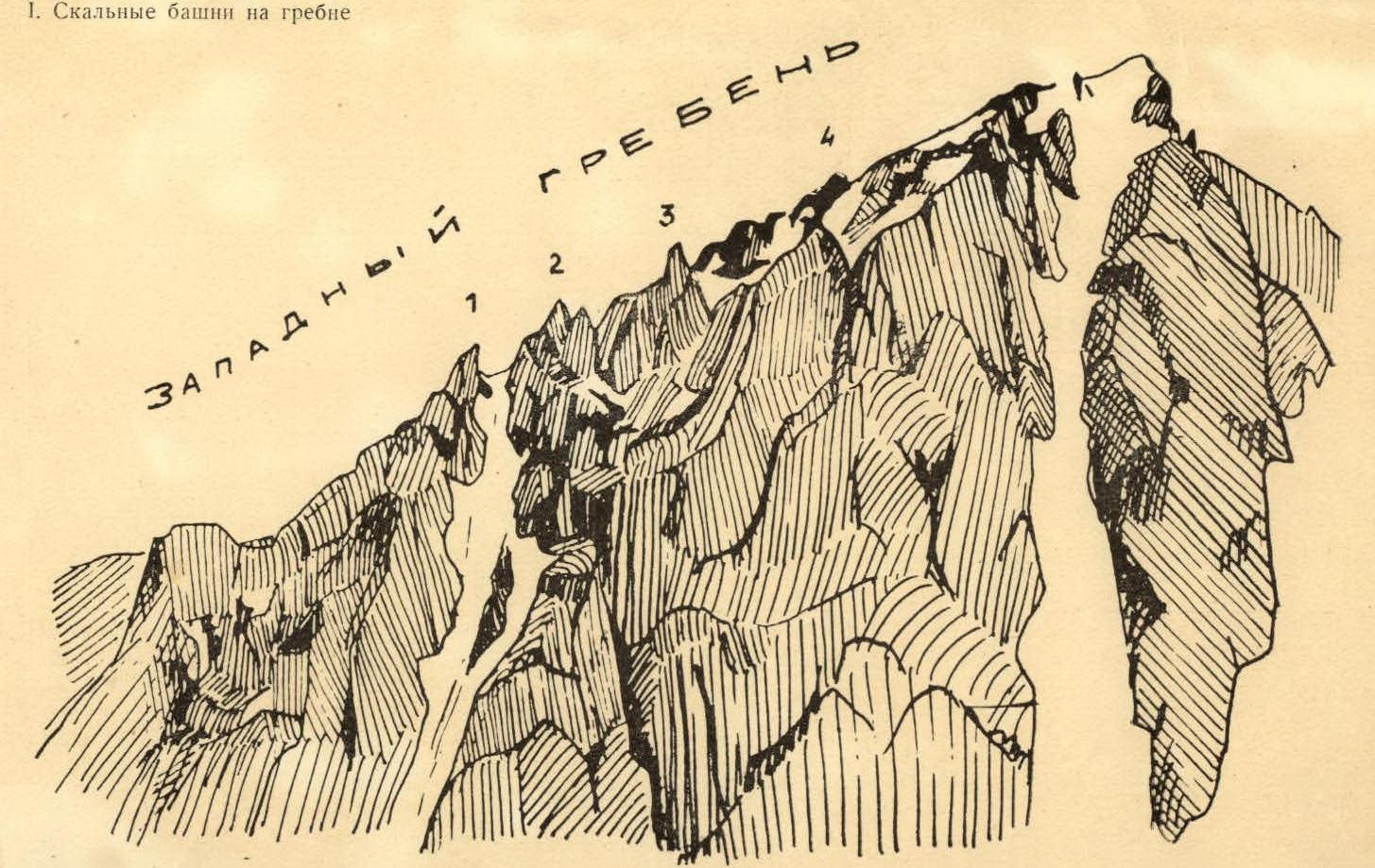
The journey from the camp to the summit takes around 7–8 hours. Following a triple "Ura!" and taking in the breathtaking panorama of the Trans-Ili and Kungei Alatau mountains, climbers begin their descent from the summit. The descent proceeds along the serrated western ridge, which separates the middle and right branches of the Bogdanovich Glacier.
Immediately below the summit rocks, a sharp snow ridge descends to the west, which can be traversed using ropes or by horseback. The ridge ends in a snowfield with a series of fragmented rocks; at its end, the first "gendarme" — a rocky tower — bars the path along the ridge. Descent from this point involves navigating smoothed, slab-like rocks directly "head-on," requiring piton belays and the establishment of rope railings.
Between the first and second "gendarme" lies an icy saddle. The most challenging section on the second tower involves a traverse to the left along a narrow rocky ledge, where, during mass ascents, ropes are typically strung, and belaying is done through securely anchored pitons.
The third "gendarme" is also bypassed on the left side, near the top. The rope for belaying can be secured around rocky outcrops. The final tower, approximately 10 m high, blocking the descent along the ridge, is circumvented on the left.
While navigating the western ridge, climbers must be cautious of the right (northern) side, where icy rocks terminate in multi-hundred-meter cliffs descending to the right branch of the Bogdanovich Glacier.
After the fourth "gendarme," climbers should descend from the ridge to the south toward the middle branch of the Bogdanovich Glacier, being mindful of the numerous crevasses at the turn of the glacier.
The descent to Talgar Pass will take 4–5 hours. While ascending Pik Komsomola, climbers must remember that every carelessly dislodged stone can injure their companions; they must adhere to mountain safety rules and establish reliable belays. Experienced mountaineers will be stationed at all hazardous and complex sections to provide belaying.
Physical culture collectives, Komsomol committees, and mountaineering sections: send forward-thinking young men and women, vanguard workers, and students to participate in the jubilee alpinada.
Veterans of Pik Komsomola, instructors, and experienced mountaineers! Your duty is not only to participate personally in the alpinada but also to actively lead the training of novices, with a particular focus on mastering:
- belaying techniques,
- rock climbing skills.
Ensure that all young participants in the alpinada pass the standards for the "Alpinist of the USSR" badge.
Participation in the jubilee alpinada is an honorable Komsomol assignment. Carry it out with honor.
- Rocky towers on the ridge
Footnotes
-
V. M. Zimin led this ascent, as well as many subsequent ones. ↩


