
Characteristics of the area and its exploration history
The Issyk Lake area has long been known to both tourists and mountaineers. Several mountaineering groups and expeditions from the Talgar alpine camp and others have operated in the upper reaches of the Issyk gorge. They have conquered many peaks in the area and compiled detailed descriptions, diagrams, and more.
However, the focus was primarily on the upper reaches of the Issyk gorge itself and its left (orographic) tributaries. There was a lack of information on ascents to the peaks of the right tributaries. Even on the most detailed map of the Trans-Ili Alatau available to us, the high peaks to the right of Issyk Lake were not marked.
Meanwhile, the high peaks of the right tributaries are clearly visible from the village of Turgen and the Issyk railway station. From there, the significant glaciation of the area is also observable. The high peaks of the Pryamoye gorge, which flows into the Issyk River below the lake, are particularly noteworthy.
In 1953, S. Kuderin and N. Shershnev attempted to approach these peaks via the Karabastau gorge, which flows into the Issyk River above the lake. The chosen path proved unsuccessful as it led to the steep and dangerous northern wall of the main peak in the area. Two months later, in May 1953, S. Kuderin and F. Lyubimov approached the glacier cirque via the Pryamoye gorge. The path turned out to be somewhat long and inconvenient for a large group. During this attempt, the group descended to the lake via the ridge separating the Issyk gorge from the Pryamoye gorge. It was found that this was the most convenient and shortest path to the glacier.
On May 1, 1955, S. Kuderin and F. Khabibullin followed this path to the glacier cirque. From there, they made an ascent to a nameless peak with an elevation of 3800 m (№ 9) via a relatively straightforward route. There was no tour or note on the summit.
The 1962 expedition of the KazGU sports club was organized with the goal of exploring the upper reaches of the Pryamoye gorge (a tributary of the Issyk gorge) and conquering the main peaks of the area.
Issyk Peak
II.
A nameless spur extending north from the main ridge of the Trans-Ili Alatau branches into three ridges near Peak Paustovsky: the Karabastau spur, known by this name among locals, the KazGU spur, and a small nameless spur. (The names used here and below were given by the KazGU sports club expedition). The KazGU spur further branches into the "Druzhnykh rebyat" (Friendly Kids), Mukan Tulebaev, and Romantics spurs. These form three glacial cirques that feed the Pryamaya River. The glaciers are one to two kilometers long, with the KazGU glacier being the largest. The main peak of the area, Peak Paustovsky, has an elevation of 4130 m (according to an altimeter). Besides it, peaks reaching 4000 m include the Obzornaya peak (4035 m) and peak № 10 (exact height unknown).
III.
To reach the described area, one must exit Issyk Lake into the right (orographic) gulley, known as the Malinovaya bukhta (Raspberry Bay). From here, follow the gulley up to the fork of two small gorges. Use the left (orographic) gorge to reach the forested ridge of the Karabastau range. Climb another 300–400 m along the ridge and then descend into the Pryamoye gorge. The upper reaches of the gorge are occupied by a large old moraine, partially covered with forest in places. There are many convenient areas for camps on the lateral slopes.
The expedition surveyed three snowy cirques. The cirques of the Paustovsky glacier and the KazGU glacier are of the greatest sporting interest.
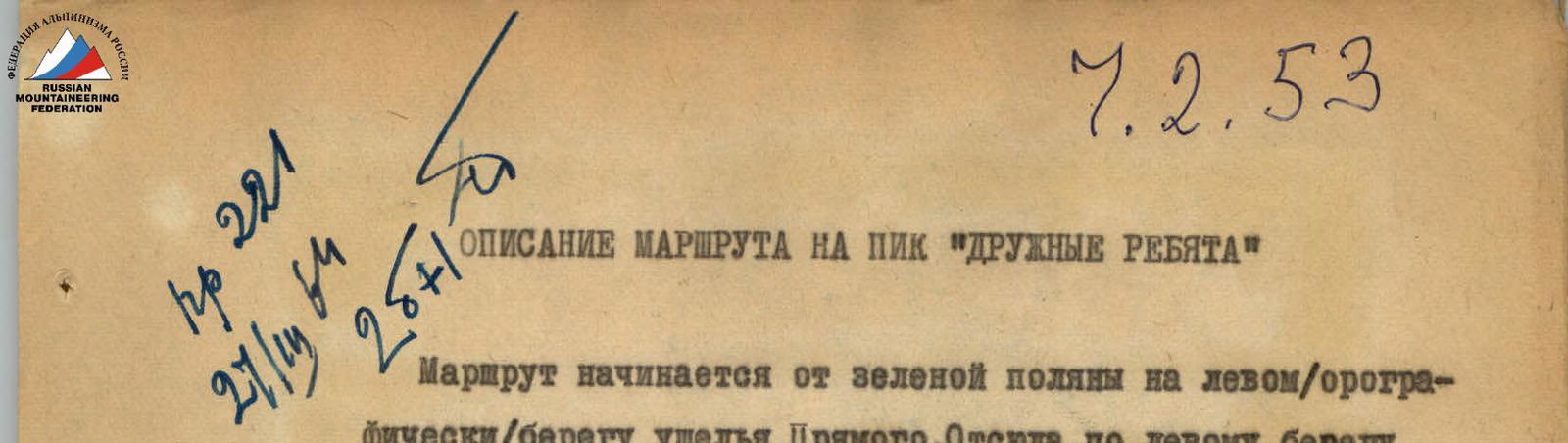
Description of the route to "Druzhnye rebyata" (Friendly Kids) Peak
The route begins from a green clearing on the left (orographic) bank of the Pryamoye gorge. From here, proceed upstream along the left bank until reaching rocks where a small waterfall flows. Here, one should cross the glacier and approach the northeastern end of the "Druzhnye rebyata" peak. The peak separates the KazGU glacier and the Paustovsky glacier and is visible throughout the approach.
From the foot, ascend via talus to the left of the rocks onto the ridge and move to its southern side. Traverse the slope along easy rocks. After 150–200 m, ascend back onto the ridge via a couloir. The ridge is narrow; continue in rope teams with simultaneous belay until reaching a large tower. The tower is about 40–50 m high. The ascent involves initially climbing right-upwards along moderately difficult rocks to the right of a chimney, then directly into the face of a small (5–6 m) sheer wall. Here, two pitons should be hammered in. Continue up easy rocks to the first summit of "Druzhnye rebyata". Descend from it via a steep wall onto the ridge using a rope. Further, there are several small gendarmes, all taken head-on via fairly complex rocks. Approach a very sharp section of the ridge-"knife edge". This is overcome with careful belay. Beyond it, ascend via medium rocks to a gendarme. The descent from it is one of the most challenging parts of the route. A 15-meter rock wall is heavily broken. Exit through a gap via medium rocks to the second summit of "Druzhnye rebyata" and descend via a series of small gendarmes to the saddle between the Obzornaya peak and "Druzhnye rebyata" peak. The further descent via talus is not particularly complex. The entire route took the group 9 hours in good weather. The route is characterized as rocky with some ice. The section from the foot of the first tower to the saddle is traversed with alternate belay. Three rock pitons were used. The group requests the route to be graded as category 2B.
