
Climbing Passport
- Climbing type — combined
- Region — Western Sayan, Borus ridge
- Pik Koshurnikova, 2300 m, S wall via zhendarme
- Assumed — 3B, first ascent
5. Route characteristics:
- height difference — 450 m.
- total length — 950 m.
- length of sections: 5th cat. diff. — 49 m, 4th cat. diff. — 55 m, 3rd cat. diff. — 131 m.
- average steepness of the wall section up to the ridge — 52°.
6. Equipment used on the route:
- camalots — 7,
- anchor pitons — 25,
- including on ITO — 20,
- left on stations and difficult sections — rock pitons — 8, U-shaped pitons — 2, "carrot" with carabiner — 1
- Total climbing hours — 8.5 h
- Team members:
- Leader: Zhigalov Alexander Vladimirovich — Candidate for Master of Sports
- Participant: Shevchenko Grigory Sergeevich — 1st sports category
9. Team coaches:
- Zakharov Nikolay Nikolaevich
- Balezin Valery Viktorovich
10. Departure date:
- On the route October 17, 2013, 9:35 AM
- Zhendarme summit — 2:30 PM
- Summit — 4:10 PM
- Return 6:00 PM.
- Organized by: Krasnoyarsk City Alpinism Federation, as part of the
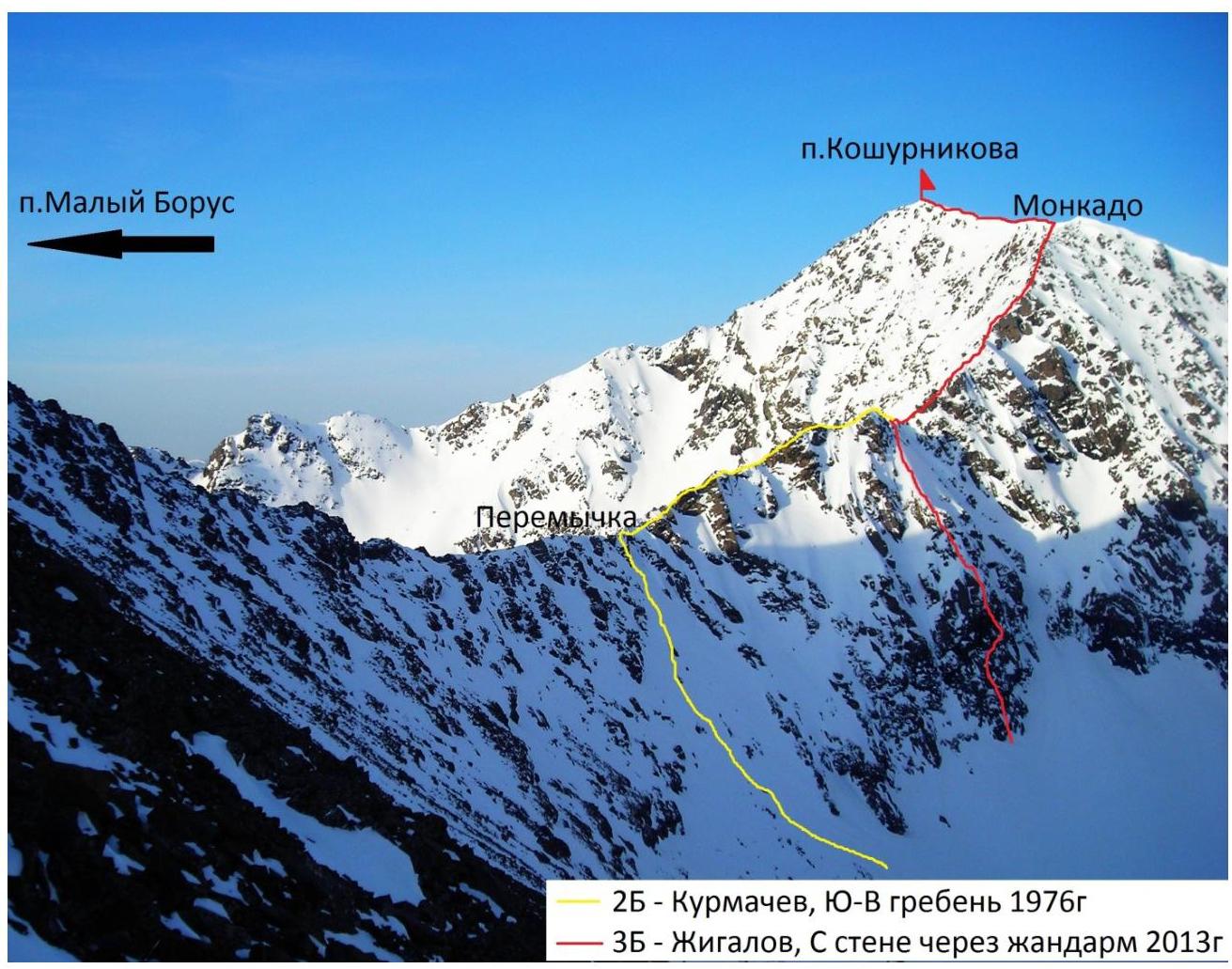
"Borus 2013" training gathering. General photo of the route
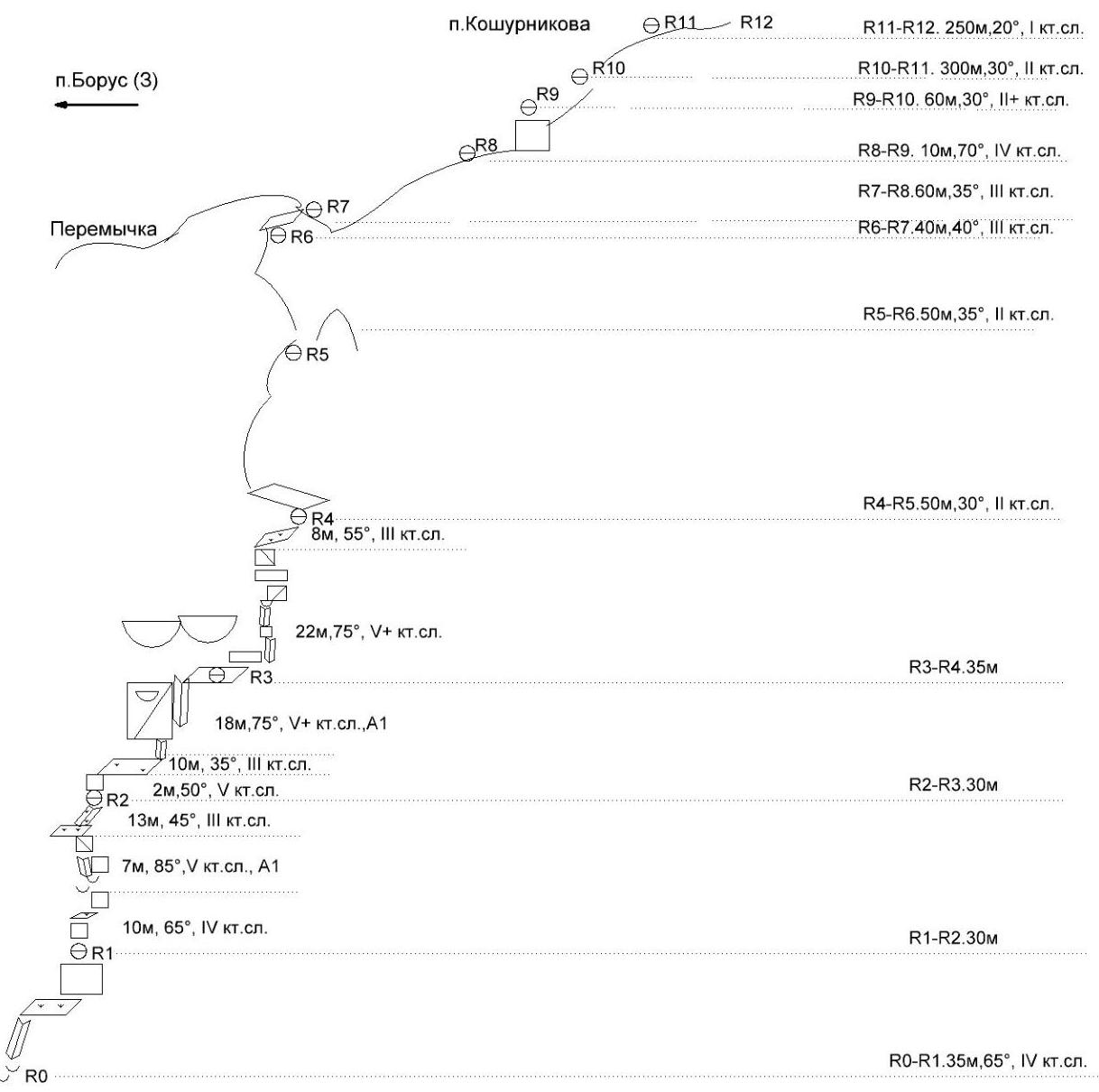
UIAA Scheme
Route Description
Pik Koshurnikova is located in the NW direction from the Borus peak in the central part of the Borus ridge, north of the Main ridge of the Western Sayan. The base camp is situated at the forest boundary on the bank of the Pelekhova stream in the Left cirque under the plateau dividing the Borus and Koshurnikova cirques, at an altitude of 1300 m above sea level, 4 hours walk from the Sayano-Shushenskaya HPP hydroelectric power plant settlement, Cheremushki.
From the base camp, follow the Pelekhova stream upstream, bypassing the Tsirk lake on the left bank. Ascend to the "saddle" between Borus and Koshurnikova. Then, uphill through the talus, veering right under the vertical wall of a large zhendarme located on the right part of the "saddle". The approach to the route takes 1.5 hours.
The route starts left of a large, separate boulder on the scree, 50 m away; possibly the boulder will be under snow, so looking up at the wall, you can see a green plastic bottle — the first control point, the start of the route.
Section R0–R1 — 35 m, 70°, IV cat. diff.
A wide internal angle with snow, which increases the slope in the upper part.
At the point where the angle approaches the ledge:
- A horizontal piton with a cable is hammered in for belay, to which a plastic bottle is tied.
From the ledge:
- Traverse right to a small wall.
- An inclined internal angle (3 steps on ITO) leads to a small shelf.
On the shelf:
- Horizontal and vertical pitons are hammered in for the station.
- A plastic can with a note is tied to one of the pitons — a control cairn.
Section R1–R2 — 30 m, 10 m, 65°, IV cat. diff. The wall, in the middle, turns into a ledge, then increases in slope. Approaches the overhang.
7 m, 85°, V cat. diff. Vertical semi-cave — an internal angle on the left part under the angle for belay, a vertical rock piton with a cable is hammered in. The angle leads to an inclined wall with a slit, along which left to a ledge, ITO on fifi, for belay — anchor pitons.
13 m, 45°, III cat. diff. Along the ledge, traverse left, then into an inclined snow-filled internal angle. Here, on the right wall, a station is organized on a vertical piton and a U-shaped piton with a cable. 2 m, 50°, V cat. diff. Along a small wall right onto an inclined ledge. 10 m, 35°, III cat. diff. Along the ledge, traverse right 10 m under a vertical internal angle.
18 m, 75°, V+ cat. diff. In the upper part of the angle, on the right side for belay, a horizontal rock piton with a rappel rope is hammered in. Then ITO on fifi right up between two cornices, exit onto an inclined ledge with narrow slits and a series of cornices. Here, for belay, a horizontal rock piton with a cable is hammered in. From above, on the left part, there are visible for orientation a wall with large cornices. Then exit to a vertical internal angle and transition through it right onto a large comfortable ledge. For the station, a small horizontal rock piton with a rappel rope is hammered in. For belay and station on the section, the following are used:
- camalots of medium sizes
- anchor pitons.
Section R3–R4 — 35 m, 22 m, 75°, V+ cat. diff. Along small ledges, along an inclined wall, traverse right, about 7 m. After — along a vertical internal angle ITO on fifi, camalots left up, a small inclined wall, then a short internal angle with an overhanging cornice in the upper part. After the cornice — a wall with a slope to the right side, a small inclined ledge, then a wall with a slit to the left side. Exit onto an inclined ledge. For belay, anchor pitons are used. Throughout the section, ITO.
8 m, 55°, III cat. diff. Inclined ledge. In the internal angle, a station. In the left wall, a stationary "carrot" with a carabiner is hammered in.
Section R4–R5 — 50 m, 30°, II cat. diff. The slope from this point changes significantly, the route becomes more gentle. Simultaneous movement up the snowy ledges.
Section R5–R6 — 50 m, 35°, II cat. diff. Snowy couloir. Section R6–R7 — 40 m, 40°, III cat. diff. Small, gently sloping walls, exit onto a ledge onto the ridge.
Section R7–R8 — 60 m, 35°, III cat. diff. Simultaneous movement along the arête in a rope team. Section R8–R9 — 10 m, 70°, VI cat. diff. Rock wall on the arête, not bypassable from the right or left. For belay, anchor pitons are used. At the top, a station is set up using the terrain.
Section R9–R10 — 60 m, 35°, II+ cat. diff. Arête with elements of climbing. Simultaneous movement.
Section R10–R11 — 300 m, 30°, II cat. diff. The arête becomes more gentle. Simultaneous movement. Exit onto the ridge.
Section R11–R12 — 250 m, 20°, I cat. diff. From the ridge, a cross installed on Pik Koshurnikova is visible. Exit onto the summit.
Descent is classic, along the eastern ridge, through the descent couloir.
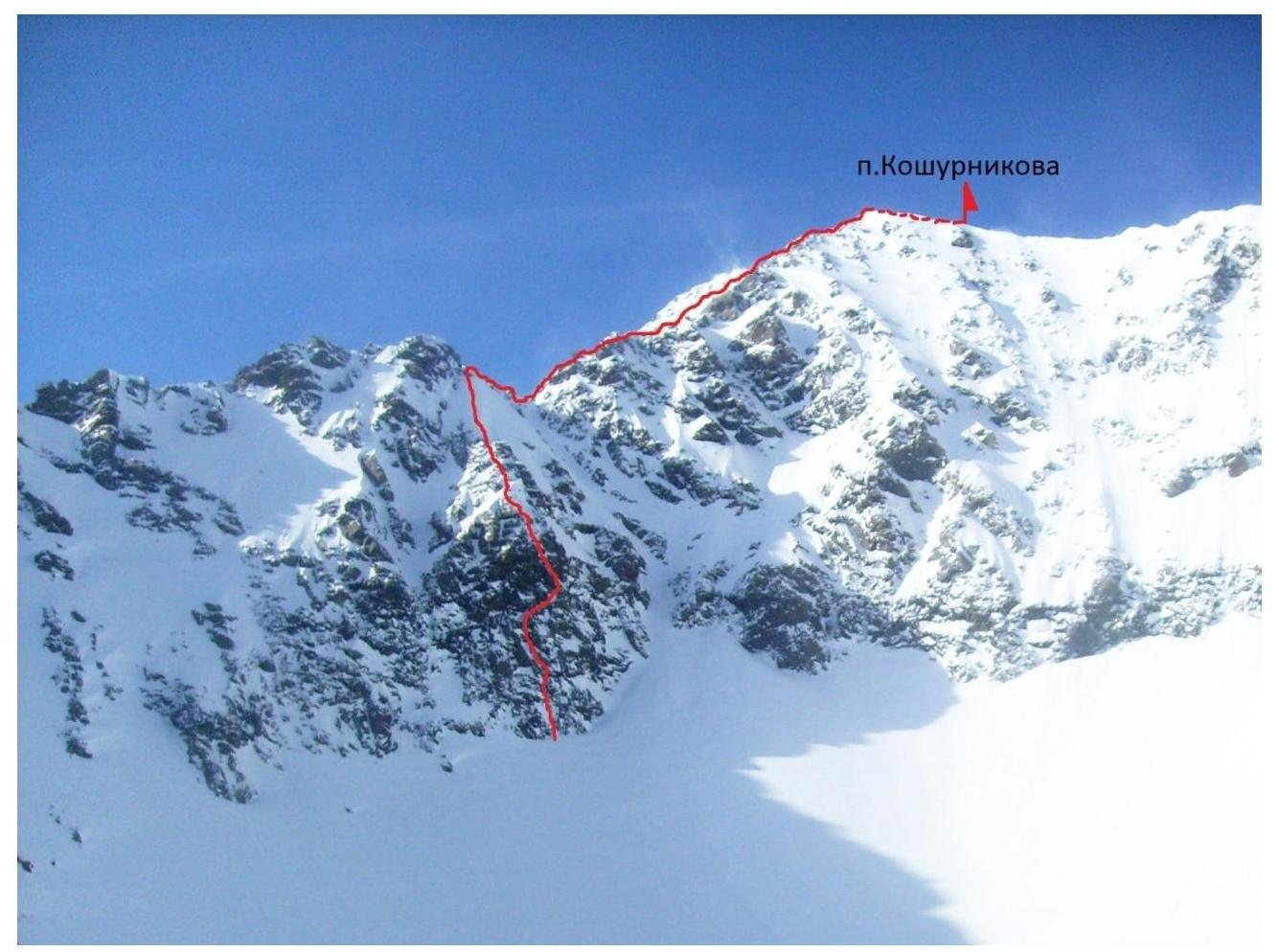
General view from Tsirk lake
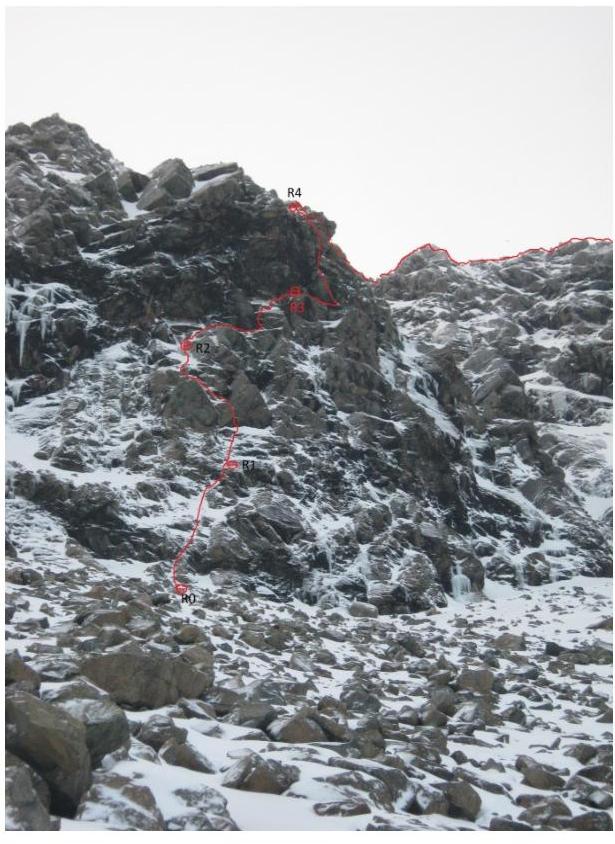
Sections R0–R4
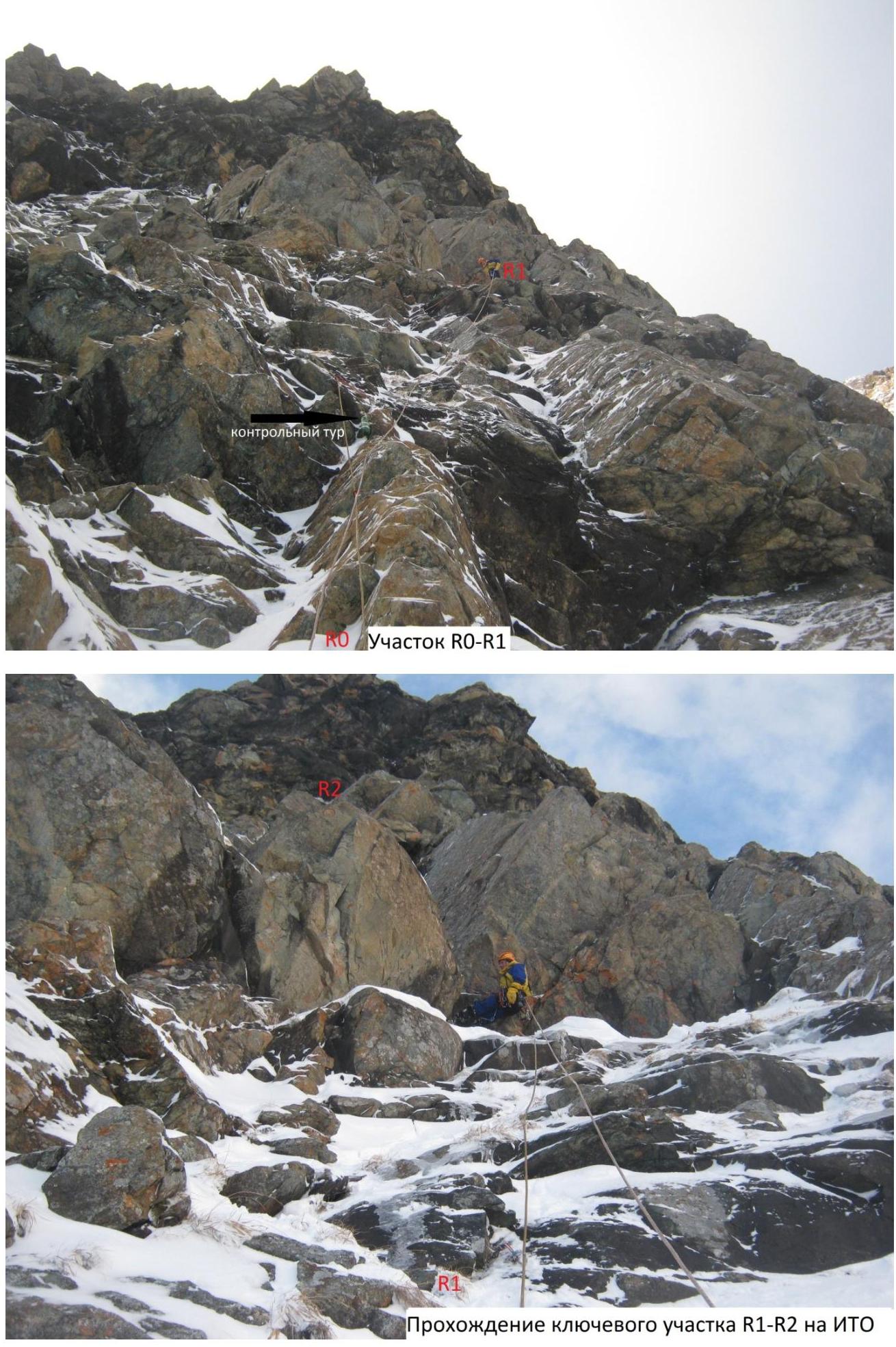
Passage of the key section R1–R2 on ITO

Comments
Sign in to leave a comment