
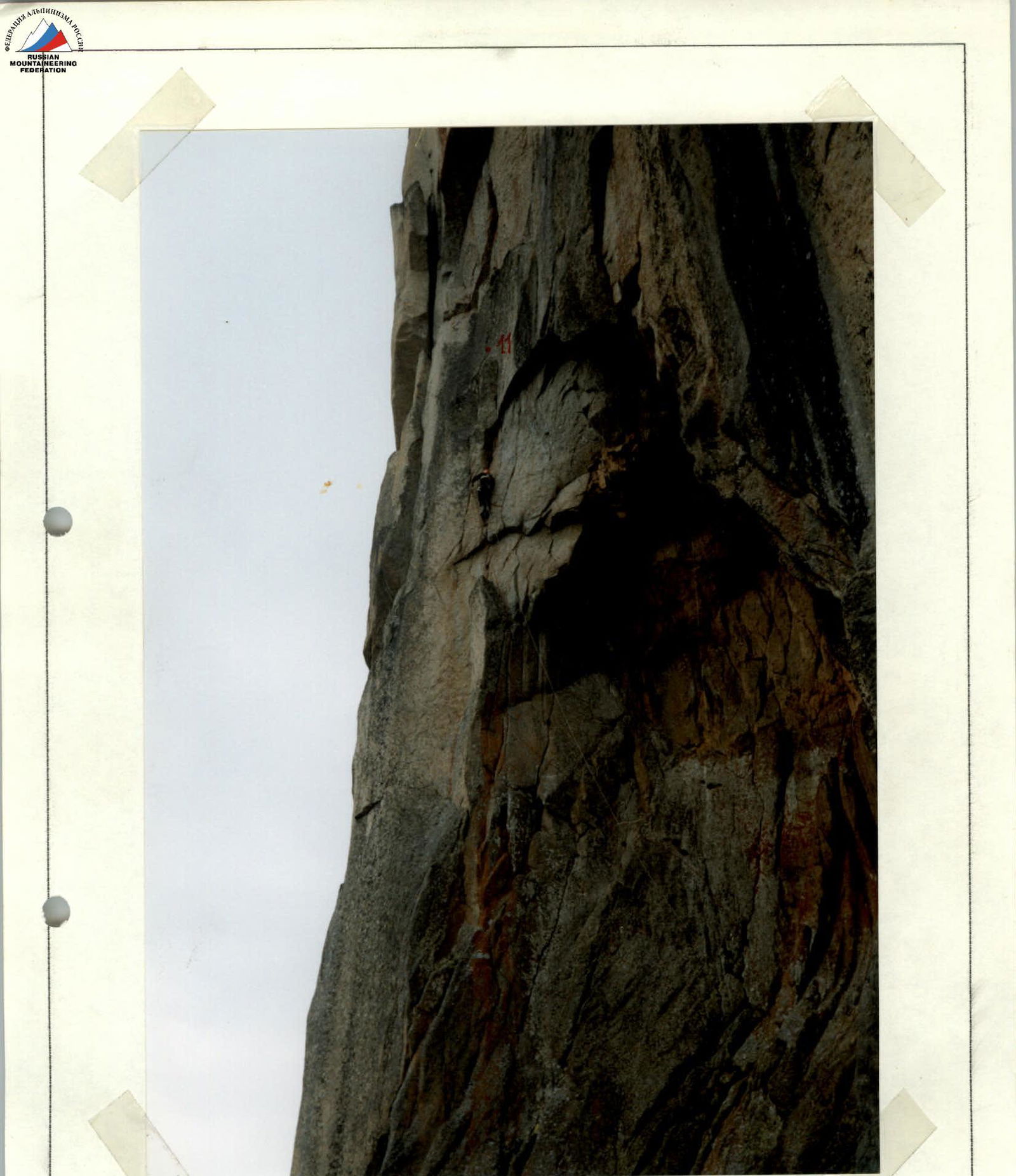
Exit from the grotto, section #10-11, taken from overnight stay #2
Ascent Passport
-
Ascent class: Rock climbing.
-
Ascent area: Western Sayan, Ergaki ridge.
-
Peak, its height, ascent route: Zub Drakona, 2170 m, South-West wall of the main bastion
-
Proposed category: 6A
-
Route characteristics:
Zub Drakona, 2170 m, South-West wall of the main bastion. Proposed category: 6A. Route characteristics:
height difference – 540 m, total length – 700 m, length of sections 6A cat. diff. – 370 m, 5 cat. diff. – 200 m, average steepness – 72°, steepness of the main part – 80°
The route used:
- chocks – 236 (190)
- rock pitons – 50 (41)
- bolt pitons – 17
Number of climbing hours – 53, days – 4
Overnight stays:
- 2 below the route
- 1 on the route – sitting
-
Team composition:
Koryukin Igor Vitalievich – CMS – leader Tsyganov Dmitry Valerievich – CMS Terentyev Alexander Yurievich – CMS
-
Team coach: Lebedev Vladimir Alexandrovich – MS
-
Departure date: for route preparation – June 30, 1999 to the summit – July 3, 1999, return to base camp – July 3, 1999.
-
Organization: Krasnoyarsk Youth Centre of Travellers. Dir. Plotnikov V. N. 1999.
Addresses
Youth Centre of Travellers
660017, Krasnoyarsk, Mira Avenue, 98, tel. 275-275, fax – 231796
Lebedev V. A.
660049, Krasnoyarsk, Perenson St., 9–43, tel. 27-30-05
Koryukin I. V.
660075, Krasnoyarsk, Maerchaka St., 42–189, tel. 21-28-74
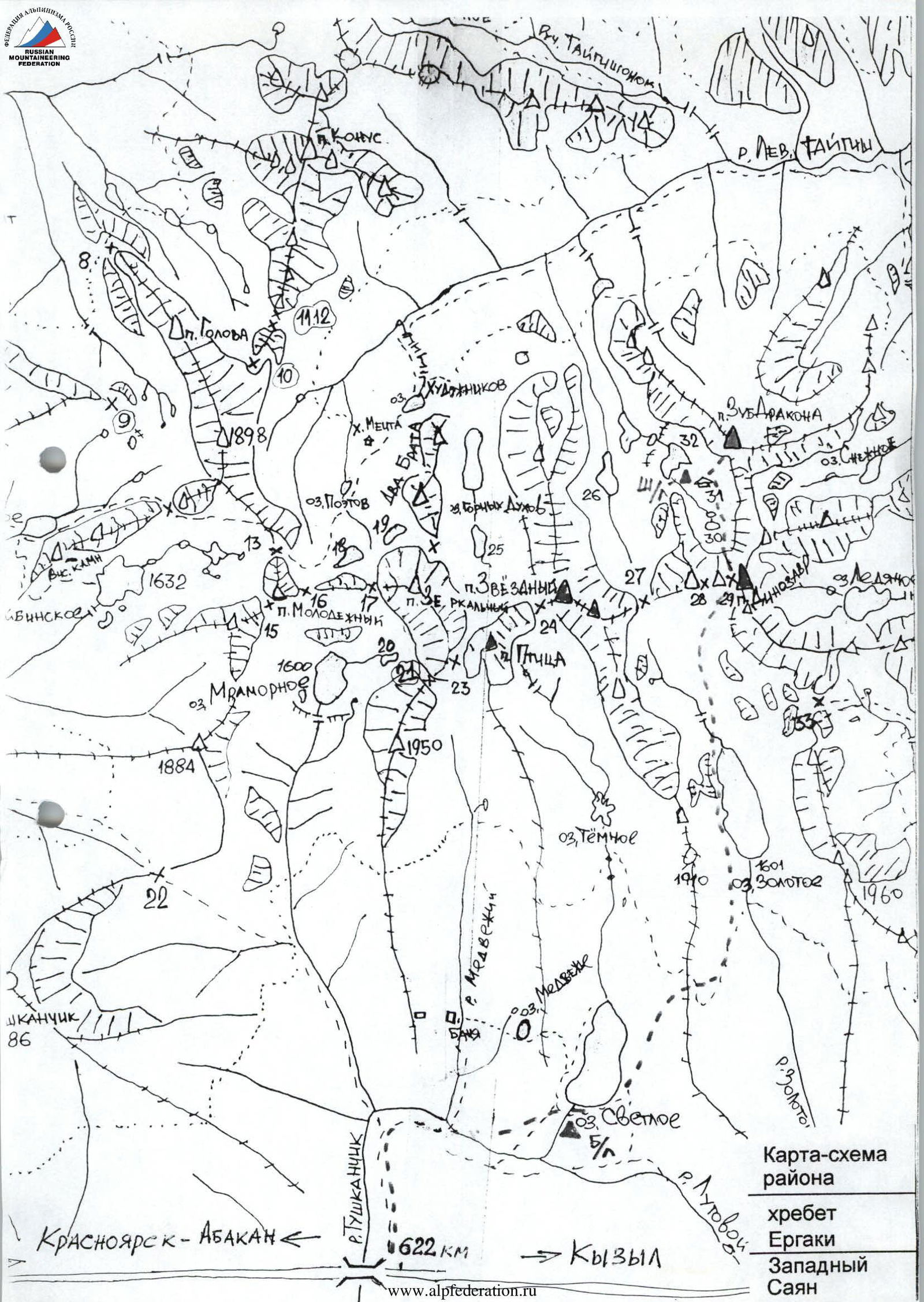
Map of the Ergaki ridge area, Western Sayan
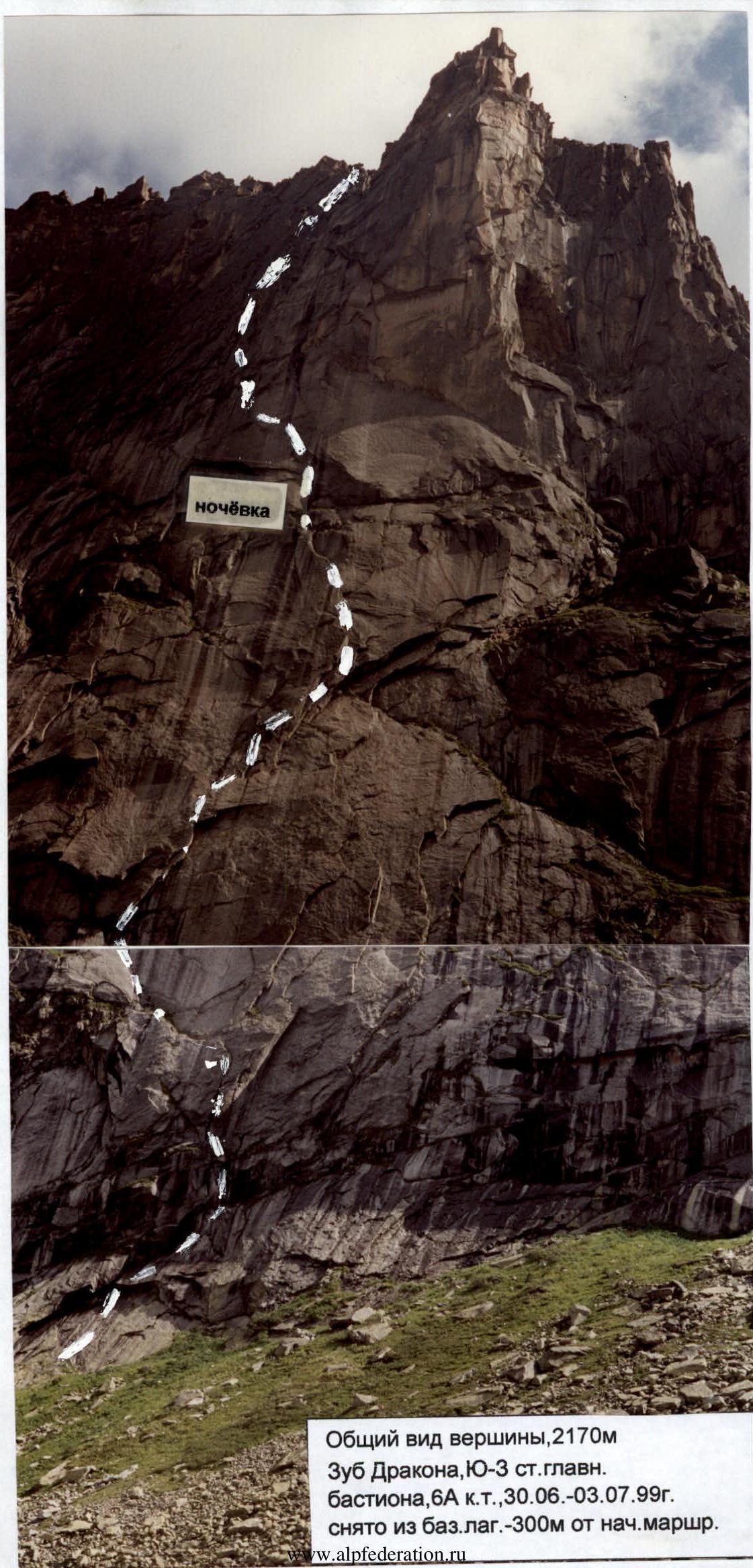
General view of the summit, 2170 m, Zub Drakona, South-West wall of the main bastion, 6A cat. diff., June 30 – July 3, 1999 taken from base camp – 300 m from the start of the route.
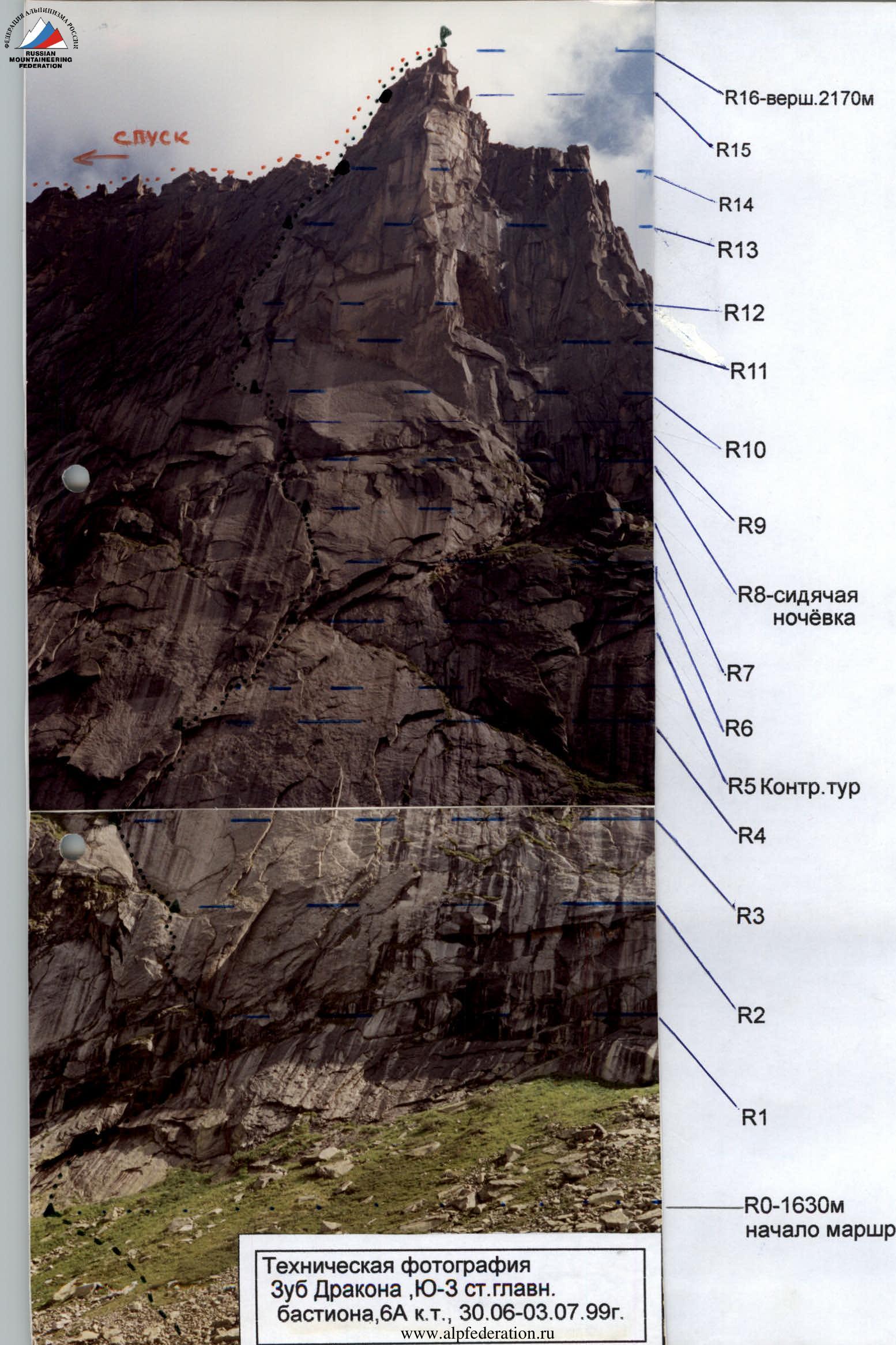
Technical photograph of Zub Drakona, South-West wall of the main bastion, 6A cat. diff., June 30 – July 3, 1999.
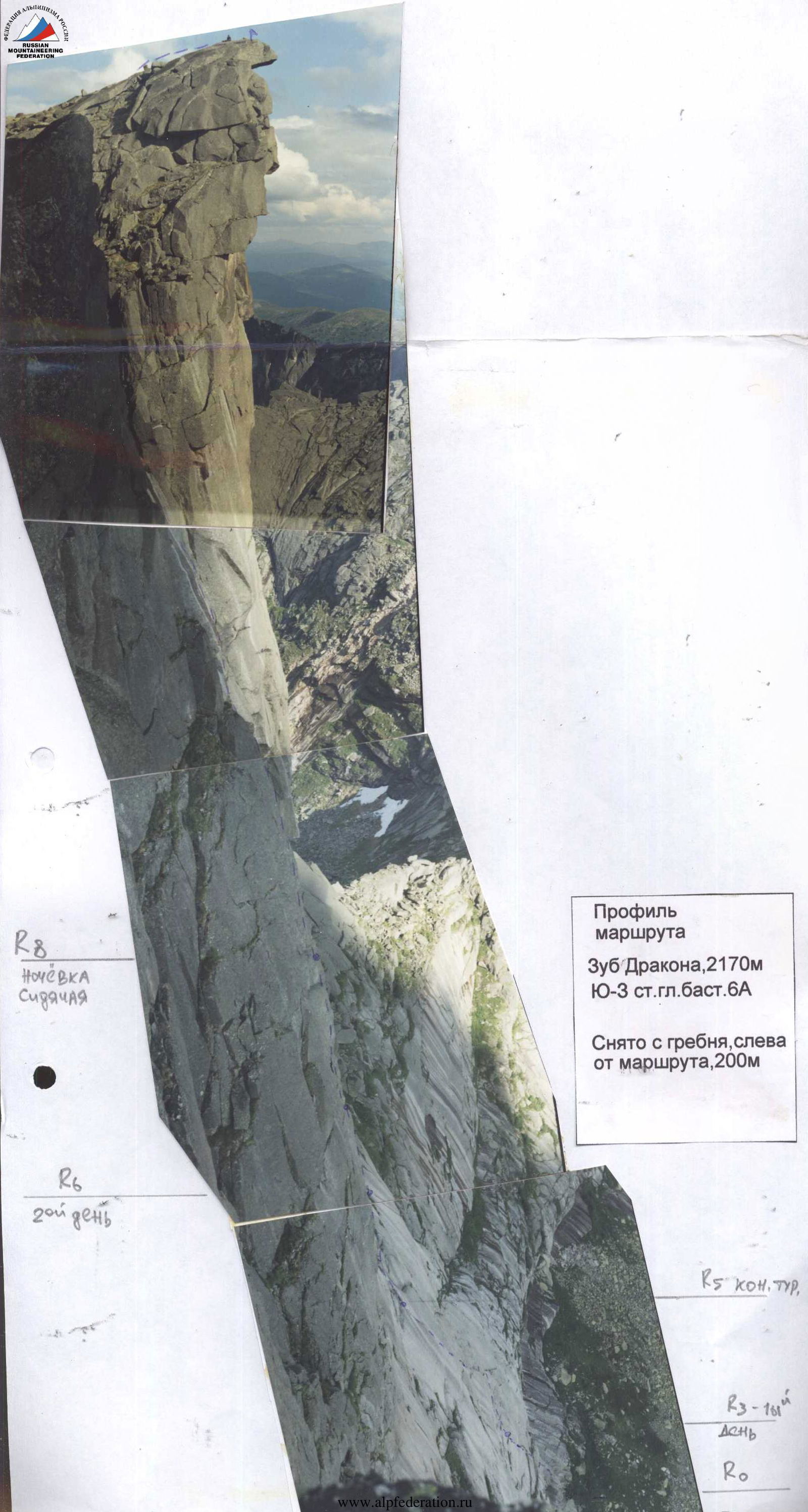
Route profile of Zub Drakona, 2170 m, South-West wall of the main bastion, 6A
Taken from the ridge, to the left of the route, 200 m. UIAA scheme
Brief description of the route by sections
R0–R1 Wide inclined slab, always damp in the upper part. R1–R2 Wall with small cracks. R2–R3 Thin crack on a monolithic slab, exit to a ledge under the cornice. R3–R4 Traverse under the cornice to the right, exit to a crack, large chocks. R4–R5 Overcoming the cornice, then a monolithic wall – sky hooks, bolt pitons, in the flake a control cairn, from it a 5 m pendulum to the right to a crack. R5–R6 Crack is wide, be cautious in the upper part – a bird's nest is in the depth. R6–R7 Damp crack with moss. R7–R8 Wall with small cracks, loose rocks, exit to a grassy ledge, on which we had a planned sitting overnight stay. R8–R9 Steep monolithic wall – sky hooks, bolt pitons. R9–R10 Crack with moss, passage using Fifi hook. R10–R11 Thin blind cracks. R11–R12 Monolithic wall, small relief. R12–R13 Damp inner corner, small cracks. R13–R14 Wall, cracks in moss, using Fifi hook, exit to the ridge. R14–R15–R16 Along the ridge to the summit – easy climbing.
Descent along the ridge to the base camp after a day of intense work took 2 h 30 min.
Tactical actions of the team
In July 1998, a reconnaissance was carried out under the South-West wall of Zub Drakona and a possible route variant to the main bastion of the peak was identified.
On June 25, the team arrived in the Ergaki area to the base camp on Svetлое lake to climb this route as part of the Open Championship of Siberia.
From June 26 to 29, 1999, the necessary food and equipment were transported under the wall.
On June 30 at 7:00, the Koryukin–Tsyganov rope team started the route preparation. Tsyganov leads first. After passing sections R0–R2, the lead is changed. Climbing is comfortable. There are no difficulties in finding belay points. At 20:00, after passing the 3rd rope, the team descended to the tents under the wall.
On July 1, 1999, at 6:00 – continuation of route preparation. Terentyev leads first. On section R3–R4, the route approaches an overhanging flake ending in the upper part with a cornice. Koryukin takes the lead. It is raining, but it does not interfere much, as after the cornice, a bolt piton road has to be made to pass the smooth slab of 75–80°. After the slab, when exiting to the sickle-shaped ledge – a control cairn. Then Terentyev pendulum-climbs under the flake, which, expanding, forms a chimney. At the top, the chimney overhangs, turning into a narrow crack. Very uncomfortable climbing on aid climbing. At 20:00, the rope team begins to descend under the wall.
On July 2, at 7:00, the team starts climbing again. Sections R6–R9 are first passed by Tsyganov. After passing a steep corner using Fifi hook and anchor pitons and a cornice, there is a steep sickle-shaped ledge filled with wet grass and soil. Climbing is extremely cautious. On the ledge (sect. R8), a sitting overnight stay is planned, above which they manage to climb one rope until 21:00.
On July 3, the start of work is at 7:00. The route becomes more and more overhanging. Terentyev leads first until the exit to the ridge. Very difficult aid climbing with difficult belay point placement, which is not very hindered by rain and fog due to the steepness. At 19:00 – exit to the summit and 2 h 30 min later, the group descends to the camp under the wall along the ridge.
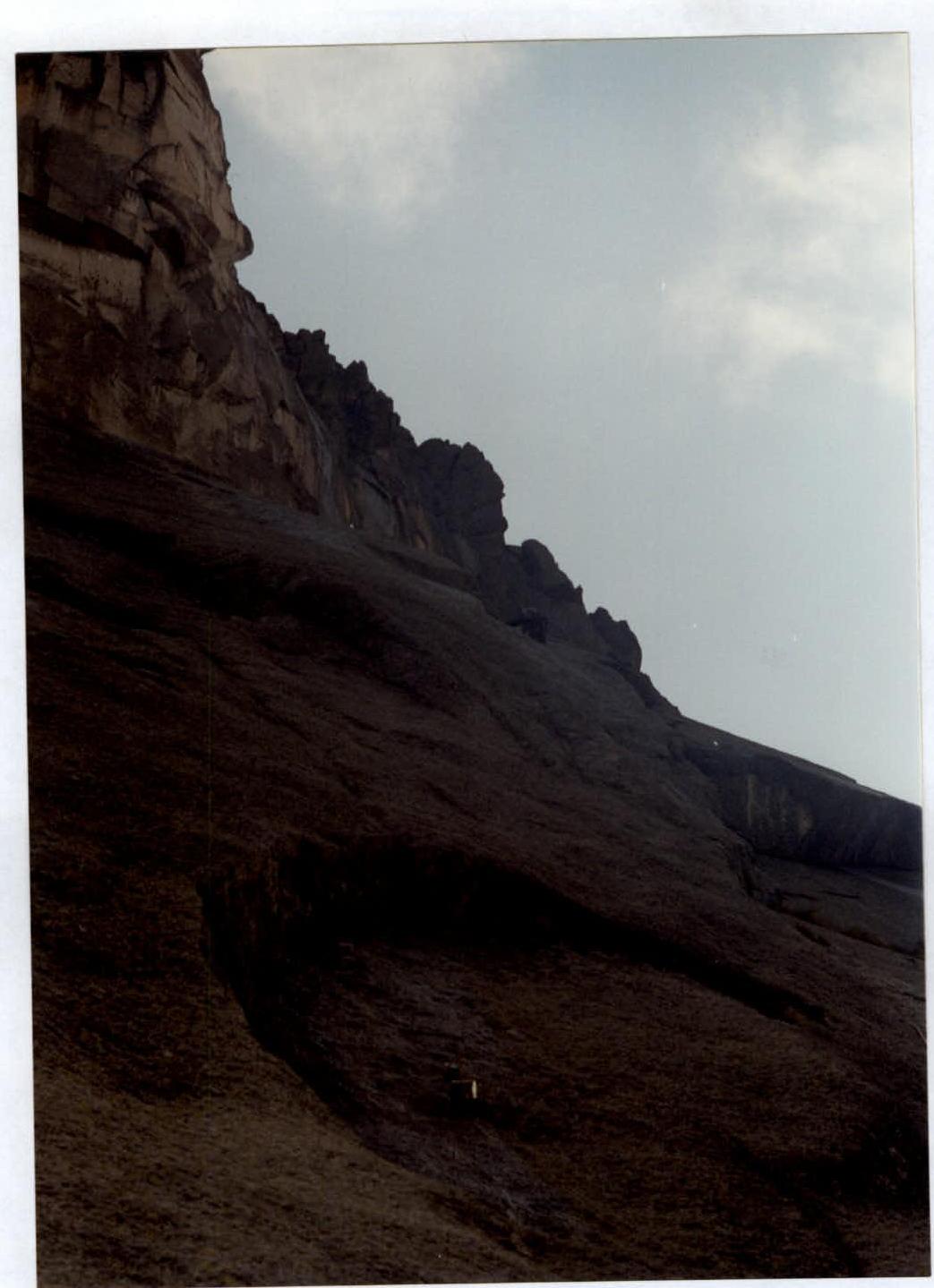
Control cairn in the sickle-shaped ledge. Section R4–R5
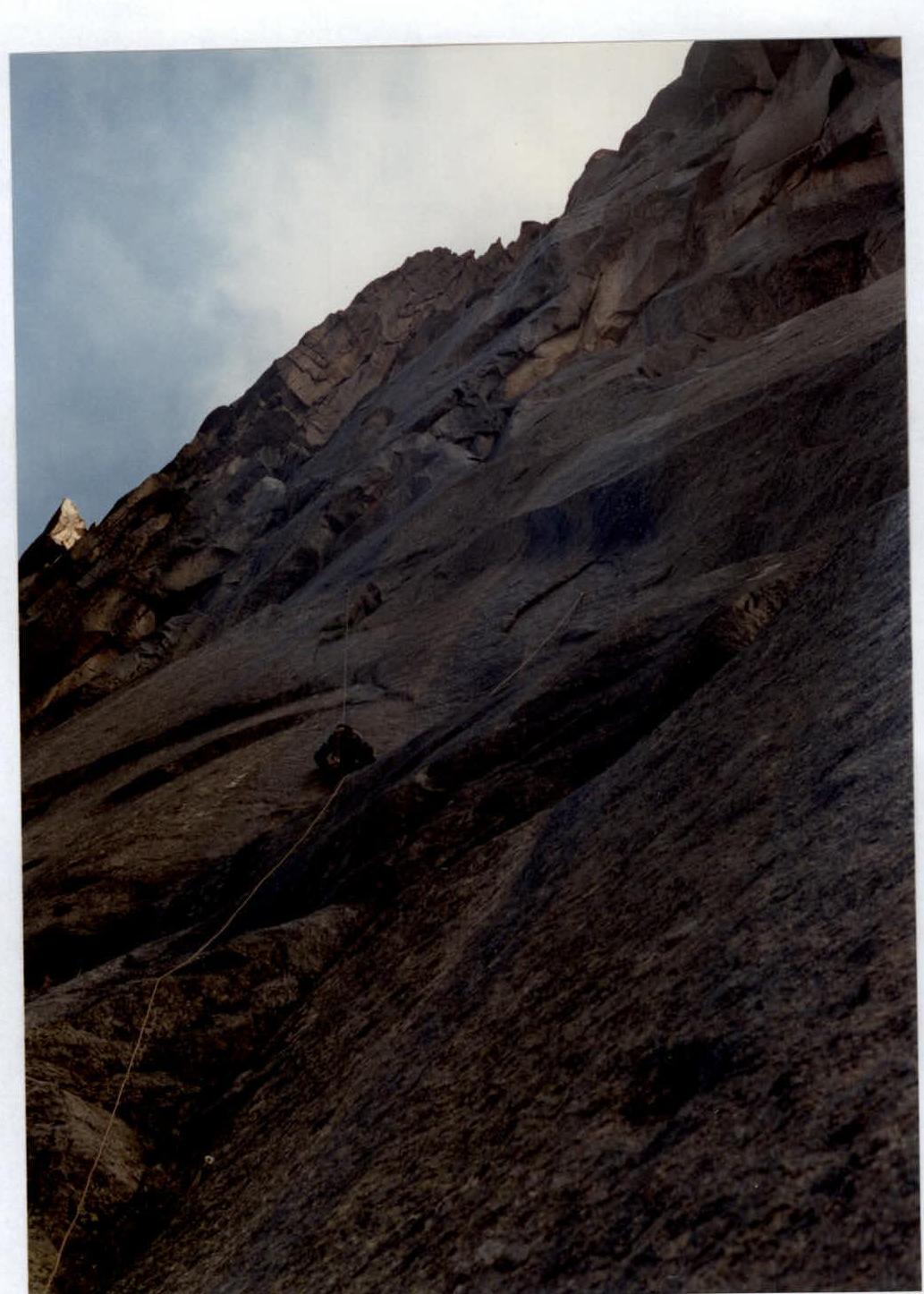
Section R8–R9
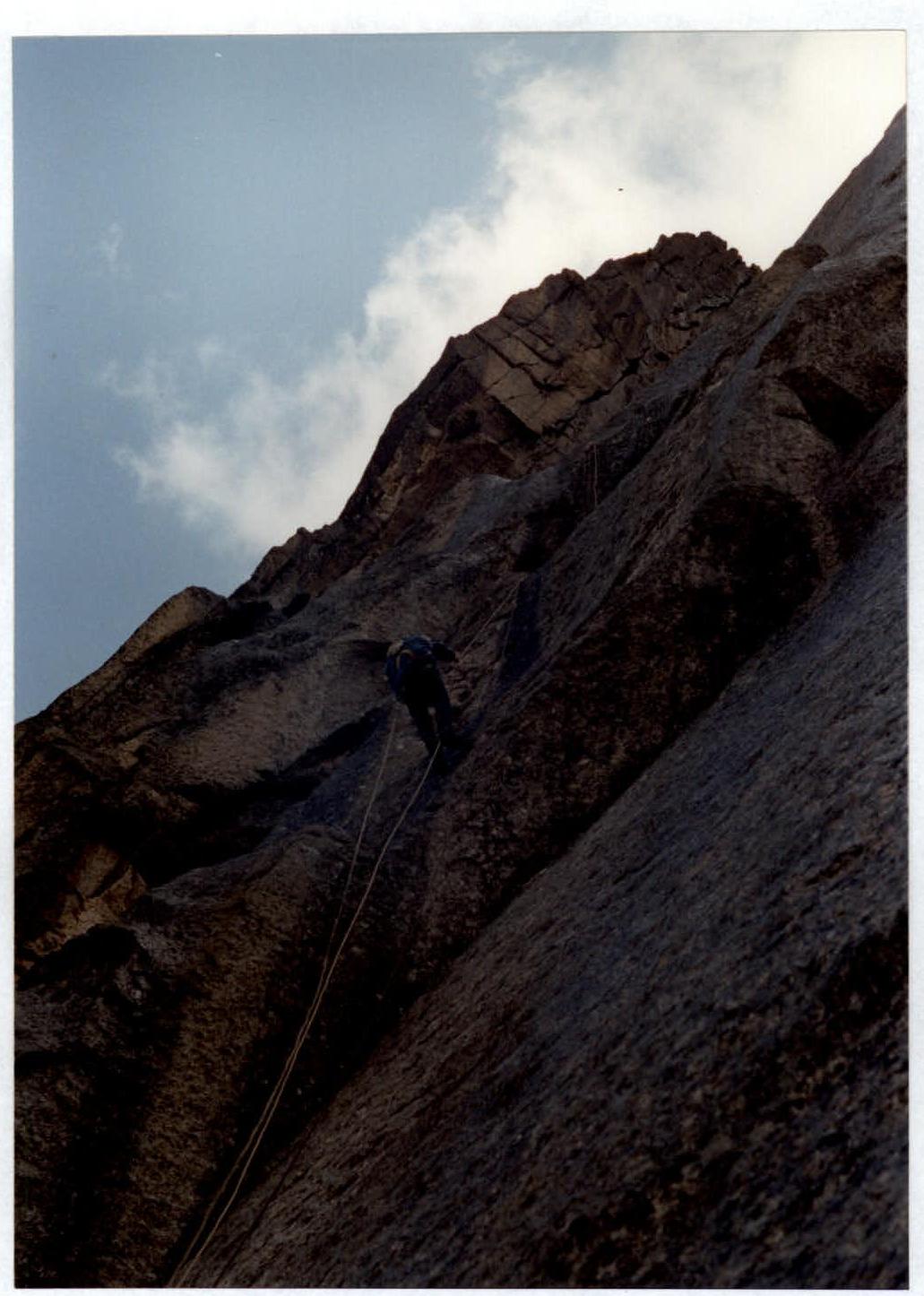
Climbing on fixed ropes. Section R11