


Ascent Record
Route: South peak of Trekhglaaya peak, 2511 m a.s.l., via South-Eastern buttress
Proposed difficulty category: 3B. Route characteristics: height difference 636 m, average slope 50°. Pitons used: rock 19 pcs., ice 0, bolted 0. Duration: 9 hours. Number of bivouacs: 0.
Leader: Krasnukhin L.I., 1st sports category. Team members: Zhila A.Yu., 1st sports category, Bolshedvorsky V.V., 1st sports category, Lebedev V.G., 1st sports category, Ponomarchuk V.S., 1st sports category, Mishchurinsky B.A., 1st sports category. Team coach: Popov V.N. Ascent date: March 7, 1978. Irkutsk

General view of Trekhglaaya peak
Route completed by the group
Previously climbed routes:
- 4B difficulty category
- 4A difficulty category
- 2B difficulty category
- 1B difficulty category
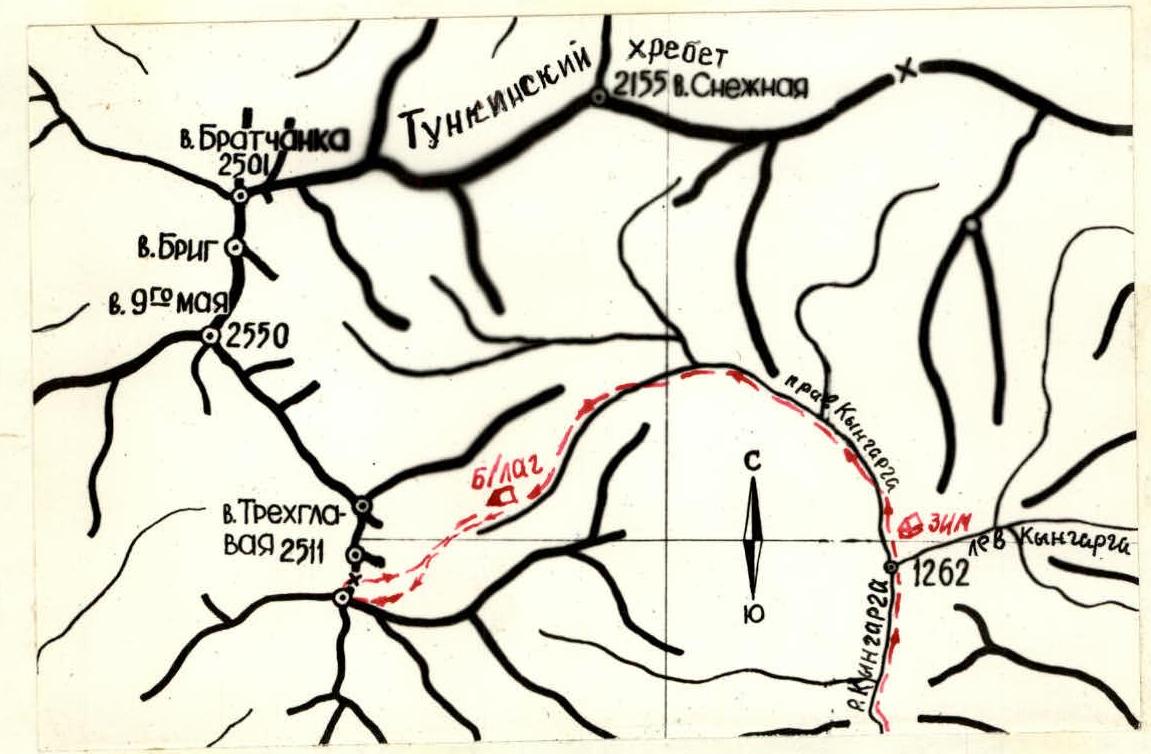
Map of Trekhglaaya peak area
Brief geographical overview of the area, sports characteristics
Trehglaaya peak massif is located in the South-Eastern ridge of the Tuninsky range, Eastern Sayan, in a long lateral spur serving as a watershed between Bugotoy and Kyngarga rivers.
Tuninsky goltsy are the highest part of Eastern Sayan. The highest point is 3266 m, located in the upper reaches of Gang-Khairym river.
Trehglaaya peak massif consists of three peaks — South, Central, and North. The highest peak is Central, with an elevation of 2511 m above sea level. The height of the South peak is 2486 m a.s.l.
There are classified routes from the Eastern circus to Trehglaaya peak: 4A, 4B, 2B, 1B difficulty categories.
The approach to the base camp starts from Arshan resort along the Kyngarga river gorge to the confluence of Right and Left Kyngarga rivers. An old hunters' wintering is located here, and it takes about four hours to reach it. From the wintering, there is a one-hour ascent along the right (orographic) tributary of Kyngarga river, then a turn to the left into a gorge, from which the Trehglaaya peak massif comes into view. From here, the ascent to the base camp goes up along the stream and takes about 30 minutes. The base camp is located just below the forest boundary, which is at an elevation of 1800 m a.s.l.
The area is characterized by unstable weather conditions, harsh climate, and short summer. There are no glaciers in the area.
In summer, routes to Trehglaaya peak are rock climbs; in winter, they are combined with sections of formed ice.
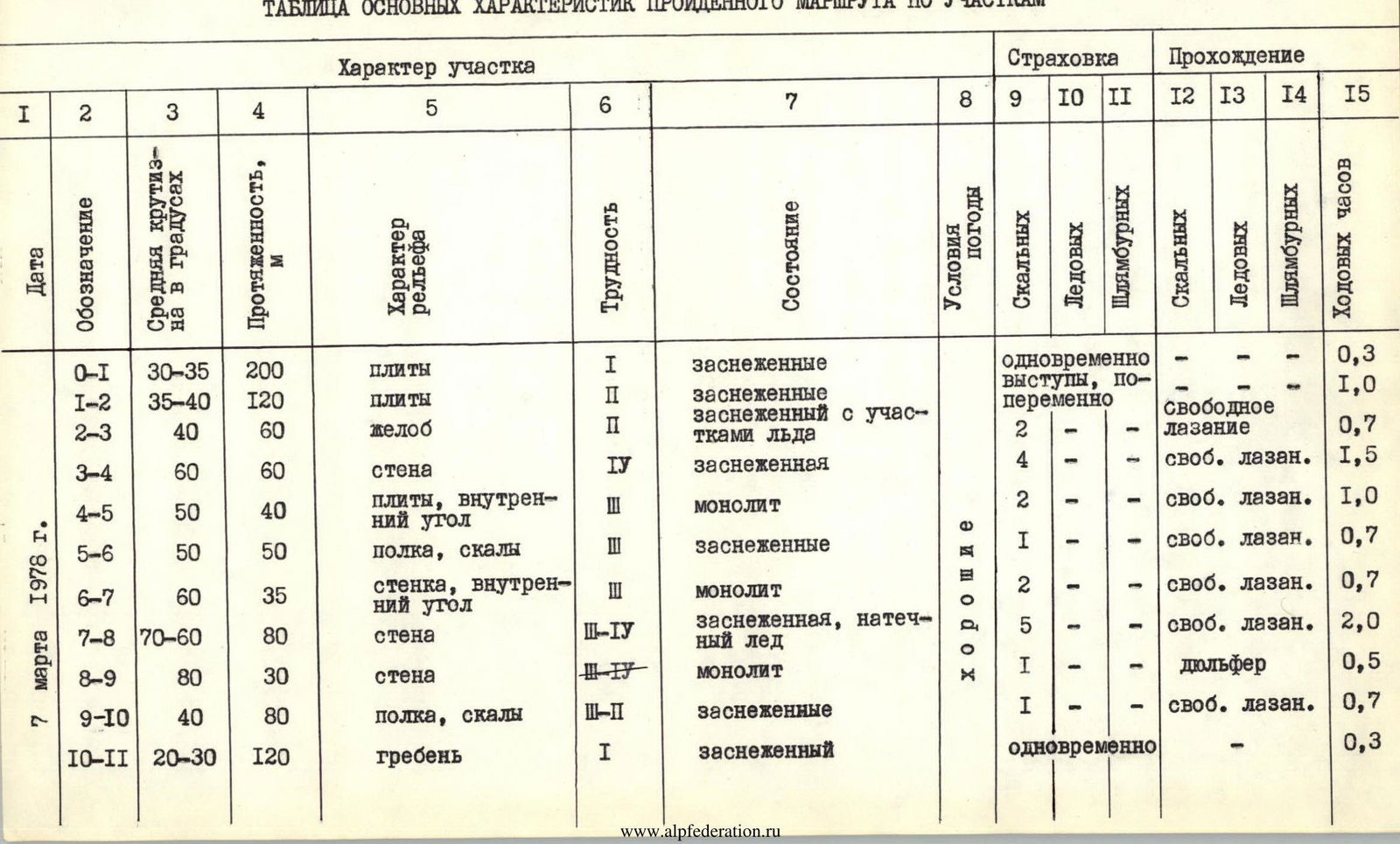
Table of main characteristics of the route by sections
Route description
From the base camp, located at the forest boundary, ascend along the stream to the Eastern circus of Trehglaaya peak. Then move along the slopes of Trehglaaya peak towards the South-Eastern buttress of its South peak. The route begins at the lowest part of this buttress. The approach from the base camp to the start of the route takes about one and a half hours.
The first section of the route (R0–R1) consists of easy snow-covered rocks. Movement is simultaneous, section length is 200 m, average slope is 30–35°. See photo 1 (general view of Trehglaaya peak).
Gradually, the slope of the buttress increases, and inclined snow-covered slabs with a slope of 35–40° are encountered (R1–R2). Insurance is simultaneous and alternating through ledges, section length is 120 m. See photo 2.
Further, the route enters a rock gully about 2 m wide at the bottom, widening upwards. The gully is filled with snow and has ice sections. The gully is 60 m long (R2–R3), with piton insurance. Slope is 40°. See photo 3. The gully leads to a narrow snow shoulder 10 m long. The "shoulder" abuts against a sixty-meter rock wall, the middle part of which, about 30 m, is the first key point of the route, with a slope of 60°, difficult climbing, limited handholds with a characteristic "pulling" sensation, piton insurance. The wall leads to a small snow shelf — a convenient place for setting up insurance (R3–R4). See photo 4.
From here, move up to the right along steep snow-covered slabs 10 m to a poorly defined inner corner, 30 m, average slope of the corner is 50°, under a bright red wall. Insurance is piton (R4–R5). See photo 5.
Bypass the red wall on the left along an inclined snow shelf 10 m and up along steep snow-covered rocks 40 m (slope 50°) (R5–R6), climbing is moderate, insurance is piton. See photo 6.
Further, the route passes along a monolithic wall 20 m, with an average slope of 60°, and up to the right into an inner corner 15 m (slope 60°), which leads to a gently sloping rock shoulder (R6–R7), climbing is moderately difficult, insurance is piton. See photo 7.
The rock shoulder, 40 m long, directly approaches a powerful eighty-meter "tooth" gendarme. Under the "Tooth" is the first control cairn, and an overnight stay is possible. The gendarme is climbed directly along steep monolithic rocks 80 m, with sections of formed ice encountered. It is impossible to bypass the gendarme; it is flanked on the left and right by almost sheer walls. The first 40 m are rocks with a slope of 70°, climbing is difficult — the second key section. Insurance is piton (R7–R8). See photo 8. The second rope length — more gently sloping rocks, slope decreases to 60°, and at the top of the "Tooth" — to 50–45°. Climbing is moderate, insurance is piton. On top of the gendarme is the second control cairn.
Descent from the "Tooth" towards the South peak of Trehglaaya peak 15 m along easy rocks simultaneously, then a vertical rappel 30 m into a gap on a very narrow saddle between the gendarme and the South peak (R8–R9), see photo 9. Caution! Loose rocks. Along the saddle 10 m, up to the left along an inclined snow shelf 20 m under snow-covered rocks of moderate difficulty (R9–R10), then 20 m up and 40 m to the right to the pre-summit ridge of the South peak. See photo 10. Average slope is 45°. Further, 120 m of simultaneous movement to the summit (see photo 11).
Descent to the saddle between the South and Central peaks of Trehglaaya peak via the 1B difficulty category route, then down along a snow-filled gully to the base camp. The group left the base camp at 6:30, approached the route in 1.5 hours, reached the first control cairn at 13:30, the top of the gendarme at 15:30, and the summit of the South peak at 17:00. The group returned to the base camp at 19:00. A total of 19 pitons were used on the route.
Based on the difficulty, length, and weather conditions of the ascent, the group evaluates the route via the South-Eastern buttress as a 3B category route.
Group leader
 L. Krasnukhin
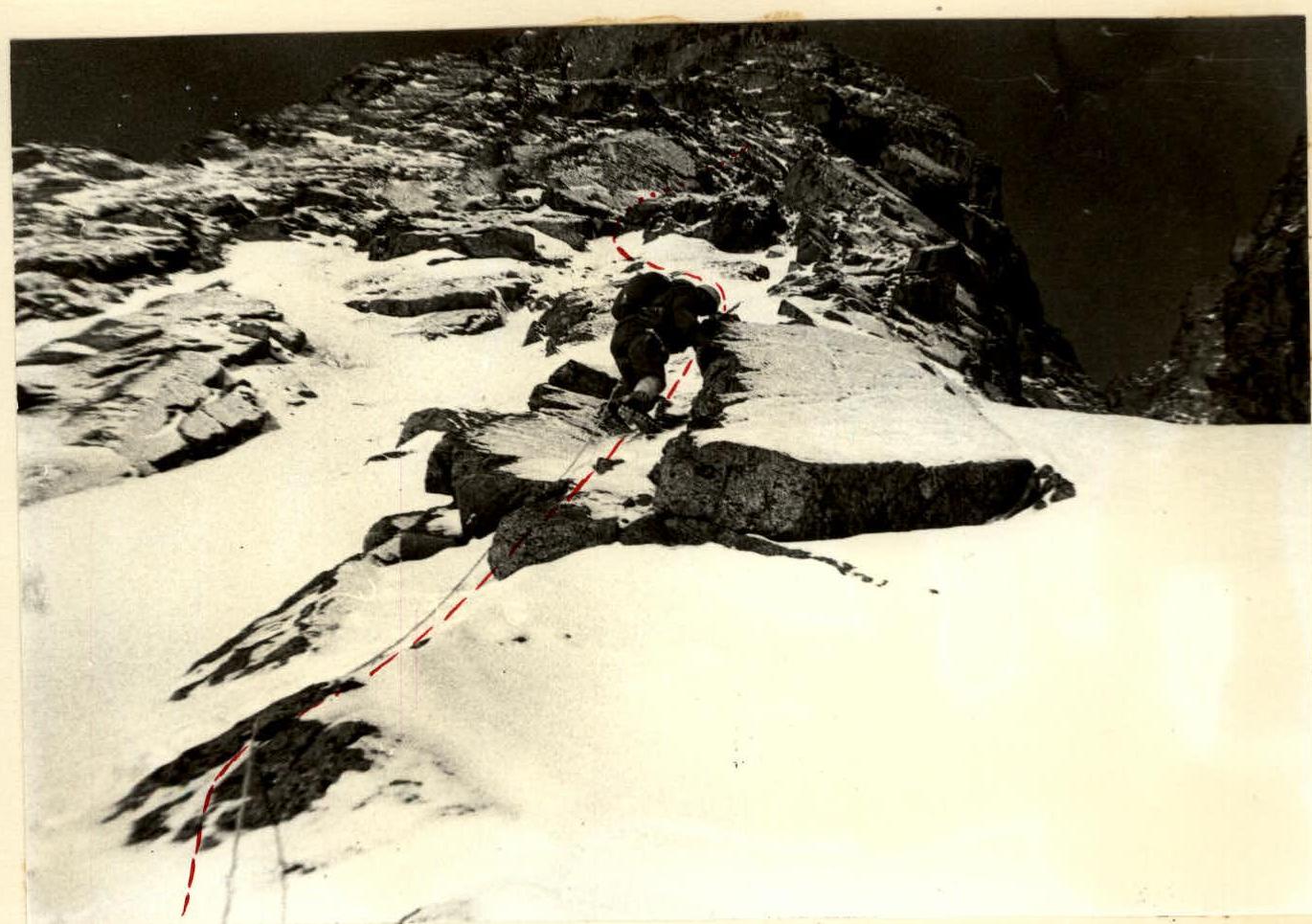
Photo 2 (R1–R2).
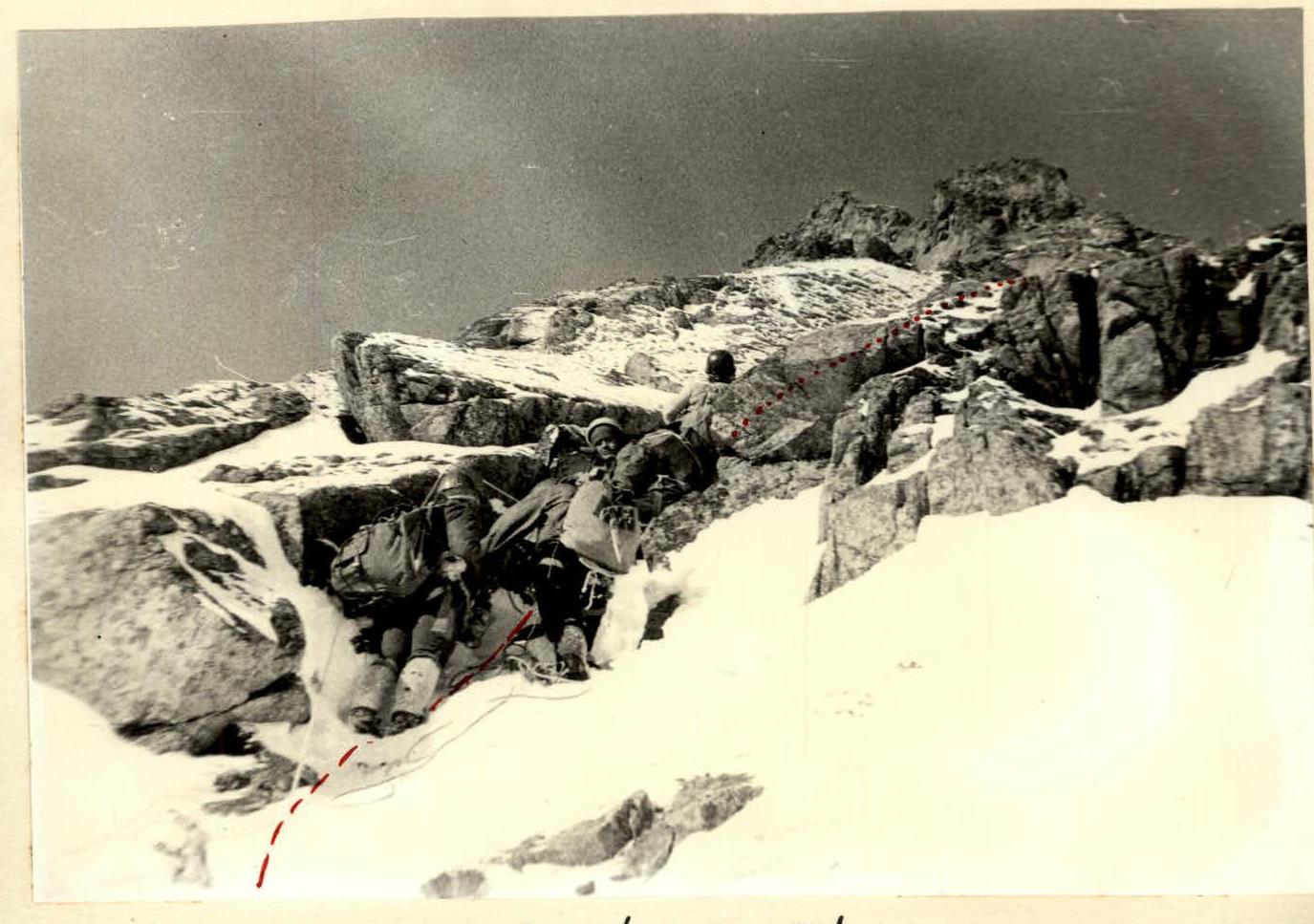
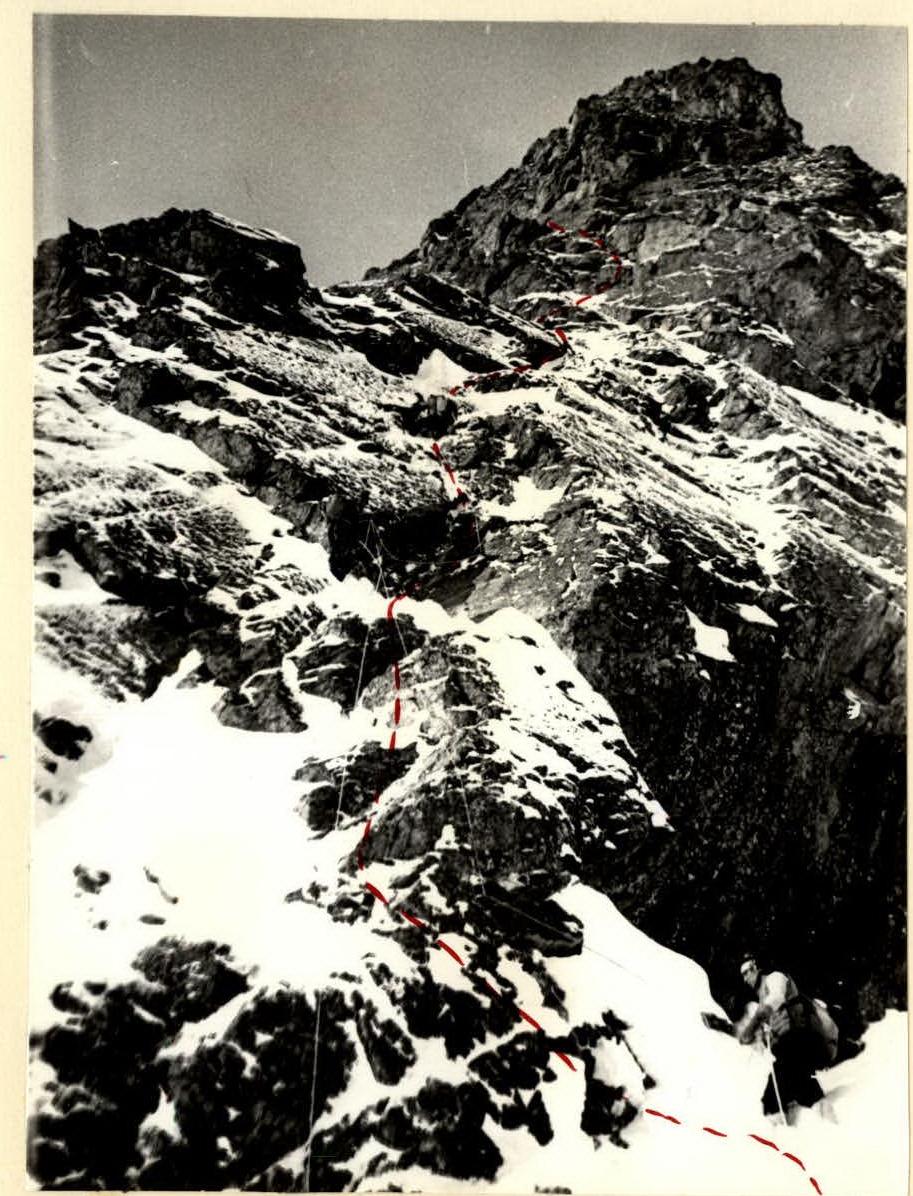
Photo 4 (R3–R4).
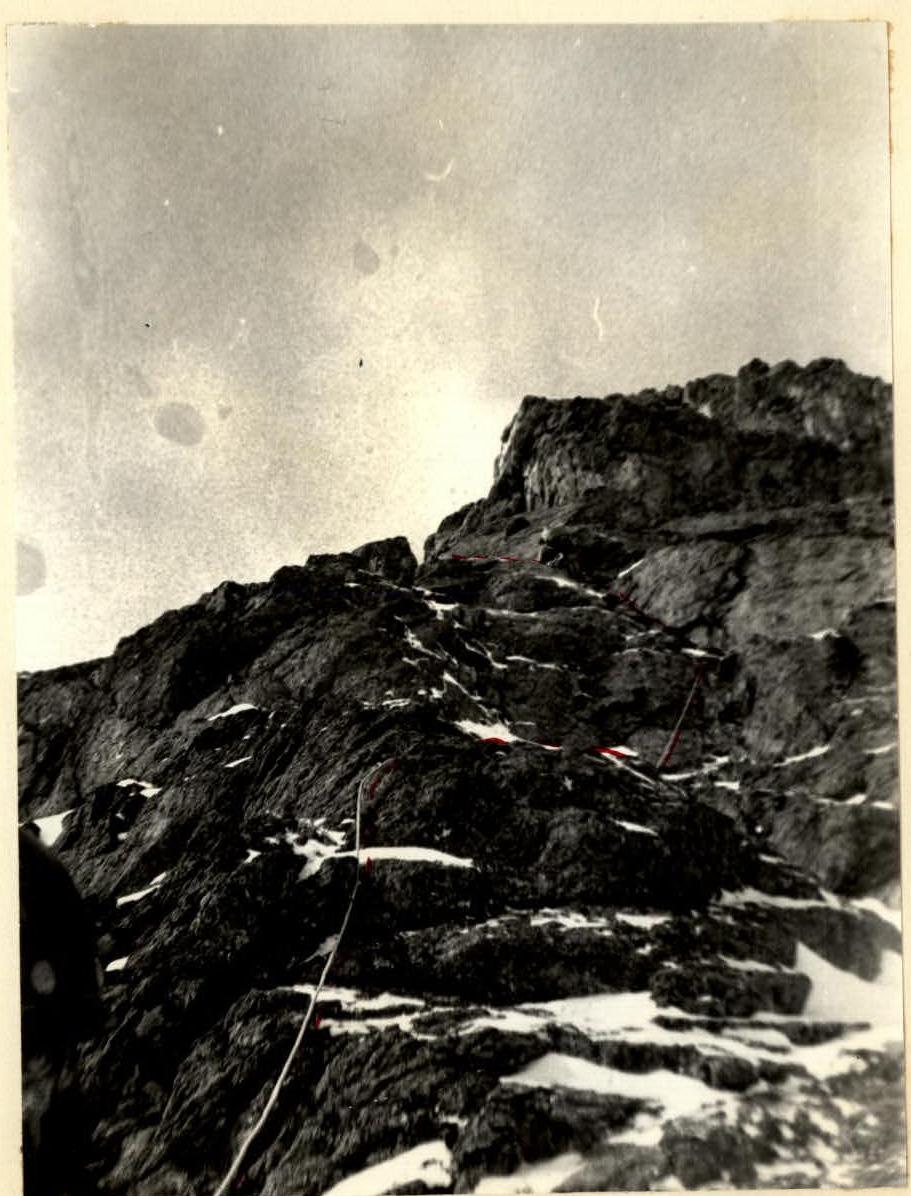
Photo 5 (R4–R5).
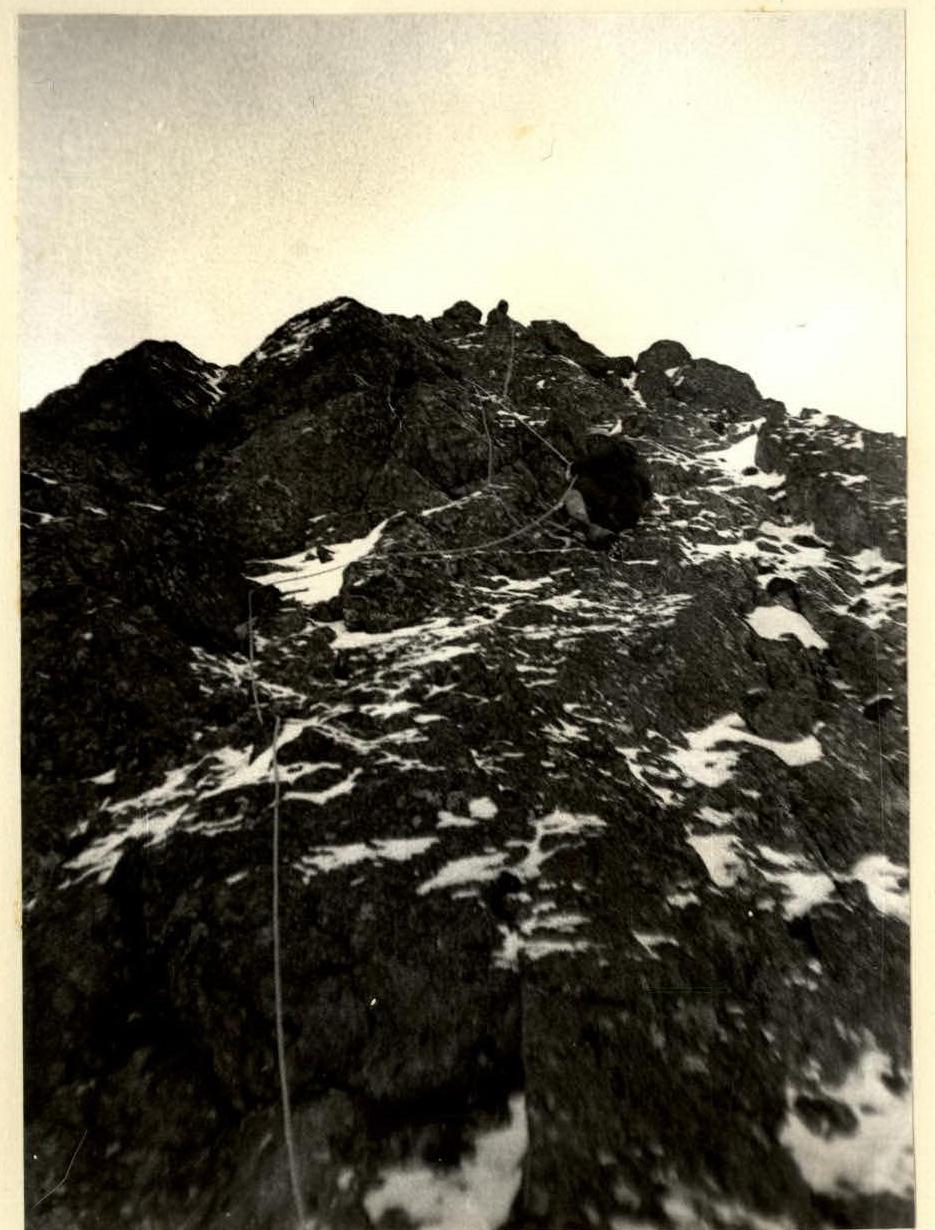
Photo 8 (R7–R8).
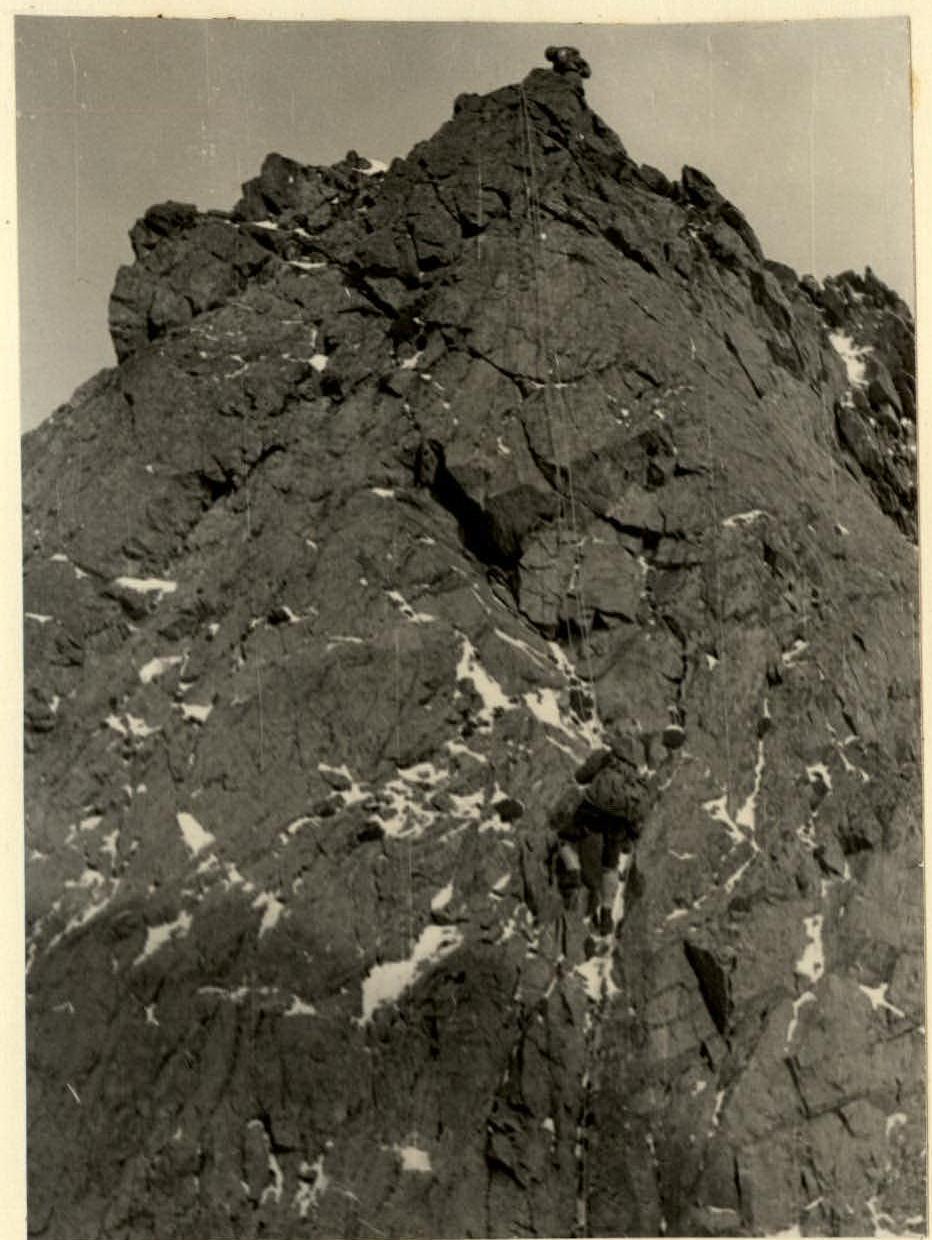
Photo 9 (R8–R9).
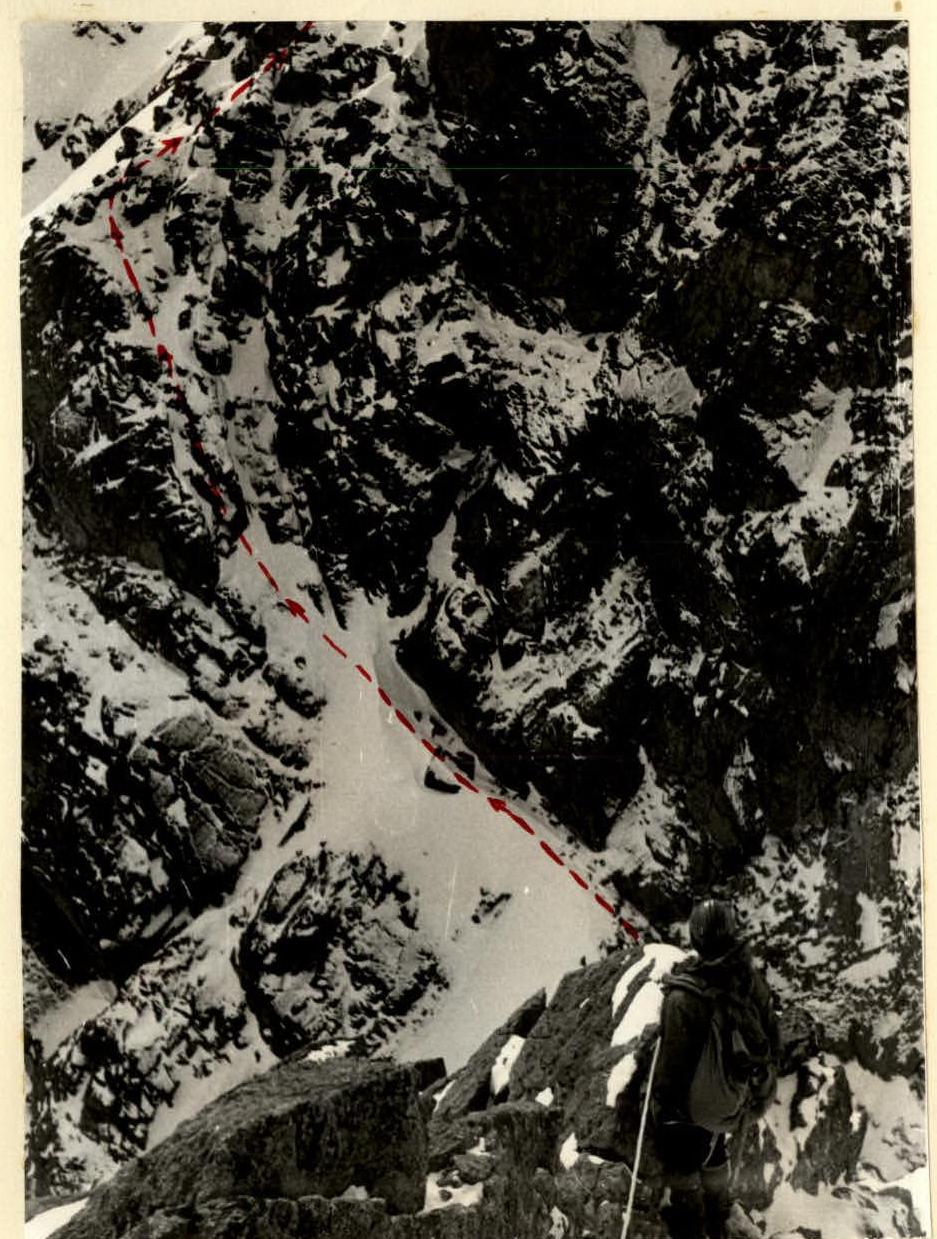
Photo 10 (R9–R10).
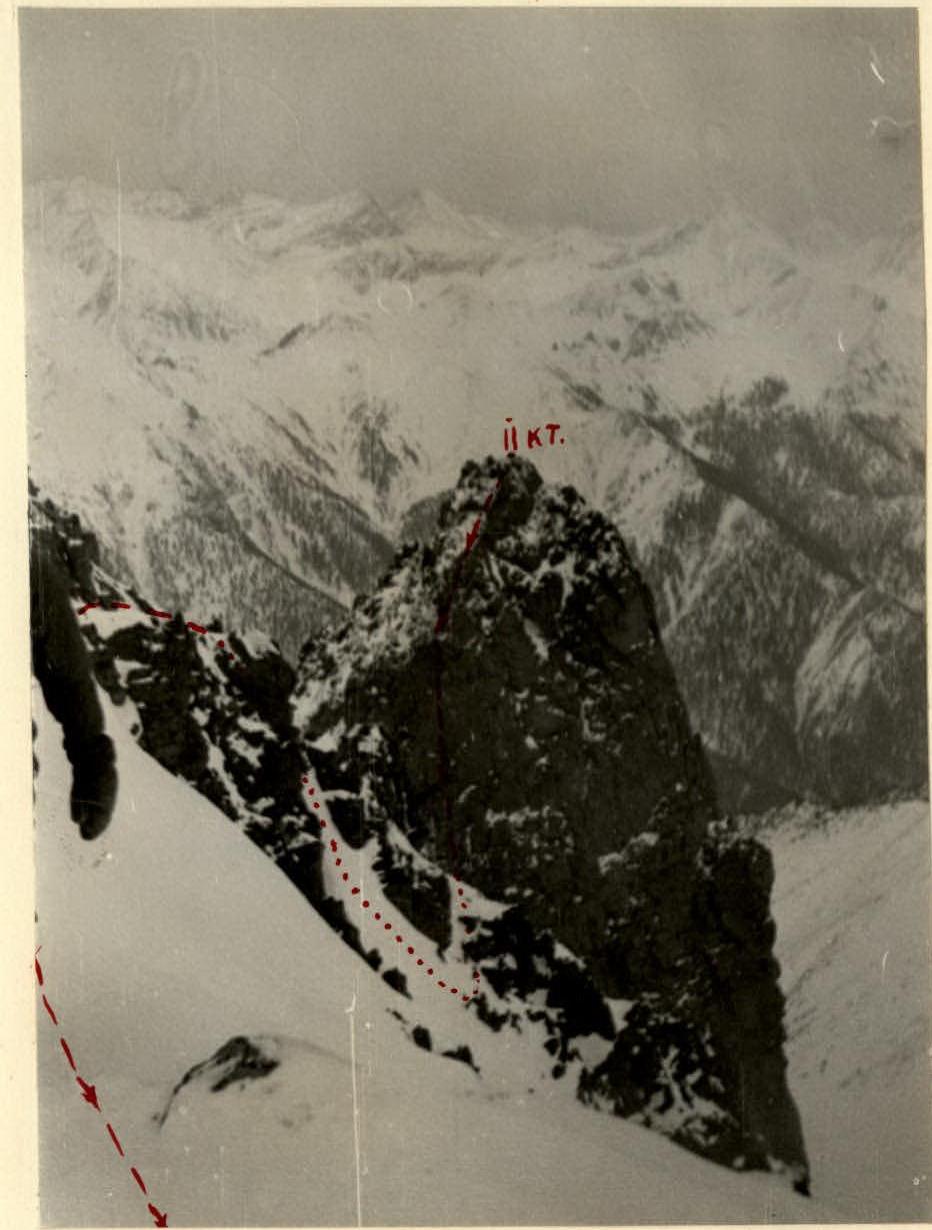
Photo 11 (R10–R11).
Comments
Sign in to leave a comment