
ASCENT DOCUMENT
I. Ascent category — high-altitude and technical. 2. Area — Pamir, Yazgulemsky Ridge. 3. Cold Wall peak, 5979 m, via the center of the eastern wall. 4. Proposed — 6B category of difficulty, first ascent. 5. Height difference — 1329 m, length — 1778 m, length of sections with 5–6 category of difficulty — 1083 m, average steepness of the main part of the wall — 84° (5170–5710 m), average steepness of the wall up to the ridge — 70°. 6. Pitons used:
| rock | bolt | chockstones | ice screws |
|---|---|---|---|
| 405 | 4 | 323 | 38 |
| 227 | 3 | 203 |
- Team's total climbing hours — 57 and days — 5.
- Overnight stops: four hanging bivouacs in platform tents.
- Team leader: Vladimir Bалыberdin, Sergey Razumov, Viktor Zhak, Alexander Glushkov, Mikhail Aivazov, Dmitry Ovsyannikov, Nikolai Shustrov, and Yuri Pozhidaev.
- Team coach — Yuri Dzhibrаev. II. Departure date — August 9, 1995, summit date — August 13, 1985, return date — August 14, 1985.
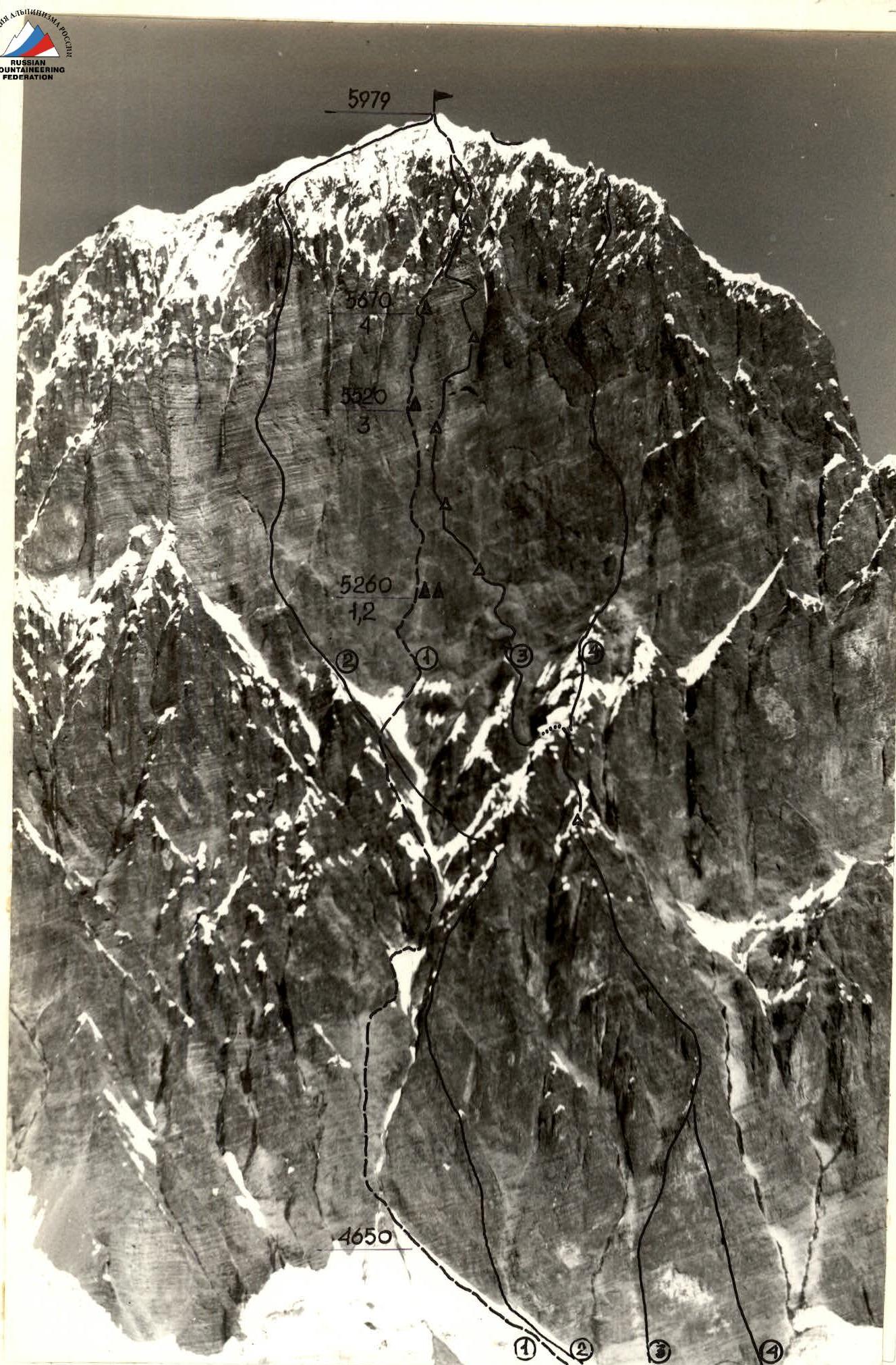
GENERAL PHOTO OF THE SUMMIT:
- Our route — 1985.
- Kovtun's group route in 1980 — 6B category of difficulty.
- RSFSR team's route — 1985.
- Solonnikov's route — 1980 — 6B category of difficulty.
Taken on August 5, 1985, at 9:30 from a height of 4750 m, distance 1.5 km, point I-50 on scheme No.1. UPPER WALL IN STRONG ABBREVIATION.
Route description by sections
R0–R1: Dense snow, convenient to pass in crampons in the morning. The route runs close to the rock wall, which protects from possible rockfall. No rockfall occurred during our ascent.
R1–R2: Crossing a snow gully, exit to the left side of the couloir, traverse towards a weakly expressed counterfort.
R2–R3: Up the left side of the counterfort to the wall.
R3–R4: Along the foot of the wall, traverse right into the couloir.
4–8: Along the left side of the couloir, to the upper side of the snow triangle.
8–9: Traverse along the upper edge of the snow to the right under the rock wall.
9–10: Up a steep, broken wall with sufficient handholds.
10–12: Up and right, twisting along a ledge and wall, exit to the crest of the left side of the couloir.
12–13: Up a rounded ridge with sections of snow, ice, and rock. Traverse right into the couloir. Along the left side of the couloir above the snow. Above the gorge, cross the couloir to the right.
13–14: Up along the right edge of the couloir under the main wall.
14–15: Right and up onto a small ledge and then left and up to the top of a fragment.
15–17: Up under a cornice and traverse right with a slight gain in height. Under the cornice, a control cairn. Very few cracks. Overhanging rock of poor quality. The first critical section of the route. Then up to a small flattening.
17–18: Straight up under the overhanging wall.
18–19: Under the wall, right 10 m. Overnight stop. Up a weakly expressed internal corner to a ledge.
19–20: Right and up along the wall. Cracks are small and few.
20–21: Right and up along a broken wall under an overhang (for a belay anchor) and left and up to a system of small internal, slightly overhanging corners. Large-block structure.
21–22: Up internal and external corners to a ledge.
22–23: Along the ledge to the right to the base of an implicit internal corner. Very poor-quality rock.
23–24: Up a weakly expressed internal corner with an awkward start, we emerge under an overhang, which goes from right below to left above at an acute angle to the route.
24–25: We cross the overhang with a traverse near a block with a horizontal roof approximately 1 × 1.5 m and along the right edge of the overhang, we approach under the wall below a snow patch.
25–27: Left and up along the wall, almost without cracks, control cairn.
27–28: Up and right along diverse large-block structure. Overnight stop.
29–30: Vertical crack, in places turning into a crevice.
30–31: Traverse right and up along terraces. Few handholds.
31–33: Up a system of cornices and a vertical internal corner with a cornice at the end. Control cairn.
34–36: A series of walls and niches of fragile monolithic blocks. Few handholds and cracks. Overnight stop.
36–37: Traverse left under a large cornice, exit to a ledge with ice.
Almost the entire section 30–37 is critical.
37–38: A "wall" of two vertical steps, covered with ice in the form of icicles.
38–39: Along the right side of the couloir to the ridge leading to the summit.
39–40: Ridge with individual, very broken walls and sections of snow.
41–48: Snow and ice ridge. In addition to ice screws for belaying and organizing ropes, ice axes were used. Before exiting to the ridge leading to the summit, there is a 5 m ice wall with an overhang, bypassed on the left.
Tactical actions of the team
When determining the movement regime on the wall, the team could already use their own experience of passing the northwestern wall of Shater peak within the framework of the 1985 Championship, which has similar technical characteristics. The team's movement on the route was carried out in a regime that ensured the fulfillment of a tense tactical plan — predominantly 12–13 hours of work and 8 hours of night rest. Daily, from the bivouac site, the 2nd rope team processed the route, which not only increased the distance traveled per day but also ensured "warm-up" and "preparation" of the leading rope team for the next day. The team spent 58.5 climbing hours on the route. The safety of the ascent was ensured by regular changes of leading rope teams, passing ropes on a 2nd rope, movement of the 1st rope on a double rope, and with a shock absorber. The team had two first-aid kits and spare food for the radio station. Considering the possibility of rockfall and ice fall in warm weather from the "roof," belay anchors were arranged under overhangs and cornices. Wide use of chockstones (up to 50%) accelerated the passage of the route. Despite the complexity of the relief, the team managed to pass it with minimal use of bolt pitons — 7 pieces. For organizing bivouacs, the team had two platform tents. All overnight stops on the route were hanging (a characteristic feature of the wall is the limited number of ledges, and the width of the available ones does not exceed 0.5–0.7 m). The tactical plan declared by the team was overfulfilled (the I overnight stop was reduced). This became possible due to the precise execution of the plan on the 1st day and a decrease in the expected length of the route (see technical characteristics of Kovtun's and Solonnikov's routes).
1st day. The main task is to pass the lower part of the wall and exit to the main vertical wall. In the 1st rope team working autonomously were Bалыberdin — Razumov. In the 1st rope team of the second echelon, Shustrov — Zhak worked. On sections 0–14, the relief is combined. At 10:00, the 1st rope team began work on the main vertical wall, at 12:00 the rest of the team joined. Ropes were hung starting from section 14. At 19:00, they reached the planned overnight stop, exiting to the overnight stop at the I "key" section of the route. Extreme climbing on artificial holds (sections 16–19). At the end of section 14, a water reserve was made — 15 liters. To protect against possible rockfall and ice fall on sections 0–14, the team laid out the route using steep walls on the left (in the direction of travel) side of the couloir. This is the shortest path to the main wall.
2nd day. The main task is to process the route to the central snow patch. Sections 19–24 were passed. The first rope team to work was Shustrov — Bалыberdin. Belay anchors only under cornices. Difficult climbing on relief with a large number of small handholds.

Comments
Sign in to leave a comment