
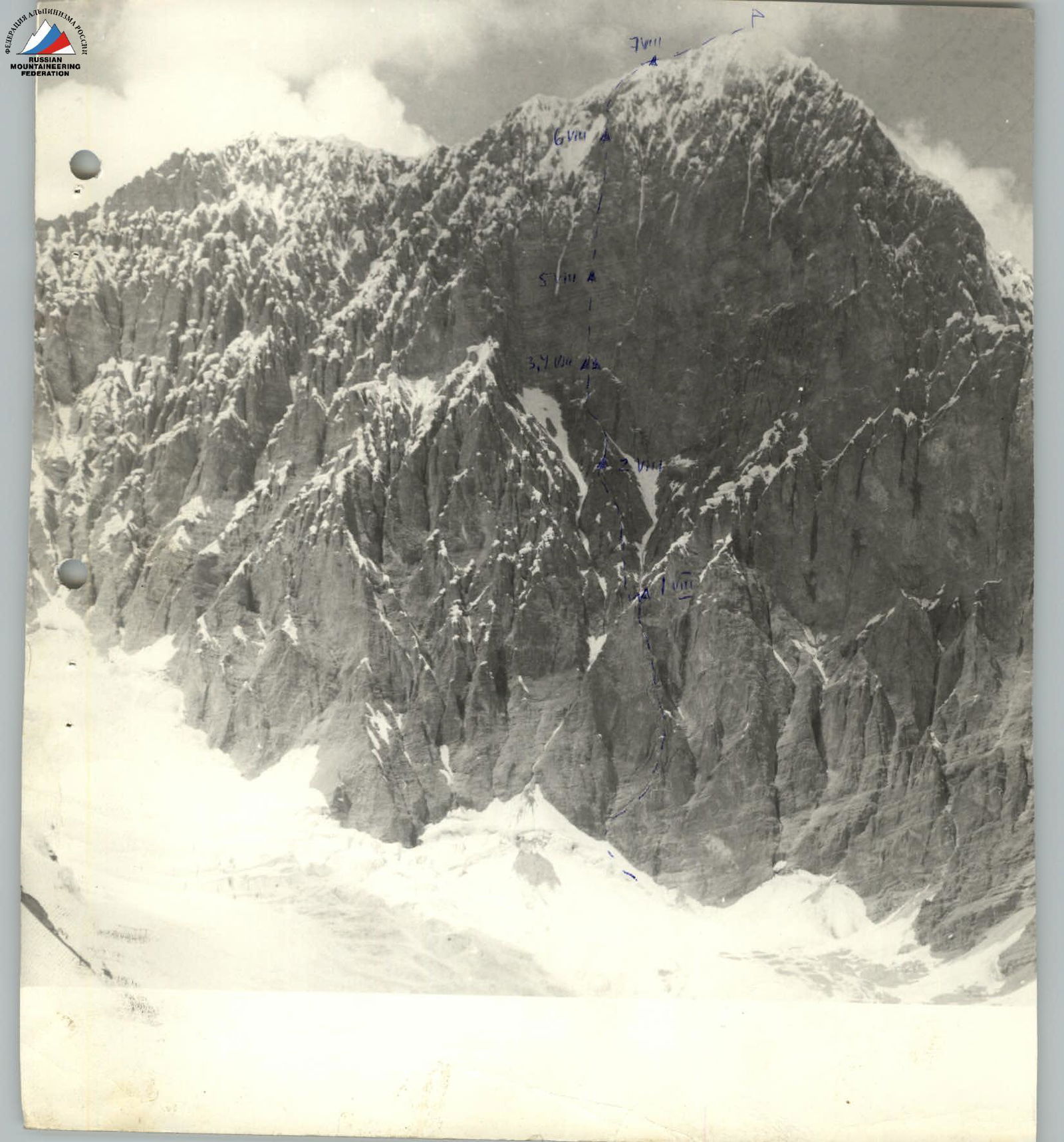
I. Ascent category — high-altitude technical 2. Ascent area — Central Pamir, Yazgulemsky Ridge 3. Ascent route — p. Kholodnaya Stena 5959 m via the center of the East wall (second ascent, Kovtun's route) 4. Route characteristics:
- height difference — 1580 m;
- route length — 2005 m;
- average steepness — 74°;
- length of complex sections — 1375 m;
- average steepness of the "mirror" — 87° with a length of 740 m.
- Pitons driven:
- rock — 308;
- chocks — 101;
- ice — 4;
- bolted — none.
- Including for creating ITO:
- rock — 21;
- chocks — 14.
- Number of travel hours — 68
- Number of nights on the route — 7, sitting and on a suspended platform
- Team of the Irkutsk Regional Council of the "Burevestnik" Sports Society
- Team members:
- Popov Valery Nikolaevich — Master of Sports — captain
- Zhila Andrey Yuvenalievich — Candidate for Master of Sports — participant
- Golygo Vladimir Nikolaevich — Candidate for Master of Sports — participant
- Savin Vladimir Viktorovich — Candidate for Master of Sports — participant
- Finkelshtein Boris Lvovich — Candidate for Master of Sports — participant
- Egorov Viktor Nikolaevich — Candidate for Master of Sports — participant
- Stanevich Arkady Mikhailovich — Candidate for Master of Sports — participant
- Team coaches:
- Koreneva Irina Efimovna — Master of Sports — category I instructor-methodologist
- Popov Valery Nikolaevich — Master of Sports — category II instructor-methodologist
II. Date of departure and return:
August 1, 1982 — August 8, 1982
 www.alpfederation.ru↗
Table of main route characteristics
| Date | Section designation | Average steepness, ° | Length, m | Terrain character | Difficulty | Condition | Weather conditions | Rock pitons | Ice pitons | Chocks | Note |
|---|---|---|---|---|---|---|---|---|---|---|---|
| August 1, 1982 | R0–R1 | 80 | 40 | Inner corner | 4 | Monolith | good | 4 | – | 2 | Exit from the assault camp at 5:00 |
| R1–R2 | 60 | 90 | Slabs | 3 | Monolith | —"— | 10 | – | – | ||
| R2–R3 | 85 | 40 | Rock wall | 5 | "Live rocks" | —"— | 8 | – | 2 | Start of movement along the route | |
| R3–R4 | 30 | 20 | Snow ridge | 4 | Snow | —"— | 2 | – | – | ||
| R4–R5 | 85 | 40 | Rock wall | 5 | Monolith | —"— | 4 | – | 2 | ||
| R5–R6 | 40 | 10 | Snow ridge | 4 | Snow | —"— | 2 | – | – | Overnight stay lying on cut cornice at 18:00 | |
| R6–R7 | 60 | 20 | Rock wall | 4 | "Live rocks" | —"— | 4 | – | – | ||
| R7–R8 | 90–100 | 10 | Rock wall with overhang | 6 | Monolith | —"— | 4 | – | – | 11 travel hours | |
| R8–R9 | 80 | 150 | Rock wall | 5 | Monolith | —"— | 22 | – | 6 | ||
| R9–R10 | 90 | 40 | Inner corner | 5 | Monolith | —"— | 5 | – | 4 | ||
| August 2, 1982 | R10–R11 | 60 | 40 | Descent into couloir | 3 | Monolith | —"— | 4 | – | – | Departure at 8:00. Overnight stay lying and on platform at 18:00 |
| R11–R12 | 80 | 40 | Inner corner | 5 | "Live rocks" | —"— | 4 | – | 3 | ||
| R12–R13 | 70 | 30 | Descent into couloir | 3 | Monolith | —"— | – | – | – | ||
| R13–R14 | 60 | 40 | Slabs | 4 | Loose rocks | —"— | 4 | – | 2 | 10 travel hours | |
| R14–R15 | 85 | 40 | Rock wall | 5 | Monolith | —"— | 6 | – | 2 | ||
| R15–R16 | 60 | 50 | Slabs | 4 | "Live rocks" | —"— | 7 | – | – | ||
| R16–R17 | 85 | 50 | Rock wall | 5 | Monolith | —"— | 10 | – | 1 | ||
| R17–R18 | 75 | 100 | Slabs | 5 | Monolith | —"— | 15 | – | – | ||
| R18–R19 | 80 | 150 | Rock wall | 5 | Monolith | —"— | 26 | – | 8 | ||
| August 3, 1982 | R19–R20 | 45 | 60 | Rock-snow | 4 | Snow | good | 6 | – | – | |
| R20–R21 | 90 | 60 | Inner corner | 6 | Inflow ice | —"— | 12 | – | 6 | Departure at 8:00 | |
| R21–R22 | 75 | 20 | Traverse of couloir | 4 | Snow-covered rocks | —"— | 5 | – | – | Overnight stay sitting and on platform at 18:00 | |
| R22–R23 | 85 | 30 | Inner corner | 5 | Monolith | —"— | 4 | – | 3 | ||
| R23–R24 | 85 | 40 | Traverse | 5 | Monolith | —"— | 8 | – | – | ||
| R24–R25 | 90 | 30 | Rock wall with crack | 6 | Monolith | —"— | 2 | – | 6 | 10 travel hours | |
| R25–R26 | 60 | 20 | Slab | 4 | "Live rocks" | —"— | 3 | – | 3 | ||
| August 4, 1982 | R26–R27 | 90 | 30 | Chimney | 5 | Monolith | —"— | 3 | – | 4 | Departure at 9:00 |
| R27–R28 | 110 | 15 | Cornice | 6 | Monolith | —"— | 15 | – | – | Return at 16:00 | |
| R28–R29 | 90 | 50 | Rock wall | 5 | Monolith | —"— | 6 | – | 3 | 7 travel hours | |
| August 5, 1982 | R29–R30 | 90 | 50 | Rock wall | 6 | Monolith | —"— | 8 | – | 3 | Departure at 8:30 |
| R30–R31 | 100–110 | 10 | Cornice with crack | 6 | Monolith | —"— | 4 | – | 8 | Overnight stay sitting and on platform at 17:30 | |
| R31–R32 | 90 | 40 | Inner corner | 5 | Monolith | —"— | 8 | – | 2 | ||
| R32–R33 | 90–100 | 40 | Rock wall | 5 | Monolith | —"— | 7 | – | 4 | 9 travel hours | |
| August 6, 1982 | R33–R34 | 90 | 50 | Rock wall | 5 | "Live rocks" | —"— | 10 | – | 2 | Departure at 9:00 |
| R34–R35 | 90–100 | 30 | Rock wall with cornice | 6 | "Live rocks" | —"— | 8 | – | 5 | Overnight stay sitting and on platform at 18:00 | |
| R35–R36 | 90 | 20 | Chimney with traverse to the right | 6 | "Live rocks" | —"— | 5 | – | – | 9 travel hours | |
| R36–R37 | 85–90 | 40 | Inner corner | 5 | Monolith | —"— | 7 | – | 1 | ||
| R37–R38 | 85–90 | 40 | Rock wall | 5 | Monolith | —"— | 6 | – | 3 | ||
| August 7, 1982 | R38–R39 | 75–80 | 80 | Cascade of steep ledges | 4 | Monolith | —"— | 10 | – | 4 | Departure at 8:00. Overnight stay sitting and on |
| R39–R40 | 90 | 120 | Rock gully | 5 | Ice-filled | good | 24 | – | 8 | platform at 18:00. 10 travel hours | |
| R40–R41 | 60 | 60 | Rock-ice-snow slope with cornice | 5 | Ice, snow | —"— | 10 | 4 | – | ||
| August 8, 1982 | R41–R42 | 50 | 150 | Snow-rock ridge | 4 | Ridge with snow | – | – | – | – | Departure at 8:00. At 10:00 the group reached the summit. 2 travel hours |
Route diagram
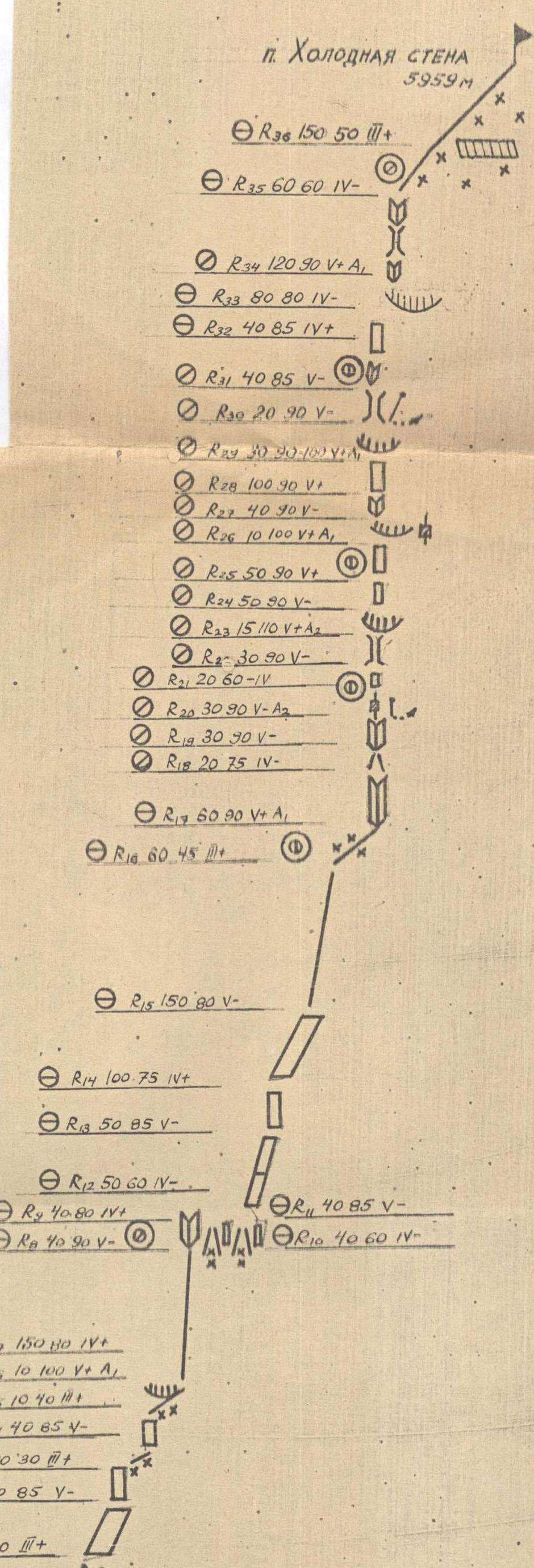
Explanations for the table
R0–R1. Inner corner, overcome by inner climbing freely. R1–R2. Steep "ram's foreheads", loose rocks on ledges, difficult to organize reliable insurance. R2–R3. Steep rock wall. Many live holds. At the top, rocks are wet from water flowing from above. Securing ropes on stones and medium-sized hexes. R3–R4. Snow ridge. Caution, cornices. R4–R5. Rock wall. Overcome by free climbing on pull-off. R5–R6. Snow ridge. Easy. R6–R7. Not steep rock wall. Main attention should be paid to careful passage so that the rope does not knock down stones. R7–R8. Rock wall with an overhanging "belly" in the middle. Movement diagonally to the right, bypassing the overhang. Insurance is carried out through petal pitons. R8–R9. Rock wall with unclearly expressed inner corners, overcome by free climbing on pull-off. R9–R10. Inner corner. In some places, pitons are used as support points. R10–R11. Descent into couloir. With rope pull. The rope may get stuck. R11–R12. Inner corner. Many live rocks. R12–R13. Descent into couloir. R13–R14. Slabs. Passed by free climbing on pull-off. In some places, movement is on friction. R14–R15. Rock wall. Passed by free climbing. R15–R16. Slabs with snow. Many live rocks. R16–R17. Rock wall. In some places, pitons are used as insurance points. R17–R18. Slabs. Difficult to organize insurance. R18–R19. Rock wall with unclearly expressed inner corners. The simplest ascent option is chosen. R19–R20. Rock-snow ridge. Caution, cornices. One 40-meter rope is not enough, a second one is added. R20–R21. Inner corner. In the middle, filled with inflow ice. Difficult. Passed by free climbing. In the middle part, pitons serve as artificial support points. Petal pitons are mainly used. R21–R22. Traverse of couloir. Dangerous. Stones may fall from above. R22–R23. Inner corner turning into rocks. Passed by free climbing on pull-off, as well as in opposition. R23–R24. Traverse along an unclearly expressed ledge; when moving the last one, additional top insurance is required. R24–R25. Rock wall with a crack. The first piton is driven with the help of an insurer. Then, medium hexes; stoppers from 4 to 7 sizes go into the crack. At the top, securing the rope on wedges. R25–R26. Slab with loose rocks. R26–R27. Rocks between the main wall and the break-off. At the top of the break-off, there is a convenient place to gather the whole group. R27–R28. Cornice. Movement diagonally to the left. Medium-length universal pitons are used. Difficult. At the top, securing the rope on stones and medium-sized hexes. R28–R29. Rock wall. Rocks have a reddish hue. R29–R30. Slippery. Caution, "live rocks". Passed by free climbing on pull-off. Difficult. R30–R31. Cornice with a crack. As insurance, chocks are placed in an opposition system. R31–R33. Further, they chose the simplest path among the cornices, by free climbing on pull-off, to reach a small ledge where an overnight stay was organized. R33–R34. Rock wall leading to the third overhanging belt. Difficult. Passed by free climbing on pull-off. R34–R35. Overhanging belt. Insurance is carried out through petal pitons; medium-sized hexes. Passed by careful climbing. Many "live rocks". R35–R36. Rocks after 10 m. Traverse on "mizers" to the right to bypass the overhanging part of the chimney. Insurance is carried out through wedges; large hexes. R36–R38. Rock wall with an inner corner. Difficult. Passed by free climbing on pull-off. The wall leads to a ledge where an overnight stay is organized. R38–R39. Further, first moving along a rapidly gaining steepness cascade, then along a rock wall to approach a steep groove. Caution, stones may fall from above. R39–R40. Rock groove with inflow ice, sometimes turning into rocks. Difficult. It is better for the whole group to wait until the first pair passes two ropes. R40–R41. Rock-ice-snow slope. Movement in crampons. Ice axes are used. At the end of the section, a cornice is overcome with the help of ice axes. R41–R42. Snow-rock ridge leading to the summit.