
REPORT
of the Uzbekistan Sports Committee team on the ascent of Peak Revolyutsii 6974 m via the NNW wall in the high-altitude class program of the USSR Climbing Championship. Tashkent, 1979
Peak Revolyutsii 6974 m, the sixth highest peak in the USSR, is located in the Central Pamir in the Yazgulem Range.
The peak was first conquered on August 17, 1954, by a team led by A. Ugarov from the east. In the sixties, seven more routes were laid to the peak, one of which was along the left counterfort of the north wall, a kilometer-long sheer wall towering above the Fedchenko Glacier cirque.
As early as 1968, photographs of this wall appeared in the team's archives, and we began to study them, examining the future object.
In mid-July of this year, the team began transporting supplies to the area of operation. Equipment and provisions were dropped under the wall and at the Abdukagor Pass. The team was deployed, and a base camp was established on the Abdukagor Glacier at an altitude of about 3900 m.
Upon distribution of the routes, our team was assigned the central part of the wall. A thorough study of the intended route was conducted, a clear, step-by-step tactical plan for the ascent was drawn up, and several descent options were developed, finalizing the team's composition.
The wall is relatively rockfall-prone, and there are practically no places for overnight stays. To pass it mobilly, it was decided to go with one tent for five people. The team consisted of: Putintsev A.V. – captain Gromov L.V. – deputy captain Bloshtein B.E. Voronin V.T. Mulyukov G.Sh.
All participants had excellent acclimatization gained on Peak Lenin and extensive experience in ascending seven-thousanders. Over several years, they had participated together in ascents of various categories and conducted regular year-round training.
Tactical Plan
After studying the route, the following tactical plan was drawn up:
First day – processing the lower ice part of the route. Second day – departure on the route. Passing the processed part and working up to an altitude of about 5700 m.
Third day – work up to an altitude of about 5900 m to the level of the upper edge of the white patch.
Fourth day – exit to the black rocks. Fifth day – processing the further path. Sixth day – passing the processed part of the wall and working up to an altitude of about 6400 m.
Seventh day – exit to the summit ridge. Eighth day – assault and descent to the assault camp. Ninth to eleventh day – descent to the base camp. Depending on the situation, three descent options were foreseen:
- along the right edge of v. Gрина,
- through v. 26 Baku Commissars,
- and bypassing v. Gрина via the Zimushikov Pass along the Vitkovsky Glacier.
Daily processing of the further path was planned, and possible changes in overnight stays were considered.
Throughout the wall, belay work was done using jumar. On particularly difficult sections, backpacks were pulled up. The second climber freed the belay rope by removing intermediate pitons. Free ropes and hardware were passed to the first climber.
Nutrition was provided at a rate of 335 g per person/day. Starting weight was 119.0 kg.
During the passage of the wall, there were some deviations from the tactical plan.
Along the route thread:
- When passing the red rocks, we always tried to move left, fearing the team from the Leningrad Regional Sports Committee working on the right and above, which had deviated from their route thread to the left.
- In the upper part of the wall, we again deviated to the left, as this option turned out to be much more logical than it seemed from below, and, in addition, working on this variant, we were under the protection of a small wall from stones falling from above in the second half of the day.
- It will not be possible to stop in the shelter for an overnight stay due to the approaching bad weather.
The volume of daily work also changed. In the lower part, it was due to a change in the route thread; in the upper part, it increased due to the team's coordinated work. Due to bad weather, the assault day was postponed, and the number of days for descent increased. In detail, the tactical plan was fully executed.
 Peak Revolyutsii 6974 m. NNW wall
Table of Main Characteristics
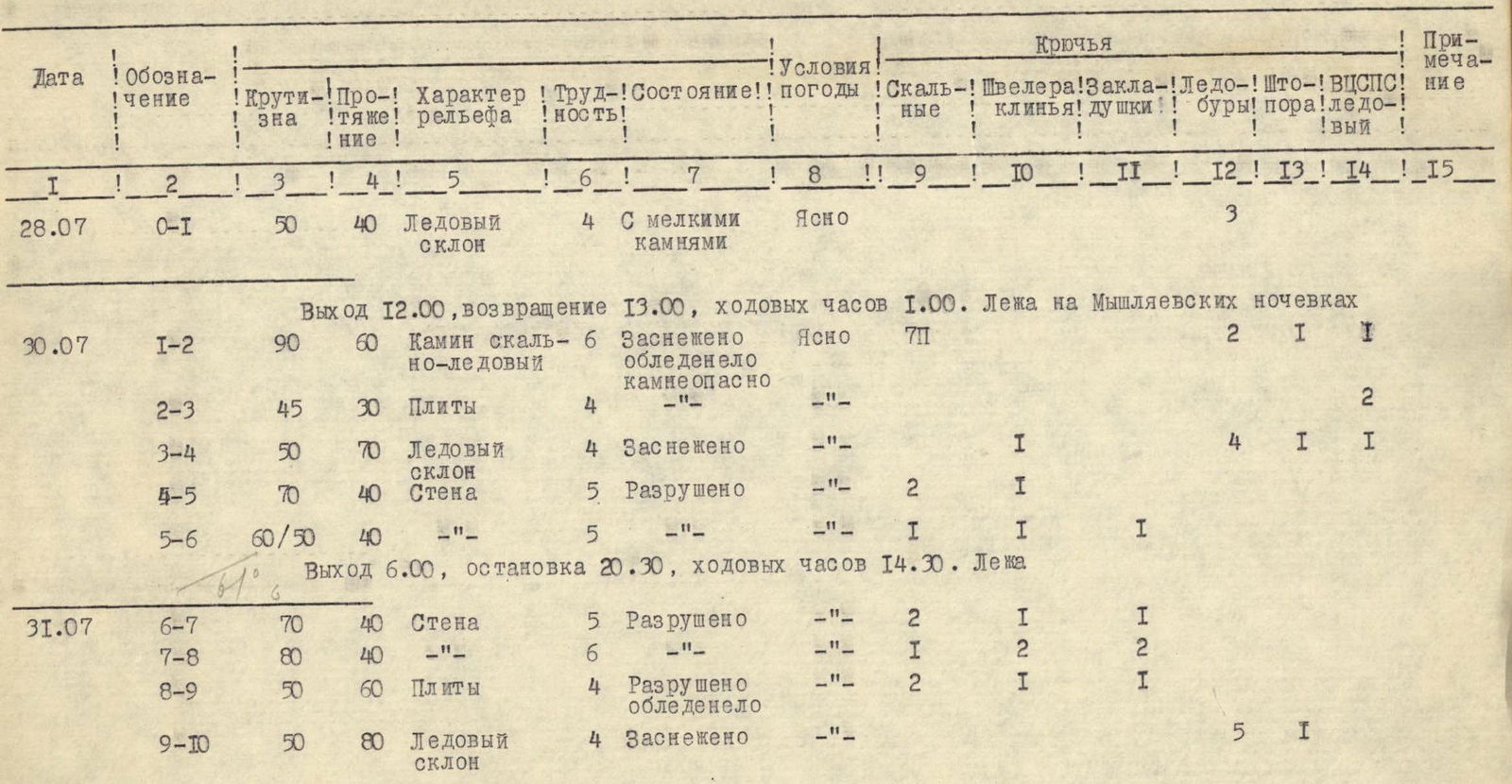
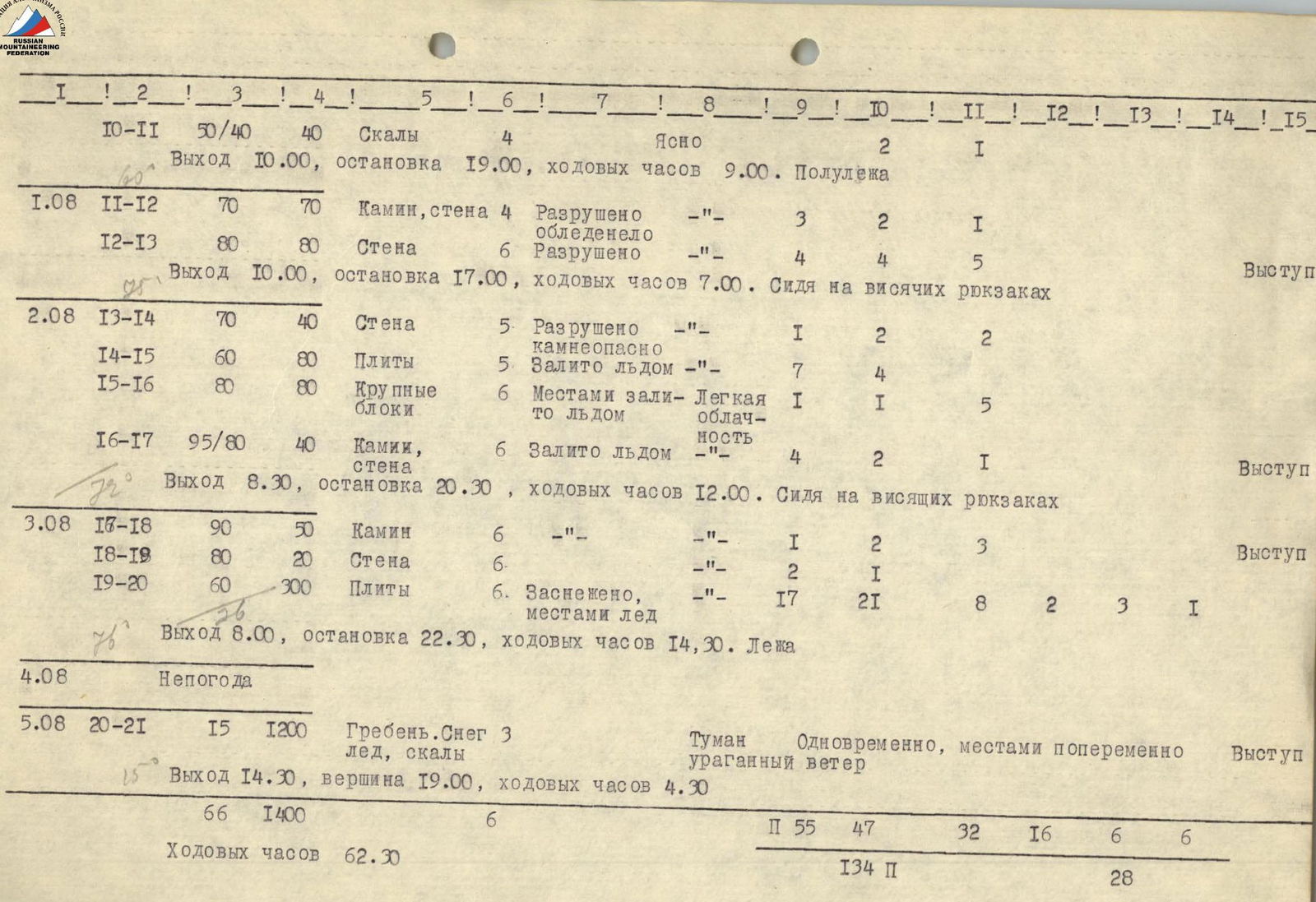
| Date | Designation | Steepness | Length | Terrain Character | Difficulty | Condition | Weather Conditions | Pitons: Rock | Channels | Placement wedges | Ice axes | Ice screws | VCSSP-pitons | Ice screws | Note |
|---|---|---|---|---|---|---|---|---|---|---|---|---|---|---|---|
| 28.07 | R0–R1 | 50 | 40 | Ice slope | 4 | With small stones | Clear | 3 | |||||||
| Departure 12:00, return 13:00, working hours 1:00. Lying on Myshlyaev's bivouac | |||||||||||||||
| 30.07 | R1–R2 | 90 | 60 | Chimney rock-ice | 6 | Snowy, icy, rockfall-prone | Clear | 7П | 2 | 1 | 1 | ||||
| R2–R3 | 45 | 30 | Slabs | 4 | -"- | -"- | 2 | ||||||||
| R3–R4 | 50 | 70 | Ice slope | 4 | Snowy | -"- | 1 | 4 | 1 | 1 | |||||
| R4–R5 | 70 | 40 | Wall | 5 | Crumbly | -"- | 2 | 1 | |||||||
| R5–R6 | 60/50 | 40 | -"- | 5 | -"- | -"- | 1 | 1 | 1 | ||||||
| Departure 6:00, stop 20:30, working hours 14:30. Lying | |||||||||||||||
| 31.07 | R6–R7 | 70 | 40 | Wall | 5 | Crumbly | -"- | 2 | 1 | 1 | |||||
| R7–R8 | 80 | 40 | -"- | 6 | -"- | -"- | 1 | 2 | 2 | 2 | |||||
| R8–R9 | 50 | 60 | Slabs | 4 | Crumbly, icy | -"- | 2 | 1 | 1 | 1 | |||||
| R9–R10 | 50 | 80 | Ice slope | 4 | Snowy | -"- | 5 | 1 | |||||||
| R10–R11 | 50/40 | 40 | Rocks | 4 | Clear | 2 | 1 | ||||||||
| Departure 10:00, stop 19:00, working hours 9:00. Semi-reclining | |||||||||||||||
| 01.08 | R11–R12 | 70 | 70 | Chimney, wall | 4 | Crumbly, icy | -"- | 3 | 2 | 1 | ledge | ||||
| R12–R13 | 80 | 80 | Wall | 6 | Crumbly | -"- | 4 | 4 | 5 | ledge | |||||
| Departure 10:00, stop 17:00, working hours 7:00. Sitting on hanging backpacks | |||||||||||||||
| 02.08 | R13–R14 | 70 | 40 | Wall | 5 | Crumbly, rockfall-prone | -"- | 1 | 2 | 2 | |||||
| R14–R15 | 60 | 80 | Slabs | 5 | Icy | -"- | 7 | 4 | |||||||
| R15–R16 | 80 | 80 | Large blocks | 6 | Partially icy | Light cloudiness | 1 | 1 | 5 | ||||||
| R16–R17 | 95/80 | 40 | Chimney, wall | 6 | Icy | -"- | 4 | 2 | 1 | ledge | |||||
| Departure 8:30, stop 20:30, working hours 12:00. Sitting on hanging backpacks | |||||||||||||||
| 03.08 | R17–R18 | 90 | 50 | Chimney | 6 | -"- | -"- | 1 | 2 | 3 | ledge | ||||
| R18–R19 | 80 | 20 | Wall | 6 | -"- | -"- | 2 | 1 | |||||||
| R19–R20 | 60 | 300 | Slabs | 6 | Snowy, partially icy | -"- | 17 | 21 | 8 | 2 | 3 | 1 | |||
| Departure 8:00, stop 22:30, working hours 14:30. Lying | |||||||||||||||
| 04.08 | Bad weather | ||||||||||||||
| 05.08 | R20–R21 | 15 | 1200 | Ridge. Snow, ice, rocks | 3 | Fog, hurricane-force wind | ledge | ||||||||
| Departure 14:30, summit 19:00, working hours 4:30 | |||||||||||||||
| 66 | 1400 | 6 | 55 | 47 | 32 | 16 | 6 | 6 | |||||||
| Working hours | 62:30 | ||||||||||||||
| 134 P | 28 |
Brief Summary of the Table
July 28. The Putintsev-Gromov pair went out to process the lower ice part of the route. They crossed the glacier and ascended a snow slope to the bergschrund. Its half-meter wall led to an ice slope (sect.R0–R1), which led to the rocks. After studying the micro-relief of the rocks and leaving equipment, the pair descended.
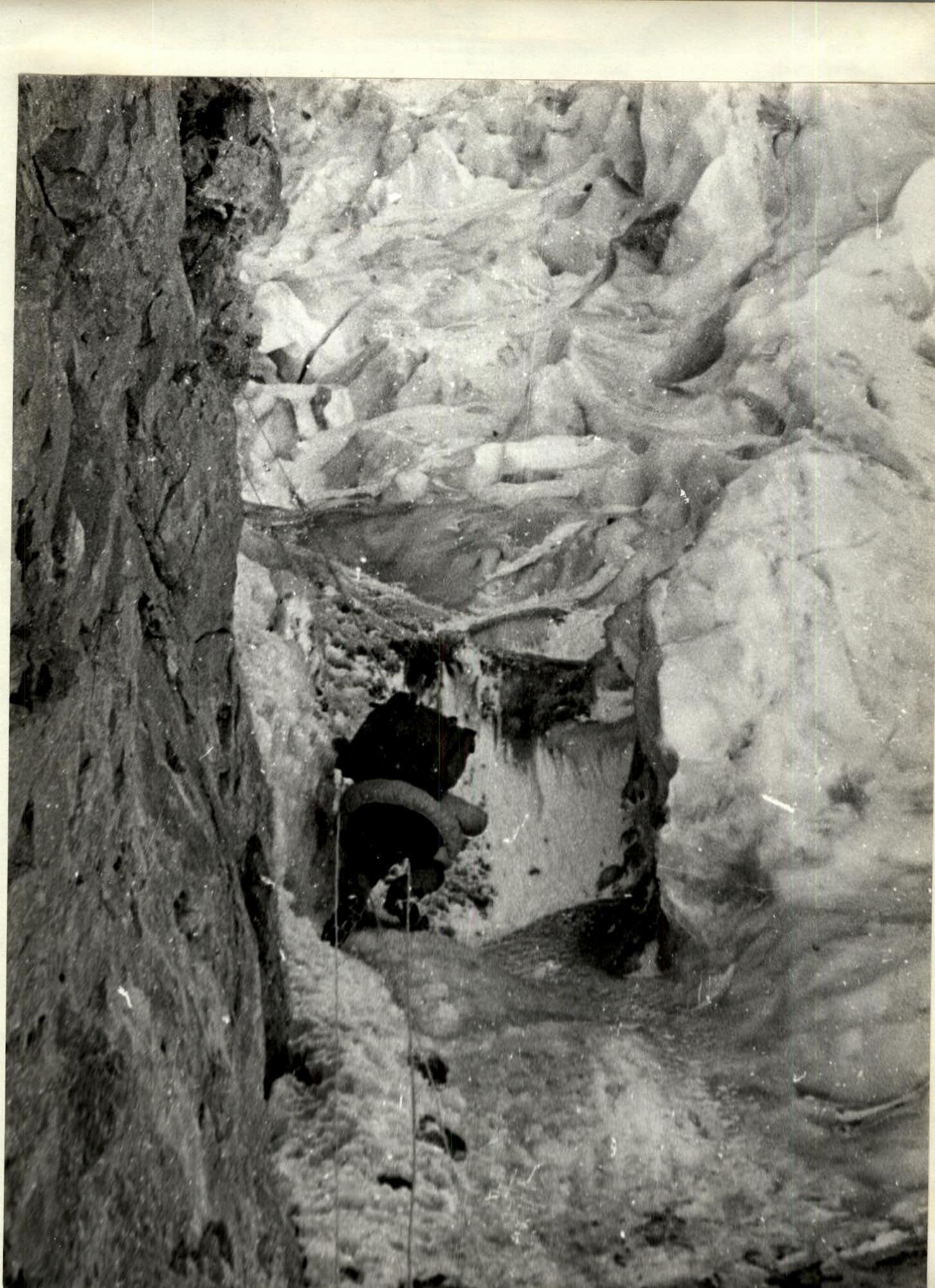
July 30. From the end of the processed part begins a vertical randkluft between the ice drop on the right and the smooth ice-covered rock wall on the left (sect.R1–R2). The ice is broken into separate blocks, and the chimney represents a series of cornice. Additionally, everything is clogged with snow. Ice pitons are difficult to place, and the ice is broken out in lenses. The belay is mainly done with "petals"; in the middle part, it was necessary to hang two ladders. Features of the passage:
- The first climber works on a double rope.
- The rest use a "fishing rod" for the backpack, as pulling it up is difficult due to the configuration of the chimney.
Behind the chimney are smooth slabs (sect.R2–R3), turning into an ice slope (sect.R3–R4), resting against a rock bastion (sect.R4–R5). Wearing crampons, Mulyukov went first. Two ropes of work: first slightly to the right, then to the left (sect.R5–R6), bypassing the overhanging wall. The rocks are very crumbly; work must be done carefully. After thoroughly working on the site, they set up a tent.
July 31. The nature of the work did not change. Gromov hung a rope (sect.R6–R7). Further, the steepness increases (sect.R7–R8). At the end of the rope, having passed a one-and-a-half-meter cornice, Putintsev reached smooth black slabs (sect.R8–R9), along which Voronin reached an ice slope (sect.R9–R10), leading to the right to an ice ridge, which led to rocks. Along the rocks (sect.R10–R11), traversing to the right, they reached a series of ledges, where an overnight stay was organized.
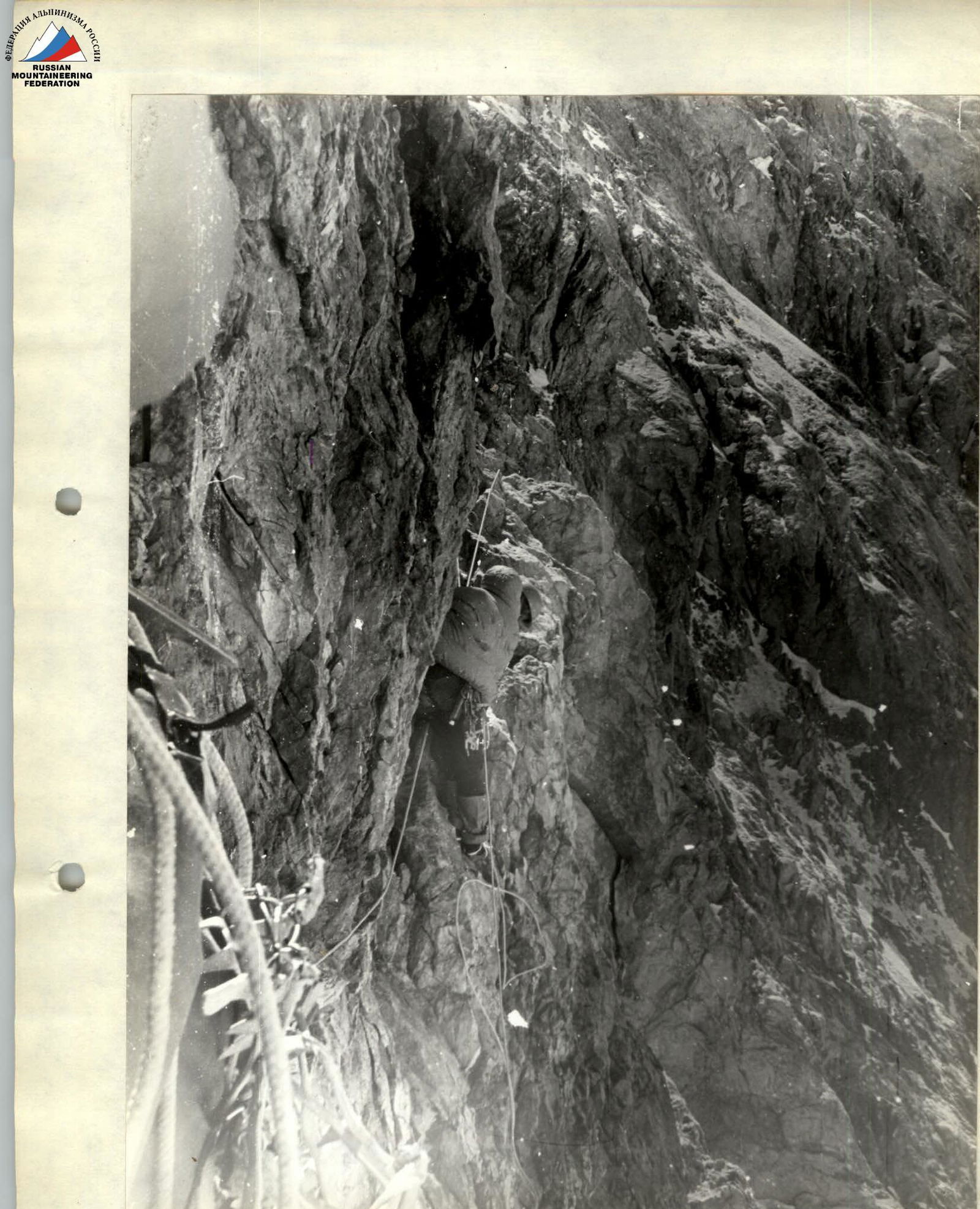
August 1. They worked 150 meters. Above, the wall was hit by stones (sect.R11–R12 and R12–R13). On sect.R12–R13, backpacks were pulled up. To facilitate passage, an additional rope was used; Mulyukov, who was last, passed the section on stirrups with jumar. They spent the night sitting on hanging backpacks.
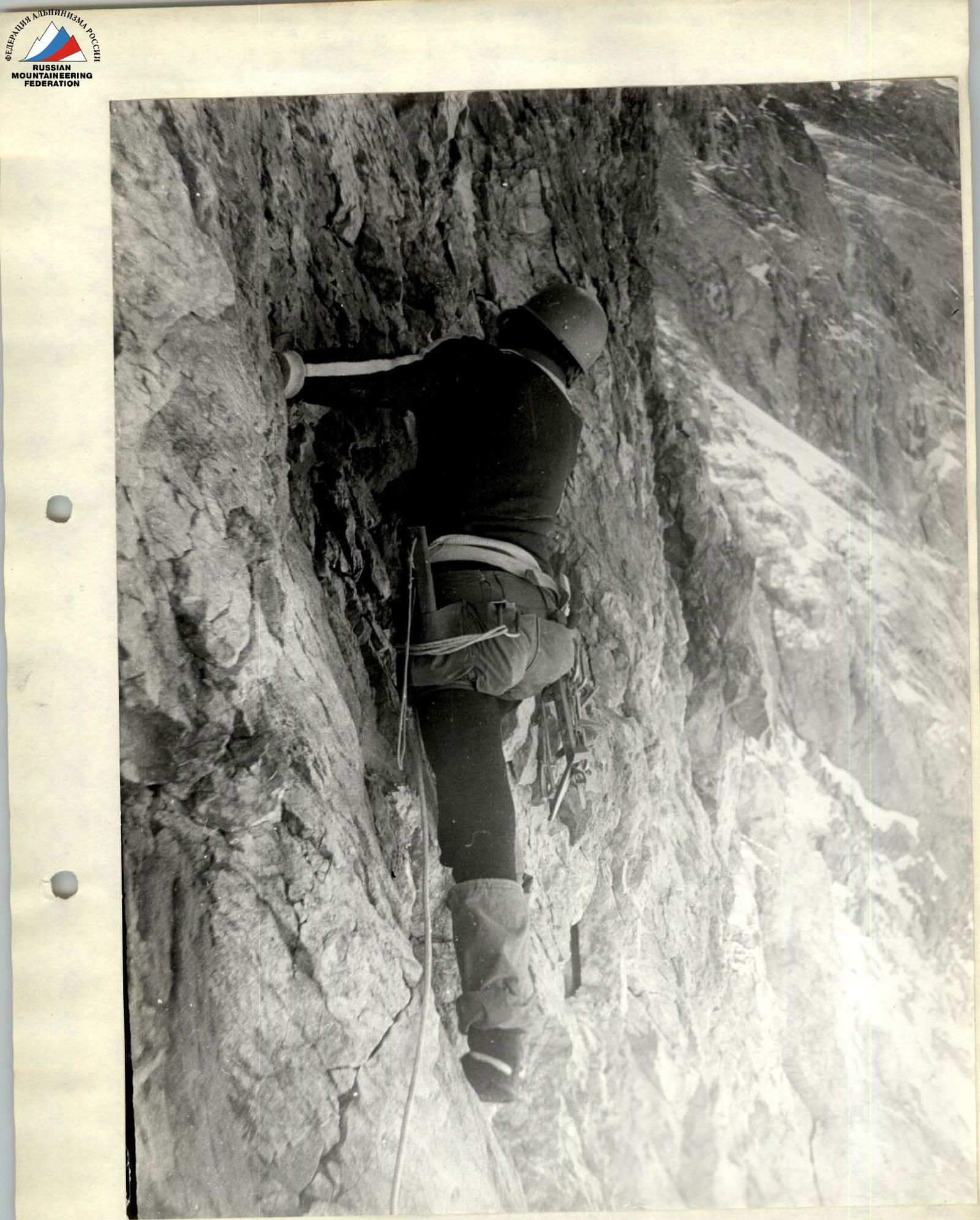
August 2. They departed early to pass the rockfall-prone section. Having passed the remaining part of the wall (sect.R13–R14), where a pendulum was needed, Gromov reached slabs (sect.R14–R15), along which, holding to the right, he reached the end of the red rocks. Further, the black part of the wall began. The black rocks have a mainly block structure. Putintsev worked ahead throughout this part of the route. Having passed the traverse of the base of an indistinct vertical couloir (sect.R15–R16), where the other participants passed individual blocks on stirrups, they reached under its overhanging right edge, cut by two chimneys (sect.R16–R17), abundantly covered with ice. The right one, passed like all very complex sections with a "fishing rod," leads to a wall leading to a series of large flakes (sect.R17–R18). Behind them is a wall leading under oblique slabs (sect.R18–R19). After processing these sections, Putintsev descended to the already organized hanging overnight stay.
August 3. They pulled up backpacks on the processed section, organizing intermediate points for pulling up backpacks, as they got stuck in the flakes. Further, there was monotonous work on the slabs until the ridge (sect.R19–R20). In the middle and upper parts, due to strong icing, they wore crampons.
August 4. They waited out bad weather.
August 5. Despite the bad weather, they went out for the assault. In very difficult weather conditions, they passed the summit ridge (sect.R20–R21) and were on the summit at 19:00. The descent took place in bad weather through the Zimovshchikov Pass, the Vitkovsky Glacier, to the Abdukagor Glacier in the base camp.
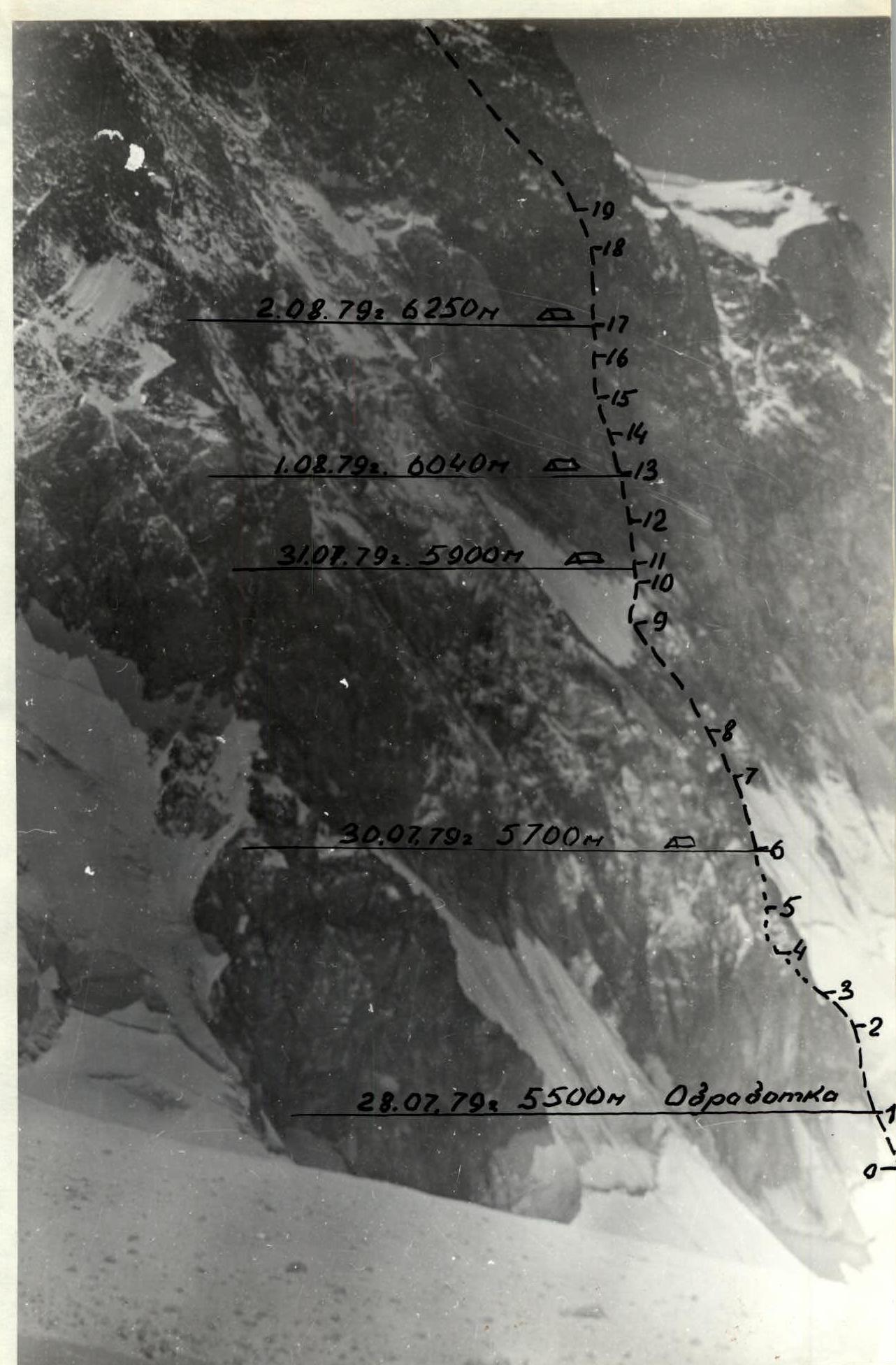
Profile of the Wall
 Height difference:
Wall – 1140 m
Route – 1670 m
Average steepness of the wall 63°
Length of the wall 1400 m
Height difference:
Wall – 1140 m
Route – 1670 m
Average steepness of the wall 63°
Length of the wall 1400 m
Beginning of Section R1–R2
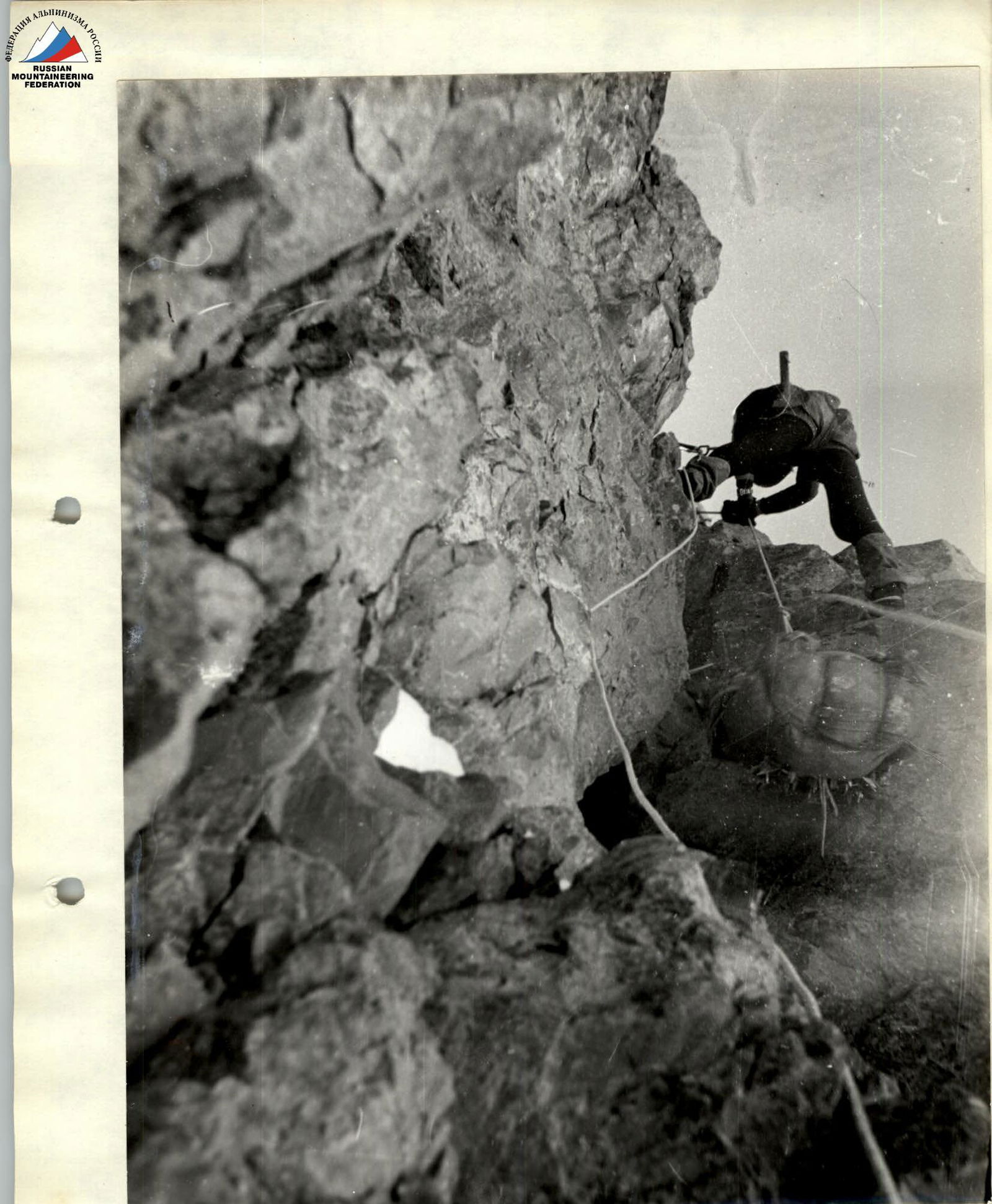
Pulling up Backpacks. Top of Section R12–R13
Beginning of Section R13–R14
Section R13–R14
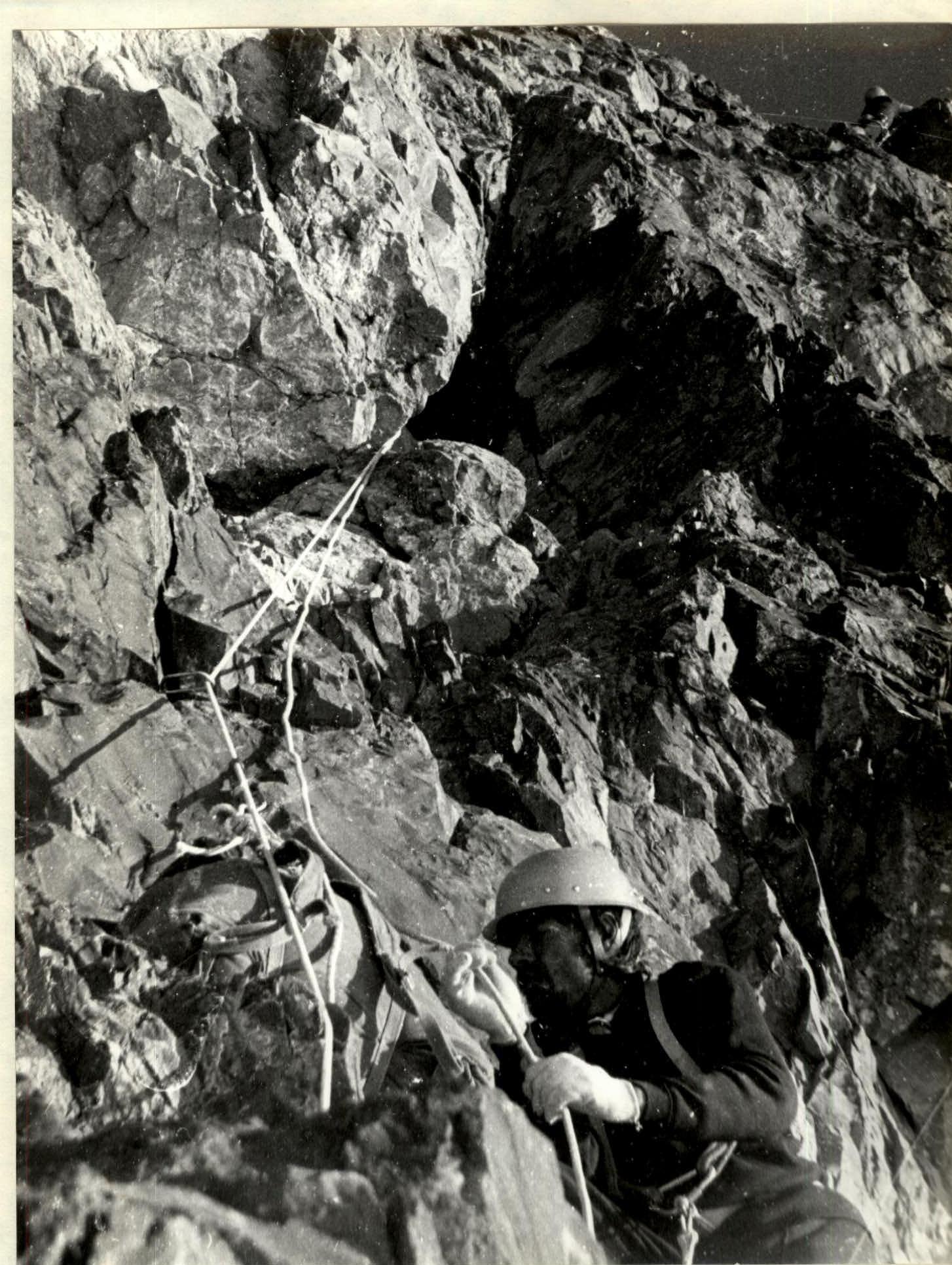
Table of Equipment Use
| № | Equipment Name | Quantity | Applied on sect. | Weight |
|---|---|---|---|---|
| clothing, footwear | in accordance with | |||
| table of main | ||||
| characteristics | ||||
| 1 | 2 | 3 | 4 | 5 |
| 1 | Main rope | 280 m | entire route | 17.0 |
| 2 | Rock pitons | 30 | R1–R2, R4–R9, R11–R19 | 1.3 |
| 3 | Wedges, channels, boxes | 12 | R3–R9, R10–R20 | 0.8 |
| 4 | Placements | 15 | R5–R9, R10–R14, R15–R18, R19–R20 | 0.5 |
| 5 | Ice pitons VCSSP | 4 | R1–R4, R17–R18, R19–R20 | 0.8 |
| 6 | Ice screw | 5 | R0–R2, R3–R4, R9–R10, R19–R20 | 0.4 |
| 7 | Pitons | 5 | R1–R2, R3–R4, R9–R10, R1–R20 | 0.2 |
| 8 | Carabiner | 50 | entire route | 4.0 |
| 9 | Ice axes | 2 | R0–R2, R3–R4, R9–R10 | 0.5 |
| 10 | Hammers | 2 | entire route | 1.2 |
| 11 | Ice axe | 1 | -"- | 1.5 |
| 12 | Ice pick | 4 | R0–R2, R3–R4, R9–R10, R19–R21 | 4.0 |
| 13 | Block-brake | 1 | R1–R2, R6–R8, R11–R13, R15–R19 | 0.1 |
| 14 | Snow wedges | 2 | R3–R4, R19–R20 | 0.1 |
| 15 | Jumar | 8 | R0–R20 | 1.0 |
| 16 | Crampons | 5 | R0–R4, R9–R10, R19–R21 | 2.0 |
| 17 | Ladders | 2 | R1–R2 | 0.4 |
| 18 | Caloshes | 1 | R4–R8, R10–R19 | 0.3 |
| 19 | Down jackets | 5 | R19–R21 and on overnight stays | 4.0 |
| 20 | Nylon pants | 5 | R19–R21 | 0.3 |
| 21 | Anoraks | 5 | R0–R2, R13–R14, R20–R21 | 1.5 |
| 22 | Helmets | 5 | entire route | 3.0 |
| 23 | Goggles | 7 | -"- | 0.4 |
| 24 | Woolen suits | 5 | -"- | 5.0 |
| 25 | Woolen underwear | 5 | -"- | 3.0 |
| 26 | Headbands-helmets | 5 | -"- | 0.7 |
| 27 | Snow-protective "lanterns" | 5 | -"- | 0.7 |
| 28 | Woolen socks | 8 | -"- five pairs | 1.0 |
| 29 | Gloves | 5 | R0–R20 | 0.3 |
| 30 | Fur mittens | 6 | R19–R21 | 2.4 |
| 31 | High-altitude Vibram | 5 | entire route | 12.5 |
| 32 | "Abalak" backpacks | 4 | -"- | 6.0 |
| 33 | Calendered backpack | 1 | -"- | 0.3 |
| 34 | Self-belay loops | 10 | -"- | 1.8 |
| 35 | High-altitude tent without a canopy | 1 | on overnight stays | 3.5 |
| 36 | Primus stove with spare parts | 1 | on overnight stays | 1.6 |
| 37 | Pot | 1 | -"- | 0.2 |
| 38 | Gasoline (petrol) | 8 l | -"- | 6.0 |
| 39 | Paraffin | 3 | -"- | 3.0 |
| 40 | 3-person sleeping bag | 1 | -"- | 3.0 |
| 41 | 1-person sleeping bag | 1 | -"- | 1.4 |
| Total: | 99.7 |
Observation Group
The rest of the expedition team under the guidance of coach V. El'chibekov observed the passage of the route. The team had stable radio communication using a "Tulip" type radio station.
OBSERVATION LOG
July 28 11:30 – Putintsev-Gromov pair departed for processing. 12:00 – began work from the bergschrund. 12:20 – reached the rocks. 13:20 – returned to camp.
July 30 6:00 – Putintsev-Gromov pair began ascent on the hung ropes. 8:00 – other participants began ascent. 9:00 – communication. Everything is fine. Canceled 12:00 communication. 11:30 – first began work on the ice slope. Others are passing the processed part, pulling up backpacks. 15:00 – first is working on rocks. Communication. Everything is fine. Reported that the lower part is rockfall-prone. 18:00 – communication. Started preparing the site. 20:30 – everyone gathered together. 21:00 – communication. Settled in normally for a lying-down overnight stay.
July 31 9:00 – communication. Having breakfast, preparing to depart. Plan to go left, under the protection of the bastion from falling stones. 10:00 – first began work. 12:00 – communication. Everything is normal. 12:30 – first is working to the right on the ice ridge. About a hundred meters below, others are pulling up backpacks. 15:00 – no communication. 16:00 – communication. Mulyukov with the radio station passed a complex section in the previous hour. Everything is fine. 18:00 – communication. Busy building a site, others are catching up. 19:00 – a tent appeared on the wall. 21:00 – communication. Settled in normally.
August 1 9:00 – communication. Rest was good, preparing to depart. 10:00 – first began work. 12:00 – communication. Reports that climbing is very difficult. Next communication canceled. 13:00 – started pulling up backpacks. First is working further. 16:00 – pulling up backpacks. 18:00 – communication. Set up for an overnight stay, above the wall after sunrise, stones are falling. Scheduled communication for 8:00 am.
August 2 8:00 – communication. Everything is fine, stones not falling yet. Preparing to depart. Spent the night sitting on backpacks. 8:30 – first began work. 11:30 – first reached the border of black rocks. 12:00 – communication. Everything is normal. Next communication canceled, complex work ahead. 13:30 – first reached under vertical rocks, "black belt," below others are pulling up backpacks. 18:00 – communication. Preparing to set up for an overnight stay and processing. 20:30 – everyone gathered, first descended, having hung about 60 m of rope. 21:00 – communication. Settled in, sitting on backpacks. Processed 70 m of very complex rocks. Scheduled communication for 8:00 am.
August 3 8:00 – communication. Spent the night normally. First began working. 12:00 – communication. Pulling up backpacks, distributed along the wall, otherwise backpacks won't go through chimneys. 13:00 – gathered at the end of the processed part. 14:00 – first went further. 15:00 communication. Due to approaching bad weather, will try to reach the summit ridge. Next communication canceled. Will communicate every hour after 21:00. Will communicate after reaching the ridge. 21:00 – no communication. As long as visible, the team was moving very quickly. Not far from the ridge. 22:00 – no communication. 23:00 – communication. Everything is fine. On the ridge, settled in for an overnight stay.
August 4 9:00 – communication. Bad weather, decided to wait out the day. Communication until tomorrow.
August 5 9:00 – communication. Bad weather, waiting for improvement. Communication scheduled for 15:00. 15:00 – communication. Began assault. Weather very bad. Scheduled hourly communication, will respond as possible. 19:00 – communication. Summit. Beginning descent. 22:00 – communication. Everything is fine. In a tent.
August 6 9:00 – communication. Due to bad weather, decided to descend via Zimovshchikov Pass – Vitkovsky Glacier. Scheduled meeting at Abdukagor Pass. Communication ended.
August 10 8:20 – group spotted on Vitkovsky Glacier. 15:20 – team met at Abdukagor Pass.
Additional Data
In terms of character, the wall passed is comparable to the NE wall of p. Kommunizma, but technically it is much more complex, and the relief is more dissected. We recommend that subsequent groups work in small numbers due to the lack of sites for overnight stays and the relative rockfall hazard of the route for more mobile passage. Every extra day on the wall increases the degree of risk. The quick passage of the route by our team is due not only to the excellent physical form of the participants but also to the use of light, comfortable equipment and clothing.

Comments
Sign in to leave a comment