
46
USSR ARMED FORCES REPORT ON THE ASCENT OF PIK OKTYABR'SKOY REVOLYUTSII – 6974 m VIA THE SOUTHWEST WALL FROM THE BARTANG VALLEY, MADE BY THE USSR ARMED FORCES TEAM IN 1968 1968
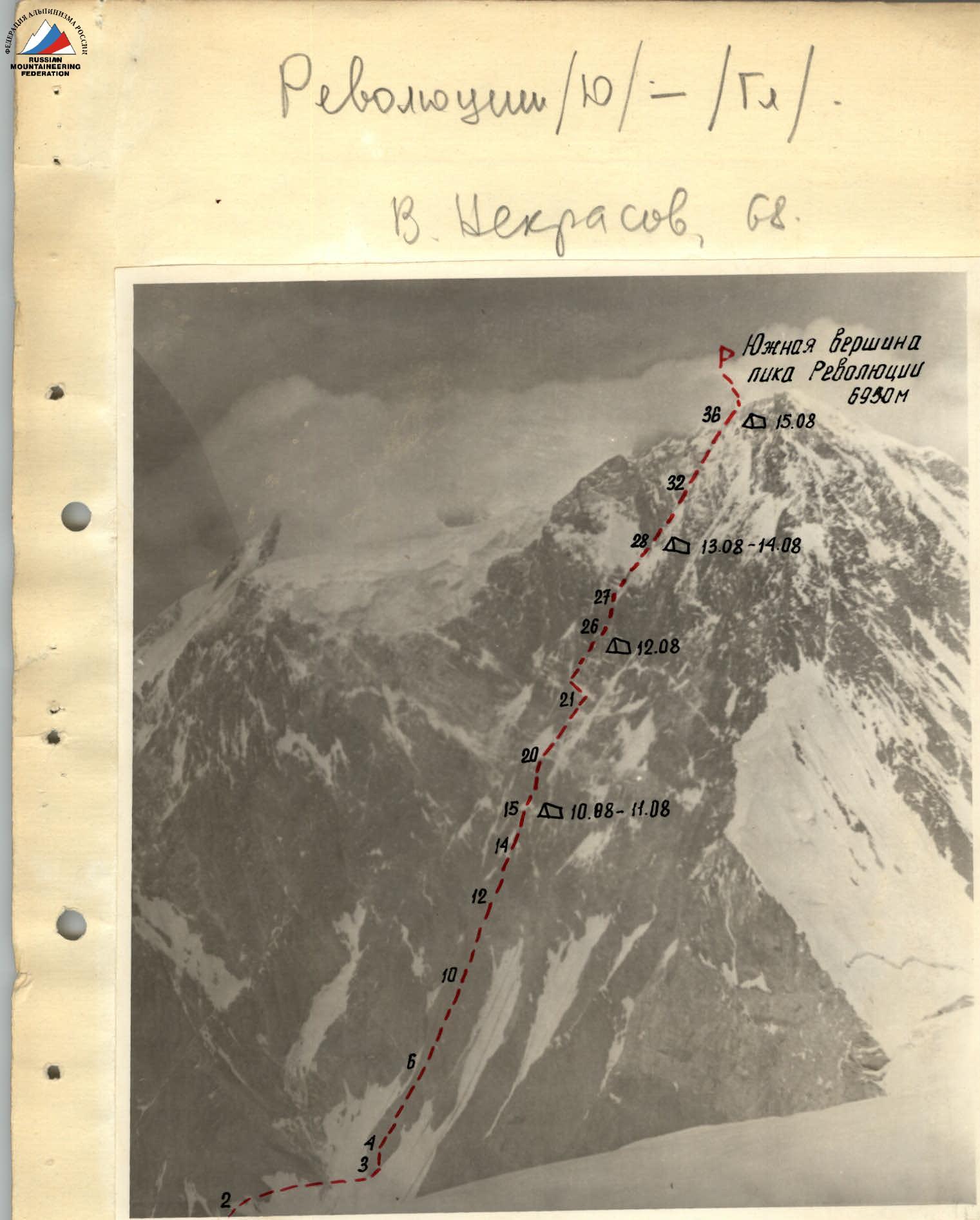
Fig. 2. Southwest wall of Pik Revolyutsii. The route taken is shown with a dotted line. The photo was taken from the summit of 6254 m.
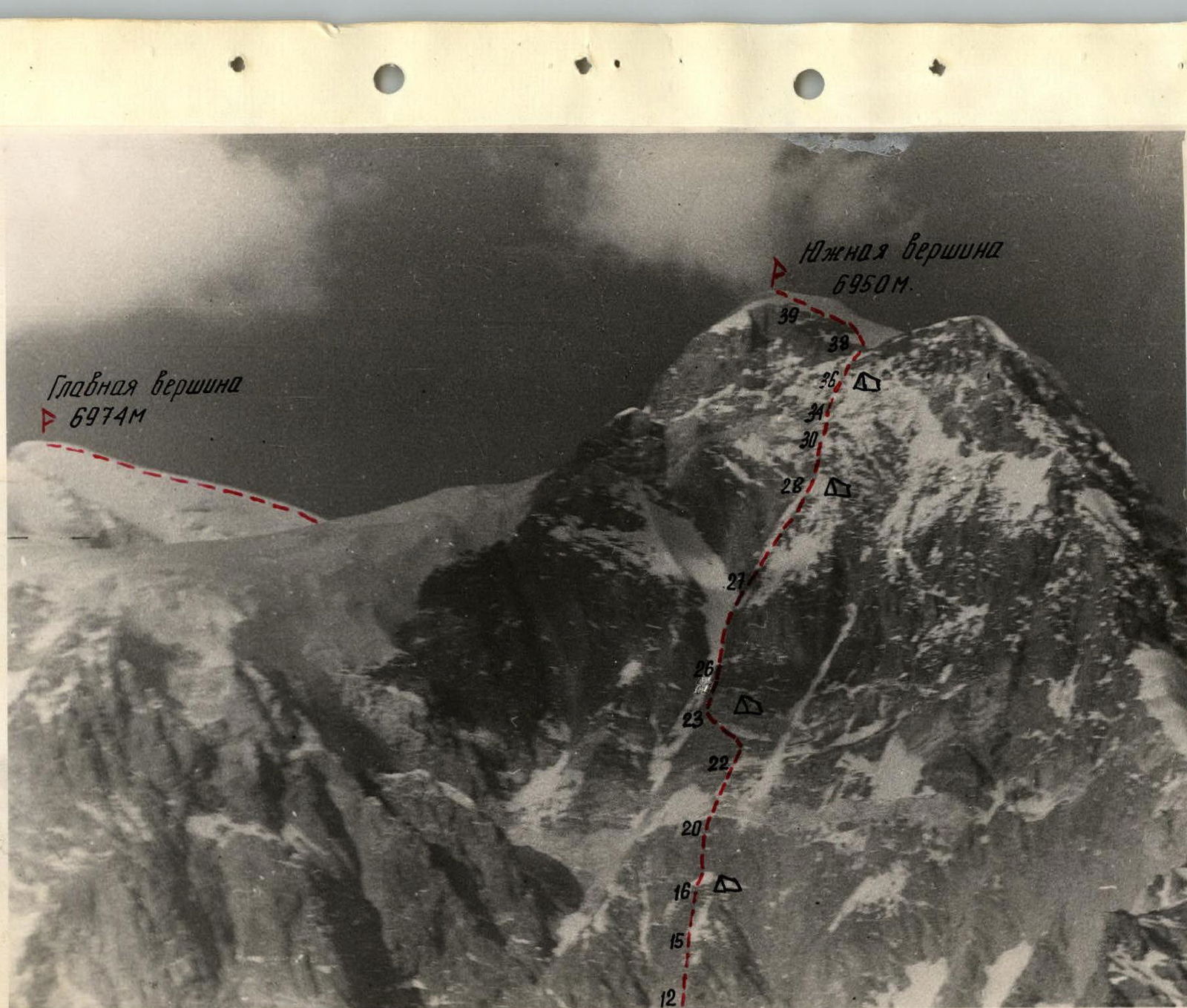
Photo #3. Southwest wall of Pik Revolyutsii.
The team ascends via the southern ridge:
- Artyukhin S.I. — Master of Sports
- Chmykhov A.S. — Master of Sports
- Mikhailov A.A. — Candidate for Master of Sports
- Ovsyannikov V.V. — Candidate for Master of Sports
- Putintsev A.N. — Candidate for Master of Sports
The leaders of the support groups are USSR Master of Sports Nazarov I.U. and USSR Master of Sports Zhizhin E.D. These groups consist of 15 climbers. They remain at the base camp.
The interaction between the groups and the signaling schedule are clarified. Nekrasov's group is to depart on August 9, Artyukhin's group on August 11.
Assault on the wall of Pik Revolyutsii
August 9 — the day of the start of the ascent. It takes 5 hours to reach the assault camp. The path goes along the tongue of the Yazgulem-dora glacier, then to the right, onto the lateral moraine of the Pik Revolyutsii glacier. We move along this moraine under the slopes of Pik 6254 m. Then we descend onto the glacier and proceed through its central part to the established assault camp at the end of the medial moraine.
We review the route again. The wall is very majestic; we are as if at the bottom of a well, the top of which is about 2 km high. Sunlight reaches the wall around 11:00. The weight of our backpacks does not exceed 13–14 kg.
The composition of the equipment and supplies that reduced the weight of our backpacks:
- Freeze-dried products
- Titanium pitons
- Austrian ropes and carabiners
We go to bed early, as the departure is scheduled for 4:00.
| August 10, 1953 | We rise at 3:00, depart at 4:00. We cross the upper reaches of the glacier to the right and upwards and begin the ascent up the ice slope to a wide crevasse, which is bypassed on the right, then we sharply turn left towards the bergschrund and cross it via a snow bridge onto the rocks of the counterfort of the southern wall. The ascent from the campsite to the rocks takes about 1 hour. Movement along the rocks of the counterfort of the southern wall goes upwards to the left. The rocks are broken and moderately difficult. We cross rocky ridges (section 1) and emerge onto slabs (section 2). Before reaching the main couloir, we move 40 m upwards to the left along the slabs to the narrow part of the couloir. The path to the couloir takes 3 hours. The couloir is icy and very steep. Piton belay and step-cutting are used. After 80 m, we emerge onto a steep snow slope (section 4). To the right is a characteristic ice chute. We move strictly upwards to the rocky rhombus of the counterfort of the southwest wall. We reach a rocky chimney, which is ascended directly upwards. The rocks here are smooth, with piton belay. The chimney ends in a small platform, from which a counterfort ascends upwards at 60°, abutting against an overhanging wall. Before the wall, there is a 10-meter-long shelf, where we have breakfast and take a short rest. Time is 11:00. Immediately after starting to move, we bypass the overhanging wall to the left and upwards along a rocky slab (section 7) and a steep, smooth couloir of a characteristic ash color (section 8). We emerge onto a rocky ridge to the right and upwards and after 40 m approach the second overhanging black wall, which is bypassed along a steep rocky slab (section 10), then turn right towards a vertical 20-meter rocky wall (section 11). |
The rocks here are steep and smooth. We move along it until we reach the third overhanging wall. The path goes to the left and upwards along a rocky slab (section 13). It is ascended with careful piton belay, then a 30-meter vertical wall (section 14) is overcome directly upwards using ladders. Backpacks are pulled up on this section. The climbing is very challenging.
The pairs in the team are distributed as follows:
- Nekrasov
- Bitny
- Demchenko
- Goryachev
Our young comrades Leonid Matyushin and Igor Khatskevich are doing well. We keep moving, changing pairs.
The ascent to the top of the third wall practically ends the main challenging work of the first day of the assault. The steepness of the counterfort decreases to 50°, and finally, we reach the designated campsite (a snow "boot"). Time is 20:00. The task for the day is fully accomplished. Above us looms the first black wall, reliably protecting our platform from possible falling rocks. We have ascended quite high during the day. The working day is 16 hours. Throughout the section from the bergschrund to the black wall, there is no water. By 21:00, we set up our bivouac, while it is still quite light. The sun sets late and shines on the wall for a long time. The first day's journey has shown that starting from the lower rhombus, the wall's steepness is great. Sections of the counterfort are interspersed with vertical walls, which are challenging to pass. We send a signal flare and see a response. We retire late, at 23:00. Snowfall begins at night.
August 11 – Everything is covered in snow, and as if specifically for the climbers, nature sets one obstacle after another. Above us looms a 80-meter vertical wall. It is not yet possible to depart; it is cold. At 12:00, a huge avalanche comes down from the left from the ice cap along the main couloir. The impact is so strong that a cloud of snow dust rises from the glacier below and covers our platform. Now we see firsthand what the main couloir holds. This is something to always remember for climbers who wish to take this route. We decide to process the wall despite the bad weather. At 12:30, the pair Nekrasov — Bitny departs. From the campsite, they go straight up the ice slope, dusted with snow, to the rocks. Then 10 m to the left (section 17) along a steep rocky shelf. Further ascent goes along a steep, narrow shelf to the right with careful piton belay to a 5-meter chimney, ending in a small platform. From here, they move upwards to the left to a hanging section of the wall (section 19), where the wall to the right is covered with rime ice. The ascent is via ladders with the use of artificial points of support. The section is extremely difficult. Processing one rope took 2 hours and 30 minutes. The first pair descends, and the second pair, Matyushin — Khatskevich, departs.
Having ascended the processed section, the pair hangs a rope on section 20. It is a smooth 40-meter wall, which ends the first black wall.
The following are hung:
- ladders
- 14 pitons are driven
By 17:00, the processing is complete. The mood is good despite the worsening weather. One of the key sections of the wall has been passed. Visibility is poor. In the evening, we send up a flare.
August 12, 1953 – It snowed all night. By 10:00, the fog has somewhat cleared. We decide to continue. At 11:30, we depart for the bivouac site. Passing the processed ropes takes about 3 hours. On section 19, backpacks have to be pulled up. After the wall, the steepness decreases to 55°. A characteristic gendarme, resembling a lying barrel, is bypassed on the left. Further, there is a marble belt over four ropes, with movement directly upwards to the black belt of rocks (section 22). Then movement goes along steep, large slabs to the left and upwards to the saddle of the rocky ridge. The section is challenging; the slabs are smooth, with careful piton belay (section 23). We emerge onto the saddle, from which we move directly upwards, orienting ourselves towards a shelf under the 2nd black wall. On this section, shelves alternate with small walls (2–3 m). Belay is via ledges. On the shelf under the black wall, we find a spot for the night. It takes only a hour and a half of work to prepare the platform. The working day is 8 hours. Above us is another serious obstacle — the 2nd black wall, 140 m long. We retire at 22:30.
August 13 – It snowed all night again; the temperature dropped. We are at an altitude of about 6300 m. Departure from the campsite is at 10:00. To the left and upwards, movement is along a steep shelf (section 25), then a traverse of the icy couloir to the sheer black wall (section 26). Increased attention is paid to the upper sections and careful piton belay. The black wall is ascended directly, head-on. Challenging climbing with piton belay; the first ascender goes without a backpack (section 27). After passing the wall, we emerge onto a counterfort, which abuts against 2 characteristic gendarmes ("ears"). The rocks of the counterfort are steep, consisting of large blocks. After passing 2 ropes, we emerge onto a narrow shelf and, after two hours of preparation, settle in for the bivouac. The weather is variable, but it continues to snow. Towards evening, the weather improves. We see Artyukhin's group descending from the summit of 6254 to the saddle towards the southern ridge. We exchange flares. It immediately becomes more cheerful. We retire at 22:00.
August 14 – It snows again all night, and it has become even colder. We decide to process the route further despite the bad weather. The pair Goryachev — Khatskevich departs for processing at 12:00. The first 40 m of the path go along a rocky counterfort; the climbing is challenging, with piton belay. Then there is a snowy ridge for 50 m. It abuts against rocky gendarmes. Between the gendarmes, the path goes to the left and upwards along a steep rocky slab (section 31). Then there is a turn to the right and upwards along the second rocky slab (section 32) and an exit onto a shelf that goes to the right. Processing these sections took 5 hours. The snowfall continues throughout the day. We retire at 20:00.
August 15 – It snows all night. It is very cold. Departure from the campsite is at 11:00.
Passing the processed sections takes about 4 hours. The further path goes along steep, tile-like rocks covered in snow (section 34). From the shelf, the path goes along a vertical 8-meter wall. These sections are complex and require great attention and caution. The supports are unreliable; the pitons hold poorly; passing the 50-meter section takes about an hour and a half.
Further, there is an ice-snow couloir, at the top of which is a characteristic large rocky outcrop. We emerge onto it via a 10-meter wall (section 36). At the top of the rocky outcrop, we stop for the bivouac. Time is 19:00. The platform is cut out in the ice for about 2 hours.
It has been a very difficult day. In the evening, the weather improves. We saw Artyukhin's group again, which is moving along the southern ridge. We exchange flares with Artyukhin and the base camp. We retire at 23:00.
August 16, 1953 – It snowed again at night. Departure from the bivouac site is at 10:30. Section 37 is a snowy counterfort with a steepness of 50°, with belay via ice axe. Movement is directly upwards. After passing this counterfort, we emerge to the right onto a steep shelf that goes to the left and upwards, bounded on the left and right by rocky walls, forming a kind of corridor. Belay is via pitons. We enter the shoulder of the southern ridge (section 38). The platform is flat and good. This concludes the wall part of the route. Before us is the final section of the path to the summit of Pik Revolyutsii. Along a snow-rocky slope, we emerge onto the southern summit of Pik Revolyutsii. The height is about 6950 m. The main summit is opposite, across the plateau. We build a cairn. No one has been on this summit before. Time is 15:30. Further movement goes along a weakly dissected ridge, descending towards the eastern summit. From the saddle, we descend to the left and downwards onto the plateau and cross it on the right side, orienting ourselves towards the saddle between the eastern and main summits. The 1967 route from the north wall also exited onto this saddle. At 19:00, we stop for the bivouac. The weather has improved. The sun is shining.
August 17 – Departure is at 8:30. Along a snowy slope, we emerge onto the main summit. The ascent takes 45 minutes. We retrieve a note from A. Kuznetsov's group from Chelyabinsk, which ascended Pik Revolyutsii from the north in 1967, following our group. We begin our descent at 9:30. We exit the saddle downwards at 10:30. By 15:00, we have descended onto the Grumm-Grжимайло glacier via the path familiar to us from last year, used by the first ascenders. On this day, we descend to the bend of the glacier. We need to hurry; we are expected at Tanymas. Early on August 18, we head downwards. By 13:00, we are on the banks of Tanymas. A helicopter is already standing on the other side. We do not organize a crossing on this day, as the water level has risen significantly. On August 19 at 6:00, we cross to the other bank and fly to the main camp — Kokjjar.
On August 20 — both helicopters fly again to Tanymas to meet Artyukhin's group, which, having descended, arrives at the camp on August 21.
On August 22 — the teams are transported by helicopters to Osh. The expedition took 35 days. Such a short duration is explained only by the use of helicopter aviation and the clear organization of the expedition.
Table
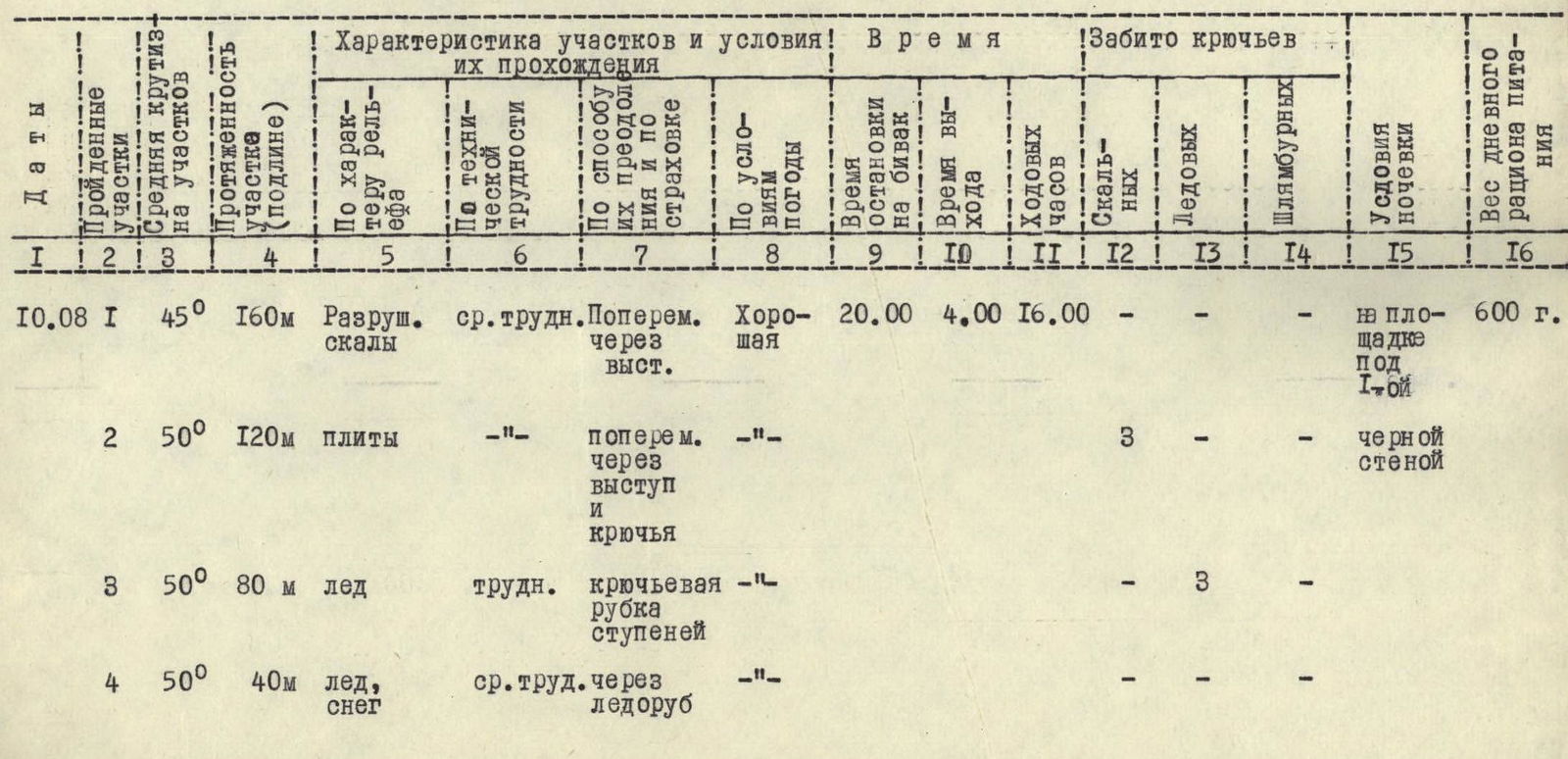
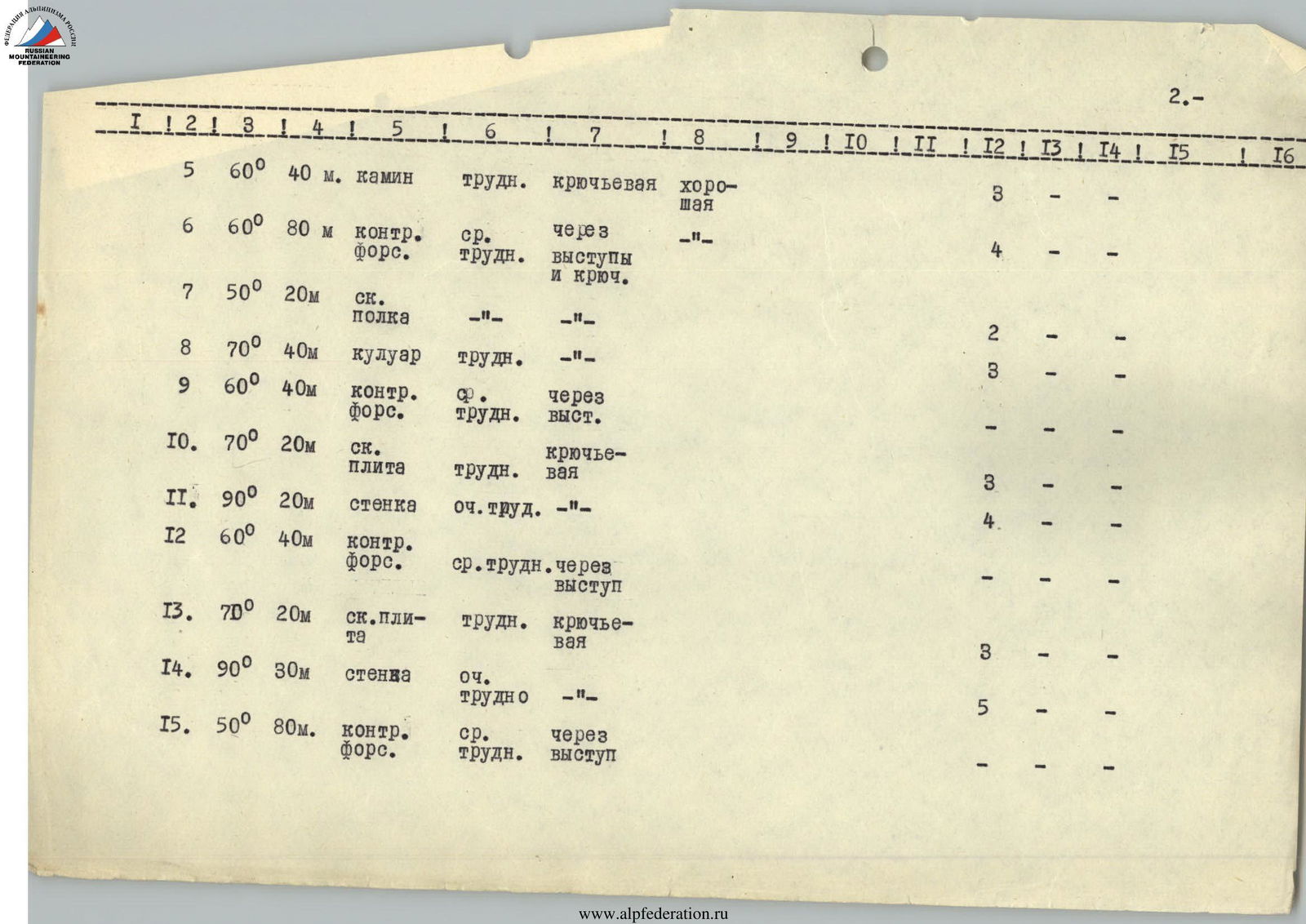
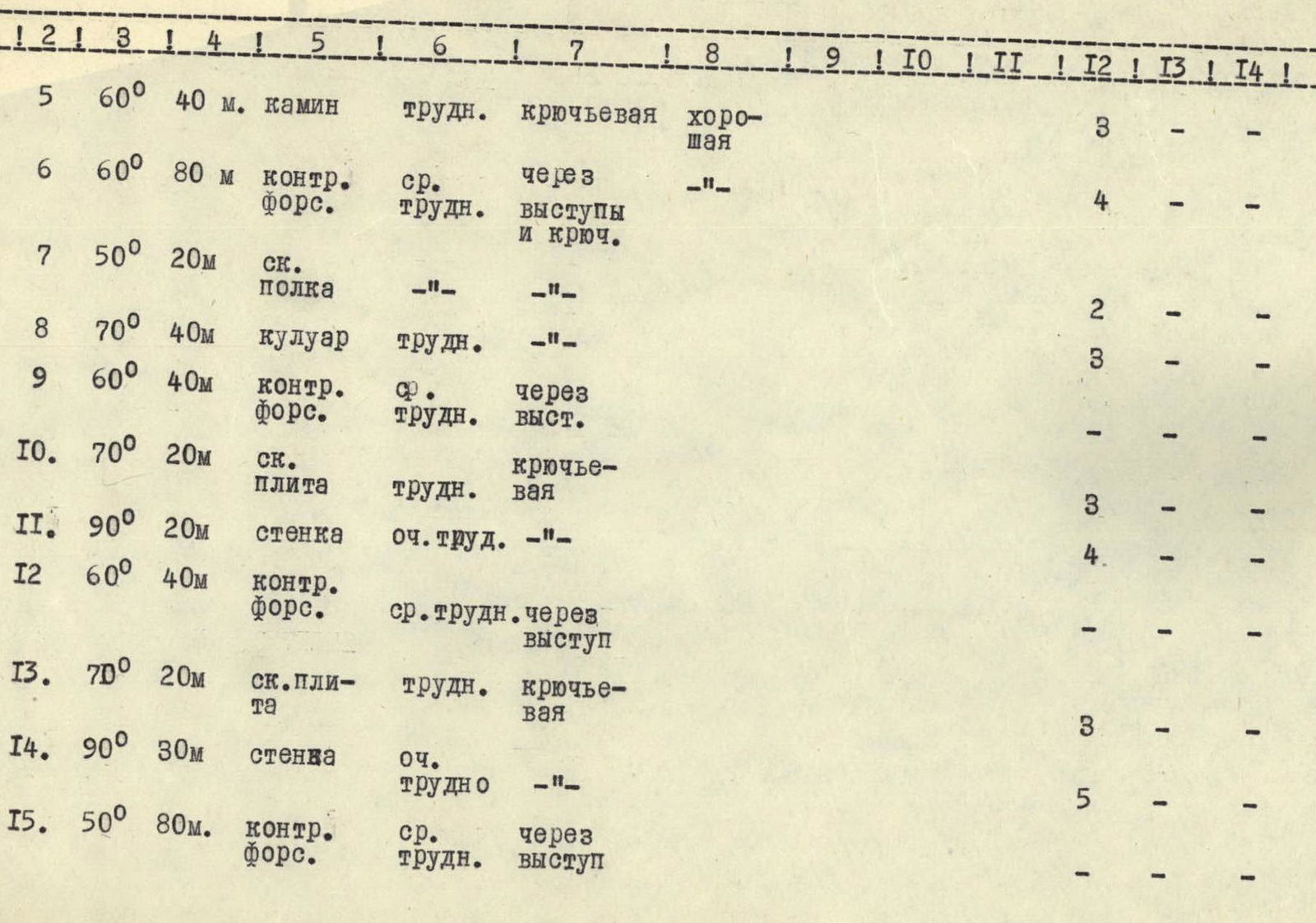
Main characteristics of the ascent route. Ascent route: southwest wall of Pik Revolyutsii. Height difference of the route: 2000 m. Including complex sections — 700 m. Steepness of the route is about 70°.
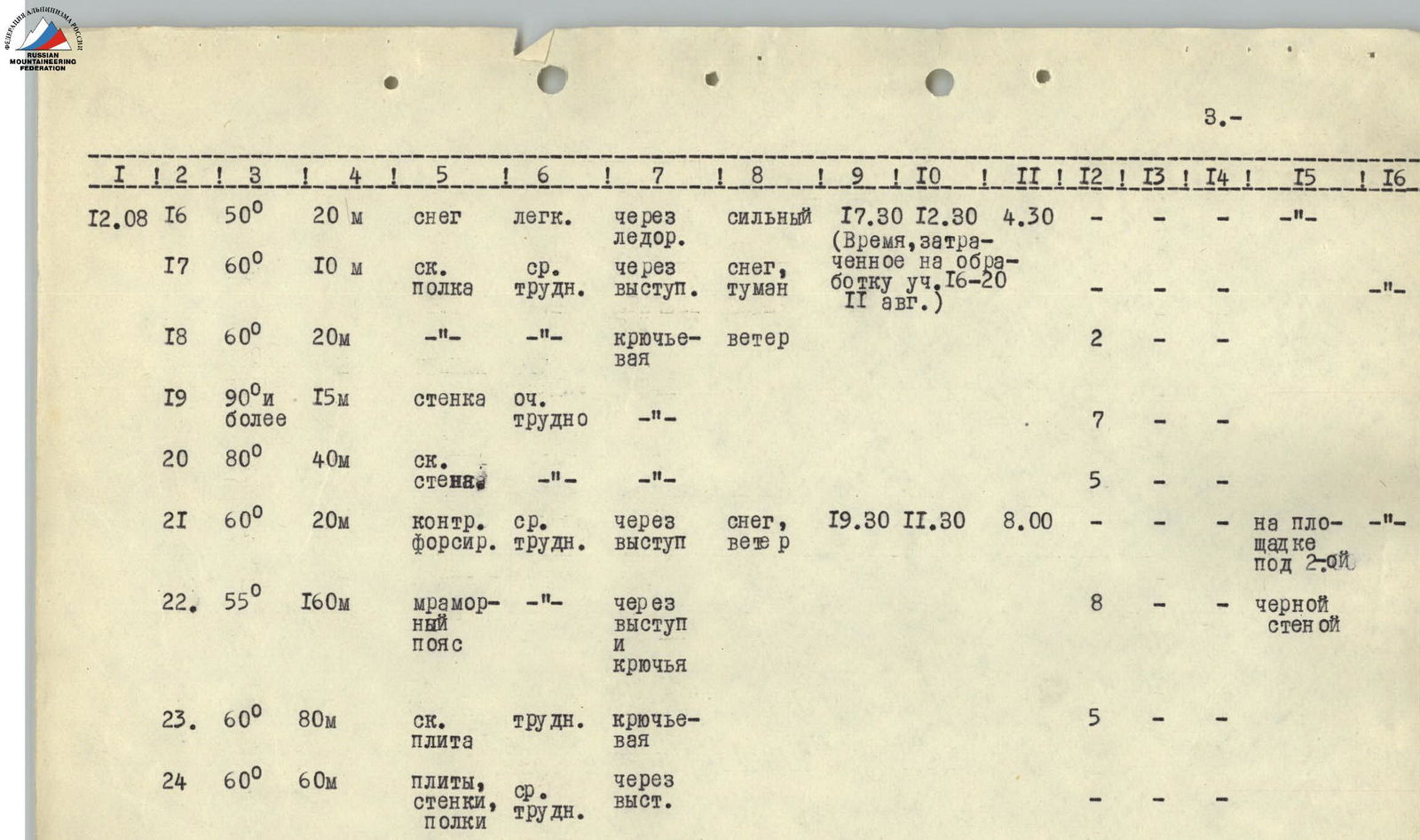
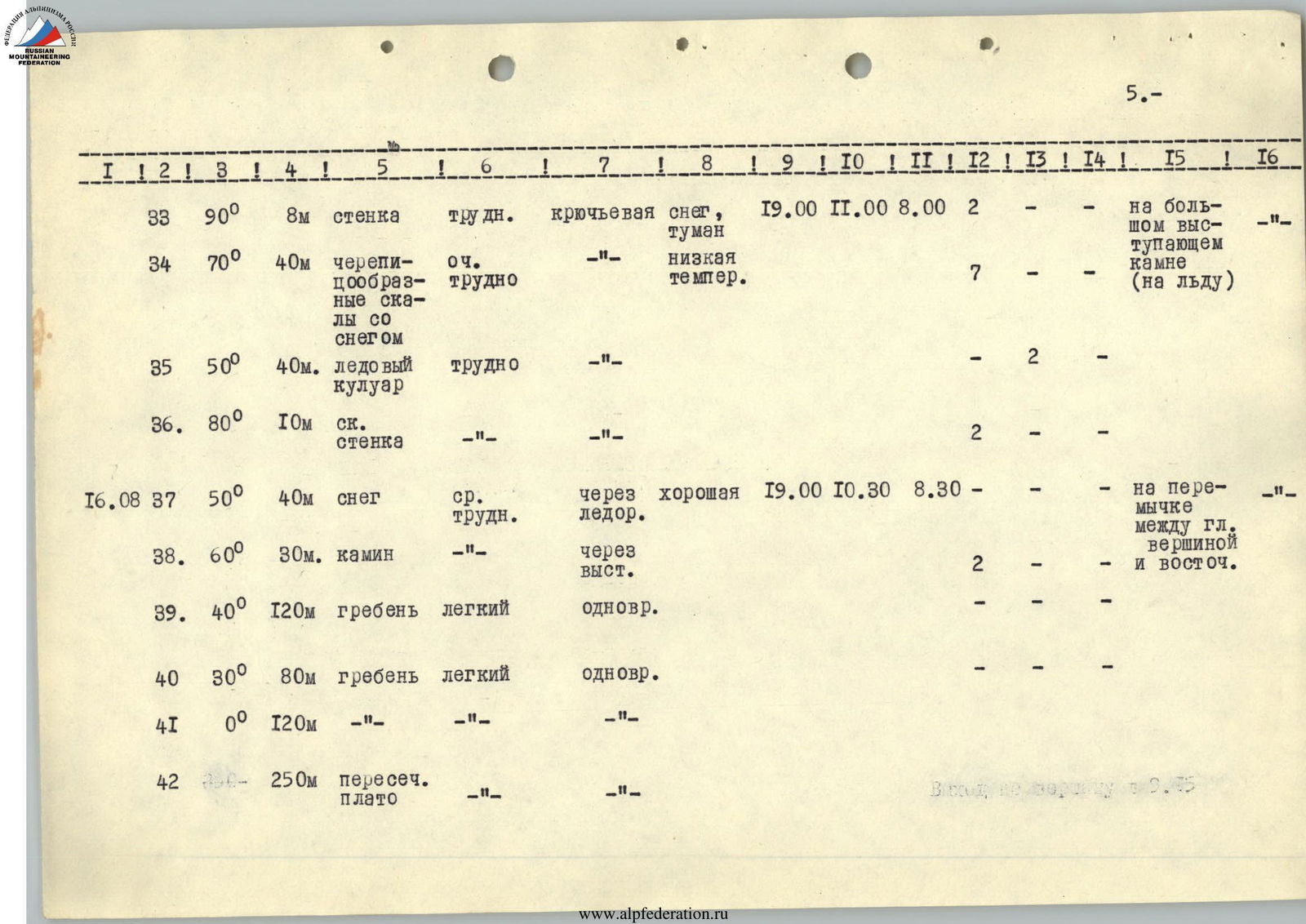
| Dates | Sections Ascended | Average Steepness of Section | Length (Removal) | Characteristics of Sections and Ascent Conditions | By Relief Character | By Technical Difficulty | By Belay Method and Belay | Weather Conditions | Time of Bivouac Start | Time of Departure | Hours Spent | Pitons Driven | Shлямбуrs | Ice | Notes | Bivouac Conditions | Weight of Daily Rations |
|---|---|---|---|---|---|---|---|---|---|---|---|---|---|---|---|---|---|
| 10.08 | R1 | 45° | 160 m | Broken rocks | Moderate difficulty | Alternating via ledges | Good | - | 20:00 | 4:00 | 16:00 | - | - | - | - | on a platform under the 1st black wall | 600 g. |
| 10.08 | R2 | 50° | 120 m | Slabs | - | Alternating via ledges and pitons | - | - | - | - | 3 | - | - | - | black wall | - | |
| 10.08 | R3 | 50° | 80 m | Ice | Difficult | Piton belay, step-cutting | - | - | - | - | 3 | - | - | - | - | ||
| 10.08 | R4 | 50° | 40 m | Ice, snow | Moderate difficulty | Via ice axe | - | - | - | - | - | - | - | - | - | ||
| 10.08 | R5 | 60° | 40 m | Chimney | Difficult | Piton belay | Good | - | - | - | 3 | - | - | - | - | ||
| 10.08 | R6 | 60° | 80 m | Counterfort | Moderate difficulty | Via ledges and pitons | - | - | - | - | 4 | - | - | - | - | ||
| 10.08 | R7 | 50° | 20 m | Rocky shelf | - | - | - | - | - | - | 2 | - | - | - | - | ||
| 10.08 | R8 | 70° | 40 m | Couloir | Difficult | - | - | - | - | - | 3 | - | - | - | - | ||
| 10.08 | R9 | 60° | 40 m | Counterfort | Moderate difficulty | Via ledges | - | - | - | - | - | - | - | - | - | ||
| 10.08 | R10 | 70° | 20 m | Rocky slab | Difficult | Piton belay | - | - | - | - | 3 | - | - | - | - | ||
| 10.08 | R11 | 90° | 20 m | Wall | Very difficult | - | - | - | - | - | 4 | - | - | - | - | ||
| 10.08 | R12 | 60° | 40 m | Counterfort | Moderate difficulty | Via ledges | - | - | - | - | - | - | - | - | - | ||
| 10.08 | R13 | 70° | 20 m | Rocky slab | Difficult | Piton belay | - | - | - | - | 3 | - | - | - | - | ||
| 10.08 | R14 | 90° | 30 m | Wall | Very difficult | - | - | - | - | - | 5 | - | - | - | - | ||
| 10.08 | R15 | 50° | 80 m | Counterfort | Moderate difficulty | Via ledges | - | - | - | - | - | - | - | - | - | ||
| 12.08 | R16 | 50° | 20 m | Snow | Easy | Via ice axe | Strong | - | 17:30 | 12:30 | 4:30 | - | - | - | - | - | |
| 12.08 | R17 | 60° | 10 m | Rocky shelf | Moderate difficulty | Via ledges | Snow, fog | (Time spent processing sections R16–R20 on August 11) | - | - | - | - | - | - | - | ||
| 12.08 | R18 | 60° | 20 m | - | - | Piton belay | Wind | - | - | - | 2 | - | - | - | - | ||
| 12.08 | R19 | 90° and more | 15 m | Wall | Very difficult | - | - | - | - | - | 7 | - | - | - | - | ||
| 12.08 | R20 | 80° | 40 m | Rocky wall | - | - | - | - | - | - | 5 | - | - | - | - | ||
| 12.08 | R21 | 60° | 20 m | Counterfort | Moderate difficulty | Via ledges | Snow, wind | - | 19:30 | 11:30 | 8:00 | - | - | - | on a platform under the 2nd black wall | - | |
| 12.08 | R22 | 55° | 160 m | Marble belt | - | Via ledges and pitons | - | - | - | - | 8 | - | - | - | black wall | - | |
| 12.08 | R23 | 60° | 80 m | Rocky slab | Difficult | Piton belay | - | - | - | - | 5 | - | - | - | - | ||
| 12.08 | R24 | 60° | 60 m | Slabs, walls, shelves | Moderate difficulty | Via ledges | - | - | - | - | - | - | - | - | - | ||
| 13.08 | R25 | 60° | 20 m | Rocky shelf | Moderate difficulty | Via ledges | Snow, fog | - | 16:00 | 10:00 | 8:00 | - | - | - | on a platform | - | |
| 13.08 | R26 | 60° | 40 m | Couloir with ice | Difficult | Piton belay | Low temperature | - | 16:00 | - | - | 3 | - | - | - | - | |
| 13.08 | R27 | 90° | 80 m | Rocky wall | - | - | - | - | - | - | 10 | - | - | - | rocky counterfort | - | |
| 13.08 | R28 | 60° | 80 m | Rocky counterfort | - | - | - | - | - | - | 4 | - | - | - | - | ||
| 15.08 | R29 | 60° | 40 m | - | - | - | Snow, low temperature | - | 17:00 | 12:00 | 5:00 | 5 | - | - | - | - | |
| 15.08 | R30 | 50° | 50 m | Snow, rocks | Moderate difficulty | Via ice axe | (Time spent processing sections R29–R32 on August 14) | - | - | - | - | - | - | - | - | ||
| 15.08 | R31 | 60° | 40 m | Rocky slab | Difficult | Piton belay | - | - | - | - | 4 | - | - | - | - | ||
| 15.08 | R32 | 60° | 40 m | Rocky slab | - | - | - | - | - | - | 3 | - | - | - | - | ||
| 16.08 | R33 | 90° | 8 m | Wall | Difficult | Piton belay | Snow, fog | - | 19:00 | 11:00 | 8:00 | 2 | - | - | on a large protruding rock (on ice) | - | |
| 16.08 | R34 | 70° | 40 m | Tile-like rocks with snow | Very difficult | - | Low temperature | - | - | - | 7 | - | - | - | - | ||
| 16.08 | R35 | 50° | 40 m | Ice-snow couloir | Difficult | - | - | - | - | - | - | 2 | - | - | - | ||
| 16.08 | R36 | 80° | 10 m | Rocky wall | - | - | - | - | - | - | 2 | - | - | - | - | ||
| 16.08 | R37 | 50° | 40 m | Snow | Moderate difficulty | Via ice axe | Good | - | 19:00 | 10:30 | 8:30 | - | - | - | on a saddle between the main and eastern summits | - | |
| 16.08 | R38 | 60° | 30 m | Chimney | - | Via ledges | - | - | - | - | 2 | - | - | - | - | ||
| 16.08 | R39 | 40° | 120 m | Ridge | Easy | Simultaneous | - | - | - | - | - | - | - | - | - | ||
| 16.08 | R40 | 30° | 80 m | Ridge | Easy | Simultaneous | - | - | - | - | - | - | - | - | - | ||
| 16.08 | R41 | 0° | 120 m | - | - | - | - | - | - | - | - | - | - | - | - | ||
| 16.08 | R42 | 20–25° | 250 m | Crossing the plateau | - | - | - | - | - | - | - | - | - | - | - | ||
| 17.08 | R43 | 35° | 150 m | Snowy slope | Easy | Simultaneous | Good | 8:30 | - | - | - | - | - | - | Ascent to the summit at 9:15. | - | - |

The descent was made via the ascent route from the Grumm-Grжимайло glacier, 5a category of difficulty (1954 route). 2 ice pitons were used during the descent. A total of 997 pitons were used. The total time spent on the ascent to the summit, including processing time on the route, was 59 hours.
Team captain — USSR Master of Sports Nekrasov.
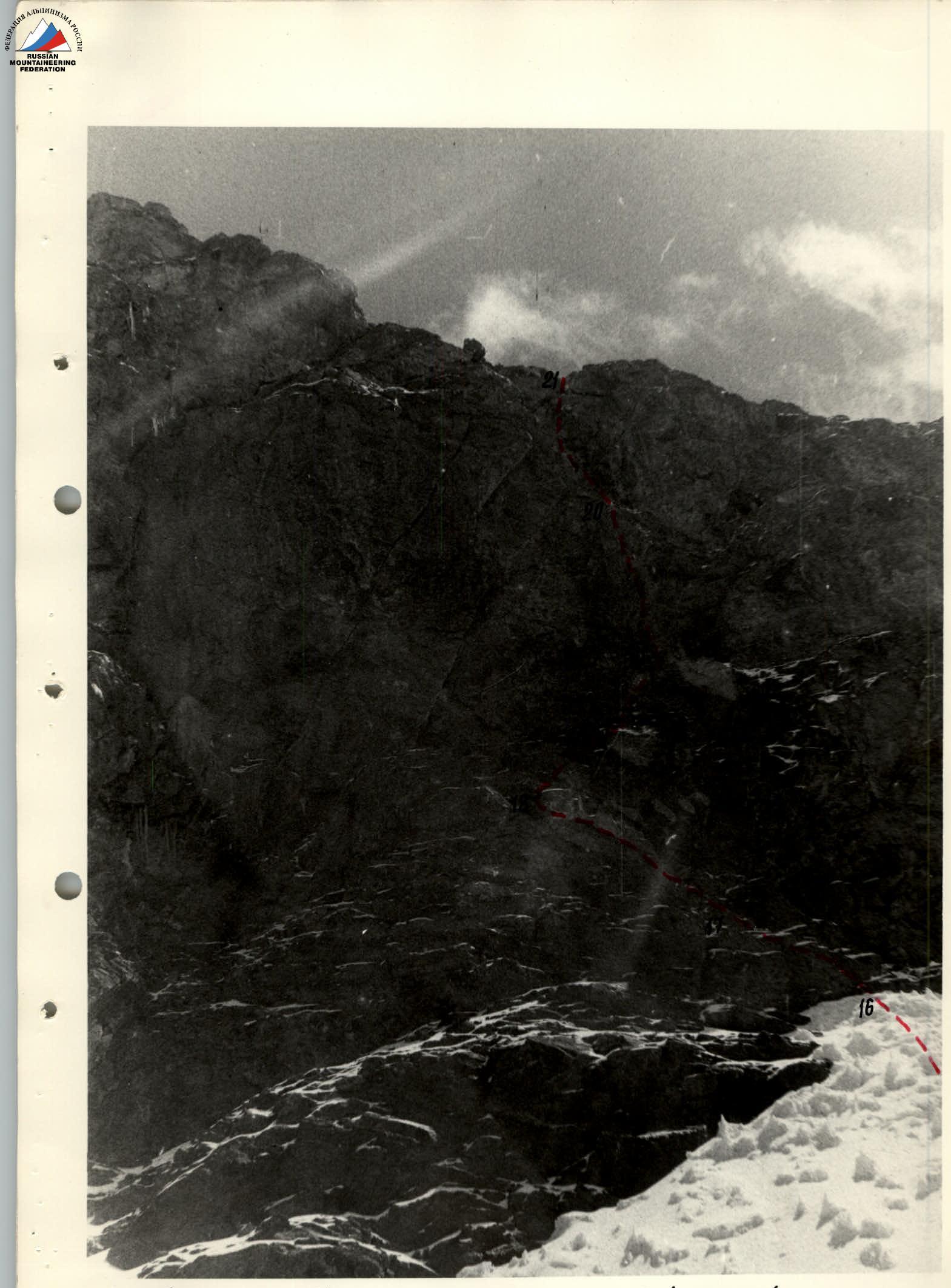
Photo #10. Ascent route along the 1st black wall. Sections R16–R20.
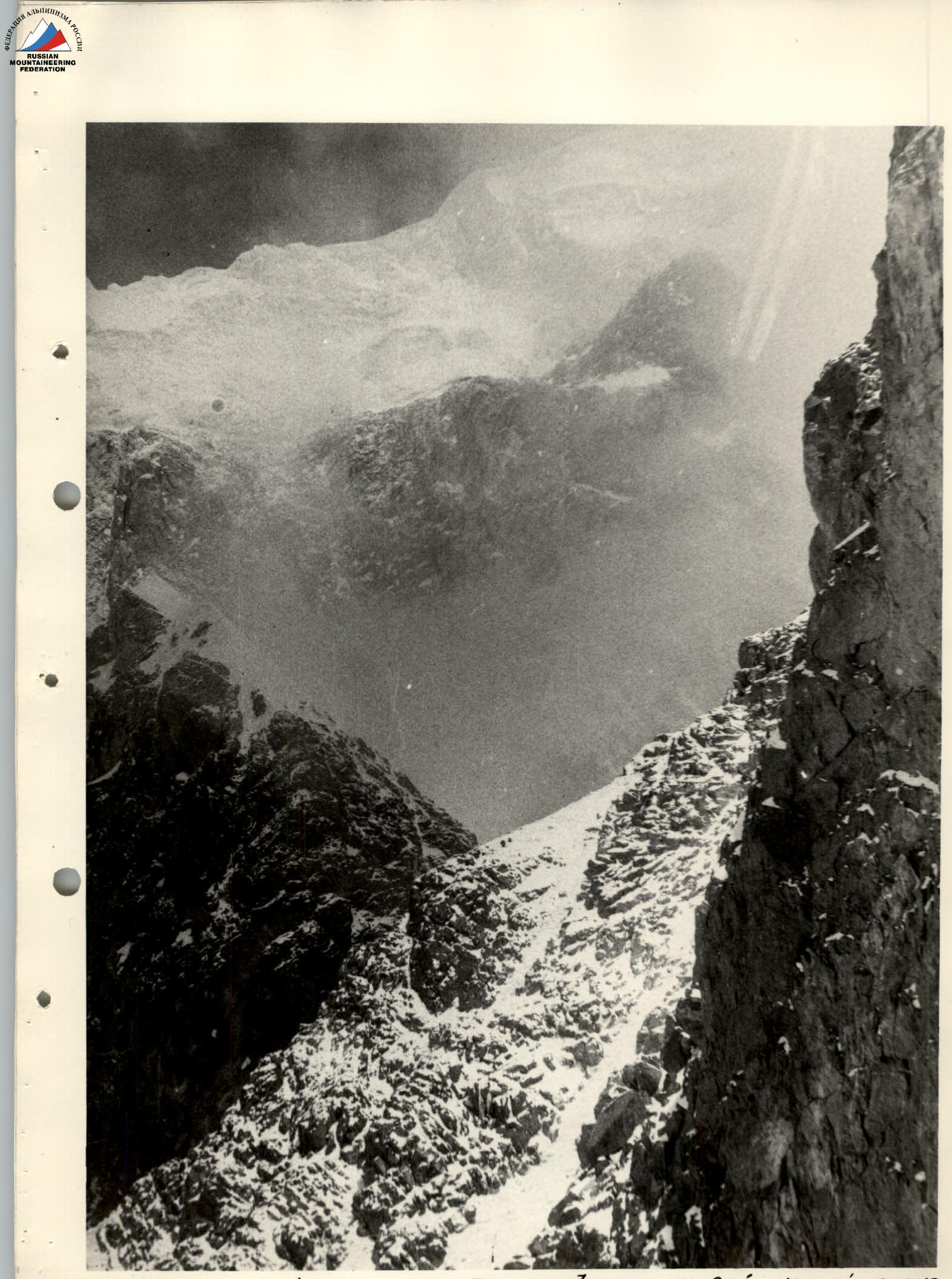
Photo #13. Section R27. Ascent route along the 2nd black wall. In the background, the ice cap of the southern wall.
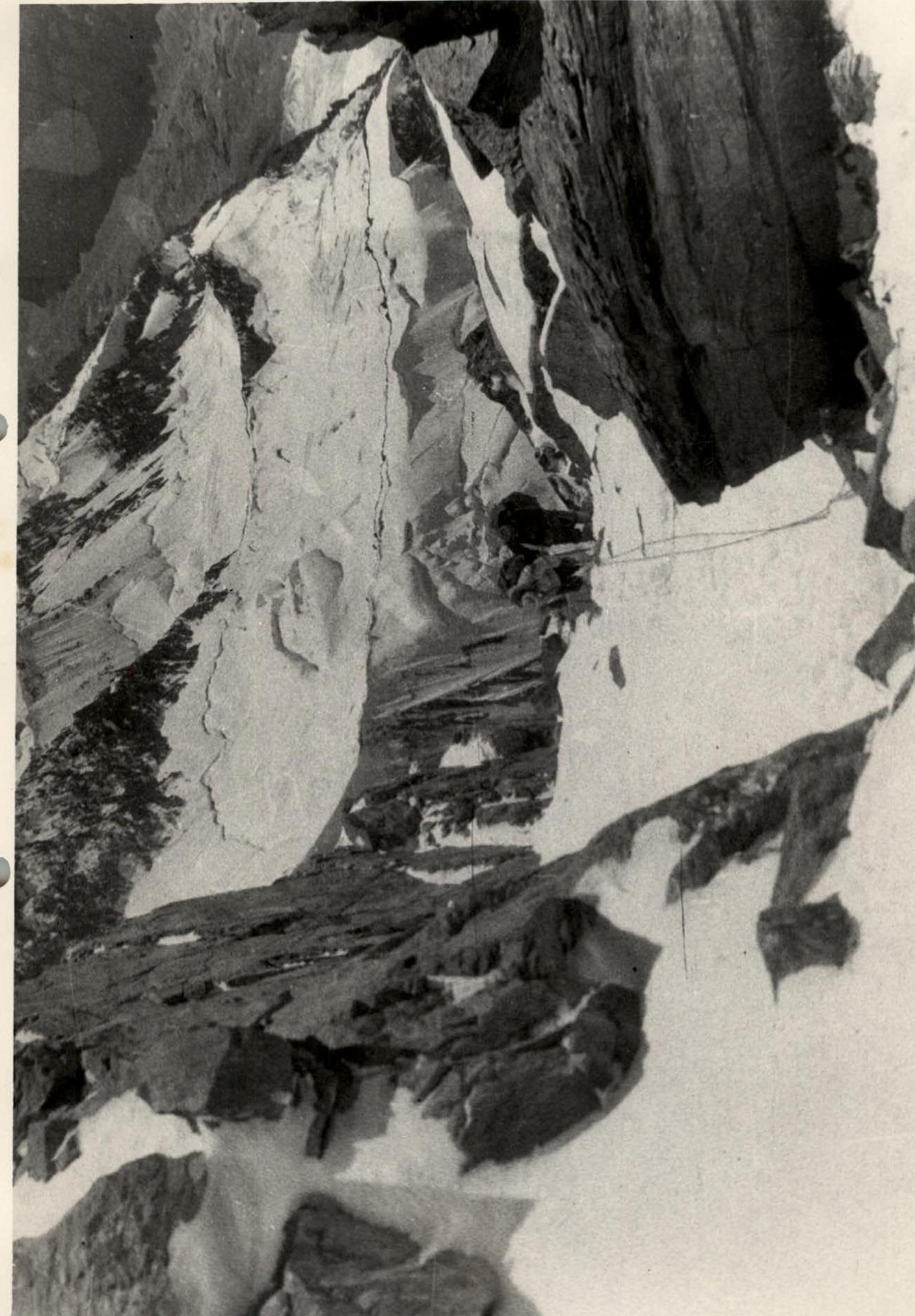
Photo #14. Exit on section R37 onto the southern ridge.

Comments
Sign in to leave a comment