
Passport
- High-altitude class.
- Pamir, Yazgulemsky Range.
- Peak Revolyutsii, 6974 m, via the NE wall from Fedchenko Glacier.
- Difficulty category — 6B.
- Height difference — 1675 m. Route length: 2425 m, wall section — 1114 m, sections of 5–6 difficulty level — 880 m, including 100 m of 6th difficulty level. Average steepness of the main (wall) part of the route — 63° (5300–6320 m), including 80° — 110 m, 85° — 60 m, 90° — 40 m.
- Use of protection points:
| Pitons | Placements | | :----------------------: | :-------: | :-------: | :-------: | | Rock | Bolt | Ice | | | 99 + 1* | 1* | 29 | 36 | | 6 | 0 | 0 | 2 |
- * previously organized protection points
- Team's total climbing hours — 38.5; 4 days.
- Overnight stays: 1 — in a tent on a good platform 2 — in a tent, semi-reclined 3 — in a tent, on a ridge.
- Team leader — Khusaenov Niyaz Mirgazyamovich, Candidate Master of Sports
Team members:
- Kraitor Sergey Grigoryevich, Candidate Master of Sports
- Pervov Sergey Ivanovich, Candidate Master of Sports
- Khakimullin Yuri Nurievich, Candidate Master of Sports
- Coach — Ryazanov Viktor Vasilyevich, Master of Sports of the USSR.
- Approach to the route — August 5, 1988.
Summit — August 8, 1988. Descent to Fedchenko Glacier — August 9, 1988.
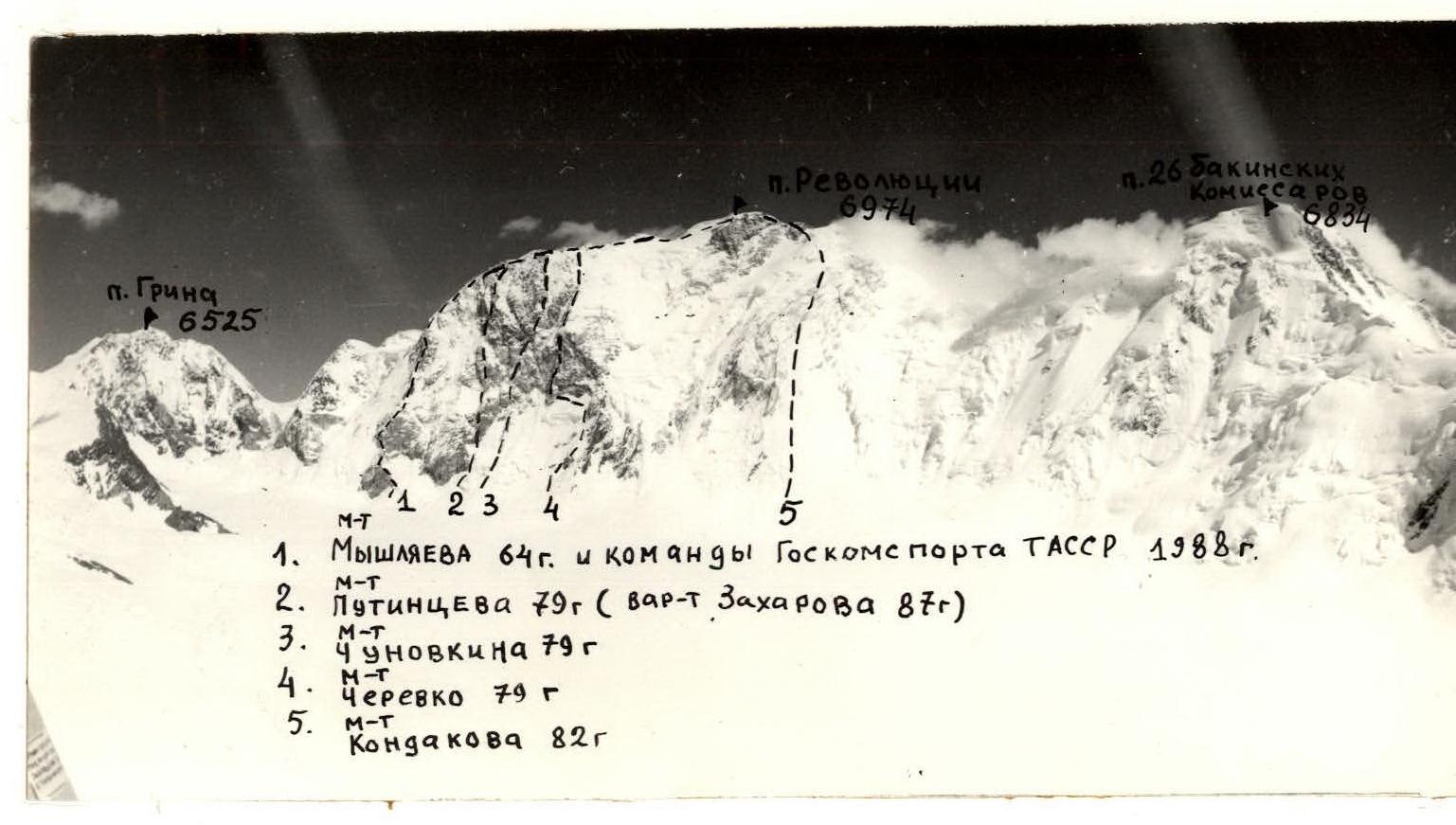
Photo of the general view of Peak Revolyutsii.
Brief overview of the climbing area
Peak Revolyutsii (6974 m), the fourth highest peak in the Pamir, is located in the Yazgulemsky Range, in the upper reaches of the Fedchenko Glacier. First conquered by Ugarov's team from the NE in 1954. This area is well-known in the mountaineering world, so there is no need to describe its geographical and climatic features. 5 routes have been ascended on the S wall of Peak Revolyutsii from Fedchenko Glacier, three of which (Myshlyaev, Putintsev, and Chunovkin) are of 6B difficulty level.
Characteristics of the S wall:
- The base of the S wall: 5200–5300 m.
- Height difference to the ridge varies from 1000 to 1200 m.
- Climbing conditions: harsh, due to heavy snow cover and glaciation of the wall.
- Illumination: the S wall starts getting sunlight from 12:00–14:00.
The routes were mostly ascended within the framework of the USSR Championships and are prize-winning.
There are several descent paths from Peak Revolyutsii:
- through Peak 26 Baku Commissars to Fedchenko Glacier (2 days);
- to Grum-Grzhimailo Glacier and further through two passes to Fedchenko Glacier (2–3 days);
- through Green Saddle Pass to Fedchenko Glacier (2 days);
- from the saddle with Peak 26 Baku Commissars down the icefall of the S wall to Fedchenko Glacier (6–8 hours).
The last descent path is the fastest but requires careful preliminary reconnaissance and study and is recommended to be used before the wall is exposed to sunlight.
Due to the inaccessibility of Peak Revolyutsii from the N, it is visited quite rarely, so the routes are not repeated often; some of them, such as Chunovkin's, have not been repeated to this day. According to incomplete data from the "Conquered Peaks" yearbook, the Myshlyaev route on the NE wall, chosen by our team, has been ascended only 3–4 times with large intervals:
- In 1964 — Myshlyaev;
- In 1967 — Nekrasov;
- In 1979 — Garkhnishvili, and judging by the note taken from the route, there was another ascent made by army mountaineers in the same 1979.
The most convenient approach to the S wall of Peak Revolyutsii is the path from the Vanch Valley along the Abdukagor Glacier through Abdukagor Pass (5100 m) and further along the Fedchenko Glacier. The approach takes 3 days due to the large height difference from the base camp in the Abdukagor Valley to Abdukagor Pass (3200–5100 m) and the complexity of traversing the heavily crevassed upper reaches of the Abdukagor Glacier. The path from Abdukagor Pass to Peak Revolyutsii is technically simple but laborious during the day due to the soft snow cover. It is best to cover the 12 km segment along the Fedchenko Glacier at night on frozen snow using special collapsible sleds for cargo.
The base camp at the tongue of the Abdukagor Glacier in the upper reaches of the Vanch Valley can be reached by car. The challenging part is the road section through the terminal moraine of the Medvezhiy Glacier and further wading through its main stream, as this road is only maintained by geologists and is often destroyed by glacier movements. It takes 6–9 hours to drive from Vanch settlement to the base camp by car.
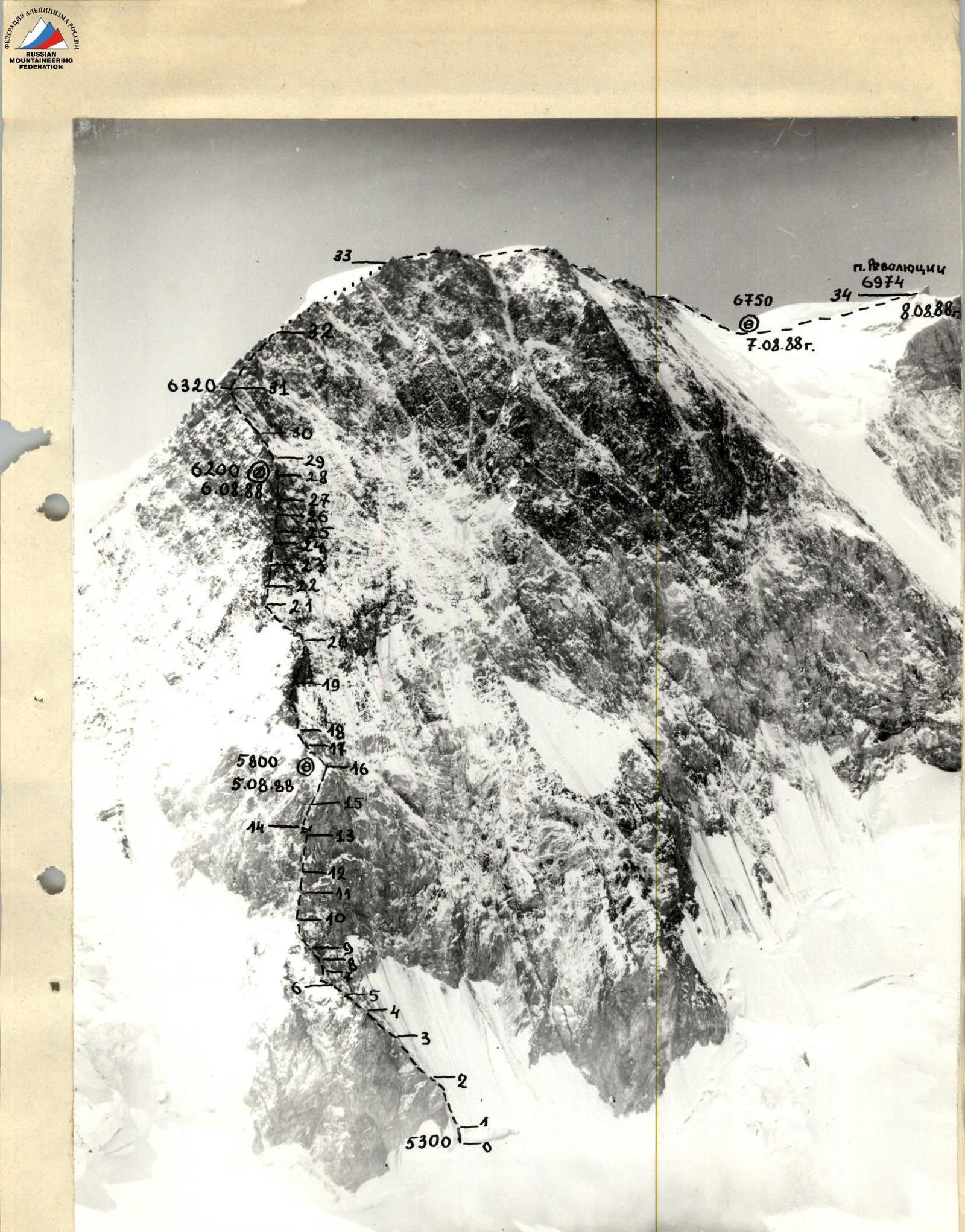
Technical photo of the route. (Shooting point #2, H = 5600 m, = 3.5 km, "Lyubitel-166-V", lens T-22, = 75 mm, 15 hours)

Area map.
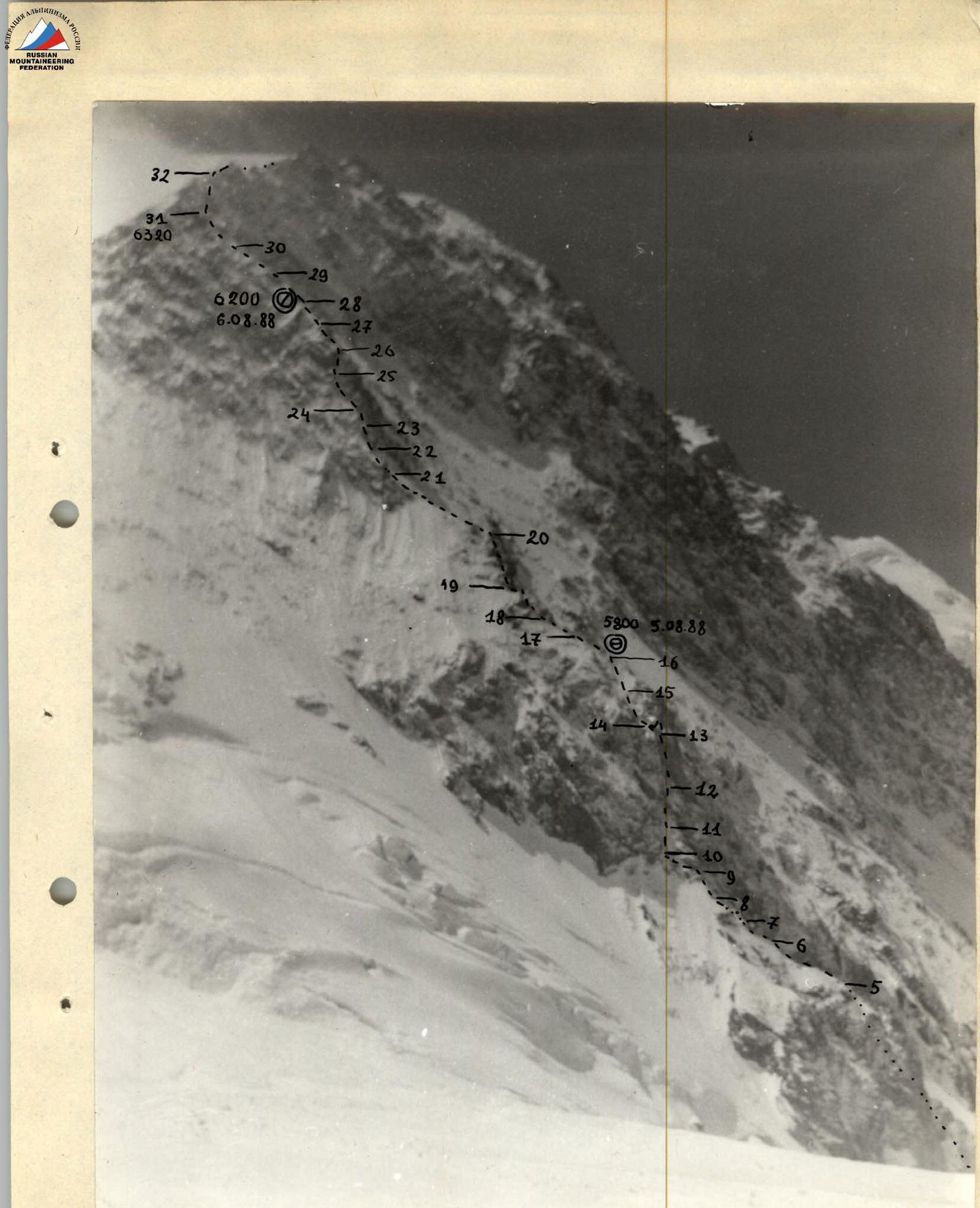
Route profile from the left. (Shooting point #1, H = 5400 m, = 2 km, "Lyubitel-166-V", lens T-22, = 75 mm, 13 hours)
Route scheme according to UTSA. M 1:5000 (wall section)
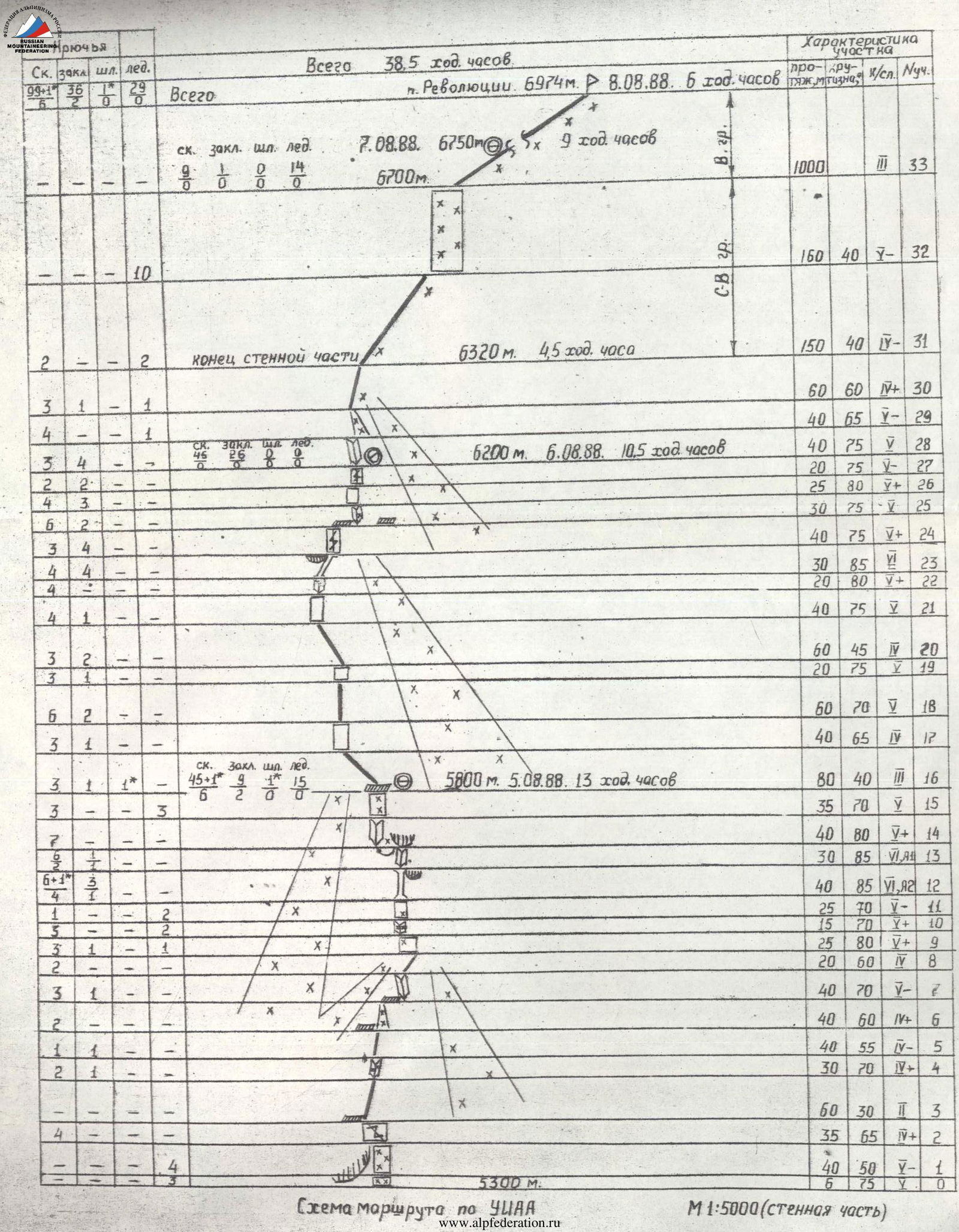
| R | Length (m) | Steepness (°) | Diff. level |
|---|---|---|---|
| 33 | 1000 | ||
| 32 | 160 | 40 | |
| 31 | 150 | 40 | 5 |
| 30 | 60 | 60 | 5 |
| 29 | 40 | 65 | 5 |
| 28 | 40 | 75 | 5 |
| 27 | 20 | 75 | 5 |
| 26 | 25 | 80 | 5 |
| 25 | 30 | 75 | 5 |
| 24 | 40 | 75 | 5 |
| 23 | 30 | 85 | 5 |
| 22 | 20 | 80 | 5 |
| 21 | 40 | 75 | 5 |
| 20 | 60 | 45 | 5 |
| 19 | 20 | 75 | 5 |
| 18 | 60 | 70 | 5 |
| 17 | 40 | 65 | 5 |
| 16 | 80 | 40 | 5 |
| 15 | 35 | 70 | 5 |
| 14 | 40 | 80 | 5 |
| 13 | 30 | 85 | 6 |
| 12 | 40 | 85 | 6 |
| 11 | 25 | 70 | 5 |
| 10 | 15 | 70 | 5 |
| 9 | 25 | 80 | 5 |
| 8 | 20 | 60 | 4 |
| 7 | 40 | 70 | 4 |
| 6 | 40 | 60 | 4 |
| 5 | 40 | 55 | 4 |
| 4 | 30 | 70 | 4 |
| 3 | 60 | 30 | 3 |
| 2 | 35 | 65 | 3 |
| 1 | 40 | 50 | 3 |
| 0 | 6 | 75 | 3 |

Descent path. (Shooting point #2, H = 5600 m, = 3.5 km, "Lyubitel-166-V", lens T-22, = 75 mm, 15 hours)
Tactical actions of the team
The tactical plan for the ascent was made based on the results of visual observation of the route during the day on August 4. The experience of detailed reconnaissance of the area and routes on the S wall of Peak Revolyutsii in 1986 was also taken into account. Since there was severe weather in the area from July 31 to August 2, the probability of more significant snow cover and ice formation on the rocks than usual was considered. Assessing the state of the route was complicated by the fact that it had not been visited for a long time (since 1979) and there was no available information in the form of reports.
It was planned to ascend the route with two overnight stays on the wall and one on the NE ridge. The overnight stay locations were chosen on ridge sections of the wall for proper rest. Stops for the night were planned for 19:00–20:00 with a reserve of 2–3 hours of daylight to prepare the platform for the tent or clear it of snow and ice.
The tactical plan (see appendix) was executed on time, and the team even ahead of schedule during the wall section, which allowed them to stay within the planned timeframe despite the challenging weather conditions during the ridge section. The team's advance on the tactical plan on the 2nd and 3rd days was facilitated by:
- good acclimatization of team members during the training camp on the 10th Pamiro-Alai;
- high technical and physical preparedness;
- optimal selection of equipment and food in terms of quality and weight.
The route on the NE wall of Peak Revolyutsii (Myshlyaev) is apparently the safest from the north, as it passes along the junction of the NE and N walls. The danger of avalanches exists only on sections R0–R3, but they make up only 2 ropes, which were passed early in the morning. There are no signs of avalanches or rockfalls on the rest of the route. The walls at such heights are usually snow-covered and icy, and the route on the NE wall is no exception, which complicates the ascent. However, this state of the rocks also has a positive side — it reduces the likelihood of rockfalls. The weather generally favored the ascent; only on the third and especially the fourth day, there was a strong headwind, sometimes reaching storm force. The wind picked up early in the morning on August 7, during the 2nd overnight stay, and was the reason for a later start than usual (see the time graph of movement).
During the ascent of the wall section (sections R0–R3, R7–R16, R18–R20, R21–R31), the team adhered to the following movement scheme:
- The first climber passed the section on a double rope (one of which was from GDR) with a tape shock absorber.
- The second used a Soviet rope as a handrail, and the GDR rope served as upper protection.
- The third passed the section on double handrails (both ropes were Soviet).
- The fourth also moved along the handrails but with upper protection.
Thus, on all complex sections, all participants had double protection. On the remaining sections, the team worked in pairs, using a single Soviet rope and applying when necessary:
- simultaneous protection (sections R16–R17, R31–R32, R33–R34);
- alternate protection (sections R3–R7, R17–R18, R20–R21, R32–R33).
The protection points organized by the first rope team were used and then removed by the second rope team. This movement scheme ensured an optimal pace. The leaders in the team changed every day:
- on the first day, Khusaenov was the leader;
- on the second — Pervov;
- on the third — Kraitor;
- on the fourth — Khusaenov again.
Khakimullin, the most experienced in such work, usually worked as the last in the group. Pitons were not left on the route; instead, several pitons from previous teams were removed as they were no longer reliable due to being gradually pushed out of the cracks by ice. The first in the group worked with a lightened (3–4 kg) backpack, which was pulled up in particularly difficult sections (R12–R15, R23–R25). This distribution of the load allowed the team to complete the entire route with free climbing. When moving to sections that required a single rope, the first climber was loaded with the freed equipment. The weight of the backpacks of the other participants ranged from 11–12 kg (at the beginning of the route) to 8–9 kg (at the end); backpacks were carried on the back, and only on particularly steep sections (R12–R15, R23–R25) were they carried "American style," hung under the body.
The food ration was calorie-rich and diverse, including restorative medications. The weight of the daily ration was 600–700 g per person. A sufficient supply of fuel — 1.2 liters of gasoline and 2.5 liters of hexane (light fraction of gasoline) — allowed for hot meals twice a day and a sufficient amount of drinking water for such heights.
The group had two autonomous first-aid kits, including everything necessary for first aid, such as:
- cardiac and pain-relieving medications;
- syringes;
- means against hypothermia and frostbite.
There were no cases of falls, injuries, or frostbite on the route.
Backup and observation of the team were carried out by a group of qualified rescuers (4 people) and a doctor-reanimatologist Semenov A.V., who had a basic first-aid kit. At their disposal were:
- a supply of equipment sufficient to repeat the route;
- an 8x binocular;
- 2 VHF radio stations "Dnepr," providing communication at a distance of up to 15–20 km;
- collapsible sleds suitable for transporting a victim.
In addition to the rescue team members, two more mountaineers of the 1st sports category and 2nd category were present under the route as assistants. If necessary, a messenger could reach Abdukagor Pass in 3 hours, from where there was reliable radio communication with the base camp in the eponymous valley. Moreover, starting from the evening radio communication on the first day, the team had radio communication with the base camp twice a day.
The nearest point where a helicopter can land is the meteorological station on the Fedchenko Glacier, 30–35 km from the Peak Revolyutsii massif — 10–12 hours away on foot. The presence of their own expeditionary all-terrain vehicle KAMAZ, which was in the base camp, made it possible, if necessary, to carry out emergency transportation to the Vanch settlement in 4–5 hours.

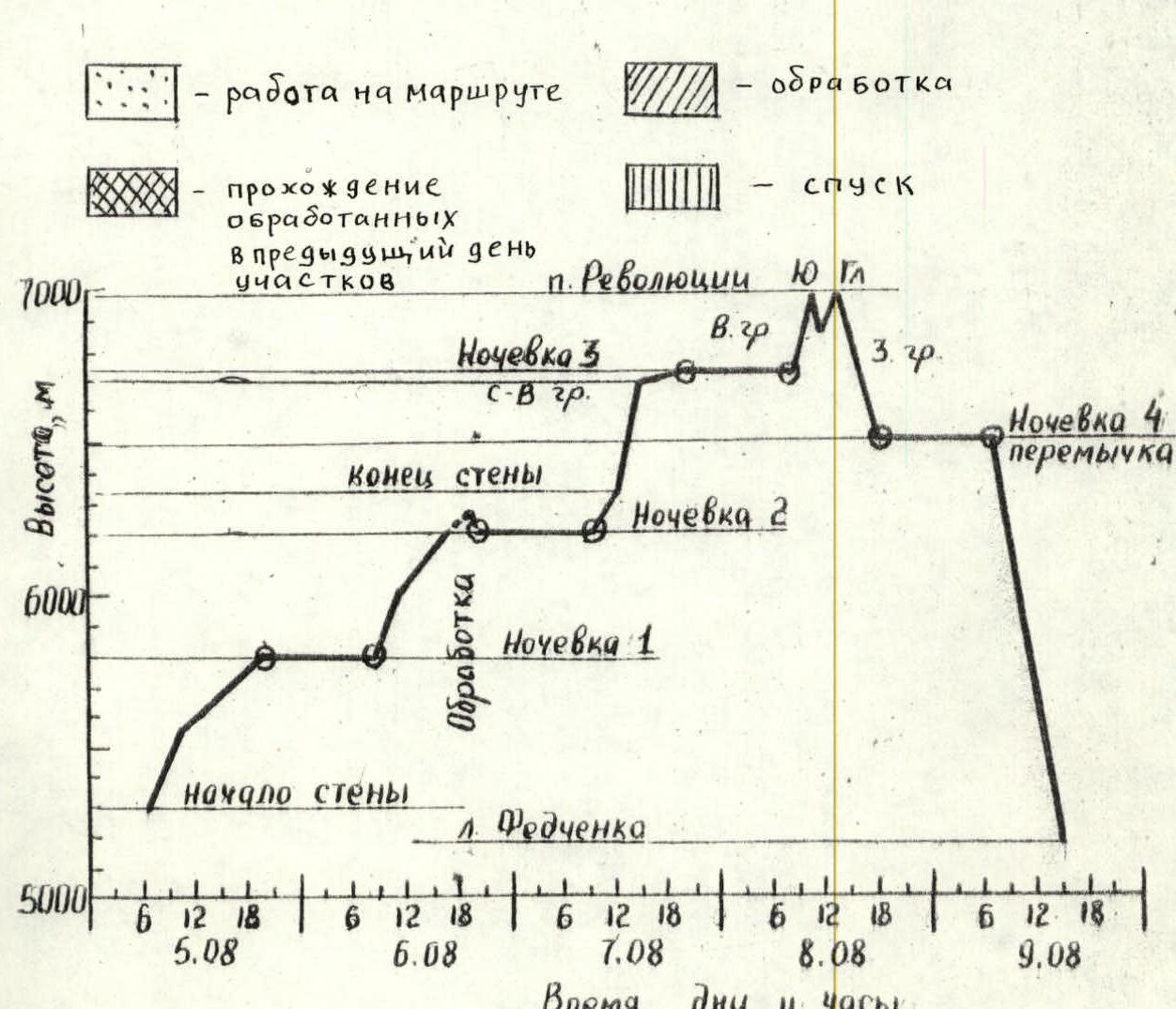
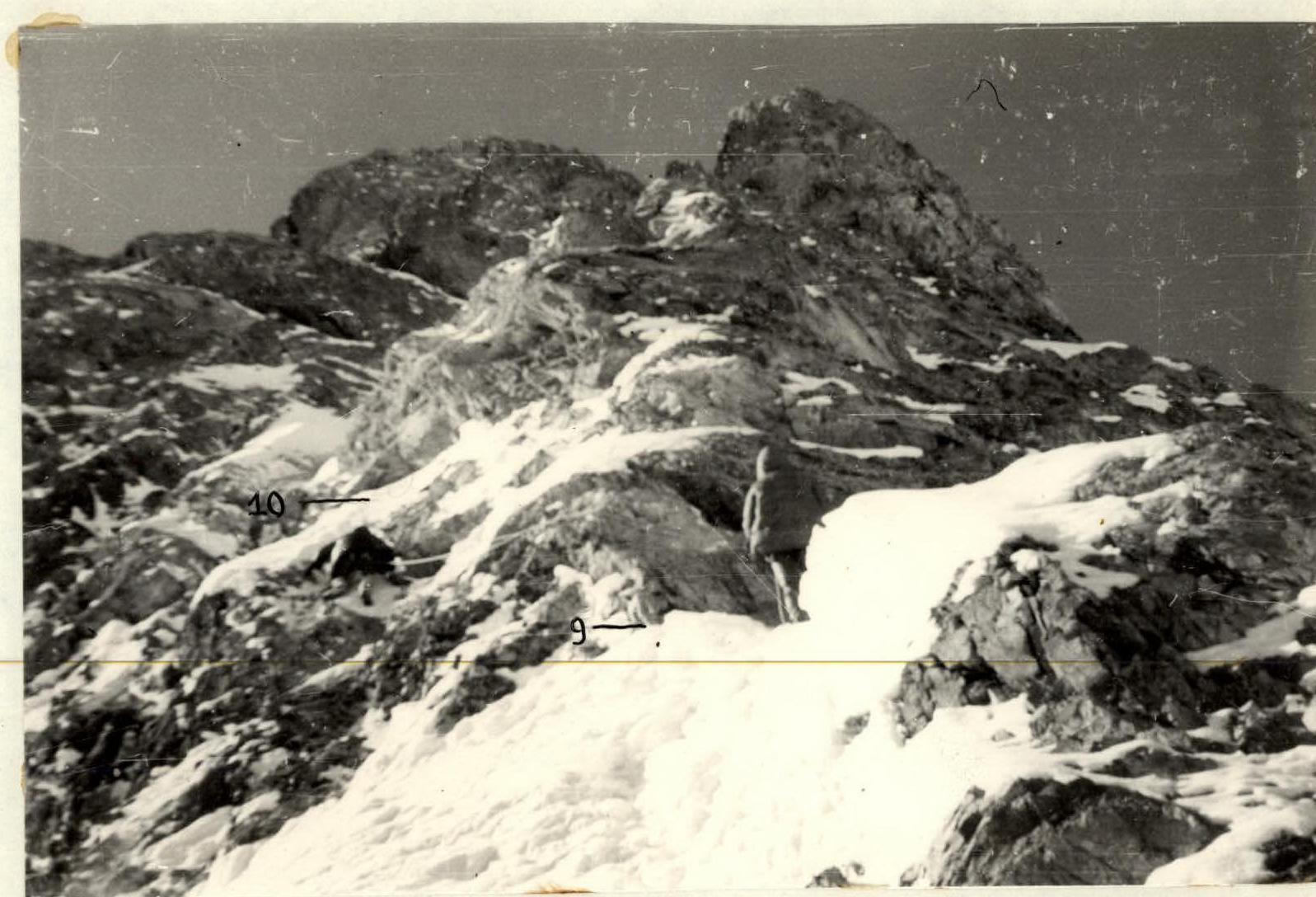
Photo 2. Sections R8–R11. Traverse under the beginning of the inner corner.
Time, days and hours (Legend: work on the route, processing, passage of processed sections from the previous day, descent, strong wind, very strong wind, blizzard. Points: Start of the wall, Overnight stay 1, Overnight stay 2, End of the wall, Overnight stay 3, Peak Revolyutsii, Overnight stay 4 on the saddle.)

Comments
Sign in to leave a comment