
29
TECHNICAL CLIMBING CATEGORY
REPORT
Paustovsky's report on the ascent of Peak 6150 m / Peak S.A. Lavochkin / via the ice wall of the southwest ridge by the MOS DSO "ZENIT" mountaineering team, Pamir, August 1970
GEOGRAPHICAL LOCATION
The gathering place for the MOS DSO "ZENIT" mountaineers in 1970 was the area of Peak Revolution on the Central Pamir, with the base camp located in the upper reaches of the Yazgulem-Dara valley. The goal of the ascent was Peak 6150 m in the southwest ridge of Peak "26 Baku Commissars".
The dominant peaks of the area are six-thousanders located in the northern part of the valley:
- Peak Revolution,
- Peak 26 Baku Commissars,
- Peak Paris Commune.
The southern slopes of these peaks give rise to the Yazgulem-Dara glacier, and the northern slopes to one of the largest glaciers in the world - the Fedchenko Glacier.
CLIMBING CONDITIONS
The remoteness - over 100 km from populated areas and roads - significantly complicates the organization of expeditions to this area. Only in 1967 did the first mountaineering expedition of CSKA athletes arrive here, organized with the goal of studying the area and identifying the most interesting routes for ascents for the USSR championship.
The expedition obtained a lot of interesting data, made first ascents:
- on Peak Shipka via the western rib,
- on Peak Bulgaria, etc.
The large altitude difference - up to 3 km or more, the steepness of the slopes, the possibility of new routes on such peaks as Peak Revolution, Peak 26 Baku Commissars, etc. - all this makes the area very promising.
Climatic conditions in this area are quite favorable. In the summer months, stable clear weather is noted here. However, at altitudes close to 6000 m, winds often blow at speeds of up to 10–20 m/s, and the temperature drops to 25–30 °C at night.
The army expedition served as the beginning of mountaineering development in this area. In the next two years, routes of the highest difficulty category were first laid:
- on Peak Revolution via the southwest wall,
- on Peak 26 Baku Commissars from the south,
- the traverse of Peak Revolution - Peak 26 Baku Commissars was completed.
These ascents were awarded prizes in the USSR mountaineering championship.
PREPARATION FOR THE ASCENT
The MOS DSO "ZENIT" mountaineering team, together with the CS DSO "ZENIT" team, arrived in the district center of Rushan on July 4. The delivery of people and cargo to the site of the base camp was carried out from the Rushan airfield by helicopter. On July 7, all work on the organization of the base camp was completed on a large flat green site at the tongue of the Yazgulem-Dara glacier, at an altitude of 3700 m.
Reconnaissance exits and training ascents were planned to:
- study a larger area,
- choose the most interesting routes for ascents,
- give athletes the opportunity to acclimatize at high altitudes.
On July 9, the entire expedition made an exit to:
- scout the path through the glacier,
- study the approaches to the peaks in the area of Peak Paris Commune and Peak Revolution.
Two days later, a group of four people, including team member Volokonsky, went on an ascent of Peak 4678 (Peak Bartang). In addition to training goals, the group was tasked with making a preliminary reconnaissance of the route to Lyap-Nazar (5988) - one of the notable peaks in the area.
On July 14, a group of five people went to Peak Bulgaria (5666) via Peak 5600.
The team members Kumandin and Volokonsky were part of this group.
At the same time, a group including team members Efimov, Strelnikova, and Naryshkin went to Peak Shipka. The height of Peak Shipka is 6254 m. All these ascents were successful.
From July 23 to 25, a group of four people, including Volokonsky, made a first ascent of Peak 5100 (Rainbow), conducting reconnaissance of the path to Lyap-Nazar.
From July 27 to 30, a group of four people, including Kumandin and Volokonsky, made an ascent of Peak 50 Years of the Armed Forces (5682 m).
For the ascent of Peak 6150, a team was formed consisting of:
- Efimov O.N. - leader, 1st sports category.
- Strelnikova A.I. - participant, Master of Sports.
- Naryshkin B.N. - participant.
- Volokonsky V.V. - participant.
- Kumandin A.G. - participant.
ORGANIZATION OF THE ASCENT
Considering the features of the route - the presence of ice and snow wall sections, as well as rocky ridge and wall sections - in addition to standard equipment, the group had:
- Ice screws (titanium) - 16 pcs.
- Rock anchors (titanium) - 8 pcs.
The group took one high-altitude tent, which had proven itself well in bad weather and strong winds. To reduce the weight of the equipment, a 4-person sleeping bag was taken.
The amount of food was calculated at 650 g of dry rations per person per day.
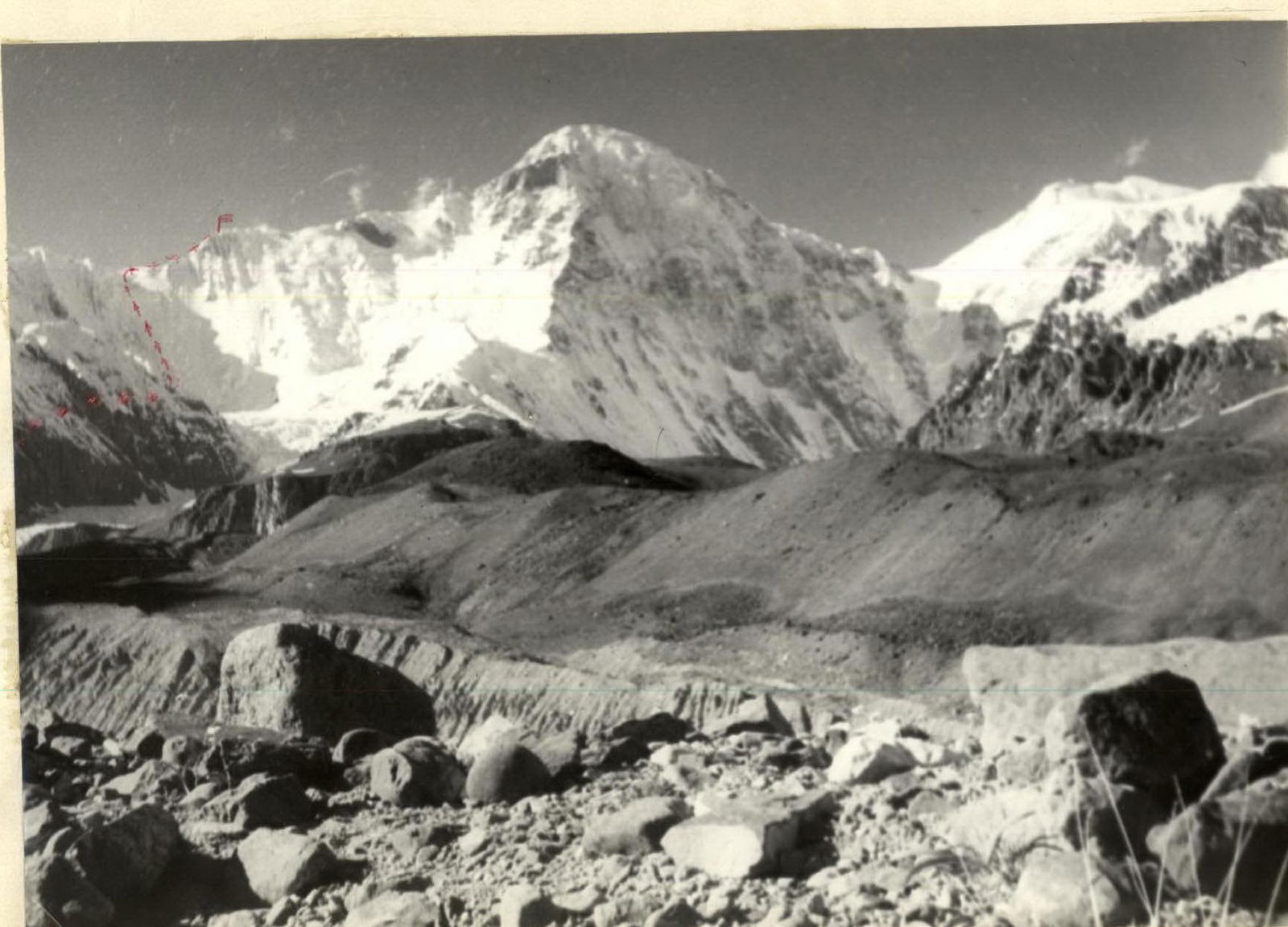 View of the wall and Peak 6150 from the base camp. The goal of the ascent was Peak 6150 m in the southwest ridge of Peak "26 Baku Commissars". The MOS DSO "ZENIT" team participated in the ascent, consisting of:
- Efimov O.N. - leader, 1st sports category.
- Strelnikova A.I. - participant, Master of Sports.
- Naryshkin B.N. - participant, Master of Sports.
- Volokonsky V.V. - participant, Master of Sports.
- Kumandin A.G. - participant, Master of Sports.
All participants, as part of their acclimatization training, made two ascents of category 4 difficulty at altitudes over 5 thousand meters in the Yazgulem-Dara valley area in 1970.
According to the tactical plan, it was assumed to start the ascent from the base camp located at the Yazgulem-Dara glacier, with the following time breakdown:
DAY 1 – Departure from the camp and overnight stay at the turn of the Yazgulem-Dara glacier on the right (orographic) moraine. DAY 2 – Crossing the glacier and approaching the start of the route. DAY 3-4 – Overcoming the ice and snow wall with an exit to the ridge. DAY 5 – Ascent to the summit and descent to the overnight stay on the ridge. DAY 6 – Descent to the Fedchenko Glacier. DAY 7 – Exit to the Khurdjin pass. DAY 8 – Return to the base camp. DAY 9 – Reserve for bad weather.
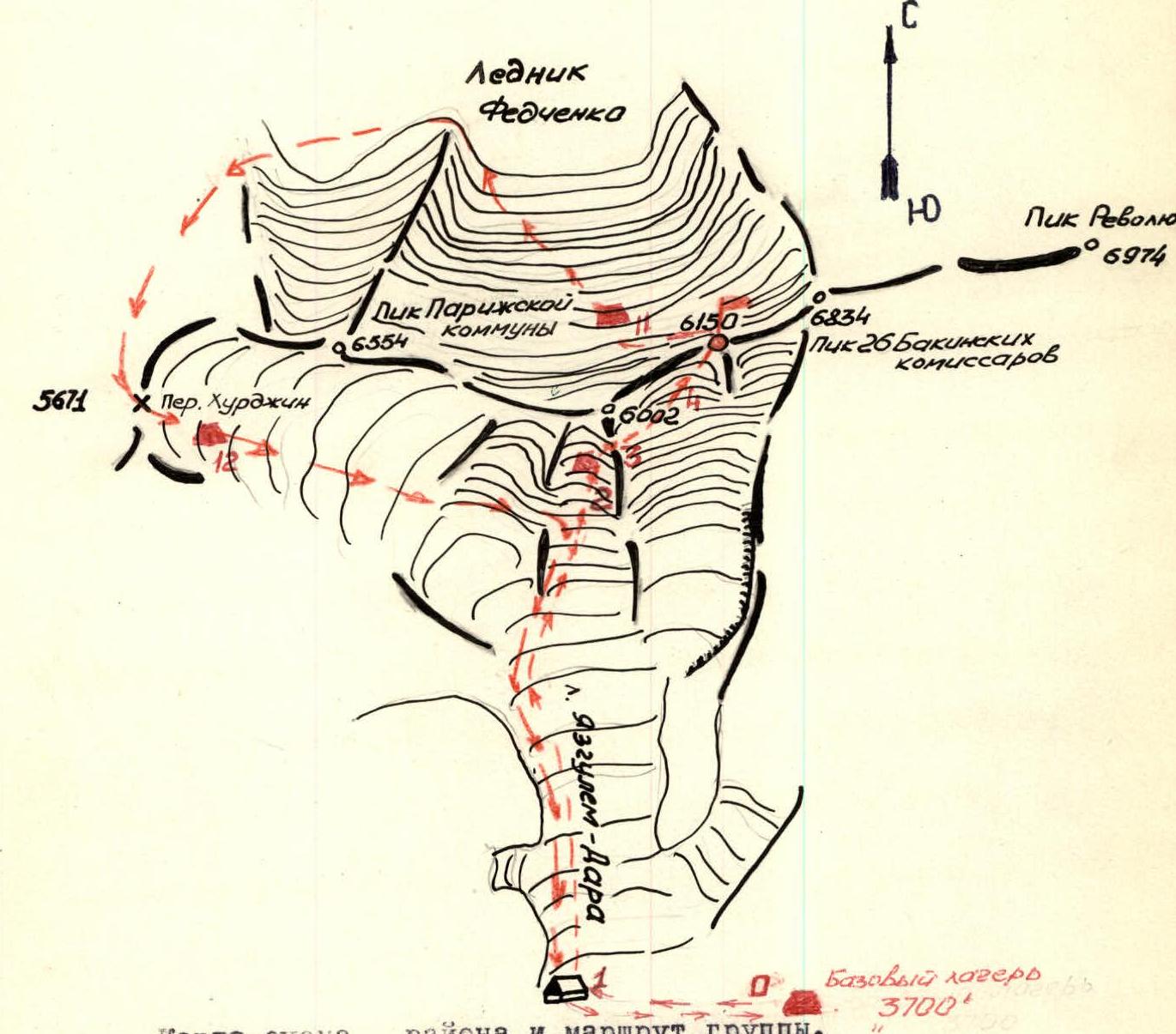
Map-scheme of the area and the group's route. To ensure safety, radio communication was maintained with the base camp (communication time 9:00 and 19:00). In addition, the main part of the route - the ascent up the wall and the exit to the ridge - was visually observed from the base camp.
The entire ascent took 9 days, and the tactical plan was largely fulfilled.
On July 31, the group left the base camp at 15:00 and climbed up the right-bank moraine (orographic) of the Yazgulem-Dara glacier, composed of large stones, for about two hours. Overnight stay on the moraine at the turn of the glacier.
August 1. Departure at 8:00. Movement in rope teams on crampons across a heavily crevassed glacier. Overcoming two icefalls. At 15:00, the group reached the hanging glacier descending from the saddle between peak 6002 and "Paris Commune" and stopped for the night on a small moraine on the left (orographic) bank of the glacier in the area of three snow couloirs leading to the upper cirque of peak "26 Baku Commissars".
The right-hand couloir was chosen for the ascent (see photo 2).
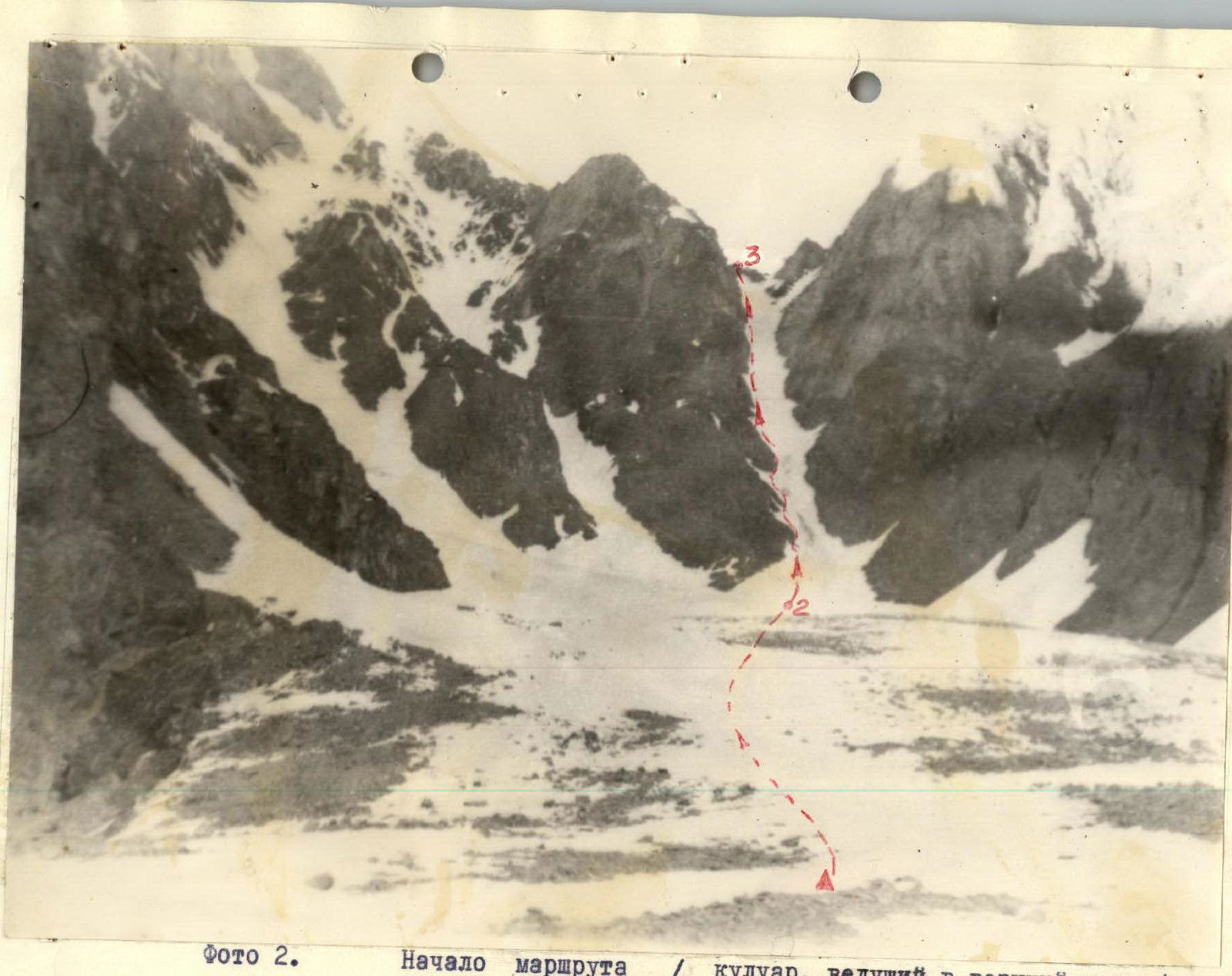 Photo 2. The start of the route - the couloir leading to the upper cirque.
August 2. Due to the steepness of the couloir (about 40–50°) and the possibility of rockfall, the group started on the route at 5:30.
The couloir is snow-firn. It was traversed on crampons with simultaneous movement of rope teams and careful observation of the upper part. At 9:00, the group reached the upper cirque. Crossing the cirque and approaching the snow and ice wall took 30 minutes.
At 9:00, the ascent up the left (by direction) edge of the wall began (see photo 3). Three ropes were passed to the first buried bergschrund (section R4–R5). Snow work. Movement in three steps with simultaneous movement of rope teams. The slope steepness is about 20–25°.
Further, the slope becomes steeper, in places up to 40–50° (section R5–R6). A thin layer of snow on the ice, ice work, in places - step cutting. Movement is alternate with rope teams and anchor protection. About 8 ropes were passed. A total of 22 ice anchors were hammered in for the day.
Approaching the wall and moving along the wall took 12 hours. The group stopped for the night at 18:00 under the first serac, organizing an artificial platform (see photo 3).
August 3. Departure on the route at 9:00.
- Slope steepness from 40 to 50°
- Section R6–R7
- Ice work
- 26 ice anchors hammered
- Overnight stay under the second serac
In total, the group was on the route for 8 hours that day. The weather is deteriorating. Average cloudiness, gusty wind, and snow showers.
August 4. Departure from the overnight stay at 7:00. The weather continues to deteriorate. It snows almost all day. Visibility is sometimes reduced to 20 m.
On this day, the group overcomes:
- two crevasses on snow bridges with rope team extraction.
The slope steepness when exiting to the ridge is up to 40° (section R7–R8). Fresh deep snow on ice. Movement in rope teams with alternate protection:
- through ice axes,
- in places - through ice anchors.
A total of 5 anchors were hammered. At 13:15, the group reached the ridge. On the ridge under the summit, there is a convenient and safe depression, bounded on the side of the Fedchenko Glacier by rocky outcrops.
Due to the deterioration of the weather, the group stopped for the night at 15:00. Height about 5900 m. From the overnight stay. The route to the summit along the snow tongue between two gendarmes with an exit to the steep rocky ridge was reviewed.
The group was on the route for 8 hours that day.
August 5. Due to poor visibility, the group started on the route at 10:00. To the rocky ridge, movement was alternate on crampons with protection through ice anchors (2 ropes). Further movement along the destroyed rocks with alternate protection through outcrops and rock anchors. A total of 16 rock anchors were hammered on the route. After 7 ropes, the slope begins to ease. 4 rocky gendarmes were passed. Before the depression of the ridge towards peak "26 Baku Commissars", a cairn was built. The depression is a snow, not clearly defined ridge. The peak was named Peak S.A. Lavochkin in honor of the famous Soviet aircraft designer.
Descent to the overnight stays by climbing down with alternate protection and organization of rappel points. 3 sports rappels with rope extraction. 4 rock anchors and loops were left. Approach to the overnight stays by 18:00. Dry snow is falling, sharp, gusty wind. The group was on the route for 8 hours that day.
The main part of the ascent took a total of 36 hours. August 6. At 7:00, the descent from the overnight stay towards the Fedchenko Glacier began. Steep ice under the snow. The slope steepness reaches 40–50°. Movement with alternate protection through an ice axe. 5 ropes were passed. Exit to two rocky outcrops.
The descent was carried out as follows:
- Sports rappel to a rocky outcrop with the leaving of a loop and an ice anchor.
- 2 rock anchors were hammered into the rocks.
- Sports rappel to the icefall.
- Overcoming the bergschrund (height difference about 4 m).
- Exit to the ice ledge.
- Through a steep ice chimney (2 ice anchors with loops were left) - exit to a clean and steep ice slope (steepness more than 50°).
- Descent by sports rappel with rope extraction - 150 m.
- 4 ice anchors with loops and one carabiner were left.
- Overcoming the bergschrund (height difference 2.5 m).
Further descent along the steep snow slope to the Fedchenko Glacier. Simultaneous movement.
At 20:00, the group stopped for the night, moving away from the icefalls and avalanche-prone slopes.
The descent took a total of 13 hours. The route is shown in photo #4.
August 7. Bypassing the Paris Commune massif and crossing the Khurdjin pass. Overnight stay on the second ice field under the pass.
August 8. Crossing the glacier and two icefalls. Return to the base camp at 15:00.
In total, the main part of the ascent - the ascent up the wall with an exit to the summit and descent to the Fedchenko Glacier - took 49 working hours.
GENERAL ASSESSMENT OF THE PARTICIPANTS' ACTIONS
All participants showed good technical and moral-volitional preparation, and were physically well-prepared. The cohesive team composition allowed for an even and rational distribution of the participants' forces on the route. Both rope teams changed places along the way, which enabled maintaining a good pace of movement. The successful ascent of Peak 6150 was also facilitated by the inherent sense of collectivism and camaraderie within the team.
CONCLUSION
The ascent represents a combined ice and rock route. The total altitude gain is 2450 m. On the main section, it is 900 m. The route corresponds to category 5B difficulty.
Team leader:
- Efimov O.N. Participants:
- Strelnikova A.I.
- Naryshkin B.N.
- Volokonsky V.V.
- Kumandin A.G.


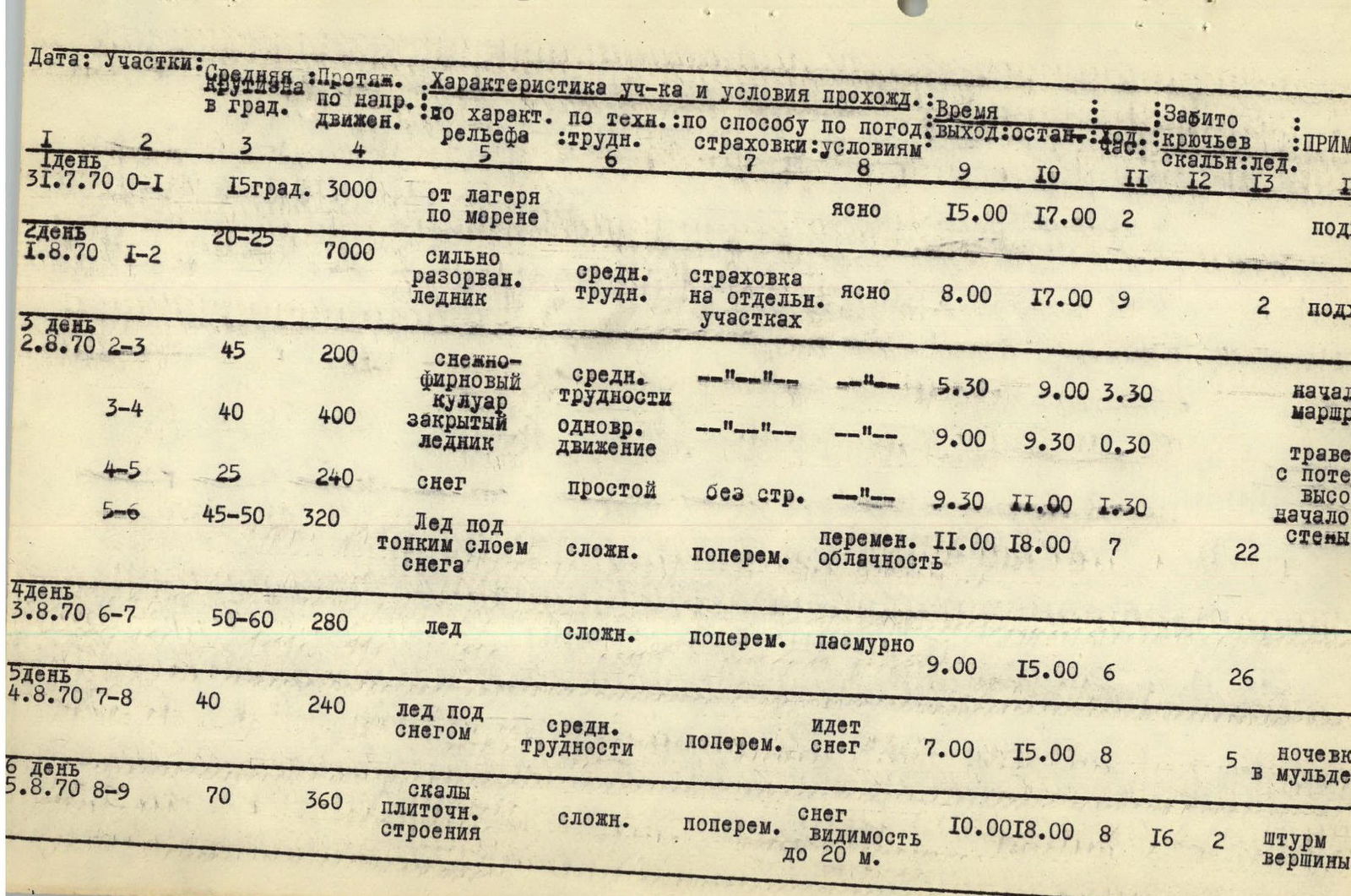
| Date / Sections | Average slope, ° | Length, m | Description of the section and climbing conditions (relief) | Technical difficulty | Protection method | Weather conditions | Departure time | Stop time | Travel time | Hammered anchors: rock | Hammered anchors: ice | Notes |
|---|---|---|---|---|---|---|---|---|---|---|---|---|
| 31.7.70 | 0–1 | 15° | 3000 | From camp along the moraine | clear | 15:00 | 17:00 | 2 | ||||
| 2nd day | ||||||||||||
| 1.8.70 | 1–2 | 20–25° | 7000 | Heavily crevassed glacier | Medium difficulty | Protection on individual sections | clear | 8:00 | 17:00 | 9 | 2 | |
| 3rd day | ||||||||||||
| 2.8.70 | 2–3 | 45° | 200 | Snow-firn couloir | Medium difficulty | 5:30 | 9:00 | 3 h 30 min | ||||
| 3–4 | 40° | 400 | Closed glacier | Simultaneous movement | 9:00 | 9:30 | 30 min | |||||
| 4–5 | 25° | 240 | Snow | Simple | Without protection | 9:30 | 11:00 | 1 h 30 min | ||||
| 5–6 | 45–50° | 320 | Ice under a thin layer of snow | Complex | Alternate | cloudy | 11:00 | 18:00 | 7 | 22 | ||
| 4th day | ||||||||||||
| 3.8.70 | 6–7 | 50–60° | 280 | Ice | Complex | Alternate | overcast | 9:00 | 15:00 | 6 | 26 | |
| 5th day | ||||||||||||
| 4.8.70 | 7–8 | 40° | 240 | Ice under snow | Medium difficulty | Alternate | Snowing | 7:00 | 15:00 | 8 | 5 | |
| 6th day | ||||||||||||
| 5.8.70 | 8–9 | 70° | 360 | Rocks of slabby structure | Complex | Alternate | Snow, visibility up to 20 m. | 10:00 | 18:00 | 8 | 16 | 2 |
| 7th day | ||||||||||||
| 6.8.70 | R9–R10 | 50° | 640 | Ice under snow | Complex | Alternate | Snow, visibility 30 m. | 7:00 | 19:00 | 12 | 2 | |
| R10–R11 | 30° | 320 | Snow | Simple | Simultaneous | 19:00 | 20:00 | 1 | ||||
| 8th day | ||||||||||||
| 7.8.70 | R11–R12 | 20° | 8000 | Closed glacier | Simple | Simultaneous | 8:00 | 19:00 | 11 | |||
| 9th day | ||||||||||||
| August 8 | 12-0 | 20–15° | 7000 | Overcoming icefalls | Medium-complex | Protection on individual sections | overcast | 6:00 | 15:00 | 9 | 2 |
TOTAL: Travel hours – 79 h. Hammered anchors: rock – 18 pcs. ice – 75 pcs.