

USSR Climbing Championship
1983
High-altitude technical ascents class
Report
on the ascent to peak "6100" via the northeast wall by the team of the Georgian Sports Committee
FIRST ASCENT
Team leader: Gheldiashvili I.A.
Deputy team leader: Tarkhnishvili D.I. 380012, Tbilisi, Bakinskaya St., 10, tel. 95-08-55
Team coach: Giuashvili R.I. 380004, Tbilisi, Kirova St., 14
Georgia Alpine Club: 380009, Tbilisi, Lenina St., 37, tel. 93-26-38
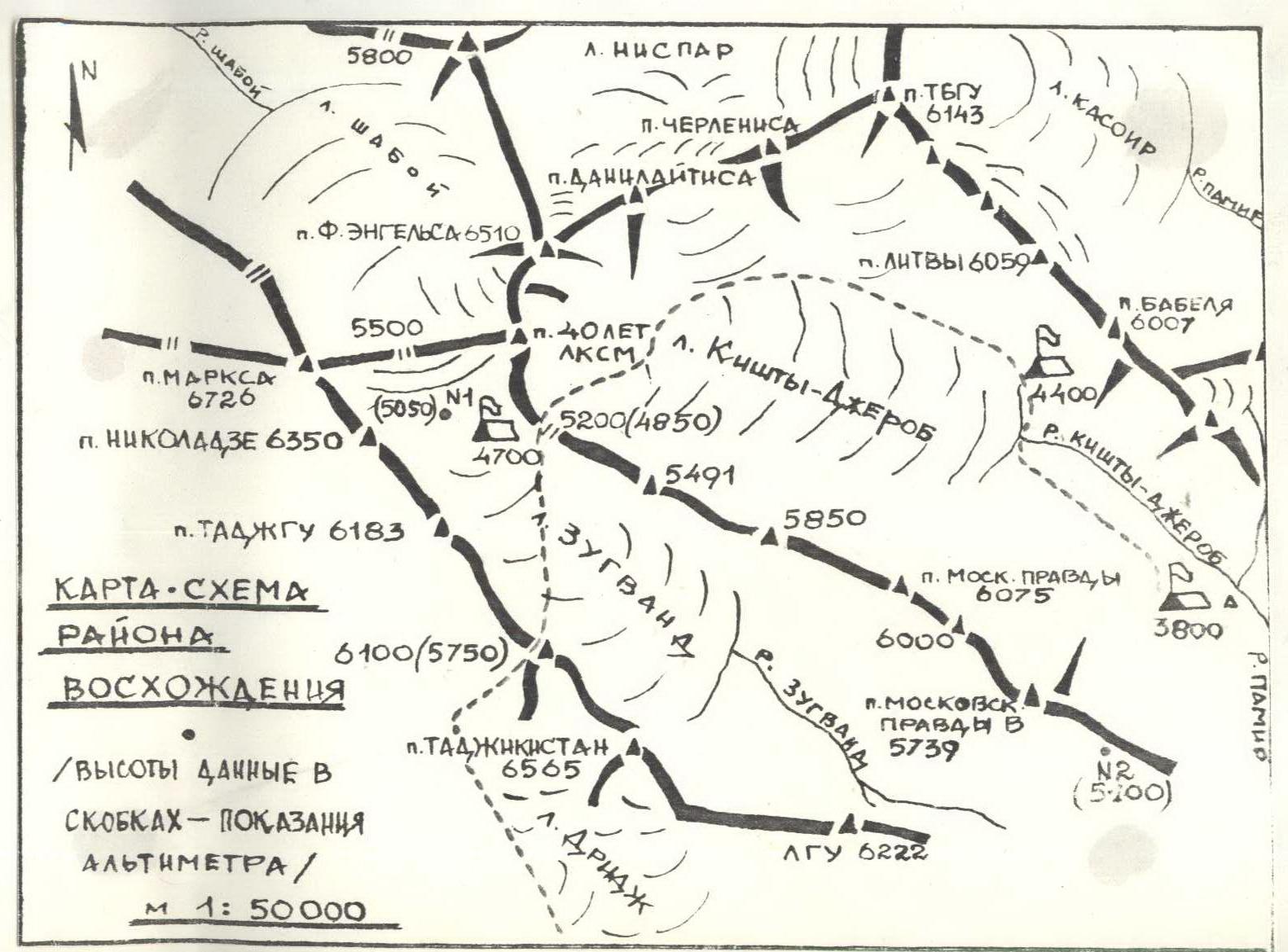
Elevations were determined using schematic maps from reports of ascents by different teams and an altimeter.
Passport
- High-altitude technical class
- Southwestern Pamir, Zuvgand valley
- Peak "6100" via NE wall
- Proposed 6th category of difficulty, first ascent
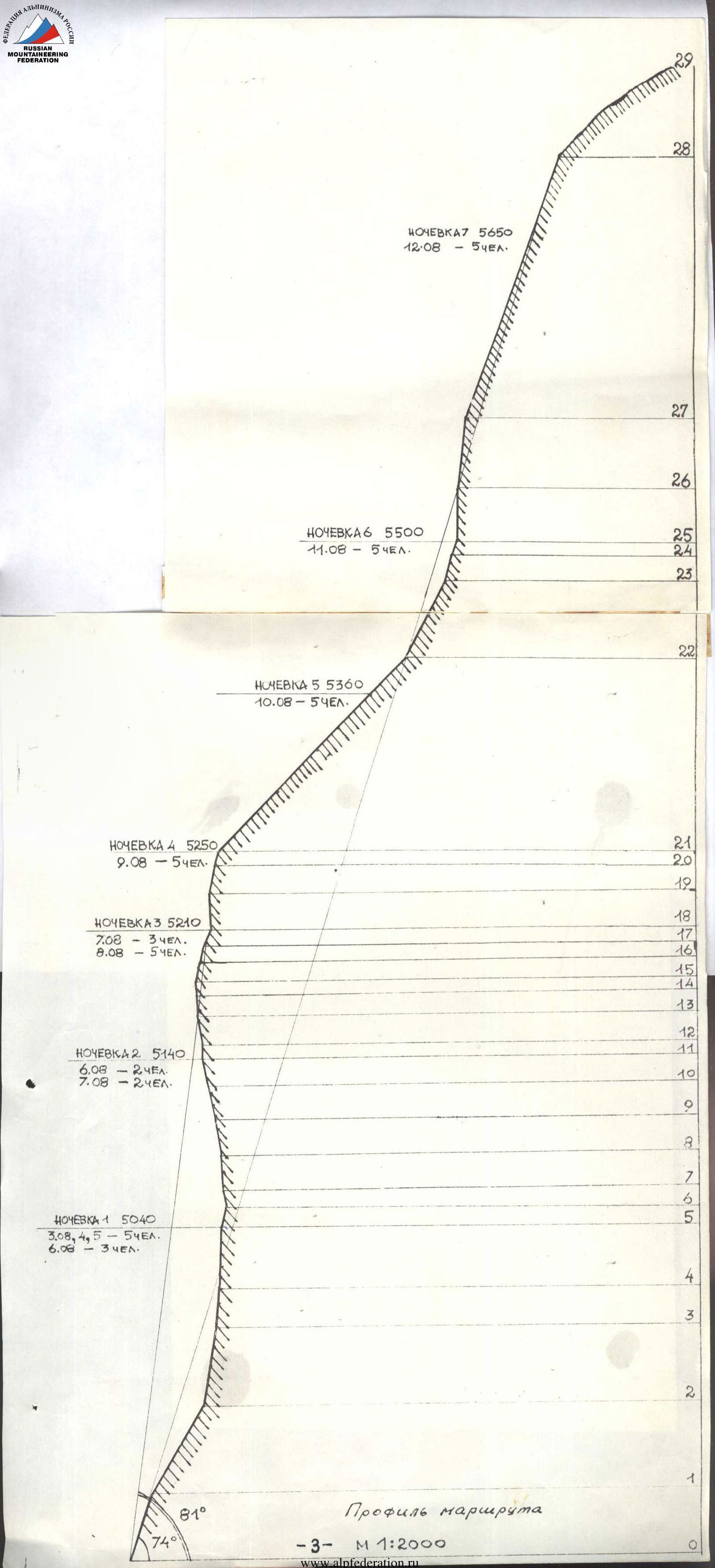
- Elevation gain 900 m Distance — 1270 m. Distance of sections with 5–6 category of difficulty — 830 m. Average steepness of the main part of the route — 74° (according to schematic maps — 5200–6050 m, according to altimeter — 4850–5700 m), including 6th category of difficulty: 88° (4940–5180 m); 90° (5210–5230 m); 75° (5370–5470 m); 84° (5480–5550 m). Elevations are based on altimeter readings.
- Pitons used:
| Rock pitons | Bolt pitons | Chocks |
|---|---|---|
| 319/92 | 17/15 | 80/27 |
- Climbing hours: 91.5 hours and 11 days
- Overnight bivouacs, sitting, 4th and 5th bivouacs were separate (2+3)
- Team composition:
- Team leader: Gheldiashvili Irakli Alekseevich, Master of Sports;
- Team members:
- Tarkhnishvili David Ivanovich, Master of Sports;
- Chichinadze Murad Grigorievich, Master of Sports;
- Kelekhsaishvili Jemal Longinozovich, Master of Sports;
- Sharashenidze Tamaz Shalvovich, Candidate for Master of Sports.
- Coach: Giuashvili Roman Ivanovich, Master of Sports.
- Approach to the route — August 3, 1983. Summit — August 13, 1983. Return — August 14, 1983.
The route taken by the team. August 2, 1983, 14:00, Vega 12 lens, F=90 mm, distance to the object — 2000 m, point #1, 5050 m according to altimeter.
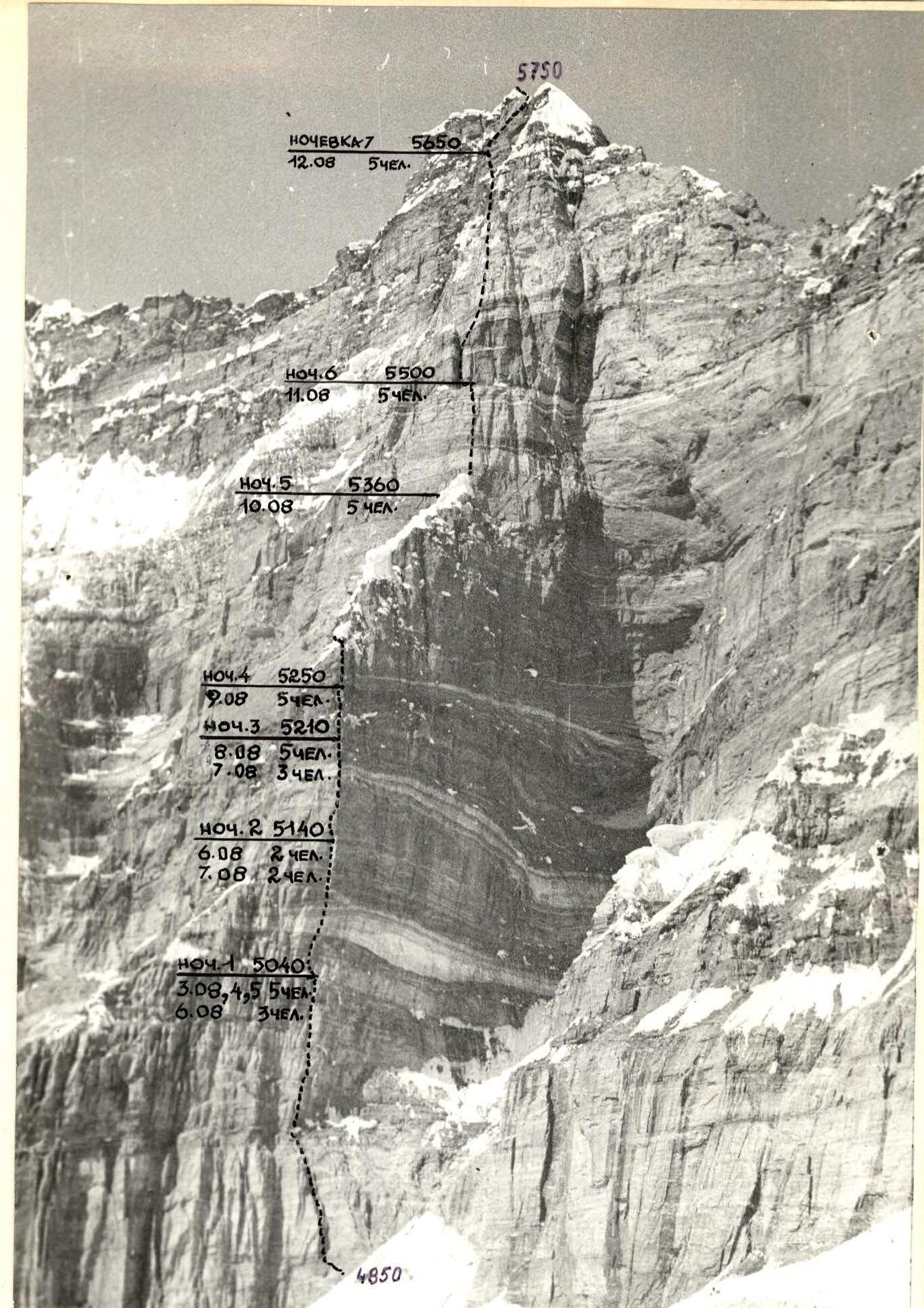
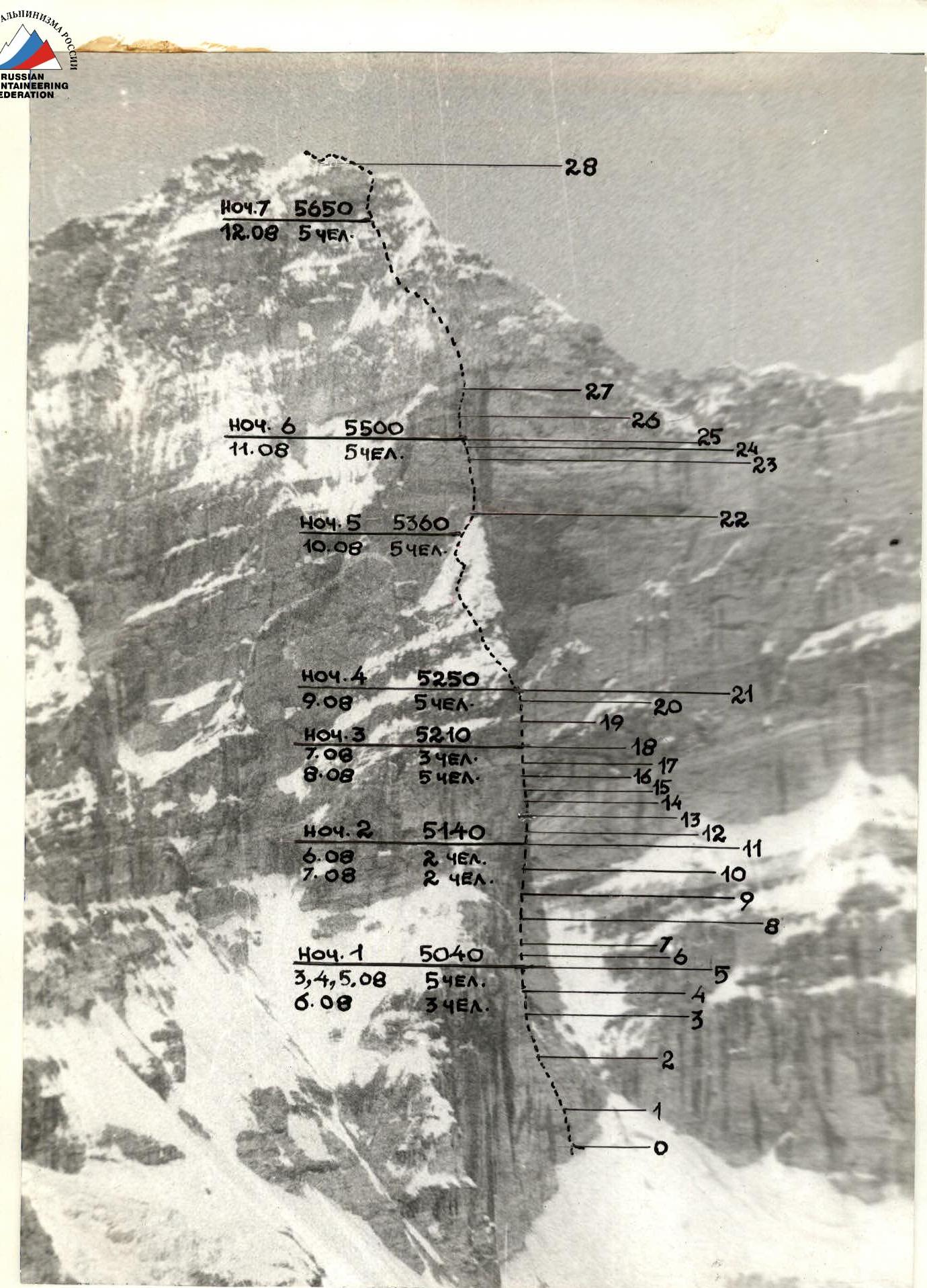
Profile of the lower bastion. July 28, 1983, 14:00, Jupiter 37 lens, F=135 mm, point #2, 4500 m to the object, 5100 m according to altimeter.
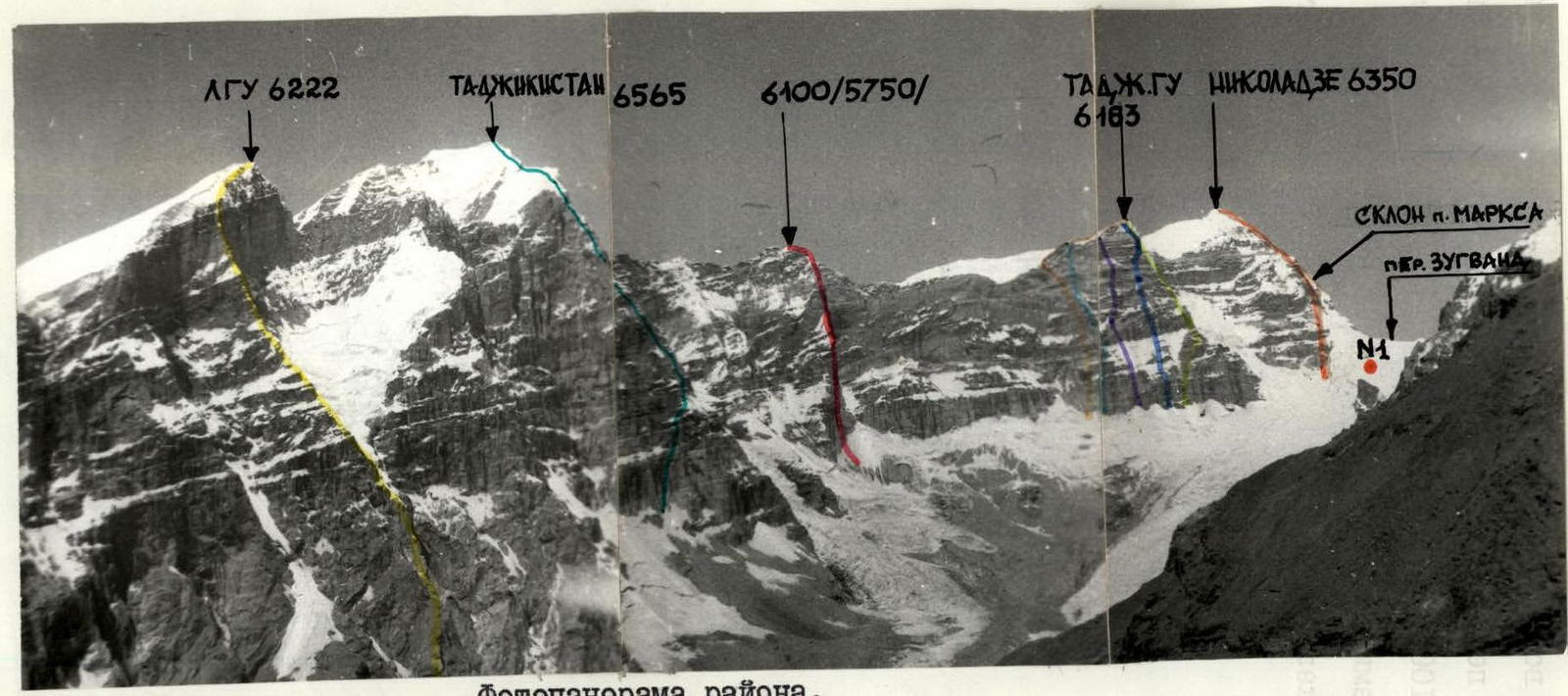
Panorama of the area.
- LenGorIspolkom route — 1981
- V. Shabokhin's route — 1973
- I. Gheldiashvili's route — 1983
- A. Solonnikov's route — 1979
- G. Kartvelishvili's route — 1979
- V. Popenko's route — 1978
- A. Solonnikov's route — 1978
- K. Shabaev's route — 1973
- 5B category of difficulty route
July 28, 1983, 14:00, I-61 lens (F=50 mm), 4500 m to the object, 5100 m according to altimeter.
- Our altimeter readings were 350 m lower than the data from schematic maps of all reports for this area. These data were verified at the "5200" pass by us and other teams, on peak "6100", and at the location marked on the area schematic map as points #1 and #2. Therefore, the "5200" pass and peak "6100" were found to be 4850 m and 5750 m respectively.
Tactical actions of the team
The route consists of 4 sections, of which 3 main sections can be identified — the lower rock belt with a bastion before the snow-ice ridge, the snow-ice ridge with powerful seracs, and the upper pre-summit bastion.
The most challenging and problematic section is the lower part up to the snow-ice ridge. The diverse rock structure, concavity of the wall, and continuous alternation of cornices, overhangs in the system of internal and external angles limiting the visibility of the macro-relief, require not only:
- high rock climbing skills;
- application of the entire known arsenal of equipment typically used on complex reliefs in the technical class;
- excellent orientation skills to navigate the most safe section of the route as planned.
Therefore, the tactics included creating intermediate bases on relatively comfortable and objectively safe locations, protected by cornices (R5, R11, R18, R21), from which problematic extended sections were processed followed by the team's relocation to the next base. Thanks to this, the team avoided purely hanging bivouacs.
Correct determination of bivouac locations (R5, R11, R18, R21, R22, R25, R28), skillful use of individual team members' qualities, mastering various climbing techniques, and rotation of leaders (R2–R3, R4–R9, R9–R11, R18, R19, R19–R21, R22–R26, R27, R27–R28) ensured an even distribution of loads, movement, and rest.
During joint and separate bivouacs, "zdarka" type tents were used, as mentioned above. In addition, during separate bivouacs (R5, R11, R18), the team had:
- 2 stoves;
- 2 radios for constant communication between team members and observers.
Throughout the route, backpacks were transported using the "American" method, and only in one case (R5, R11) was one backpack pulled up; double ropes and double belays were also consistently used (photos 1–25).
After passing the lower bastion, some of the equipment that became redundant was dropped to the glacier (R18) and was later retrieved by observers (4 ropes, a stove, some pitons), which naturally eased and accelerated further movement.
On August 9, due to deteriorating weather, a sharp change in temperature, and fog on the wall, the ascent was delayed. The team, having covered the section processed the day before and approaching the ice ridge in the middle of the day, correctly assessed the objective danger of the state (R22–R22) of the ice seracs and returned to the previous bivouac, having worked for only 3 hours, deciding to pass this section in the morning. On August 10, this section was overcome before it was exposed to the sun.
Other tactical actions of the team (navigating cornices by climbing, organizing belays using duplicated pitons, organizing bivouacs in protected locations, communication systems, and using double ropes) followed known techniques and did not deviate from the pre-developed tactics.
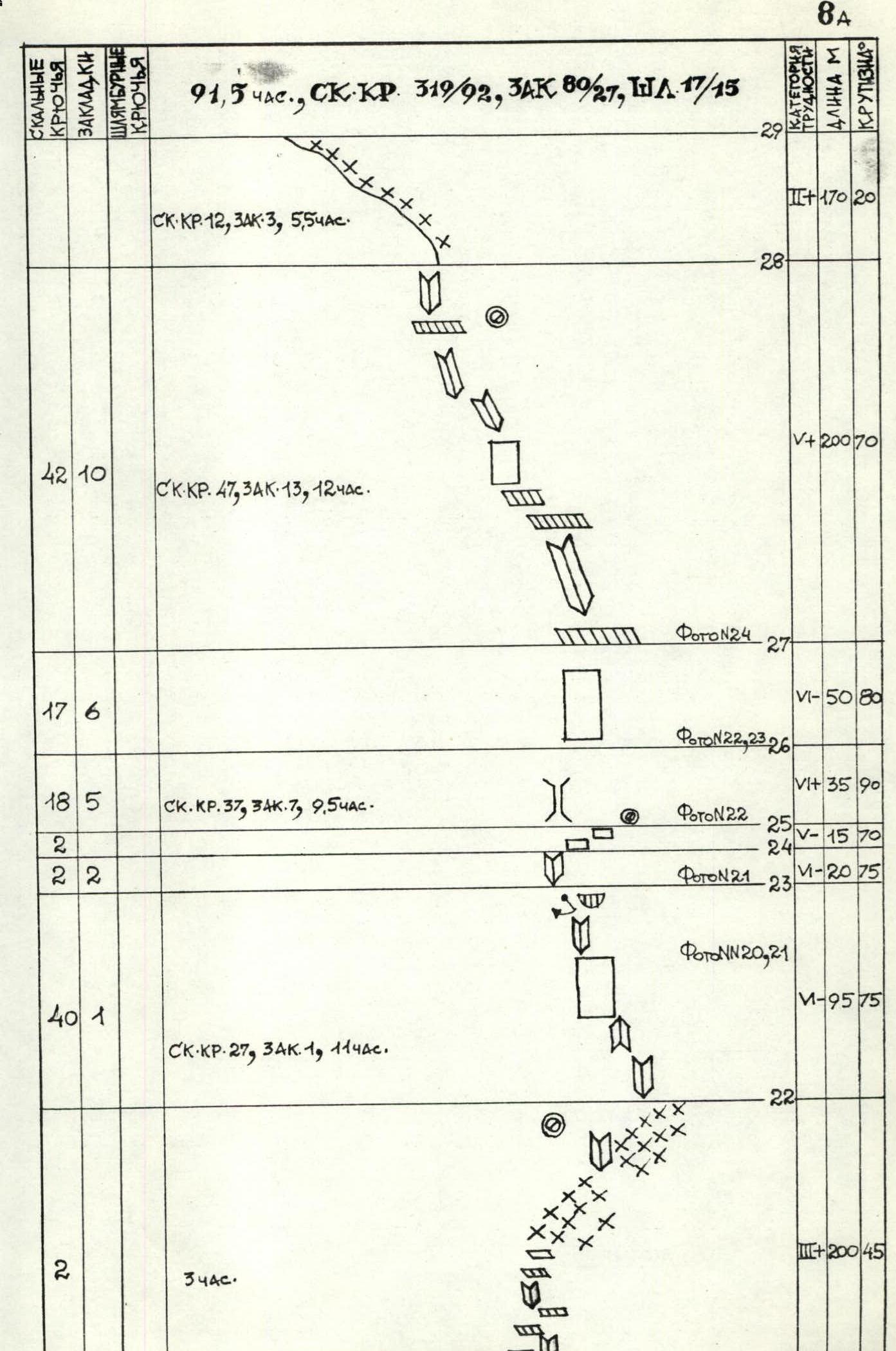
Section R0–R2: Kelekhsaishvili and Sharashenidze lead. Rocks are heavily fragmented, many loose stones, requiring extreme caution during movement.
Section R2–R3: internal corner with a limited number of holds, Chichinadze leads.
Section R3–R4: movement upwards from left to right through a system of internal and external corners. In some cases, a ladder was used. The rock is extremely diverse, with layer thickness sometimes not exceeding 1 m.
Section R4–R5: leftwards, bypassing an overhang on a smooth slab, then through an internal corner. Gheldiashvili leads, wearing galoshes — extremely difficult climbing. Much time is spent on pitons due to:
- the small number of suitable cracks;
- the fragility of the rock.
We reach a ledge and set up a bivouac.
Section R5–R8. Gheldiashvili leads. Traverse left, enter an internal corner that ends in a cornice. The cornice is traversed on its left side. Enter a hanging internal corner. Then a hanging slab. Much artificial climbing equipment is used.
Section R8–R9: a system of small overhangs, the wall is wavy and smooth. As preliminary study of the wall showed, there are no places for a bivouac and none are expected for a while. Therefore, we leave equipment at the end of the processed section and descend to a bivouac according to the preliminary tactical plan. Further, a smooth slab leads under a large cornice.
Section R9–R10. The cornice is climbed head-on. Here, the lead is passed on. Gheldiashvili descends to the category to Tarkhnishvili, who is belayed by Sharashenidze, who has caught up. Further:
- work on a small platform;
- end of processing;
- descent.
Section R10–R11. Tarkhnishvili leads. Through a hanging section via an 8-meter crack under a large cornice, in the hope that there is a crack under the cornice that will allow bypassing it on the left. There is no crack, so descent and pendulum leftwards, then through a system of small overhangs leftwards and upwards to a ledge. Here, Tarkhnishvili and Gheldiashvili bivouac. The others bivouac at the previous location.
It is noted that on sections R5–R11:
- the last climber's (Kelekhsaishvili) backpack was pulled up;
- the large negative slope threw it significantly away from the wall, greatly complicating piton placement.
Section R11–R18. Gheldiashvili and Tarkhnishvili continue. The others follow. The relief is extremely diverse, requiring the lead climber to have exceptionally high skill and mastery of a large number of technical techniques. Where the rock allowed, a "sky hook" was used, saving time and energy for the climbers. On these sections, Gheldiashvili primarily led as the team's strongest rock climber. In the upper part of these sections, the rock surface is heavily weathered and easily flakes off, creating uncertainty during friction climbing. Moreover, for the same reason, seemingly well-placed pitons were not very reliable, so belay pitons were often duplicated. Chocks were especially helpful in such cases.
Bivouac on a sloping ledge. Bivouacking are:
- Gheldiashvili;
- Tarkhnishvili;
- Kelekhsaishvili.
The others bivouac below.
Section R18–R19. Chichinadze leads. Passes a hanging crack, then an extensive, hanging, wavy wall with small cornices.
Section R19–R21. Kelekhsaishvili — Sharashenidze lead. In the second half of the day, the weather begins to deteriorate. Everyone gathers at the bivouac.
Section R21–R22. The weather is bad in the morning. We depart late. By 13:00, we approach the base of the ridge. On the ridge, there are ice seracs with large cornices, and the slope is covered with high, delicate calgspurs. The condition of the section was objectively dangerous. Therefore, we decided to return to the bivouac to pass this section early the next morning. In the morning, we navigate the ridge on the left slope and begin processing the upper bastion.
Section R22–R23. Gheldiashvili — Tarkhnishvili lead. The rocks are extremely fragile. Bivouac on a rock ledge just below the upper end of the snow ridge.
We continue working on section R22–R23; the slab turns into an internal corner ending in a cornice, from under which Gheldiashvili moves leftwards using a pendulum.
Section R23–R25. Leads to a ledge to the right of a large chimney. Here, we bivouac.
Section R25–R26. Gheldiashvili climbs the chimney using climbing techniques and resting. The chimney is north-facing with accretion ice. It's very cold inside. Generally, the weather, although mostly clear, is very cold, especially since the sun leaves the wall early. Down jackets and galoshes on the lead climber proved very useful.
Section R26–R27. An extensive wall. Bands of white rock with smoothed relief alternate with dark ones. Difficult friction climbing.
Section R27–R28. A system of walls, corners, and ledges leads to the summit ridge. Rest. Literally a few meters away are the bivouacs of the team that traversed peak Tajikistan — Marx in 1973. We did not find a note on the summit.
We leave our note and begin descent.
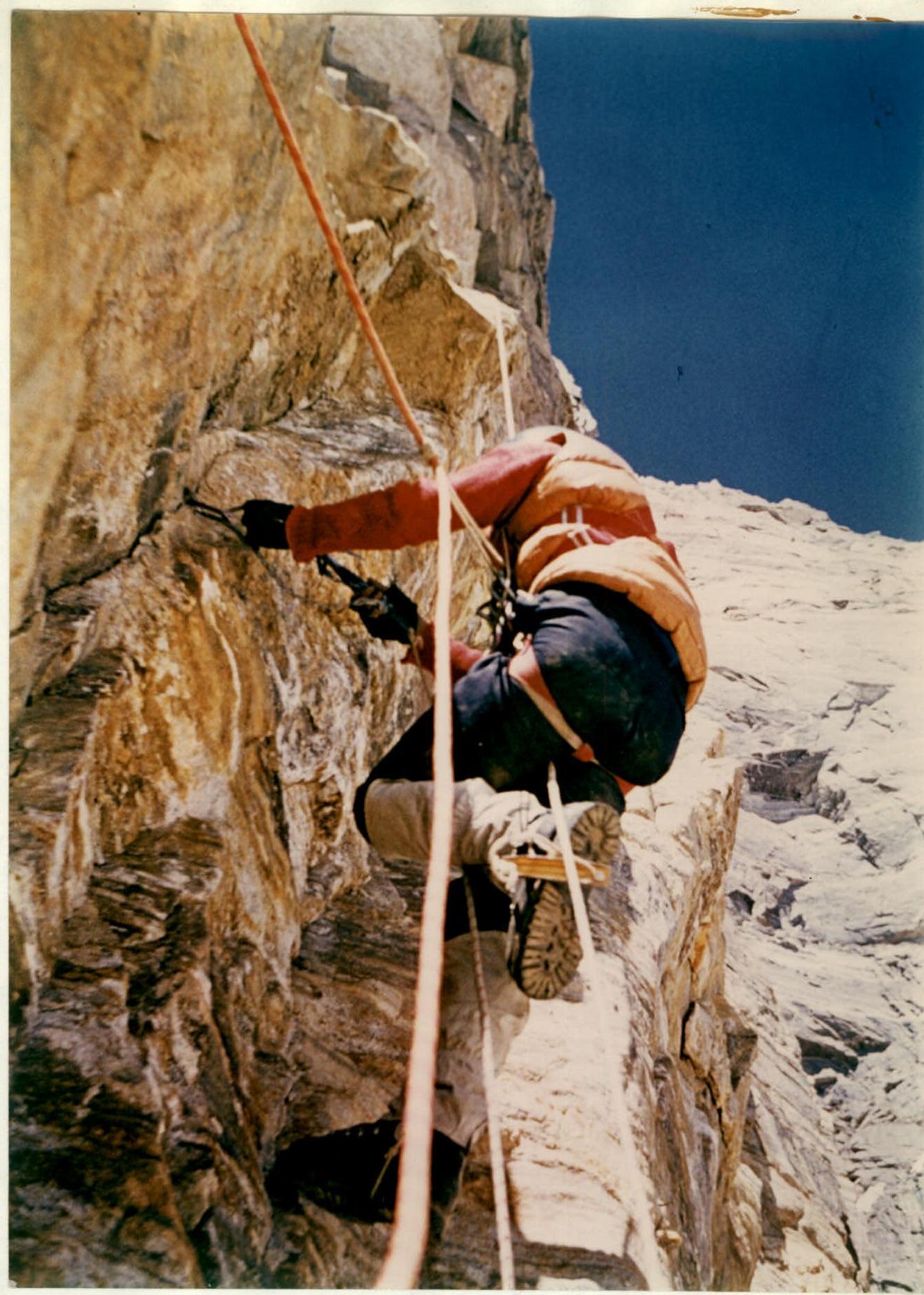
PHOTO #1. Section R3–R4. August 3, 1983.
Note: All photos taken with T69 lens, F=40.
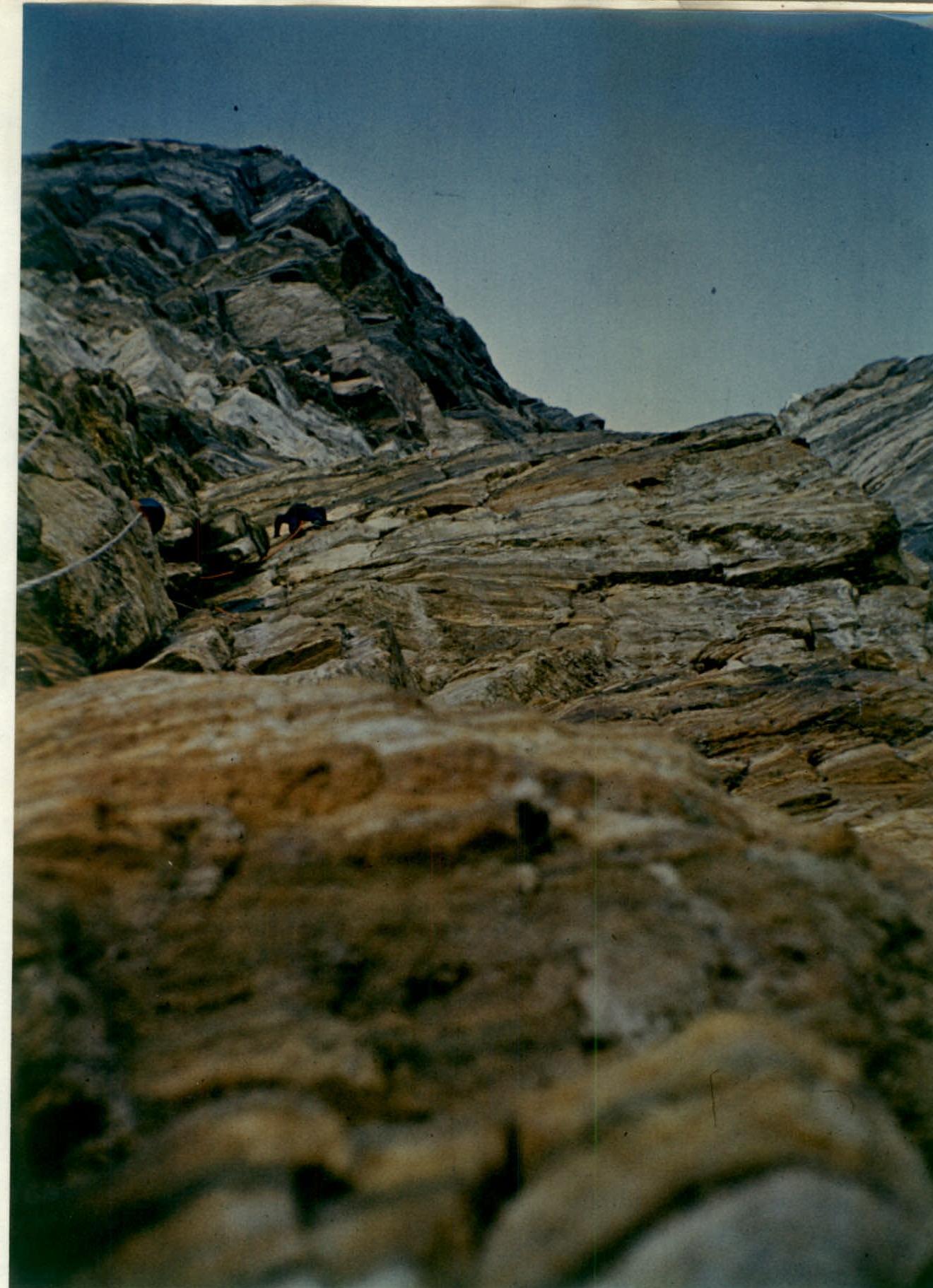
PHOTO #2. Section R4–R5. The team leads. August 3, 1983.
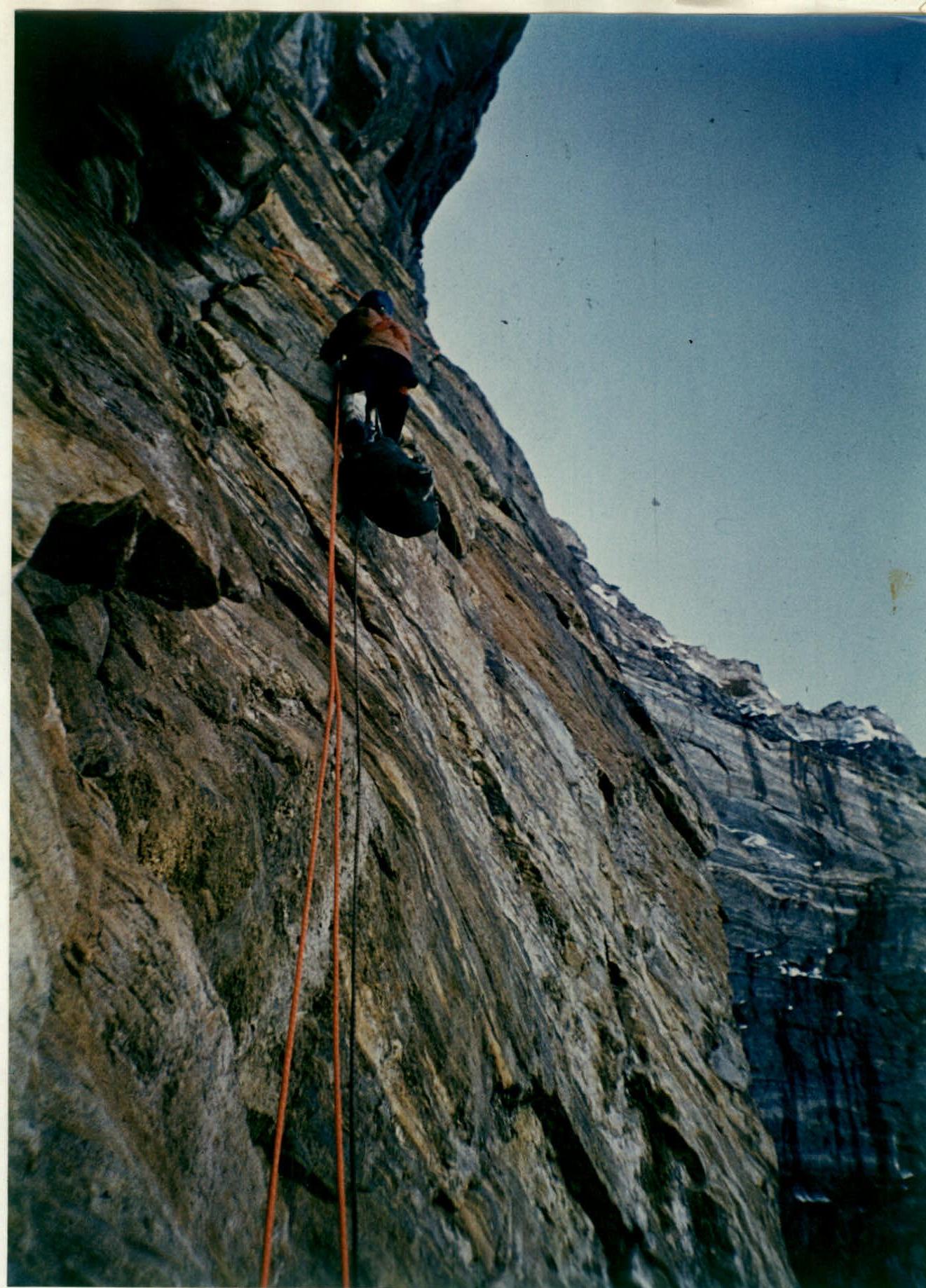
PHOTO #3. Section R4–R5. On the belay. August 3, 1983.
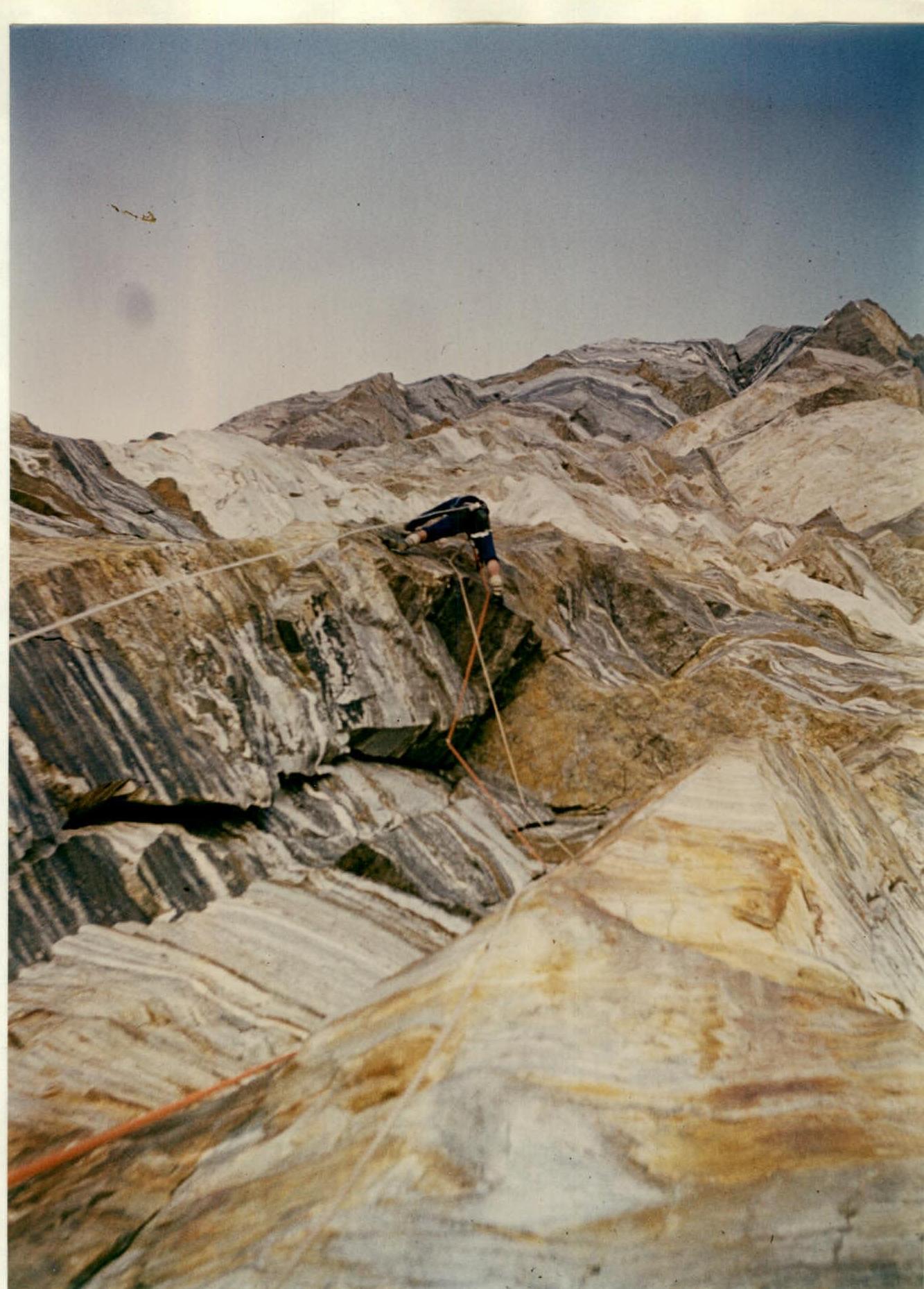
PHOTO #5. Section R5–R7. Continuation of photo #4. August 4, 1983.
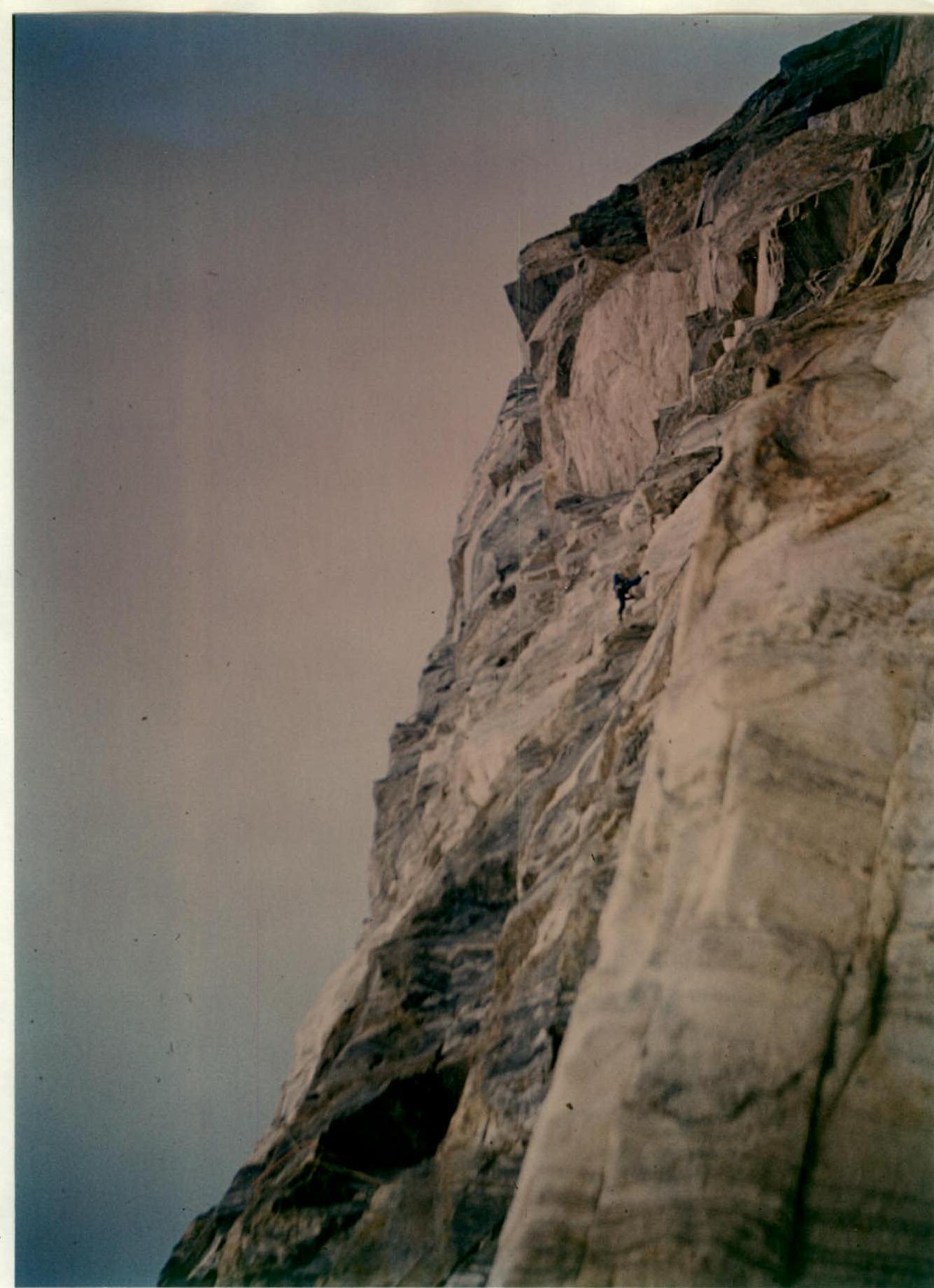
PHOTO #6. Section R5–R11. In the lower left corner is a cornice (see photos #4, #5). August 4, 1983.
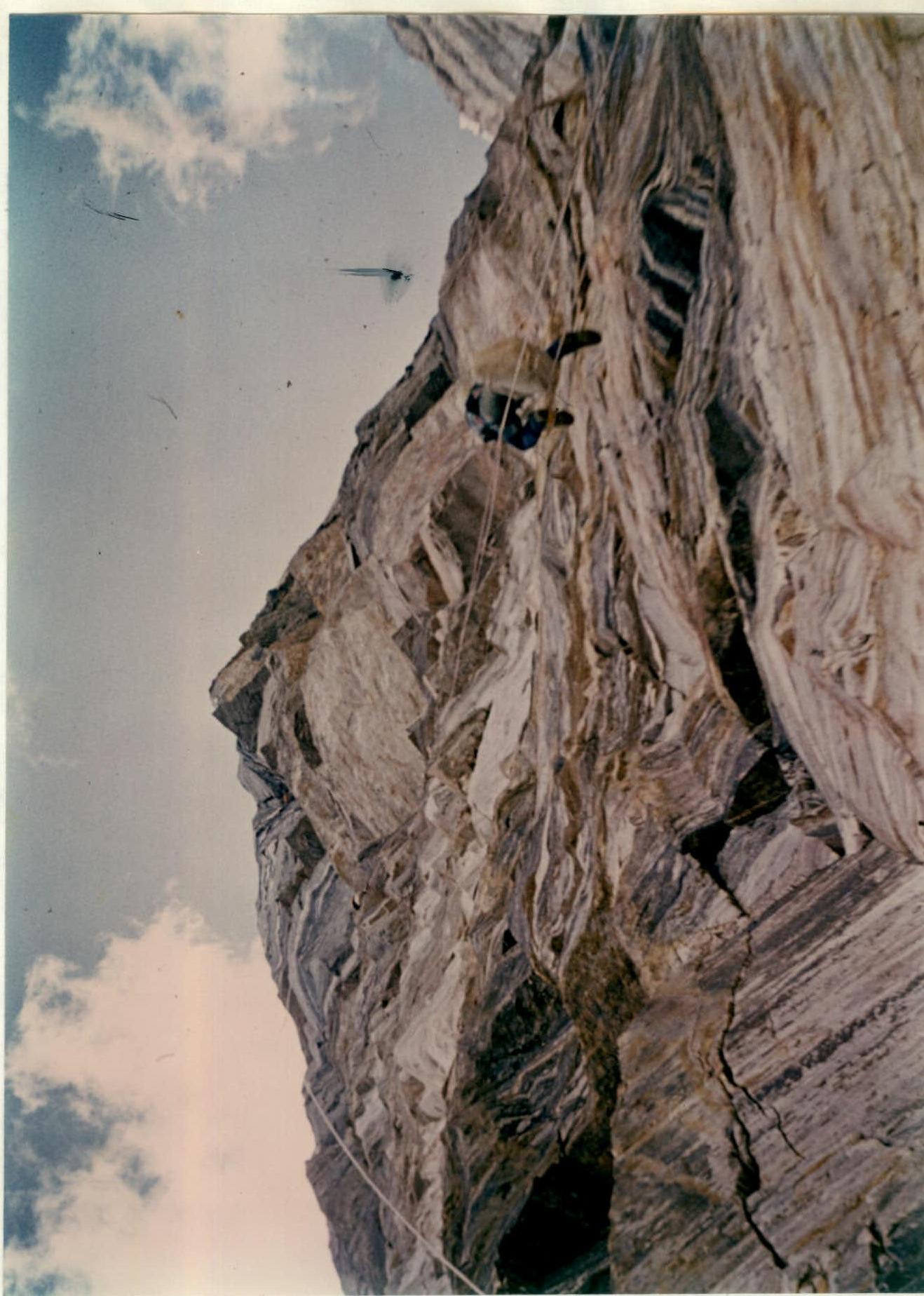
PHOTO #7. Section R6–R11. On the belay. August 7, 1983.
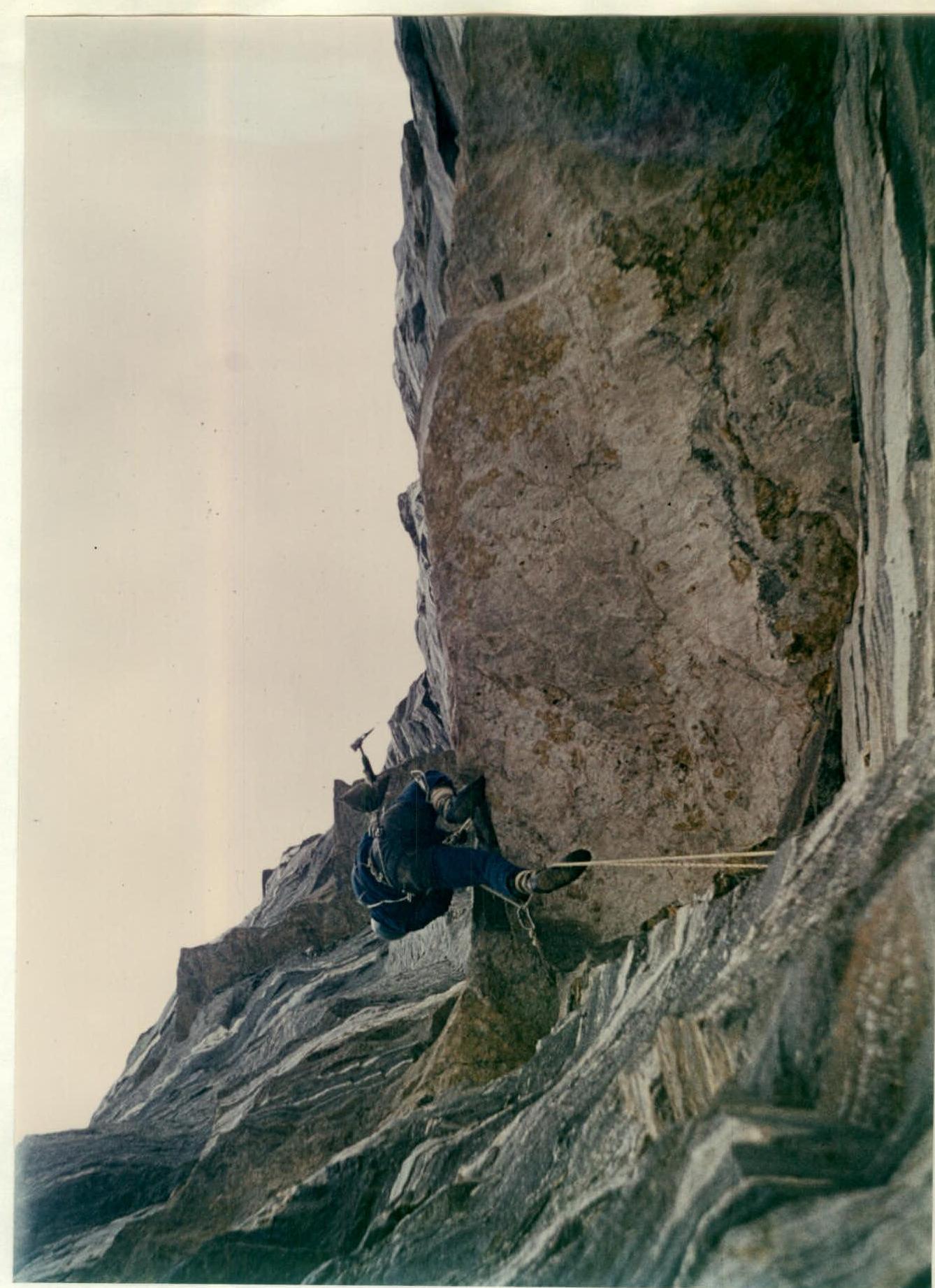
PHOTO #9. Section R8–R10. Exit to the cornice. August 5, 1983.
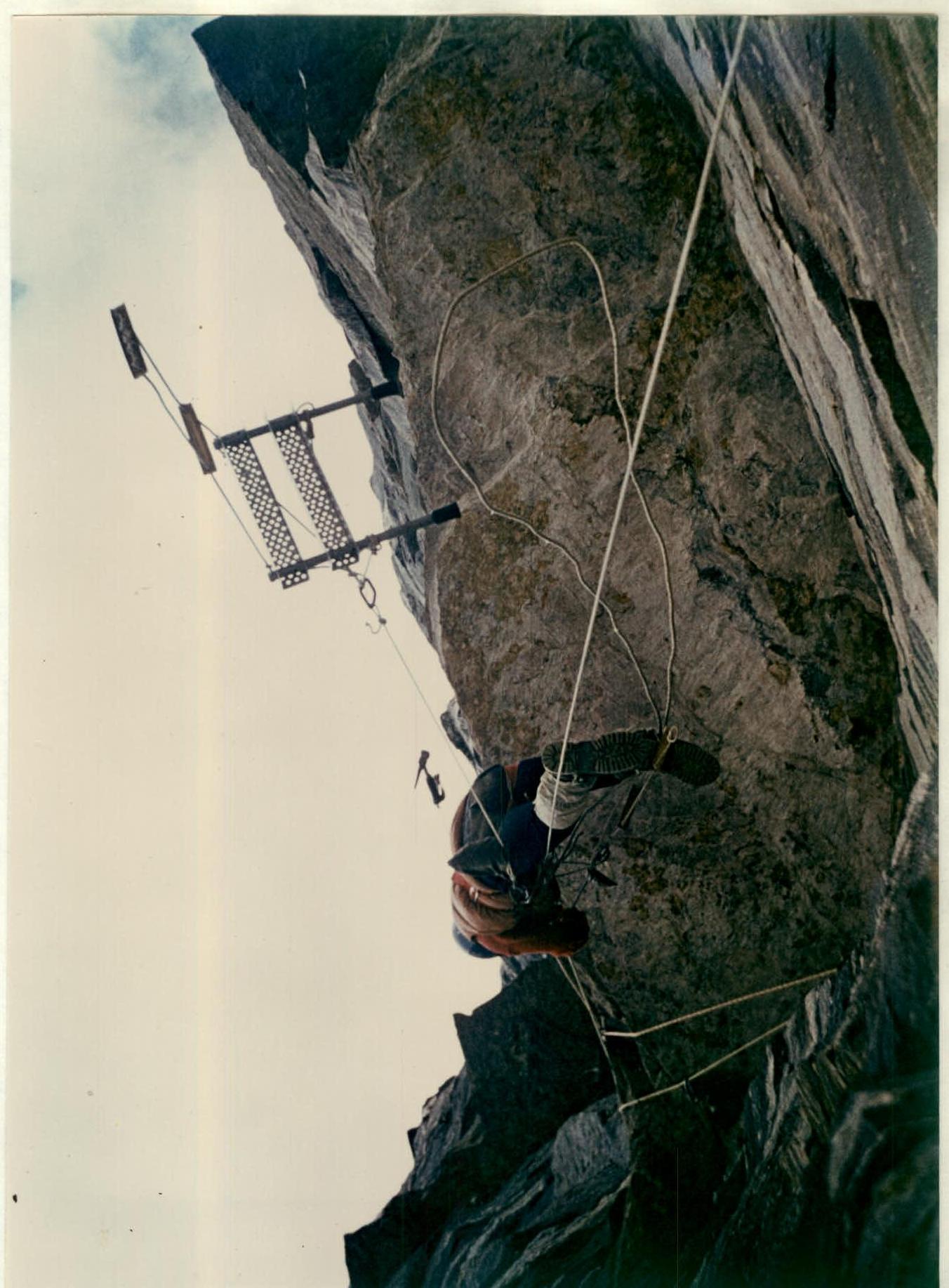
PHOTO #10. Section R8–R10. Changing the lead. August 5, 1983.
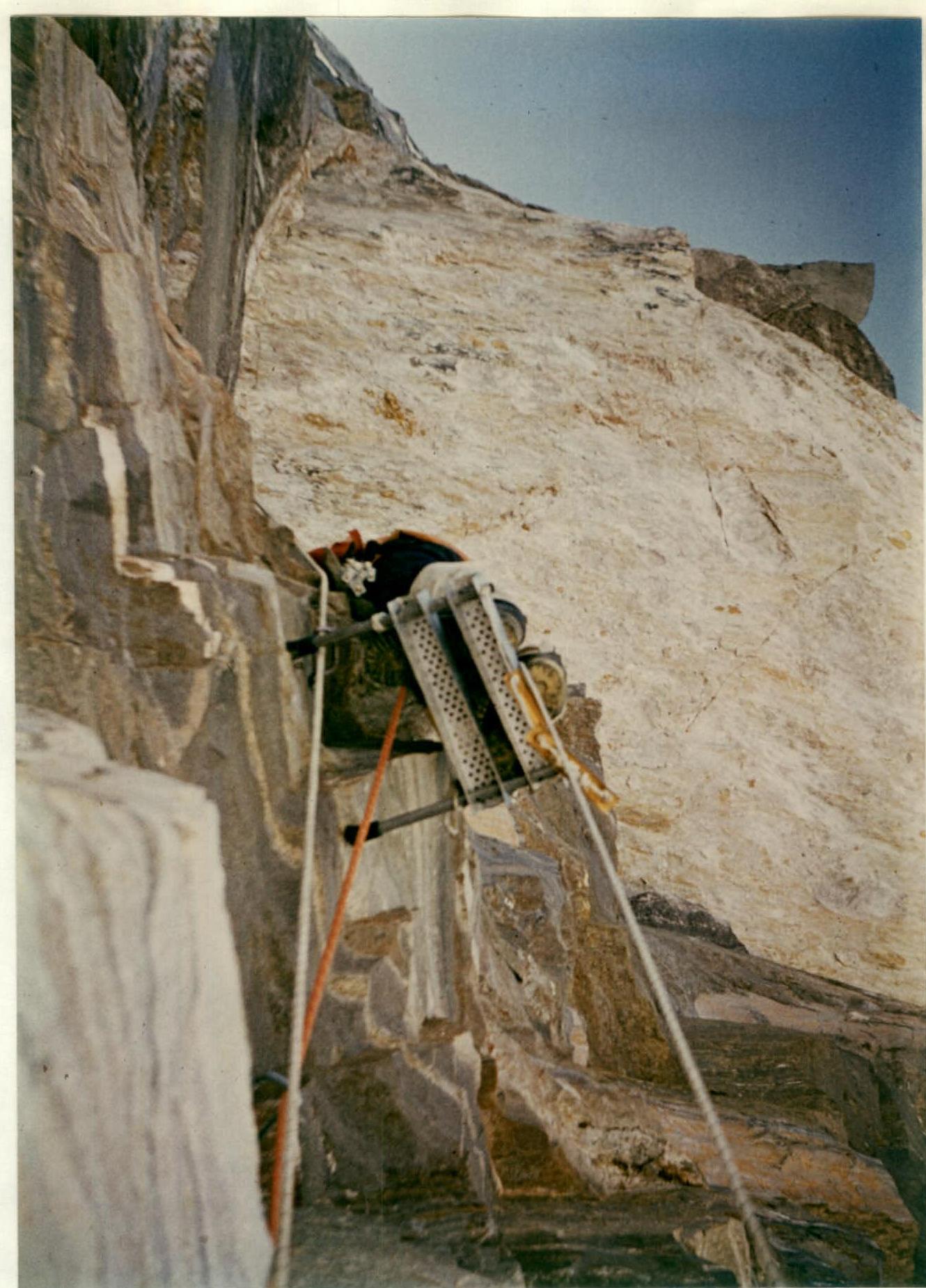
PHOTO #11. Section R9–R10. On the platform. August 5, 1983.

PHOTO #12. Section R10–R11. Overhanging the counterfort of Tajik State University. August 7, 1983.
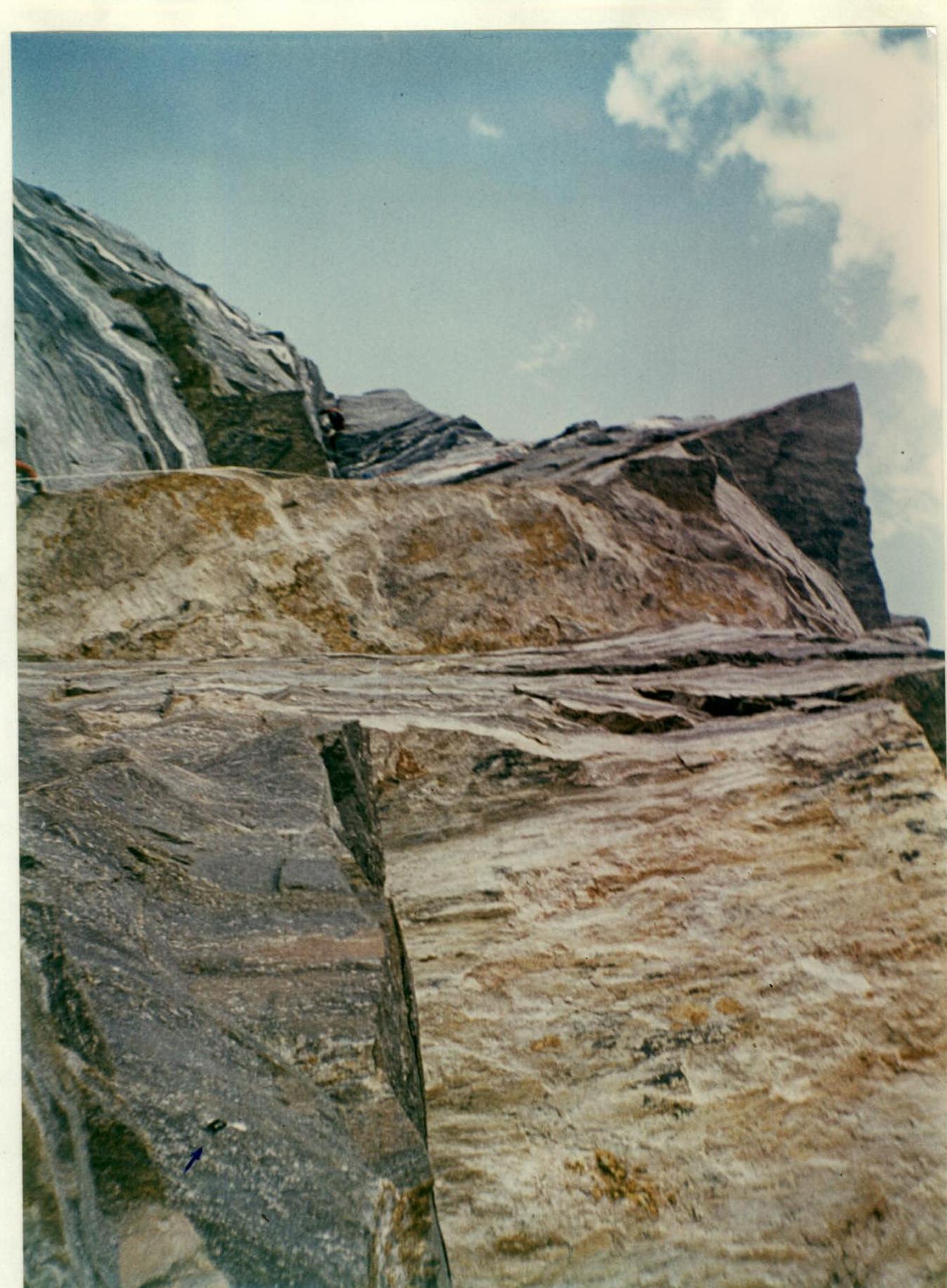
PHOTO #13. Section R9–R11. Cascade of cornices. August 6, 1983.
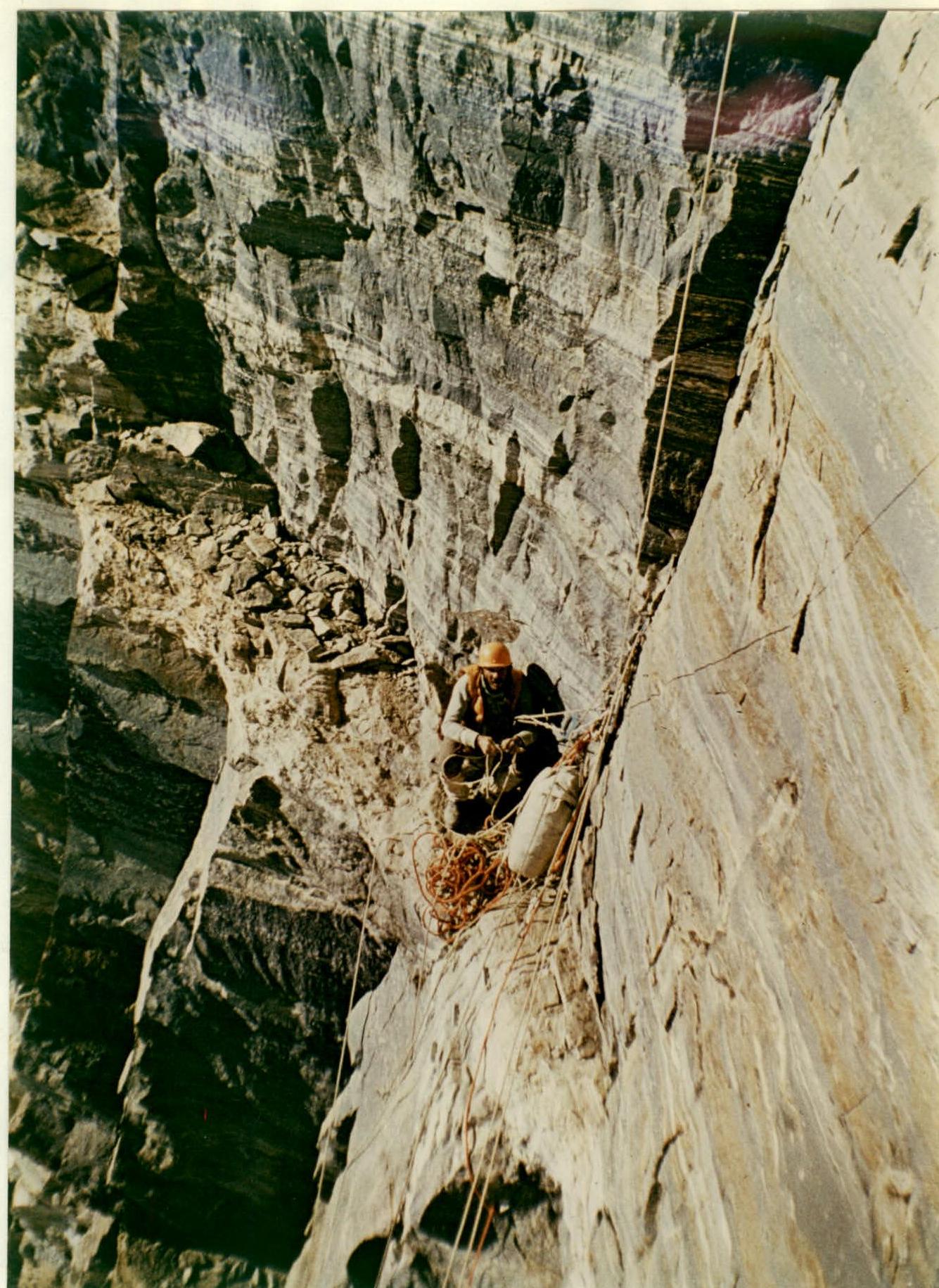
PHOTO #14. Section R10–R12. The last one prepares to leave the bivouac above the cornice. August 8, 1983.
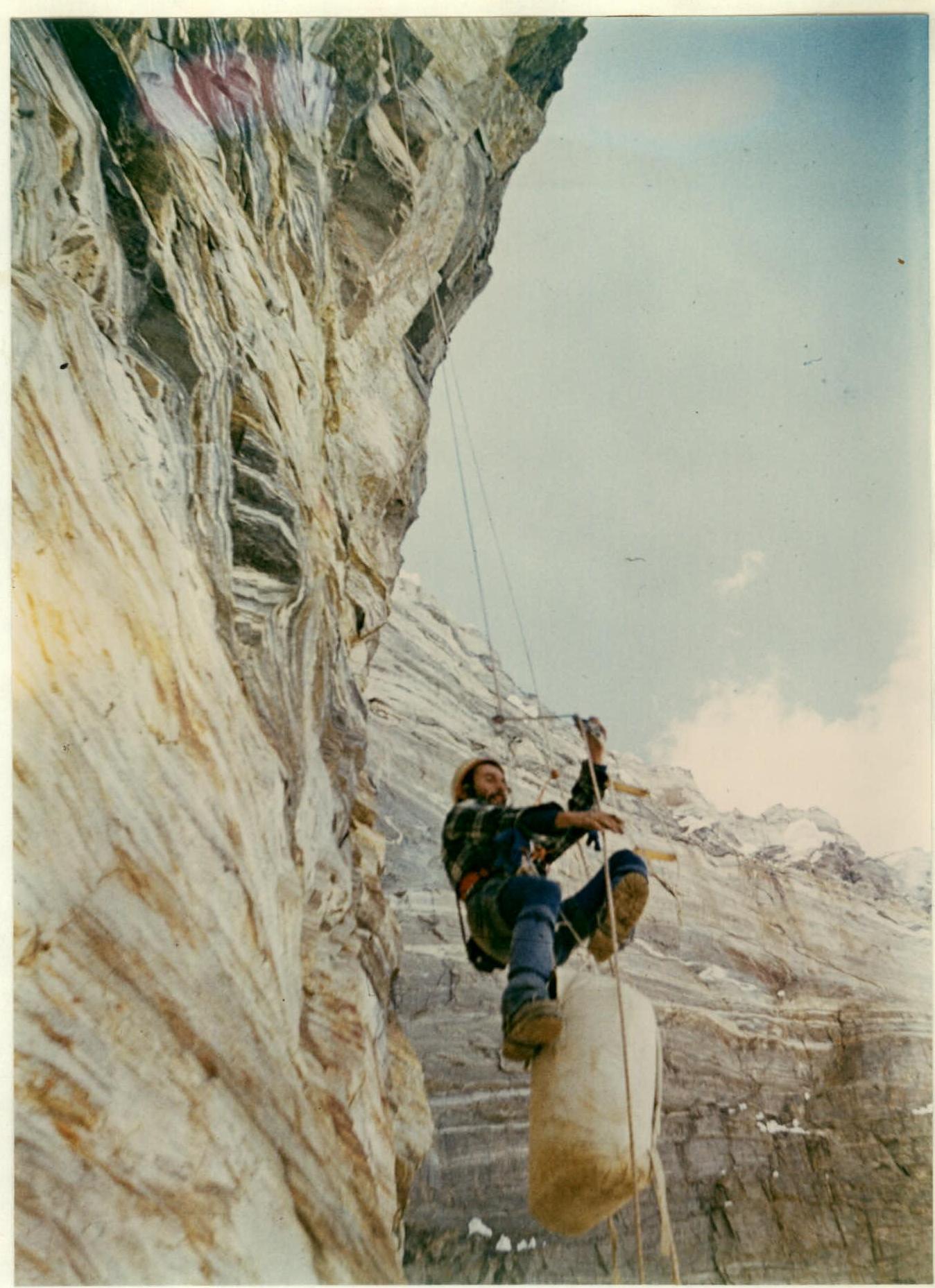
PHOTO #15. Section R12–R13. August 8, 1983.
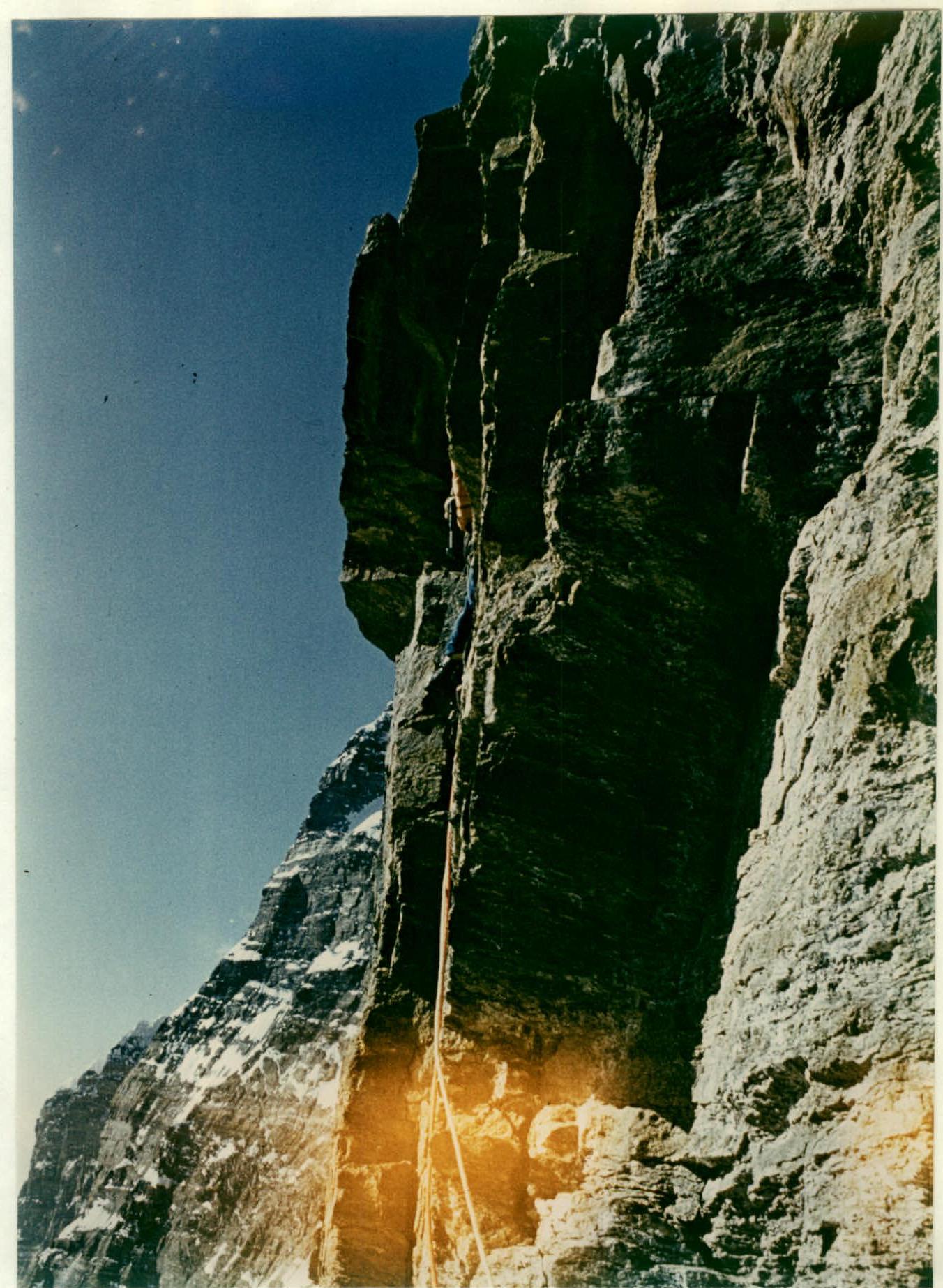
PHOTO #16. Section R13–R14. Internal corner. August 7, 1983.
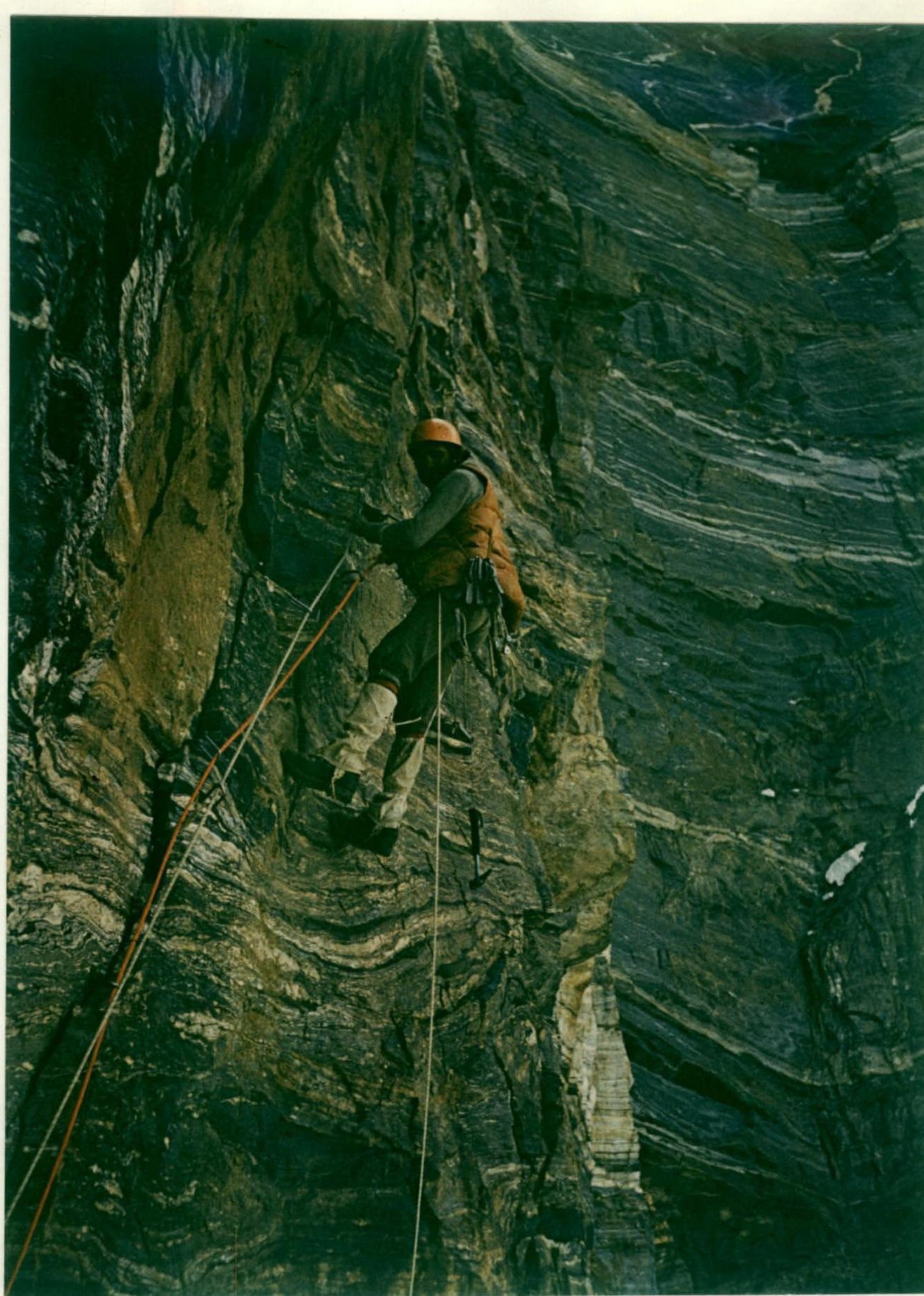
PHOTO #17. Section R18–R19. Along the cracks. August 9, 1983.
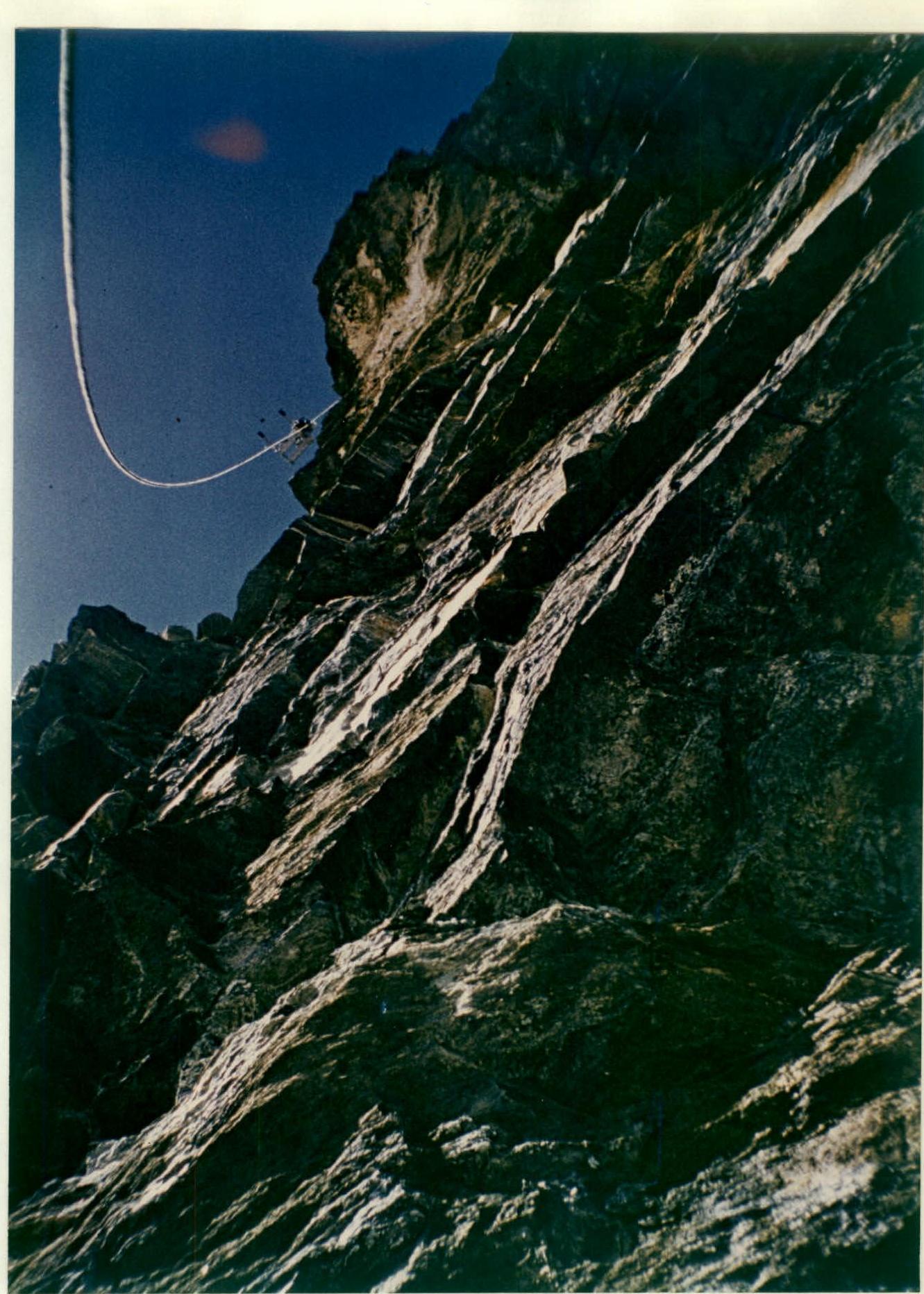
PHOTO #18. Section R18–R19. Pulling up equipment. August 9, 1983.

PHOTO #19. Section R21. Bivouac. August 9, 1983.
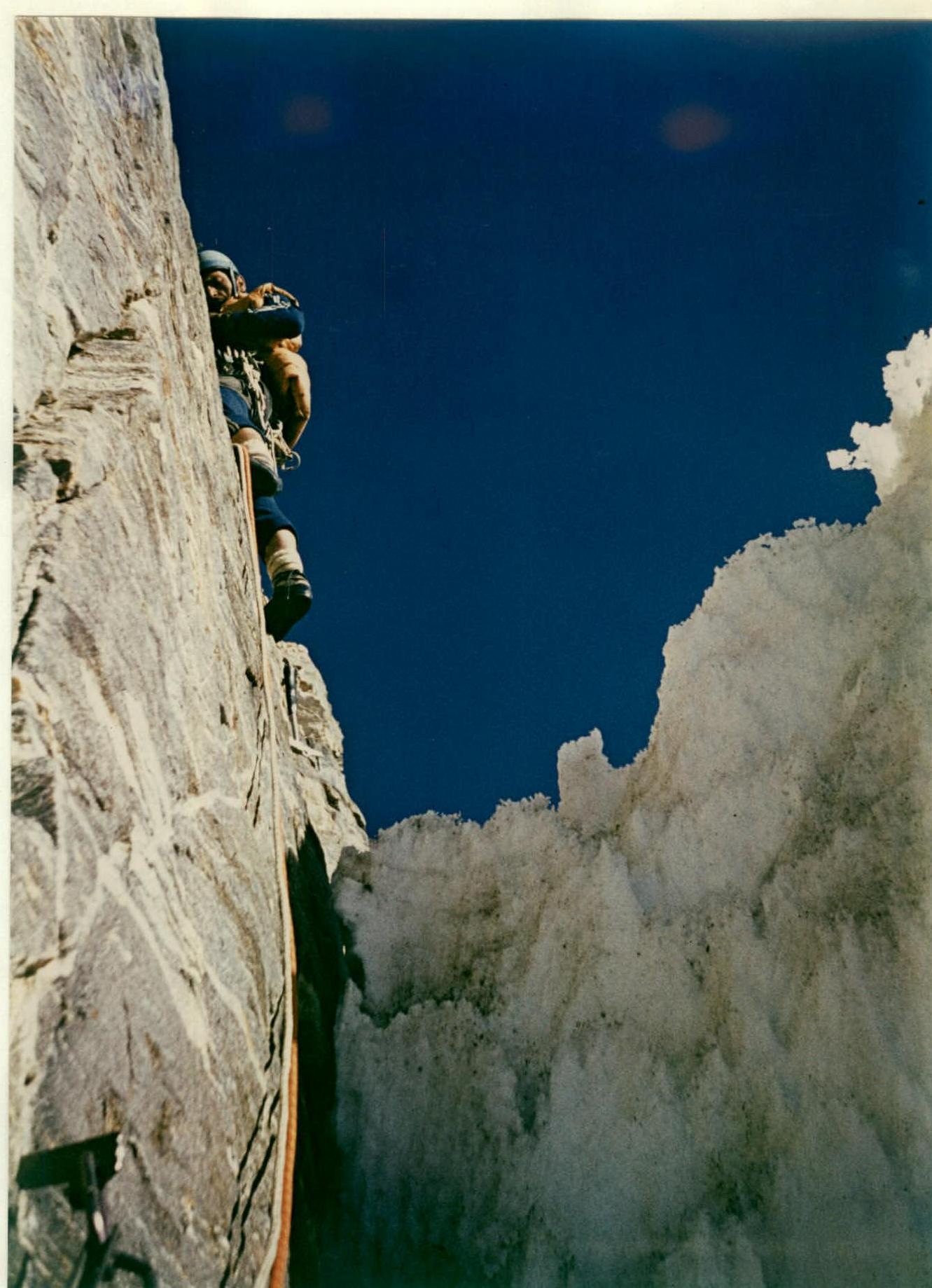
PHOTO #20. Section R22–R23. Beginning of the upper bastion. August 11, 1983.
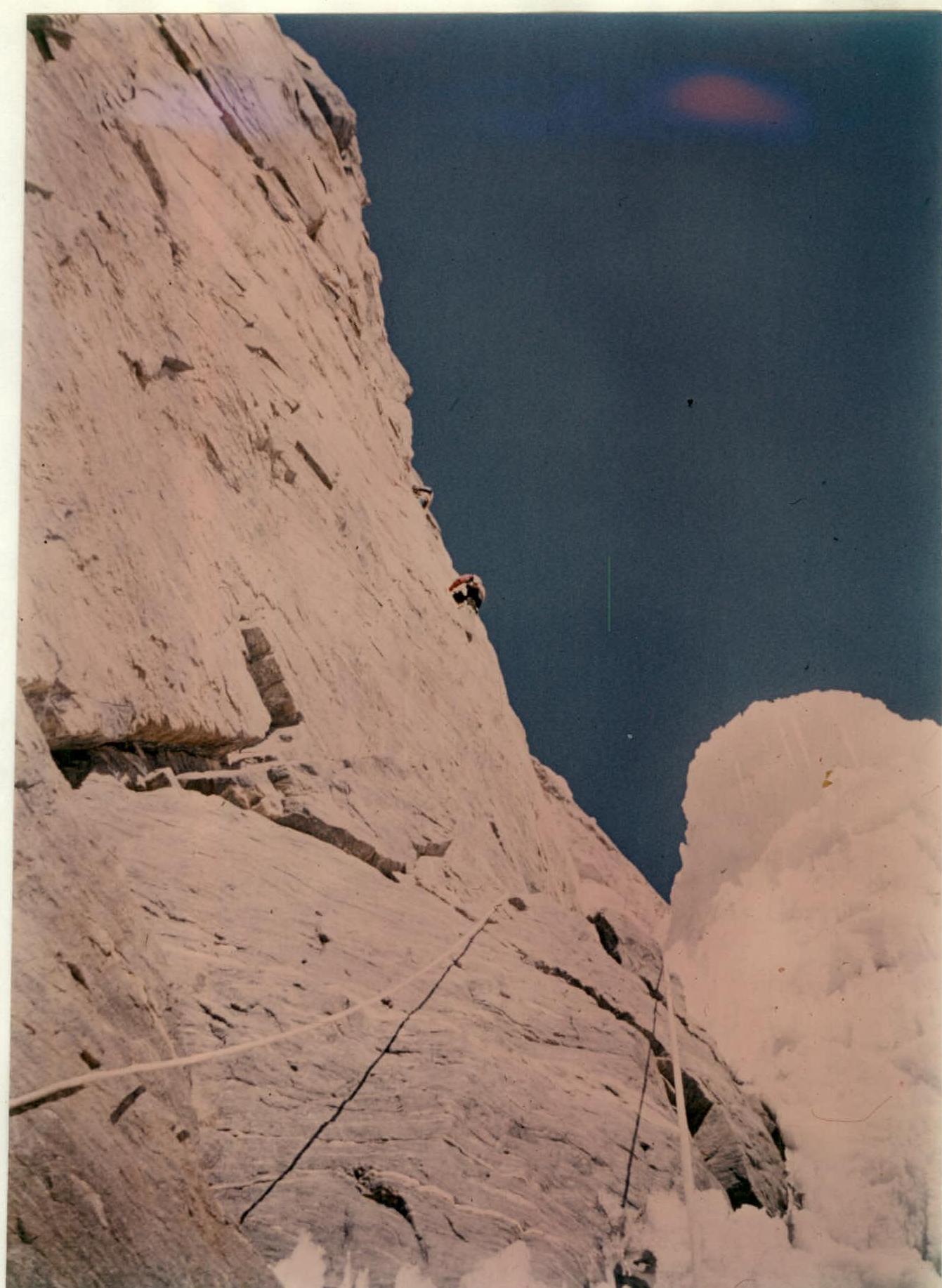
PHOTO #21. Section R22–R23. Upper bastion. August 11, 1983.
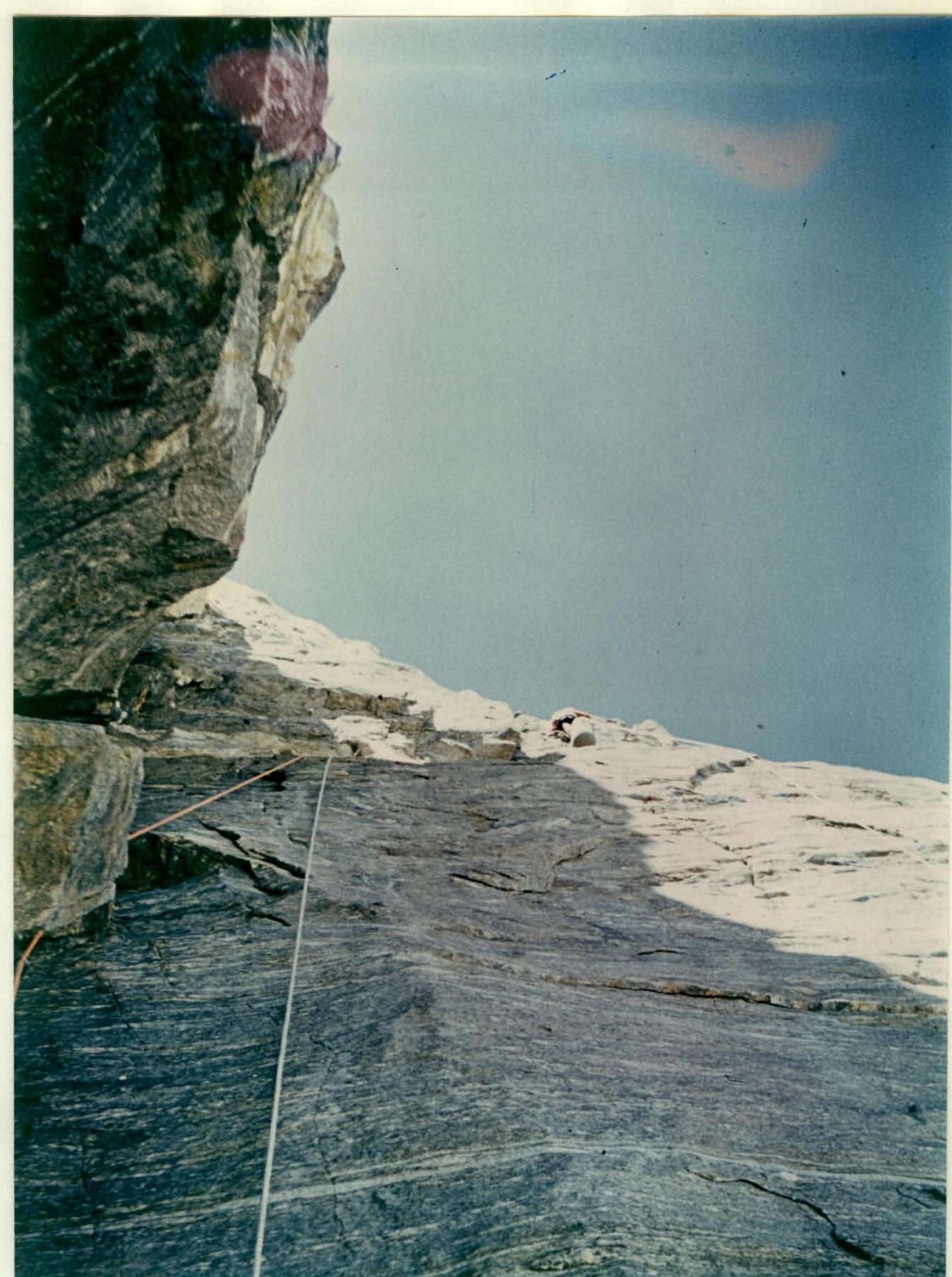
PHOTO #22. Section R22–R27. From the chimney to the slab. August 12, 1983.
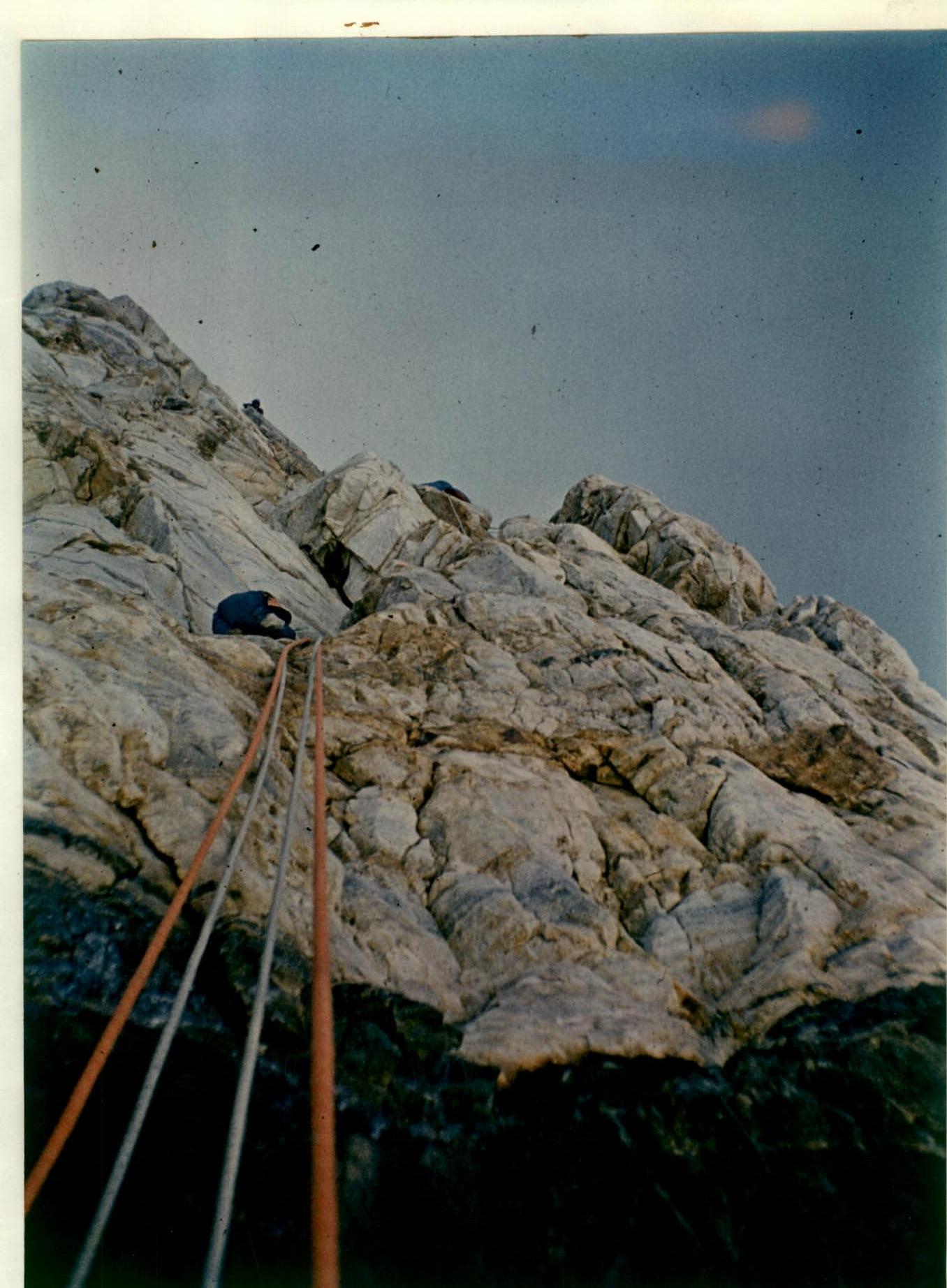
PHOTO #24. Section R27–R28. Getting easier. August 12, 1983.