


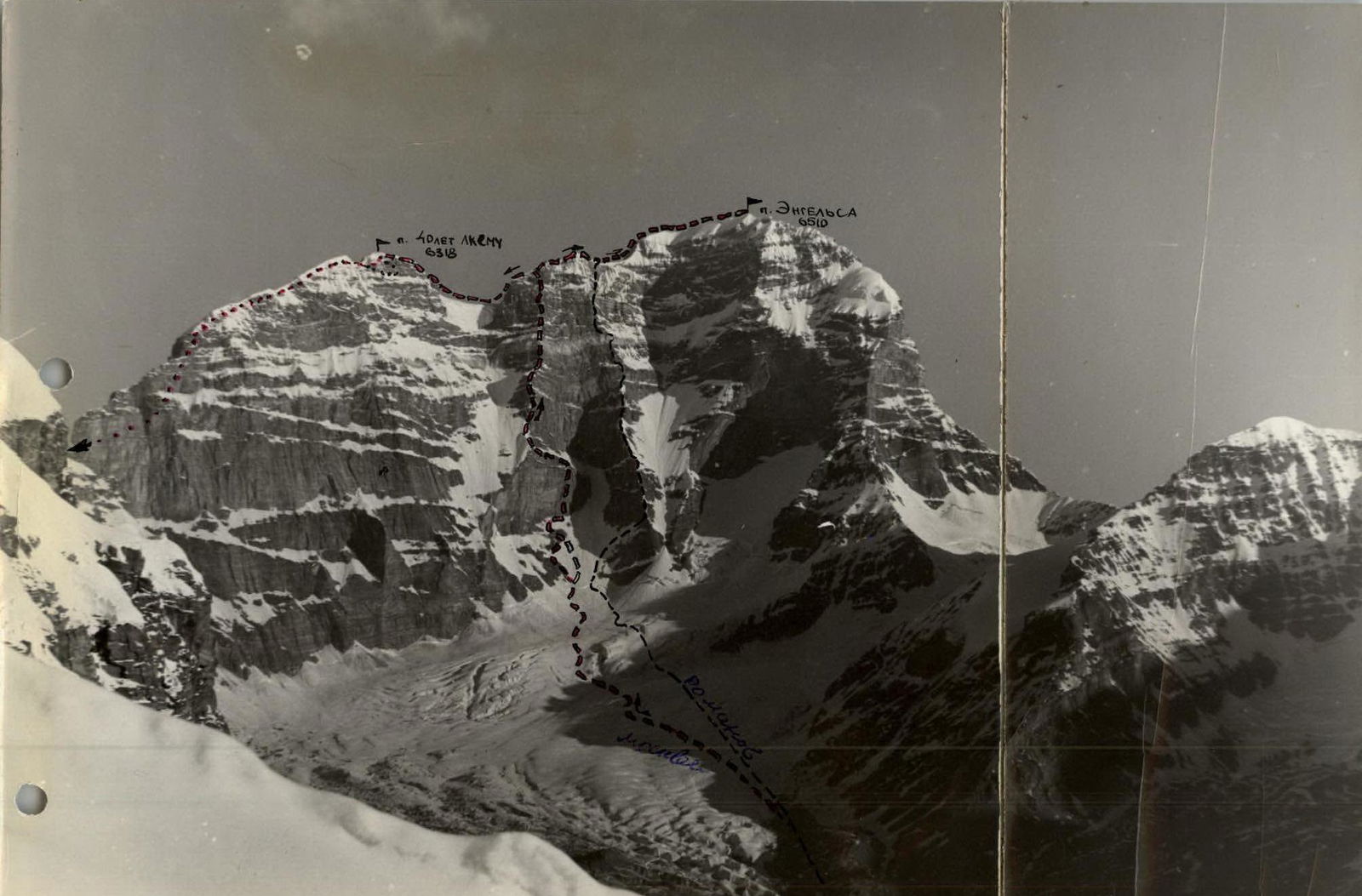
Description of the traverse of peaks Engels, 40 let LKSMU and the ridge of Moskovskaya Pravda with ascent to peak Engels via the south wall
COMPLETED BY THE TEAM FROM MOSCOW from July 17 to August 2, 1971
Group Composition
The team has extensive experience in joint ascents in both the Pamir and the Caucasus. All members of the main composition, except E. Smirnov, had experience with ascents of 6th category of difficulty. When forming the team in Moscow, several complications arose regarding the release and financing of participants. The Moscow Committee covered the participants' championship expenses for food; other expenses were borne by the participants. It was clear in Moscow that there should be no more than 6 people on the route due to the high steepness and complexity of the South wall of peak Engels. A few days before departure, it became known that one of the strongest team members, O. Abalakov, was not released from work; V. Bezlyudny was also unable to participate. The remaining participants traveled to the area of peak Engels. During the final departure, D.A. Filippov fell ill and had to be left at the observation group's camp. Thus, the group embarked on the route with 5 members.
| № | Full Name | Year of Birth | Sports Rank | DSO | Insurance Certificate № |
|---|---|---|---|---|---|
| 1 | Kavunenko V.D. | 1935 | МСМК | «Spartak» | PN394735 |
| 2 | Piskulov Yu.V. | 1933 | КМС | " | P.394748 |
| 3 | KoproV V.M. | 1938 | КМС | " | P.394741 |
| 4 | Smirnov E.G. | 1940 | КМС | " | P.394737 |
| 5 | Zaid P.S. | 1935 | КМС | " | K.204128 |
| 6 | Filippov D.A. | 1930 | КМС | " | P.394745 |
x – Did not participate in the ascent. All participants in the summer season of 1970 completed ascents of either 6th or 5B category of difficulty.
Route Description
July 17. Departed from the base camp at 6:00. Weather is excellent. Backpacks are light. Had lunch at the observation group's camp. By evening, we reached the tents under the wall. July 18. Weather is good. We traversed the 1st and 2nd sections on crampons. Passing the bergschrund did not cause complications. Three ropes through destroyed rocks. Sometimes there are small wall sections. We followed steep snow to the wall and traversed right along a ledge (R4) to a pronounced internal angle. From here, the trio descended, leaving equipment and supplies, while the duo began processing. The R5 section is traversed with difficult climbing without a backpack; the internal angle turns into a vertical narrow slit with small overhanging sections. Part of the slit is traversed with ladders. The slit leads to an overhanging section. The rocks are strong – there are places to hammer in pitons. At the top of the wall, there is a good spot for pulling up backpacks. Stones fall onto the ledge. We descended back down. July 19. We departed as a full group, retrieving most of the cargo. The duo ascended to the ledge and, after pulling up some equipment, proceeded right-upwards along the ledge. The snow was quite steep but held well. The duo reached the apex of the triangle and began to prepare a platform. The trio arrived, left their load, and descended back down. The remaining time was spent on "building" the platform and reconnaissance. July 20. We proceeded left-upwards through destroyed rocks (R9). Steep, dense snow (R10). We followed along the rocks as stones began to fall from the left, and insurance via an ice axe was unreliable. The snow led us to a very steep wall (R11) with an inclined internal angle. Rocks were constantly falling from the angle; we had to use ladders. The internal angle turned into an overhanging section with a narrow slit (R12). The slit led to destroyed rocks with good narrow ledges. We could hear the voices of the trio below. We requested that they bring bivouac equipment and spare ropes to the start of the wall. I and Piskulov pulled up two backpacks and a spare rope, while the others spent the night on the ledge. We traversed another rope right-upwards and, despite still having daylight, stopped for the night as the trio was directly below us, and a falling stone could injure someone. July 21. We waited for the others to move left before beginning our ascent right-upwards along an inclined slit (R14). Very difficult climbing. Next, we encountered a sheer section (R11–R12) with overhanging rocks in the upper part. We used ladders. To the right of the counterfort, there is a small ledge where we could set up a sitting platform. We decided to pull the main loads to this spot and process part of the wall. The trio pulled up the backpacks, and the duo traversed another rope. Destroyed rocks (R17); there are cracks for organizing insurance. July 22. The trio caught up with us at our bivouac and pulled up their backpacks. The duo ascended via the hung rope. We helped pull up some backpacks and continued. Destroyed rocks (R18) required extreme caution. A four-meter overhanging wall (R19) led to the ridge. Here, we planned good bivouacs and were not mistaken. Three ropes along the ridge were of medium difficulty – and we reached the next ascent. Bivouacs were excellent; by the end of the day, the entire group had gathered here. Directly above us, a dark-brown wall rose vertically, transitioning into a huge white belt. This was one of the key sections. While the others set up camp, we attempted to glance left and right from the angle but found nothing reassuring. In the evening, Pavel Zaid, a geologist, gave us a lecture on the formation of such belts and what lay ahead:
- The lower part of the belt consists of schistose and folded biotite-feldspar gneisses.
- There is a fault zone along the gneisses here, making the rock soft and insurance organization very challenging. Pavel was correct in his assessment. July 23. At 6:00, Pavel woke us with hot coffee in our sleeping bags. Within 15 minutes, a hot breakfast was ready. The day started perfectly, but the beginning of the ascent up the wall did not promise anything good. The first 20 meters (R24) were traversed directly along the angle; difficult climbing, but the rocks were strong. Further, the angle became overhanging. We had to move right. A very complex traverse right along crumbly gneisses (R25); we hammered in many pitons, but there was no complete confidence in their reliability, so we loaded them very softly with great caution. Only a channel iron wedge inspired trust. Above us, a horizontal slit (R26) was visible, formed by exfoliated slabs, but the overhanging section leading to it consisted of the same crumbly gneisses. With great difficulty, we hammered in pitons suitable for hanging ladders. This was the most unpleasant section of the day. The 15-meter traverse (R26) was no less complex; the slit was convenient for hands, but it seemed as if the slabs would collapse at any moment. With great difficulty, we found cracks above the slit for pitons. The slit led to an external angle (R27). The rocks were stronger here; we hammered in a good piton. There were small holds and ledges. Compared to the previous section, it was a relief. A sharp boundary between dark and white rocks. The next belt consisted of huge snow-white blocks; the rocks were very strong, with diverse relief. Pitons went in with a clang. The section was difficult but pleasant. It was late; we began descending to the tents. July 24. The day promised to be intense. We needed to traverse the entire processed part of the wall, pull up backpacks, and reach the end of the white belt. The duo departed from the tents at 6:00. The others dismantled their bivouac and prepared backpacks for pulling up. We traversed the processed section and moved on to a complex traverse (20 meters) to the angle of the counterfort. Directly below us was a tent. We dropped an 80-meter rope; it barely touched the wall. We received one participant from the trio; his task was to remove the ropes and knock out pitons. The remaining two would ascend via the rope using jammers. Interaction between participants was automated. Two backpacks were pulled up, and the fourth participant was almost up, while the first duo was already ready to move further upwards. The beginning was a very complex overhanging section of strong rocks with small ledges (R29). If the first part of the white belt was strong, now there were sections with destroyed rocks. We traversed difficult climbing another 20 meters of the white belt (R30). Before us was a vertical wall (R31), but we felt that there should be a bend beyond it. We had to hang ladders in several places. There was very little daylight left. The wall led to a rocky, snowy ridge where we could stand. We secured the rope and organized a spot for pulling up backpacks. It started getting dark. We decided to pull up two backpacks, set up a bivouac, and pull up the rest the next day. We spent the night together. July 25. Before sunrise, we began preparing breakfast. The duo ascended along the destroyed ridge, while the trio handled the backpacks. The steepness of the ridge decreased slightly, and there was a horizontal section just below the summit tower. The last wall made a strong impression. It was very steep, and it was unclear where to start the ascent. We secured the rope and moved off to retrieve the backpacks… The others chopped out a platform while we went right for reconnaissance. It was possible to traverse complexly into the internal angle between the two pre-summit peaks, but it was heavily exposed to rockfall, so we abandoned this option. We returned to the ridge. It was already 12:00; we quickly ate and moved slightly left. To our left, we saw a narrow chimney; we headed towards it:
- Internal angle (R35) with good, strong holds
- Further, a complex traverse left-upwards (R36); strong rocks, sometimes overhanging; we had to use ladders
- At the entrance to the chimney, there was a three-meter eave (R37) blocking the path With the help of ladders, we traversed the eave and reached the beginning of the narrow chimney (R38). Some sections of the chimney were frozen. In two places, the chimney was blocked by plugs. We had to exit onto the wall to the right of the chimney. Above the chimney, there was a small platform to stand on. We left all the equipment and began descending to the bivouac. It was getting dark. The others greeted us with a hot dinner. The tents were on chiseled platforms; we would sleep comfortably tonight. July 26. At 6:30, we finished breakfast, and the first duo departed upwards with some equipment. The trio dismantled the bivouac and prepared to pull up the backpacks. From the end of the secured rope, a smooth, overhanging wall (R39) was traversed on ladders.
- Section R40 – strong rocks with small holds – traversed via climbing
- Another sheer drop (41 meters); almost no cracks; we had to hammer in piton anchors
- Section R42 – strong rocks, good holds
- Overhanging wall (R43) with small cracks. We had to use ladders; pitons were petal-shaped and piton anchors.
- Internal angle (R44) traversed via climbing, leading to the second white belt (R45) with strong holds and ledges. The steepness of the wall decreased, and by the end of section (R46), we reached a ledge with a snowy drift. Directly above the ledge, an enormous cornice overhung. To the left, we saw an option to bypass the large cornice. Under the moonlight, we finished organizing our bivouacs. July 27. We moved left-upwards along an overhanging internal angle (R47) to a three-meter cornice (R48) – ladders; further, 20 meters along difficult rocks (R49) to an overhanging section with small cornices. Strong rocks; pitons went in well. After the cornice, we traversed left-upwards to the exit onto the ridge. Along destroyed rocks, we ascended one rope upwards and stopped for the night. We set up good platforms. Nearby, in a snowy cirque, there was a small lake. Bivouacs were excellent. In the afternoon, a group led by V. Klimashin reached the saddle between peaks Engels and 40 let LKSMU. After negotiations, V. Klimashin's group proceeded to peak 40 let LKSMU, and we remained at our bivouac. July 28. In the morning, we ascended peak Engels without heavy packs. It was easy. The ascent to the summit took 1 hour 30 minutes. We did not find a tour on the summit. Previously, a can was tied to a pole; now, there was nothing but snow. We left a note on a rocky shoulder and descended to our tents. We gathered our camp and descended to the saddle between peaks Engels and 40 let LKSMU. There was often ice. The ascent to peak 40 let LKSMU was not complex. The descent from the summit to the saddle was significantly more challenging. We descended to the right of the ridge, often using double ropes. By 19:00, we were on the saddle. Here, we had a cache of food and fuel. Yuri Piskulov complained of pain in his right hand. We contacted a group making a counter-traverse via radio. Their doctor was part of the group, and since they would be on the saddle in the first half of the day, we decided not to depart until meeting them. July 29. In the morning, we sorted out our equipment, deciding what to take on the traverse and what to leave on the saddle. At 12:00, we met A. Martynovsky's group. Doctor Gumenyuk examined Piskulov's hand carefully. Due to contamination, a deep scratch on Piskulov's right-hand finger had begun to fester. We decided to send Piskulov down with A. Martynovsky's group. Thus, we were left with four members. July 30. The weather was good. We began descending from peak "Vechernyaya Moskva" (5491 m). The rocky ridge was destroyed. We approached the start of the "saw". From the summit, this section looked like a giant porcupine with huge sharp quills. Sections of strong rocks alternated with destroyed rocks. The first part of this section was traversed directly along the ridge; ledges allowed for good insurance. Frequent descents and rather complex ascents; sometimes, we had to organize a descent via a secured rope. The second part of the "saw" was traversed mostly to the right. After the "saw", there was a small, even ridge, and a ascent began to the first trapezium. Destroyed rocks, sometimes covered with snow, required extreme caution. There were ledges for insurance. Before reaching the horizontal ridge, there was a steep snowy slope; under the snow, there was ice; steps in the snow did not hold – we had to chop into the ice (piton anchors). The even section of the ridge allowed us to move simultaneously. The descent from the I-st trapezium was along destroyed rocks (very cautiously) to the right of the ridge. On the saddle, there was an excellent spot for bivouacs. We limited ourselves to a snack and continued. The ascent to the II-nd trapezium proceeded along an oblique slit, from which rocks were constantly ejected. Further, there were destroyed rocks. Difficult climbing. Maximum caution was required. The ridge of the second trapezium was of medium difficulty; small dips (10–12 meters), destroyed rocks, or dense snow. We stopped for the night without beginning the descent from the II-nd trapezium. July 31. We descended to the right of the ridge. Initially, along strongly destroyed rocks, then along strong rocks resembling "ram's foreheads". Before us lay a wall on peak "Vechernyaya Moskva" – a key section of the traverse. The upper part of the wall (150–200 meters) coincided with A. Snesarev's route; the lower part, about 200 meters, was unclimbed. The first ascent was along extremely destroyed rocks with a черепичного structure, making insurance organization challenging. Under the wall, we traversed right 25–30 meters along a talus ledge and began the ascent left-upwards to the feathers on the ridge (2 ropes). Slightly to the right of the ridge, we ascended directly upwards along a strongly destroyed wall to a horizontal ridge. This section was traversed with intervals between links due to increased rockfall danger. From the shoulder, A. Snesarev's wall was visible; we had to ascend to the right of it. Ascent sections:
- R68 – very difficult due to natty ice on rocks,
- R69 – almost sheer wall with good, strong holds; steepness gradually decreased,
- R71 – again, ice on rocks,
- R72 – along an inclined ledge, I approached the internal angle; steep, but no ice; the upper part slightly overhung; ladders were needed. A small platform to stand on. To the left, a rope left by A. Snesarev's group was visible.
- R73 – complex traverse along rocks covered with ice; transition left,
- R74 – strong rocks, sometimes covered with ice,
- R75 – along destroyed rocks, we reached the shoulder. From the slabs, we set up a good platform. August 1. A 10-meter dip. We traversed right 5 meters and ascended upwards along strongly destroyed, steep rocks (R76). An even ridge (5–10 meters) and another ascent. The first section resembled a frozen mudflow: mud, rocks, and huge overhanging blocks of gray granite above. We had to traverse complexly right-upwards (R77). Further:
- R78 – a small negative ledge traversed on ladders,
- R79 – along destroyed rocks, we approached a snowy slope (R80),
- Snow was dense; it was hard to chop steps, but it held well. The ascent ended – we were on the summit. After a brief snack, we continued. The descent from peak "Moskovskaya Pravda" was of medium difficulty. Further ascent was significantly easier compared to the wall on peak "Moskovskaya Pravda". One of the peaks (approximately 6000 meters) on the ridge. We left a note and continued. The descent from the summit was along a snowy slope with huge calgaspors. The snow had melted, and we kept провалива through to the icy base. The snow ended – again, a destroyed rocky ridge. Insurance was via ledges. Many descents and ascents on the ridge. We spent the night before peak Krylova. August 2. The ascent to peak Krylova was 4 ropes along strongly destroyed rocks. The descent from the summit was less steep. Before us lay the ascent to the final summit (5739 meters):
- destroyed rocks,
- sometimes small walls. At 10:00, we reached the summit. The descent from the summit was familiar. By 13:00, we had descended to the base camp.
General Conclusion on the Route
The traversed traverse is logical and safe throughout its entire length. The traverse proceeds at a high altitude and is saturated with sections featuring the most diverse rocky, snowy, and icy relief. The length of the traverse is approximately 13 km (according to aerial photography maps). Excluding cache placements and wall observation, the group spent 17 days on the route; 172 working hours were expended, 335 pitons were hammered in, including:
- 283 rock pitons,
- 40 titanium channel irons,
- 12 piton anchors. The most complex section of the traverse includes the ascents to peak Engels, the I-st and II-nd trapeziums, and peak "Moskovskaya Pravda", totaling over 2000 meters of very complex wall climbing. The ascent to peak Engels required 109 working hours. The wall's length is about 1700 meters, with a height difference from the wall's start to the pre-summit ridge of about 1350 meters. The average steepness of the rocky sections is more than 80°, and in the upper part, more than 85°. The wall is diverse in rocky relief. There are dry and wet rocks, as well as sections covered with natty ice. The route is of great interest to athletes with rock climbing experience. The ascent via the wall is parallel to Romanov's route, allowing for constant comparison of section steepness. The lower part of the route, up to 5800 meters, is significantly steeper than Romanov's; the middle is almost the same, and the upper part is slightly steeper and longer. The wall is significantly more complex than all routes participants had undertaken before. The considerable length and height impose high demands on participants' physical fitness. The ascent to peak Engels and most of the traverse along the ridge of peaks "Moskovskaya Pravda" were completed for the first time. The section from peak Engels to the ridge of peak "Moskovskaya Pravda" proceeds at a high altitude but is not very technically complex. The ridge of peak "Moskovskaya Pravda" includes 7 peaks up to 6000 meters. The most complex sections of the ridge require the application of the highest rock climbing techniques and feature very steep walls. For example, the ascent to peak "Moskovskaya Pravda" is part of Snesarev's complex wall route. Traversing just this wall required about 20 hours. There are many sections of similar complexity on this ridge, but they are significantly shorter. Deviation from the route to the left or right is practically impossible due to high rockfall danger. Considering the route's great length and complexity, the group believes that the traverse of peaks Engels, 40 let LKSMU, and the ridge of peak "Moskovskaya Pravda" can be classified as the highest category of difficulty.

| Date | Section № | Avg. Steepness, ° | Length, m | Characteristic of the Section and Climbing Conditions | Method of Overcoming | Tech. Difficulty | Insurance | Weather Conditions | Exit Time | Stop for Bivouac | Working Hours | Rock Pitons | Channel Irons | Piton Anchors | Bivouac Conditions |
|---|---|---|---|---|---|---|---|---|---|---|---|---|---|---|---|
| July 18 | R1 | 40 | 60 | Dense snow | Easy | Simultaneous | Good | 5:00 | 17:00 | 12:00 | |||||
| July 19 | R2 | 50 | 180 | Firm snow, bergschrund | Ice axe | Medium difficulty | " | 5:00 | 13:00 | 8:00 | |||||
| R3 | 60–70 | 120 | Destroyed rocks | Medium difficulty | Pitons | " | 12 | ||||||||
| R4 | 60 | 80 | Snow on a rocky ledge, traverse | Medium difficulty | Pitons | " | 4 | ||||||||
| R5 | 85 | 30 | Internal angle | Very difficult | Pitons | Without backpack | 6 | ||||||||
| R6 | 90 | 20 | Slit | Very difficult | Pitons | Ladders, without backpack | 3 | 2 | |||||||
| R7 | 95 | 5 | Overhanging wall | Very difficult | Pitons | Ladders, without backpack | 4 | 1 | |||||||
| R8 | 60 | 80 | Inclined ledge with snow | Medium difficulty | Pitons | 3 | 2 | ||||||||
| July 20 | R9 | 75 | 20 | Destroyed rocks | Difficult | Pitons | Good | 8:00 | 17:00 | 9:00 | 1 | In different places, average | |||
| R10 | 65 | 60 | Snow on a rocky ledge | Difficult | Pitons | 4 | 2 | ||||||||
| R11 | 90 | 25 | Wall, inclined internal angle | Very difficult | Pitons | Ladders, without backpack | 8 | ||||||||
| R12 | 100 | 7 | Slit | Very difficult | Pitons | Ladders, without backpack | 4 | 1 | |||||||
| R13 | 70 | 40 | Rocks, snow | Difficult | Pitons | 5 | |||||||||
| R14 | 85 | 18 | Inclined slit | Very difficult | Pitons | Without backpack | 10:00 | 17:00 | 7:00 | 4 | Bivouacs in different places, sitting | ||||
| July 21 | R15 | 90 | 3 | Wall | Very difficult | Pitons | Without backpack | 1 | |||||||
| R16 | 100 | 6 | Wall | Very difficult | Pitons | Ladders, without backpack | 3 | 1 | |||||||
| R17 | 80 | 40 | Wall | Very difficult | Pitons | Without backpack, processing | 6 | 1 | |||||||
| R17 | Along a secured rope hung on July 21 | ||||||||||||||
| July 22 | R18 | 70 | 20 | Destroyed rocks | Medium difficulty | Pitons | 9:30 | 17:30 | 8:00 | 2 | 1 | Good (snowy ridge) | |||
| R19 | 95 | 4 | Wall | Very difficult | Pitons | Ladder, without backpack | 3 | ||||||||
| R20 | 65 | 30 | Rocky ridge, destroyed rocks | Difficult | Pitons | Ledges | 2 | 1 | |||||||
| R21 | 40 | 40 | Snowy ridge | Medium difficulty | Simultaneous | ||||||||||
| R22 | 55 | 20 | Sharp snowy ridge | Difficult | Ice axe | ||||||||||
| R23 | 40 | Sharp snowy ridge | Medium difficulty | Ice axe | |||||||||||
| August 23 | R24 | 85 | 20 | External angle | Very difficult | Pitons | Without backpack | Good | 7:00 | 20:30 | 13:30 | 3 | 2 | On a snowy ridge, good | |
| R25 | 95 | 10 | Traverse, destroyed rocks | Very difficult | Pitons | Ladders, without backpack | 5 | 1 | |||||||
| R25A | 100 | 8 | Overhanging wall | Very difficult | Pitons | Ladders, without backpack | 3 | 2 | |||||||
| R26 | 90 | 15 | Slit, traverse | Very difficult | Pitons | Without backpack | 3 | 1 | |||||||
| R27 | 85 | 40 | Wall, internal angle | Very difficult | Pitons | Without backpack | 5 | 2 | 1 | ||||||
| R28 | 85 | 40 | Marble belt, slits, eaves, chimneys | Very difficult | Pitons | Without backpack | 7 | 1 | |||||||
| August 24 | R29 | 105 | 12 | Overhanging wall, cornice | Very difficult | Pitons | Ladders, without backpack | 7 | 1 | Sitting | |||||
| R30 | 85 | 20 | Marble belt, wall | Very difficult | Pitons | Without backpack | 6:00 | 21:30 | 15:30 | 3 | 1 | 1 | |||
| R31 | 90 | 15 | Wall | Very difficult | Pitons | Without backpack | 4 | ||||||||
| R32 | 60 | 35 | Snowy slope, ridge | Medium difficulty | Ledges | Pitons | 2 | ||||||||
| R33 | 75 | 50 | Destroyed rocks | Difficult | Pitons | Good | 4 | 1 | |||||||
| August 25 | R34 | 60 | 60 | Snowy ridge | Medium difficulty | Pitons | Ledges | 7:00 | 20:00 | 13:00 | 3 | 1 | |||
| 75 | Reconnaissance of the ascent to the summit tower | ||||||||||||||
| R35 | 80 | 15 | Internal angle | Difficult | Pitons | 3 | |||||||||
| R36 | 90 | 20 | Wall, traverse right-upwards, sometimes overhanging | Very difficult | Pitons | Ladders, without backpack | 4 | 1 | 1 | ||||||
| R37 | 110 | 3 | Rocky cornice | Very difficult | Pitons | Ladders, without backpack | 2 | 1 | |||||||
| R38 | 90 | 30 | Chimney, two plugs | Very difficult | Pitons | Without backpack | 6 | ||||||||
| Return to bivouacs | Good | 6:30 | 22:00 | 15:30 | |||||||||||
| August 26 | R39 | 105 | 6 | Overhanging wall | Very difficult | Pitons | Ladders, without backpack | 4 | |||||||
| R40 | 85 | 30 | Wall | Very difficult | Pitons | Without backpack | 5 | 1 | |||||||
| R41 | 90 | 10 | Smooth wall | Very difficult | Pitons | Ladder, without backpack | 2 | 1 | 3 | ||||||
| R42 | 70 | 15 | Strong rocks | Medium difficulty | Pitons | 2 | |||||||||
| R43 | 110 | 8 | Smooth overhanging wall | Very difficult | Pitons | Ladders, without backpack | 4 | 2 | |||||||
| R44 | 80 | 40 | Internal angle | Difficult | Pitons | Without backpack | 6 | 1 | |||||||
| R45 | 85 | 30 | I-st white belt, strong rocks | Difficult | Pitons | Without backpack | 5 | ||||||||
| R46 | 70 | 15 | Destroyed rocks | Difficult | Pitons | 2 | |||||||||
| August 27 | R47 | 95 | 15 | Overhanging internal angle | Very difficult | Pitons | Ladders | Good | 8:00 | 18:00 | 8:00 | 8 | |||
| R48 | 100 |