
Central Council of the Student Sports Society "Burvestnik"
Management of the Nurek Hydroelectric Power Station Construction
Class of Traverses 7-15
Traverse (6100)
PEAK TADZHIKISTAN – PEAK BEZYMYANNY – PEAK TTU – PEAK NIKOLADZE – PEAK ENGELS – PEAK 40 LET LKSMU With ascent to Peak Tadzhikistan via the central part of the north-eastern wall through "Kniga" (first ascent)
(Team of the special squad of the Central Council of the Student Sports Society "Burvestnik" and the Nurek Hydroelectric Power Station of the Tajik SSR)
Team captain – sports master V. Bozhukov
Team coaches:
- Honored Master of Sports, Honored Coach of the USSR K. Kuzmin
- Sports master, senior instructor A. Belopukhov
Nurek, South-West Pamir
1971
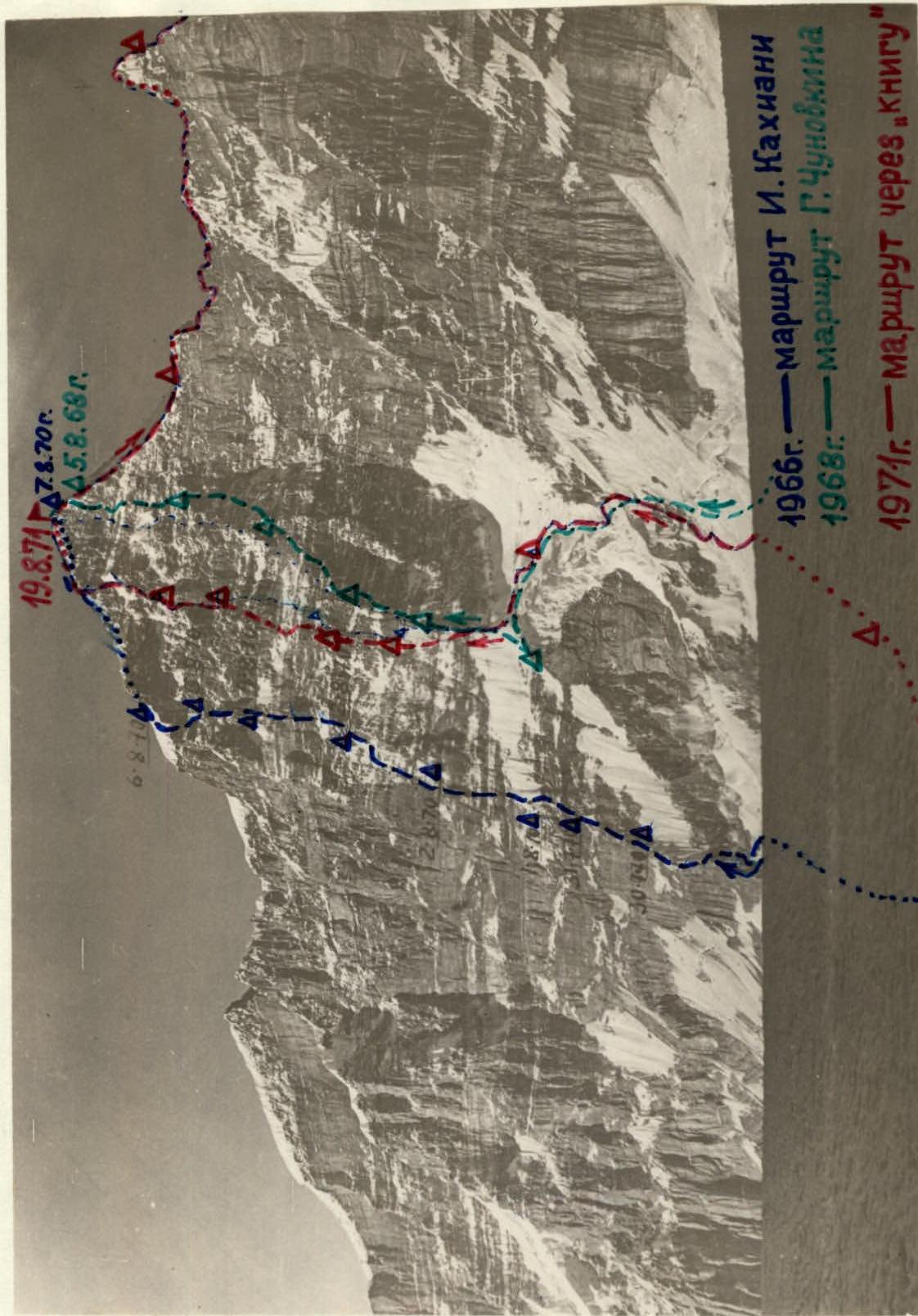
Routes to Peak Tadzhikistan from the north-east
1966 – I. Kakhiani's route
1968 – G. Chunovkin's route
1971 – route through "Kniga"
Team Composition:
| Surname, First Name, Patronymic | Rank | Role | City |
|---|---|---|---|
| Bozhukov V.M. | MS | leader | Moscow |
| Vanin V.V. | CMS | participant | Moscow |
| Akopdzhanyan Yu.A. | CMS | participant | Moscow |
| Danilov V.I. | CMS | participant | Nurek |
| Lavrushin V.I. | CMS | participant | Moscow |
| Shramko G.I. | CMS | participant | Moscow |
Team Coaches:
- Honored Master of Sports, Honored Coach of the USSR K. Kuzmin
- Sports Master of the USSR, senior instructor A. Belopukhov
Peaks included in the traverse:
- Peak Tadzhikistan – ascent via the north-eastern wall through "Kniga" (first ascent)
- Peak Bezymyannyy – traverse from the south, 5B category difficulty
- Peak Nikolaadze
- Peak K. Marx
- Peak Engels – ascent from the saddle at 5500 m via the 5A category difficulty route
- Peak 40 let LKSMU – traverse from the north with descent to the Kishty-Dzherob glacier
This variation of peaks and ascent/descent routes has been traversed for the first time.
8. Ascent Chronicle
Day 1. August 9, 1971
At 9:00, we left the assault camp on the moraine under the wall of Peak Tadzhikistan. Crossed the glacier and entered the heavily crevassed icefall of Peak Tadzhikistan. Navigating through the crevasses, trying to pass along the left orographic side of the glacier (boulders fall from the wall of Peak Tadzhikistan!), we reached the area of the icefall. Fearing ice avalanches from the upper part of the icefall (fresh huge ice fragments indicate the possibility of an avalanche), we moved to the right onto the rocky wall of the ridge bordering the glacier. We ran through the dangerous zone one by one.
Climbing the wall is very challenging; the rocks are wet – ice on top. The overall steepness is 85°, 3 hooks were hammered in, the length of this section is about 100 m, the last 25 m become gentler and lead to a wide ledge. Above – an ice slope, 60 m, steepness 30°. Leads to the ridge. To the left – a descent to the icefall, which leads under the wall we need. To the right – an ice slope with a steepness of up to 70° with several rocky outcrops, separated from the gentle snow slope by a clearly visible bergschrund.
Considering the objective danger of the path taken – the possibility of ice avalanches – we decided to proceed via the right ice slope in further work. We left a cache of equipment, food, and fuel – 67 kg total, and descended down the ice slope. For further ascent, we left a 80-meter rope fixed on 3 hooks.
Descent via the rocky outcrops – climbing with belay. In two places:
- at the top, on a 25-meter section of a very steep chimney with rime ice;
- at the bottom, when crossing the bergschrund,
we left a rappel rope.
Day 2. August 10, 1971
At 9:00, lightly packed, taking personal gear, Lavrushin, Shramko, Akopdzhanyan, and Vanin set out to process the further path under the wall. Passed the snow slope, rocky outcrops, and ice slope. Loaded up at the cache. Carefully belaying (ice hooks, 3 pcs.), but quickly passed through the labyrinth of the icefall. The path was laid:
- through the central part of the icefall with a clearly expressed ice ridge;
- then to the left into a wide mulde;
- through it – to the upper steps of the icefall.
Here, 200 m from the wall, under the protection of an overhanging ice wall, the upper assault camp was set up, food and equipment were left.
Day 3. August 14, 1971
After a three-day rest, we set out to assault the wall. At 12:00, we said goodbye to the observers in the assault camp on the moraine under the wall of Peak Tadzhikistan. At 16:00, we were in the upper assault camp before the wall. The Bozhukov – Danilov team processed the wall, fixed 80 m of rope, and descended to the camp at 19:30.
Day 4. August 15, 1971
At 9:00, everyone set out from the overnight stay. 50 m later, we approached the bergschrund under the wall. Section R1. The first 15 m – a vertical wall. 2 rock and 1 ice hook. Passes along the boundary of ice and rocks. We pull out backpacks immediately from the bergschrund. Section R2. Further 20 m along strongly destroyed rocks with a steepness of 70°. 2 rock hooks. Section R3. Up slightly to the left, bypassing the overhanging forehead, along yellow rocks with a steepness of 60°, climbing is not difficult, but everything is alive, and there's nothing to hold onto; the rope of the preceding climber dislodges stones. We have to pass this section extremely carefully. The rocks are местами icy, 45 m, 1 ice hook. Section R4. Almost straight up – slightly to the left. Steepness 60°, 40 m. The rocks are the same. We climb with backpacks, although it's heavy and would be better to pull them out, but we can't, as there's nowhere for the lower climbers to hide from the stones that will be dislodged by the backpacks. 2 rock hooks.
Section R5. Steepness 45°. To the white-red striped rocks, 80 m. Steepness 50°, 6 rock and 1 bolt hook were hammered in. We passed with backpacks, one by one. Section R6. Straight up, all the way to the white-red rocks. Steepness 60°. The rope dislodges stones, very dangerous, time 14:25, 80 m passed. Section R7. To the left, traverse 20 m along a narrow ledge to a vertical couloir. The rocks became unstable, layered; we search for a long time for a spot to hammer in a hook. 2 rock hooks were hammered in. Section R8. Up the crack-couloir 60 m to a ledge on the left, climbing is very challenging, 70°, 6 rock hooks. We pull out backpacks. We spend the night on this ledge, widening it and hanging hammocks; from below, we build up with rock fragments. In the end, all six of us are somewhat suspended. The weather is good; we don't need a tent. We admire the starry sky. We obtain water for drinking and cooking from ice.
Day 5. August 16, 1971
Section R9. We started moving at 9:00. From the left end of the ledge where we spent the night, first straight up 50 m along a wall with a steepness of 75°, the rock is fragile, like sandstone. 3 ice hooks and 3 large channels were hammered in. Section R10. Traverse 20 m to the left along a narrow ledge to a cornice, under which a large snow lump is stuck. We organize a pull for the backpacks over this cornice. 3 rock hooks were hammered in on the traverse. Section R11. Up the slabs 40 m, 60°. The rocks became solid, but the rope still dislodges small stones. 4 rock hooks were hammered in. Section R12. To the left along an osypnaya ledge 5 m, 1 hook. Section R13. A very interesting place: a crack-chimney on a sheer wall. First, it's passed on oporakh hands-legs, then it narrows so much that you have to press your back against one side of the chimney and your legs against the other – a classic case. One side of the chimney overhangs, and the other is first 5 m wide with a steepness of 70°, and then also overhangs. All team members are fans of free climbing, so we decided to pass such sections without hanging ladders. Ahead is the Nurek high-altitude climber, virtuoso of rocks Gena Shramko, who climbs boldly but is carefully belayed. 5 hooks were hammered in. When you look at the crack from below, it gives the impression of a tunnel in the wall. We pull out backpacks, 45 m. Section R14. The chimney widens. The path goes along the middle of its gentle part. Length 40 m, steepness 70°. Gray granite, solid. It's very good to climb in galoshes. At the very top of the chimney, the first climber discovered two live stones-“пера” frozen with their sharp ends into rime ice. He warns the others. Everyone passes this place carefully, and the last one knocks them off the wall for safety. 5 rock hooks were hammered in. Section R15. Further, there's a 10 m wall, which is the right side of the chimney, steepness 90°, with a crack where you can insert your foot. 1 ice hook at the top of the wall. We pull out backpacks. Section R16. Then along a ledge to the right to the bend in the ridge – 20 m, with a small gain in height. We decided to spend the night here. We spent three hours clearing and widening the ledge; as a result, four of us slept on the ledge, and two were in hammocks above them. We also built a control cairn here. The weather is wonderful. We can see the mountains of Afghanistan, Pakistan, and India in one direction – peaks stretch endlessly into the distance; in the other direction, Peak K. Marx becomes visible from behind Peak Nikolaadze. The ridge between Peak K. Marx and Peak Engels is already below us. Section R17. On the same day, the Shramko – Bozhukov team processed another 100 m. First, 20 m to the right from the overnight stay along an oblique ledge, 2 rock hooks were hammered in. Section R18. Then, continuing to move to the right and up, along rocks of very difficult climbing, after 20 m, we approached a wall. Another 3 rock hooks. Section R19. The wall is an interesting section. 60 m high, completely sheer – 90°. In one place, it overhangs. It's passed through a crack-chimney. The crack is mostly half a meter wide, sometimes wider or narrower. 12 rock hooks were hammered in. The rocks are solid. “Lots of acrobatics, and at the highest level. One unpleasant thing – the chimney is in the shade, and its 'cheeks' are crusted with rime ice,” reports our songleader G. Shramko. “Hands were freezing – had to remove gloves. And feet were in galoshes.”
Day 6. August 17, 1971
We left the overnight stay at 9:00. We pass sections R16–R19. We pull out backpacks. The general direction of movement is straight up under the middle of "Kniga". "Kniga" is a rock sheer face consisting of two walls, as if open to the observer. It's visible from below and in all photos of Peak Tadzhikistan. Section R20. Directly above us lies snow – ice. We bypass it on the left along small bastion-like formations with ledges in the direction of the left part of the wall above the snowpatch. A good landmark: the upper part of this wall stands out brightly with a light-red color. Steepness 60°, 40 m passed, 2 rock hooks. Section R21. Up the rocks of medium difficulty, large protrusions, 65°, 40 m, 4 rock hooks were hammered in. Section R22. Further along white rocks 15 m (60°), then along dark ones 25 m (80°). The white rocks are very unstable, thin-layered. They go in the II layer, crossing the entire wall, tilted towards Peak Nikolaadze. 4 rock hooks were hammered in, then a ridge departs upwards. Its upper part overhangs and now blocks our view of the right side of "Kniga". Only part of the left "page" is visible with a small snow patch in the depression. To the left of us, against the sky, a grandiose gendarme overhangs in the eastern ridge of Peak Tadzhikistan; the path of Kakhiani leads to it. Section R23. Up another 40 m along slabs with a steepness of 65°. It's good to pass them in galoshes; we have two in galoshes and four in vibration boots. In vibration boots, it's normal, but their rigid sole often dislodges sandy footholds from the wall and slabs. 4 rock hooks and 1 bolt hook were hammered in here. Section R24. One of the extremely challenging places. The walls departing from the monolith, powerful rock foreheads, formed first a narrow and then a widening crack with an overhang from the central part. The path lies first through the narrow crack on an 80° wall, then it becomes absolutely smooth. Section R25. Transition to the left from the constrained crack to the monolith on a 75° wall. The rocks are slippery. The passage is very challenging, actually without footholds, using balance and friction on the wall's bumps that the feet feel out. Thus, after 25 m, we move slightly to the left to a small destroyed ledge with a slope of 30°. The crack on our right, from the level of the ledge, begins to widen and turns into a chimney with overhanging sides. The left wall of the chimney turns to the left into a 90° wall; on it, along the central part, a ledge is visible, half a footstep wide. Section R26. From the destroyed 30° ledge, straight up along the wall with a distinctive edge. Straight and slightly to the right-up to the beginning of a crack in the left wall of the chimney, which then turns into a destroyed ledge half a footstep wide on a 90° wall. Here, extremely challenging climbing – 25 m. You have to be in a bent position, leaning away from the wall, holding mainly with your hands, 5 rock hooks. Section R27. This oblique ledge leads to the right, back to our chimney, which in its upper part transitions from overhanging to vertical, having the same slippery side walls. At this point, you need to successfully climb from the ledge into the chimney, using only supports and friction of the soles on the rocks. The most challenging climbing, vibration boots or galoshes are necessary. At the very end of the chimney, a stone protrudes; holding onto it, we carefully exit onto the top of the stone slab, section 8 m. 2 bolt hooks were hammered in, and a wedge at the top. From the stone slab, we organized a pull for the backpacks. Section R28. Further along the slab, traverse to the right 5 m, 1 ice hook was hammered in. Section R29. Straight up 40 m along short walls, about 2 m each, alternating with small ledges. The walls have protrusions of 1–2 cm; climbing is challenging. 5 rock hooks were hammered in: 1 wedge, 1 channel, 3 horizontal, and 1 ice hook. The section ends with a ledge; above us, another ascent of our wall. Section R30. From the ridge of the ascent to the right, first 10 m with a small steepness of 45°. Gradually increasing, the steepness reaches 90°, another 10 m. Section R31. Further, in the 90° wall, there's a very challenging section of 30 m. There are two overhangs of 1.5 m. The rocks are destroyed. Above the wall, there's a ledge, 2 ice hooks and 2 rock hooks were hammered in. Section R32. Hurray! "Kniga" is very close. It's 180 m away. But it's very challenging; the wall is 70°. We need to go up slightly to the right. The footholds on the wall are grabs from below for hands, and hooks are hammered in somewhere near the belly; feet are placed on ledges in упор. Thus, we pass 30 m, 5 rock hooks were hammered in. Section R33. We continue to climb the wall; further 20 m of cracks in a 90° sheer face. Here, we hang two ladders, each with two rungs. 6 rock hooks were hammered in. Section R34. From the crack to the inclined ledge under "Kniga" – traverse up – to the right. Steepness is almost the same – 85°. Again, grabs for hands from below. 30 m of very challenging climbing. To the right of the beginning of "Kniga", a snow-ice slope departs; after 20 m, it rests against a belt of a destroyed rocky balcony, on which a steep snow with small osyp lies in two tiers due to weathering sandy rocks. We decide to stop for the night on this balcony.
In the snow and osyp, 1.5 hours are spent by two climbers (Akopdzhanyan and Vanin) to carve out ledges 30 cm wide, 10 m apart. And four others, 5 meters to the left, settle in hammocks. We finish setting up for the night already in the dark. The overnight stay is inconvenient, completely exposed to the wind. But there's nothing better. By morning, almost everyone is freezing; the sun appears for a short time and hides behind the eastern ridge. Here, on a bolt hook, we leave a control cairn. When setting up the bivouac, 9 bolt and 6 rock and ice hooks were hammered in – for belay and hammocks.
Day 7. August 18, 1971
The whole day is spent on the "honor book" of Peak Tadzhikistan, as we called this key place in the route. 100 m are passed vertically for the day. Section R35. From the overnight stay, traverse to the left to the middle (backbone) of "Kniga" 15 m along a rocky wall and ledge, and then along steep firn snow. 2 rock hooks and 1 ice hook were hammered in. The weather is, in principle, wonderful, but very cold. We climb in down jackets. Section R36. The first 10 m – a narrow crack-chimney. Clogged with rime ice, steepness 85°. Further, a plug with an overhang; the plug is passed by climbing to the right along a very narrow crack. There are no footholds; we wedge our fist into the crack. 2 hooks were hammered in: a wedge and a channel. Section R37. After the plug, the chimney widens. Its middle part is completely smooth. We climb, pressing against the side walls of the chimney. The height, length of arms, and legs are barely sufficient; we climb 3 m like this. Then, from the chimney, there's a very challenging transition to its left side. In the end, you find yourself in a crucifixion position – this is the most responsible moment. Along a narrow crack clogged with ice, 5 m to a ledge in the chimney. The sheer face is 90° throughout the "Kniga". All transitions and searches for footholds are performed over an 800-meter abyss. A bolt hook was hammered in. Section R38. Further along the crack, another 10 m. Ice and plugs made of stones – the first 5 m. Then you need to climb onto the left part of the crack; this side is completely smooth. You stretch to your full height and grab both hands well; you squeeze onto a small ledge. You have to rest often; the height is 6100 m, almost everywhere it's a strength workout. Further, there's 3 m of ice plug. As soon as Gennady passed here, you're amazed! Again, into the crack, which is significantly narrower. It works with your back – legs, all on supports and friction. 5 m along it. 1 ice hook and a channel were hammered in; almost everywhere, we thread a steel cable into the hooks, making it significantly easier to pull the double rope behind Shramko. Section R39. Again, an ice plug. You need to climb onto the left side of the crack; it overhangs; the most challenging "fly" acrobatics. We hang two ladders. Another 6 m of "Kniga"'s text are conquered. Section R40. The first climber has to hammer in a hook directly into the crack; for the others, this is an additional obstacle. Having squeezed into the crack and supported themselves with their whole body, they re-clip. Higher up, there's a chimney 7 m long, mostly clogged with snow. In the middle, there's a plug in the form of a stone. And the wall here is the same – sheer and without footholds. It's passed only on friction with the help of supports. After 7 m, one ladder is hung on a bolt hook on the left smooth side; the right wall overhangs. The angle is still clogged with ice. Section R41. The exit from the previous section is covered by a cornice-plug. There's only a crack left. Bent in three, you slowly squeeze through this door-window. The left side has a 45° slope for 1 m. Here, you can finally rest a bit. A bolt hook. Section R42. Further, again, a chimney with smooth sides. Again, you climb on supports: knees – back. Gradually, the chimney widens; climbing on supports becomes impossible. We pass along its left side; having hung two ladders on bolt hooks. Section 10 m, 2 bolt hooks, and one wedge. Section R43. The chimney continues upwards for another 60 m. But you can take a simpler path to the left, traverse under the snowpatch, which we called "Utka" due to its shape. Traverse along a monolithic wall 10 m. 5 bolt hooks were hammered in; taut handrails were hung. At the same place, we organized a pull for the backpacks right from the overnight stay; the total length of the pull is 80 m. Section R44. The traverse to the left continues along a slightly overhanging wall. For feet, there are ledges half a footstep wide. Section 15 m, 3 rock hooks. Section R45. Now straight up along monolithic rocks in the form of large steps. 20 m, steepness 50°, 2 rock hooks. Section R46. Further up and to the right 40 m along an arc to the rocky osyp on the ridge directly above "Utka". Belay is alternating. From the pull site (sections R42–R43) to the rocky osyp, the backpacks were first carried by Shramko, who was free, and then by Bozhukov and Akopdzhanyan along the hung handrails. Here, we decide to set up a comfortable overnight stay and really rest in a tent. We spend 2 hours preparing the site. Under the osyp, there's a frozen slope with rime ice. We chisel it like woodpeckers; finally, everything is ready; the time is 20:30. We set up a tent, securing it and ourselves with rock (6 pcs.) and bolt hooks (4 pcs.).
Day 8. August 19, 1971
From the overnight stay, the summit is visible. It seems close, but we reached the summit only at 17:30. Still, the mood is upbeat. We decide to lighten our load as much as possible from the gear for the wall route. We leave items that are unlikely to be needed further on the overnight stay:
- hammocks
- galoshes
- a fourth pair of crampons
- extra candles
- batteries
- other trifles
Since every gram of cargo slows down the pace of movement. We also set up another control cairn here. Section R47. Along osyp ledges 40 m, slightly to the right, bypassing overhanging destroyed rocks. 45°. Section R48. Further up, still to the right. The general direction of movement is towards the three "pera" in the ridge of the summit. Through destroyed rocks like a forehead to a ledge going to the right with overhanging large destroyed protrusions above it. 30 m, steepness 60°, 2 rock hooks. Section R49. Along the ledge 40 m, squeezing through cracks between the ledge and overhanging large stones from the wall. At the beginning of a completely smooth wall going to the right, we turn to the left and exit through 15 m to a good site. Ice and rock hooks for self-belay. Length 60 m, 45°. Section R50. From here, challenging climbing along a 70° wall with destroyed stones. It's passed very carefully with a backpack. It's hard, but we really want to reach the summit this day. We reached the next ledge. 40 m, 70°, 5 rock hooks; on the ledge, another 3 hooks and a channel. Section R51. Further, slightly 3–4 m to the right to the next starting position, from where up and then to the right along destroyed rocks of medium difficulty to a place where a slab 8×5 m protrudes from the wall. To the right of it, a crack in the wall is visible, clogged with destroyed stones. 90°, 8 m of very unpleasant (everything is alive) and extremely challenging climbing along its right side. We hang a ladder. At this point, everyone pulls out their backpack, fixed on the handrails, and without delay, moves higher. Further 40 m of 60° challenging climbing upwards. 4 rock hooks were hammered in. Section R52. To the right, a ridge of large blocks is visible, attached to the wall. It ends with a snow ridge leading under the summit bastion. It seems that the path is there. To the ridge, 60 m of climbing upwards and then 20 m traverse to the right along large destroyed stones. 4 hooks (including 2 ice) – and we're on a ledge under the snowpatch. But going straight up to continue the direct route to the summit is obviously not worth it, as the path to the left, exiting onto the main ridge, seems significantly simpler. Section R53. To the left, an ice slope 30 m, steepness 50°. It's good that we have 3 pairs of crampons for vibration boots. 2 ice hooks were hammered in, and a third – a rock hook in the wall of the гребёнка, вдающегося in the ice slope. Further 8 m bypassing rocks on the left. The ice slope becomes steeper and narrower – we don't want to go on ice, 6 m – 60°. We approach a rock wall again; traverse along it 10 m to the left, and at overhanging destroyed rocks on the right, we squeeze onto a sloping ledge going to the left (towards the summit ridge). The first climber, Bozhukov, shouts to us: "Further is simple!" On the passed section: 2 ice hooks and 2 rock hooks. Climbing is challenging, with backpacks, a total of 400 m. Section R54. After 10 m from the left edge of the sloping ledge, a snow slope goes up to the ridge with a steepness of 45°. Up 8 m, and having cut out a window in the snow in the place of the overhang, Bozhukov finds himself on the ridge. 20 m.
Further, the path is to the left of the ridge along snow-ice slopes. The picture changes completely. It's warm. Thousands of rays from the sun playing on the calgasporah hit your eyes. Here, it's quite steep, and the calgasporah are nasty. We pass the bergschrund and almost along the snow ridge, we exit onto the summit – 120 m (in height). The summit of Peak Tadzhikistan is a wide field of stones-"cherepichek", местами covered with snow. Finally, you can untie and walk without using your hands. The time is 17:30. The South-West is before us in all its glory. A ridge stretches to the north, which we will then have to overcome; further, against the sky, the outlines of the peaks of K. Marx and Engels are visible. There's a lot of ice here, and to the south, below, are the dry valleys of the Pamir and Pyandzh rivers; and further, beyond the Vakhan-Darya river, the Hindu Kush rises; to the southeast of it, the seven-thousanders of the Karakoram are visible. Chogori is also shrouded in mist, as if beyond the horizon. Thoughts wander to the time when the flag of our country will be illuminated by the sun over these giants.
We write a note. It says that we dedicate our new route to Peak Tadzhikistan to our friend, the commissar of the Nurek special squad, an alpine climber – Master of Sports, a multiple champion of the USSR, a scientist – Candidate of Technical Sciences, associate professor of the Bauman Moscow State Technical University, a courageous, unbreakable person – Adik Belopukhov. He's not with us now, but in the base camp, he's carefully listening to the messages of our observers via radio.
Section R55. On the summit, there are excellent sites for an overnight stay, but according to the ascent plan, our overnight stay is below, on the ridge. We descend to the north along the ridge, first traversed in 1968 by the "Trud" team (led by B. Efimov). After not difficult rocks to the left of the ridge, a snow-ice slope begins with a steepness of 40–45°. Five descents – sporting. Belay via ice axes and ice hooks. The last, V. Danilov, goes in crampons; intermediate belays from below are set by V. Bozhukov. The section is dangerous because a steep snow unexpectedly turns into ice with hidden crevasses under a thin layer of snow. We exit onto rocks. The time is 20:30. After 80 m, we find an excellent site. In anticipation of a good and full rest, we start preparing for the overnight stay. Today, the first stage of our journey ended. Everyone is delighted with the wall. But we have, possibly, another week of work at heights from 6000 to 6700 m, as they say, in a completely different key. The work is hard and exhausting.
Day 9. August 20, 1971
From the overnight stay under Peak Tadzhikistan – to the saddle to Peak Bezymyannyy. Section R56. Along osyp ledges 300 m to the gap in the ridge. Section R57. Dyuльfer 40 m without backpacks. Backpacks are very effectively lowered along taut handrails. At the attachment point, we leave 2 rock and nylon hooks with a loop. The rope is pulled through. Section R58. Dyuльfer 30 m, not touching the wall, to the saddle. Without backpacks. Section R59. From the saddle along the ridge 20 m up along rocks of medium difficulty. Section R60. Along the left (in the direction of travel) side of the ridge along a creeping osyp, bypassing several gendarmes, 450 m. Almost everywhere, belay is alternating. You can't walk along the ridge because there are cornices made of rocks, ice, and snow. To the left, the ridge is initially gentle, and then it breaks off with steep walls. Section R61. Ascent to the summit of Peak Bezymyannyy along osyp. It creeps underfoot. Up 150 m, steepness 30°. Section R62. From the summit, we descend into a gap with a negative dюльfer from a very beautiful huge rocky balcony 40 m. Below, the rope is 8 m away from the wall. The saddle is 20 m wide with a snow cornice. Section R63. Exactly along the ridge – a gendarme. 40 m, steepness 50°. The ridge is sharp; climbing is very challenging. Section R64. Not reaching the summit of the gendarme – traverse along the wall 6 m. Climbing on balance. Interesting rock formations: bright green stones; stones entirely covered in mica sparkles, like sparks. But they're somehow oily to the touch and slippery for vibration boots. Throughout the path, the right side of the ridge is covered with snow in calgasporah. Now it's the end of August, and they're especially good. But walking on them in a horizontal direction is very challenging. Not only vibration boots but also knitwear hold very poorly. Section R65. A small descent to a huge stone in the form of a "khata" with its roof down – 20 m. Further down 5 m. Calgasporah slide towards the western (our) side of the ridge. The path is along the boundary of ice and rocks – along a ledge. Section R66. The stone-"khata" is bypassed to the right along a ledge. The time is 13:30. Section R67. Along the sharp ridge 80 m without loss or gain in height. Section R68. On the ridge, there's a stone made of sandstone. To bypass it, you need to descend 2 m down in a sporting manner, like a shelf, and traverse 4 m to exit back onto the ridge. The section is on balance; with a backpack, it's very challenging. We don't hammer in hooks because there are good protrusions everywhere. Section R69. Along the ridge to the left to the overnight stay site – 30 m. We make a site by clearing sandstone slabs in the ridge and set up a tent. The time is 20:00. The height is 6000 m.
Day 10. August 21, 1971
Section R70. From the overnight stay down 10 m climbing. 2 rock hooks. Section R71. Down to the left 15 m, climbing of medium difficulty. 1 rock hook was hammered in. Section R71–R72. Further down along rocks, sporting climbing along a rope on the boundary of ice, 40 m. 2 rock hooks. Section R73. Traverse 10 m along a ledge. 1 rock hook. Section R74. Descent sitting on a rope 40 m along rocks like "baranii lby" to the saddle. Steepness 80°. The last one goes on a double rope with pulling through. The section looks very impressive from below. A huge triangle is obliquely covered with calgasporny ice. In the center of the triangle is the beginning of the dюльfer, and at the top of the triangle is our overnight stay. Section R75. Traverse 10 m along the ridge. Section R76. Further, the ridge descends with walls 2.5–3 m with small terraces. On the walls, challenging climbing 20 m. Section R77. In the ridge, there's a 90° wall; a very challenging dюльfer 25 m. You need to descend down first and then swing to the left