
Pik Tajikistan is located on the Southwestern Pamir in the Southeastern spur of the Shahdara Range, adjacent to Peak K. Marx (see diagram). This area was explored later than other regions of the Pamir. The first mountaineering expedition was organized in 1946 by the All-Union Committee for Physical Education and Sports. The head of the expedition's assault group, Honored Master of Sports E.M. ABALAKOV, compiled an alpinist-geographical description of this most interesting region.
In recent years, the Shahdara Range has become very popular, with a number of mountaineering expeditions visiting it. Now, this area is well explored. Without going into detail about the description, as it has been done quite thoroughly by previous expeditions, we can note only the main characteristic features of the area. Here, there are very convenient and close approaches from the access roads (highways), good stable weather, and low air humidity. Almost all ridges and crests end in gorges with powerful walls.
The idea of ascending Pik Tajikistan from the east arose in 1964 during the ascent of Peak Moskovskaya Pravda. From this peak, Pik Tajikistan had a very majestic and grandiose appearance. In the Zughvand gorge, the peak ended in a giant wall. Additional information about the object of ascent was obtained from Spartakovites K. KLETSKO and G. AGRANOVSKY, who observed this peak in 1964 from the slopes of Peak Engels and confirmed that
BRIEF INFORMATION ABOUT THE AREA AND OBJECT OF ASCENT
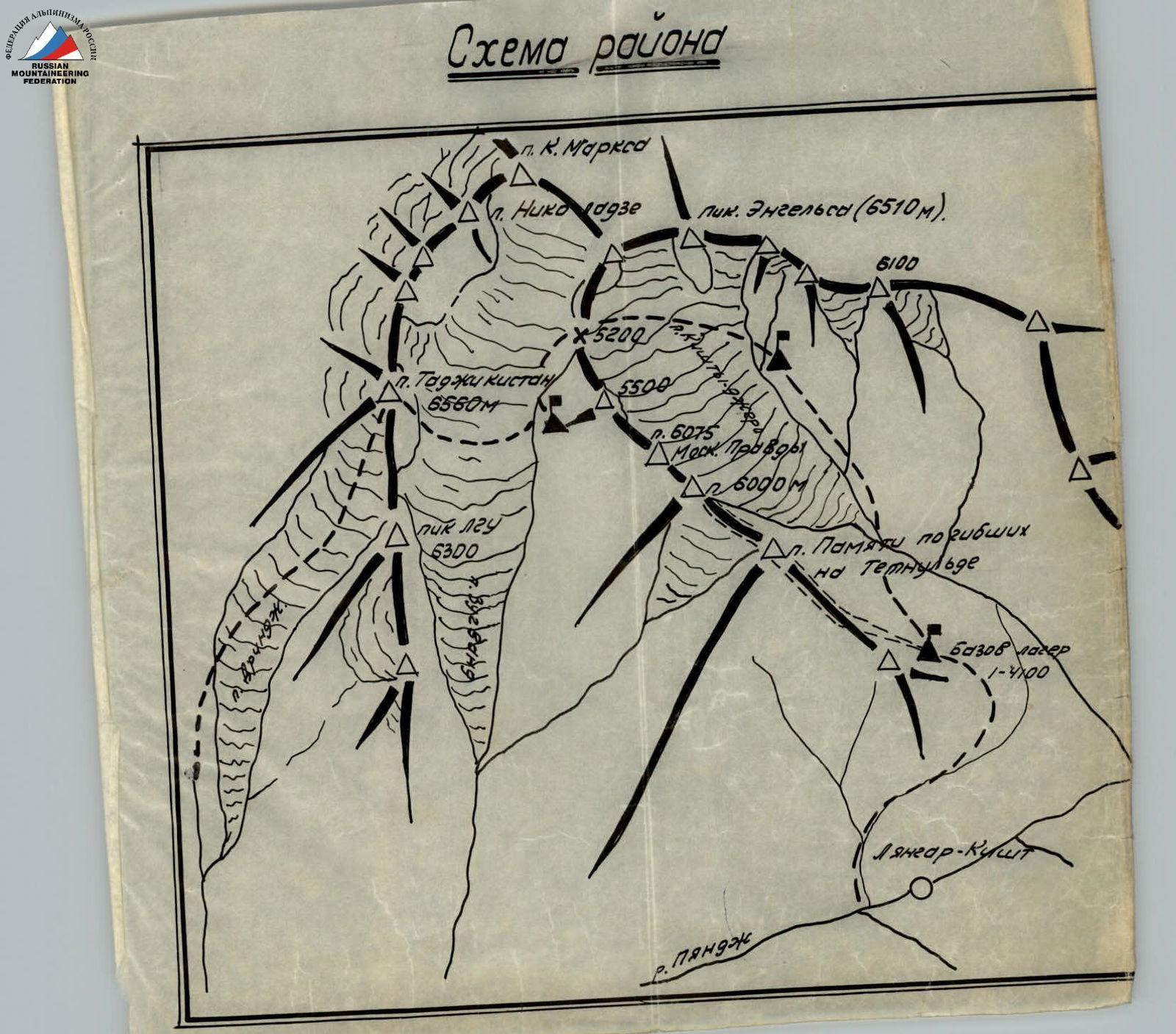
the eastern wall of Pik Tajikistan has a very large steepness and length.
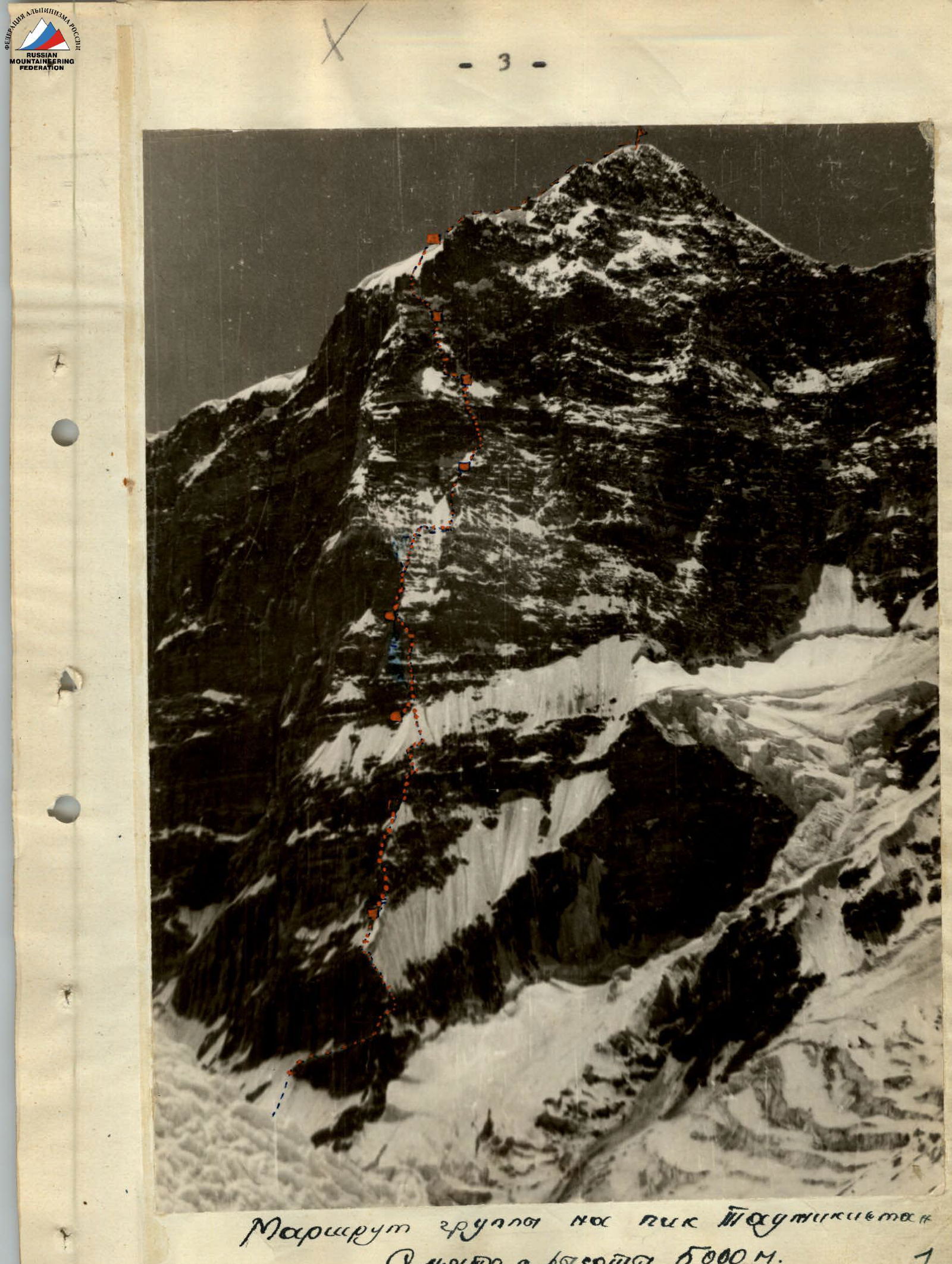
A valuable consultation about the area and Pik Tajikistan was provided by Honored Master of Sports V.M. ABALAKOV. He also kindly provided a photograph of the profile of the eastern wall of Pik Tajikistan, taken from the southern slopes of Peak Engels. All this information confirmed the initial ideas about the route.
The first ascent of Pik Tajikistan was made from the Southeast by a group of the "Burevestnik" sports society led by SAVVON in 1962. The descent of the Kabardino-Balkaria team from the peak was planned along the route of this group.
TACTICAL PLAN FOR THE ASCENT
Before starting the assault, the team had all the necessary information about the object of ascent. The most logical and safe route, as well as the places for overnight stays, were finally determined. It was necessary to pass a wall of great steepness with rocks similar to those of Peak Moskovskaya Pravda and Peak Engels. All available data indicated that the wall would be very complex and would require the use of all modern techniques used when passing the most difficult walls in the Caucasus. Unlike the Caucasian routes, this route was distinguished by:
- very large extent (more than 1500 m);
- high altitude above sea level (6560 m), especially the upper, most steep part.
In addition, the unstable weather in the Pamir this year was taken into account, and the ascent could be carried out in conditions close to winter. It was obvious that, despite the good preparation of the team, the ascent would take at least 8 days even in perfect weather.
Taking into account all the above, it was necessary to organize the ascent in such a way that:
- the physical load was distributed evenly over a large number of days;
- when passing the upper part of the wall, the team had a sufficient reserve of physical strength.
This was supposed to ensure:
- safety of passing the route;
- readiness to overcome various difficulties associated with bad weather and other complications.
Based on this, the following were planned:
- schedule of movement;
- distribution and alternation of rope teams;
- distribution of responsibilities within the team;
- organization of passing various sections, selection of equipment, organization of bivouacs and nutrition.
DESCRIPTION OF THE ASCENT
August 2
On August 2, at 10:00, two rope teams, SHATSKY – POROKHNYA and KAKHIANI – STEPANOV, loaded with pitons, ladders, and other equipment, went to process the lower part of the wall. They quickly crossed the glacier in half an hour and began their ascent along a narrow ledge (R1), 1 m – 1.5 m wide. The ledge led to a smooth granite wall that rose steeply. Here, the safest path was along an internal angle (R2) ending in a stone cork. With careful belaying, the teams passed through the internal angle and the "cork." Then, they moved along an inclined slab (2.5 m) to overhanging rocks, which they had to bypass along very smooth rocks with few handholds.
(All complex sections were passed by climbing, with the passage of the cork and the bypass of the overhanging rocks being particularly challenging).
The bypass was made to the right and upwards along a 10 m smooth rock face. They used ladders to pass a slab and gathered on a small inclined platform. Almost the entire section (about 40 m) was climbed. Particularly difficult was:
- overcoming the cork;
- bypassing the overhanging rocks;
- climbing the slab.
From the platform, the group moved upwards, first along a barely noticeable ice ledge 8 m long, and then along an internal angle filled with ice. Here, it was very difficult to exit the internal angle onto a rib. They had to clear snow to hammer in pitons for belaying; this place was in the shade and cold. During the ascent on this day, S. SHATSKY led the way.
At 17:00, the processing group began their descent to the assault camp, where they were met by their comrades who had been watching the processing.
August 3
On August 3, the entire assault group of eight people set out on the route at 6:00 am. Despite the fixed ropes and steps cut into the ice, the pace of advancement was slow due to heavy backpacks (20–22 kg). Finally, the entire group reached the end of the last fixed rope. From here, POROKHNYA went first with a lighter backpack, carefully belayed by SHATSKY.
Initially, they overcame a 6-meter crevice that led to a rocky edge with a steepness of about 60°. The edge was covered with rimed ice, and the rocks were smoothed, making movement difficult and requiring careful belaying. At the top, the edge connected to a snow-ice ridge, to the left of which hung huge cornices. From here, the entire group could be seen stretched out along the entire length of the edge. KERIMOV and STEPANOV brought up the rear, removing pitons and passing the freed ropes and carabiners to the front rope team. About 75 m were passed along the edge, and after overcoming it, the group bypassed the cornices on the left and approached the base of a snow-ice slope (R5) with a steepness of about 45°. Movement along the slope was on the front teeth of crampons with belaying through ice screws towards a lone large rocky outcrop. After passing 55 m of ice, all participants reached a steep wall (R6) that blocked further progress. Here, there were excellent places for an overnight stay, and tents could be set up. While preparing the bivouac, SHATSKY and POROKHNYA continued processing. Initially, they overcame a 20-meter wall with snowy bands, and then moved 4 m up a crack and 3–4 m along a ledge to the right. POROKHNYA, going first without a backpack, carefully hammered in pitons for belaying. The sun had set behind the peak, and it became colder; climbing became very difficult. To overcome a hanging internal angle, they had to hang a ladder. Having processed 50 m, SHATSKY and POROKHNYA descended to the bivouac, where tents were already set up and a primus stove was working.
August 4
On August 4, early in the morning, a "febus" (a type of wind) began to blow; they boiled coffee from ice, had breakfast, and at 7:30, POROKHNYA, SHATSKY, and KAKHIANI set out without backpacks along the fixed ropes. They reached the top and faced a challenging task – pulling up all 8 backpacks, as they could not overcome the overhanging part of the wall with them. Using a block, jammers, and a 80 m long rope, they pulled up the backpacks one by one.
The further path lay along a belt of destroyed yellow rocks with many loose stones. The first rope team moved very slowly and with great caution. They passed:
- a 6-meter ledge leading to an internal angle (10 m);
- a strongly destroyed ridge that led to overhanging rocks;
- bypassed them along a small ledge;
- climbed a very steep internal angle (25 m).
Behind the internal angle was a wall with a crevice. This section was very energy-consuming, as the backpacks were very heavy, and pulling them up was dangerous due to the destroyed rocks and the risk of stones falling.
Ahead was a snow-ice ridge (R8). The only way to reach the ridge was to the right, under hanging snow-ice caps. The first climber put on crampons and began to move forward, cutting steps and hollows for pitons. After 20 m, they had to crawl on their knees under one of the ice caps. Finally, they passed another 30 m, and ahead was a sheer wall (R9). The time was 15:30. There was an excellent place for a bivouac.
While the rest of the participants were approaching, the POROKHNYA–SHATSKY rope team began to pass the wall. POROKHNYA moved very slowly, with good handholds on monolithic rocks, but the steepness was close to vertical. They passed 45 m in 1 hour 30 minutes. Ahead was a smooth wall without handholds; the only path was through a chimney with a giant "stone-tooth" protruding from it. This marked the end of the working day. SHATSKY and POROKHNYA descended.
At this time, the rest of the group had already passed the ice-snow ridge and were preparing platforms for a bivouac. The overnight stay was even better than the previous one.
August 5
On the next day, armed with ladders, pitons, and other equipment, NAUGOLNY went first. Victor slowly, step by step, made his way to the chimney. The sound of a hammer tapping out holes for pitons and the hanging of a ladder accompanied his progress. Finally, Victor "rode" the tooth. He rested for a long time. This was a very difficult section. KAKHIANI and SHATSKY ascended using jammers to organize the pulling of backpacks.
The further route passed along a belt of strongly destroyed white rocks (R10). NAUGOLNY was still in the lead. Movement slowed down significantly, as they had to be careful not to dislodge any stones onto those below. Ahead, a snowy slope was visible, with sections of rimed ice and small ice sections.
They passed another 55 m. Along a barely noticeable ledge, the group moved forward.
The further ascent was along a snow-ice ridge. The first climber went on crampons. The snow was slushy and slid along the rimed ice. Steps were carefully cut, and ice screws were hammered in one by one.
Approaching the base of the wall, Victor shouted that he saw a good place for platforms. Soon, everyone had climbed up to this spot. It took a lot of work, but they were able to sleep lying down.
August 6
On August 6, they set out at 7:00. NAUGOLNY was in the lead, followed by POROKHNYA. Gradually, the other participants caught up. Today was expected to be a very difficult day, as ahead was a wall with a steepness of up to 80° (R12), ending in a negative wall, which they had seen from the camp through binoculars. The first 50 m were passed directly upwards along snowy rocks, with difficulty finding cracks. The sun had already illuminated the wall, and above, 150 m higher, huge icicles had formed overnight. Now, as they thawed under the sun's rays, they broke off, fell down, shattered, and their fragments reached the climbers. They carefully watched the climber in front, and the rope gradually moved upwards. Victor approached a very difficult spot – an internal angle filled with ice, 20 m long.
In many places, the rocks were wet, and the rope quickly became covered in ice. The path through the angle was blocked by a 3-meter cornice with a crack. A piton was hammered in, a ladder was hung, and Victor squeezed through the crack with great difficulty. Another piton was hammered in, and the cornice was finally passed. The nature of the rocks did not allow for pulling up the backpacks at this spot. They had to climb with heavy backpacks along a practically vertical 70-meter wall.
After the internal angle with the cornice, there was another 40-meter wall, but it was slightly gentler and easier than the previous section (R13). Having overcome this section, they reached good ledges where they could rest.
Further ahead towered a 40-meter sheer wall, almost smooth, with a small cornice at the top (R14). Everyone carefully examined the further path. Victor began the ascent. There were almost no cracks; one piton was hammered in, then a second. Time passed quickly. Everyone looked around anxiously, searching for a place to spend the night, as no one wanted to hang on the wall at night.
Victor finally reached the key section – the cornice. Ladders were hung, and he was suspended over the wall, belayed on a double rope. After a few more efforts, he was seen to have completed the section. The voice came: "Done! You can come up."
On this section:
- they pulled up backpacks;
- ascended using jammers.
Above the cornice, there was a good place for a bivouac. While preparing the platforms, POROKHNYA and SHATSKY processed the further path. This was a completely vertical 20-meter rock face, but its passage was facilitated by large vertical cracks (R15).
August 7
On August 7, they set out at 7:00. They quickly ascended and pulled up their backpacks along the 20-meter wall. From there, the path went along a very steep rocky ridge. SHATSKY was in the lead. The rocks were porous, with very sharp edges, and the steepness of this section was up to 70° (photo 19). In the upper part, the steepness increased, and everything was covered with rimed ice. They had to traverse to a neighboring ridge to the right. Steps were carefully cut (feet), and belays were organized. They traversed about 80 m to the right ridge, where they could rest on a ledge. Then, they ascended again along the ridge (R17) for 120 m, with a steepness of 65°. The rocks here were like "ram's foreheads." Before reaching the snowy ridge, they overcame two very difficult sections:
- a 5-meter internal angle;
- a 7-meter smooth wall with a crevice.
At 17:30, they reached a bend where there were excellent platforms for an overnight stay. On this day, they had ascended 280 m vertically. Ahead, the main part of the wall was visible, completely covered in snow. This year, there had been a snowy winter and very unstable weather in the summer.
August 8
On August 8, at 7:00, POROKHNYA went first. Initially, they overcame a snowy slope with a steepness of 45°, 35 m long. He approached the base of the wall, and the path went up a 6-meter wall to a ledge. Here, NAUGOLNY caught up, and then he went to the right along the ledge for 15 m to the base of an internal angle with a steepness of 80° (R19). They couldn't see him; time passed agonizingly slowly; the rope slowly moved, and the sound of a hammer was heard. Finally, they could start moving. The others followed with intervals of 30 m (KURILOV). The weather began to deteriorate; a gusty wind blew, and graupel fell from above. The saying "On the Southwestern Pamir, there is no rain" proved false.
Victor passed a smooth 10-meter slab with a crevice, inserting his fingers into it without gloves, and overcame this section. By the end, his hands were very cold, and he had to warm them up for a long time. From the slab, the path led to a 30-meter wall with an overhanging "ridge" at the end, which they overcame using ladders. This was a very complex section. It took a lot of time to pass, and the others followed using jammers, which was faster but still required great effort, as the backpacks pulled them back.
All around, nothing could be seen – a snowstorm. There were no suitable platforms or ledges. The further path lay along a snowy, icy ridge, 40 m long, with a steepness of about 65° (R20), which led to a very steep wall (R21).
It was already 17:00; they needed to find a place to spend the night. They moved upwards to the right for 15 m and decided to bivouac on a stone 60 cm wide and 2 m long. Five people settled here, while the other three cut out platforms in the ice slope.
It took 3 hours to prepare the platforms, and the snow continued to fall, with avalanches of snow falling from above. They hardly slept that night. They had to boil tea until 22:00. On this day, they had ascended only 165 m vertically.
August 9
On August 9, they set out at 8:00. NAUGOLNY was in the lead again. Initially, they descended from the overnight stay to the rope fixed the day before. Then, the path went along an internal angle, 60 m long, with a steepness of up to 85°, which took about 4 hours to overcome. The weather was still bad, and the altitude was taking its toll, as they were already above 6000 m above sea level. They moved slowly, never relaxing their belay. After the angle, walls (R22) alternated with snowy, loose slopes. By 18:00, they had ascended another 100 m along the wall with a steepness of up to 70°. They didn't find suitable platforms for an overnight stay, so they bivouacked in pairs, scattered over a distance of 15–20 m, directly in the snow and ice, carving out niches. It seemed that this would be the last night on the wall, as they were already in front of a wall that should lead to a ridge to the summit. The night was terribly cold, and almost no one slept. They didn't feel like eating in the evening; they just chewed on chocolate and some crackers with black caviar, and had a few sips of warm water.
August 10
On August 10, they set out at 9:00. KAKHIANI went first. Initially, they traversed to the left and upwards along icy slabs for 30 m and then approached the base of a wall (R23) overhanging the abyss. NAUGOLNY went first, using pitons. The rock was very hard; two pitons broke, and they passed spare ones down the chain to him. There were very few cracks on the wall and two small cornices. This was the most difficult section that none of the team members had encountered before. It took Victor about 3 hours 30 minutes to overcome this wall. When he climbed up, his fingertips were swollen, cracked, and bleeding from the tension and cold. The rope hung for pulling up using jammers was not touching the wall in any place, and in some places, the distance to the wall reached 3–4 m. The others ascended using jammers (photo 16) and pulled up their backpacks. By 16:00, the last participant had climbed up, and the first ones had already processed a snowy slope (R24) with a steepness of 55° and 80 m long, preparing platforms directly on the snow. The platforms were large – they could lie down and stretch out. Everyone's faces were bearded and tanned from the sun and snow, but they shone with joy, as the summit was almost within reach, and the path had already been traversed in 1962 by SAVVON's group. The weather had also improved. Until 23:00, they heated primus stoves, boiled tea from snow, and drank it plentifully.
August 11
On August 11, they set out at 9:00, all without backpacks, taking only pitons and ropes. The path initially went along a snowy slope with a steepness of 25°, 120 m long, then bypassed a "gendarme" 70 m high on the left along a slope with a steepness of 40–45°, leading to a snowy ridge. After 40 m, the ridge led them to the summit. At 11:00, they reached the highest point – 6565 m. The weather and visibility were excellent. Around them, as far as the eye could see, were snowy giants. They found a note from SAVVON's group on the summit; on the gendarme, a rope hung, left by their group. Within an hour, everyone had descended to the bivouac. They packed their belongings into backpacks and carefully descended in rope teams to the glacier. There, they had to navigate through meter-high crevasses. Finally, they reached the moraine by a stream. Further down, there were grassy slopes. Here, they could congratulate each other on their victory over the wall of Pik Tajikistan, which their team had climbed for the first time. Late in the evening, around 23:00, they arrived at Lyan'gar, at the border outpost.
CONCLUSIONS
The route was logical and safe throughout. The overall steepness of the wall was 68–70°, with a length of 1500 m. The steepness was mitigated by several snow-ice sections. The average steepness of the rocky sections was about 75°. This included about 450 m of the most complex walls with a steepness of more than 80°. The route was very diverse, featuring dry monolithic granite rocks, belts of destroyed rocks, smoothed rocks like "ram's foreheads," icy and snowy walls, and snow-ice slopes. To pass many complex sections, it was necessary to use ladders and pitons. They overcame 6 rocky cornices. During the passage of the wall, they used about 350 rock and ice pitons and 15 pitons for drilling holes. The load during the ascent was so great that all participants lost 5–8 kg of weight. Comparing the route on Pik Tajikistan with other wall routes in which alpinists from Kabardino-Balkaria participated, it can be said that this wall is significantly more complex than, for example, the Eastern wall of North Ushba (SNE SAREV's group), Peak Shchurovsky via "Bastion" (team of the Kabardino-Balkarian ASSR), Dalar (North wall), North wall of Donguz-Orun, North wall of Chatyn (the lower part was processed and passed by I. KAKHIANI with V.M. ABALAKOV's team), Tutyu-Bashi central via the North wall, winter ascent on Ullu-Tau via the North wall, and others. In terms of complexity and the nature of the rocks, this route is very similar to the wall of Peak 6075 (Moskovskaya Pravda). Unlike this wall, the route on Pik Tajikistan is significantly longer, higher in altitude, completely safe, has more places for overnight stays, and the group believes that this route can be classified as category 6B.
CHARACTERISTICS OF THE GROUP'S ACTIONS
The ascent was carried out clearly and in an organized manner; the team was a friendly and cohesive collective. All group members were on top, excellently prepared both physically and technically. Mutual assistance was observed on the route; everyone knew their place.
| Team Captain | I. KAKHIANI |
|---|---|
| Team Coach | G. STEPANOV |
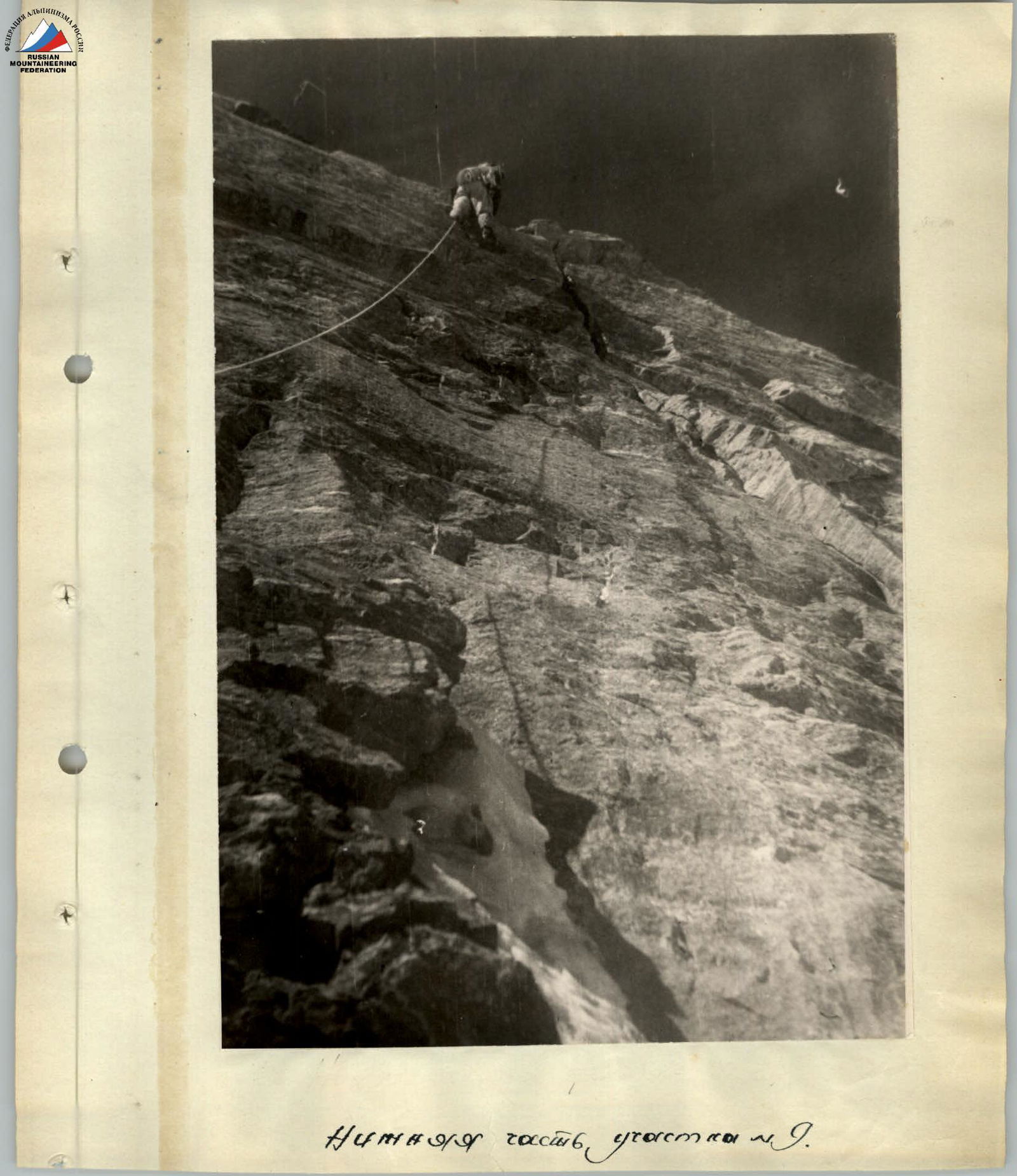
TABLE OF MAIN CHARACTERISTICS OF THE ASCENT ROUTE ON PIK TAJIKISTAN VIA THE EASTERN WALL
The height difference of the route from the Zughvand glacier to the summit is 1865 m, including the most complex sections: 1500 m. The steepness of the route is 60°, including the most complex sections: 68–70°, the steepness of the wall from section №2 to section №21.
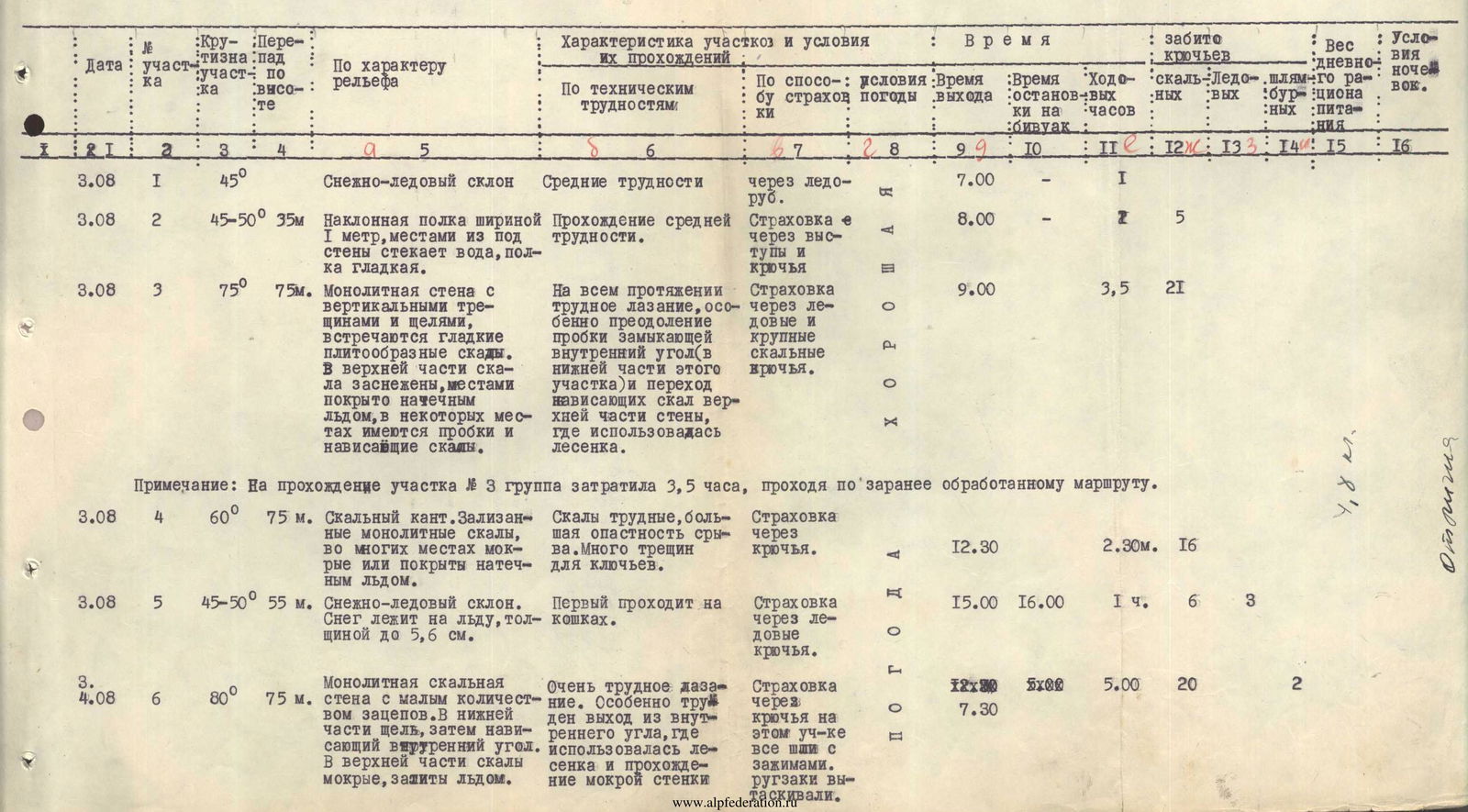
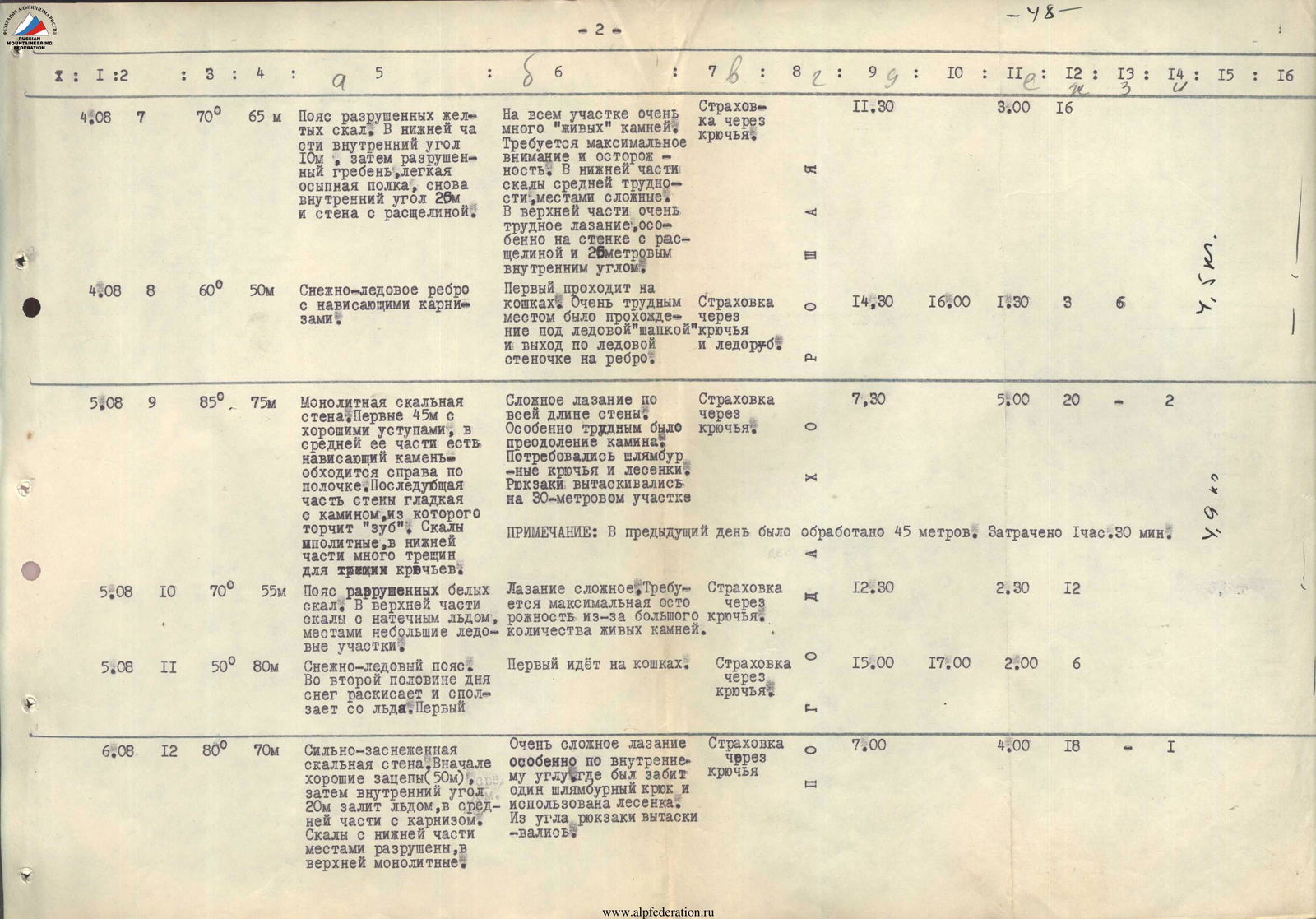
| Date | Section № | Steepness | Vertical height difference | Description of terrain | Technical difficulties | Method of belaying | Weather conditions | Time of departure | Time of stopping for bivouac | Working hours | Number of pitons driven | Conditions of daily nutrition | Conditions of overnight stay |
|---|---|---|---|---|---|---|---|---|---|---|---|---|---|
| 3.08 | R1 | 45° | 35 m | Snow-ice slope | Medium difficulty | Through ice axe | 7:00 | 1 | |||||
| 3.08 | R2 | 45–50° | 1 m | Narrow ledge 1 m wide, местами из-под стены стекает вода, полка гладкая. | Passage of medium difficulty. | Belaying through outcrops and pitons | 8:00 | 2 | |||||
| 3.08 | R3 | 75° | 75 m | Monolithic wall with vertical cracks and crevices, встречаются гладкие плитообразные скалы. In the upper part, the rock is snowy, местами covered with rimed ice, in some places there are corks and overhanging rocks. | Difficult climbing throughout, especially overcoming the cork closing the internal angle (in the lower part of this section) and the passage of overhanging rocks in the upper part of the wall, where a ladder was used. | Belaying through ice and large rock pitons | Good | 9:00 | 3.5 | 21 | |||
| Note: The group spent 3.5 hours on section R3, passing along a pre-processed route. | |||||||||||||
| 4.08 | R6 | 80° | 75 m | Rocky edge. Smooth monolithic rocks, in many places wet or covered with rimed ice. | Rocks are difficult, with a high risk of falling. Many cracks for pitons. | Belaying through pitons | Good | 12:30 | 2 ч 30 мин | 16 | |||
| 4.08 | R7 | 45–50° | 55 m | Snow-ice slope. Snow lies on ice, 5–6 cm thick. | First passes on crampons. | Belaying through ice screws | 15:00 | 16:00 | 1 ч | 6 | 3 | ||
| 4.08 | R8 | 80° | 75 m | Monolithic rocky wall with few handholds. In the lower part, a crevice, then an overhanging internal angle. In the upper part, rocks are wet, covered with rimed ice. | Very difficult climbing. Especially difficult is the exit from the internal angle, where a ladder was used and the passage of the wet wall. | Belaying through pitons, on this section everyone climbed with jammers, backpacks were pulled up. | 17:00 | 22:00 | 5 | 20 | 2 | ||
| 4.08 | R7 | 70° | 65 м | Belt of destroyed yellow rocks. In the lower part, an internal angle 10 m, then a destroyed ridge, a light talus ledge, again an internal angle 25 m, and a wall with a crevice. | Throughout the section, there are many "live" stones. Maximum attention and caution are required. In the lower part, rocks are of medium difficulty, местами сложные. In the upper part, very difficult climbing, especially on the wall with a crevice and the 25-meter internal angle. | Belaying through pitons | 11:30 | 3 | 16 | ||||
| 4.08 | R8 | 60° | 50 m | Snow-ice edge with overhanging cornices. | First passes on crampons. Very difficult was the passage under the ice "cap" and the exit along the ice wall onto the edge. | Belaying through pitons and ice axe | 14:30 | 16:00 | 1 ч 30 мин | 3 | 6 | ||
| 5.08 | R9 | 85° | 75 m | Monolithic rocky wall. The first 45 m with good handholds, in the middle part there is an overhanging stone, bypassed to the right along a small ledge. The subsequent part of the wall is smooth with a chimney, from which a "tooth" protrudes. Rocks are monolithic, in the lower part many cracks for pitons. | Complex climbing along the entire length of the wall. Especially difficult was overcoming the chimney. Ladders and pitons for drilling holes were required. | Belaying through pitons | 7:30 | 5 | 20 | 2 | |||
| Note: On the previous day, 45 m were processed. 1 hour 30 minutes were spent. | |||||||||||||
| 5.08 | R10 | 70° | 55 m | Belt of destroyed white rocks. In the upper part, rocks with rimed ice, местами небольшие ледовые участки. | Climbing is complex. Maximum caution is required due to the large number of loose stones. | Belaying through pitons | 12:30 | 2 ч 30 мин | 12 | ||||
| 5.08 | R11 | 50° | 80 m | Snow-ice belt. In the second half of the day, the snow becomes slushy and slides off the ice. First. | First goes on crampons. | Belaying through pitons | 15:00 | 17:00 | 2 | 6 | |||
| 6.08 | R12 | 80° | 70 m | Heavily snowy rocky wall. Initially, good handholds (50 m), then an internal angle 20 m filled with ice, in the middle part with a cornice. Rocks in the lower part are местами destroyed, in the upper part monolithic. | Very complex climbing, especially along the internal angle, where one piton for drilling holes was hammered in and a ladder was used. The backpacks were pulled up from the angle. | Belaying through pitons | Cloudiness, wind | 7:00 | 4 | 18 | 1 | ||
| 6.08 | R13 | 70° | 40 m | Rocky wall leading to a destroyed ridge. Rocks are snowy, many cracks. | Rocks are difficult, especially complex is the exit to the ledges, a three-meter wall with few handholds and a steepness of up to 80°. | Belaying through pitons and outcrops | Cloudiness, wind, snow | 11:00 | 2 | 8 | 3 | ||
| 6.08 | R14 | 85° | 35 m | Sheer rocky wall. Rocks are monolithic, very few handholds and cracks. In the upper part of the wall, a rocky cornice. | Very complex climbing, ladders and pitons for drilling holes were used. Backpacks were pulled up, jammers were used. | Belaying through pitons | Cloudiness, wind, occasional graupel | 13:00 | 17:00 | 4 | 12 | 3 | |
| 7.08 | R15 | 90° | 20 m | Monolithic rocky wall with large vertical cracks. | Difficult climbing. Backpacks were pulled up. | Belaying through pitons | Cloudiness, wind. Temp. -20–50. | 7:00 | 1 | ||||
| 7.08 | R16 | 70° | 120 m | Rocky wall entirely snowy, перемежается полочками. Rocks are monolithic, many handholds and cracks for pitons, then a traverse to the right 80 m to the ridge along smoothed slabs and an ice couloir. | Climbing is complex. The most difficult spot is the traverse. | Belaying through pitons | Cloudiness, wind | 8:30 | 4 ч 30 мин | 18 | |||
| 7.08 | R17 | 65° | 120 m | Rocky ridge, snowy, местами натечный лед. Rocks like "ram's foreheads." There are handholds and cracks. | Climbing is complex. Especially difficult is the 5-meter internal angle filled with ice and the smooth wall with a crevice in the upper part of the section. | Belaying through pitons | Good weather | 13:00 | 17:30 | 4 ч 30 мин | 22 | ||
| 8.08 | R18 | 45–50° | 35 m | Snow-ice slope, сверху плотная корка, далее пушистый снег 35–40 см и лед. | Passage of medium difficulty, very tiring as the foot sinks. | Belaying through pitons and ice axe | Cloudiness, gusty wind | 7:00 | 45 мин | 3 | 3 | ||
| 8.08 | R19 | 80° | 75 m | Internal angle, smoothed, snowy rocks. In the upper part, a smooth slab, above it a cornice with a crevice. | Very complex section, especially overcoming the |