
Ascent Log
- Ascent class — high-altitude technical
- Ascent area — South-West Pamir
- Summit of the route — peak Moskovskaya Pravda (6075), via the North-East wall (Solonnikov's route, partial)
- Difficulty category — 6
- Route characteristics: height difference of the wall 1129 m, length of sections with 5–6 difficulty category — 1040 m, average steepness of the wall section — 80°
- Pitons driven: for belaying: rock 382, ice 5; for creating intermediate technical objects (ITO): rock 30.
- Number of climbing hours 90.
- Number of nights — 8,
of which:
- lying down 6;
- sitting 2.
- Team composition: leader: Glushkovsky A.E. — Master of Sports; Larionov S.A. — Master of Sports; Basenko A.I. — Candidate for Master of Sports; Nakhabtsev D.V. — Candidate for Master of Sports.
- Team coach: Troshchinenko L.A.
- Date of departure on the route August 19, 1982. Date of return August 28, 1982.
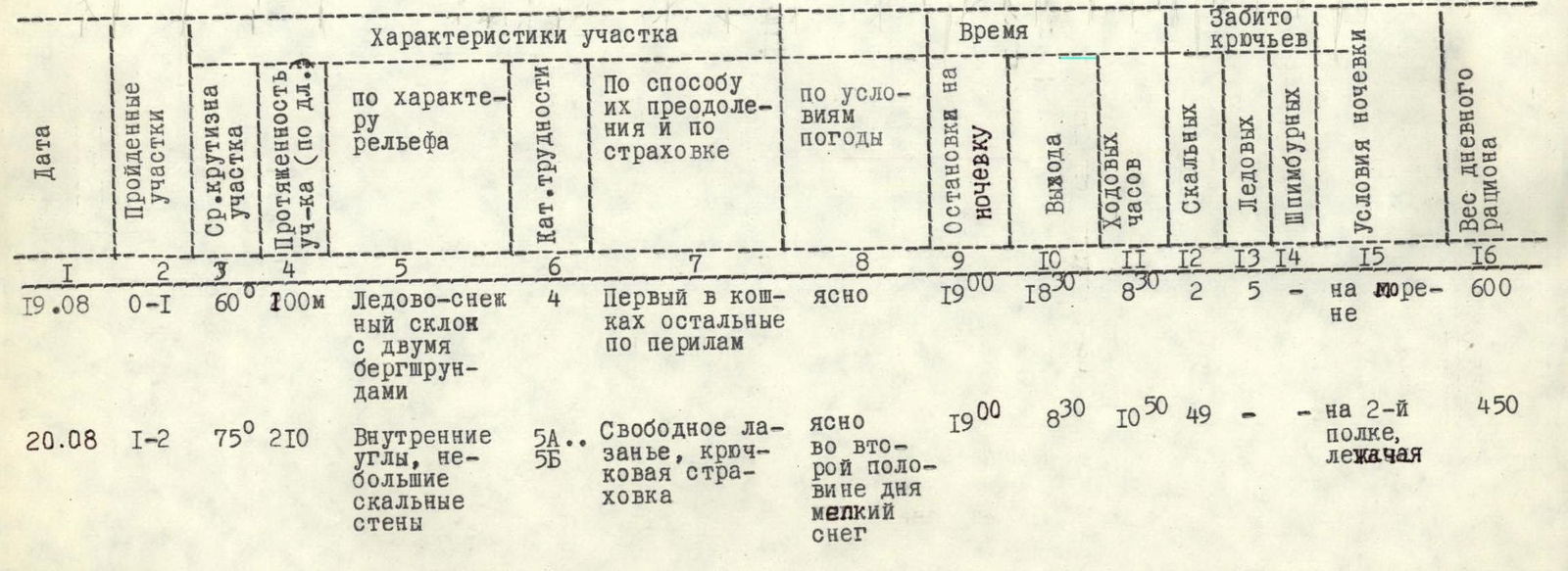
Table
Main characteristics of the ascent to peak Moskovskaya Pravda (6075 m) via the North-East wall (partial).
Route length — 1600 m (including the ridge). Height difference of the route — 1129 m. Including most difficult sections — 1040 m. Steepness of the wall — 80°. Steepness of the most difficult sections — 82°.
| 1 | 2 | 3 | 4 | 5 | 6 | 7 | 8 | 9 | 10 | 11 | 12 | 13 | 14 | 15 | 16 |
|---|---|---|---|---|---|---|---|---|---|---|---|---|---|---|---|
| 19.08 | 0–1 | 60° | 100 m | Snow-ice slope with two bergschrunds | First in crampons, others on running belays | clear | 19:00 | 18:30 | 8:30 | 2 | 5 | - | not | 600 | |
| 20.08 | 1–2 | 75° | 210 m | Internal corners, small rock walls | 5A–5Б, free climbing, piton belay | clear, snow flurries in the second half | 19:00 | 8:30 | 10:50 | 50 | 49 | - | on | 450 | |
| 21.09 | - | - | - | - | Waiting out bad weather | cold, snowfall | - | - | - | - | - | on 2nd ledge, lying down | 350 | - | |
| 22.09 | 2–3 | 78–80° | 250 m | Rock slab and system of rock-piton wall sections, rocks lightly snow-covered | Climbing, rock-piton belay. In small areas — using ladders | very cold, occasional light snow | 21:00 | 8:30 | 12:30 | 72 | - | under overhanging rocks on a small ledge, half-lying down | 450 | - | |
| 23.09 | 3–4 | 85–90° | 160 m | Red rocks, internal corners, walls, small cornices | 5Б–6, climbing with use of ladders and pitons for ITO in some areas | very cold, snow in the second half | 20:35 | 8:00 | 12:35 | 53 | - | on a snowy cornice, lying down | 350 | - | |
| 24.08 | 4–5 | 75–83° | 130 m | Block walls. Rocks snow-covered | 5Б, mainly free climbing, piton belay | cold, snow flurries at the end of the day | 21:30 | 12:10 | 9:00 | 57 | - | on a large snow drift under a cornice | 200 | - | |
| 25.08 | 5–6 | 80° | 170 m | Internal corner, cornice, rocks iced and snow-covered | 5Б–6, free climbing in difficult conditions, ladders and pitons for ITO, piton belay | cold, heavy snowfall from the second half | 20:30 | 11:00 | 9:30 | 63 | - | on a large snow drift under a cornice | 200 | - | |
| 26.08 | 6–7 | 87–90° | 140 m | Rock slab, cornices, rocks heavily snow-covered, ice | 6, climbing with use of ITO and ladders | very cold, occasional snowfall | 20:30 | 11:00 | 9:30 | 63 | - | on a small ledge, sitting | 180 | - | |
| 27.08 | 7–8 | 83–89° | 200 m | System of slabs and small cornices | 5Б, free climbing | very cold, light snow in the morning | 20:10 | 10:45 | 9:15 | 43 | - | on the ridge, lying down | 130 | - | |
| 28.08 | 8–9 | - | - | Ridge, ice and rock | 5, free climbing | cold | 23:40 | 15:10 | 8:30 | 17 | - | in the bivouac | 130 | - |
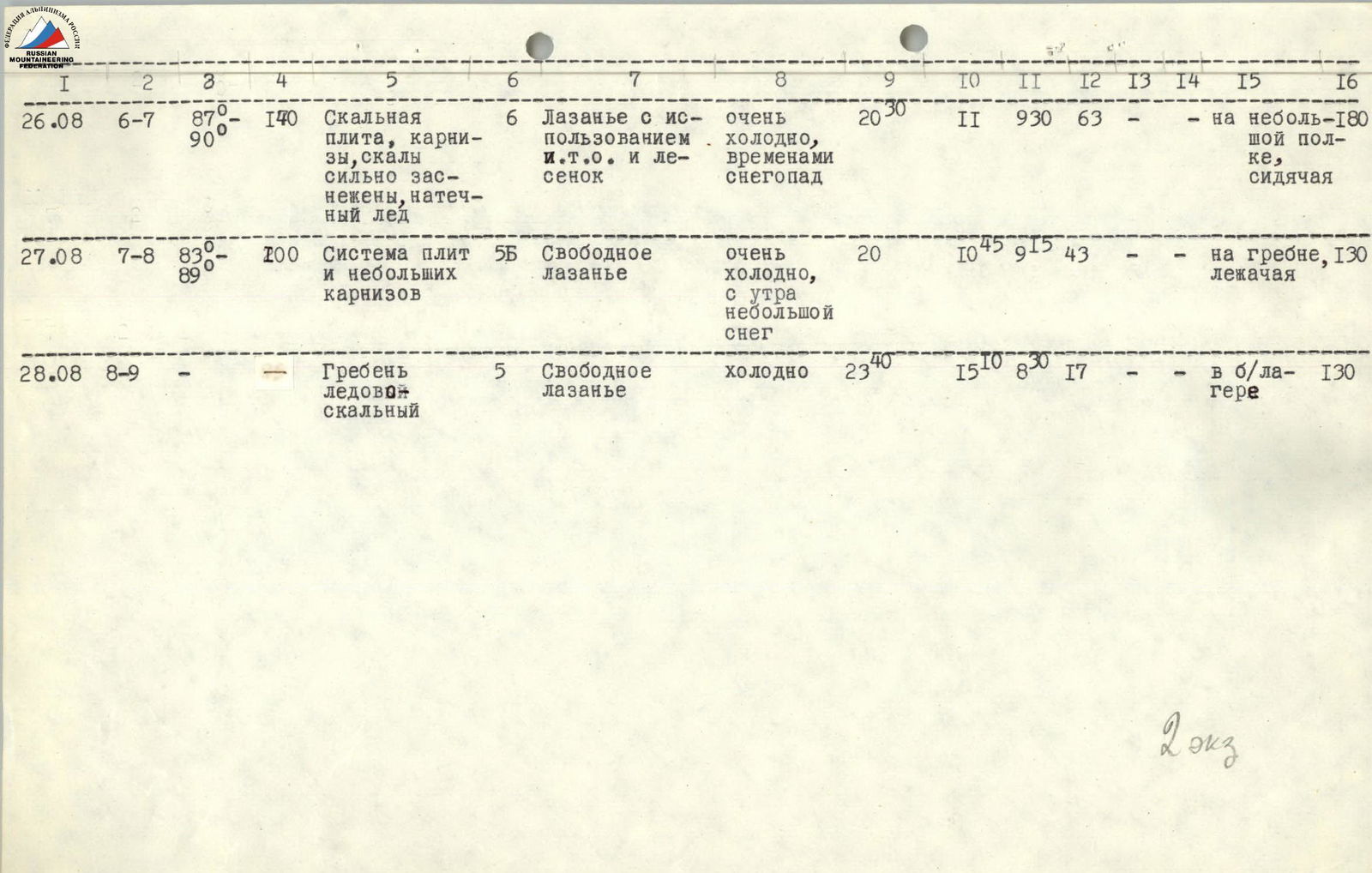
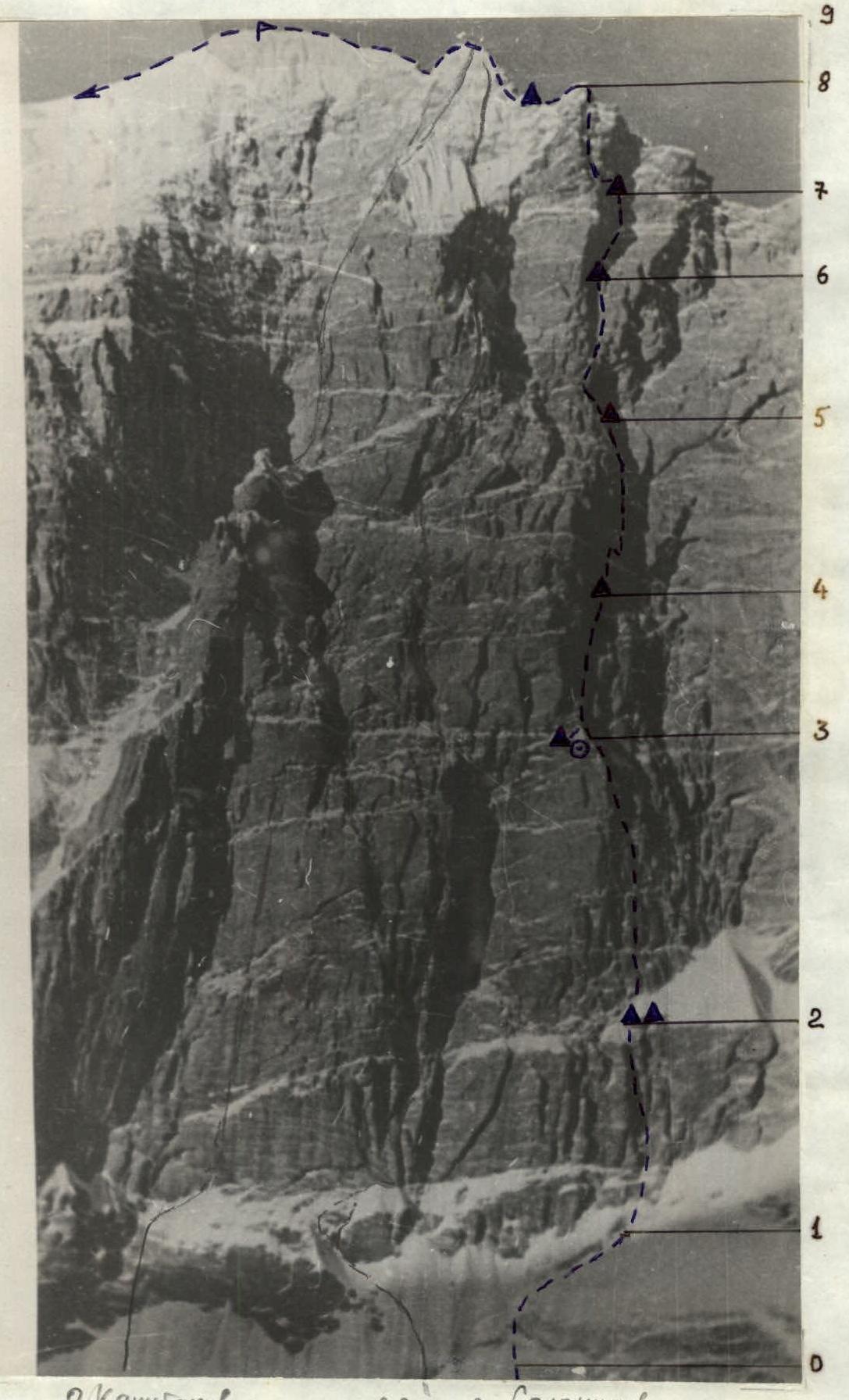
Photo 1. Route of ascent to peak Moskovskaya Pravda (6075 m) via the North-East wall ○ control tours ▲ overnight stays
Protocol
Debriefing of the ascent by the LOS SDSO "Burevestnik" team on peak Moskovskaya Pravda (6075 m) (third passage) (high-altitude technical class). August 29, 1982.
The debriefing was attended by: the team in full (Glushkovsky A.E. — leader, Larionov S.A., Basenko A.I., Nakhabtsev D.V.), observation group members Polyakov E.A., Mozhaev M.V., Gubin A.N., head of the rescue team Parshin V.S., and other participants of the gathering.
Glushkovsky: On August 17, the pair Glushkovsky–Larionov left the base camp for the route. The whole day on August 18 was spent observing the wall. The observation showed that the usual rock and ice fall areas are to the right and left of the route, and the route itself is not being threatened. In the evening of the same day, the pair Basenko–Nakhabtsev arrived. On August 19, the trio Glushkovsky–Basenko–Nakhabtsev set out in the morning to process the route. They covered 120 m of a snow-ice slope with a bergschrund and three ropes of rock. On August 20, the group started on the route. The pair Larionov–Nakhabtsev led. After reaching the planned overnight stay, they processed three more ropes upwards. At night, it started snowing, and in the morning, the entire wall and glacier below were covered in snow. The snowstorm continued until 15:00 on August 21. It was decided to wait out the snowfall. By evening, the snow had stopped. On August 22, the group continued moving along the route. The pair Glushkovsky–Basenko led. That day, they reached the planned overnight stay on the second snow ledge and processed two ropes under the red belt, with a control tour on this ledge. On August 23, Larionov–Nakhabtsev led. They covered a significant part of the red belt — a steep and complex section of the route. The overnight stay was on a snow drift — a good one. One rope was hung above the overnight stay. On August 24, the red belt was completed. Glushkovsky–Basenko led. Towards the end of the day, it got colder, and snow occasionally started falling. Above the red belt, the rocks were heavily snow-covered and iced. There was an excellent overnight stay under a rock overhang, and one rope was passed above it on the same day. On August 25, the group reached the base of the upper bastion. The pair Larionov–Nakhabtsev led. From mid-day, heavy snowfall began, and it got significantly colder. The overnight stay was again on a snow drift, very good. One and a half ropes were processed upwards. On August 26, the snowfall continued, and it was very cold. All rocks were covered in snow, greatly complicating the first's work. Glushkovsky–Basenko led. The overnight stay was sitting, four ropes from the previous one and three before reaching the ridge. On August 27, the snow almost stopped.
The pair Larionov–Nakhabtsev led. By the end of the day, they reached the ridge. It was very cold, with strong winds. On the ridge, there was a good area for tents. On August 28, the weather was good, with frost and wind. The pair Basenko–Nakhabtsev led, with Larionov–Glushkovsky following. They moved in independent rope teams. Along the ridge, they reached the main summit. On the summit at 16:15. The descent via the South summit took 7 hours. In the base camp at 23:40.
Parshin: What footwear did the first climber use on the route?
Glushkovsky: In the lower part and when passing the red belt — galoshes, and in the upper part, when the weather worsened — boots.
Parshin: How did the bad weather affect the speed of the route?
Glushkovsky: We lost two days due to bad weather. One day — August 21 — we had to wait it out, and one unplanned overnight stay was before reaching the ridge. According to our tactical plan, we had two days allocated for potential bad weather.
Larionov: The route taken by the group undoubtedly deserves a sixth category. It's a complex, interesting "six". With overall great steepness, the route is practically not threatened by rocks, and there aren't many sections with destroyed rocks. I believe the group was well-prepared for the ascent technically and physically and managed to complete the ascent in good style under difficult conditions.
Basenko: This was my first ascent of 6B category. The route is, of course, much stronger than those I had climbed before. The group's work was liked for its clear leadership and coordinated actions of all participants.
Nakhabtsev: I was in charge of the group's provisions on the route, which were taken at a rate of 450 g per person per day. The two days lost due to bad weather practically did not affect the ration, as there was a reserve for two climbing days — exactly for such a case. I'm very pleased with the good morale in the group and the friendly relations between the participants. I believe it was useful for me to work on such a complex ascent with more experienced comrades.
Glushkovsky: — I, the releasing officer. The group passed the route competently, in accordance with the tactical plan. Leadership and participation are credited to the group members.
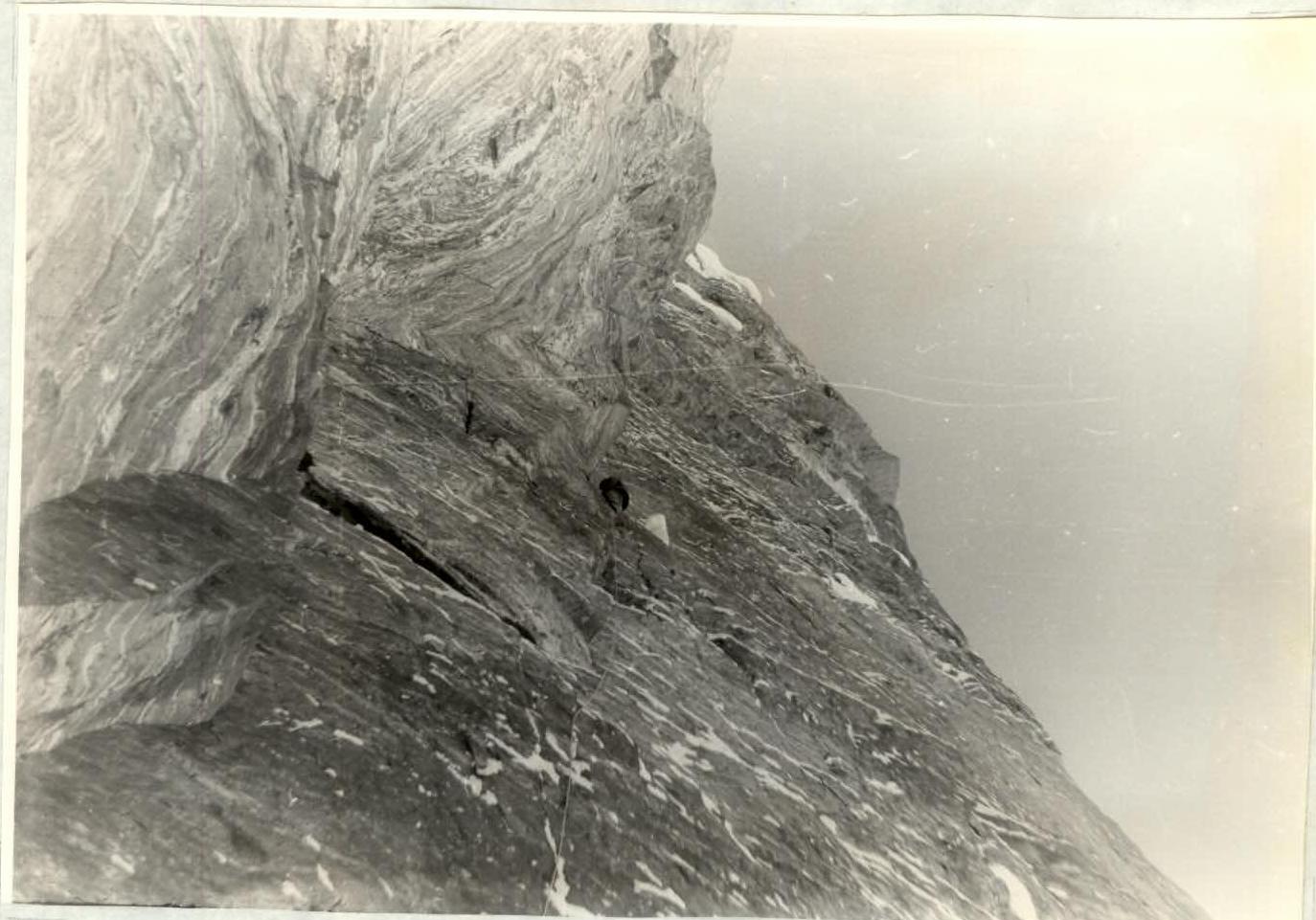
Photo 6. Section 6–7.