Passport
I. High-altitude technical class 2. South-western Pamir, Kish-ty-Dzherob river gorge 3. Peak Moskovskaya Pravda 6075 m, via the right part of the NE wall (V. Solonnikova) 4. 6B category of difficulty 5. Height difference — 375 m. Technically complex part — 270 m. Length: ice — 170 m; rocks — 1100 m; ridge — 300 m; length of sections with 5B–6B category of difficulty — 1000 m. Average steepness: ice — 50°; rocky wall part — 78°; overall average steepness — 75°; length of sections with 6B category of difficulty — 270 m. 6. Pitons driven:
| rock | bolt | chocks | ice screws |
|---|---|---|---|
| 67/II | 0+6/0+4 | 95/29 | 8/0 |
- Climbing hours — 56, climbing days — 6.
- Overnights: 1, 2, 3 — narrow rock ledges (three in a tent, two under накидками on ledges); 4 — snow-ice ledge on the wall, semi-sitting; 5 — good platform on top of the bastion.
- Leader — Dubrovskikh Vladimir Viktorovich, Candidate Master of Sports
Team members:
- Bazhukov Grigory Nikolaevich, Candidate Master of Sports
- Kvashin Sergey Georgievich, Candidate Master of Sports
- Sitnikov Nikolay Nikolaevich, Candidate Master of Sports
- Yagupov Sergey Nikolaevich, Candidate Master of Sports
- Coach — Yakovlev Gennady Semenovich, Master of Sports
- Approach to the route on August 9, 1983.
Summit — August 14. Return — August 14
| 5990 m | 29 | |
|---|---|---|
| 26 | ||
| 25 | ||
| 24 | ||
| 23 | ||
| 23 | ||
| 22. A | 86 | |
| 21 | ||
| 19 | ||
| 18 | ||
| 18 | ||
| 5450 m | 17 | |
| 46 | ||
| 15 | ||
| 14 | ||
| 13 | ||
| 250 m | 12 | |
| 41 | ||
| 10 | ||
| 6 | ||
| 5 | ||
| 3 | ||
| 3 |
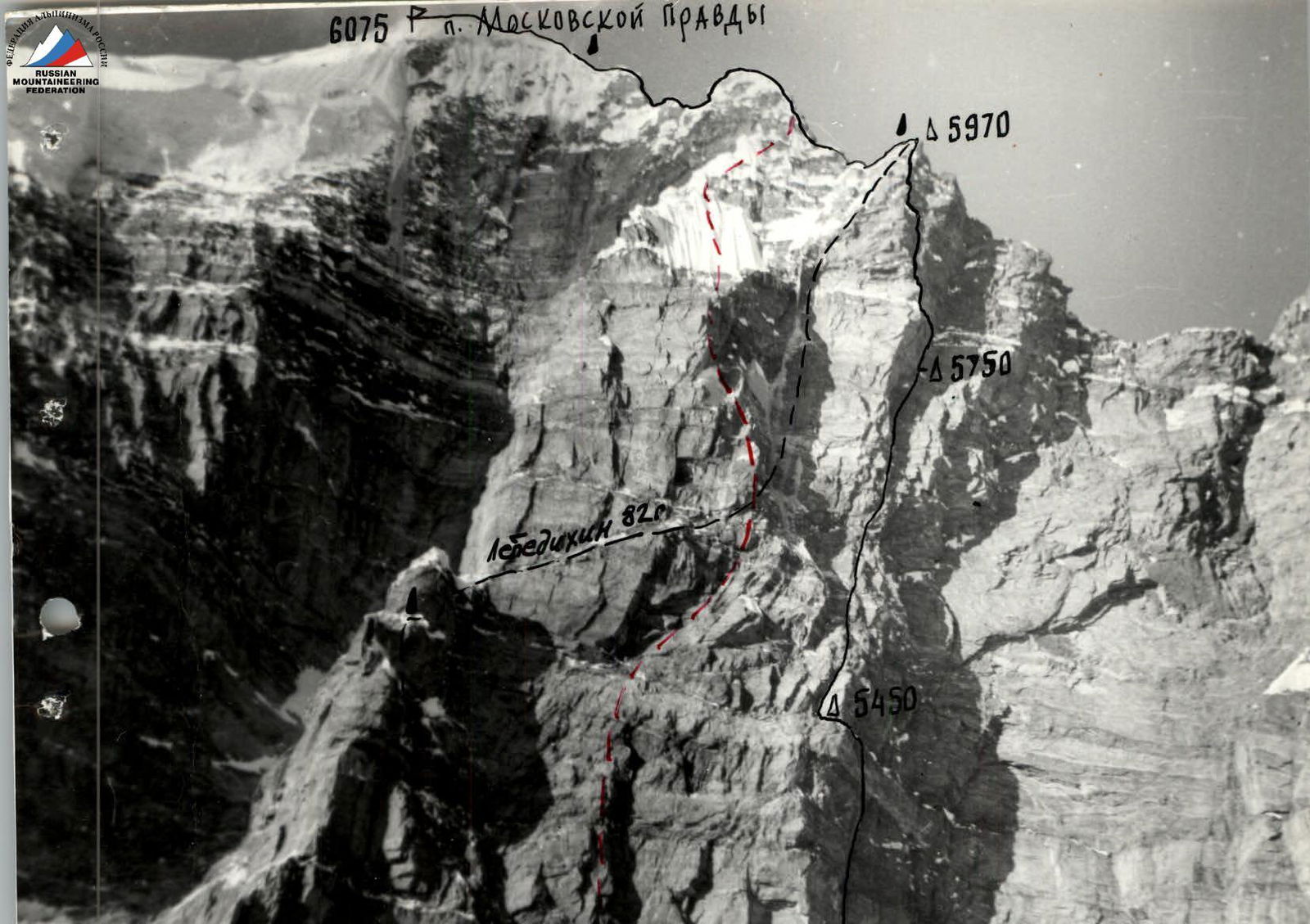
Shooting point No. 2 Camera "Lyubitel". Shooting time August 8, 1983 9:00 am. Team's route, overnight stays.
Profile of the wall on the left. Team's route, overnight stays. Shooting time August 7, 1983 9:00. Camera "Lyubitel", shooting point No. 2 (4700).
Tactical actions of the team
Despite some difficulties in determining the time required to complete the route (first ascenders took 9 days, and the Novosibirsk team took 11), after a detailed study of the route on site, taking into account the good physical condition of the participants and their own experience of climbing similar routes, it was decided to complete the route with 5 overnight stays. Considering that the route was "recently" climbed by the Novosibirsk team and that not much time would be needed to organize overnight stays, the team was determined to be 5 people, which was sufficient for:
- constant change of the lead rope team;
- maintaining the necessary pace of movement.
The tactical plan included:
- passing key sections in ladders using ITO;
- working with all participants on a double rope;
- using two hammocks to organize normal rest;
- using galoshes where possible;
- completing the route without pulling up backpacks;
- two hot meals per day, at 450 g per person per day.
The observation group was to maintain constant radio contact with the team and conduct visual observations using a spyglass. In case of an emergency, the group was equipped with two red signal flares. The team's medic, Bazhukov G., had everything necessary to provide qualified medical assistance to an injured person.
Since the wall is sunlit only in the early morning, the start of work on the route was planned no later than 8 am and finishing by 6–7 pm, in order to:
- organize a more comfortable bivouac;
- if possible, conduct advance processing of sections for the next day.
The team's tactical actions on the route were carried out in strict accordance with the tactical plan outlined before the ascent, except for the use of hammocks on bivouacs.
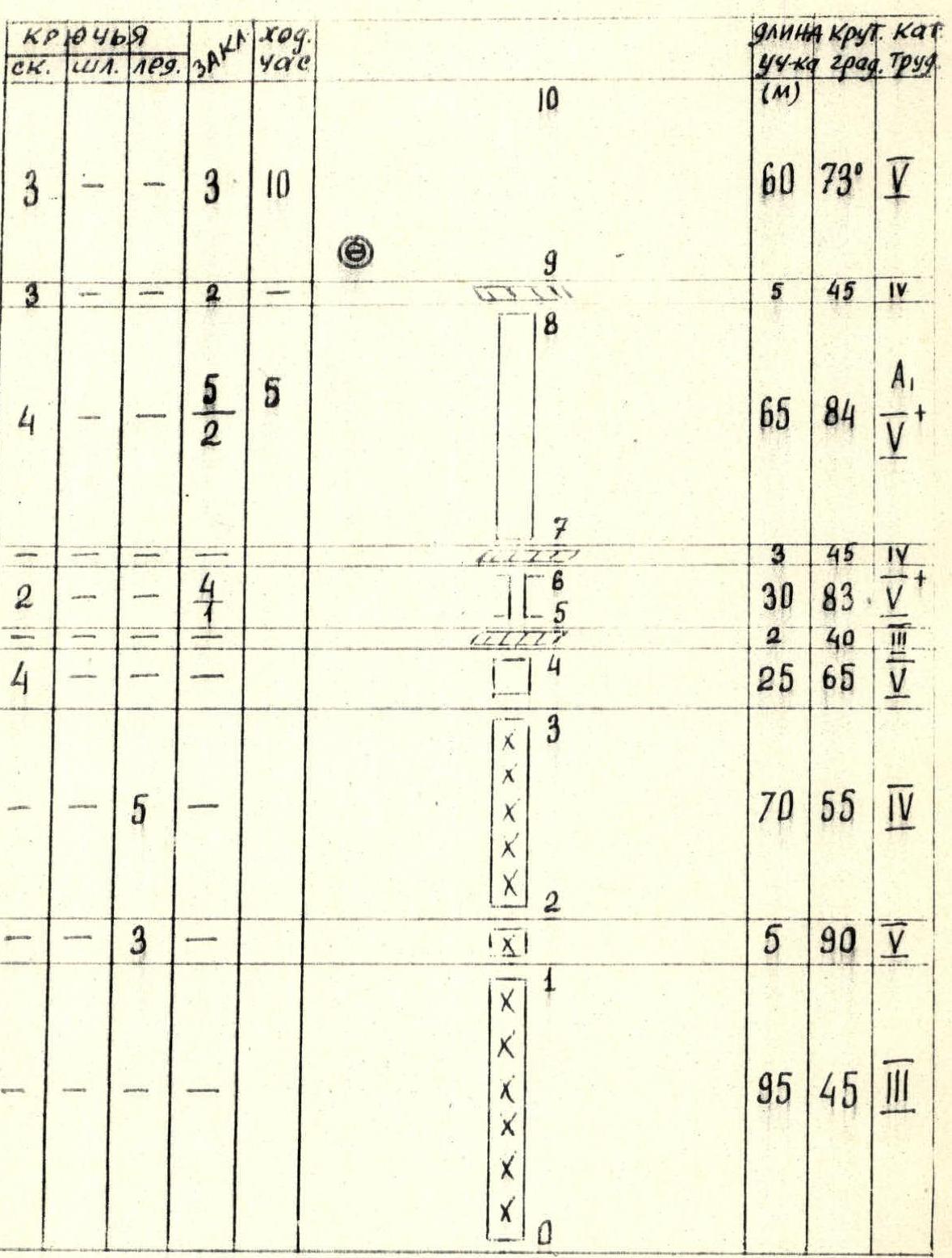
M 1:2000
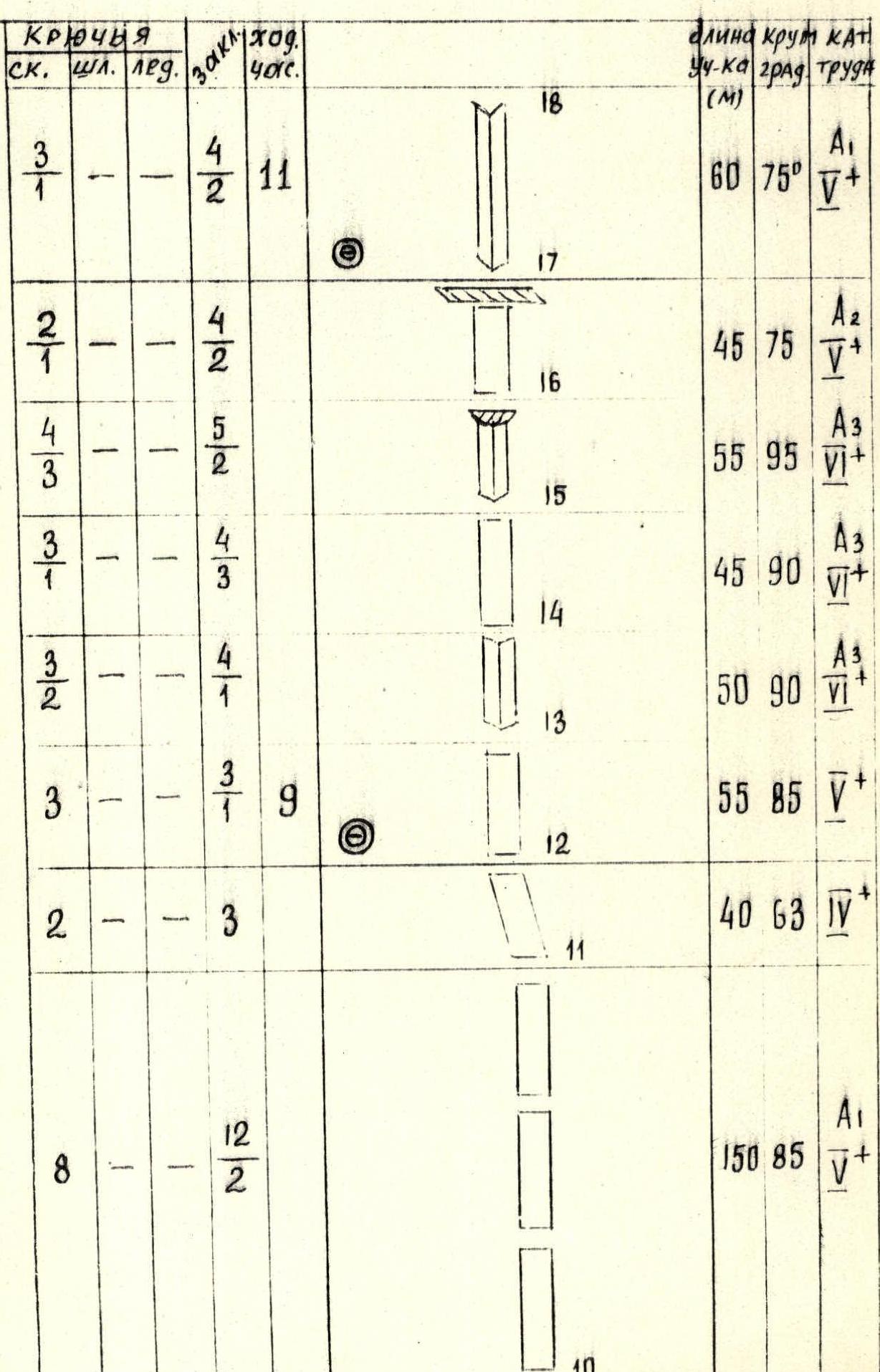
M 1:2000

- 1 — Simultaneous ascent in crampons. Condition — firm snow.
- 2 — Bergschrund — free climbing. Condition — firm snow and ice.
- 3 — Snow-ice slope 70 m, steepness 55°, ascent with alternate belay.
- 4 — Rock wall. Not particularly difficult.
- 5 — Ledge with traverse to the right under a large chimney.
- 6 — Chimney is wet, with loose rocks.
- 7 — Ledge where the team can gather.
- 8 — Wall with wide vertical slots. Large chocks fit well. Micro-relief is good, galoshes hold well. Cold. Had to put on warm clothing, down jackets.
- 9 — Ledge to the left for overnight stay. There are several narrow horizontal ledges. Three people slept in tents and two separately on ledges. On the first day on the ice, Sitnikov worked ahead. On the rocks, Kvashin processed above the overnight stay on 2 ropes, Yagupov — Sitnikov.
- 10 — From the overnight stay to the right and up 60 m of rock with good relief.
- 11 — Wall with vertical slots and cracks. The route is not clearly defined. Can go to the right or left by 10 meters. Belays are attached to blocked 2–3 pitons and upper and lower ones. All team members move on 2 ropes.
- 12 — The wall becomes less steep with a move to the left onto platforms for overnight stays. The first three overnight stays are similar — located under overhangs and are safe from falling rocks, which occasionally fly by. Another 2 ropes were processed.
- 13 —
- 17 — Almost vertical walls with an overhang for 200 m. Rocks of category 11 difficulty. Use of ITO, ladders. At the end of section 17:
- a ledge in the form of a niche;
- which leads left around the corner for 10–15 m to overnight stays.
The ledge before overnight stays is narrow, had to crawl, passing backpacks on ropes.
- 18 — To the left of the overnight stays, up the corner 60 m.
- 19 — Further, the route becomes less steep to 55–60° and follows a system of chimneys under a large internal angle of the bastion.
- 20 — Difficult rope with an overhang. Relief is good, chocks and швеллеры fit well.
- 21 — The wall turns into a large internal angle, which goes up to the right. Movement follows the internal angle.
- 22 — The same angle gradually overhangs, and the difficulty increases. The use of ITO and ladders allowed the team to overcome this section and stop for overnight stay on a snow-ice islet, which barely accommodates five people in a semi-sitting position. The sun never reaches here. Cold. On the same day, 1 rope was processed above.
- 23 — Difficult climbing up the angle with an overhang, large chocks fit well. There are also 4 bolt pitons on the wall to the right. Further up to the left along small ledges (pushing off) in the direction of the bastion's edge. Exactly on a 40-meter segment from the overnight stay — two bolts — a belay anchor.
- 24 — Along the edge through eaves and an internal angle, exit to a niche (there was an overnight stay of the previous group, which spent a whole day on these two ropes).
- 25–27 — Further up, to the left, the route gradually becomes less steep and the exit to the bastion is not difficult. Overnight stays on the bastion are excellent. Sunlight. On the same day, two more ropes were fixed further up along the rise on the ridge.
- 28 — The next day at 2 pm, the team reached the summit. The ridge is long and quite cut up: rises, dips, gendarmes, etc. Descent to the south summit and further down via 2A category of difficulty to the base camp took about 5 hours.
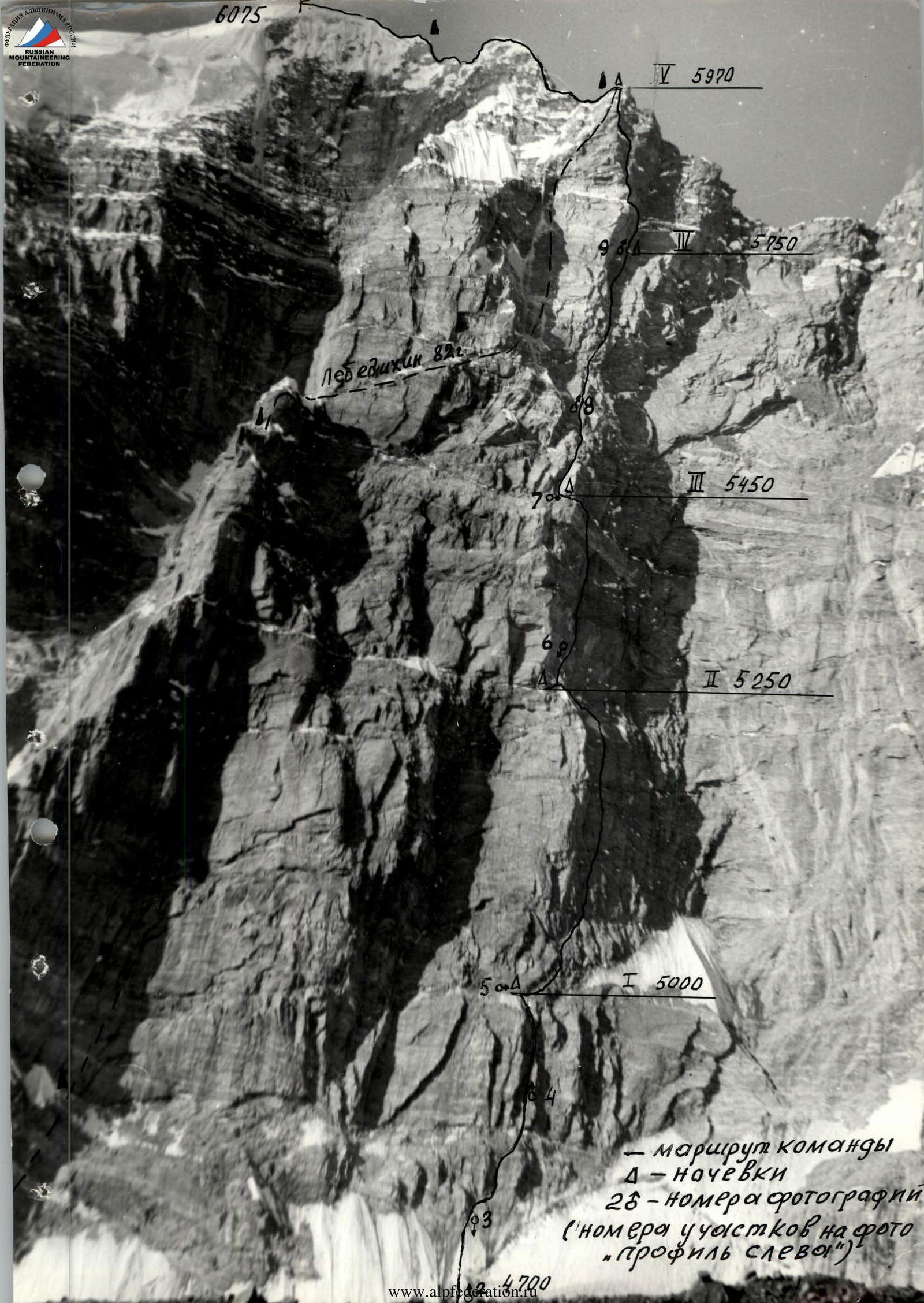
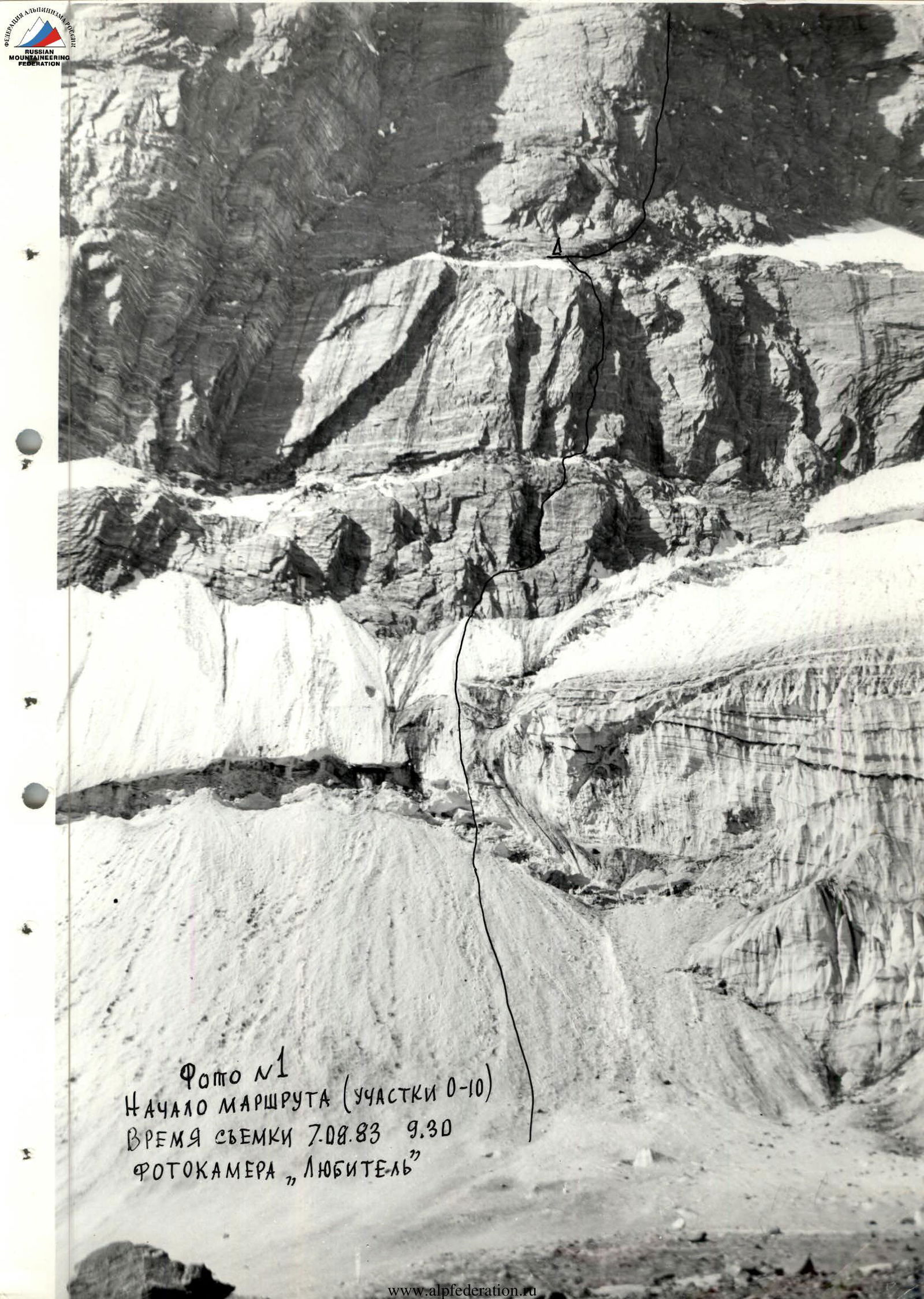
Photo #1
Start of the route (sections R0–R10). Shooting time August 7, 1983 9:30 am. Camera "Lyubitel".

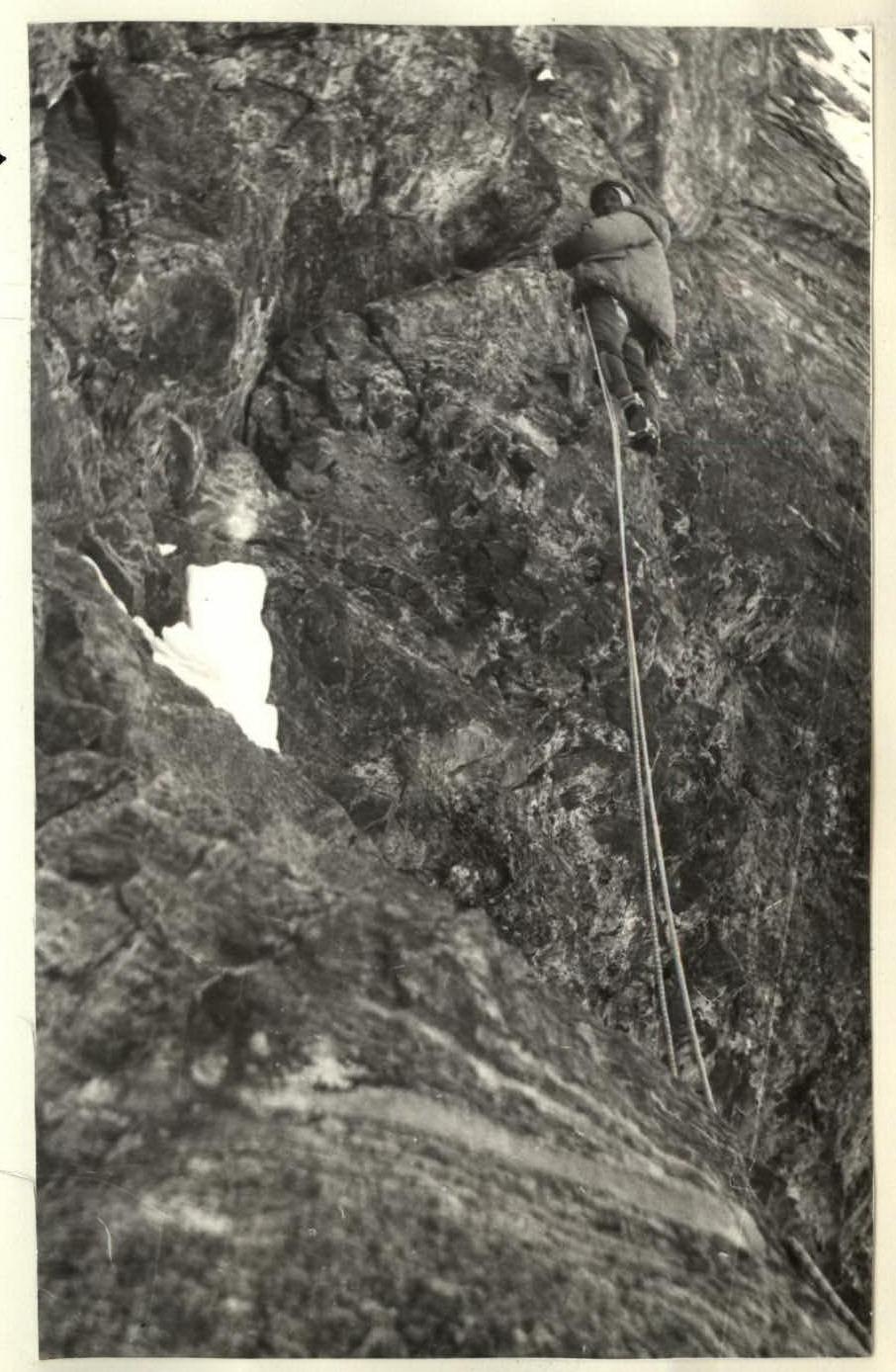
Photo #4. Section #8. August 9, 1983 3 pm.
Photo #5. Overnight stay 1. August 10, 1983 7:30 am.
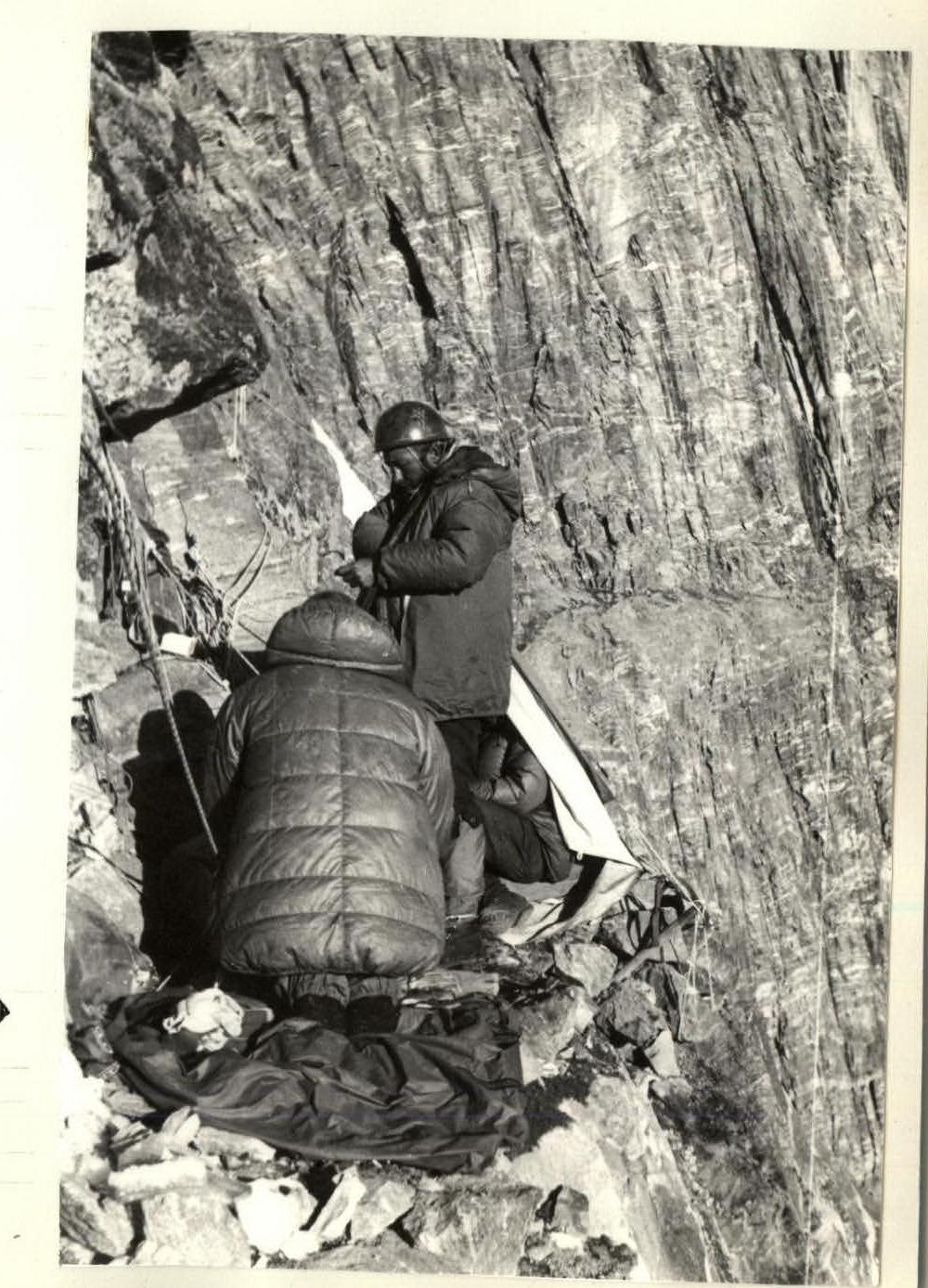

Photo #9
Section #23
August 13, 1983 9 am.
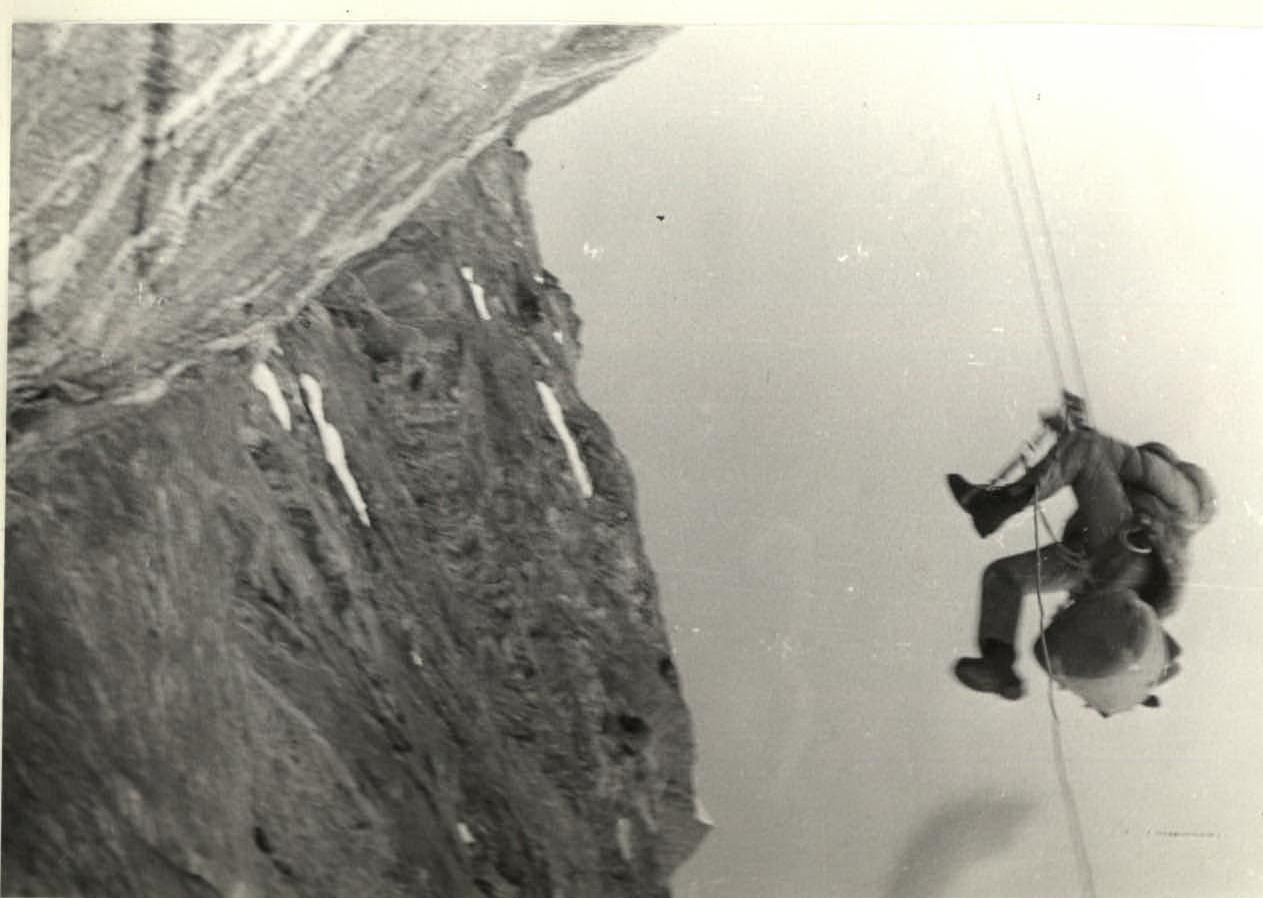
Photo #8. Section #19. August 12, 1983 10:30 am.