

Ascent Passport
- Ascent class: high-altitude technical
- Ascent area: South-West Pamir, Shakhdarin Range.
- Peak, its height, ascent route: peak Luknitskogo, 5800 m, via the center of the Western wall.
- Proposed difficulty category: 6
- Route characteristics:
- height difference: 1350 m
- average steepness: 65°
- average steepness of the wall section: 72°
- length of sections with 5–6 difficulty categories: 1237 m
- Pitons hammered for belay:
- rock: 223
- ice: 13
- bolt: —
for creating artificial holds:
- rock: 9
- ice: —
- bolt: —
- Number of travel hours: 52 hours
- Number of bivouacs and their characteristics:
five bivouacs: 1 and 2 on platforms, reclining; 3 on a shelf under a rock cornice; 4 and 5 — on shelves, semi-reclining.
- Surname, name, patronymic of the team leader, participants, and their qualification:
Team leader: Mikhailov Alexander Alexandrovich, Master of Sports Deputy team leader: Baychenko Yuri Petrovich, Candidate Master of Sports Participants:
- Ponomarev Valery Alekseevich, Candidate Master of Sports
- Sarkisov Lev Arshakovich, Candidate Master of Sports
- Starchik Grigory Panteleevich, Candidate Master of Sports
- Team coach: Master of Sports Mikhailov A. A.
- Date of departure for the route and return:
August 22, 1976 — departure from the base camp, August 29, 1976 — return to the base camp.
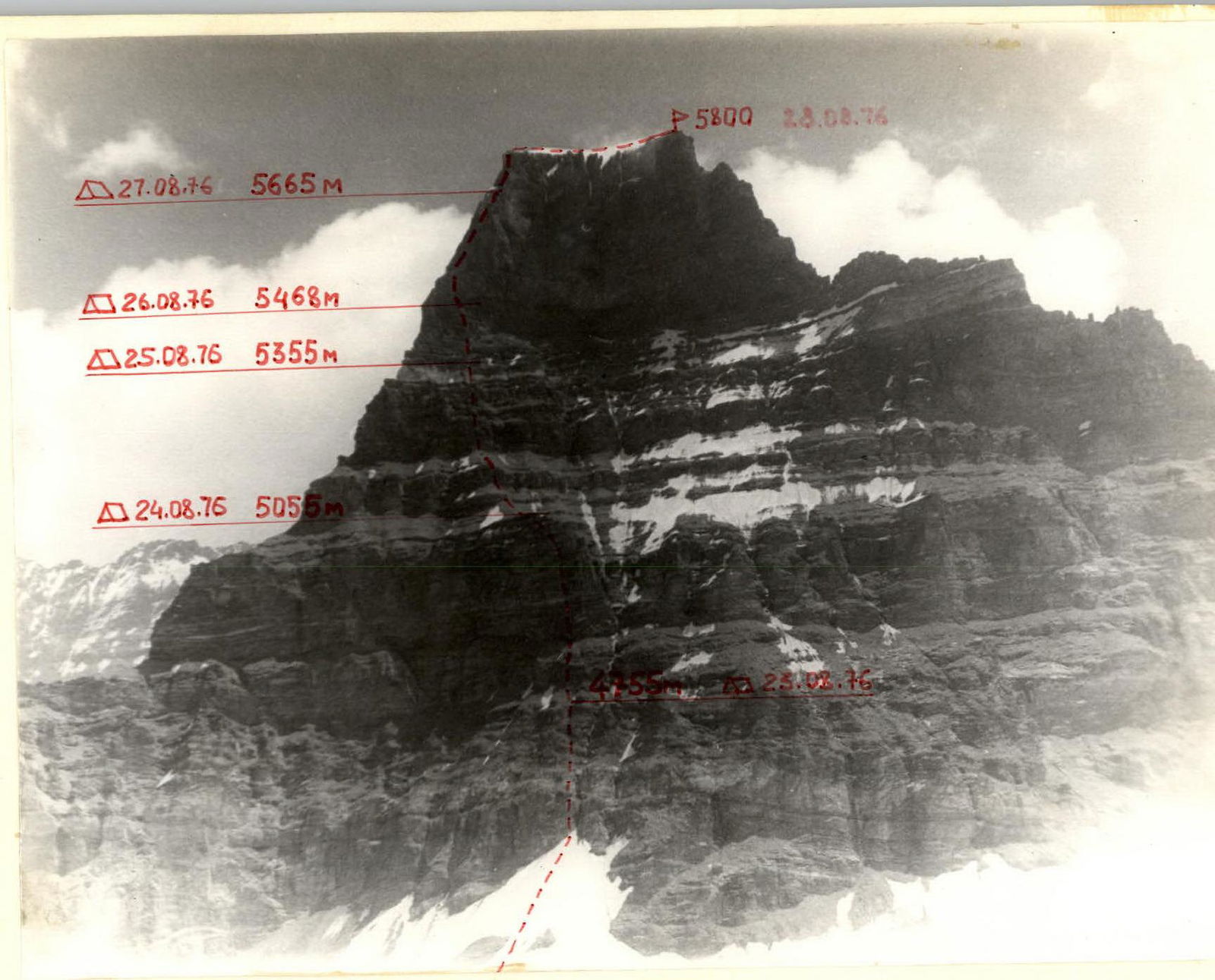
Altitude marks and dates
- August 28, 1976: 5800 m (summit)
- August 27, 1976: 5665 m
- August 26, 1976: 5468 m
- August 25, 1976: 5355 m
- August 24, 1976: 5055 m
- August 23, 1976: 4755 m
IV. Tactical plan of the ascent and its implementation
The tactical plan of the ascent included one day of approach to the bivouac under the Western wall of peak Luknitskogo from the base camp near the village of Sezh. It was planned to take 6 days to overcome the wall section with five bivouacs on the wall, 7 days in total for the ascent, and 8 days considering bad weather. One day in the preparatory period was allocated for processing the lower part of the route. On August 19, Mikhailov, Muravyov, Baychenko, Sarkisov, Starchik processed the lower part of the route up to approximately 4650 m. The coaching council decided that it was advisable to have a team of 5 people for the ascent. The assault team included:
- Master of Sports Mikhailov A. A.,
- Candidate Masters of Sports Baychenko Yu. P.,
- Ponomarev V. A.,
- Sarkisov L. A.,
- Starchik G. P.
During reconnaissance, the предполагаемые places for bivouacs on the route were identified. It was planned to take 4 backpacks and a fifth lightened one for the lead climber. For most of the route, it was planned to pull the backpacks using a homemade block-brake. It was planned to stop for a bivouac around 16:00 with further route processing by a two-person team without backpacks. The main interaction schemes for the rope teams were defined. The team leaders planned for the lead climbers to change.
The lead climber in the first rope team on rocky terrain wore galoshes. The team also had one pair of "Vibram" boots.
The descent from the summit was planned via the North-East ridge to the saddle between peaks Asham and Luknitskogo, followed by a descent into the Sezh valley and return to the base camp via this valley.
The tactical plan did not require any adjustments during the ascent and was fully implemented.
VIII. Description of the route passage
August 22. At 6:00, the assault team consisting of Mikhailov A., Baychenko Yu., Ponomarev V., Sarkisov L., Starchik G. along with the observation group left the base camp near the village of Sezh and reached the assault camp under the Western wall of peak Luknitskogo by 16:00.
August 23. The team of five started from the bivouac at 8:00 and began overcoming the lower ice section of the route (R0–R1) at 8:30. By 10:15, having passed 240 m of ice with a steepness of up to 45° at the top, they began traversing an 80-meter rock section of the wall using pre-fixed ropes (R2–R3). The rocks were monolithic, smoothed, and blocky in nature. A pull-through point for backpacks was organized after 40 m, and a second pull-through point was set up after another 40 m. By 14:40, they traversed another two ropes of steep rocks using free climbing (R4–R5). Perils were organized, and the belay was variable. They started preparing a bivouac platform. The duo Mikhailov–Baychenko proceeded to process the further ascent route. Mikhailov worked first. At 18:00, the duo returned to the bivouac. 160 m of the route were processed. On this day, the Mikhailov–Baychenko rope team worked first.
August 24. They departed at 9:00. They traversed the first three ropes using pre-fixed ropes with variable belay. The fourth rope — the lower part of the rock bastion in the central part of the Western wall — was overcome using pre-fixed ropes, jammers, and top-rope belay. The first climber processed this section using free climbing; two ladders were used when passing through a cornice (R9, R10). Backpacks were pulled through. The next two ropes (R11–R14) were traversed similarly. Section R15, featuring alternating steep walls and talus shelves, led to the top of the rock bastion in the central part of the wall. According to the tactical plan, this was the second bivouac. At 16:00, the Mikhailov–Baychenko duo started processing the next sections of the route. The lead climber changed, with Baychenko working first. At 18:00, the processing duo returned to the bivouac. 120 m of the route were processed. The bivouac turned out to be reclining as planned.
August 25. The night was very cold. They departed at 9:30.
- The first rope (R15–R16) was traversed with simultaneous belay.
- The second (R17) — with belay through rock features.
- The next 40 m — an internal corner of the "yellow" rock bastion with a vertical slab at the beginning (R18, R19) — were overcome using pre-fixed ropes with top-rope belay. During processing, the lead climber traversed this section using free climbing in galoshes; one ladder was used on the slab. Backpacks were pulled through.
- The next rope (R20) along simple, destroyed rocks led to the base of the "black" rock bastion.
- This bastion (R21, R22) was overcome by the first climber (Baychenko) using free climbing; two ladders were used in the lower part.
- The remaining sections were traversed using pre-fixed ropes with top-rope belay. Backpacks were pulled through.
- Two ropes (R23) were traversed with alternating belay and organization of perils. Mikhailov, with a lightened backpack, traversed first using free climbing in galoshes.
- The next section (R24) represented a vertical "reddish" rock belt. The section was overcome by the lead climber (Mikhailov) using free climbing. There were very few cracks for hammering pitons. Backpacks were pulled through.
The team traversed the section using pre-fixed ropes with top-rope belay and jammers. At the top of the "reddish" rock belt, transitioning into sheer monolithic rocks of gray color, they began organizing a bivouac under a rock cornice. After 2 hours, they managed to prepare a platform for a semi-reclining bivouac. The Mikhailov–Baychenko duo processed the next 80 m of the route. Mikhailov worked first. At 18:45, the processing duo descended to the bivouac.
August 26. They departed at 10:00. The rocks were very cold. They traversed two pre-fixed ropes from the previous day (R25). The third rope — an inclined internal corner — led to a small inclined platform at the base of the "yellow" marble belt, about 45 m wide, encircling the entire summit tower. The internal corner (R26) was traversed first by Mikhailov. The rocks had ice accretion. Climbing was very challenging. The remaining sections were traversed using pre-fixed ropes. Backpacks were pulled through. At 12:13, they began organizing a bivouac. The Sarkisov–Mikhailov duo started processing the "yellow" and the summit tower via R27. Sarkisov worked first. At 13:20, he reached an inclined shelf in the upper part of the belt. Then, having received Mikhailov, he traversed another rope of slabby rocks (R28). Climbing was very challenging. Individual slabs, 3–4 m high, had a steepness of up to 90°. Mikhailov traversed the next rope. The terrain was similar. At 17:30, the Mikhailov–Sarkisov duo, having processed 120 m of the route, descended to the bivouac.
August 27. Departure at 10:00. They traversed 3 ropes processed the previous day. Backpacks were pulled through. At 14:00, the Mikhailov–Baychenko rope team began reconnaissance and processing of the further ascent route via the Western ascent of the summit tower. Baychenko worked first. By 17:00, the team completed traversing two 40-meter sections, concluding section R29, and reached a small shelf with ice accretion. Throughout section R29, backpacks were pulled through three times every 40 m:
- the first time — after 40 m,
- the second time — after another 40 m,
- the third time — after completing the section.
After 2 hours, the platform for a semi-sitting bivouac was ready.
August 28. Departure at 10:30. Despite a relatively late start, the rocks were very cold. The Mikhailov–Baychenko rope team traversed 40 m of monolithic yellow rocks with a steepness of up to 85°. Mikhailov worked first. This section involved movement along pre-fixed ropes. Backpacks were pulled through. The next 20 m of this section (R30) led to a rock shoulder before a 20-meter step of the summit tower with giant icicles. The step led to the snow-ice dome of the summit. Mikhailov, roped with Baychenko, traversed the final sections of the route along the Western wall of peak Luknitskogo. At 14:00, they pulled through backpacks for the last time, gathered on the dome, and built a control cairn. Control cairns were also left at previous bivouacs. At 15:00, they reached the control cairn on the summit. They retrieved the note left by the first ascenders — a group of army climbers led by Nekrasov V. P. At 15:30, they began descending from peak Luknitskogo into the Sezh valley. At 20:00, they met the observation group, which had arrived from the assault camp after additional radio communication, at the base camp in the Sezh valley. On August 29, they descended to the base camp for climbers from the USSR Armed Forces near the village of Sezh.
IX. Evaluation of participants' actions during the ascent
The team fully implemented the planned tactical plan for the ascent. Each participant was physically, technically, and psychologically prepared for traversing such a route. Four out of five participants worked as lead climbers during the ascent. The excellent rock climbing skills of the participants maintained a fairly high pace of route traversal. All key sections were traversed using free climbing without the use of bolt pitons. The correct and clear actions of each participant minimized the time spent on:
- organizing belay points,
- pulling through backpacks,
- extracting pitons,
- organizing bivouacs.
It is a pleasure to note the excellent psychological climate within the team and the sense of humor that did not abandon the participants throughout the ascent.
All participants demonstrated skilled use of modern mountaineering techniques.
Team captain and coach Master of Sports A. A. Mikhailov.
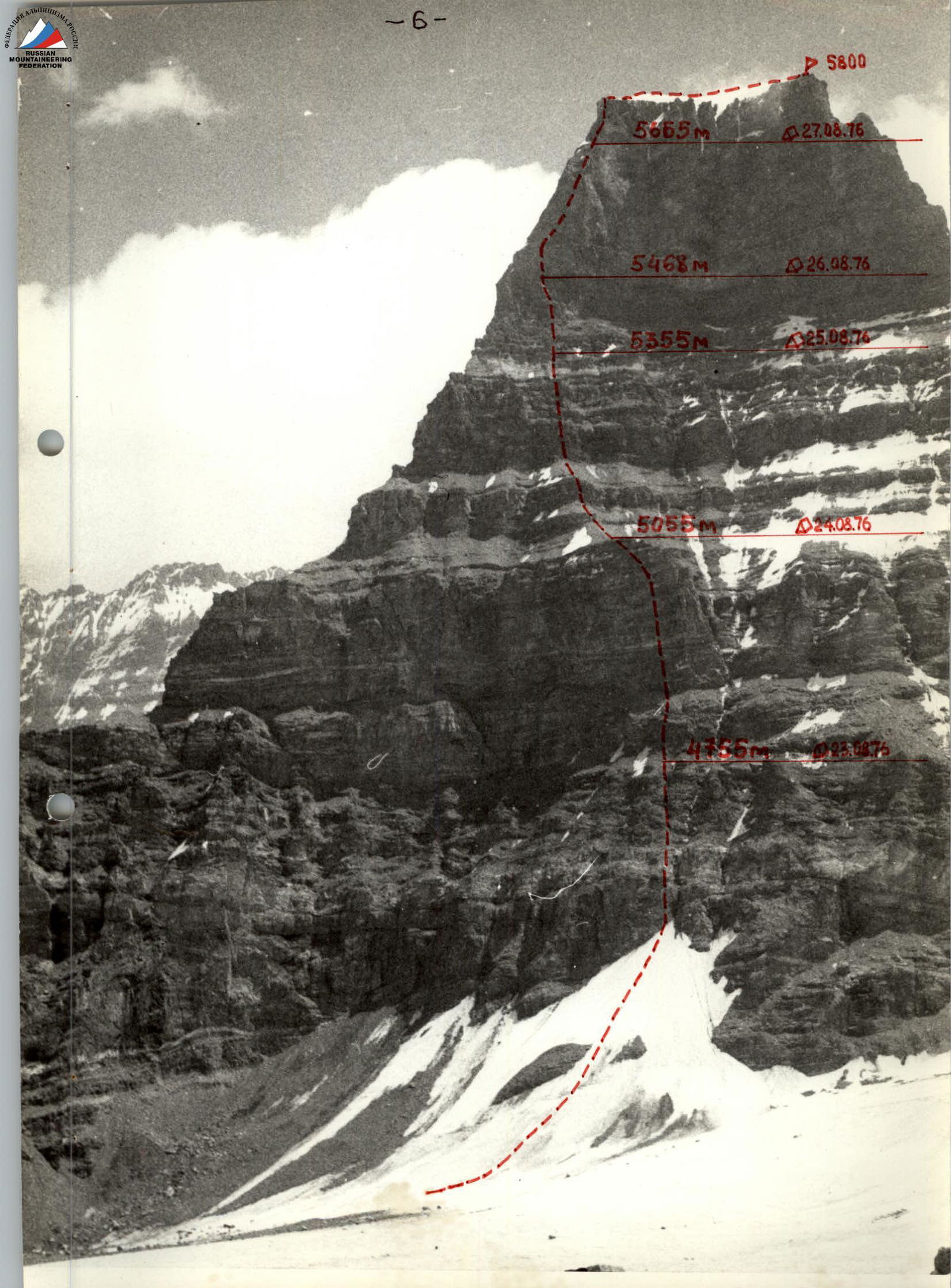
Table of main route characteristics
Ascent route: Western wall (first ascent) of peak Luknitskogo (5800 m)
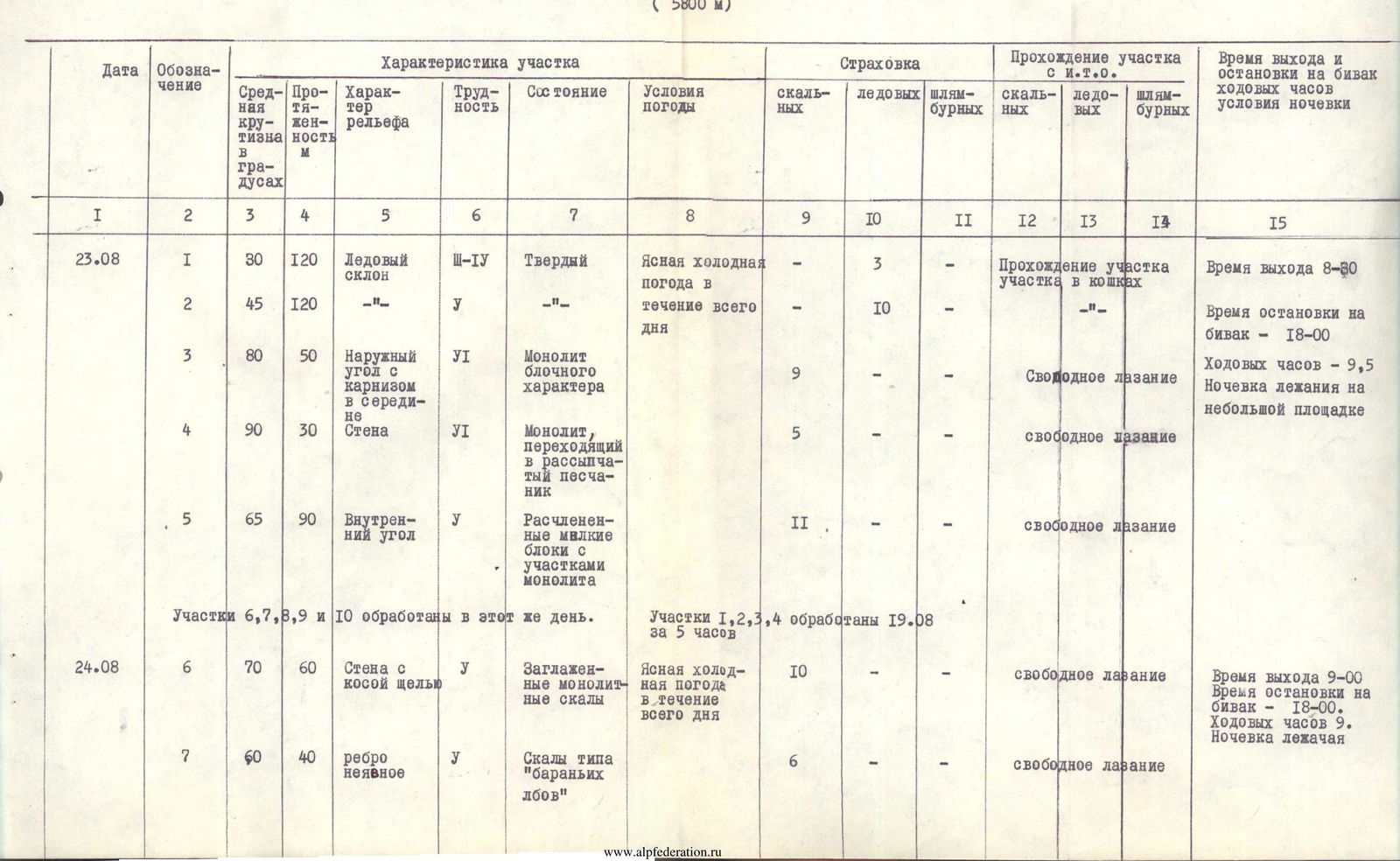
| Date | Designation | Average steepness in degrees | Length in m | Character of relief | Difficulty | Condition | Weather conditions | Rock | Ice | Bolt | Rock | Ice | Bolt | Passage of the section, method of belay and bivouac |
|---|---|---|---|---|---|---|---|---|---|---|---|---|---|---|
| R8 | 50–60 | 20 | slabs with talus | 4 | dry, strong | 4 | – | – | free climbing | |||||
| R9 | 80 | 37 | outer corner of bastion | 6 | monolith, blocky in nature | 7 | – | – | free climbing | |||||
| R10 | 95 | 3 | cornice | 6 | monolith | 5 | – | – | 2 | – | ||||
| R11 | 80 | 32 | wall of bastion | 6 | monolith, blocks | 6 | – | – | free climbing | |||||
| R12 | 95 | 8 | inner corner with cornice | 6 | monolithic sandstone | 5 | – | – | 2 | |||||
| R13 | 85 | 35 | outer corner | 6 | monolith | 7 | – | – | free climbing | |||||
| R14 | 95 | 5 | cornice | 6 | monolith, not strong | 5 | – | – | 1 | |||||
| R15 | 65 | 80 | walls alternating with shelves | 5 | weathered monolith | 11 | – | – | free climbing | |||||
| Sections R16–R19 processed on the same day | ||||||||||||||
| August 25 | R16 | 40 | 45 | rocks with talus | 2 | clear, cold weather throughout the day | simultaneous | simultaneous movement. Departure time 9:30. Stop time for bivouac 18:45. Travel hours 9 hours 25 minutes. Bivouac semi-reclining under a rock cornice | ||||||
| R17 | 55 | 40 | counterfort | 4 | destroyed rocks | rock features | free climbing | |||||||
| R18 | 90 | 3 | slab | 6 | monolith | 2 | – | – | 1 | |||||
| R19 | 85 | 38 | inner corner | 6 | smoothed monolith | 6 | – | – | free climbing | |||||
| R20 | 40 | 40 | wide counterfort | 2 | destroyed rocks | simultaneous | simultaneous movement |
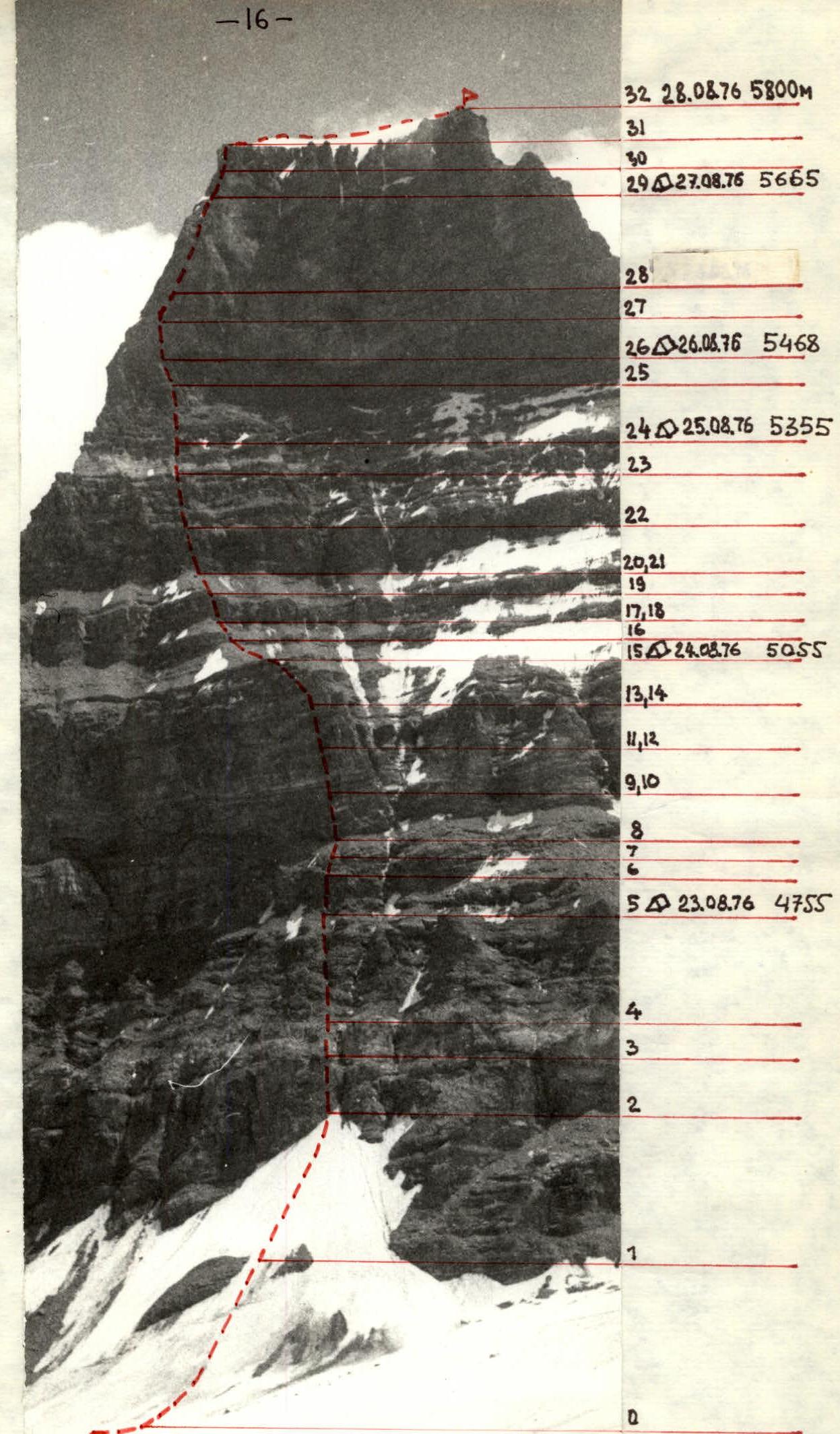
Photo 2. Western wall of peak Luknitskogo
| R32 August 28, 5800 m | R31 | R30 |
|---|---|---|
| R29 August 27, 5665 m | R28 | R27 |
| R26 August 26, 5468 m | R25 | R24 August 25, 5355 m |
| R23 | R22 | R20, R21 |
| R19 | R17, R18 | R16, R15 August 24, 5055 m |
| R13, R14 | R11, R12 | R9, R10 |
| R8 | R7 | R6 |
| R5 August 23, 4755 m | R4 | R3 |
| R2 | R1 | R0 |
Photo 2. Western wall of peak Luknitskogo
| R21 | 90 | 8 | slab | 6 | dry, strong rocks | 2 | – | – | 2 | |||||
|---|---|---|---|---|---|---|---|---|---|---|---|---|---|---|
| R22 | 85 | 53 | walls of the chimney | 6 | smoothed monolith with ice accretion | 13 | – | – | free climbing | |||||
| R23 | 65 | 80 | inner corners alternating with walls | 5 | monolith, slabs | 14 | – | – | free climbing | |||||
| R24 | 90 | 40 | "reddish marble" belt | 6 | monolith | 9 | – | – | free climbing | |||||
| On the same day, section R25 was processed | ||||||||||||||
| August 26 | R25 | 70 | 80 | counterfort | 5 | dry, strong rocks | clear, cold weather throughout the day | 12 | – | – | free climbing. Departure time 10:00. Stop time for bivouac 17:30. Travel hours 7 hours 30 minutes. Bivouac semi-reclining, uncomfortable | |||
| R26 | 75 | 40 | inner corner | 6 | monolith with ice accretion, blocks | 7 | – | – | free climbing | |||||
| On the same day, sections R27, R28, and 40 m of section R29 were processed | ||||||||||||||
| August 27 | R27 | 85–90 | 45 | "yellow marble" belt of the summit tower | 6 | monolith with few cracks | clear, cold weather throughout the day | 10 | – | – | free climbing. Departure time 10:00. Stop time for bivouac 17:15. Travel hours 7 hours 15 minutes. Bivouac on a small shelf, semi-reclining | |||
| R28 | 70 | 40 | slabs | 6 | monolith | 8 | – | – | free climbing | |||||
| R29 | 75 | 120 | walls of the pre-summit bastion with smoothed relief | 6 | monolith of non-cherpchatyi profile. Ice accretion on individual sections | 30 | – | – | free climbing |
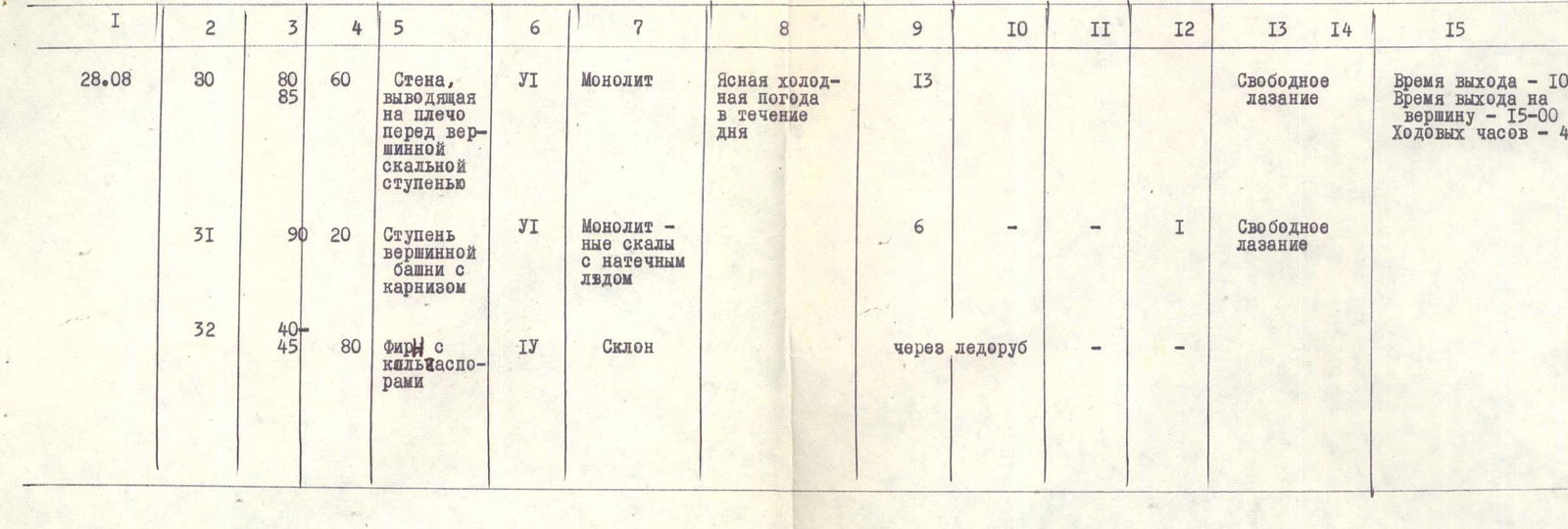
| Date | Designation | Average steepness in degrees | Length in m | Character of relief | Difficulty | Condition | Weather conditions | Rock | Ice | Bolt | Rock | Ice | Bolt | Passage of the section, method of belay and bivouac |
|---|---|---|---|---|---|---|---|---|---|---|---|---|---|---|
| August 28 | R30 | 80–85 | 60 | wall leading to a shoulder before the summit rock step | 6 | monolith | clear, cold weather throughout the day | 13 | free climbing. Departure time 10:30. Time of reaching the summit 15:00. Travel hours 4 hours 30 minutes | |||||
| R31 | 90 | 20 | step of the summit tower with cornice | 6 | monolithic rocks with ice accretion | 6 | – | – | 1 | free climbing | ||||
| R32 | 40–45 | 80 | firn with calderas | 4 | slope | through | – |
Team coach and captain Master of Sports A. A. Mikhailov.
— Budumbīū nymb HeBuqumbīū nymb

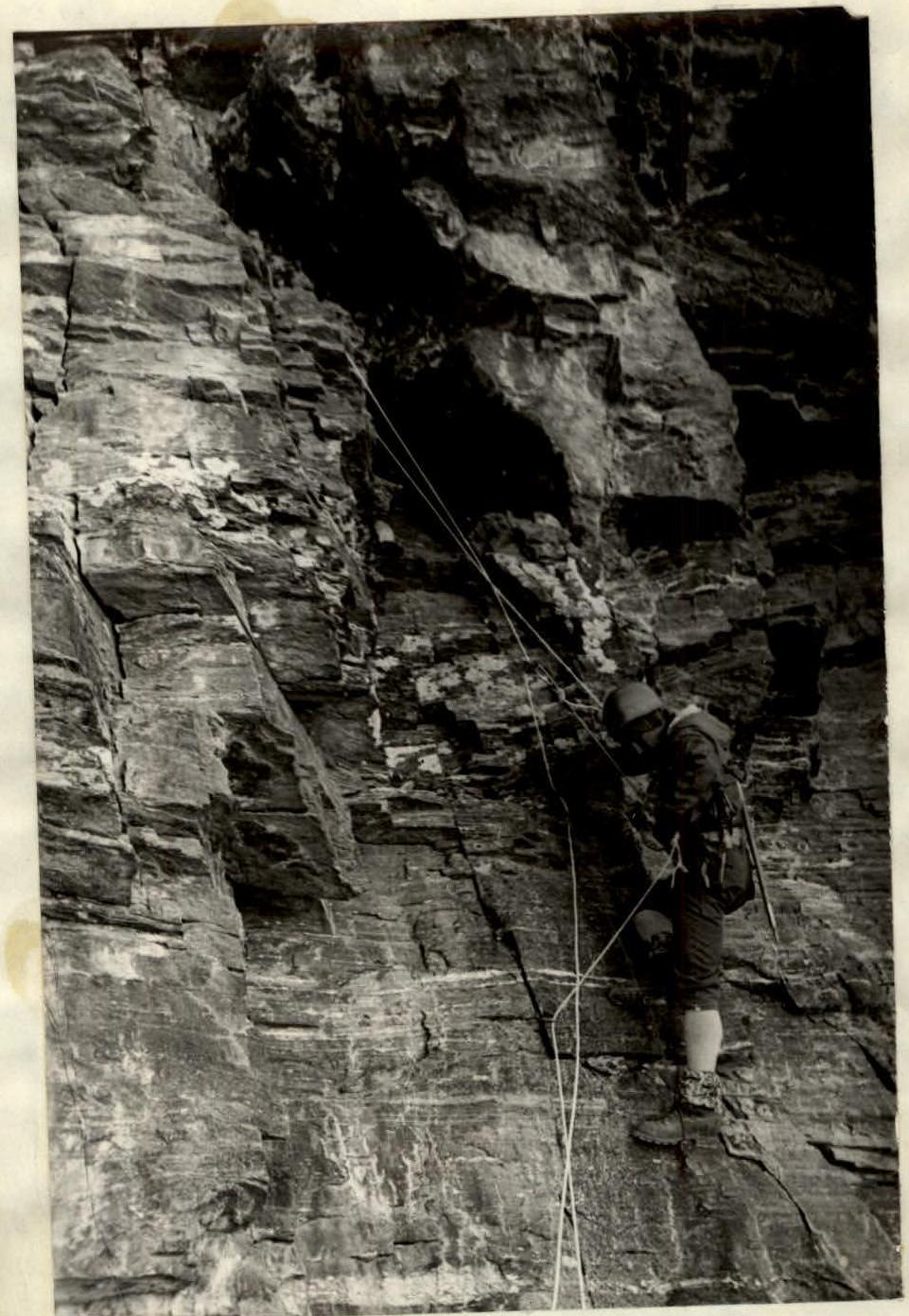
Photo 10. Section R21