
Burevestnik Central Sports Council Alpine Championship, high-altitude class CENTRAL PAMIR. ACADEMY OF SCIENCES RANGE. PIK ROSSIA (6852 m). Via the bastion of the south-eastern wall. Team from the Irkutsk Regional Council of the Burevestnik Sports Society. Second ascent of the route. Irkutsk, 1980.
Ascent Details
- Ascent class — high-altitude
- Ascent area — Central Pamir, starting from the Bivachny Glacier
- Ascent route — Pik Rossia, 6852 m, via the bastion of the south-eastern wall
- Route characteristics: height difference — 2050 m; bastion — 1150 m, "lap" — 800 m, average steepness — 70°; bastion — 75–80°, "lap" — 55°, length of difficult sections — 1460 m
- Pitons used:
- rock pitons — 242
- chocks — 107
- ice screws — 5
- no drilled pitons used
- Total climbing hours — 56
- Number of bivouacs on the route — 8, including one sitting bivouac
- Team from the Irkutsk Regional Council of the Burevestnik Sports Society
- Team members:
- Popov Valery Nikolayevich — Master of Sports — team captain
- Belov Sergey Viktorovich — Candidate for Master of Sports — team member
- Golygho Vladimir Nikolayevich — Candidate for Master of Sports — team member
- Zhila Andrey Ovenalyevich — Candidate for Master of Sports — team member
- Zuev Vladimir Leonidovich — Candidate for Master of Sports — team member
- Mishurinskiy Boris Yevgenyevich — Candidate for Master of Sports — team member
- Savin Vladimir Viktorovich — Candidate for Master of Sports — team member
- Team coach Koreneva Irina Yefimovna — Master of Sports — Category I instructor
- Dates of departure and return
August 14, 1980 – August 22, 1980
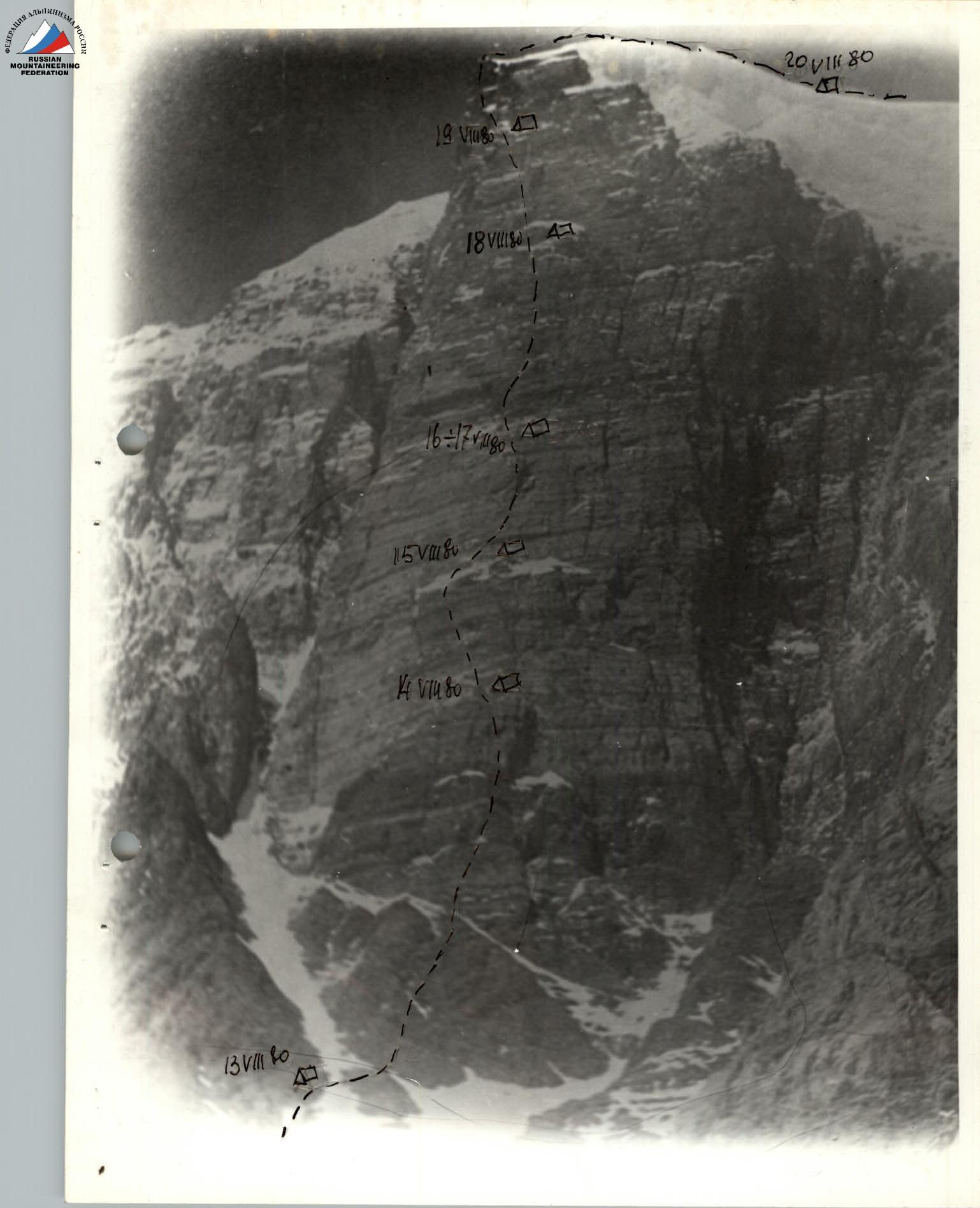
Table of Main Route Characteristics
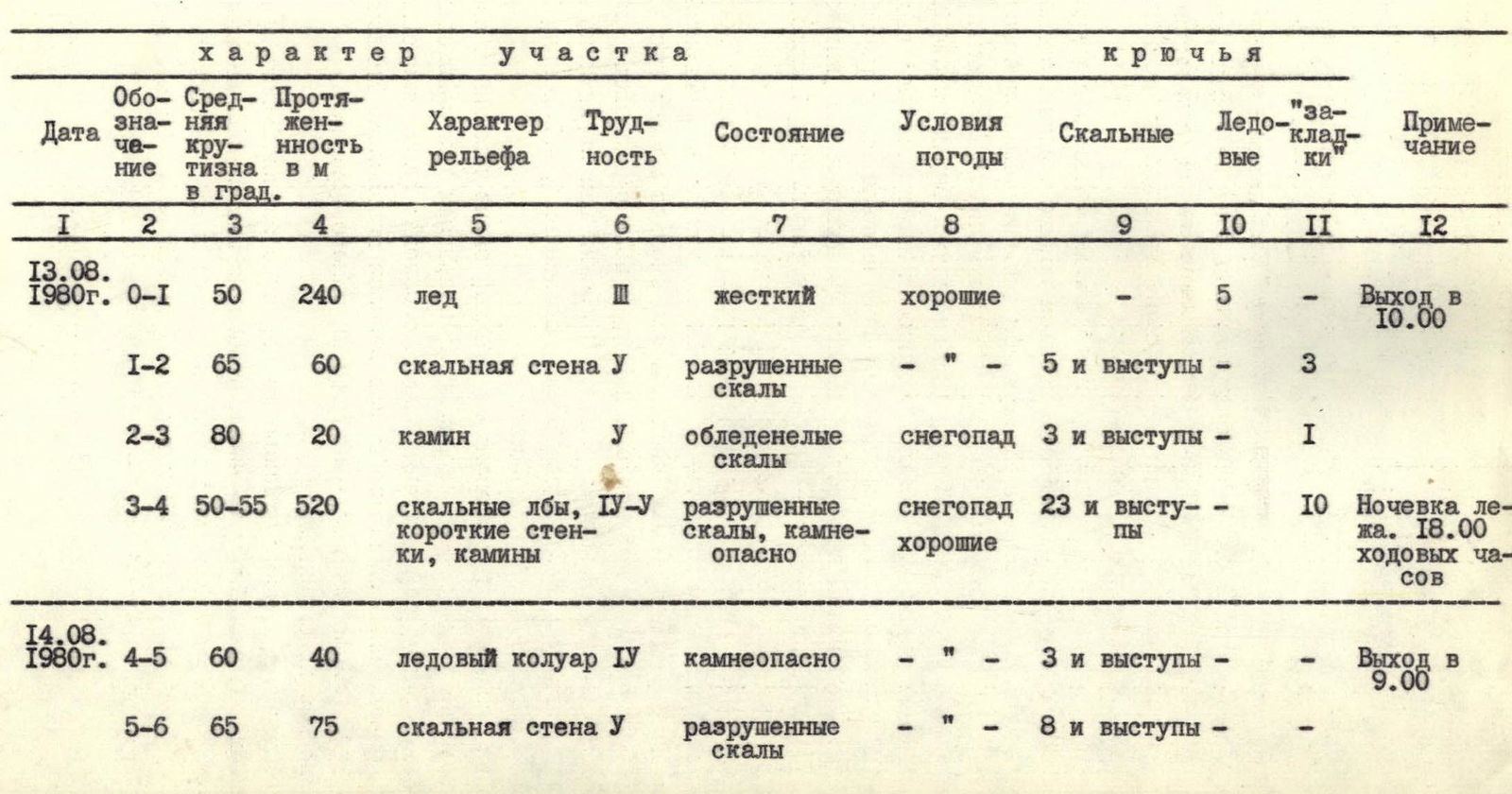
| | Section designation | Average steepness in degrees | Length in meters | Terrain characteristics | Difficulty | Condition | Weather conditions | Rock pitons | Ice screws | Chocks | Notes |
| :------------------: | :-------------------: | :----------------------: | :---------------: | :------------------------------: | :---------: | :-----------------------: | :---------------: | :--------------: | :--------: | :------------------------------------------: |
| August 13, 1980 | R0–R1 | 50 | 240 | ice | 3 | hard | good | — | 5 | — | Departure at 10:00 |
| | R1–R2 | 65 | 60 | rock wall | 5 | crumbling rocks | " | 5 and features | — | 3 | |
| | R2–R3 | 80 | 20 | chimney | 5 | icy rocks | snowfall | 3 and features | — | 1 | |
| | R3–R4 | 50–55 | 520 | rock ledges, short walls, chimneys | 4–5 | crumbling rocks, rockfall hazard | snowfall, good | 23 and features | — | 10 | Overnight bivouac. 18:00, 6 hours climbing |
| August 14, 1980 | R4–R5 | 60 | 40 | ice gully | 4 | rockfall hazard | " | — | — | 3 and features | Departure at 9:00 |
| | R5–R6 | 65 | 75 | rock wall | 5 | crumbling rocks | " | — | 8 and features | — | |
| | R6–R7 | 50 | 45 | internal corner | 5 | slabs | good | 3 and features | — | — | |
| | R7–R8 | 85 | 20 | chimney | 6 | monolith | " | 3 | — | 2 | |
| | R8–R9 | 70 | 60 | rock wall | 5 | crumbling rocks | " | 6 and features | — | — | |
| | R9–R10 | 55 | 40 | rock ledges | 4 | crumbling rocks | " | 3 and features | — | — | |
| | R10–R11 | 60 | 20 | rock wall | 5 | monolith | " | 3 and features | — | — | |
| | R11–R12 | 80 | 20 | chimney | 6 | monolith | " | 2 | — | 4 | |
| | R12–R13 | 85 | 40 | rock wall | 5 | slab-like rocks | " | 3 | — | 3 | |
| | R13–R14 | 50 | 40 | rock shelf | 4 | crumbling with snow | " | 2 and features | — | — | |
| | R14–R15 | 85 | 40 | rock wall | 6 | monolith | " | 8 | — | 7 | |
| | R15–R16 | 50 | 40 | rock ledges | 4 | crumbling rocks | " | 3 and features | — | — | |
| | R16–R17 | 70 | 30 | steep slabs | 5 | monolith | " | 4 | — | — | Overnight bivouac. 9 hours climbing. 18:00 |
| August 15, 1980 | R17–R18 | 80 | 20 | rock wall | 6 | monolith | " | 4 | — | — | |
| | R18–R19 | 110 | 10 | cornice | 6 | monolith | " | 5 | — | 5 | |
| | R19–R20 | 85 | 120 | internal corner | 6 | monolith | " | 14 | — | 10 | Departure at 10:00 |
| | R20–R21 | 100 | 20 | cornice | 6 | monolith | " | 7 | — | 5 | |
| | R21–R22 | 50 | 40 | rock ledges | 4 | crumbling with snow | " | 3 and features | — | — | |
| | R22–R23 | 110 | 15 | cornice | 6 | monolith | " | 4 | — | 3 | |
| | R23–R24 | 90 | 20 | internal corner | 6 | monolith | " | 3 | — | 2 | |
| | R24–R25 | 85 | 30 | diagonal crack | 5 | monolith | " | 4 | — | 4 | |
| | R25–R26 | 80 | 30 | wall | 6 | monolith | " | 4 | — | 3 | |
| | R26–R27 | 90 | 20 | internal corner | 6 | monolith | " | 3 | — | 2 | |
| | R27–R28 | 85 | 50 | wall | 6 | monolith | " | 8 | — | 3 | Overnight bivouac. 18:00, 8 hours climbing. |
| | R28–R29 | 60 | 40 | rock ledges | 5 | crumbling | " | 3 and features | — | — | |
| August 16, 1980 | R29–R30 | 65 | 60 | rock ledges | 5 | crumbling | good | 4 and features | — | — | Departure at 9:00 |
| | R30–R31 | 80 | 20 | wall | 6 | monolith | " | 2 | — | 2 | |
| | R31–R32 | 95 | 25 | internal corner | 6 | monolith | " | 4 | — | 2 | |
| | R32–R33 | 75 | 80 | wall | 6 | smooth rocks | " | 10 | — | 4 | |
| | R33–R34 | 80 | 40 | internal corner | 5 | crumbling rocks | " | 6 and features | — | — | |
| | R34–R35 | 75 | 30 | diagonal crack | 5 | crumbling rocks | " | 4 and features | — | — |

| | Section designation | Average steepness in degrees | Length in meters | Terrain characteristics | Difficulty | Condition | Weather conditions | Rock pitons | Ice screws | Chocks | Notes | | :------------------: | :-------------------: | :----------------------: | :---------------: | :------------------------------: | :---------: | :-----------------------: | :---------------: | :--------------: | :--------: | :---------------------------------------: | | | R35–R36 | 90 | 15 | wall | 6 | monolith | snowfall | 5 | — | 2 | Overnight bivouac. 7 hours climbing. | | | R36–R37 | 70 | 45 | internal corner | 5 | monolith | " | 7 | — | — | | | August 17, 1980 | R37–R38 | 80 | 10 | wall | 5 | monolith | snowfall | 2 | — | — | Departure at 9:00 | | August 18, 1980 | R38–R39 | 65 | 40 | crumbling rocks | 6 | snow-covered | " | 4 | — | — | | | | R39–R40 | 90 | 30 | wall | 6 | monolith | " | 4 | — | 3 | | | | R40–R41 | 95 | 10 | internal corner | 6 | monolith | " | 3 | — | — | Overnight bivouac. 18:00, 9 hours climbing | | | R41–R42 | 90 | 20 | wall | 6 | monolith | " | 1 | — | 6 | Departure at 10:00 | | August 19, 1980 | R42–R43 | 80 | 20 | wall | 5 | crumbling icy rocks | " | 4 | — | — | | | | R43–R44 | 80 | 60 | internal corner | 6 | monolith | " | 6 | — | 5 | Sitting bivouac 18:00, 8 hours climbing | | | R44–R45 | 80 | 30 | wall | 6 | monolith | " | 4 | — | 3 | | | August 20, 1980 | R45–R46 | 75 | 60 | internal corner | 6 | monolith | good | 8 | — | 2 | Departure at 11:00 | | | R46–R47 | 85 | 60 | wall with few holds | 6 | monolith | " | 6 | — | 4 | Overnight bivouac on a snow dome 18:00 | | | R47–R48 | 90 | 60 | wall with overhangs | 6 | monolith | " | 8 | — | 5 | 7 hours climbing. |
Team Captain V.N. POPOV Team Coach I.E. KORENEVA
Brief Explanation of the Table
August 13, 1980 — day of departure. Clear and frosty weather in the morning. We quickly gain altitude, first on ice, then on rocks of moderate difficulty, gradually becoming more challenging. By 13:00, the weather starts to deteriorate. Snow begins to fall. At 17:00, we set up a bivouac, slightly short of our planned location.
August 14, 1980 — not a single cloud in the sky. The weather gives us hope that we can make up for lost time. By 12:00, we approach the bastion. The wall becomes steeper and more complex. Using free climbing and pitons for protection, we ascend the complex wall to the second planned bivouac site.
August 15, 1980. Before us is a vertical internal corner topped with a cornice. There are sufficient holds and cracks for pitons, so the lead climber (rotated daily) quickly navigates this difficult section. Another two ropes of challenging climbing, and we reach a shelf for an overnight bivouac. The weather is deteriorating. It's cold. While five team members prepare the bivouac, a pair climbs another rope.
August 16, 1980 — In the morning, after processing a section, we approach a vertical gray slab. The slab has many "live" holds, requiring great attention. After the slab, the rocks overhang, so we traverse rightward, bypassing the overhang via an internal corner and reaching the next shelf. It's only 15:00, but snow starts falling again, forcing us to set up a bivouac. The weather is deteriorating further. Small avalanches of snow pass on both sides of the bastion.
August 17 — snow behind the tent, wind, visibility 15–20 m, so we decide not to depart today.
August 18. The weather improves slightly in the morning. We depart, traverse a rope, then two ropes up a vertical corner lead us to overhanging rocks. Traversing with a gain in altitude, we reach the left edge of the bastion. Snow starts falling again. Using pitons as support points, we overcome a small overhang. Another rope of steep rocks, and we are at the planned bivouac.
August 19. We depart as soon as the sun illuminates our wall. Very challenging climbing up an internal corner, partially overhanging, takes us to the base of the next internal corner. We manage to climb only 4 ropes that day. There are no lying-down bivouac platforms. Only after two hours of hard work can we set up a makeshift sitting bivouac.
August 20. The same very difficult climbing continues. Our entire "arsenal" is in use. The rope changes are hanging. We have to utilize all our experience gained on the Yaghnob wall. By 18:00, we reach the bastion's dome. The wall is climbed.