797
Report
JOINT TEAM REPORT OF CS "BUREVESTNIK" AND UE "NUREKGESSTROY" ON THE ASCENT OF PIK OGPU 6028 m VIA THE CENTER OF NAMESTOVSKY, 1966, AND STEPANOV, 1968, ROUTES.
High-Altitude Technical Class
Team Captain, Candidate for Master of Sport S. Efimov
Team Coaches: Honored Master of Sport, Honored Coach of the USSR K. Kuzmin
Master of Sport, Senior Instructor A. Belopukhov
Nurek, Central Pamir
1972
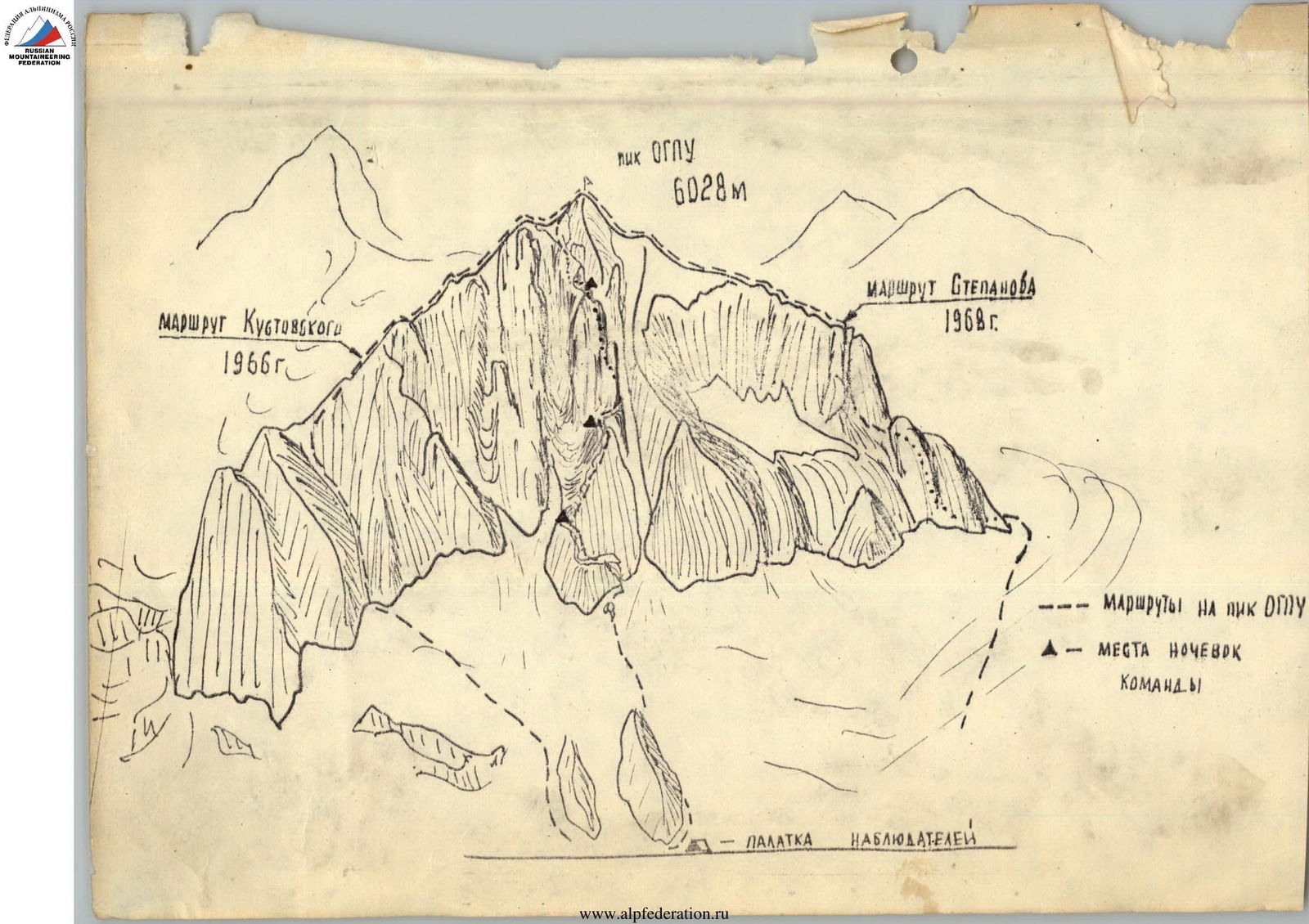
Kustovsky's route, 1966. Pik OGPU 6028 m. Stepanov's route, 1968. Route to Pik OGPU. Team overnight locations. Observers' tent.
Nutrition
The selection of food products was based on the following criteria:
- lightness
- caloric content
- taste qualities
In addition to regular products, the team was provided with high-calorie foods such as:
- Grain caviar
- Sturgeon balyk
- Chocolate
- Honey
Large doses of vitamins were taken daily. The daily ration was 500 g per person and contained over 5000 calories.
Safety Organization
During the ascent, the team was continuously observed. Observers had binoculars and a 60x telescope. Daily communication was carried out using flares.
Team
The team included the following climbers-rock climbers with experience in high-altitude and high-altitude technical ascents.
Team Captain — Efimov S.B., born 1944, Candidate for Master of Sport in alpinism, Candidate for Master of Sport in rock climbing, prize-winner at the CS "Burevestnik" rock climbing championship in 1970–1971, engineer.
Deputy Captain — Samoilin M.S., born 1946, Candidate for Master of Sport in alpinism, Candidate for Master of Sport in rock climbing, prize-winner at the USSR alpinism championship in 1971, engineer.
Members: Lebedikhin A.V., born 1946, Candidate for Master of Sport in alpinism, Candidate for Master of Sport in rock climbing, champion of CS "Burevestnik" in rock climbing in 1970, engineer.
Pushkarev V.M., born 1939, Candidate for Master of Sport in alpinism, 1st sports category in rock climbing, engineer.
Photo #1. Participant #2. Height 4700 m. Traverse along rocks under the start of the wall. Start of the wall.
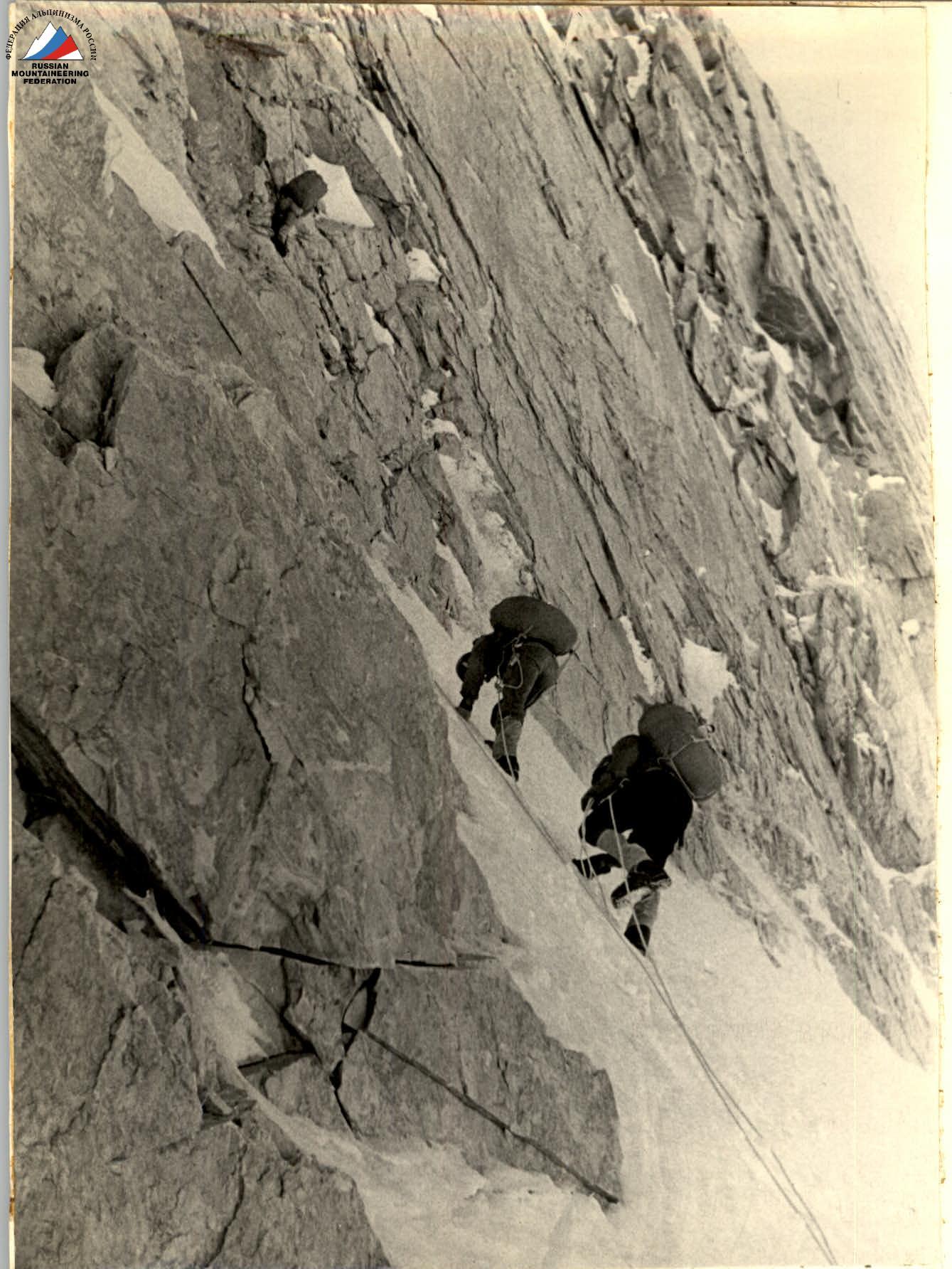
Photo #2. Participant #3. Duo Efimov—Yakovlev passing the first rope of the wall. Samoilin—Lebedikhin approaching the route. Yakovlev V.A., born 1941, Candidate for Master of Sport in alpinism, engineer.
Mikhailov A.A., born 1943, Master of Sport in alpinism, prize-winner at the USSR alpinism championship in 1968, 1969. Unfortunately, Mikhailov was unable to leave Sverdlovsk and participate in the championship due to family circumstances.
Ascent Description
On July 31, the team consisting of Efimov, Lebedikhin, Samoilin, Pushkarev, and Yakovlev left the base camp "3700" under Pik OGPU for the camp "4300" on the moraine under the route.
On August 1, at 11:00, the group Samoilin, Pushkarev, Lebedikhin, taking 4 ropes with them, set out to process the route. After navigating through the seracs of the "Troyka" glacier, they began the ascent up the steep snow-ice slope, 550 m long (section #1). In areas where ice was visible, steps were cut. Movement was directed towards the rocky "arrow" under the start of the route (section #2). From the "arrow," 40 m to the right, a traverse along rocks was made on deep snow, leading to an internal corner. Height 4700 m (Photo #2).
Samoilin led the way (section #3). Climbing was very difficult. They moved vertically upwards for 30 m, then traversed left along a weakly expressed ledge. After securing the belay, Samoilin descended.
The group returned to the moraine at 19:00 on August 2. They set out again at 9:00. On the snow slope, yesterday's tracks were covered with snow. They had to re-tread the path and cut steps on the ice section. It was very cold. They approached the wall. The duo Efimov—Yakovlev went first, using the belay ropes (Photo #3).
A narrow, oblique, icy ledge, where the belay ropes were secured, was partially interrupted and turned into a wall (section #4). Movement along the ledge to the left — into the internal corner (Photo #4). The length of the entire ledge was 20 m.
From the ledge, directly upwards along the right wall of the internal corner, with a steepness of 85°, under an overhanging cornice (1 m), which was overcome using a ladder (section #5, Photo #5). The internal corner, 40 m, led to a snow-ice slope. Rucksacks were pulled up on this section.
Further, left-upwards along the snow-ice slope, with a steepness of 55°, under the wall (section #6). In areas where clean ice was visible, steps had to be cut.
The wall, with a steepness of 80–85°, was traversed along small ledges and shelves (section #7); Photo #6). The rocks were destroyed. Thin marble slabs were layered and very "live." Climbing was difficult. The overall direction was left-upwards, 40 m, along a 15-meter sheer wall, 90°, composed of large blocks (section #8), which was traversed directly.
Then, along easy, destroyed rocks (40 m), they reached the ridge (section #9).
Here, there was a platform for an overnight stay. Time was 17:00. While the platform was being expanded for a high-altitude tent and the overnight stay was being organized, the duo Efimov—Lebedikhin, wearing crampons, went to process the route.
The duo moved along the ridge, with a steepness of 55–60° (section #10). The rocks were smoothed, like "ram's foreheads," and were partially covered with ice. After hanging 160 m of ropes, the duo returned to the platform at 19:30.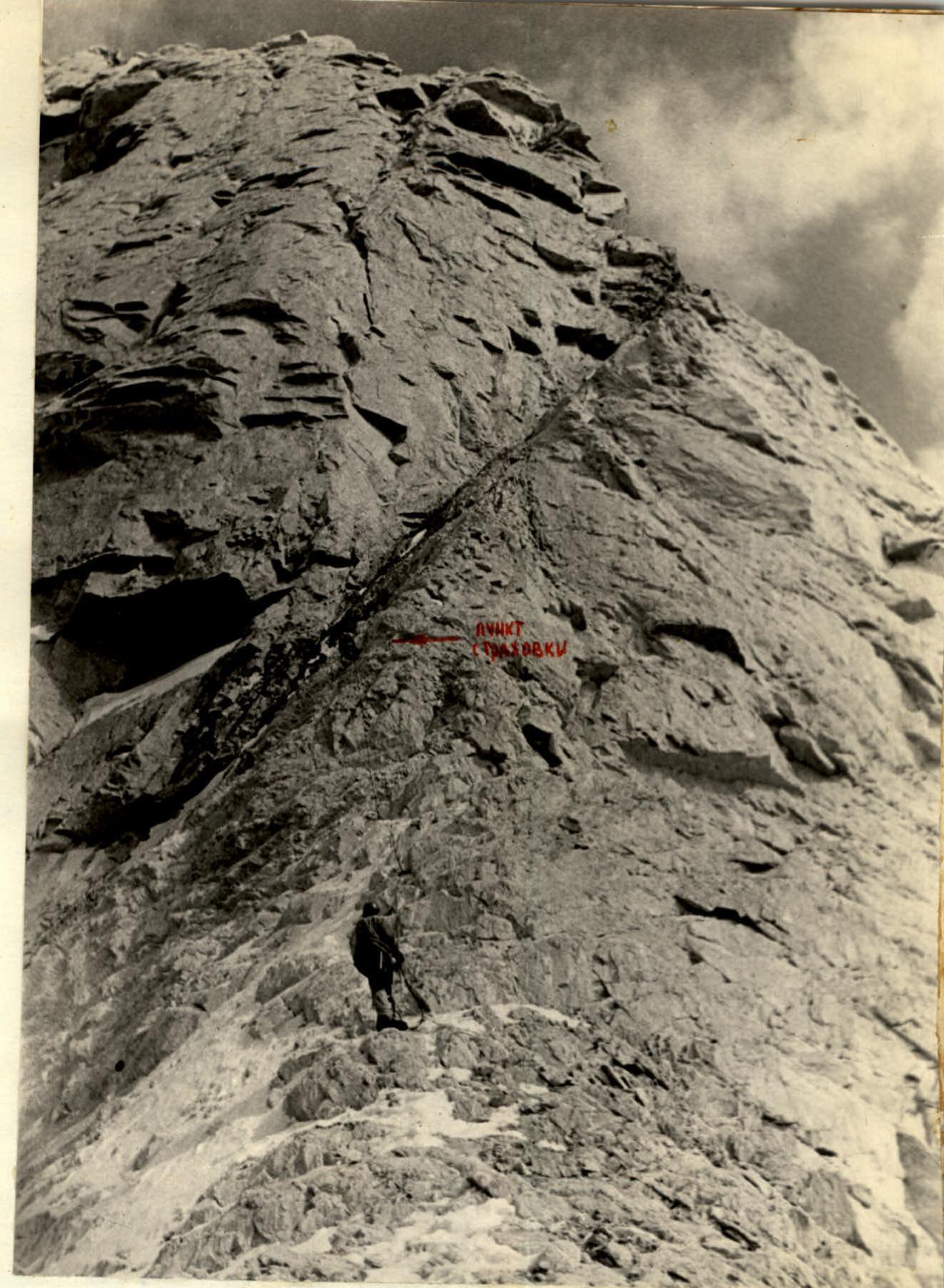
Photo #5. Section #18. "Oblique Ledge." Height 5400 m.
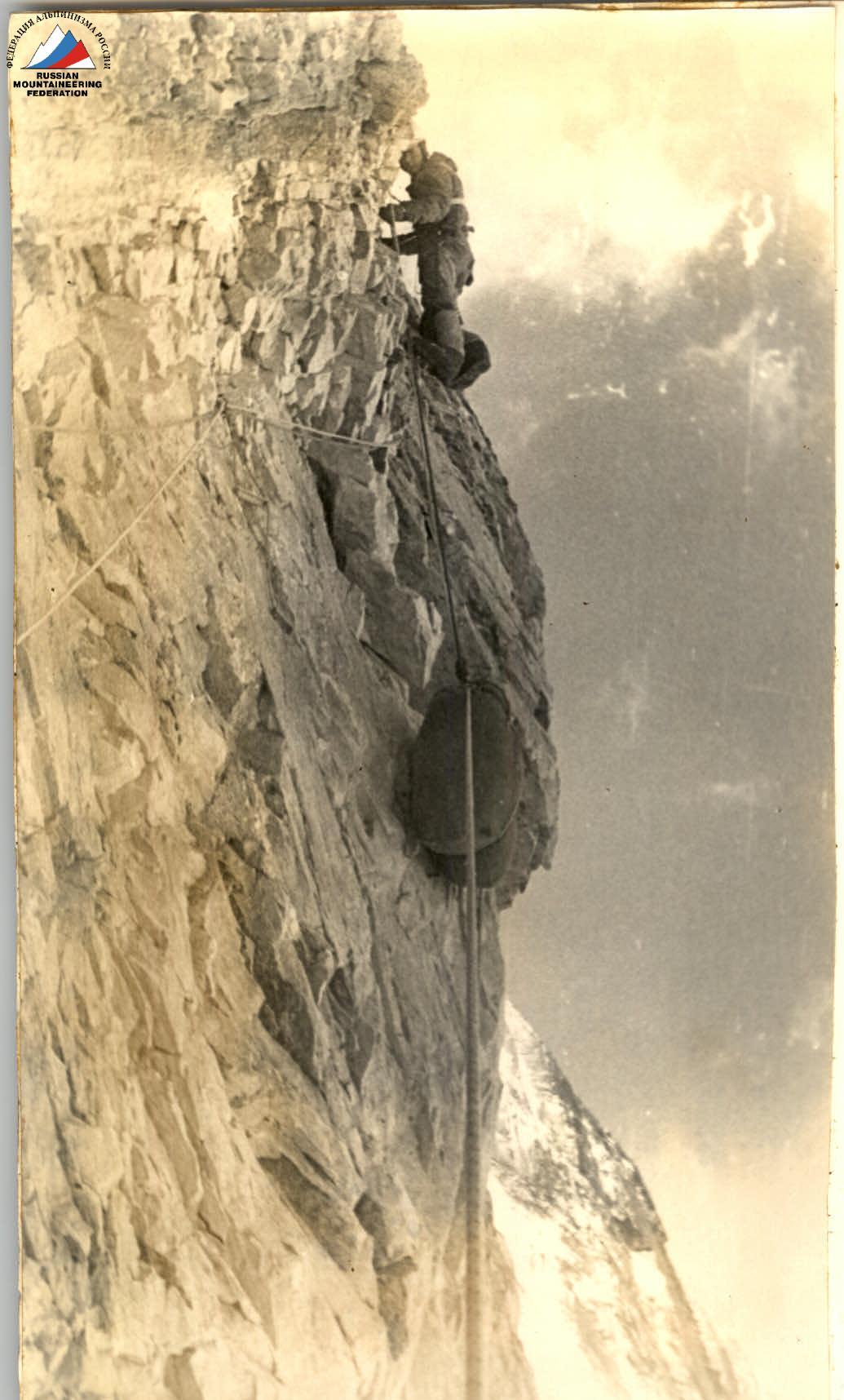
Photo #6. Smooth monolithic wall passed. Rucksack extraction began. Section #19.
On August 3, they set out at 9:00, moving along the ropes. It was very cold. The rocks were covered with frost overnight. They were slippery like soap.
160 m were passed along the ropes. Further, the duo Lebedikhin—Pushkarev led the way. Movement was along the ridge of the "Iron." Walls of 30–40 m were overcome. Climbing was of medium difficulty, pleasant, and the rocks were cold. The steepness of the rocks increased (section #11).
After passing 150 m, they reached a ledge where everyone could gather. Directly ahead, a wall of the last ascent of the "Iron" rose, with a rocky cornice on the left. The cornice was bypassed on the left along a ledge with rime ice (cutting steps), then along a weakly expressed internal corner (85°, 35 m) (section #12), and then along strongly destroyed rocks, 40 m, to the top of the "Iron" (section #13).
Further, they saw a ridge with a steepness of 40° and individual gendarmes. The ridge led to a massive 200-meter wall, the "Tower," with an inclined crack crossing it from left to right. At the start of the ridge, a control cairn was built. The ridge was heavily indented. The first two gendarmes were overcome directly (Photo #7) (belaying on rock outcrops) (section #14). The third gendarme was bypassed on the left along a sheer wall (90°; 20 m) with a small number of holds (section #15). The rocks were covered with snow. Climbing was very difficult. This section was first passed without a rucksack. Another 30 m of difficult climbing along destroyed rocks (section #16) (70°) — and they reached a gendarme. Here, there was a platform suitable for a bivouac. Time was 17:10. Height 5400 m.
Three remained to expand the platform and set up a tent. The duo Efimov—Lebedikhin, taking ropes, went to process the route. The first 40 m went along rocks with a "tile-like" structure, with a steepness of 60° (section #17). Then, an oblique ledge began, going from left to right (Photo #8) (section #18). The rocks above the ledge were overhanging, monolithic. The ledge itself, up to 1.5 m wide, was extremely destroyed. There were many "live" rocks, so movement along it was possible only one person at a time. After 80 m, the ledge ended, and a smooth monolithic wall began (10 m, 85°) (section #19) with a very small number of holds. On the wall, 5 hammered piton hooks with broken ears were visible. At the start of the traverse, a ice hook was managed to be hammered in; further, no cracks were visible. With maximum attention, on friction (Efimov wore crampons), these 5–6 m were passed to a crack where a hook could be hammered in (Photo #9). Further, the ledge, which was already very weakly expressed, continued, but a 3-meter overhanging wall led to it (section #20). Hooks were hammered in, and ladders were hung. Having reached the ledge and securing the ropes, the duo returned to the bivouac at 20:00.
On August 4, at 9:00, movement under the ledge and along it was possible only one person at a time due to many "live" rocks. The rocks were cold, covered with morning frost. "Vibram" soles slipped. They moved along the ropes on jumar with a Prusik knot. On the smooth wall and overhanging section, rucksacks were pulled up.
Then, they traversed right along the ledge for 20 m, after which the ledge ended.
They began to move along strongly destroyed walls, partially turning into crevices (section #21):
- Climbing was complex.
- The direction of movement was right-upwards (40 m) to a narrow, ice-covered couloir that intersected their path.
To cross the couloir, they had to:
- Descend into it (10 m),
- then, cutting steps, approach the opposite wall (section #22),
- move directly upwards (section #23).
The rocks were cold, unlit. There were few holds, and many were clogged with ice. The first to pass these two sections (sections #22–23) without a rucksack.
Further, upwards to the right, 60 m, in the direction of a ledge on the ridge. The rocks were layered, very fragile, and protruding like feathers. In some places, they were repelled (section #24). On this section, mainly shovels and ice hooks were used.
From the ledge, movement was left-upwards towards a massive overhanging 100-meter wall.
The rocks were strong, composed of large blocks. A 20-meter wall (Photo #10) approached a steep (85°) internal corner (section #26) with rime ice. The rocks were smoothed, wet from water seeping from above. "Vibram" soles held poorly. They had to hang a ladder. Climbing was very complex. There were few holds. As points of support, long shovels and ice hooks hammered in were used.
The internal corner led to a small shelf covered with "live" rocks. From it, movement was left-upwards (to avoid dropping rocks on those below) along rocks of medium difficulty (50 m) (section #27) under the overhanging 100-meter rock.
On a snowfield under this rock, there was a place for a platform. They stopped for an overnight stay (Photo #11), time 17:30. Height 5700 m. While the platform was being prepared from snow and rocks, the duo Samoilin—Efimov went to process the route. The wall was traversed like a spiral, from left to right.
Immediately from the platform (right part of the wall), a narrow couloir went right-upwards (40 m). Movement began along it. Sometimes on repulsions, sometimes cutting steps in the ice, they passed these 40 m. Then, 20 m of traverse to the right, to the edge of the wall (section #28).
At this point, the wall overhung, but there were strong outcrops and cracks for hammering in hooks.
Samoilin (he went maximally lightened, wearing crampons) began the traverse of the overhanging rock (section #29) (Photo #12). Extremely complex climbing. The load was mainly on the hands. Having passed 7 m and hung a ladder, he began to move upwards (Photo #13). 20 m of the overhanging wall: In the upper part, the steepness decreased, and the wall turned into an oblique ledge, from which they were repelled. Samoilin passed this in 40 minutes.
From the ledge, movement was vertically upwards along an internal corner with a steepness of 90° (35 m). In the upper part, there was a cornice, 1 m. Movement was on repulsions (section #31) (Photo #15). Having secured the ropes, the duo returned to the tent at 20:10.
On August 5, the departure time was 9:15. Having passed the processed section, they reached the shoulder of the 100-meter wall. On sections #29–31, rucksacks were pulled up (Photo #14, #15, #17).
From the shoulder, right-upwards along the wall with smoothed rocks (70 m) (section #32). There were few places for hammering in hooks. Climbing was difficult, mainly on friction. The wall led to a ridge before a snow-ice slope, which led to the pre-summit ridge.
The snow-ice slope with rock islands was traversed with alternate belaying through hooks in the rocks. In the upper part of the slope, there was ice. Steps were cut (section #33).
The pre-summit ridge had cornices facing north. The ridge itself was rocky. Movement along the ridge was simultaneous. Belaying was on rock outcrops (section #34). The length of the section was 160 m.
At 16:00, the group reached the summit. The weather began to deteriorate.
At 16:30, they began the descent to the south, to the pass between Pik OGPU and Borovshiy Vyetnam.
On August 6, at 6:10, they began the descent to the OGPU glacier. The weather worsened. It started snowing. At 14:15, they reached the observers' tent.
Conclusion
In terms of the number of extremely complex sections and overall steepness, the route surpasses routes previously completed by the participants, such as Pik Revolyutsii via the southwestern counterfort, P. Engels via the southern wall (Romanov's route), and P. Kom Academy from the south (CSKA), and is undoubtedly a route of the highest category of complexity.
Excellent physical preparation of all team members, year-round training on rock massifs near Sverdlovsk and Crimea, as well as lightweight and improved equipment allowed the team to complete the route at a good pace.
The pairs worked well together on previous ascents, so movement along the route was uniform. There was no lagging behind of the last pair, and the lead climbers did not delay the overall movement.
M. Samoilin and A. Lebedikhin successfully coped with the role of lead climbers on the most complex sections.
All team members were satisfied with the ascent.
Team Captain
Team Coach
Table of Main Characteristics of the Ascent Route
Ascent Route: Pik OGPU via the Northwest Wall Height difference on the route — 1700 m Including the most complex sections — 360 m Route steepness — 75°
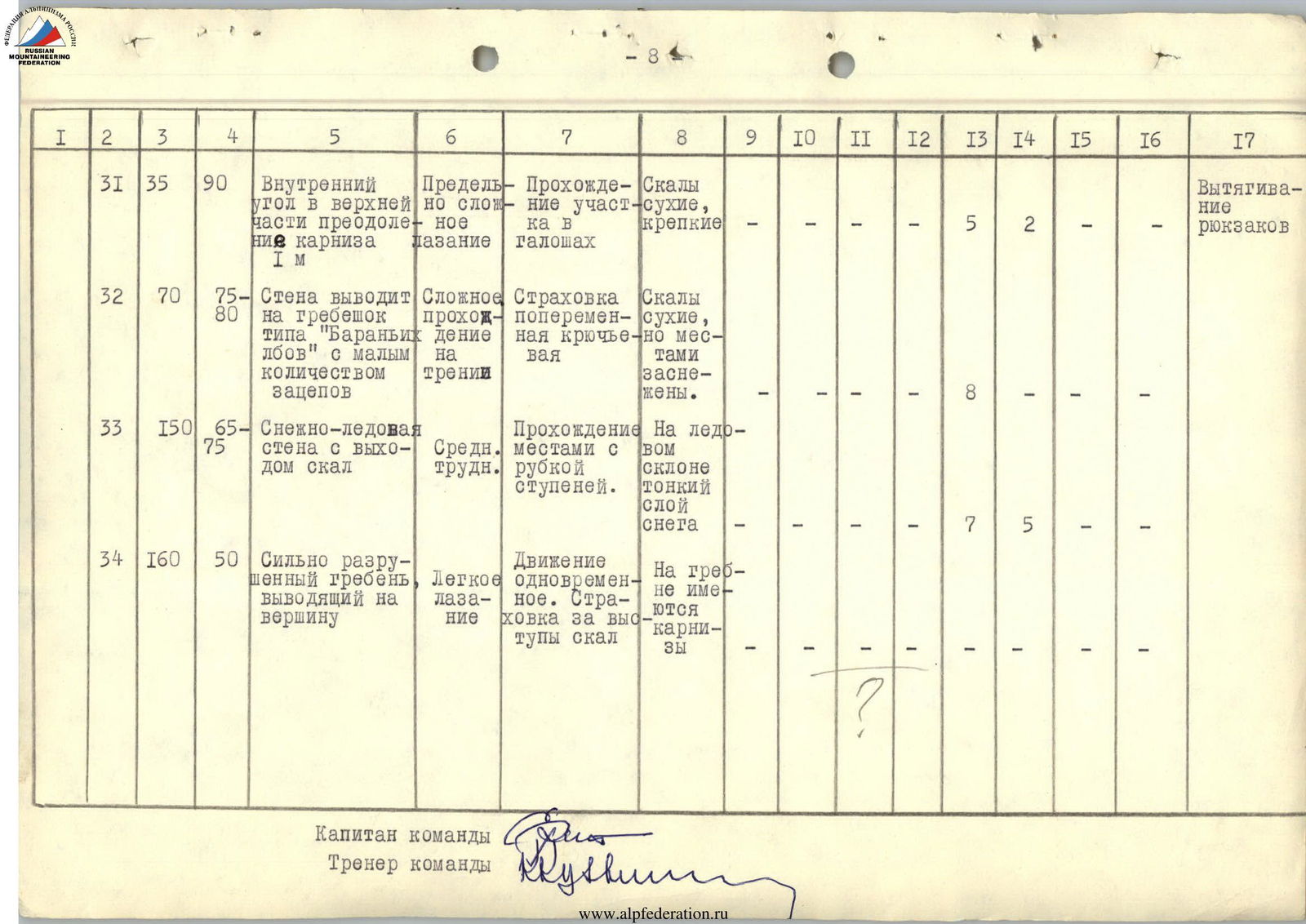
| Section # | Section Length (by length), m | Average Section Steepness (degree), ° | Section Characteristics and Passage Conditions | Technical Difficulty | Passage Method and Belaying | Weather Conditions | Date | Overnight Stops | Departure | Hiking Hours | Hiking Hours (driven) | Rock Hooks | Ice Hooks | Piton Hooks | Daily Nutrition Weight, g | Notes |
|---|---|---|---|---|---|---|---|---|---|---|---|---|---|---|---|---|
| 1 | 550 | 50 | Snow-ice slope | Medium difficulty | Movement is alternating with hook belaying and step cutting on ice sections (1 m). | Firm snow | 2.08.72 | - | 9:00 | - | - | 3 | - | - | 500 | |
| 2 | 80 | 55 | Snow slope | Easy | Alternate belaying on rock outcrops and hooks. | Snow with a thin firn crust. | - | - | - | - | 2 | - | - | - | ||
| 3 | 30 | 85 | Slabs, partially iced | Very complex | Alternate movement, hook belaying | Good weather. Dry rocks. | - | - | - | - | 6 | - | - | - | ||
| 4 | 20 | 85 | Narrow ledge, snow-covered, partially turning into a wall. | Complex | Alternate movement. Hook belaying. | Cold, dry rocks. | - | - | - | - | 4 | - | - | - | ||
| 5 | 40 | 85 | Slabs. In the upper part, an overhanging cornice — 1 m | Extremely complex climbing | Hook belaying. Ladder used to overcome the cornice. | - | - | - | - | - | 10 | 2 | - | - | Rucksack extraction on the section | |
| 6 | 40 | 50 | Snow-ice slope | Medium difficulty | Hook belaying, step cutting in some places | Ice covered with snow. | - | - | - | - | 2 | 3 | - | - | ||
| 7 | 65 | 85 | Narrow, strongly destroyed ledge, partially turning into a wall. | Complex climbing | Alternate movement. Hook belaying | Dry rocks. | - | - | - | - | 2 | 4 | - | - | Section is very rockfall-prone. Few places for hook placement. | |
| 8 | 10 | 90 | Large-block rocks | Very complex | Hook belaying | Dry rocks. | - | - | - | - | 3 | 1 | - | - | ||
| 9 | 20 | 45 | Rocky ledge | Easy climbing | Alternate hook belaying | -"- | 17:30 | - | 10.5 | Laid out platform (4 hours of work) | 3 | 1 | - | - | Includes time for further route processing | |
| 10 | 160 | 55 | Rocks like "ram's foreheads" | Medium difficulty | Alternate hook belaying | Cold rocks, covered with frost. | 3.08.72 | - | 9:10 | - | - | 22 | 1 | - | - | Few places for hook placement. |
| 11 | 160 | 65 | Rocks like "Iron" in 30–40 m sections | Medium difficulty | -"- | Rocks partially covered with frost. | - | - | - | - | 18 | 2 | - | - | ||
| 12 | 35 | 85 | Internal corner. In the lower part, a ledge with rime ice. | Complex climbing | -"- | Dry rocks. | - | - | - | - | 4 | - | - | - | ||
| 13 | 40 | 70 | Strongly destroyed rocks | Difficult climbing | Alternate, hook belaying | Dry rocks. | - | - | - | - | 3 | 2 | - | - | ||
| 14 | 75 | 40 | Narrow, destroyed ridge | Medium difficulty | Alternate belaying on rock outcrops and hooks. | -"- | - | - | - | - | 2 | - | - | - | ||
| 15 | 20 | 90 | Wall with few holds, covered with snow. | Very difficult | Alternate, hook belaying | Cold rocks. | - | - | - | - | 5 | - | - | - | ||
| 16 | 30 | 70 | Strongly destroyed rocks | Difficult climbing | -"- | -"- | 17:00 | - | 11.5 | Laid out platform on the ridge | 4 | 1 | - | - | Includes time for further route processing (4 ropes) | |
| 17 | 40 | 60 | Strongly destroyed slabs like "tiles" | Medium difficulty | -"- | Cold rocks, covered with frost. | 4.08.72 | - | 9:00 | - | - | 4 | - | - | - | |
| 18 | 30 | 85 | Oblique ledge, up to 1.5 m wide, extremely destroyed. Traverse from left to right at an angle of 65°. | Very complex and rockfall-prone section | -"- | Very cold rocks. | - | - | - | - | 8 | 2 | - | - | Few places for hook placement. Movement along the ledge only one person at a time. | |
| 19 | 10 | 85 | Traverse of a wall with very few holds | Extremely complex climbing | Alternate hook belaying | Dry, cold rocks. | - | - | - | - | 2 | - | - | - | Practically no places for hook placement. | |
| 20 | 3 | 100 | Overhanging wall | Very complex | Passage with artificial points of support (4 ladders with 2 steps each) | -"- | - | - | - | - | 4 | - | - | - | Rucksack extraction | |
| 21 | 60 | 70 | Strongly destroyed walls, partially turning into crevices. | Complex climbing | Alternate hook belaying | -"- | - | - | - | - | 6 | 1 | - | - | ||
| 22 | 15 | 65–70 | Traverse of a couloir with rime ice | Complex climbing | Icy rocks, sunlit. | - | - | - | - | 3 | - | - | - | Step cutting during traverse (rockfall-prone!). Few places for hook placement. | ||
| 23 | 30 | 85 | Wall with few holds | Very complex climbing | Icy rocks, sunlit. | - | - | - | - | 7 | - | - | - | Few places for hook placement. | ||
| 24 | 60 | 75–80 | Movement right-upwards along strongly destroyed rocks, partially repelled. | Complex climbing | Dry rocks. Sun. | - | - | - | - | 3 | 4 | - | - | Many "live" rocks on the section. | ||
| 25 | 20 | 80 | Rocks with block structure, many "live" rocks. | Complex climbing | Alternate hook belaying | Dry rocks. Sun. | - | - | - | - | 3 | 2 | - | - | Rockfall-prone. | |
| 26 | 15 | 85 | Internal corner with rime ice | Very complex climbing | Passage with artificial point of support (1 ladder) | Wet rocks. Water flow. | - | - | - | - | 3 | 3 | - | - | ||
| 27 | 50 | 75 | Strongly destroyed rocks. Many "live" rocks. | Medium difficulty | Alternate hook belaying | Wet rocks. | 17:30 | - | 11.0 | Overnight on snow under the wall. Platform made of snow and rocks. | 4 | 3 | - | 600 | Includes time for further route processing (2.5 hours) | |
| 28 | 60 | 75–80 | Couloir with rime ice | Complex climbing | Step cutting. Hook belaying | Wet rocks, rime ice. | - | 9:15 | - | - | 7 | - | - | - | ||
| 29 | 7 | 110 | Traverse under overhanging rocks | Very complex climbing (repelled) | Alternate hook belaying (passage in crampons) | Dry, strong rocks. | - | - | - | - | 3 | 1 | - | - | Rucksack extraction | |
| 30 | 20 | 110 | Overhanging wall leading to an oblique ledge | Extremely complex climbing | Passage using artificial points of support (3 ladders) | -"- | - | - | - | - | 10 | 2 | - | - | Rucksack extraction | |
| 31 | 35 | 90 | Internal corner in the upper part with overcoming a 1 m cornice | Extremely complex climbing | Passage in crampons | Dry, strong rocks. | - | - | - | - | 5 | 2 | - | - | Rucksack extraction | |
| 32 | 70 | 75–80 | Wall leading to a ridge like "ram's foreheads" with few holds | Complex passage on friction | Alternate hook belaying | Dry rocks, partially snow-covered. | - | - | - | - | 8 | - | - | - | ||
| 33 | 150 | 65–75 | Snow-ice wall with exit to rocks | Medium difficulty | Passage with step cutting in some places | Thin snow layer on the ice slope. | - | - | - | - | 7 | 5 | - | - | ||
| 34 | 160 | 50 | Strongly destroyed ridge leading to the summit | Easy ascent | Simultaneous movement. Belaying on rock outcrops. | Cornices on the ridge. | - | - | - | - | - | - | - | - |
Team Captain
Team Coach