
№56. Ukrainian SSR Alpine Championship
High-altitude Technical Class
We dedicate the ascent
to our friends Kovtun V.G. and Bodnik V.N.
Akademiya Nauk Ridge
Peak Blyukhera via the South Ridge — first ascent (orient. 5B cat. diff.) — Team of the Ukrainian Republican Council of the "Burevestnik" Sports Society
| № | Surname | Initials | Rank | Role |
|---|---|---|---|---|
| 1 | Tsakanyan | O.S. | CMS | team leader |
| 2 | Bychek | A.M. | MS | participant |
| 3 | Kovtun | N.P. | MS | —"— |
| 4 | Derkach | A.A. | MS | —"— |
| 5 | Barsukov | V.A. | CMS | —"— |
| 6 | Bozhko | I.V. | CMS | —"— |
| 7 | Kuzmuk | V.V. | CMS | —"— |
Team coach — Honored Coach of the Ukrainian SSR, MS, Kovtun V.G.
PAMIR – 1981
Brief Geographical Description and Sporting Characteristics of the Area
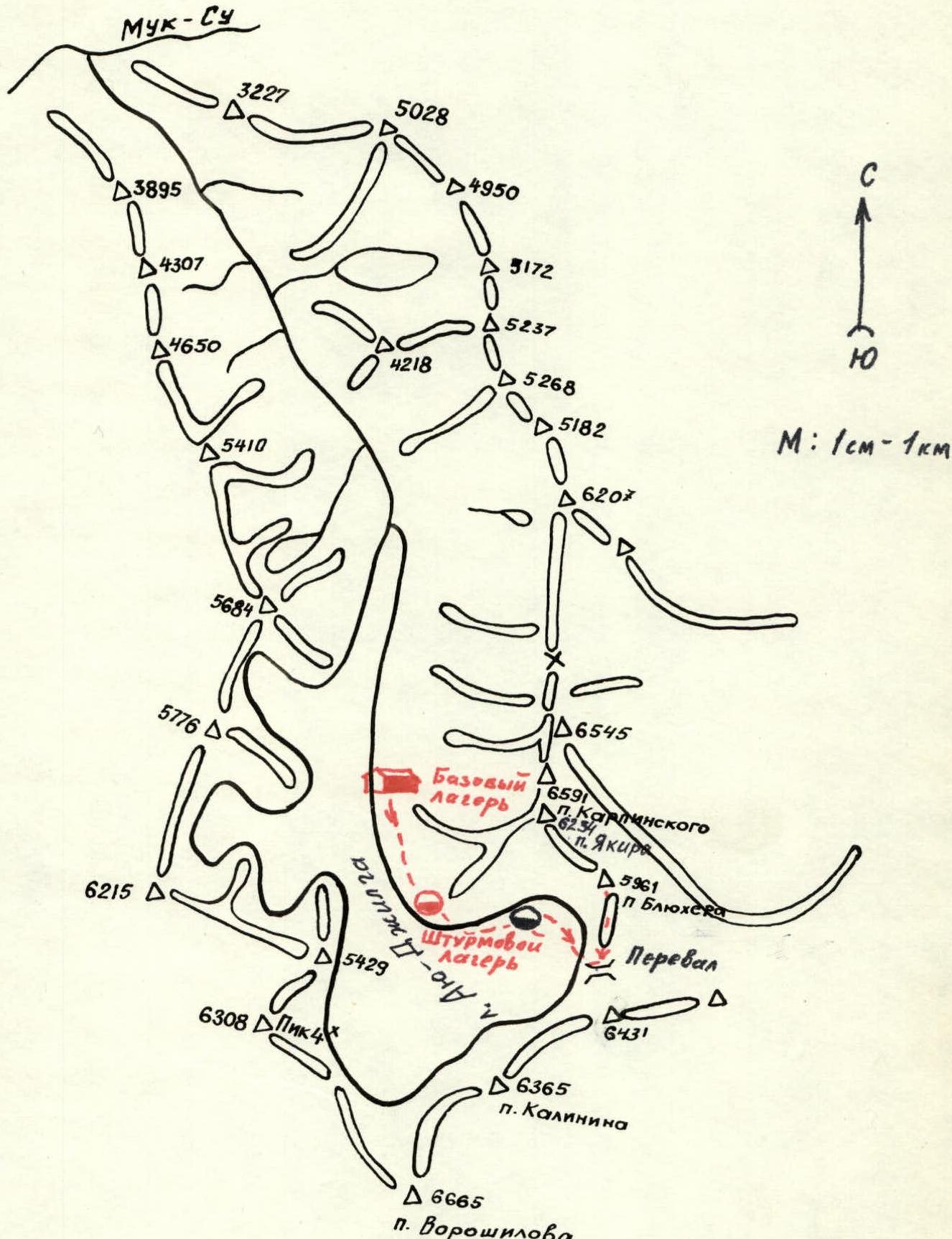
Peak Blyukhera is located in the Peter I Ridge and closes the Ayu-Dzhilga gorge. The length of the gorge is about 20 km. The Ayu-Dzhilga glacier stretches from south to north and occupies an area of about 20 sq. km. The length of the glacier is 9 km. The Ayu-Dzhilga river flows out of the glacier, which, flowing through the gorge to the north, flows into the Muk-Su. The Ayu-Dzhilga river is quite full-flowing, and it can only be crossed in its upper part via the glacier. Vegetation in the gorge starts at an altitude of 3000 m, 9 kilometers from Muk-Su. The southern part of the glacier expands and forms a cirque with an area of about 10 sq. km. This cirque contains unnamed peaks:
- p. 5429
- p. 6431
- Peak 4-kh
- p. Voroshilova
- p. Kalinina
- p. Blyukhera
- p. Yakira
The development of the gorge began in 1966. Routes were made to p. Yakira, p. 5100, and Peak 4-kh.
The second expedition was conducted by Dnipropetrovsk climbers in 1975. The low frequency of visits to this area led to the fact that many peaks do not have records of their conquest. All routes in the southern cirque of the Ayu-Dzhilga glacier are combined or snow-ice routes.
The massif of Peak Blyukhera is characterized by destroyed glaciated rocks, which sometimes complicates the organization of reliable insurance. In this regard, the ridge nature of the route is advantageous in terms of insurance (self-insurance) organization compared to other routes to this peak.
- Destroyed glaciated rocks
- Complicated organization of reliable insurance
- Advantage of the ridge nature of the route
Map of the ascent area to Peak Blyukhera
Weather Conditions
The weather in July 1981 was unstable in the ascent area. There were cases when about 40 cm of snow fell overnight. This led to frequent snow avalanches from many peaks. Bad weather required maximum attention when choosing routes and making tactical ascent plans.
The ascent to p. Blyukhera also took place in unstable weather: frequent snowfall and poor visibility significantly complicated the route passage.
Remoteness from populated areas and alpine bases
The nearest populated area from the base camp was the Altyn-Mazar weather station, which was 30 km away. Communication with Altyn-Mazar and Dzhirgital was carried out using helicopters. The expedition's cargo was also delivered by helicopter to the base camp, which was located on a clearing under the slopes of p. Yakira. The height of the base camp above sea level was determined by an altimeter and was 4100 m.
Organizational and Technical Ascent Plan
The combined team of the Ukrainian Republican Council "Burevestnik" began preparing for participation in the 1981 USSR Championship in the autumn of 1980, when all participants of the planned expedition gathered in Kiev after the summer season. Here, the objects of ascent were finally chosen, and it was decided to ascend p. 5429 or p. Blyukhera to participate in the Ukrainian SSR Championship. For this purpose, available materials on ascents in the Ayu-Dzhilga glacier area were studied, including:
- maps and literature related to its geological structure, nature, and glaciation;
- routes and structure of peaks.
To take photographs, the senior team coach, Kovtun V.G., flew by helicopter to the Ayu-Dzhilga glacier area in June 1981, while in the base camp of the Ukrainian SSR Sports Committee's expedition. The photographs taken helped to finally choose the ascent route.
I. Preparation before Departure to the Mountains
All participants directly prepared for the ascents during the autumn-winter period of 1980-1981. All participants conducted training in their sections according to a plan developed by the senior team coach. Training was conducted at least four times a week, and starting from February 1981, training on rock formations was added on Saturdays and Sundays. Here, technical questions of passing particularly difficult sections, tactical, and organizational team work issues were practiced.
In May 1981, the team conducted a 15-day gathering in Sudak, where they finally practiced:
- tactical and technical interaction of rope teams;
- changes of leaders;
- options for pulling up backpacks;
- organization of bivouacs on walls.
The equipment used by the team was also tested and checked (reports were made) there. During the autumn-winter period, the planned amount of titanium rock and ice equipment was manufactured. The team used "Irbis" titanium carabiners. All equipment showed complete suitability for passing routes of high category difficulty.
II. Preparation in the Mountains
On June 6, all expedition participants flew to two areas for preliminary preparation and acclimatization. 6 people, led by the senior team coach, participated in the Ukrainian SSR Sports Committee's expedition. They made ascents (first ascents) to:
- p. Pavla Tychyny (orient. 4B cat. diff.);
- p. 1500-letiya Kievu (orient. 3B cat. diff.);
- p. Vozrozhdenie (orient. 5B cat. diff.).
The rest of the expedition members (except for the doctor and cook) worked as instructors at the "Torpedo" alpine camp and made an ascent to v. Passionarriya (5A cat. diff.) and v. Uilpita (5B cat. diff.).
On July 1, all 23 participants of the Ukrainian Republican Council "Burevestnik" expedition gathered in Dzhirgital. A container was received from Kiev, and all economic issues were resolved. On the same day, the first four people were airlifted by helicopter to the base camp area.
On July 2, the entire expedition team and all cargo were delivered by helicopter to the base camp area. The base camp was set up under the slopes of p. Yakira, a 1 hour and 30 minutes walk from the helicopter landing site.
By July 4, all cargo was transferred, and the base camp was fully equipped.
The camp had a radio station that maintained regular communication with Dzhirgital. Communication with the assault camp and groups was carried out using "Vitalka" radio stations.
The expedition included a doctor and a wide range of medications. Along with setting up the camp, reconnaissance was conducted.
It was planned to organize an assault camp 20 minutes from the start of the route to p. 6431 (Kiev) on the moraine where it turns towards p. Blyukhera. Two tents were set up here.
A 40x spotting scope allowed observing all sections of the route to p. Blyukhera.
The team's departure to the route was scheduled for July 5. On the same day, two groups were to ascend Peak 4-kh, ensuring interaction and information transfer to the base camp. In addition, two observers were in the assault camp at that time, observing the route to p. 6431, and monitoring the groups on p. Blyukhera and Peak 4-kh.
Tactical Ascent Plan
The work of the first team on difficult sections of the route was planned to be done in galoshes without a backpack and on a double rope. During the ascent, the temperature was between –5 °C and –15 °C. Moreover, the state of the route (ice and snow) did not allow the use of galoshes.
The team's work was planned so that the maximum possible part of the route was processed or traversed daily, allowing the entire team to start work practically at once, significantly reducing the time taken to complete the route. We aimed to complete the given route in the shortest possible time and, naturally, with maximum safety.
The ascent plan was as follows:
- First day — approach under the route and reconnaissance of the path to the pass via the closed glacier. Overnight stay was planned on the moraine under the pass.
- Second day — ascent to the pass, passage of the first and second rises, processing of the third rise. Overnight stay was planned under the third rise.
- Third day — passage of the third rise and maximum possible ascent towards the peak. Overnight stay was planned under the summit dome.
- Fourth day — ascent to Peak Blyukhera and return to the base camp. Descent was planned into the Maly Tanymaz gorge, then through the pass to the base camp.
It is worth noting that observing the route and realistically assessing the difficulties expected by the team allowed for a plan that was almost fulfilled. The third overnight stay was organized not under the summit dome but on the fourth rise due to bad weather.
Nutrition. The daily nutrition ration consisted of a set of high-calorie products and was about 700 g per person per day:
- In the morning — tea, honey, glucose, meat, sugar.
- During the day, all participants ate products from the "daily bag":
- sausage
- nuts
- sugar
- candies
- glucose
- dried fruits
- In the evening — soup was cooked, tea was made.
The bags were distributed in the morning, the day before departure.
The team's diet included high-calorie protein preparations. As the ascent showed, the selection of products and daily nutrition ration was correctly composed and fully satisfied the needs of the climbers.
Ascent Description
July 5: at 10:00, the group left the base camp and began ascending the left side of the Ayu-Dzhilga glacier and reached the assault camp in 2 hours. From the assault camp to the moraine, and then to the glacier to the rock islands under the pass — 4 hours and 30 minutes. On one of the rock islands, two tents were set up, and steps were cut under the pass. July 6: at 9:00, the group left the bivouac, approached the pass, and began ascending it. The ascent to the pass was via a steep 50–60° snow-ice slope (6 hours and 30 minutes from the assault camp). From the pass, to the right upwards via steep destroyed rocks — exit to the ridge. Conclusion from the pass to the right upwards via steep destroyed rocks. Via a steep ridge, alternating with sheer walls — to the first rise. The first rise is tackled head-on via steep snowy rocks with sheer walls. The height begins to take its toll, making it significantly harder to climb. From the top of the first rise, passing small (30 m) walls, the group approaches under the 2nd rise of the ridge. Here is the planned bivouac site, and it's already 18:00. The Bychek–Derkach duo goes to process the second rise, while the rest start compacting snow and setting up a tent. With difficulty, one high-altitude tent is set up. Barsukov–Bozhko help the first duo to pull up another rope and hang 80 m of belays. The weather worsens in the evening, and someone has to stand guard and shake snow off the tent all night. July 7: in the morning, it's snowing, temperature –10 °C. The wind quickly makes hands and legs unresponsive, and they need to be warmed up constantly. At 10:00, the last rope team leaves the site. The 2nd rise is tackled via the right side of a huge internal angle, which ends in a sheer wall. From the top of the rise via the ridge, alternating with overhanging walls — to the 3rd rise. Two of them are bypassed on the left at the top, and the third is tackled on the right. At 17:00, the weather finally worsens, snow blinds the eyes and makes breathing difficult. It was decided to stop for a bivouac, not reaching the planned site. The first rope team, Tsakanyan–Barsukov, returns after hanging only 10 m of belays. The site is compacted, and a tent is set up.
July 8: in the morning, the snow stops, but the route is still in fog. At 9:00, the group starts the assault on the peak. Every meter of complex climbing is very difficult at almost 6-kilometer height. The third and fourth rises are tackled head-on. The fourth rise ends with a sharp snow-ice ridge. Kuzmuk crosses it "astride," moving along. Further, another 200 m of a steep snowy slope, and the long-awaited "Peak" is heard. At 14:00, all participants gather on Peak Blyukhera. The weather does not allow for a good view of the area, and 10 minutes later, the group begins the descent.
The descent was organized into the Maly Tanymaz gorge via the path planned on July 6. Descending snowy sections and cutting steps using ice axes on ice, at 17:00, the group reached under the pass, and at 18:00, they ascended it. In 2 hours, the group stood at the checkpoint in the assault camp, where they were met by their comrades led by the team's senior coach, V.G. Kovtun.
Brief Characteristics of the Route
The route, according to the group's assessment, is combined, logical, safe, and requires three days of complex, intense work at a relatively high altitude. Most of the difficult sections are traversed by free climbing. The group used ITO only on the R7–R8 section. The route can be recommended to sports groups for further improvement.
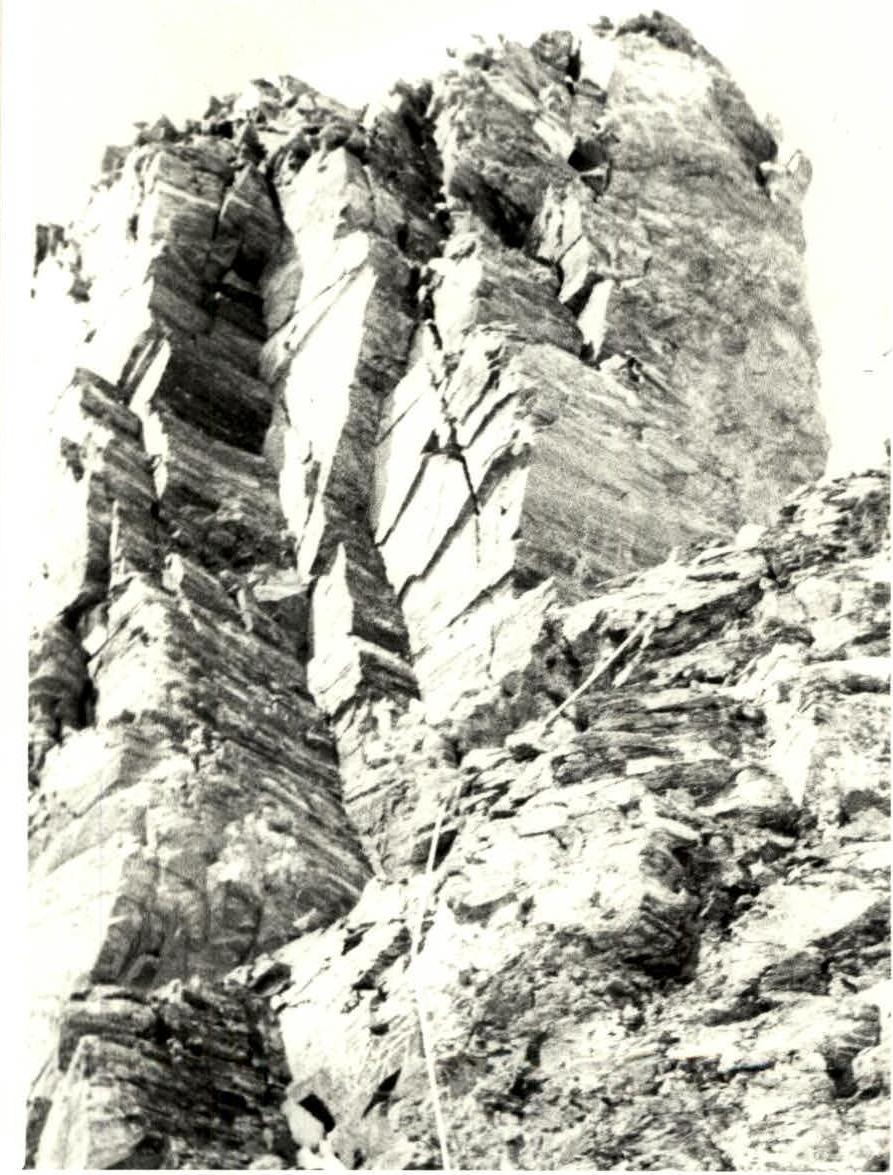
Passage of the R7–R8 section
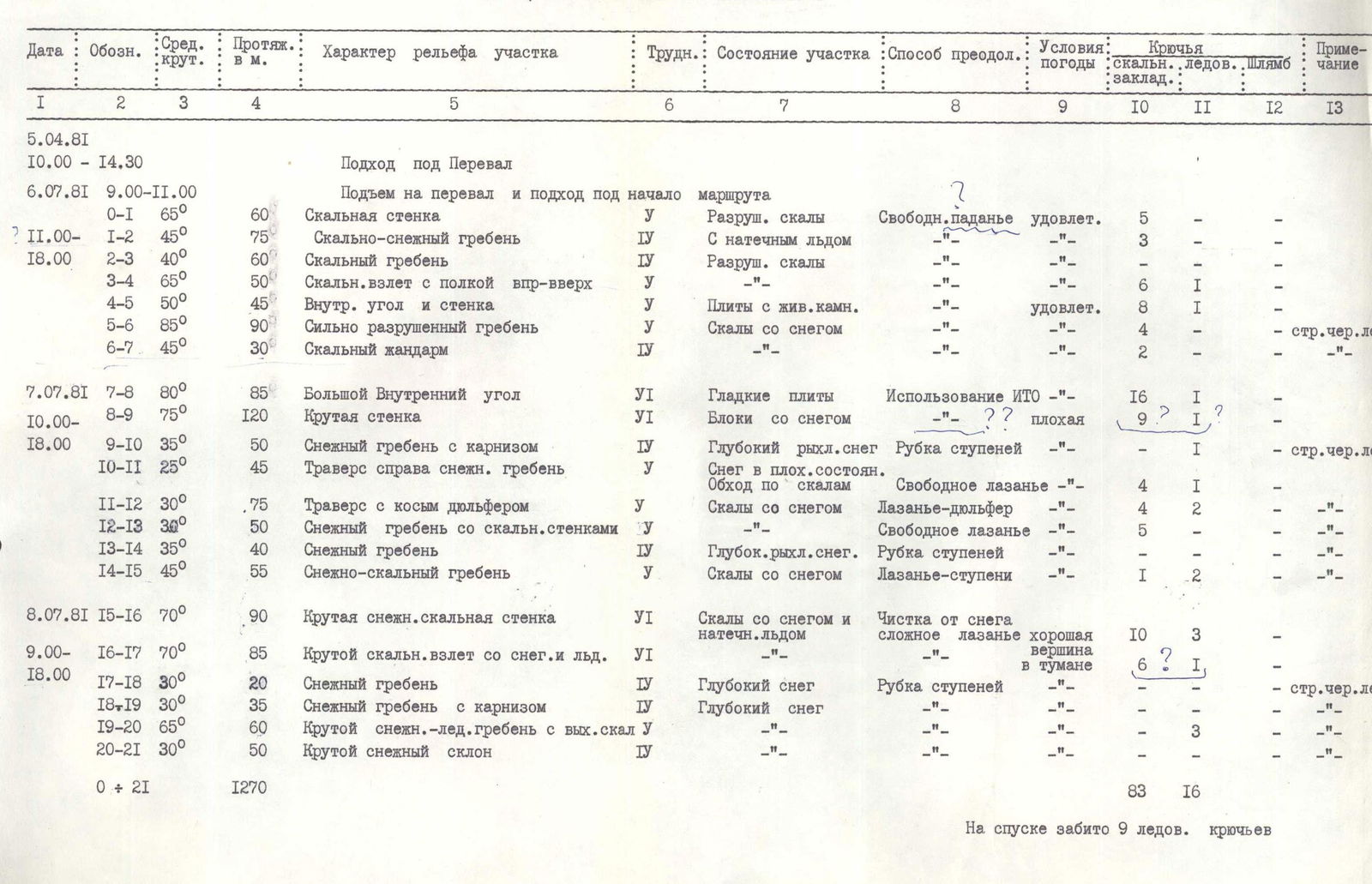
Table of Main Route Characteristics
| Date | Denot. | Avg. Steep. | Length | Terrain Characteristics | Diff. | State of Section | Method of Passage | Weather Conditions | Rock Hooks | Ice Hooks | Shoulder Hooks | Note |
|---|---|---|---|---|---|---|---|---|---|---|---|---|
| 5.07.1981 | Approach under Pass | |||||||||||
| 10:00–14:30 | ||||||||||||
| 6.07.1981 | Ascent to pass and approach under start of route | |||||||||||
| 9:00–11:00 | R0–R1 | 65° | 60 m | Rock wall | 2 | Destroyed rocks | Free climbing | satisfactory | 5 | 3 | ||
| 11:00–18:00 | R1–R2 | 45° | 75 m | Rock-snow ridge | 4 | With rime ice | —"— | —"— | ||||
| R2–R3 | 40° | 60 m | Rock ridge | 4 | Destroyed rocks | —"— | —"— | |||||
| R3–R4 | 65° | 50 m | Rock rise with a ledge upwards | 2 | —"— | —"— | —"— | 6 | ||||
| R4–R5 | 50° | 45 m | Internal angle and wall | 2 | Slabs with alive stones | —"— | satisfactory | 8 | 1 | |||
| R5–R6 | 85° | 90 m | Strongly destroyed ridge | 2 | Rocks with snow | —"— | —"— | 4 | 2 | (black ice) | ||
| R6–R7 | 45° | 30 m | Rock sentry | 4 | —"— | —"— | —"— | |||||
| 7.07.1981 | R7–R8 | 80° | 85 m | Big Internal angle | 6 | Smooth slabs | Use of ITO | —"— | 16 | 1 | ||
| 10:00–18:00 | R8–R9 | 75° | 120 m | Steep wall | 6 | Blocks with snow | —"— | bad | 9 | 1 | ||
| R9–R10 | 35° | 50 m | Snow ridge with a cornice | 4 | Deep loose snow | Step cutting | —"— | 1 | (black ice) | |||
| R10–R11 | 25° | 45 m | Traverse right snow ridge | 2 | Snow in poor condition. Bypass via rocks | Free climbing | —"— | 4 | 1 | |||
| R11–R12 | 30° | 75 m | Traverse with diagonal rappel | 2 | Rocks with snow | Climbing-rappel | —"— | 4 | 2 | —"— | ||
| R12–R13 | 30° | 50 m | Snow ridge with rock walls | 2 | —"— | Free climbing | —"— | 5 | —"— | |||
| R13–R14 | 35° | 40 m | Snow ridge | 4 | Deep loose snow | Step cutting | —"— | 1 | —"— | |||
| R14–R15 | 45° | 55 m | Snow-rock ridge | 2 | Rocks with snow | Climbing-steps | —"— | 1 | 2 | —"— | ||
| 8.07.1981 | R15–R16 | 70° | 90 m | Steep snow-rock wall | 6 | Rocks with snow and rime ice | Cleaning from snow, complex climbing | good | 10 | 3 | ||
| 9:00–18:00 | R16–R17 | 70° | 85 m | Steep rock rise with snow and ice | 6 | —"— | —"— | peak in fog | 6 | 1 | ||
| R17–R18 | 30° | 20 m | Snow ridge | 4 | Deep snow | Step cutting | —"— | (black ice) | ||||
| R18–R19 | 30° | 35 m | Snow ridge with cornice | 4 | Deep snow | —"— | —"— | —"— | ||||
| R19–R20 | 65° | 60 m | Steep snow-ice ridge with exit to rocks | 5 | —"— | —"— | —"— | 3 | —"— | |||
| R20–R21 | 30° | 50 m | Steep snowy slope | 4 | —"— | —"— | —"— | —"— | ||||
| R0–R21 | 1270 m | 83 | 16 |
On the descent, 9 ice hooks were driven.

Comments
Sign in to leave a comment