
Ascent Passport
- Class of winter ascents.
- Region 2.10, Caucasus, Dagestan mountains, Chekhychay gorge.
- Shalbuzdag Central, 4142 m, via the center of the SW wall, through the cornice, rock route.
- 5B category of difficulty, first ascent. 48
- Route characteristics: height difference of the route — 280 m, wall — 150 m (from 3860 m to 4010 m), average steepness of the route — 53°, wall — 77°. Route length — 575 m, wall — 180 m. Section lengths: 2 – 100 m, 3 – 250 m, 4 – 90 m, 5 – 97 m, including 24 m on artificial climbing holds (ITCH), 6 – 38 m (on ITCH); total climbing on ITCH — 62 m, with difficulty: A1 — 8 m, A2 — 36 m, A3 — 18 m.
- Equipment used on the route:
- rock pitons 34/18
- including 7 at belay stations
- chocks 57/40
- including 5 at belay stations
- bolt hangers 7 Left behind:
- rock pitons 3
- chocks 5
- bolt hangers 2
- Team's travel days — 4, hours — 22, including preliminary processing — days — 3, hours — 13.
- Overnight stay below the route in ABC on platforms under the SW wall, in the Ihir river valley, at an altitude of 3550 m.
- Team leader:
- Dorro Konstantin Eduardovich — Master of Sports Team members:
- Aliyev Shankhal Ramazanovich — Candidate Master of Sports
- Pashuk Evgeny Grigorievich — Candidate Master of Sports
- Leonov Petr Georgievich — Master of Sports
- Sogokon Vladimir Alexandrovich — Candidate Master of Sports
- Shanavazov Shanavaz Eldarovich — Master of Sports
- Coach: Murtazaliev Ziyabudin Murtazalievich
- Acclimatization and cargo delivery February 18, 1998. Departure from "Erydag" base camp February 20, 1998. Preliminary processing February 22-24, 1998. Departure on the route, summit, and return to ABC February 25, 1998. Return to "Erydag" base camp February 26, 1998.
- Organization: Dagestan Republican Search and Rescue Service of the Ministry of Emergency Situations of Russia.

Photo 1. General view of Shalbuzdag Central peak from the northwest at an altitude of 3550 m.
- Team's route via the center of the SW wall
- E. Rumsh's route, 81, via the left part of the SW wall, 4A category of difficulty
- V. Melnikov's route, 79, via the SW ridge, 3B category of difficulty.
Photo taken from ABC on February 26, 1998, 11:00, Smena — Symbol
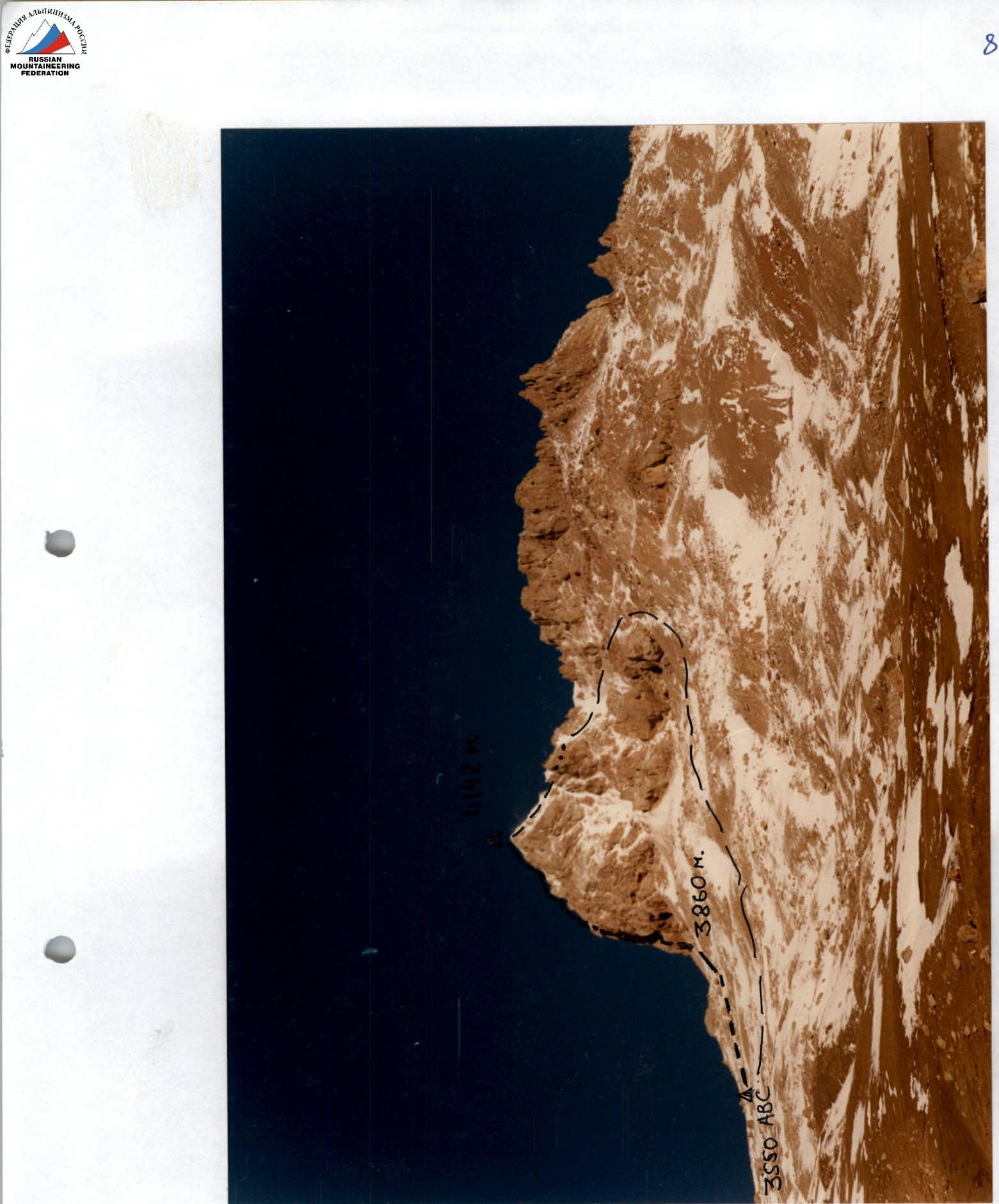
Photo 2. Profile of the SW wall of Shalbuzdag Central from the right. Taken from the village of Kurush on February 28, 1998, at 10:00, Nikon-XL, ×8 magnification.
Profile of the ascent route to Shalbuzdag Central via the center of the SW wall.
Height in meters.
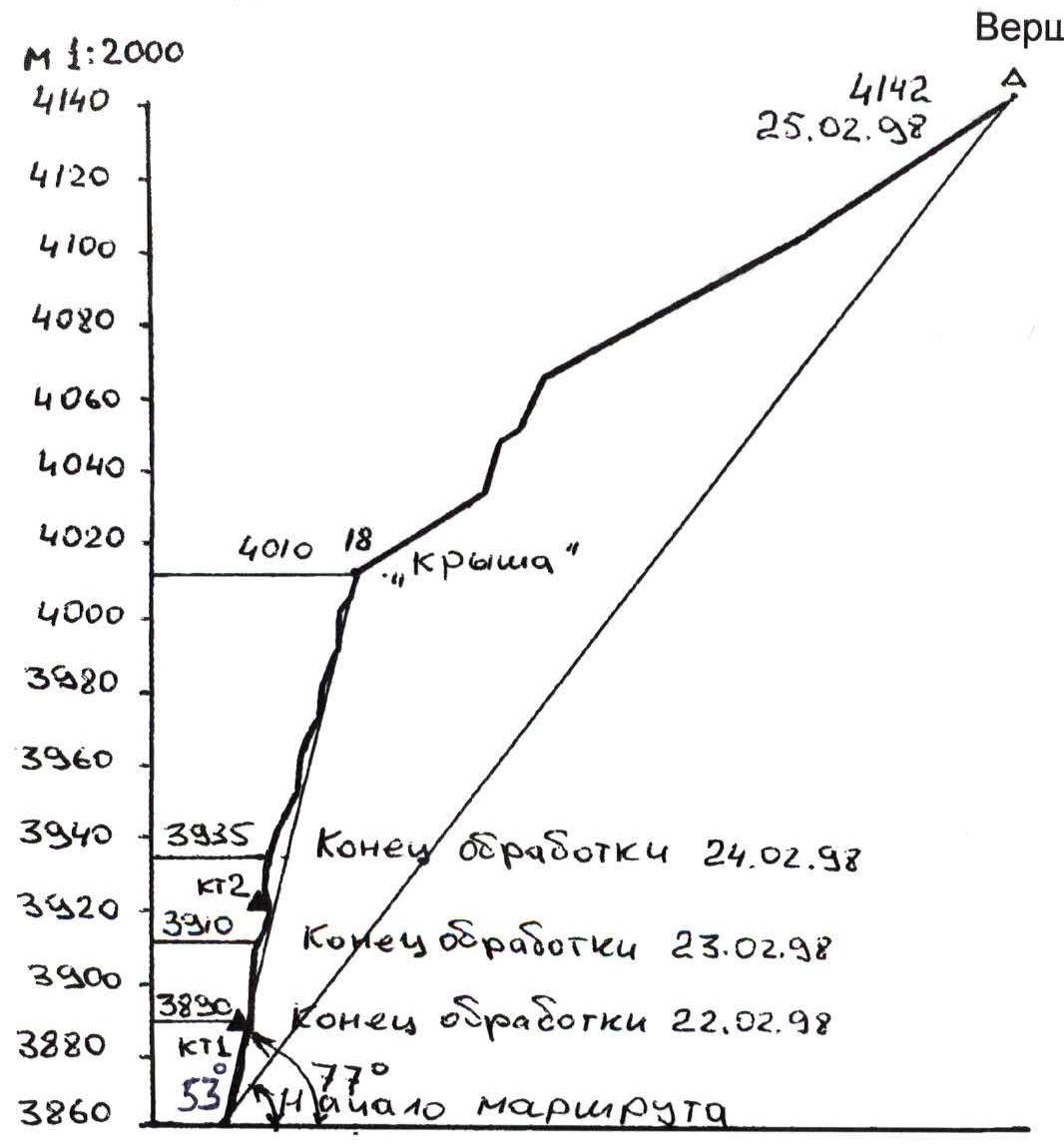
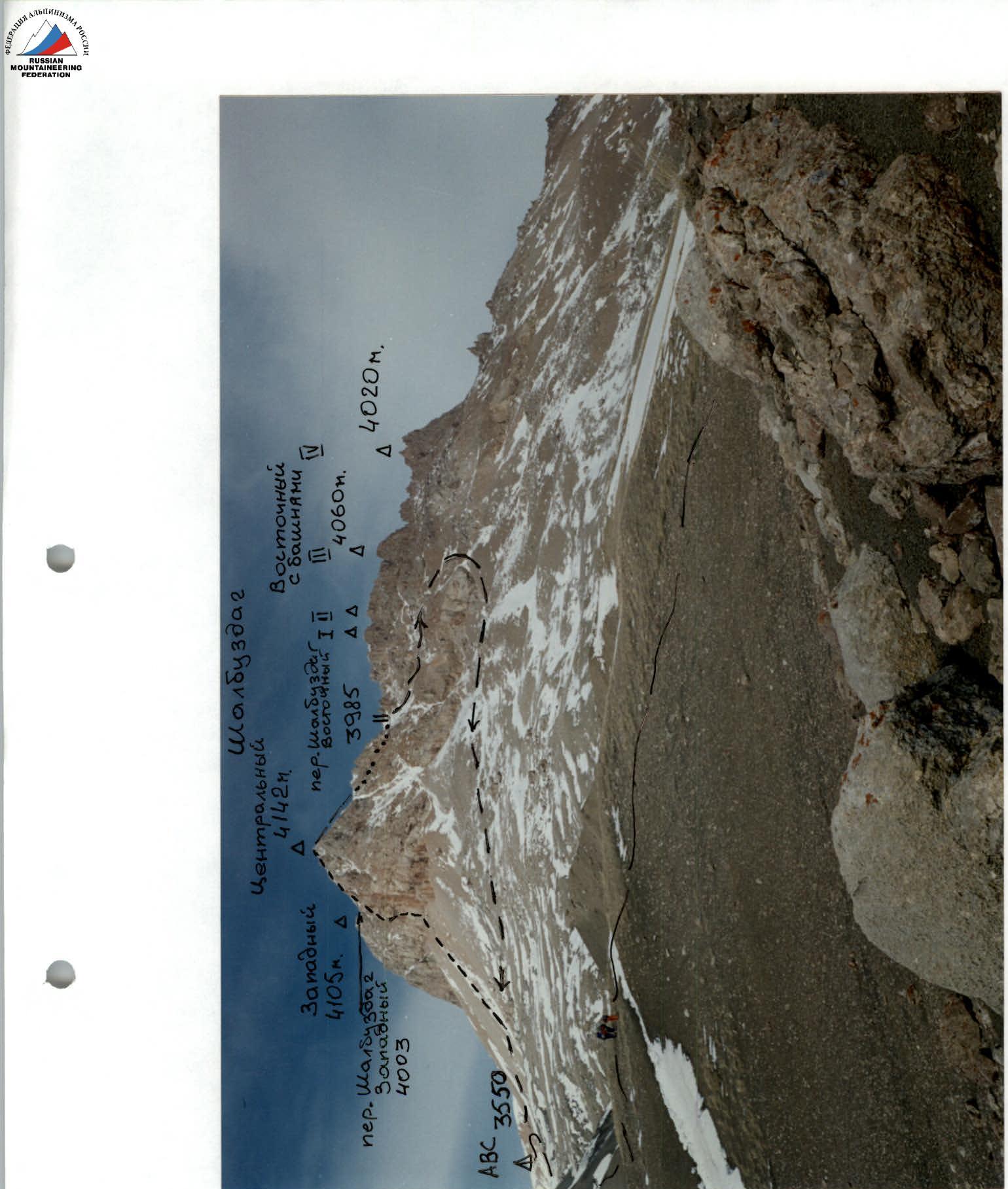
Photo 3. Panorama of the ascent area. Taken on the approach, at an altitude of 3100 m on February 20, 1998, 13:00, Smena — Symbol
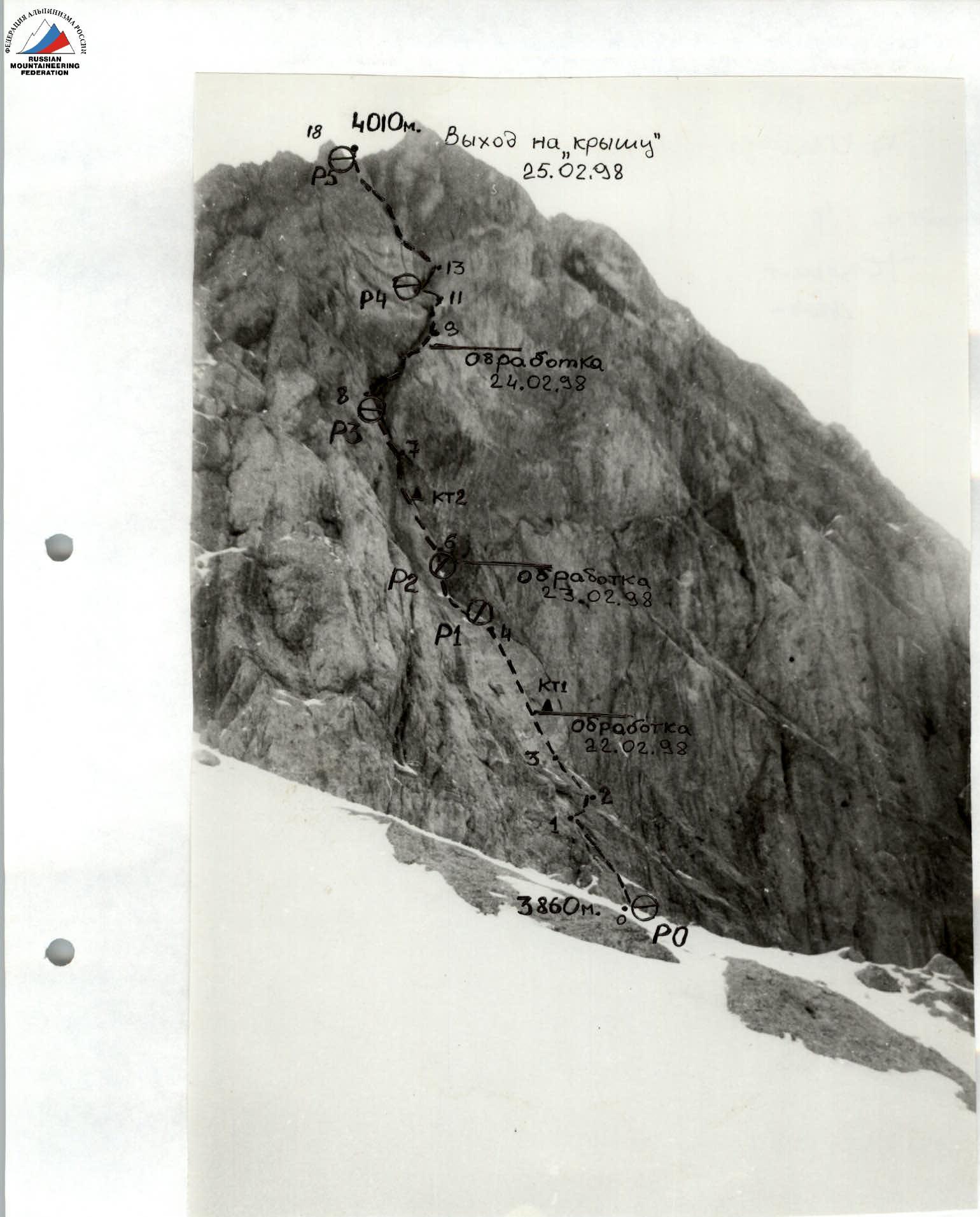
Photo 4. Technical photo of the route from an altitude of 3800 m, May 7, 1993, 10:00, Smena — 8M
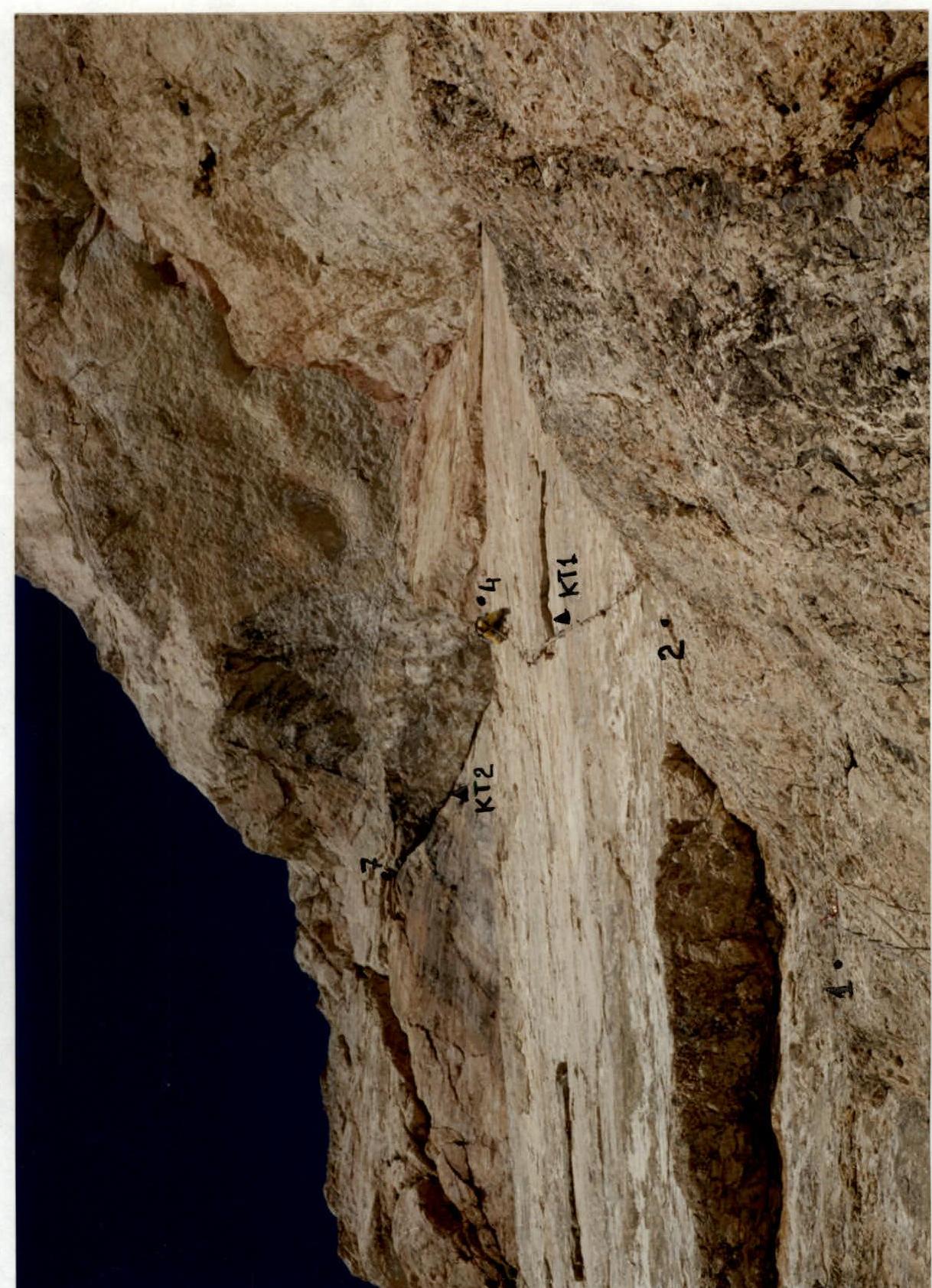
Photo 5. Lower part of the wall. Sections R0-R7. Sogokon is leading on the upper part of section R3-R4. Photo taken from under the wall on February 23, 1998, 14:00, Smena — Symbol
MAP OF THE ASCENT AREA
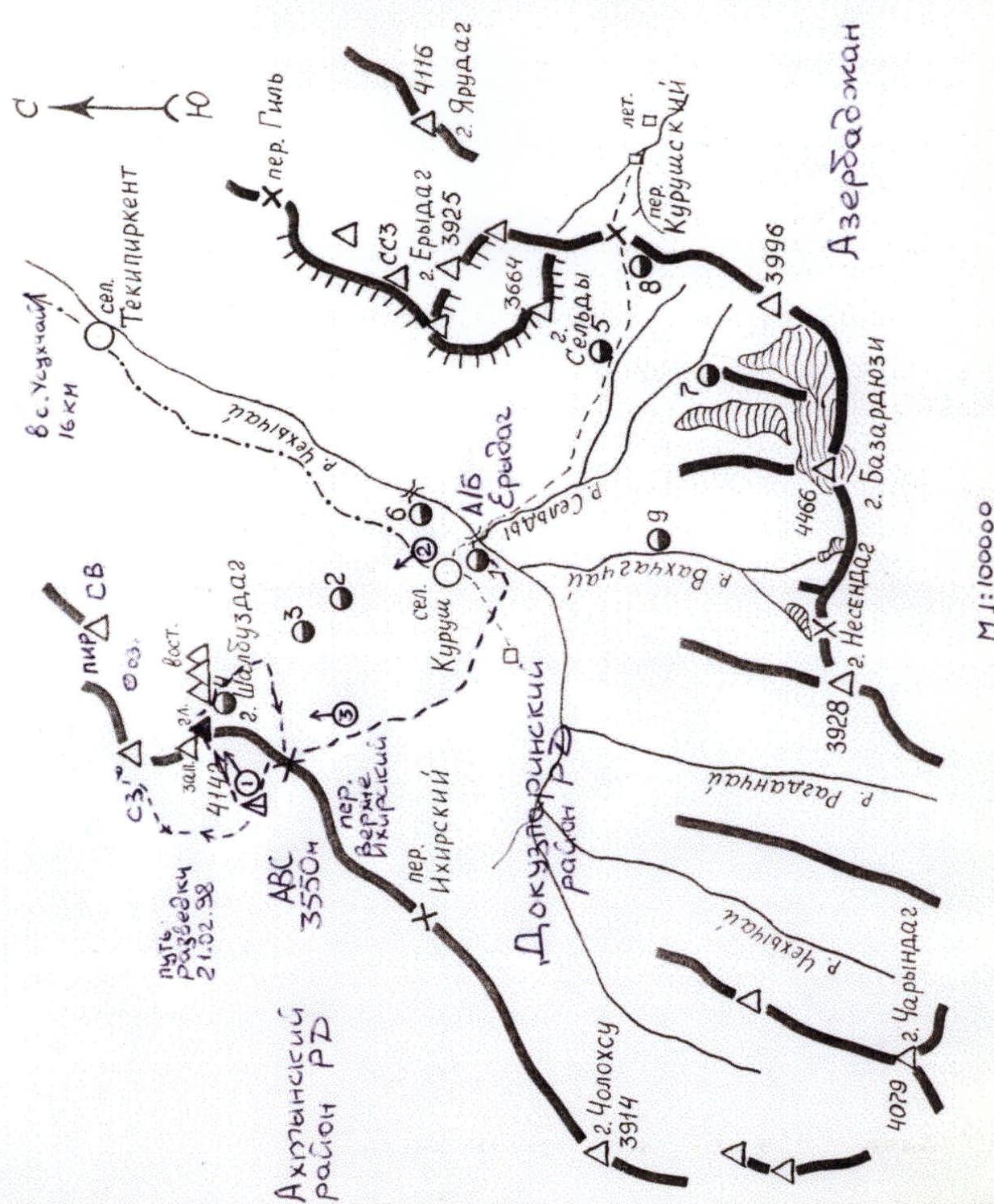
Map of the Chekhychay gorge. Overnight stays:
- 1 — Kurushskie;
- 2 — Shalbuzdagskie;
- 3 — Upper Shalbuzdagskie;
- 4 — "Grotto";
- 5 — Sel'dy;
- 6 — Erydagskie;
- 7 — "Big Stone";
- 8 — Bazardyuzi;
- 9 — Vakhchagskie.
Tactical Actions of the Team
Having arrived in the ascent area on February 17, the team departed on the next day for a delivery from the "Erydag" base camp towards the Verkhne-Ikhirsky pass. Departing at 12:00, the group reached a characteristic clay hill on the ridge at 15:30 (altitude 3300 m), where they stored their equipment. Then they studied possible routes on Shalbuzdag Western and Central peaks using optics and returned to the base camp at 17:30.
On February 20, 1998, the team departed from the "Erydag" base camp after a day of rest and preparation at 9:00. At 12:00, they reached the delivery site. Then, together with assistants, they carried the load to the Verkhne-Ikhirsky pass (3600 m), which is directly on the ridge of the Shalbuzdag range under the southern walls of Shalbuzdag Central. Then, by traversing left to the terrace under the SW wall, they established ABC at 16:30. The entire team made another trip to the pass for the remaining cargo.
On February 21, 1998, in anticipation of worsening weather, a reconnaissance of the NW wall of Shalbuzdag Northwest was conducted, but it became clear that it was impossible to relocate the camp 4-5 km northwest with a single group. It was also discovered:
- Radio communication on VHF radio "Lastochka" to the base camp at such a distant location was impossible; a repeater might be needed.
- The wall was much more complex than expected. The team decided to stick with the SW wall of Shalbuzdag Central. The wall was expected to be sunlit by 11:00, increasing the chances of a successful ascent in extremely cold conditions (temperatures were noted to be –32°C in the shade during the day). Starting from 11:00 on February 21, 1998, the weather deteriorated: humid cold wind (–18°C), snow. The group returned to ABC at 17:00, having spent the entire travel day on reconnaissance.
On February 22, 1998, Dorro, Sogokon, and Pashuk departed from ABC at 10:00 for processing. At 12:00, they approached the SW wall of Shalbuzdag via the talus slope. Dorro began working first at 13:00, belayed by Sogokon. The first worked on a dynamic rope 11 mm (Beal, Spain, UIAA) and carried a static rope 10.5 mm (Russia). The start showed that even the lower part of the route required the use of bolt hangers, specifically double ones, as the wall was composed of large calcite crystals are extremely strong but brittle; crystals can be dislodged, and when hammering in a piton, they can develop a network of cracks. The group used screwed-in pitons 8 mm (length 25 mm). Dorro progressed about 30 m and reached an almost vertical slab cut by a crack, but the entry was very difficult: the junction of the slab and the "ram's foreheads" of the lower part of the route were destroyed conglomerate rocks with inclusions of quartz crystals. Dorro managed to reach a crack by performing a "pendulum" move left (on a "carrot stick"). The crack was climbed using ITCH with pitons and medium chocks. The edges of the crack were sometimes destroyed, and the crack itself was "deaf" (filled with calcium). Dorro reached a "booming" slab-flake by 16:30. He did not proceed further (was mentally and physically exhausted, cramps started in his hand muscles, pitons were very difficult to place). He hammered in a piton, made a blockage ("the ear" on the piton broke, and it had to be left behind — it held the control cairn 1). He descended by 17:00.
The processing team was in sunlight, but the frost was –21°C (they had a thermometer) with a fairly strong wind. Warm clothing helped:
- several Polartec jackets and pants (France, VTN)
- "Patagonia" gloves, Polartec
- for "fine" work — cut-off double woolen gloves The first worked in alpine rock shoes (Ufa), a larger size (11), glued with thin felt from the inside. To protect feet from the cold:
- woolen gaiters
- over them — gaiters made of avizent, specially sewn for rock shoes to prevent snow and wind from entering Only the sole, toe, and heel of the rock shoe remained unprotected. The first worked with "hook-legs," maximizing movement speed and distance between ITCH. A hook on a short (10 cm) reepschnur was also used for resting on points and stations. Everyone had this, allowing for better rest on stations and intermediate belay points.
The group descended to the tents in ABC at 18:00, having processed 40 m in 4 hours.
On February 23, 1998, Sogokon, Dorro, and Leonov departed from ABC at 10:00 for processing. Approaching the wall at 11:30, the group sorted out their equipment, and at 12:00, Sogokon began moving on the fixed ropes. On the piton, the first left "kickers." Almost everyone used the method:
- right "kicker" — on the chest on a sling up to the outstretched hand (right),
- left "kicker" — on the left leg, fixed under the knee, at waist height. Pashuk's method was leg-leg, and Leonov's was right leg — "harness" (cam). At 12:30, Sogokon continued the passage through the crack. Movement had to be very cautious, and no pitons were hammered in for 3 m, as the crack was overlain by the edge of the slab, and the entire right part was "booming." Dorro belayed Sogokon. At 14:30, Sogokon finished the rope. However, the section length exceeded the rope length, and Dorro ascended via the temporarily fixed ropes to the second chock (about 10 m) and continued belaying Sogokon from there. The ropes were extended. Dorro ascended to Sogokon's station, and at 15:00, Sogokon continued processing. He bypassed a rock block on the left via the crack and made a station under the cornice at 16:30. Processing was completed, and Sogokon and Dorro descended to the talus slope by 17:00. A gusty wind continued, and a cyclone was approaching. It partially warmed up, with the thermometer reading –11°C at 16:00.
On February 24, 1998, the Dorro-Sogokon duo departed from ABC at 10:00 for processing. Quickly approaching the wall (within 1 hour), they sorted out their equipment, retrieved the static ropes, and Dorro began ascending the fixed ropes at 12:00. Having gathered at station R2, Dorro began moving through the crack under the cornice at 13:00. It was warm in the morning (–6°C), but by 12:00, the wind picked up, and clouds were approaching from the west; the weather was deteriorating, but the wall was still in sunlight. At 14:30, Dorro passed the cornice and reached R3. Dorro worked on ITCH using cams (it was possible to use chocks, but sometimes this was not feasible — the crack sometimes opened downwards). For belaying, chocks were left (stoppers, medium-sized rocks). Sometimes limestone tiles were wedged in the crack, complicating the work. At 14:00, the weather worsened: snow showers, hurricane-force winds, frost (temperature dropped to –15°C). Visibility decreased to 30-40 m. The ropes for the second climber were very heavy, almost horizontal; with equipment and gear, it was impossible to straighten them. While Sogokon was passing them, Dorro froze significantly at the station. However, the duo decided to continue processing, and at 15:30, Dorro reached a small ledge before a system of internal corners, bypassing a hanging block. Progress became impossible, and Dorro and Sogokon, extremely cold, descended to the talus slope at 16:00. The descent was complicated by snowy rocks and difficult fixed ropes, where Dorro used "hook-legs" on the descent, and Sogokon used a specially taken ladder on a hook.
On February 25, 1998, the group departed from ABC at 6:30 and began working on the fixed ropes at 8:00. On section 6-7, when straightening the ropes, Dorro used a "skyhook," but three chocks had to be left behind (on the leftmost one, in the crack — control cairn 2). Having ascended to point 9, Dorro continued working on the third rope from 10:00, belayed by Shanavazov from R3. The others moved up the fixed ropes with top-rope belay. Having passed complex, sometimes overhanging, corners and chimneys, Dorro (another 1.5 ropes) reached an osypnoy balcony with a wedged block at 14:00 and began to receive the others. At 16:00, Aliyev, working last, reached R5. The wall was passed. The team, divided into pairs, traversed the roof complicated by two rock steps. The team reached the summit at 17:00. The weather was cold, –17°C, sunny, and windy. The descent followed the 1B category of difficulty route under the S wall. Warning! Do not unclip! Hard crust and destroyed rocks. The team fixed three ropes for the descent. Locally, a "board" slide is possible. Traversing, bypassing the southern bastions (about 2 km), the team reached the Verkhne-Ikhirsky pass, where they left unnecessary equipment and returned to ABC at 20:00.
On February 26, 1998, the team descended to the "Erydag" base camp. At the base, there was a ZIL-131 PPU vehicle with a van. The vehicle was equipped with a HF radio set for communication with Makhachkala three times a day (8:45, 13:45, 16:45). Communication was conducted on the "Lastochka" radio set; at the base, a stationary VHF radio set R-163 was used. If necessary, the base had a set of tethered equipment (500 m cable) for rescue operations, a rope winch "Petzl," France, medications, knitted stretcher, and splints ("Paramedic"), blood transfusion systems, plasma reserves, saline solution, strong реаниматологические and anesthetic medications, as well as medications for frostbite and stimulants. The entire team used chemically regenerating heat packs from the Ministry of Emergency Situations (regenerated by boiling), two pieces per person, during the ascent.
The rescue team was located at the "Erydag" base camp:
| Surname, Name, Patronymic | Rank, Position |
|---|---|
| Sogokon A.E. | Candidate Master of Sports, II category, head of rescue team |
| Krasnopolsky Yu.V. | Candidate Master of Sports, I category |
| Mamedov A.N. | Candidate Master of Sports, III category |
| Skornyakov A.N. | Candidate Master of Sports, III category |
| Bublik O.I. | 1st sports category |
| Voronin S.V. | 1st sports category |
| Goryaev A.E. | 1st sports category |
| The rescue team had: |
- all personal and public equipment
- communication systems (including "Standard" radio set, Japan — even between rescuers)
- a helicopter for rapid evacuation of the victim The Dagestan PSS of the Ministry of Emergency Situations has an agreement with the Makhachkala air squadron. Communication is direct on VHF from the PSS base in Makhachkala to the airport and to the departmental rescue service. In case of bad weather — evacuation to a hospital in the village of Usukhchai (district center) on a ZIL-131 PPU vehicle.
During the ascent, there were no injuries, falls, or illnesses. The first, Dorro and Sogokon, were excellent rock climbers and worked with maximal free climbing. Especially Dorro — in the upper and lower parts of the route, he climbed extremely complex sections for winter conditions using free climbing.
Where ITCH was used, the team fully utilized their technical arsenal:
- pitons of various configurations and sizes, mainly titanium, as well as small and thin ones made of 30KhGSA steel
- chocks: hexes and cams (including those for cracks 10-12 mm), stoppers, and rocks
- "skyhooks" when passing fixed ropes and under the cornice Reliability was ensured by using a UIAA rope (11 mm, Beal, Spain, withstands 12 falls according to UIAA). Stations were made from at least 3 points, with self-regulating loop blockage.
On the route:
- no litter was left — during snack breaks, everything was collected in a bag and brought back to ABC, where some was burned, and some was buried
- pitons and chocks were left to a minimal amount — only on "pendulums" for the last climber and under the cornice (3 pieces, chocks) The team decided not to spend the night directly on the route — this would have increased the load and slowed down the movement. A processing tactic was chosen, which fully justified itself under unstable weather conditions and winter circumstances: the team did not move on the route in the dark.
Average rates of altitude gain:
- on the route — 13 m/h
- on the wall section — about 7.5 m/h
- for the first climber — 11.5 m/h
- speed of passing the wall part of the route for the first — about 14 m/h
Route Description
The route starts along the same vertical as the right edge of a giant cornice in the upper part of the wall. Move along rocks like "ram's foreheads" in the direction of a long cornice with a 1 m outreach. A poorly defined crack and internal corner go; from a block, move right-upwards along difficult rocks, with protection via bolt hangers, preferably blocked (fragile rock). Then, along slabs on friction and small "shells," approach a steep smooth slab cut by a crack; enter it, making a "pendulum" move left (Caution! The rock is not strong). The beginning of the crack is destroyed. But further on, it is monolithic. The crack gradually narrows (thin, rigid pitons are needed for its upper part). At the middle of section R3-R4 — control cairn 1 on a bolt hanger (do not use it, it is not screwed in fully). Above, a slab-flake hangs on the right; do not load it, as it "booms." It is desirable not to hammer in pitons on this section. Further, there is a re-bend of the wall, and under an overhang — block R1.
The rope length is insufficient; it is necessary to approach. An intermediate station can be made 10-15 m from the talus slope.
From R1:
- Left along the crack; be cautious, as pitons work on pull-out
- In summer weather, it is possible to climb using free climbing
- The crack turns around a corner; it is necessary to bypass a block
- The rope gets stuck in the crack; it is necessary to make station R2 directly under the cornice
From the station:
- Upwards along the internal corner to the crack
- Cornices
- Work immediately on ITCH using cams (it is possible to use chocks, but sometimes this is not feasible — the crack sometimes opens downwards)
- In the middle of the crack (section 6-7) — control cairn 2 on a chock, in a can
- Having bypassed the cornice along the crack, enter a wide chimney and along it under an overhang
- Here is R3
- On the left, there is a grotto; it is possible to rest
Further:
- Into a niche under a hanging block
- On ITCH, bypassing it
- On the right, there are talus slopes Approach an internal corner — a very unpleasant place. The corner itself is oblique, everything is "slick" (water flows). Then, along a system of internal corners and chimneys — onto a balcony.
There are five ascents in total:
- All ascents start with overhangs; climbing is difficult; rocks are "slick," smooth.
- They are mainly passed on ITCH.
- Under overhangs — grottos.
- It is difficult to exit even on ITCH — feet sink into voids.
- Exits from corners — "slick" gutters and couloirs, where, on flattening, there is debris material. It is necessary to move cautiously — stones!
On the balcony is R5. Nearby — a large wedged rock block. Caution! Do not load. This is the exit onto the roof.
Further, move along a destroyed rock slope to a rectangular "jendarme" on the SW ridge. Bypass it on the left along the wall, exit onto a saddle, and then through another wall onto the ridge. Rock ascents alternate with firn couloirs.
Warning!
- On the roof, do not unclip.
- On ascents — alternate belay.
On the summit — a triangulation point, a cairn. Descent along the 1B category of difficulty route along the SE ridge.
Do not unclip! Very dangerous descent. A slide of snow "boards" is possible.
Under the wall, it is better to descend along a terrace towards the Shalbuzdag Western peak:
- To the 3rd tower
- Then, under the wall to the right onto the Shalbuzdag range ridge.
UIAA scheme of the route on Shalbuzdag Central via the center of the SW wall.
M 1:2000
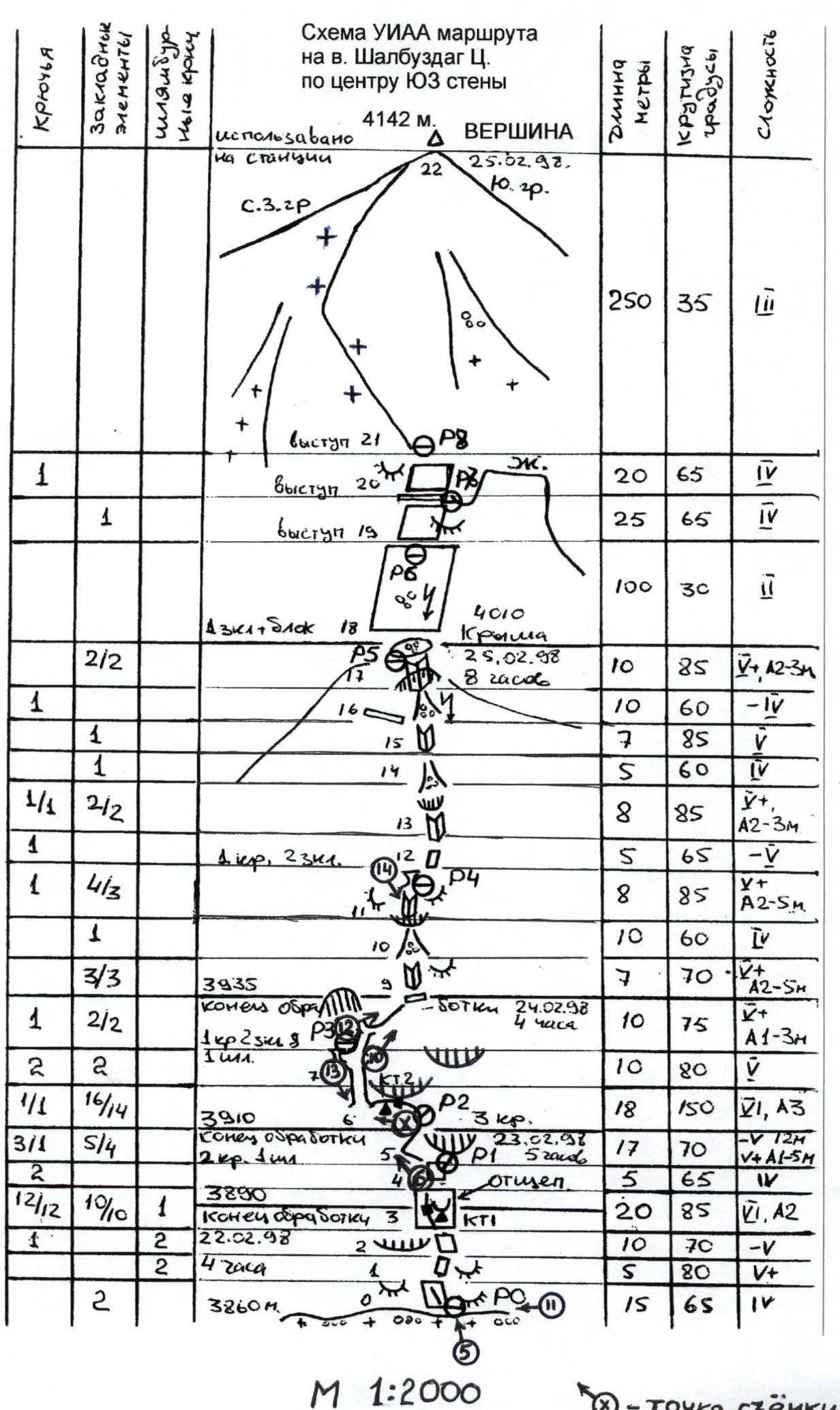 Point of photo 7, 8, 9.
Photo 8. Dorro passes the crack under the cornice, section 6-7. Taken from R2 on February 24, 1998, 13:40, Smena — Symbol.


Comments
Sign in to leave a comment