
2005 Russian Mountaineering Championship. Technical Ascents Class
Report
On the first ascent by the team of the Dagestan Alpine Federation (combined team of the Southern Regional Rescue Squad of the Russian Emergency Ministry) on Erydag (NW), 3887 m via the cornices of the central part of the right bastion of the NW wall, category 6B.
Addresses
354003, Krasnodar Krai, Sochi, 151-a Plastunskaya St., Southern Regional Rescue Squad of the Russian Emergency Ministry, tel.: (8622) 68-03-03, 68-02-02
367015, Republic of Dagestan, Makhachkala, 17 Erliha St., Dagestan Rescue Squad of the Russian Emergency Ministry
Tel./fax: (8722) 67-23-75

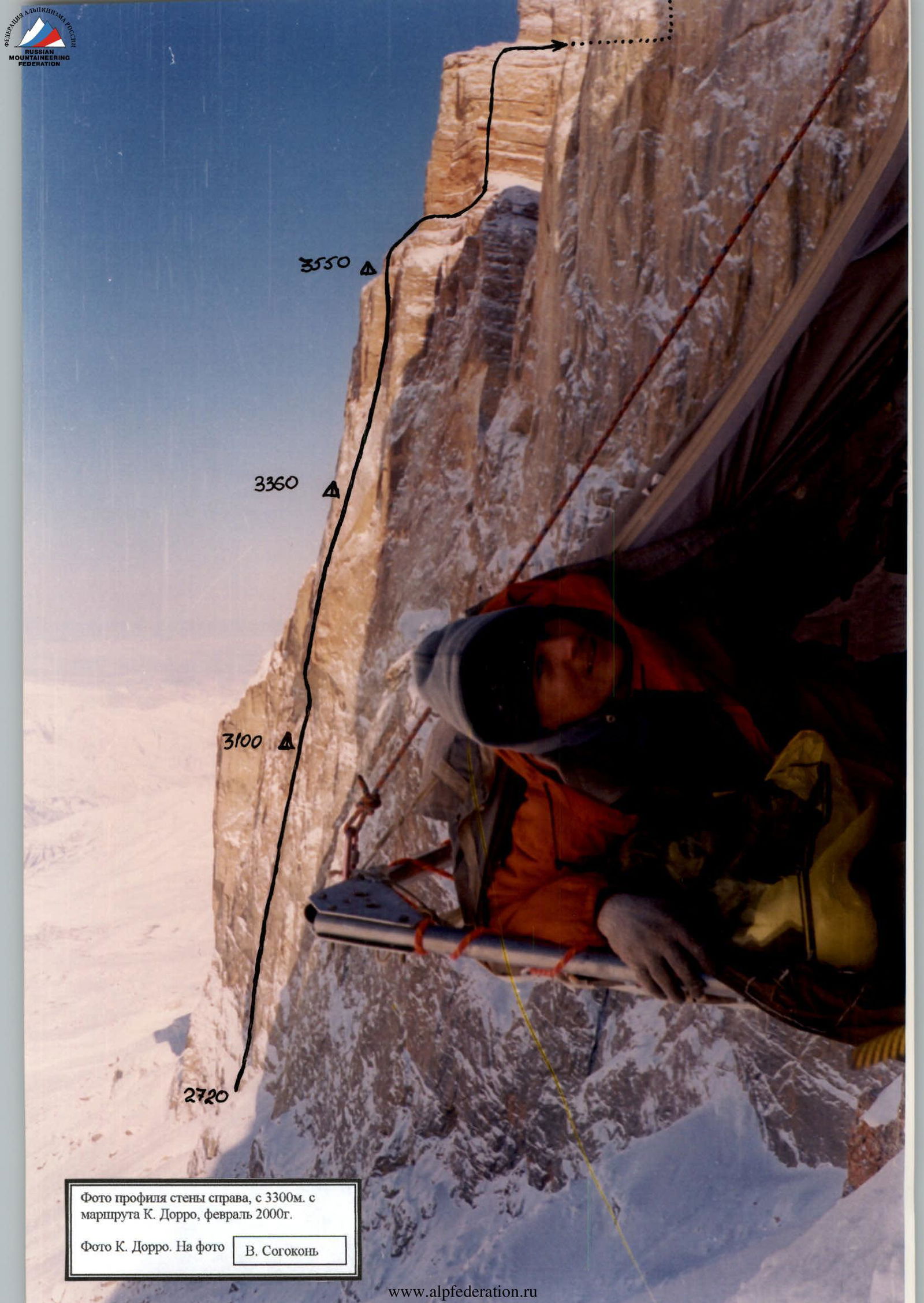
Photo of the wall profile from the right, at 3300 m, from K. Dorro's route, February 2000. Photo by K. Dorro. In the photo: V. Sogokon.
Area Overview and Brief Ascent Description
The Erydag massif is located in a short northeastern spur of the Greater Caucasus Range, on the border between Russia and Azerbaijan. It forms almost a single plateau with Yarydag and Shahdag (plateau size is 10×20 km). In Dagestan, the walls plunge 300–1200 m.
The wall is composed of metamorphosed limestones.
The climate in the area is dry:
- High precipitation occurs in May–July.
- In winter, there is frosty, dry weather with periods of strong winds and precipitation (no more than 2–3 days).
A major issue on the wall is the lack of water, which can occur even in winter:
- Snow does not stay on the wall; it is blown away.
- Due to the dry air, snow evaporates without melting.
Wall orientation:
- The wall of the right bastion of the NW wall has a purely western exposure.
- The northwest exposure begins to the left of Dorro's route.
To reach the ascent area from Makhachkala, drive south on the federal highway "Caucasus" to the village of Novo-Gopцах (180 km), then turn right, up the Samur River to the village of Usukhchai (district center of Dokuzparinsky District) (225 km, 2500 m). The journey from Makhachkala takes 6–8 hours.
From the village of Kurush:
- Descend along the trail to the confluence of the Sel'dy River into the Chekhychai River on the right (2250 m);
- To the right, on the terrace (left bank), are the kungis of the "Erydag" base of the Dagestan Rescue Squad of the Russian Emergency Ministry (30 minutes);
- It is possible to drive by car on the new road leading to the Kurush border post.
Then:
- Cross two bridges to reach the terrace (right bank);
- Along it, slightly to the left, in the direction of the Wall, walk about 800 m;
- Cross the stream and reach the farm;
- From it, slightly to the left, an unfinished road begins;
- Traverse along the slope (to the NE) for about 2.5 km;
- Turning right along the grassy slopes, move towards the "Big Well";
- Traverse through the zone of gullies and clay couloirs.
On the terrace, to the right of the waterfall, 400 m from the wall, is the advanced base camp (ABC) (on the line of Babitsky's route), 4 hours from the a/b Erydag (2700 m).
From ABC:
- Cross the gully in the area of large rocks;
- With a slight gain in height and bypassing the rocky promontory (on the line of Voronin’s route), enter the couloir.
Here is 2720 m, the start of the route from ABC – 30 minutes.
The team's route passes between Goloshchapov's and Voronin's routes along the most direct line through smooth slabs and the cornice belt to the monolithic internal corner locked by cornices. The "Direct" wall was not climbed; Goloshchapov's and Voronin's routes deviated from the most logical and direct line, which is also the most complex, to the left and right, respectively. The team's route is the most challenging among those taken on the wall; it is safe from rockfall, and logical. The route is very steep; even in winter, with snow present, there is a problem with water: on the second or third day after snowfall, the wind blows snow off the rocks. It was necessary to:
- Melt snow in ABC and in plastic bottles to lift it to the platforms;
- Cut bottles and melt frozen water;
- Collect snow from ledges into bags and lift them to the platforms.
On the wall, there are sections of "ringing" slabs that require particularly careful route selection and maneuvering on the wall. During the ascent, passing the cornice belt was particularly problematic: overhangs of such extent were not encountered even on Lukashvili's and Grigorov's routes on Kukurtly (the cornice overhang on a 45 m rope was about 20 m). In addition to the cornice belt, there were about 5 cornice sections with 2–3 m overhangs on the route. The relief on the cornices is unreliable; the rock surface is flaking, cracks are short and dead, filled with calcium. Descent from the wall after passing the cornice belt is impossible.
During the ascent, the team tried to minimize the use of drill hooks, especially for progression, but not at the expense of safety. Stations were made as reliable as possible. On some stations and on cornices, insurance points had to be left for the last person to swing off. For progression, the entire technical arsenal of devices was used: skyhooks, cam-hooks, ice-fifi, hatchets, anchors. When moving on belayed rope, крюконоги + крюкопуз were used. Load hauling was not used; bags and backpacks were transported under the harness. The first climber had several working falls due to rock crumbling during progression on belayed rope. During one of the falls, the belayer received severe bruises after being hit by the first climber, resulting from the extraction of protection. On days following bad weather, the first climber worked in crampons.
The weather was mostly cloudy and windy, with an average air temperature of -15 to -20°C, but several days were anomalously cold, -25 to -30°C with high humidity. Two team members received frostbite of 1st-2nd degree.
Special attention was paid to cold protection:
- Insulation of the belayer;
- Two pairs of gaiters were worn;
- Down clothing was used;
- A seat for belaying with glued foam polyethylene.
For camps, two platforms were used, 3- and 6-person. The route is not rockfall-prone in winter, but it is necessary to carefully choose places for the platform under the cover of cornices. The location for the second camp was chosen unsuccessfully: during the work of the first climber, several large rocks hit the platform, and it was damaged. Camp 2 should have been set up in the area of R14.
For overnight stays on the platform, the team used sleeping bags with "Tunsalайт" (Red-fox) insulation. In total, the team had 17 ropes, and before the descent, 15 ropes were hung. The 3-person platform was lowered to ABC; the lower 9 ropes were thrown onto the talus.
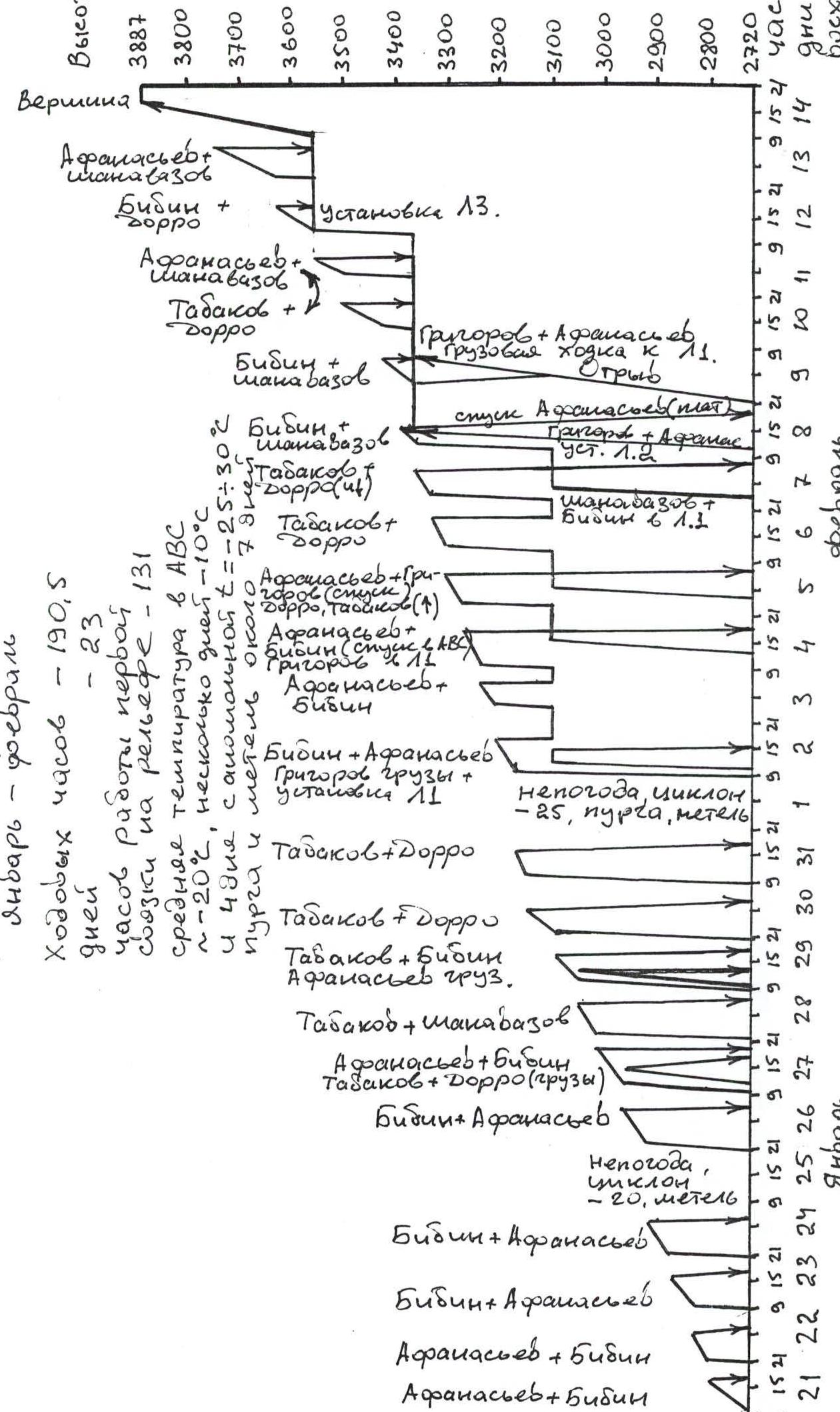
The average ascent speed was 1 rope per day (5–7 m/h). On the bastion, there are no ledges for overnight stays; staying on a platform, especially in winter, is exhausting and does not provide full rest. The steepness of the wall and hanging belays, as well as progression along the cornice belt, created psychological tension.
The team performed a huge amount of work in winter conditions (in short daylight) with a large quantity of gear and equipment. Physically, psychologically, and morally, the loads were comparable to, if not higher than, those during Grigorov's route in winter 2003 on Kukurtly. Technically, the route is comparable in difficulty to Grigorov's and Andreev's route on Kukurtly and more challenging than Lukashvili's route on Kukurtly and Razumov's route on Shkhara (3).
The team expresses great gratitude and appreciation for help and support during the ascent:
- Dmitry Golubev (Maykop);
- Roman Veyner (Saratov).
| Section № | Rock Hooks | Nut Protection | Drill Hooks | Special ITO Means | Date | Length, m | Steepness, ° | Difficulty |
|---|---|---|---|---|---|---|---|---|
| R0 | 3 | 2 | 1 | 50 | 45 | 1 | ||
| R1 | 2 | 1 | 30 | 65 | 4 | |||
| R2 | 2 | 1 | 20 | 35 | 2 | |||
| R3 | 3/3 | 2/2 | 4/3 | 15 | 21.01.2005 | 30 | 70 | 5 |
| R4 | 2/2 | 1/1 | 4/3 | 20 | 22.01.2005 | 25 | 80 | A2 |
| R5 | 1 | 1 | 15 | 23.01.2005 | 10 | 50 | 3 | |
| R6 | 2/2 | 2/2 | 4/4 | 20 | 24.01.2005 | 25 | 80 | A2 |
| R7 | 3/3 | 2/2 | 5/4 | 30 | 26.01.2005 | 40 | 80 | A2 |
| R8 | 2/2 | 2/2 | 5/4 | 30 | 27.01.2005 | 40 | 80 | A2 |
| R9 | 5/5 | 4/4 | 4/3 | 25 | 28.01.2005 | 40 | 80 | A2 |
| R10 | 3/1 | 2/2 | 4/2 | 5 | 29.01.2005 | 15 | 75 | V+–5 m, A1–10 m |
| R11 | 2/2 | 3/1 | 2/2 | 10 | 29.01.2005 | 25 | 75 | V+–15 m, A1–15 m |
| R12 | 2/2 | 3/2 | 3/1 | 10 | 9.02.2005 | 25 | 80 | V+–10 m, A1–15 m |
| R13 | 2/1 | 1/1 | 3/2 | 5 | 15 | 75 | V+–5 m, A1–10 m | |
| R14 | 1 | 3 | 3/1 | 2–7.02.2005 | 10 | 85 | V+ | |
| R15 | 3/3 | 2/2 | 2/2 | 20 | 30.01.2005 | 25 | 90 | A3–10 m, A2–15 m |
| R16 | 5/5 | 1/1 | 8/8 | 30 | 31.01.2005 | 40 | 120 | A3 |
| R17 | 2/2 | 1/1 | 4/2 | 15 | 3.02.2005 | 20 | 80 | A2 |
| R18 | 3/3 | 1/1 | 4/4 | 20 | 4.02.2005 | 25 | 90 | A2 |
| R19 | 1 | 2 | 12–13.02.2005 | 30 | 55 | 3 | ||
| R20 | 3 | 1 | 11.02.2005 | 100 | 10 | 1 | ||
| R21 | 5/5 | 5/3 | 15 | 20 | 90 | A2 | ||
| R22 | 4/4 | 3/3 | 3/3 | 10 | 20 | 90 | A2 | |
| R23 | 1 | 1 | 10.02.2005 | 10 | 50 | 2 | ||
| R24 | 3/3 | 10/10 | 2 | 5 | 15 | 95 | A2 | |
| R25 | 4/2 | 2 | 3/2 | 20 | 45 | 75 | V+–15 m, A1–15 m, A2–15 m |
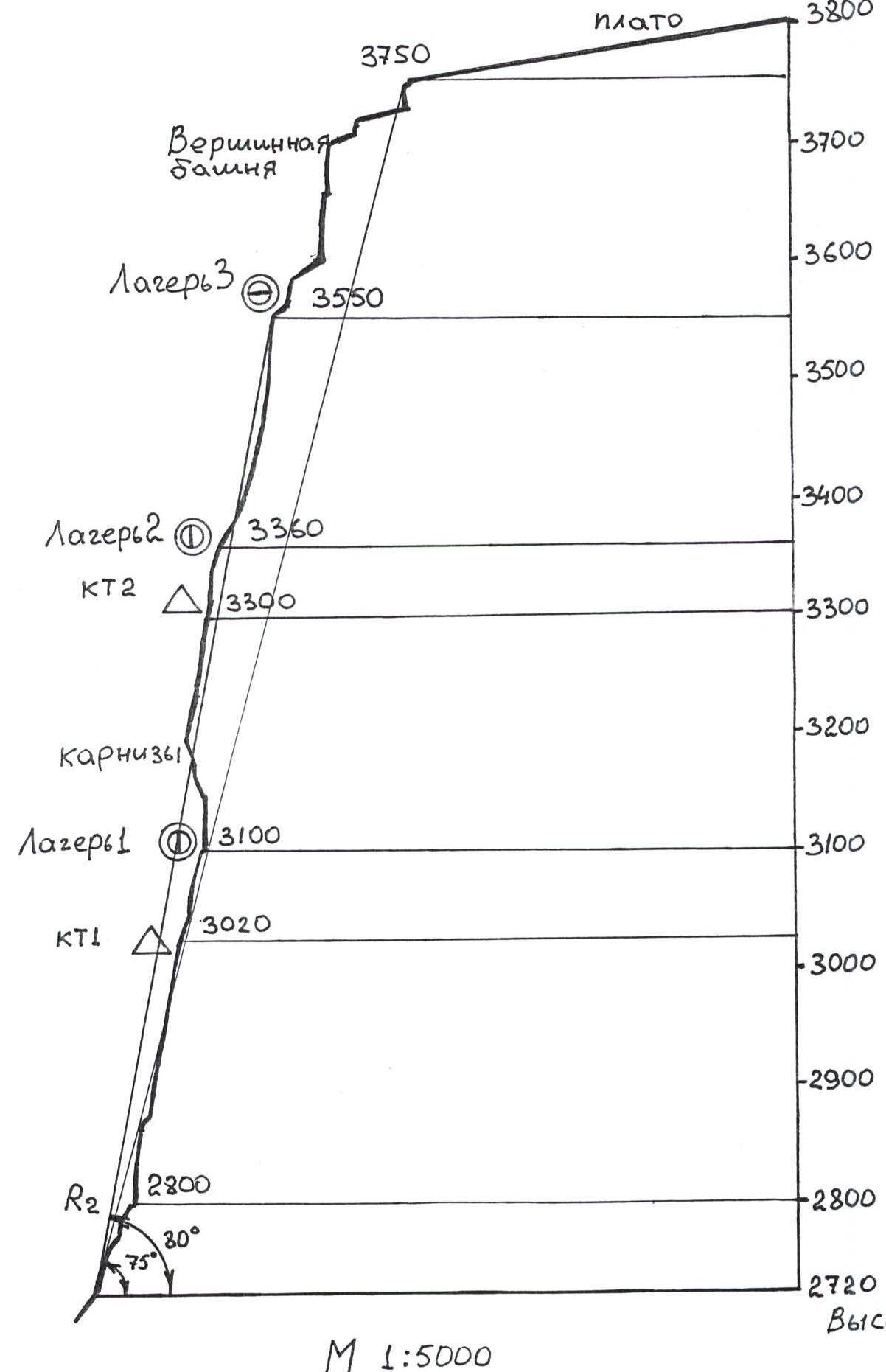
Route profile on Erydag (NW), 3887 m, via the cornices of the central part of the right bastion of the NW wall
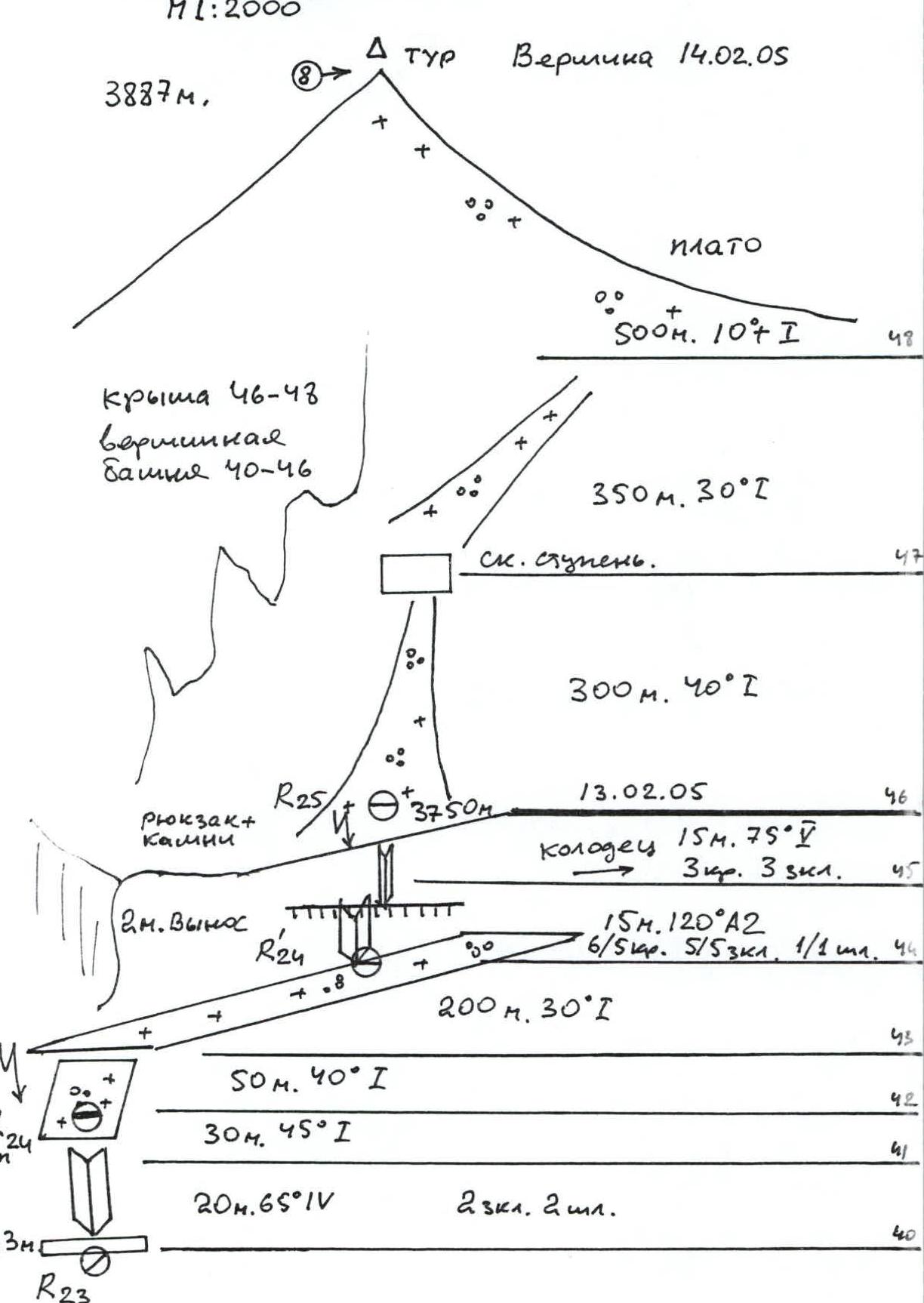
Erydag (NW), 3887 m
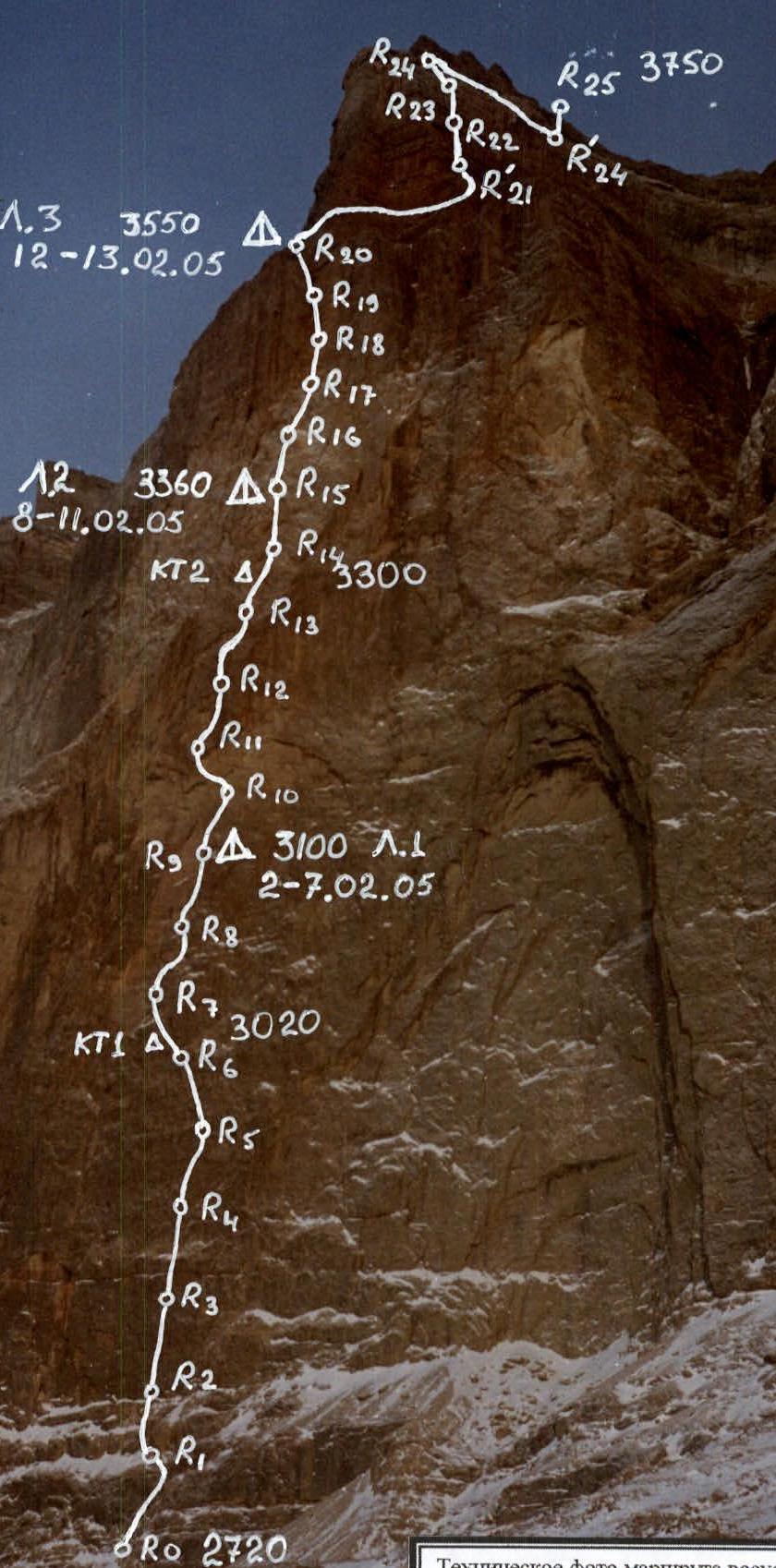
 ]
]
Photo 1. Lower part of the bastion and the route thread. Taken from the belays from the 4th rope. January 2004. Photo by K. Dorro.
Photo 2. Camp 1 on the left edge of the "Voronin" ledge, R9, Tabakov on belays. February 2005. Photo by K. Dorro.
Photo 3. Beginning of the cornice belt. Tabakov on ITO. January 2004. Photo by K. Dorro.
Photo 4. Tabakov on belays, on the cornice belt. Taken from the 10th rope. February 2005. Photo by K. Dorro.
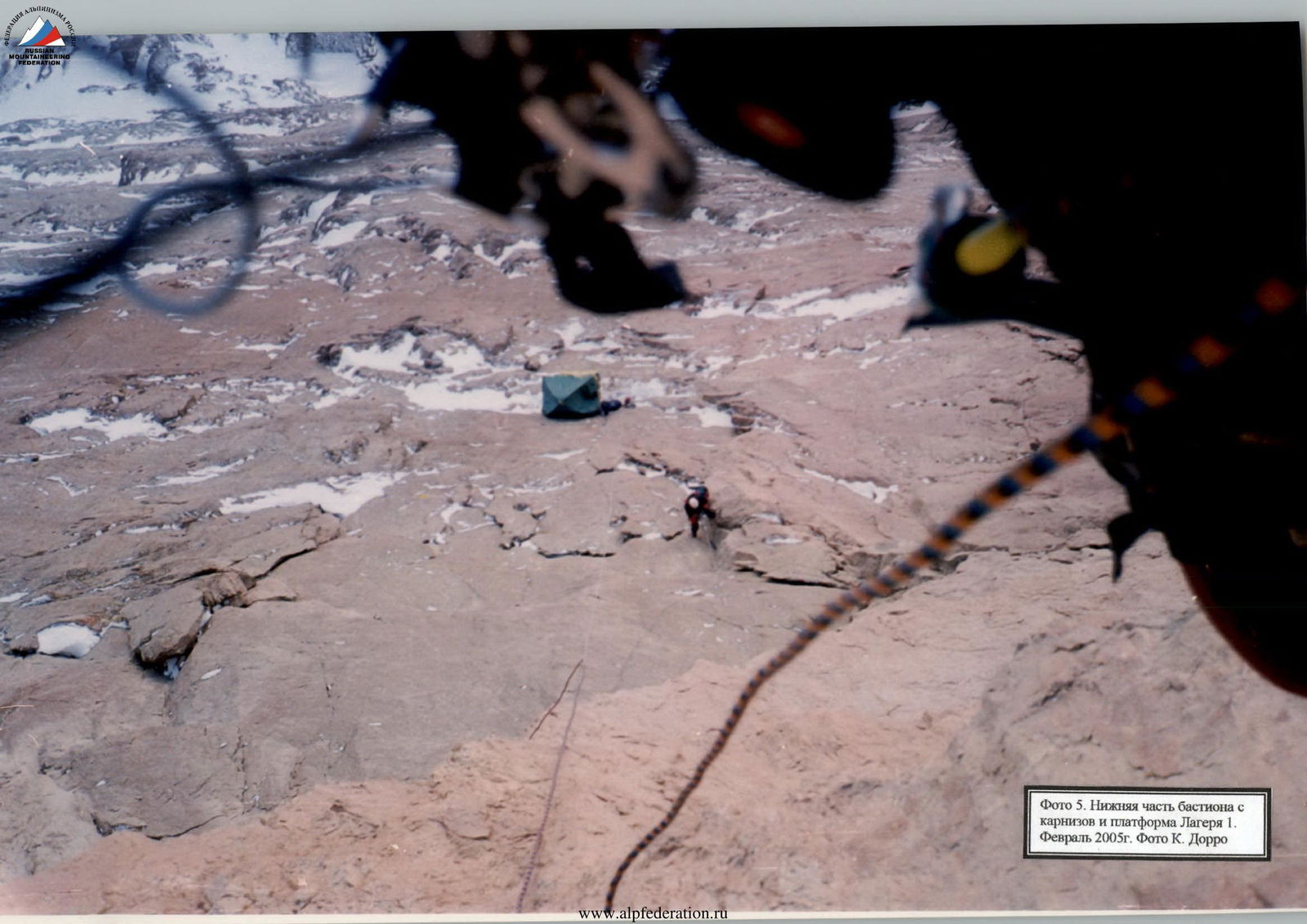
Photo 5. Lower part of the bastion with cornices and platform of Camp 1. February 2005. Photo by K. Dorro.
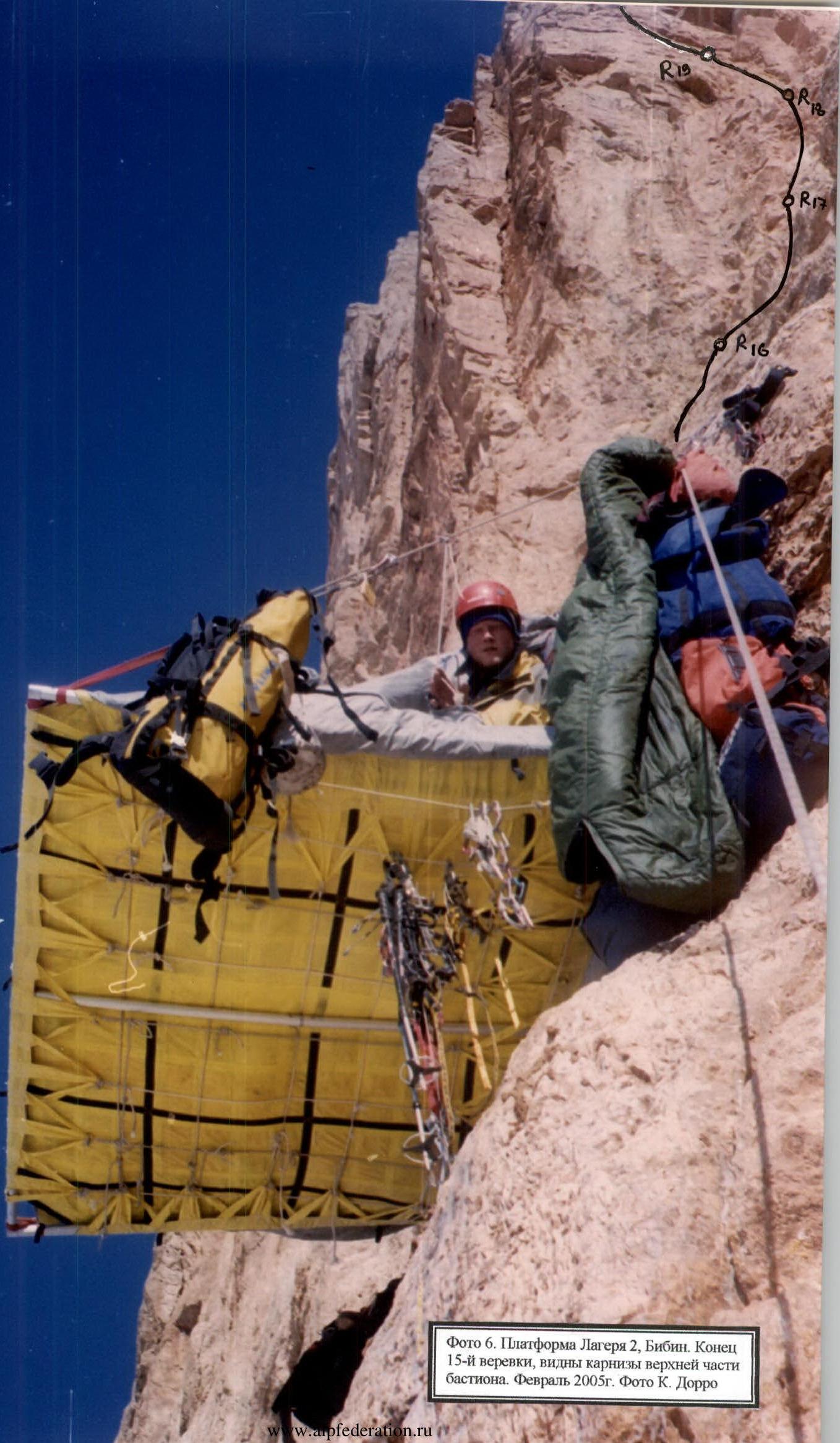
Photo 6. Platform of Camp 2, Bibin. End of the 15th rope, the cornices of the upper part of the bastion are visible. February 2005. Photo by K. Dorro.

Photo 7. Tabakov passes the cornices of the upper part of the bastion. Taken from R19. February 2005. Photo by K. Dorro.
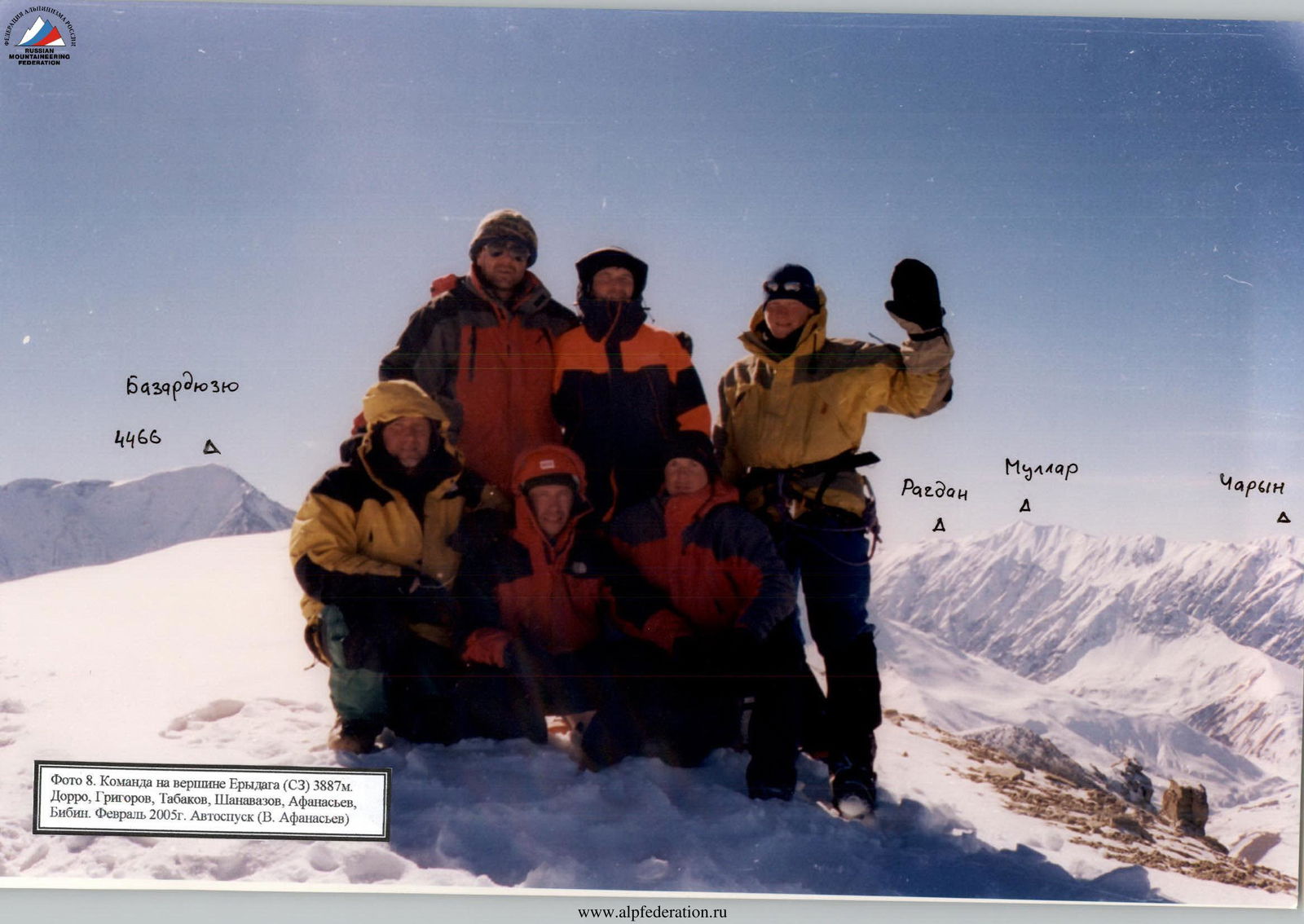
Photo 8. Team on the summit of Erydag (NW), 3887 m. Team composition:
- Dorro
- Grigorov
- Tabakov
- Shanavazov
- Afanas'ev
- Bibin. February 2005. Auto-descent (V. Afanas'ev).

Comments
Sign in to leave a comment