
Ascent Passport
- Ascent class — Rock
- Ascent region — Eastern Caucasus
- Peak, its height, ascent route — Yarydag (I western), 4020, via the center of the NW wall.
- Proposed difficulty category — 6
- Route characteristics:
- Height difference — 1000 m
- Length of sections: III — 40 m, IV — 230 m, V — 455 m, VI — 405 m.
- Average steepness — 85°
- Pitons hammered:
- For belaying:
- rock — 221
- ice — 4
- bolt — 4
- For creating artificial climbing obstacles (AIT):
- rock — 12
- bolt — 1
- For belaying:
- Number of climbing hours — 58
- Number of bivouacs and their characteristics: 4 (two sitting, two semi-reclining)
9. Surname, name, patronymic of the leader, participants, and their qualifications:
- STADNIK Vladimir Fedorovich, Master of Sports of the USSR
- GREBENNIKOV Alexander Alekseevich, Candidate Master of Sports
- KHOROSHILOV Alexander Afanasievich, Candidate Master of Sports
- ZADVORNY Igor, 1st sports category
- PASTUKH Viktor Ivanovich, 1st sports category
-
Team coach: STADNIK Vladimir Fedorovich, Master of Sports of the USSR
-
Date of departure and return: departure on July 15, 1982, return on July 19, 1982.
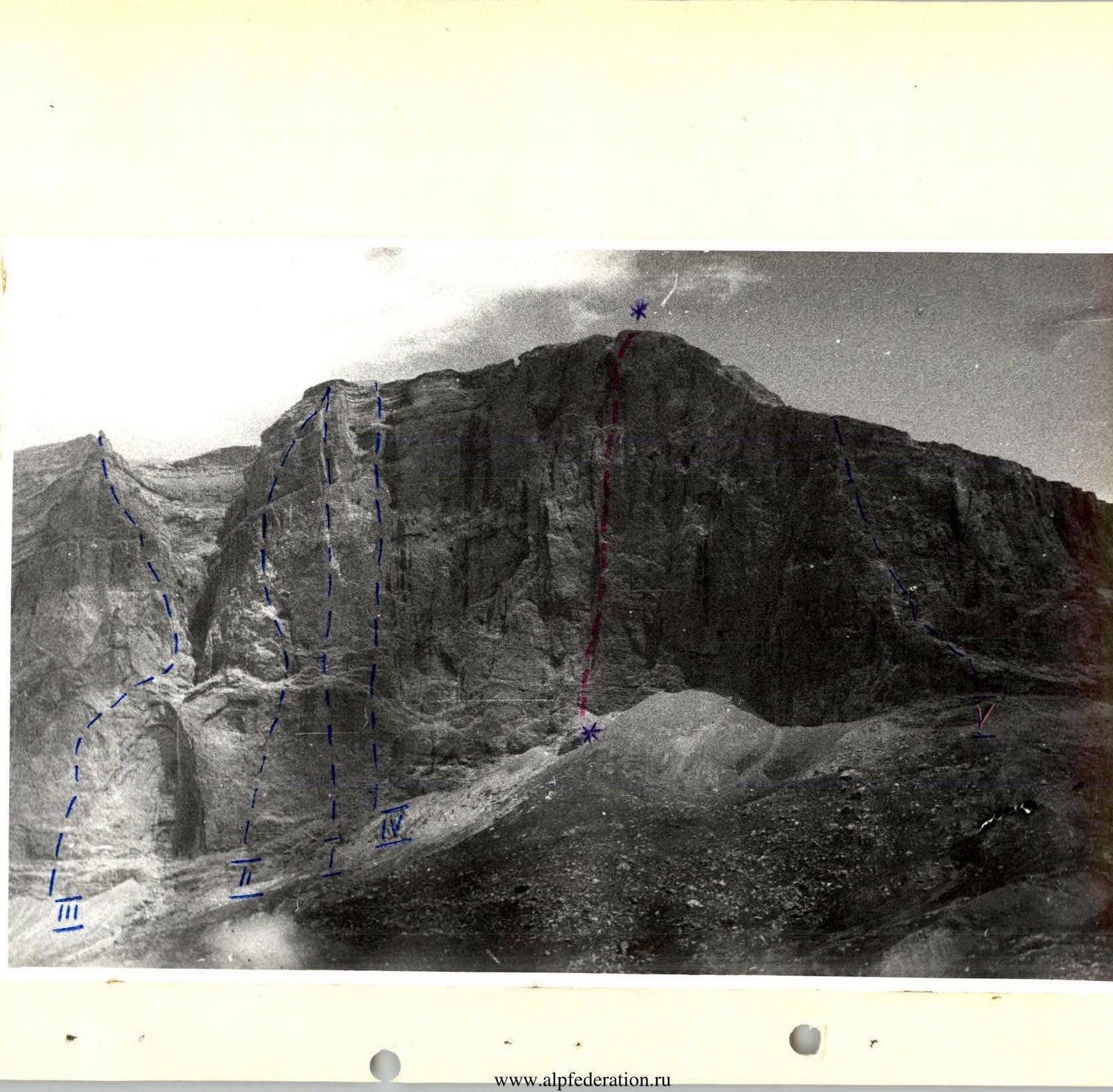
Conclusion and Recommendations for the Route
The route to Yarydag (I western) via the center of the NW wall is technically very complex and rocky. According to the participants, it is more challenging than previously climbed routes of 5B category and routes of 6 category on the peaks of Nakhar, Zinden, and Bodkhona. This route has the following features:
- Most of the route has a steepness of 75–80°, and some sections — 90° or more.
- The rocks throughout are quite monolithic, except for a belt of destroyed rocks on the R13–R15 section.
- The nature of the rocks varies — smoothed surfaces like "ram's foreheads" on sections R1, R2, R9–R10, internal corners and chimneys on sections R8, R9, R10–R11, overhangs and cornices on sections R4–R5, R12–R13.
- Belaying on most sections was done mainly with wedges and boxes; placement of nuts is also effective.
- The route's significant steepness and length require excellent physical and technical preparation.
- There are no good bivouac sites on the route, but there are ledges for sitting and semi-reclining overnight stays.
- The optimal group size is 4–6 people.
- Objectively, the approaches to the wall (section R0–R1) and sections of destroyed rocks (R14–R16) are stonefall-prone.
- Rockfall is practically independent of the time of day, as the wall is purely rocky in July–August.
- Water is absent on a significant part of the route (section R6–R16).
- The rocky route through the center of the NW wall of Yarydag (I western) is very interesting, logical, and, according to the ascent participants, corresponds to routes of 6 category.
7. Route Progression Order
July 15
The group left the base camp near the village of Kurush lightly packed at 5:00 and approached the route at 7:00 (the main part of the gear and supplies was brought to the route on July 14).
First, they approached the main wall via "ram's foreheads" covered with small stones (45–50°) (stonefall hazard!). Then, they climbed up ~45 m via slabs and an internal corner (80°) from monolithic rocks to a ledge for two people (R1–R2).
From the ledge, they climbed straight up 80 m via an internal corner and its left part. The rocks are monolithic and smoothed (75°) (section R2–R4).
On section R4–R5 (8 m), there is an overhang (AIT), after which they exited to a niche under a large cornice to the left of the internal corner.
- 1st bivouac and 1st control checkpoint.
- Overnight stay was sitting, with ice in the cracks.
The Grebennikov — Khoroshilov team was the first to pass this section of the route. The sections are complex, 5–6 category. They stopped for a bivouac at 13:00.
July 16
At 7:00, the Grebennikov — Stadnik team started working. Having overcome an overhang in the right part of the large cornice (AIT), they crossed the internal corner and exited to a complex wall 60 m (80°, section R6–R7). They climbed the wall with free climbing; boxes and wedges are well-placed. After the wall, there are steep, smooth rocks with small ledges for 2–3 people (section R7–R8). Then, there is an internal corner (40 m, 80°) turning into a vertical chimney (35 m, 90°), which is climbed with very complex climbing. The exit from the chimney is via an internal corner to a small shelf under a grey rock.
The Khoroshilov — Pastukh team moved forward. The grey rock is heavily smoothed, with few cracks for pitons, and they had to hammer in bolt pitons for belaying. The grey rocks abut the base of a vertical wall with overhangs ("cucumber"), section R11–R14.
There was no convenient platform under the wall:
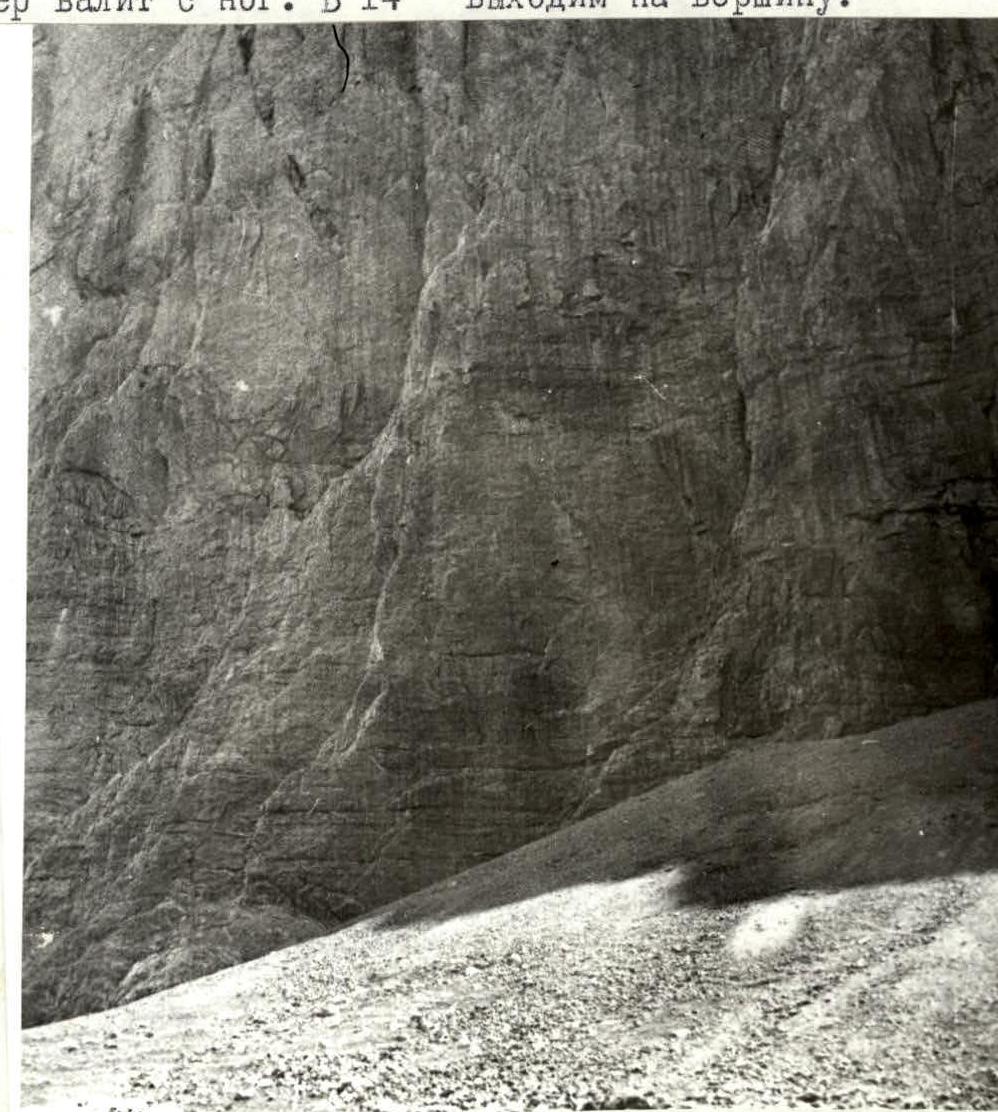
- A semi-reclining bivouac (photo 1)
- was organized on a small ledge under the grey wall.
- They stopped for a bivouac at 19:00.
July 17
The Grebennikov — Stadnik team began passing the processed section at 6:30. Then, they moved via an internal corner from left to right to the right part of the "cucumber".
Up the "cucumber" wall, they climbed right-upwards to a vertical chimney with overhanging blocks. Climbing is very complex. After 60 m of chimney, there is a small ledge, and then — 40 m of vertical wall. To the ledge for 1 person, Grebennikov A. climbed the wall using AIT (very complex).
From the ledge:
- traverse left across a smooth wall (they hammered a bolt piton for belaying);
- a series of protruding ribs;
- exit under a large overhanging section of the upper part of the "cucumber".
V. Stadnik worked first. Under the overhang:
- first, a traverse left across a smooth wall 5 m (bolt pitons);
- then left-upwards through the overhang to a diagonal chimney (AIT).
The complexity of this section did not allow fulfilling the tactical plan for the 3rd day. Additionally, progress was hindered by limited water usage, as there is no water on section R6–R12, and reserves had to be used very sparingly.
The 3rd overnight stay (semi-sitting) was organized on small ledges (Stadnik, Grebennikov, slightly lower — Zadvorny, and 10 m lower — Khoroshilov, Pastukh).
July 18
They started working at 5:30. Having passed a sloping chimney and then traversed left via a gutter, Stadnik V. exited to the upper part of the "cucumber", section R13–R14 (control checkpoint). Section R14–R15 is a series of walls 4–6 m, alternating with small shelves with loose rocks. After a short "rest" on this section, they again had to overcome steep (75–85°) sections of the wall, which are significantly destroyed in some places, greatly complicating their passage. The belt of destroyed rocks ends at a black chimney. Here, there is water, and they can finally drink to their heart's content.
Having organized a bivouac in a small niche to the left of the chimney, they continued processing the route.
Via the right part of the chimney (very complex climbing) (80–90°):
- Khoroshilov A. climbed 50 m to a small ledge,
- secured the rope, and descended.
Time is 18:00 (Photo 2).
July 19. Having left the bivouac at 6:00, the Khoroshilov — Pastukh team passed the fixed ropes and again began fighting for every meter of the wall. Some sections are climbed very complexly. The steepness of the pre-summit wall is 75–35°. Sometimes they encountered pitons from the first ascendants. Additionally, there are loose rocks in the upper part of the wall, and they had to move extremely cautiously, as there is practically no cover for those behind. Progress is also hindered by a hurricane-force wind.
They ascended to the plateau at 13:00 and walked to the summit, holding hands, as the wind was knocking them off their feet. At 14:00, they reached the summit.
| Date | Designation | Average steepness, ° | Length, m | Terrain characteristics | Difficulty | Condition | Weather conditions | Rock | Ice | Bolt |
|---|---|---|---|---|---|---|---|---|---|---|
| 15.07 | R0–R1 | 50 | 40 | Ram's foreheads | III | Monolithic | good | 2 | ||
| R1–R2 | 80 | 45 | internal corner | V | " | " | 8 | |||
| R2–R3 | 75 | 40 | wall, internal corner | V | " | " | 6 | |||
| R3–R4 | 80–90 | 40 | smoothed wall | VI | " | " | 12 | |||
| R4–R5 | 90 | 33 | wall, internal corner | VI | " | " | 12 | |||
| R5–R6 | 80–90 | 80 | series of walls | V–VI | " | " | 19 | |||
| 16.07 | R6–R7 | 80 | 60 | wall | V | " | " | 14 | ||
| R7–R8 | 80 | 40 | internal corner | V | " | " | 9 | |||
| R9–R10 | 90 | 35 | vertical chimney | VI | " | " | 13 | |||
| R10–R11 | 60 | 40 | internal corner | IV | " | " | 6 | |||
| 17.07 | R10–R11 | 90 | 40 | wall | VI | " | " | 6 | 2 | |
| R11–R12 | 70 | 80 | internal corner | IV–V | Monolithic with loose rocks | " | 15 | |||
| R12–R13 | 90–100 | 160 | chimney, walls, cornices | VI | Monolithic | " | 54 | 3 | ||
| 18.07 | R13–R14 | 80 | 40 | sloping, chimney, wall | V | " | " | 6 | ||
| R14–R15 | 60–70 | 160 | walls | IV–V | shelves with loose rocks | " | 21 | |||
| 19.07 | R15–R16 | 90 | 50 | wet chimney | VI | monolithic | " | 11 | ||
| R16–R17 | 60–90 | 140 | walls | IV–V | Monolithic and destroyed walls | " | 19 | |||
| Total: | 233 | 5 |