
Ascent Passport
I. Ascent class - rock
-
Ascent area - Eastern Caucasus
-
Peak Yarydag 1st western peak via NW wall, through the "mirror".
-
Proposed difficulty category 5B (third ascent)
-
Height difference - 980 m
-
Route length - 1380 m
Length of sections with 5-6 difficulty category - 940 m. Average steepness - 80°, including 6th category complexity sections with 85°–95° (3490–3570), 90°–95°.
-
Pitons driven: | Rock | Bolt | Nuts | | :------- | :--------- | :------- | | 93/35 | 5/4 | 87/19 |
-
Team's travel hours - 74 h; 5 days.
-
Overnight stops: 1 - on a wide ledge 2 - three on the "glove", three on a wide ledge 3 - ledge above the "mirror" at the base of the giant internal corner №10.
-
Team leader - Yuri Ivanovich Shortov - Candidate for Master of Sports
Team members:
- Vladimir Vasilievich Efremov - Candidate for Master of Sports
- Igor Leonidovich Rozin - Candidate for Master of Sports
- Ivan Dmitrievich Erokhin - Candidate for Master of Sports
- Sergey Georgievich Krasnenko - Candidate for Master of Sports
- Alexander Vladimirovich Bezrodny - Candidate for Master of Sports
II. Senior coach - Master of Sports of the USSR Stanislav Yurievich Drobot Coach - Alexander Vladimirovich Bezrodny
- Departure on the route - July 16, 1983 Summit day - July 20, 1983 Return - July 20, 1983
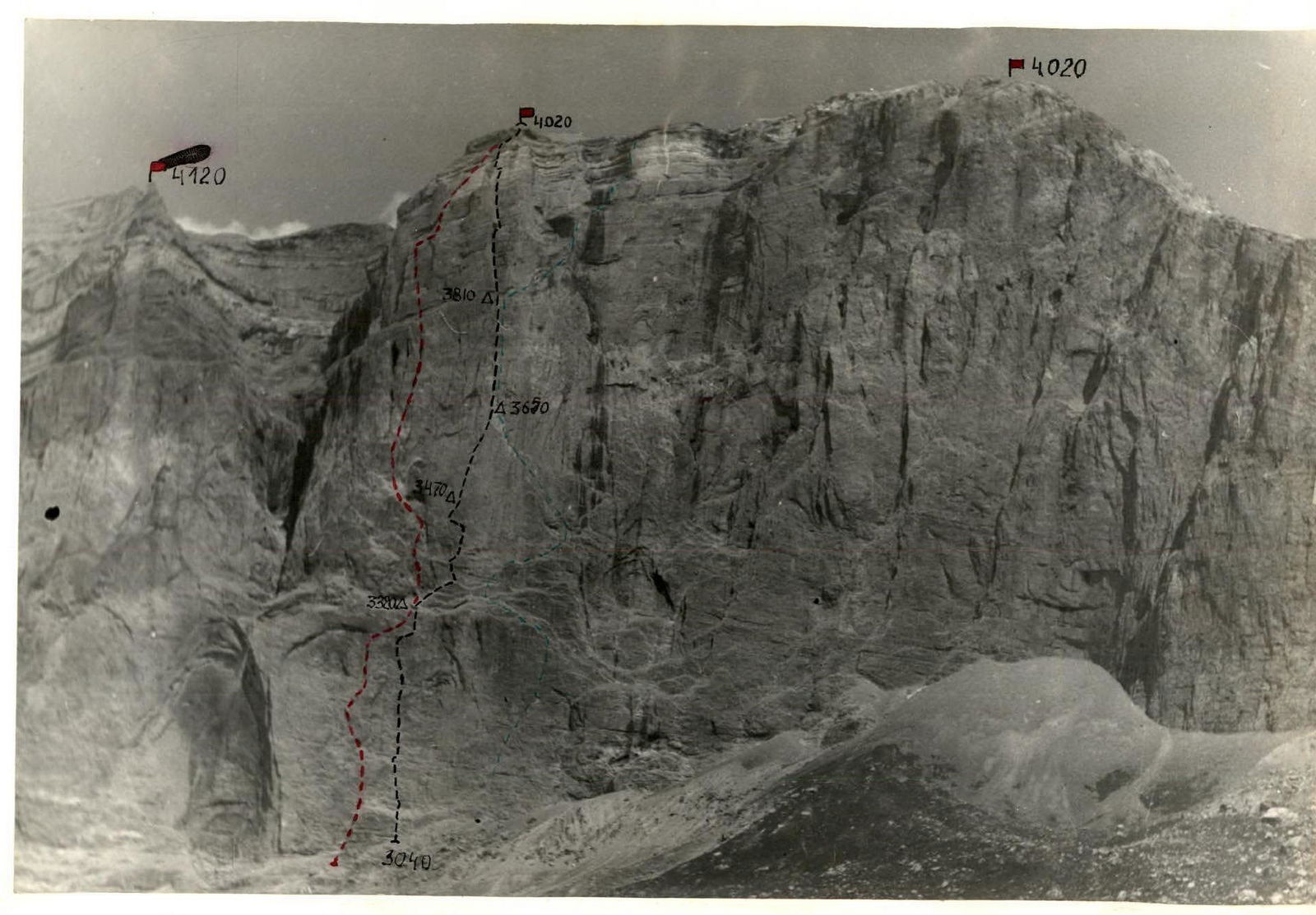
General photo of the summit. July 14, 1983. Lens T-43, F = 40 mm, shooting point I, distance 4 km, height 2850 m.
- Efimov's route,
- Shchedrina's route,
- Moscow city's route.
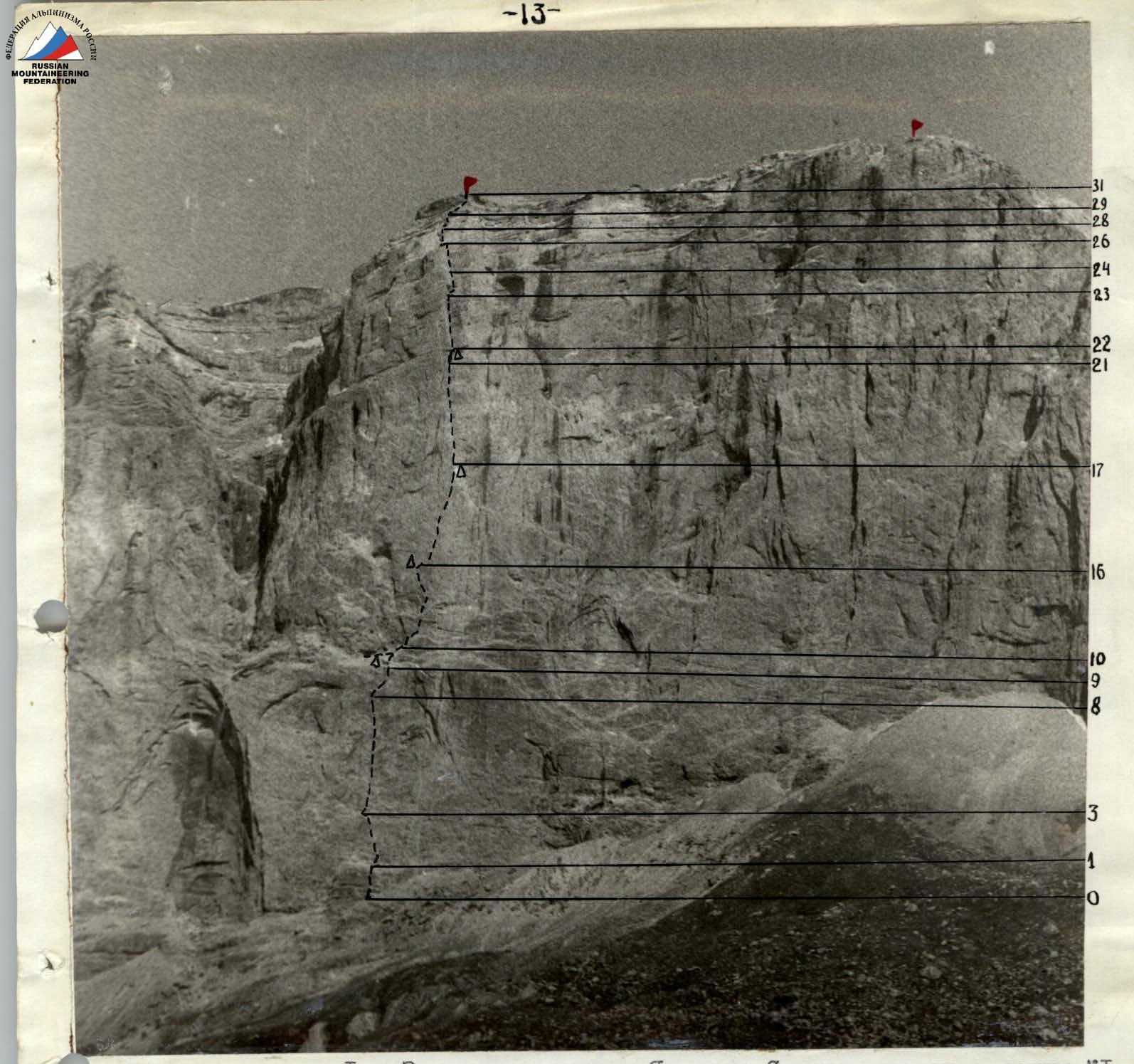
Yarydag's 1st Western peak. Photo taken from point №I on July 14, 1983, distance 2 km, height 2750 m, lens T-47, F = 4 cm.
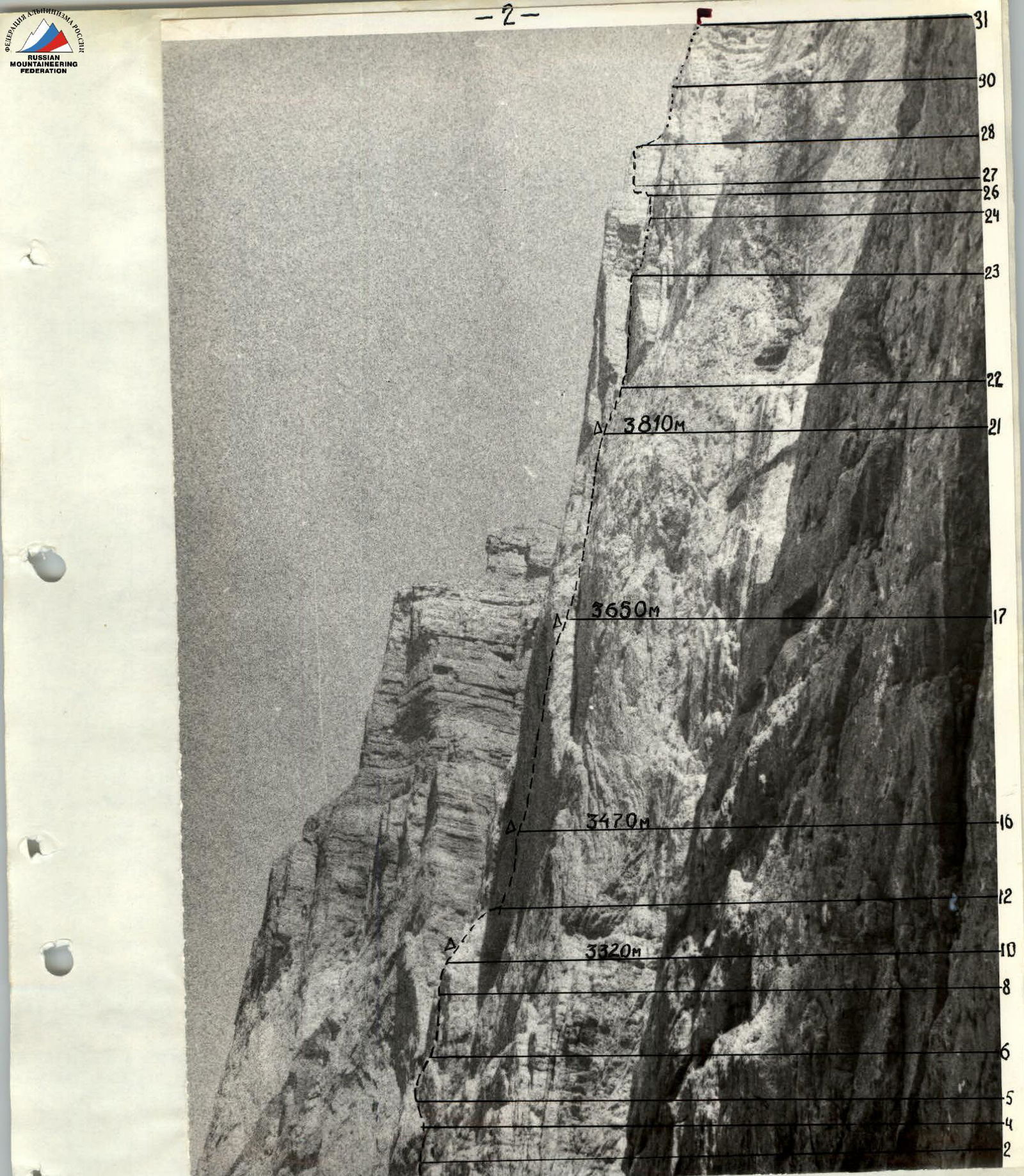
Wall profile. July 14, 1983. Lens T-43, F = 40 mm. Shooting point 2, distance 300 m, height 3050 m.
Team's Tactical Actions
During the training cycle, a team of 6 people was formed:
- Shortov Yu.I. - captain
- Efremov V.V. - deputy captain
- Krasnenko S.G. - team member
- Rozin I.L. - team member
- Erokhin I.D. - team member
- Bezrodny A.V. - team member, coach.
As a result of preparation: studying the report of the "Torpedo" team, received consultations, observations, realistically assessing the difficulties of the route and their capabilities, the team concluded that they could complete the route with 5 overnight stops and drew up a tactical plan (see supplement - route sheet). Upon entering the route, the team strictly adhered to the tactical plan.
The movement on the route proceeded as follows:
- July 16 - Rozin–Efremov–Erokhin work ahead and pass the lower bastion of rocks. Shortov–Krasnenko–Bezrodny follow on the fixed ropes. They stopped for the night in the "grotto".
- July 17 - Bezrodny–Shortov–Krasnenko work first and reach the "glove" by 10:00. Then they process 60 m of the lower part of the "mirror" and descend to the "grotto" for the night, as the "glove" was an uncomfortable place for the whole team to spend the night. To continue processing the "mirror" with fresh forces the next day, Rozin–Efremov–Erokhin ascended to the "glove" for the night.
July 18 - the team of Rozin–Efremov–Erokhin processed the remaining part of the "mirror" and reached a ledge under the base of the giant internal corner. By 18:00, Shortov–Krasnenko–Bezrodny ascended to the ledge.
July 19 - Bezrodny–Shortov (Krasnenko) work first and reach the base of the "book" in the upper part of the corner. Here they have a sitting bivouac on two separate ledges.
July 20 - the team of Rozin–Efremov–Erokhin processed the "book", passed the cornice on the right, then the "feather" wall and the red wall with a narrow slit. At 20:00, the team reached the summit. During the ascent, the team advanced ahead of the tactical plan on July 17, section 11–16 from the "grotto" to the "glove" was passed faster than planned.
This made it possible to process 60 m of the lower part of the "mirror" on July 17. Further movement along the route followed the planned schedule.
The team's work on the route was organized as follows. The team was divided into two teams of three people. This allowed maintaining a high pace of movement, as the first in the team processed the section, fixed the ropes, and received the second team member, who carried the necessary equipment for the next section, and the first one moved on. At this time, the third team member removed excess pitons from the processed section and carried the remaining necessary equipment. The second team of three followed on the fixed ropes and hauled all the remaining loads. Movement on the fixed ropes was either with upper or lower belay. Thus, the team member was on a double rope throughout the route. Since the team had a sufficient number of ropes, this scheme of movement on the fixed ropes did not slow down the team's pace, and the speed of movement was determined only by the speed of the first team member.
The constant alternation of the leading team allowed:
- starting work from 5–6 am (see the temporary schedule, sheet 6, reverse side);
- the second team to rest well.
The movement on the route was organized in such a way that overnight stops were arranged in the most convenient places. That is why, after reaching the "glove" and processing the lower part of the "mirror", the team of Bezrodny–Shortov–Krasnenko descended to the "grotto", where the most comfortable overnight stay was.
To complete this route, the team had to solve two problems:
- the first - passing the key sections "mirror" and "book", which have minimal relief and smoothed rocks like "ram's foreheads" with a steepness of 85°–95°;
- the second - high temperature and complete lack of water on the route.
The team successfully coped with them. For passing the "mirror" and "book", there was specially prepared equipment:
- platform,
- "heavenly" piton,
- screw-in bolts,
- sufficient amount of ropes.
The team carried 30 liters of water in light tin cans of 5 liters each (1 liter per person per day).
Communication with observers was carried out using two "Vitalka" radios. Communication between the teams was also conducted using these radios. The team was observed through an 8x binocular. In addition, the team had 5 rockets and a flare gun.
Thus, thanks to:
- high technical, physical, and psychological preparation of team members;
- using specially selected equipment;
- passing fixed ropes with belay;
- good organization of overnight stops;
- correctly chosen movement scheme,
the route was completed safely and at a good pace.
Team captain Shortov Yu.I.
Route in UIAA symbols. Scale 1:2000

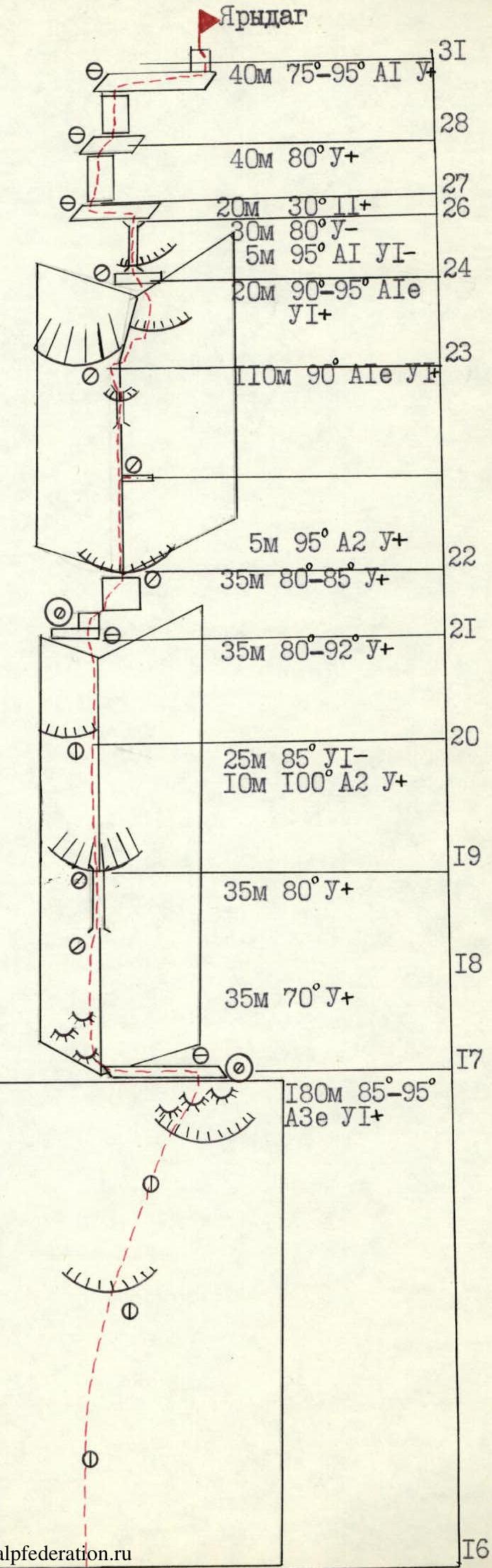
Route Description by Sections
Section 0–1. Rocks of medium difficulty, lead to the middle part of the ledge. 30 m, 70°, 4th cat. diff.
Section 1–2. From the middle of the ledge to the end of the lower bastion (to the overnight stop) two cracks rise: left and right. The ascent starts on the left, after 15 m - transition to the right, on it exit to the wall 10 m. Exit to a narrow ledge. 35 m, 75°, 4th cat. diff.
Section 2–3. From the ledge upwards on the wall - 15 m, then left - 8 m and upwards through the crack to an inclined ledge going left. Ascent to a horizontal ledge. On it, move right. 15 m, 80°, 5th cat. diff. (20 m and 75°, 5th cat. diff.).
Section 3–4. Ascent on a 3-meter wall into the "neck", in which go on the left crack to a horizontal ledge, the crack is partially overhanging. 35 m, 85°–92°, 5th cat. diff.
Section 4–5. From the ledge on the left crack, partially overhanging, exit to a wall with an overhang - 30 m. The overhang is bypassed on the left on the wall - 10 m, then the second overhang is gone "head-on". Exit to a narrow ledge. 45 m, 90°–95°, 6th cat. diff.
Section 5–6. On the left crack, move right through a small cornice. To a horizontal ledge with a niche. 30 m, 80°, 5th cat. diff.
Section 6–7. Hole - 10 m to the left crack, very difficult climbing. Then ascent on the left outer part of the crack 10 m, 90°, 6th cat. diff. 25 m, 75°, 4th cat. diff.
Section 7–8. On the ledges, move left under the crack in the black rocks 10 m, 70°, 4th cat. diff. Then through the overhang by free climbing enter the black crack, in the upper part overhanging. After that, a vertical wall follows 10 m, no cracks, holds are limited. Passed in tense free climbing. On the section, AIDs are used, "heavenly" pitons 6 ladders. Backpacks are pulled out. 25 m, 90°–95°–90°, 6th cat. diff. 10 m, 85°, 5th cat. diff.
Section 8–9. On the destroyed rocks, move right upwards to a ledge. From it on a 10-meter wall, ascent straight up, the wall is smooth, passed by free climbing. 25 m, 70°, 3rd cat. diff.
Section 9–10. Ascent on a not clearly defined right crack. Exit to a scree ledge straight to the red stone. Overnight stay in the grotto on a good platform. 35 m, 80°, 5th cat. diff.
Section 10–11. From the grotto, move right on the ledges. 70 m, 20°–30°, 2nd cat. diff.
Section 11–12. Wall with an unclear relief. Backpacks are pulled out. 35 m, 80°–90°, 5th cat. diff.
Section 12–13. On the destroyed rocks, move right - 15 m, 60°, 2nd cat. diff.
Section 13–14. Wall in the lower part without cracks, slightly overhanging, AIDs are necessary, "heavenly" pitons, ladders. Backpacks are pulled out. 35 m, 85°–95°–85°, 6th cat. diff.
Section 14–15. The previous section leads under the "glove". The next 100 m is an exit to the "glove". Ledge 35 m and 20°, 2nd cat. diff.
Section 15–16. From the end of the ledge, move on the cracks right upwards to the "glove". 50 m, 80°, 4th cat. diff.
Section 16–17. "Mirror". Represents a key section of the route. Has minimal relief and steepness of 85°–95°. In a very tense mode: here both free climbing on the verge of a fall, and the use of "heavenly" pitons, and bolt work, and AIDs - in a word, the use of the highest mountaineering technique. 180 m, 85°–95°, 6th cat. diff.
Section 17–18. "Mirror" leads to a giant internal corner, on which it is necessary to ascend almost to the summit (section №29). The lower part of this internal corner is a smoothed rocks like "ram's foreheads". There are few places for belay organization. Steep, but you need to go on friction. 35 m, 70°, 5th cat. diff.
Section 18–19. The corner narrows, steepness increases, chimney technique and climbing are used. 35 m, 80°, 5th cat. diff.
Section 19–20. Through a 2-meter cornice, ascent on the center of the corner. AIDs and ladders are necessary. 10 m, 100°, 6th cat. diff. 25 m, 85°, 6th cat. diff., wall with a platform 35 m, 92°–80°, 5th cat. diff.
Section 21–22. Ascent on the left wall left upwards to a ledge. From the ledge, ascent on the wall straight up 5 m, then under the cornice move right into the internal corner 15 m, 5th cat. diff. 20 m, 80°, 5th cat. diff.
Section 22–23. Through the cornice, ascent on the internal corner with smooth walls. There are very few cracks. Ascent is vertical.
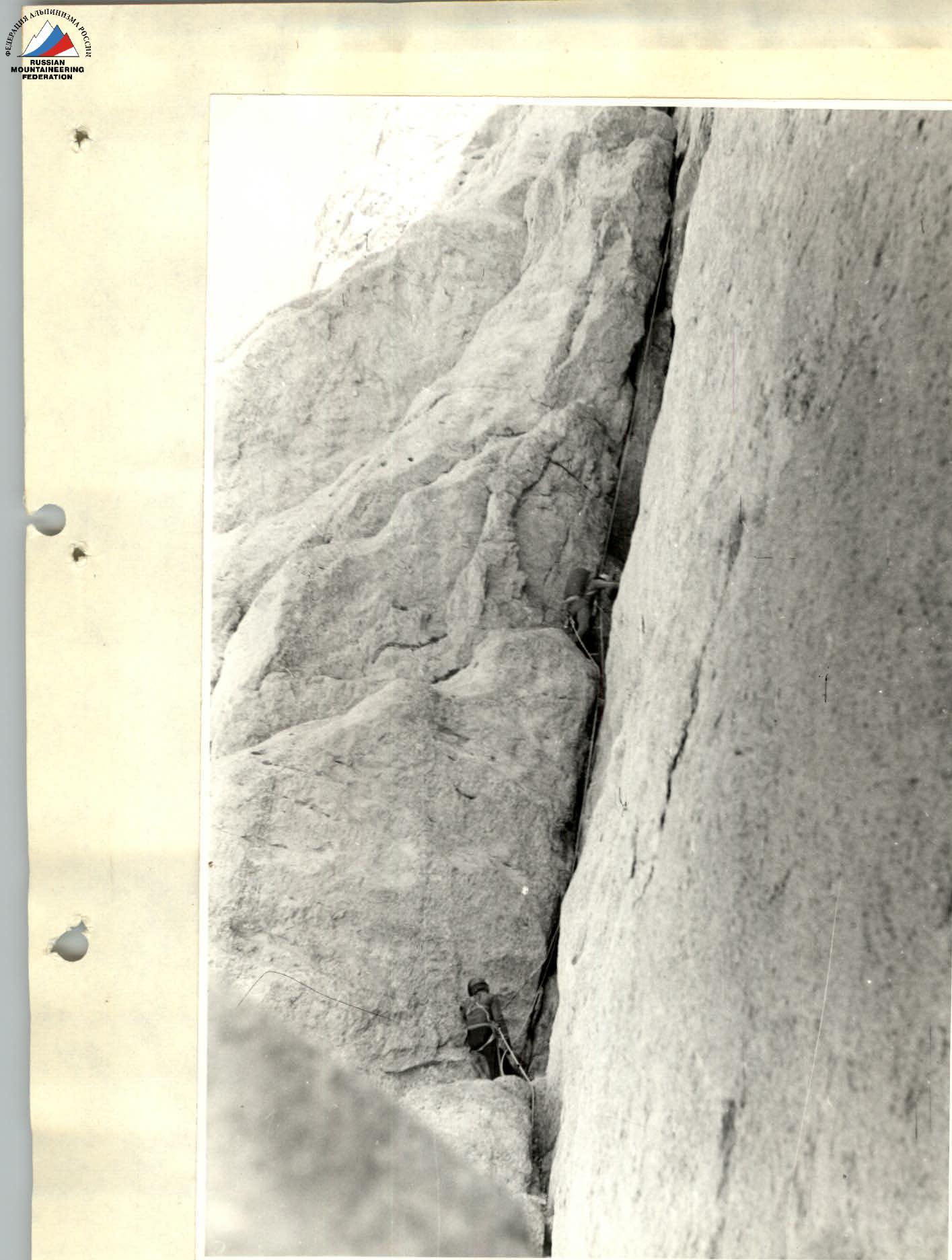
Photo 5. Section 17–18.
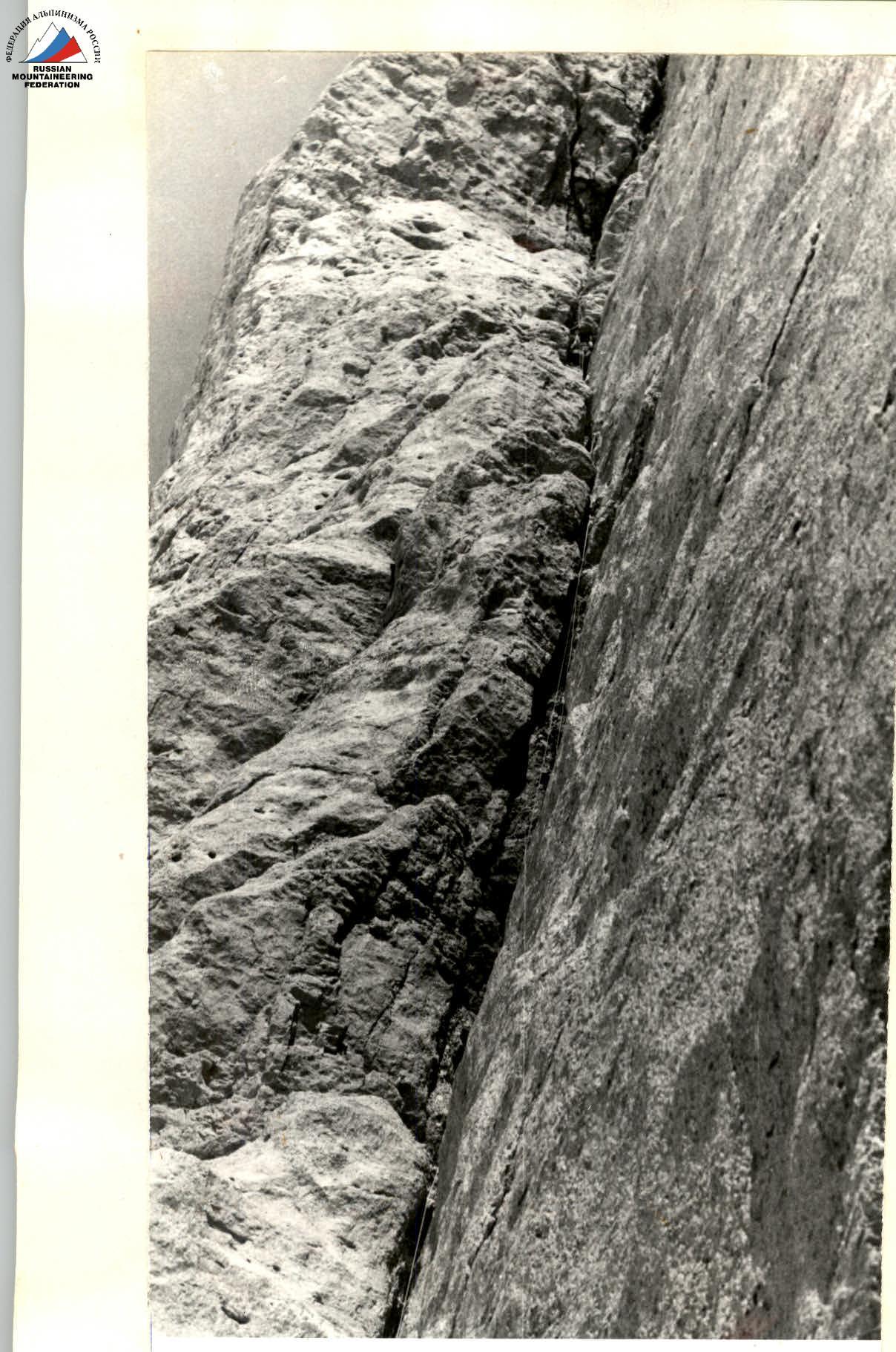
Photo 6. Passage of the giant internal corner, section 17–21.
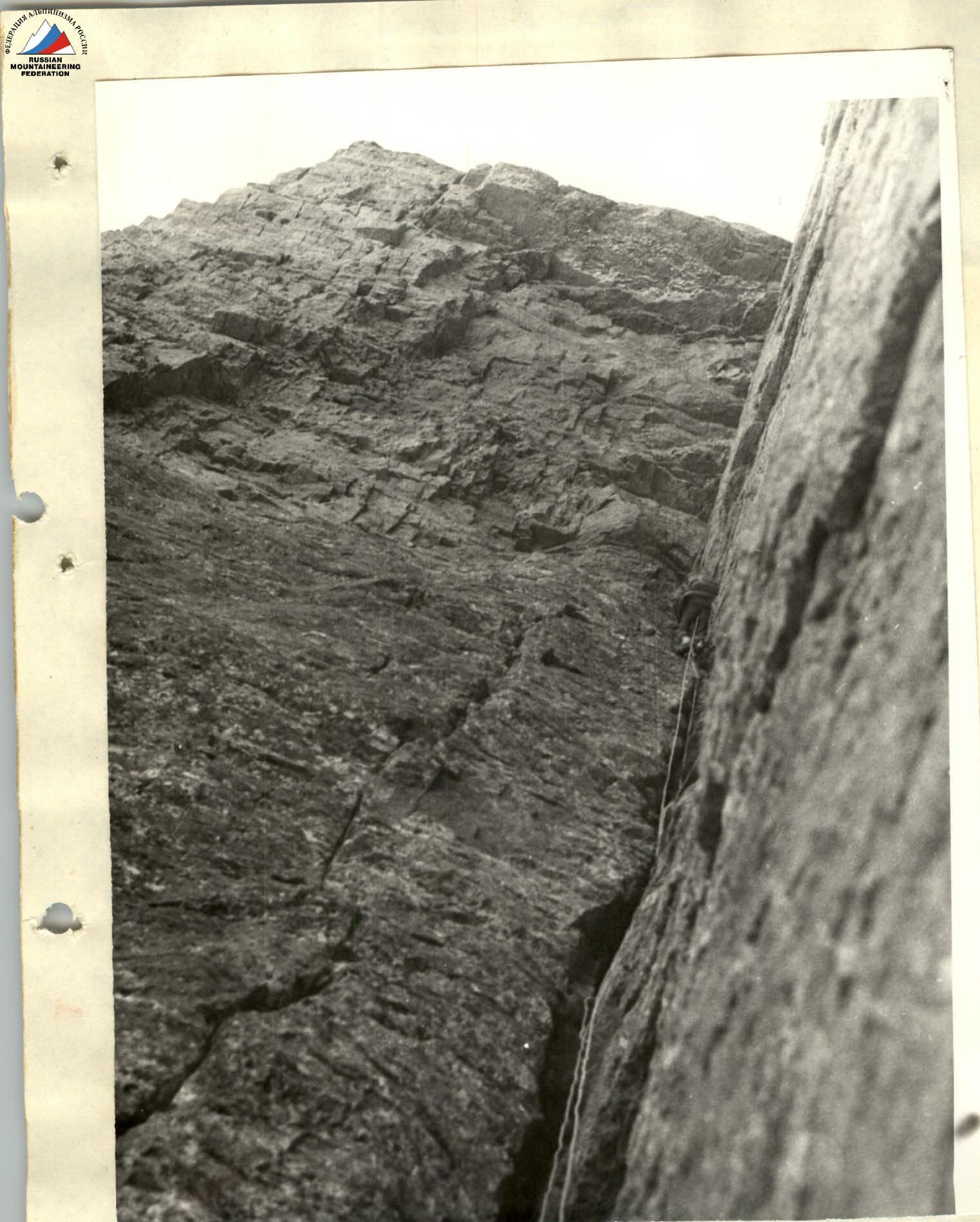
Photo 9. Passage of the "book", section 22–23.
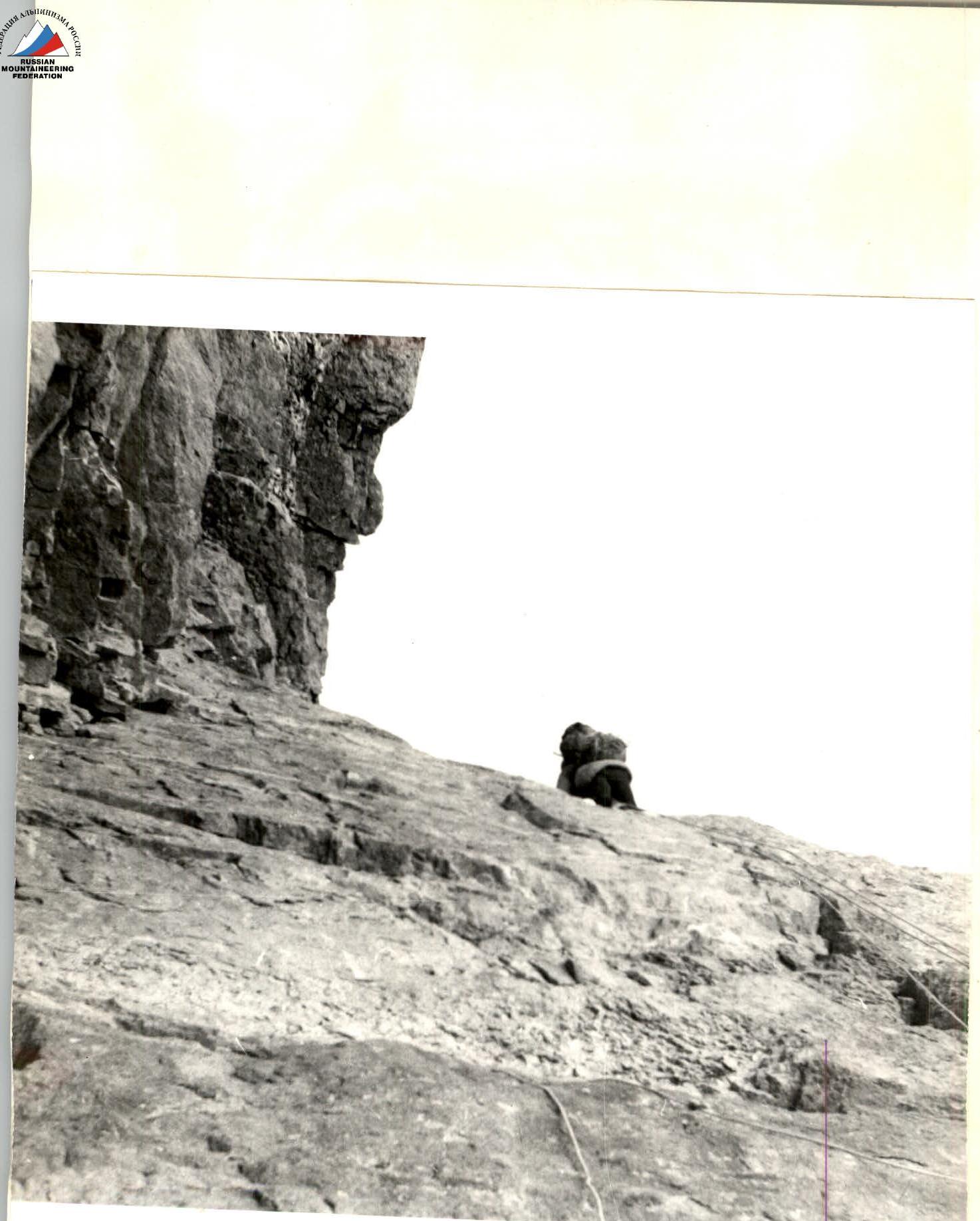
Photo 10. Passage of the cornice in the upper part of the "book", section 23–24.

Photo 10. Section 28–29, red wall with a slit. July 20, 1983.
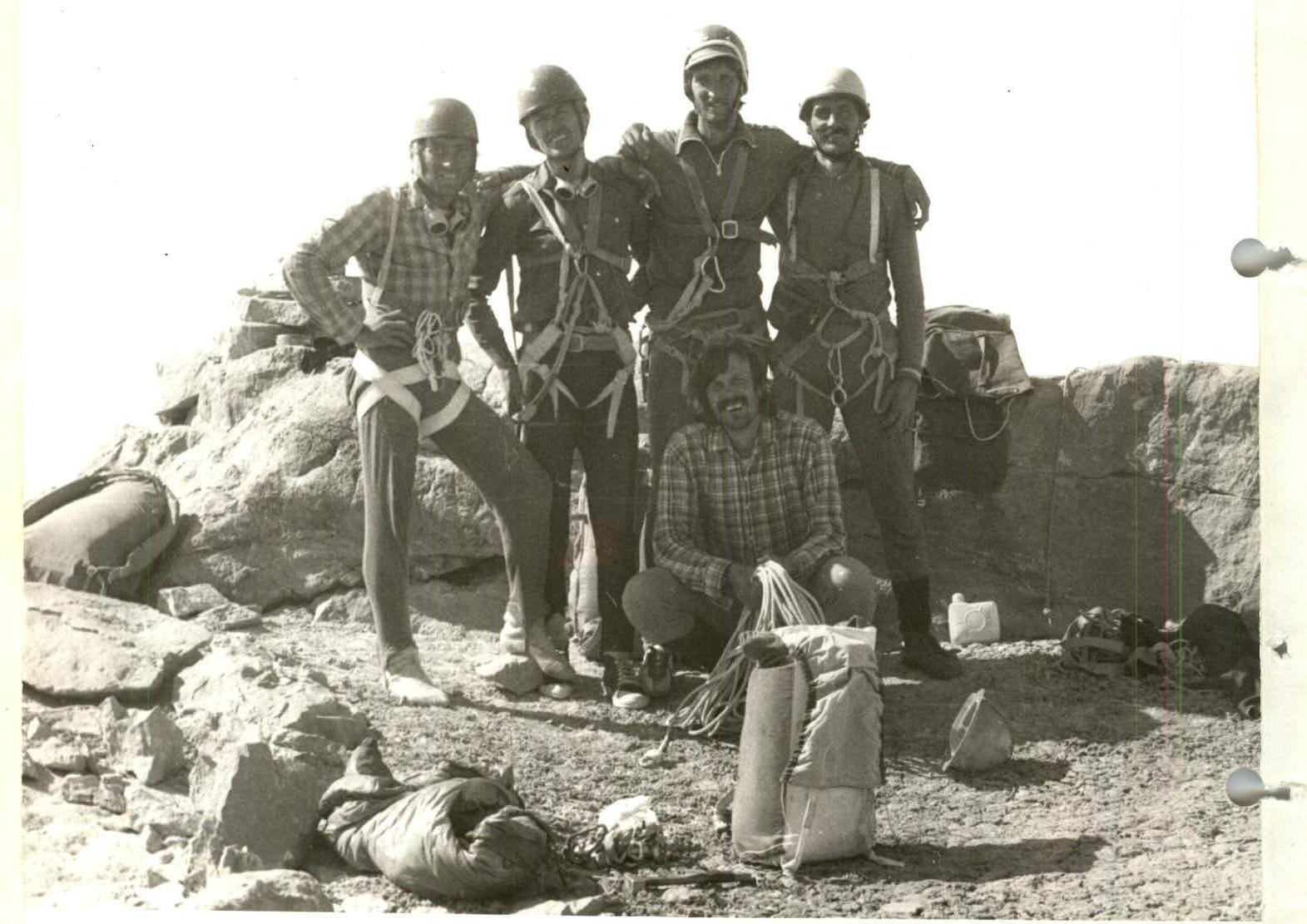
Photo 10. Summit. July 20, 1983.