

ASCENT FORM
- Technical Climbing Category
- Caucasus, Tsey Region
- Chanchakhi Peak (4420 m) via North-East Face
- Complexity Category - 5B, combined, third ascent
- Height difference - 620 m, length - 810 m, length of sections with 5B-6 complexity category - 420 m average steepness of the main part of the route (3800–4420) - 60° of which 6 complexity category (4000–4225) - 80°
- Pitons driven: rock - 56, bolt - 0, chocks - 50, ice - 10
for ITO - 12, - 0, - 8, - 0
- use of previously driven pitons
- Team's climbing hours: 18, days - 2
- Overnight stays: one, sitting on a rock ledge in a suspended tent
- Leader: Zagirnyak Mikhail Vasilyevich, Master of Sports of the USSR participants: Bragin Vladimir Mikhailovich, Candidate for Master of Sports Dulepov Evgeny Nikolaevich, Candidate for Master of Sports Ivanov Anatoly Kuzmich, Candidate for Master of Sports
- Team coach: Korneev Valery Nikolaevich, Candidate for Master of Sports category II instructor-methodologist
- Date of departure on the route July 20, 1986 reaching the summit July 22, 1986 return July 23, 1986
- Voroshilovgrad Regional Sports Committee
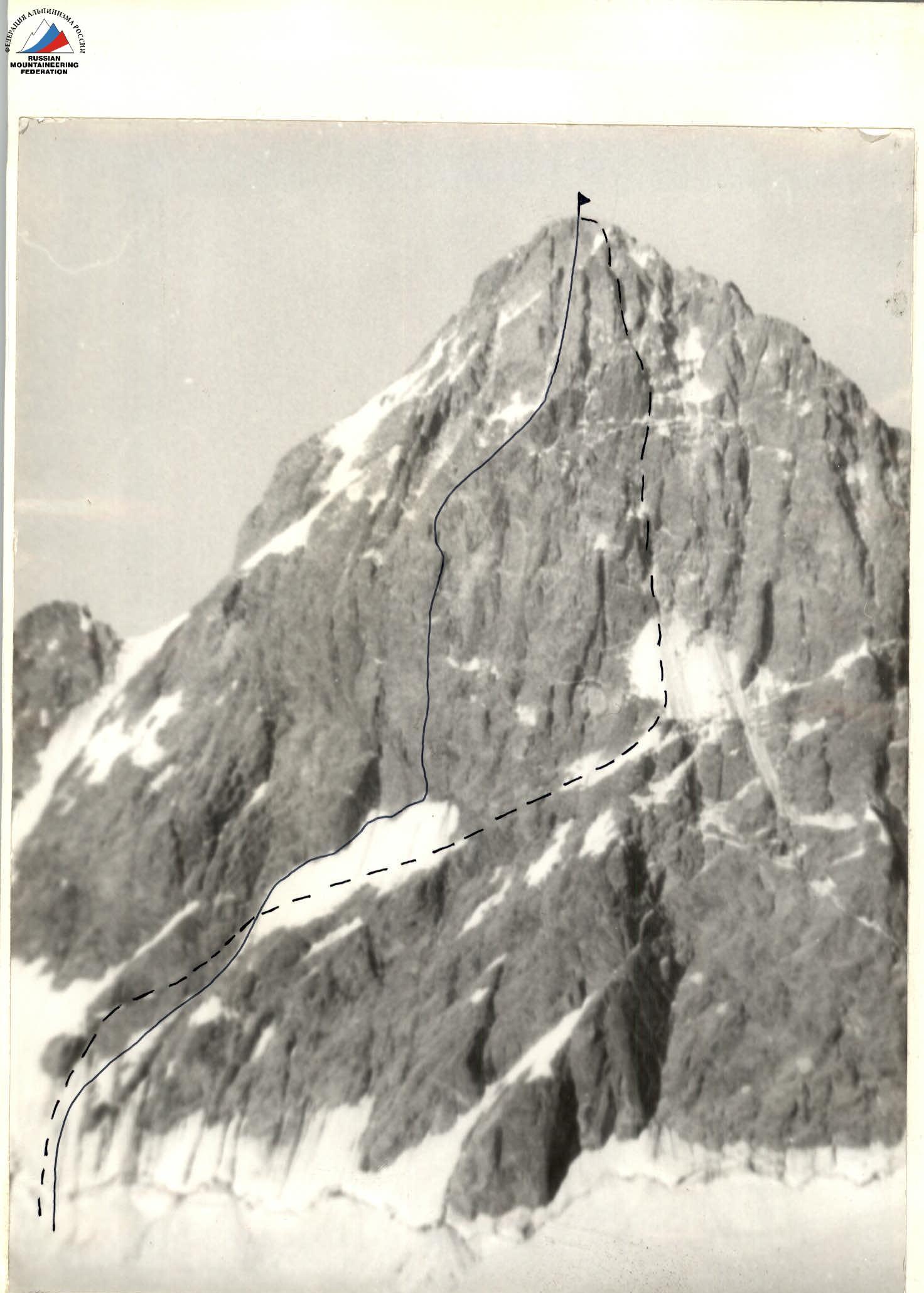 route to Chanchakhi Peak via N-E face
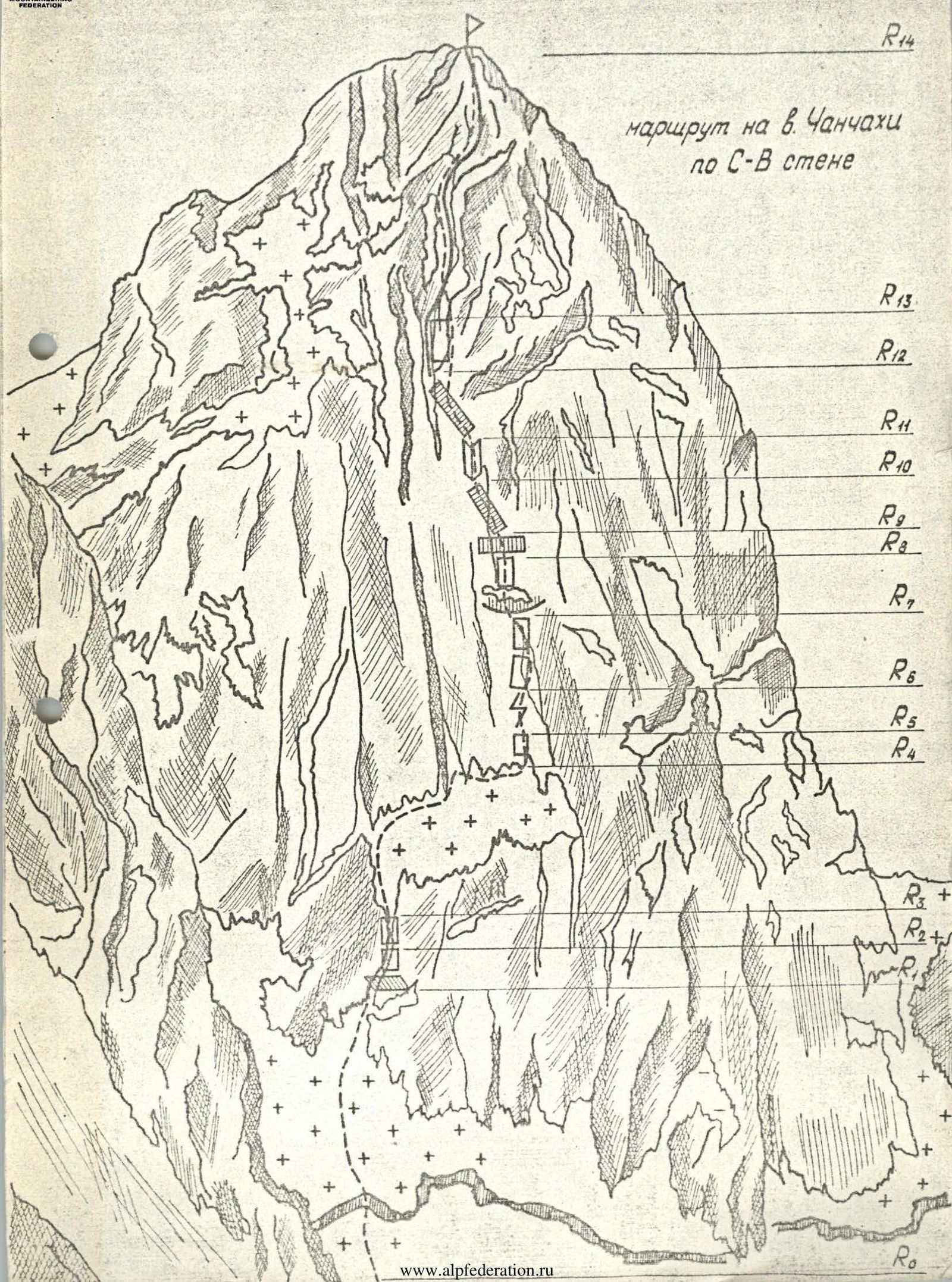
Route Description by Sections
R1–R4 – Snow and ice slope with a bergschrund. To ensure safety, it is necessary to overcome it early in the morning before the wall is exposed to sunlight. Everyone wears crampons. Ice screws are used. At the end of each rope – 2, intermediate anchors in the middle – 1.
R5 – Rock wall. Characteristics at the time of passage. The first person works on a double rope.
R6 – Diagonal crack filled with ice, with an overhang at the top.
R7 – Chimney turning into an internal corner, with a cornice at the top. The first person works using artificial holds. Protection through pitons and chocks.
R8 – Wall with an internal corner and a cornice. The cornice is passed on the left-upwards. Pitons protection. Ledge. Control cairn.
R9 – Ridge and wall. Rocks are fragile. Team members move with a necessary interval for safety, possible rockfall.
R10 – 4 m cornice. Overcome by free climbing.
R11 – Diagonal crack. Overcome by free climbing with piton protection.
R12 – Chimney with an overhang. Overcome using artificial holds.
R13 – Fragile wall leading to a ridge. Team members move on fixed ropes with an interval – "live" rocks.
R14 – Fragile ridge leading to the summit. Teams move independently with alternate belays.
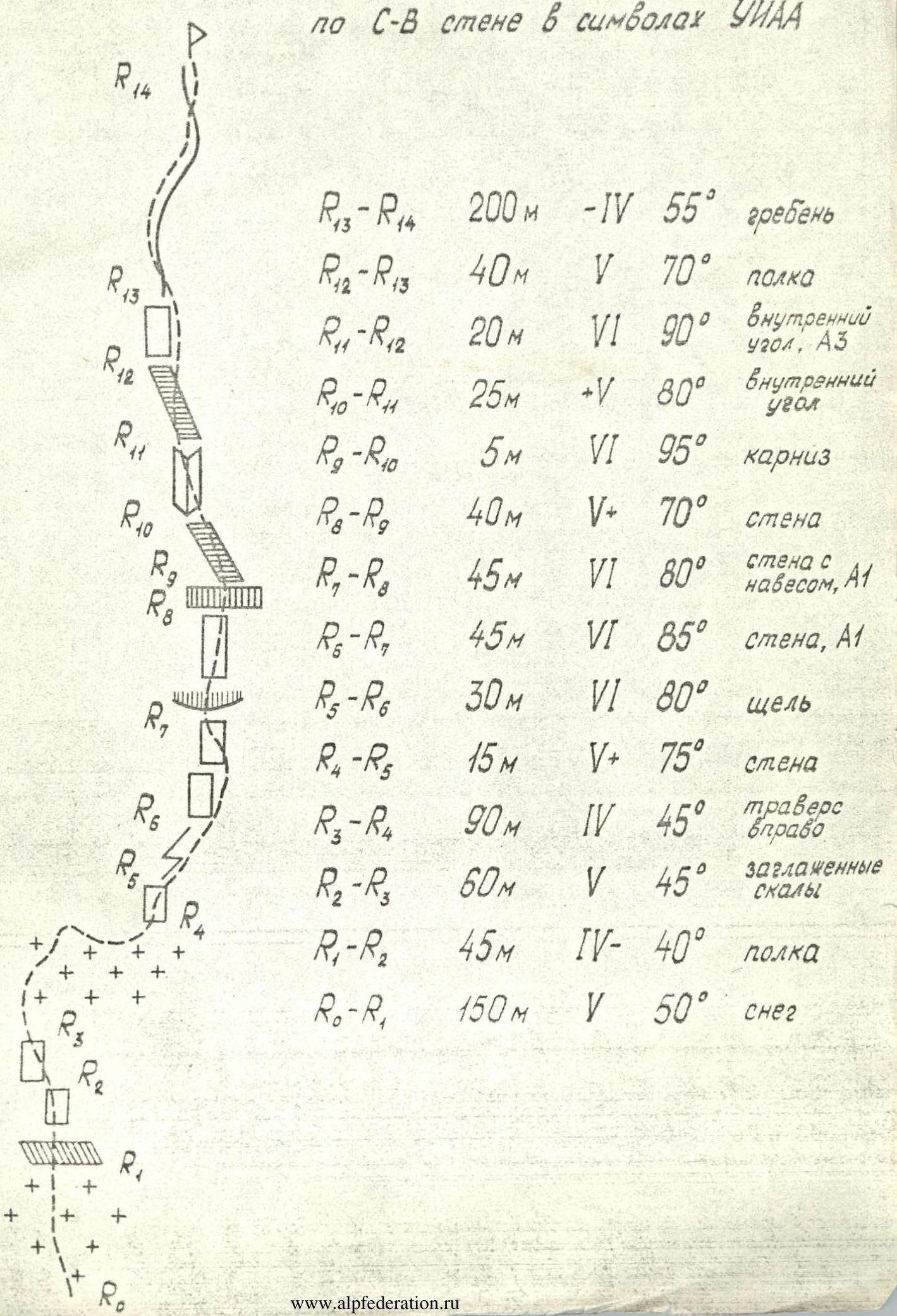
Route diagram on Chanchakhi Peak via N-E face in UNAA symbols
Team's Tactical Actions
The tactical plan provided for passing the route with two overnight stays. Due to unstable weather in the area, a reserve day was planned for bad weather.
The route was completed from 15 to 16 August in 19 climbing hours without prior processing.
Before departing on the route, the weather was clear and sunny, resulting in increased rockfall danger on the route, and also, taking into account the recommendations of the first ascendants, it was decided to start the route with a team of four: Comrade Aigistov - captain, Comrade Vekhter, Comrade Povetin, Comrade Ryabov. Given the strong and even composition, the work of the rope teams was organized: Ryabov-Povetin, Aigistov-Vekhter. The first in the teams worked without backpacks on a double rope. During the passage of the route, the rope teams and leaders were regularly changed. The main principle for choosing bivouacs and passing the route was safety.
According to the tactical plan, the departure on the route was scheduled for 4:00, but due to bad weather, it was postponed to 8:00.
The team followed the Rusyaev route strictly. However, on R2, we discovered a deviation of the Rusyaev group from the route reflected in the report, as evidenced by a rappel loop and bolt pitons driven during the transition to the Polevoy route.
The deviation from the route was 3 ropes. Given the danger of passing the upper part of the triangle due to overhanging "live" blocks, the team decided to transition to the Polevoy route along the path taken by the Rusyaev group.
It should be noted that the Rusyaev group's report was not written in an ethical manner.
When the team moved along the Polevoy route, there were no deviations from the tactical plan.
The safety measures for passing the route were:
-
High physical, technical, and psychological preparation of the team.
-
Tactical plan for passing the route.
-
Material support, including the use of new equipment: titanium pitons and carabiners, chocks of various designs, GDR ropes.
-
Stable radio communication via the R-147 radio station.
On the route, two hot meals and "pocket" snacks were planned. Nutrition was calculated at 400 g per person per day.

Route Description by Sections
Section R0–R1 The section is a snow and ice slope, intersected by a bergschrund at the bottom, 80 m up to 70°, 5. Section R1–R2 Steep internal corner-flake leading to a diagonal snow ledge 20 m, 80°, 5. Section R2–R3 Diagonal snow and ice ledge turning into a verti- cal internal corner. The corner is passed on the right vertical wall. 34 m, 80–90°, 5. Section R3–R4 Overhanging internal corner with cornices. 25 m, up to 100°, 6. 1st control cairn. Section R4–R5 Wet slabs with "live" rocks. 40 m, 70°, 5. Section R5–R6 Internal corner-chimney. 25 m, 80°, 6. 2nd control cairn. Section R6–R7 Vertical slab, then internal corner under the pro- tection of cornices. 15 m, 90°, 6. Section R7–R8 Traverse from right to left into an internal corner. 35 m, 90–95°, 6. Section R8–R9 From the corner of the chimney along the right wall, overcoming a small cornice. 30 m, 90°, 6. Section R9–R10 Slab 55 m, 70°, 5. Overnight stay. Section R10–R11 Traverse from right to left along the slab under an overhanging cornice. 40 m, 80°, 5. Section R11–R12 Internal corner. 80 m, 70°, 5. Section R12–R13 Series of internal corners going from left to right, steeply upwards. 80 m, 65°, 5. Section R13–R14 Internal corner leading to a ledge. 40 m, 65° 5. Section R14–R15 Steep rock ridge with snow drifts, 200 m, 50°, 4. Section R15–R16 Snow ridge, descent to a saddle, 20 m, 40°, 2. Section R16–R17 Steep snow slope. 80 m, 50°, 2. Section R17–R18 Heavily fragmented snow-covered rocks leading to the main ridge. 80 m, 60°, 4. Section R17–R18 Traverse 40 m, 60 m, 20°, 2. Section R18–R19 Descent via "doulfer" to a saddle, 20 m, 90°. Section R19–R20 Along the snow and ice ridge with steep sections, reaching the summit. 200 m, up to 45°, 2.
Protocol
of the competitive ascent review of the combined team of SA and VM within the framework of the USSR Alpine Championship (technical category) on Mamison Peak via the center of the triangle on the northern wall, 5B category.
August 18, 1984. Present: the team in full; representatives of the judging panel: Korshunov D.M., Levin M.S., Parfenenkov V.S.; KSP head Gerasimov V.A., KSP senior instructor Serdyukov I.I. The review is conducted by senior coach, 1st category, Master of Sports Timofeev A.V. Team leader Aigistov G.A.: "The tactical plan provided for a team of four. Two overnight stays and one reserve day for bad weather were planned. We reviewed the route. The upper rock triangle was a 'white spot'."
On August 15 at 8:00, we left the base camp. At 10:00, we began working on the route. The first person processed 2 ropes on ice. Then we started working on the lower triangle. 7 ropes of rock of medium steepness, 30°. Three of them were 6 complexity category. After reaching the triangle, we had the 1st overnight stay. The overnight stay was 'semi-sitting'. In 9 climbing hours, we completed 10 ropes. In the evening, while two team members organized the overnight stay, the other two processed one rope of rock. The path through the upper triangle, as drawn in Rusyaev's report, is objectively dangerous due to the extremely high rock fragmentation. The Rusyaev group did not pass it, as the tracks, driven pitons, and rappel loops lead to the left, onto the Polevoy route. Due to the objective danger of this path, the team decided to transition to the Polevoy route.
On August 16 at 8:00, we passed the processed rope and transitioned to the Polevoy route. On this route, 7 ropes (60–70°) are quite complex. Then we reached a ridge and a crest leading to the summit.
On the second day, in 10 hours, we completed 20 ropes. Regarding the team members: Povetin and Vekhter are participating in the USSR Championship for the 3rd time, Ryabov - for the first time. Before the USSR Championship, the team had a training camp in the Fann Mountains, where they climbed routes of 5-6 complexity category. The team practiced interaction in rope teams. The second rope team did not delay the first; they quickly passed the fixed ropes. All team members worked as leaders on separate sections. Cornices were passed in galoshes; the rest was done in crampons. The route is quite complex, corresponding to the 5th complexity category with a reserve. The route length was 1200 m. Of these, 5-6 complexity category - 600 m, 6th - 120 m. During the ascent, we used bolt pitons left by the previous group. We drove 10 ice pitons, used 8 bolt pitons driven by the previous team, drove 53 rock pitons, and used 88 chocks.
Timofeev A.V.: "What explains the late start of the group?" Aigistov G.A.: "Unstable weather."
Korshunov D.M.: "Why did the team start the route with four people instead of six?" Aigistov G.A.: "Considering the increased rockfall danger on the route in August and the recommendations of the first ascendants, it was decided to start with a team of four."
Korshunov D.M.: "Does the route correspond to the 6 complexity category?" Aigistov G.A.: "The lower triangle quite corresponds."
Parfenenkov V.S.: "Which route did the team descend?" Aigistov G.A.: "The team descended via the 3A category route. On the descent, there were tracks of a discharge group from the 'Tsey' alpine camp."
Korshunov D.M.: "How do you evaluate the route compared to other routes you have climbed?" Aigistov G.A.: "The route is more complex than many we have climbed before. The complexity can be evaluated as 5B category."
Gerasimov V.A.: "Do you think the route is logical? Should it be left in the classification as an option?" Aigistov G.A.: "The route is quite logical."
Korshunov D.M.: "How did the rope teams work on the route?" Aigistov G.A.: "During the passage of the route, the rope teams regularly changed."
Parfenenkov V.S.: "What kind of ropes did you use?" Aigistov G.A.: "4 German ropes: 2 blue and 2 red."
Korshunov D.M.: "Was all the taken equipment used?" Aigistov G.A.: "All, except for bolt pitons."
Povetin A.A.: "The high-quality equipment contributed to the quick passage of the route. The weight of the equipment was relatively small for each participant. I believe that the route corresponds to the 5B category."
Levin M.S.: "How did you personally observe the route?" Povetin A.A.: "The day before the ascent, we found the start of the route, outlined landmarks, places for potential overnight stays, and noted rockfall-prone areas. In the upper part, the route is more fragmented than in the lower part. That day, we still had doubts - whether to leave from under the wall (second triangle) or not."
Gerasimov V.A.: "Rusyaev did not pass the 2nd triangle. In the report, it is given as passed. You should give your conclusion and classify the route as you passed it."
Korshunov D.M.: "It seemed to me that a transition to the right would be more rational?" Aigistov G.A.: "There are 'live' blocks hanging there. The path to the left is more logical and safer."
Ryabov S.G.: "I was pleased to observe the clear work of the team on the route. I believe that passing the lower part of the triangle will bring full satisfaction to high-level climbers. The climbing is very complex, monolithic. Communication was well-established. The upper part of the route is not complicated, but it is impossible to climb simultaneously due to rockfall danger."
Vekhter V.V.: "This is the third year I have been climbing with this team. The team is strong. Ryabov is in his first year with our team. A wonderful fighter. The team's atmosphere is healthy. This is my first time in the Caucasus. The route was very impressive. Unfortunately, we were unlucky with the weather. The route was passed with a 'safety margin'."
Features of the passage:
- The first person climbed the entire route on a double rope.
- The nutrition was quite good, high-calorie.
The route corresponds to the 5B category with a significant reserve, especially the lower part.
Gerasimov V.A.: "Did you bring a tent?" Aigistov G.A.: "A tent, 4 'legs', down jackets, 3 cloaks, a stove, gasoline in sealed cans."
Timofeev A.V.: "I believe that the team coped with the task. The leadership and the ascent are confirmed. The team should prepare a report and submit it to the relevant organization for the second ascent of the route to be counted."
Review conducted by 1st category coach Review recorded by K. Serova

Comments
Sign in to leave a comment