Moscow Order of Lenin Aviation Institute
named after Sergo Ordzhonikidze
Ascent
to the summit of Mamisong Khokh via the right edge of the North face (approximately 5B category of difficulty) First ascent.
Group leader: V. Obruchnikov.
Coaches: Master of Sports of the USSR L. Puchkov Master of Sports of the USSR M. Zinin
– 1972 –
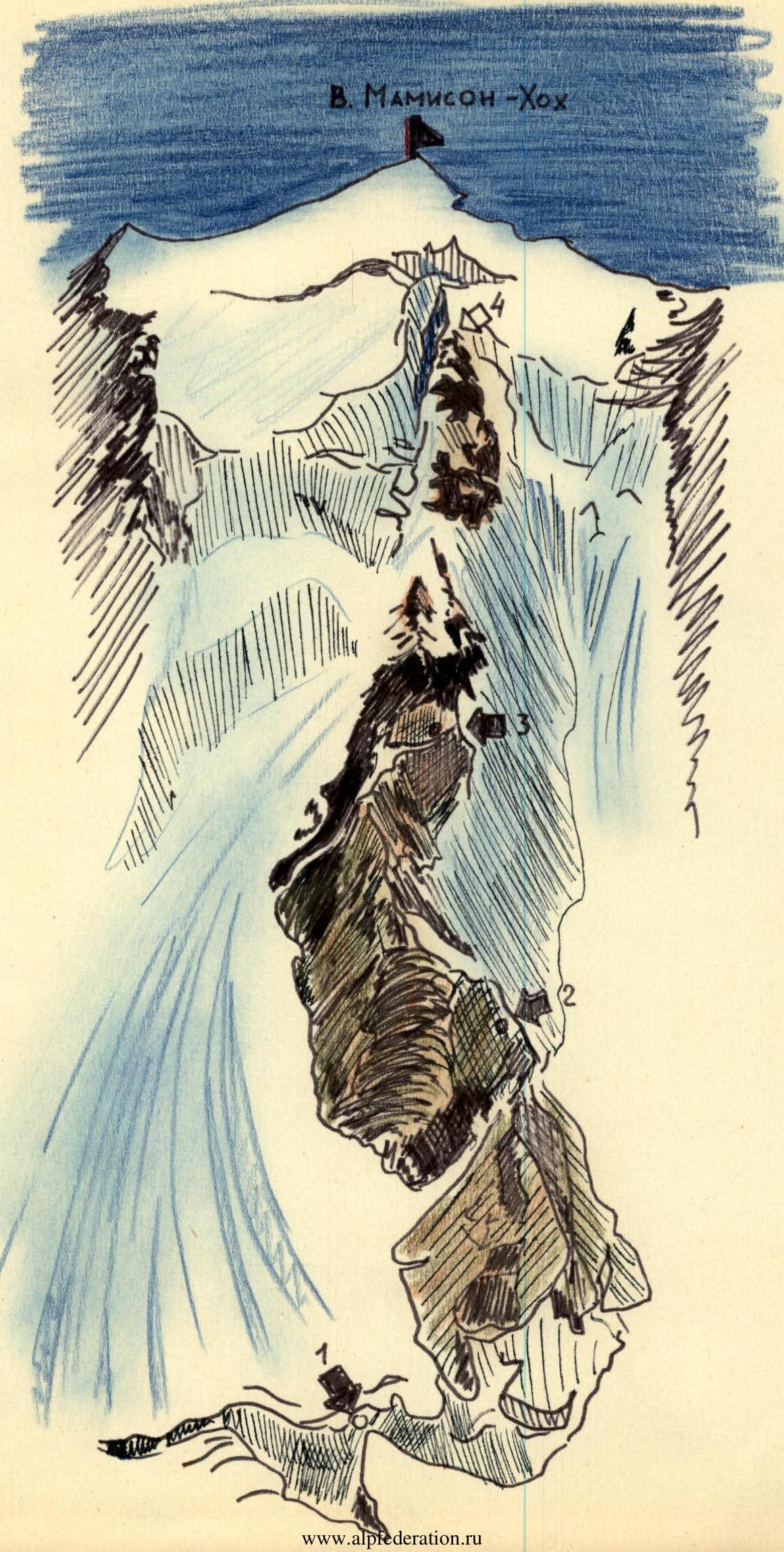
V. Mamisong Khokh
Brief geographical description and sporting characteristics of the ascent object
The summit of Mamisong Khokh is located in the eastern part of the Main Caucasian Range. It is one of the most interesting peaks in the Cei region from an alpinism perspective.
Mamisong Khokh is a nodal peak. To the east, it has a ridge with the peak Khitsan Khokh and peak Nikolaev, dividing the Cei glacier into southern and northern branches. The ridge extending to the southeast leads to the peak Ronketi, and to the west — to the peak Chancha khi Khokh. The height of Mamisong Khokh is 4358 m. There are three peaks:
- Eastern;
- Main;
- Western,
connected by a snow-rock ridge.
Three routes of 5B category of difficulty and one route of 5A category of difficulty have been traversed and classified on the North face. On the southern side of Mamisong Khokh, there is a route of 3A category of difficulty.
The MAI team chose the uncharted right edge of the North face of Mamisong Khokh, representing a combined route, approximately 5B category of difficulty.
The base camp for the ascent was the branch of the "Torpedo" alpine camp of the CS DSO "Zenit", located in the area of the Belaya Rechka.
The Cei region has a rather harsh climate, second only to the Central Caucasus in this respect. The region is characterized by significant glaciation and unstable weather.
Day 1
On August 21, 1972, the group in the planned composition set out from the base camp at 6:00. After approaching, the group stopped for the night in a snow bowl at the foot of Mamisong Khokh at 13:00.
After lunch and rest, at 14:00, the rope team Murashov — Smirnov went out to process the bergschrund and the lower part of the route. Within 4 hours of work, a path through the bergschrund was found and processed, and pitons were hammered into the base of the rock edge.
At 20:00, the group went to sleep.
Day 2
On August 22, after breakfast and dismantling the bivouac, the group in crampons and with headlamps set out on the route. The weather was clear.
The path goes along a steep ascent of the glacier towards the right edge of Mamisong Khokh under the bergschrund (section R1). The bergschrund was overcome with the help of a rope hung the day before and ladders (section R2). Then, traversing to the right upwards along a steep ice slope, we exit onto the rocks of the edge. Here, we remove crampons (section R3).
Further, to the left upwards along the wall (pitons insurance, section R4) and traversing to the right 4–5 m, we exit under an internal corner. Along the internal corner (section R5), there is an exit to rock outcrops under the wall. The wall is complex with very small holds; the first approach is in galoshes, using the possibilities of support points (section R6). The wall leads to a snow-covered horizontal ledge. Here, we organize the hauling of backpacks. The ledge is wide enough for a 4–5 person overnight stay. We set up the 1st control cairn, leave a note, and at 9:00 continue the ascent.
From the control cairn, we ascend along a 10-meter wall (section R7), and then to the left (15–20 m) exit onto the ridge of the edge under the 2nd rock ascent (section R8).
Along a narrow rock ridge, we approach under the 2nd rock ascent. In some places, the rocks are covered with ice (section R9). The ascent is a 20-meter wall, reaching a steepness of 80–90° in the upper part. The wall is traversed head-on. Insurance is with pitons. Pitons of the "shveller" type hold well in cracks with ice. Climbing is complex, using ladders. There are "live" stones (section R10).
Further, along a snow-ice slope, we exit onto rocks of medium difficulty to the left of the 3rd rock ascent (section R11). We approach the base of the 3rd rock ascent along a vaguely expressed icy ledge under a narrow crack (section R12). To the right, a horizontal snow-covered ledge with a small number of loose stones is visible, ending in a sheer drop.
Along the crack to the right-upwards, we exit under an overhanging stone, which we bypass to the right along an internal corner (section R13), and further upwards along the wall 20–25 m to the ridge (section R14).
The rocks of the 3rd rock ascent are covered with ice. Climbing is complex,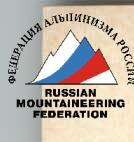 in some places very complex, requiring very thorough insurance. Despite small sections of ice, it is preferable to go in slippers or galoshes.
Along the rock ridge of medium difficulty, we exit onto the summit of the 3rd rock ascent. Here, on a 1.0 × 3.0 m site, we set up the second control cairn. We hang a can with a note on a piton (section R15).
We approached the site around 18:00. Since there are approximately 1.5 hours of daylight left, we decide to stop for the night. Although it is not possible to fully set up the tent, we stretch it overhead with the help of pitons. In all other respects, the place is convenient; the risk of stones and ice fragments is excluded. There is no water. We melt ice. We constantly monitor the serac. During the ascent, the serac did not give any signs of activity.
Day 3
On August 23, 1972, we set out at 5:00 to overcome the serac and the subsequent snow slope by 8:00–9:00.
Along a vaguely expressed snow-ice ridge with protruding rock islands, we move in the direction of the serac. The section is of medium difficulty, but the rocks are местами heavily iced. We go in crampons, with alternating insurance (section R16).
From a rock island, we exit onto a rock wall completely covered with ice (section R17). To the left is a serac, to the right is a steep ice groove. We traverse the wall head-on using artificial holds (section R18). After this, having passed one rope length upwards to the right along the ice (section R19), we approach an ice wall leading to the top of the serac (section R20). We overcome the ice wall with a belay and along a snow-ice ascent exit onto the top of the serac. There is a possibility to arrange a good, convenient overnight stay here. From here, traversing a steep snow slope (section R21), we approach a rock, heavily snow-covered ridge. We remove backpacks and along the ridge (section R22) exit onto the main ridge between the peaks of Mamisong Khokh (section R23). Along this ridge, at 12:00, we reach the Western peak of Mamisong Khokh. We take a note from the "Torpedo" alpine camp climbers who reached the summit via the 3A category route. We leave our own note.
At 12:30, we began the descent along the 3A category route into the Cei cirque of the Cei glacier and further through Nikolaev pass and Cei glacier, returning to the base camp at 19:00.
Throughout the ascent, the rope teams Obruchikov V., Stroganov Z., and Smirnov R. — Muranov S. worked evenly, constantly changing roles as lead and guide in the rope teams.
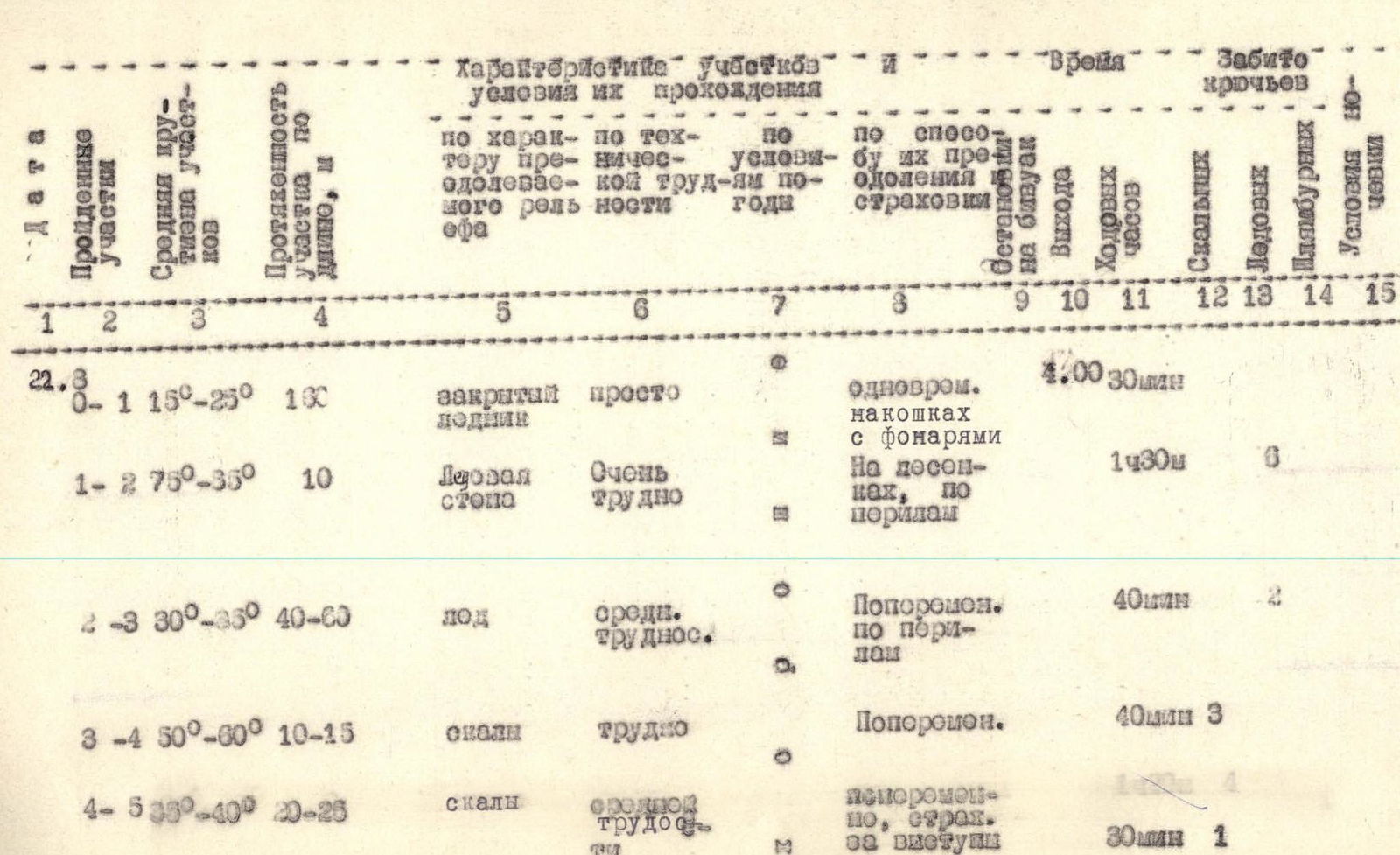
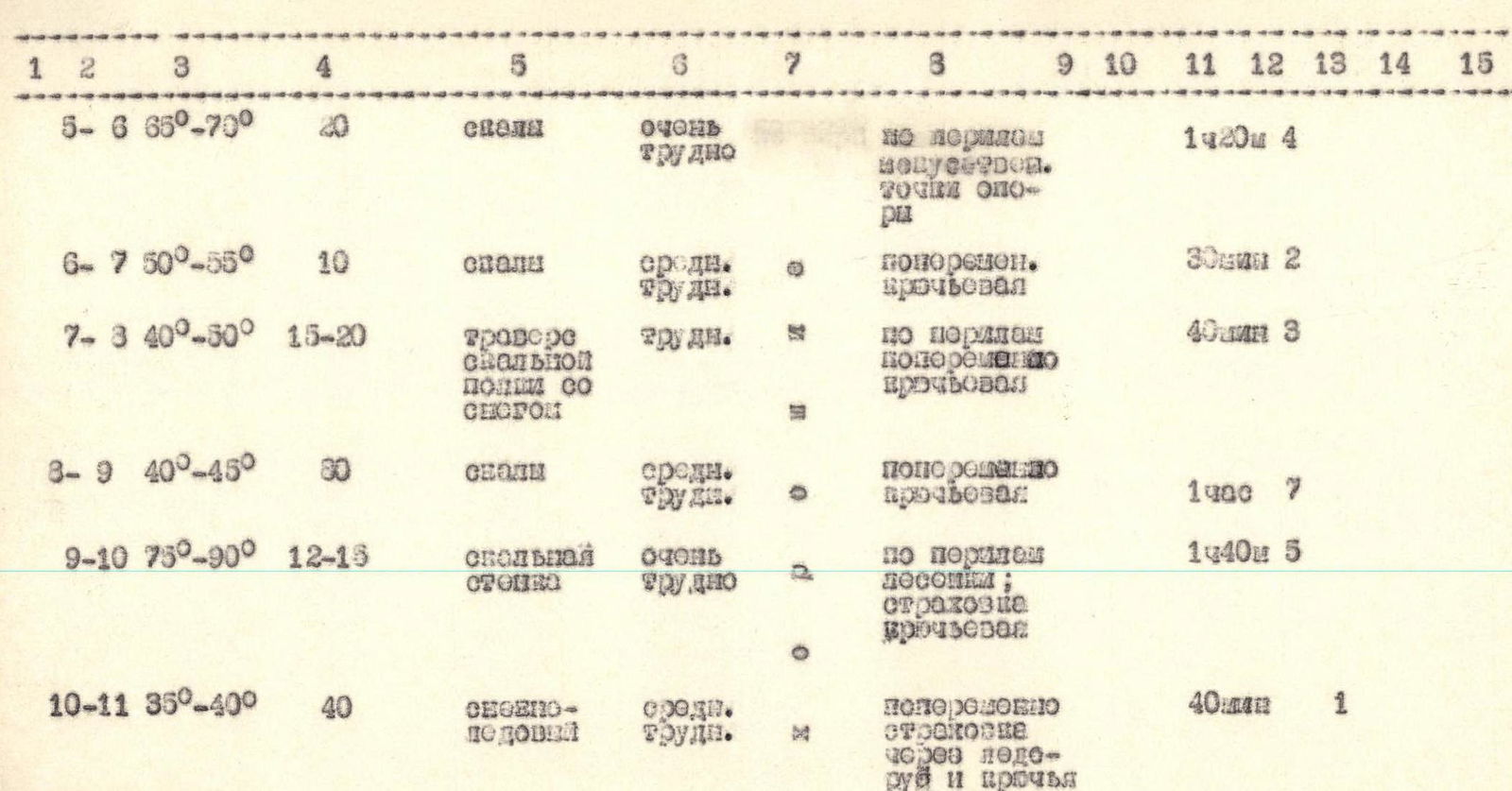
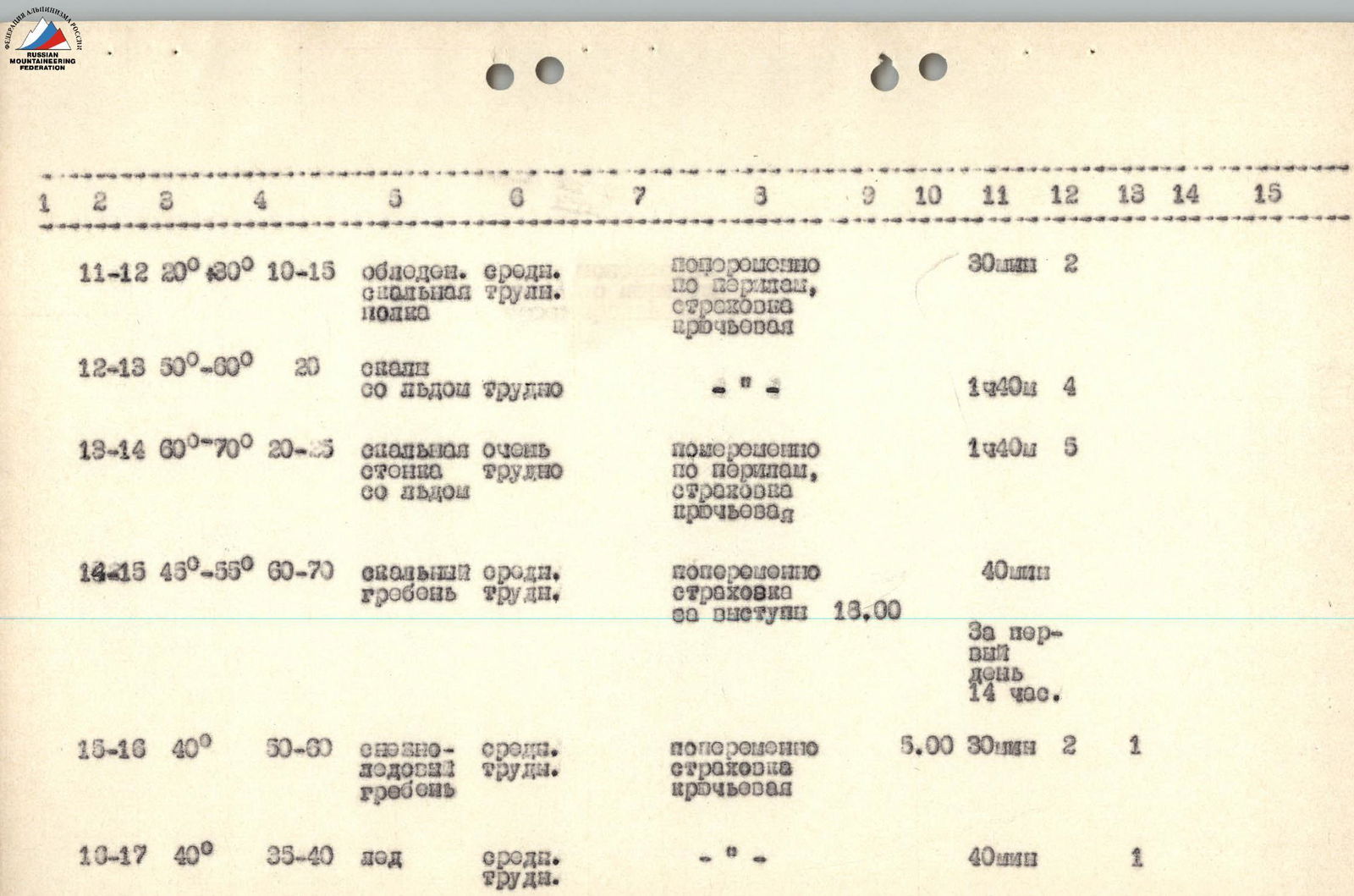
Characteristics of sections and conditions of their passage
| Section | Length, m | Relief | Technical difficulty | Method of overcoming, insurance | Time | Pitons hammered (rock / ice / shl.) | Overnight stay conditions |
|---|---|---|---|---|---|---|---|
| R0–R1 | 150–250 | Closed glacier | Easy | Simultaneously, in crampons, with headlamps | 4 h 30 min | 0/0/0 | |
| R1–R2 | 10 | Ice step | Very hard | On ladders, on fixed ropes | 1 h 30 min | 6/0/0 | |
| R2–R3 | 40–60 | Approach | Medium difficulty | Alternating, on fixed ropes | 40 min | 2/0/0 | |
| R3–R4 | 10–15 | Rocks | Hard | Alternating | 40 min | 3/0/0 | |
| R4–R5 | 20–25 | Rocks | Medium difficulty | Alternating, insurance for ledges | 30 min | 1/0/0 | |
| R5–R6 | 20 | Rocks | Very hard | On fixed ropes, artificial holds, pitons insurance | 1 h 20 min | 4/0/0 | |
| R6–R7 | 10 | Rocks | Medium difficulty | Alternating, pitons insurance | 30 min | 2/0/0 | |
| R7–R8 | 15–20 | Traverse of rock ledge with snow | Hard | On fixed ropes, alternating, pitons insurance | 40 min | 3/0/0 | |
| R8–R9 | 80 | Rocks | Medium difficulty | Alternating, pitons insurance | 1 h | 7/0/0 | |
| R9–R10 | 12–15 | Rock wall | Very hard | On fixed ropes, ladders, pitons insurance | 1 h 40 min | 5/0/0 | |
| R10–R11 | 40 | Snow-ice | Medium difficulty | Alternating, insurance through ice axe and pitons | 40 min | 1/0/0 | |
| R11–R12 | 10–15 | Icy rock ledge | Medium difficulty | Alternating, on fixed ropes, pitons insurance | 30 min | 2/0/0 | |
| R12–R13 | 20 | Rocks with ice | Hard | 1 h 40 min | 4/0/0 | ||
| R13–R14 | 20–25 | Rock wall with ice | Very hard | Alternating, on fixed ropes, pitons insurance | 1 h 40 min | 5/0/0 | |
| R14–R15 | 60–70 | Rock ridge | Medium difficulty | Alternating, insurance for ledges | 40 min | 0/0/0 | |
| R15–R16 | 50–60 | Snow-ice ridge | Medium difficulty | Alternating, pitons insurance | 5 h 30 min | 2/1/0 | |
| R16–R17 | 35–40 | Ice | Medium difficulty | 40 min | 0/1/0 | ||
| R17–R18 | 12–15 | Rock wall with flow ice | Very hard | On fixed ropes, artificial holds, pitons insurance | 1 h 30 min | 5/0/0 | |
| R18–R19 | 40 | Ice | Medium difficulty | Alternating in crampons, pitons insurance | 30 min | 0/1/0 | |
| R19–R20 | 12–15 | Ice wall | Very hard | On fixed ropes, ladders, pitons insurance | 1 h 20 min | 0/5/0 | |
| R20–R21 | 200–250 | Traverse of snow-ice slope | Medium difficulty | Alternating in crampons, pitons insurance and through ice axe | 50 min | 0/2/0 | |
| R21–R22 | 120–140 | Snow-covered rock ridge | Medium difficulty | Alternating, insurance for ledges | 50 min | 0/0/0 | |
| R22–R23 | 200–250 | Rock ridge | Easy | Simultaneously | 40 min | 0/0/0 |
View of the upper part of the route
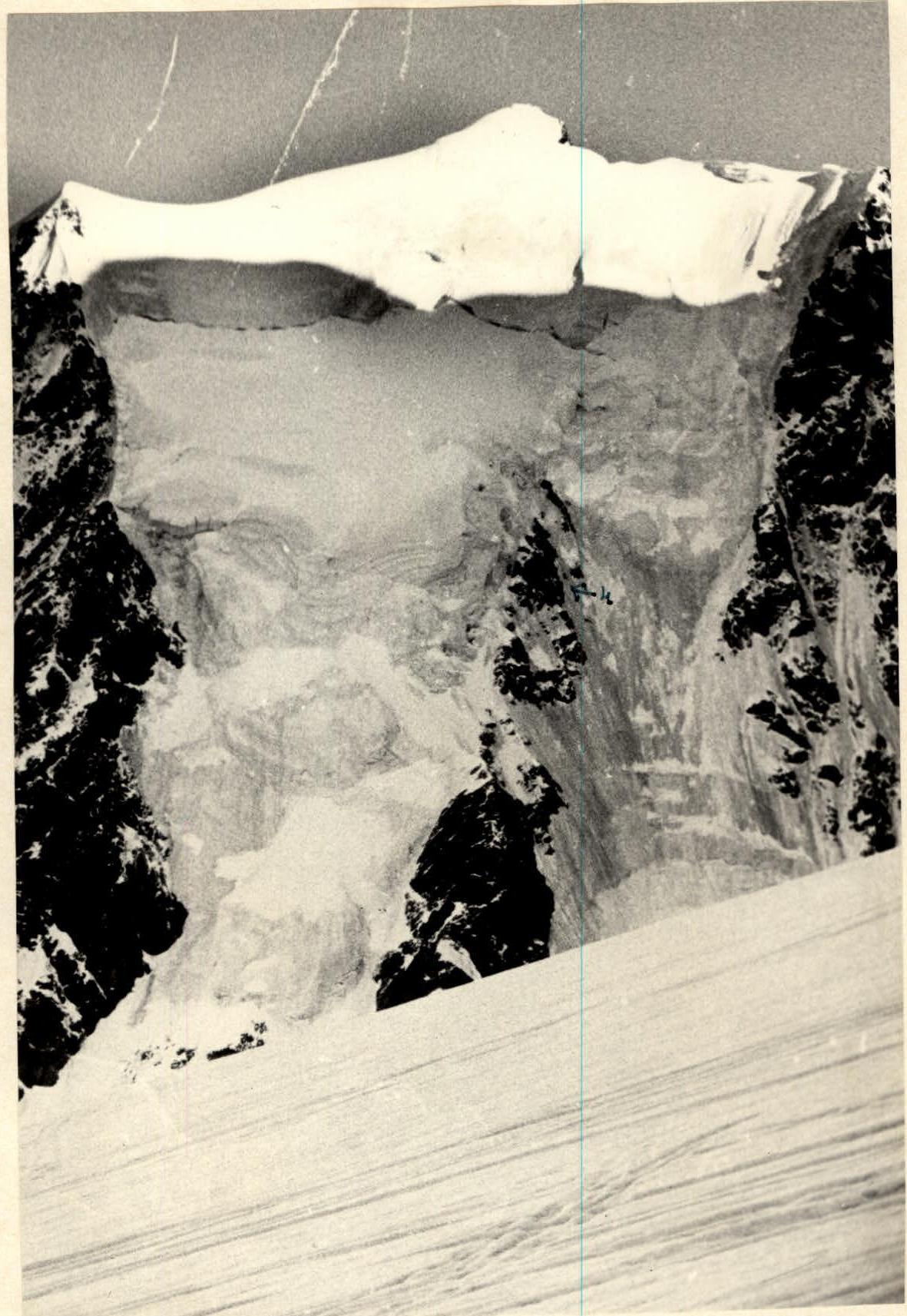
Fragment #1
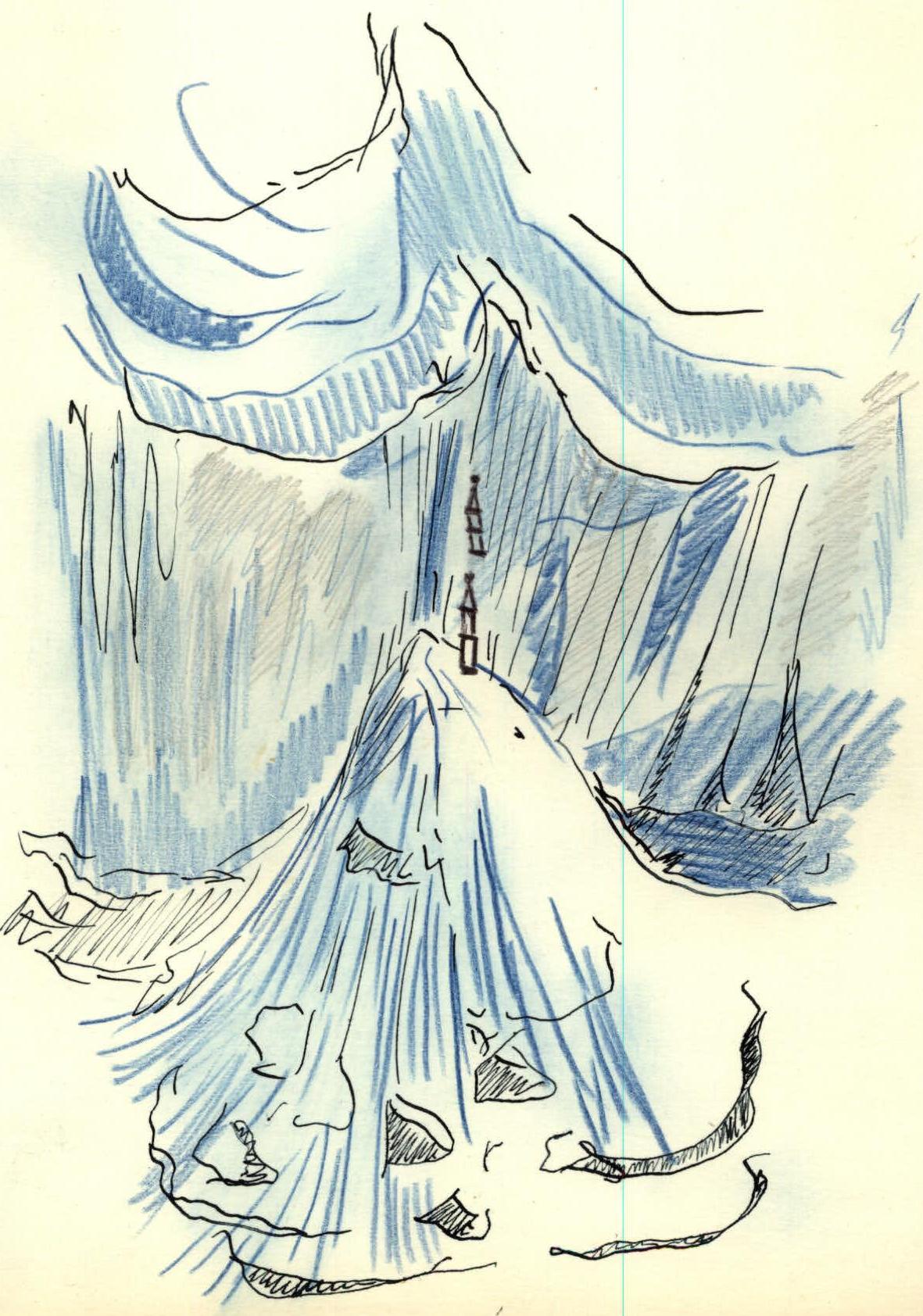
Fragment #2 Wall
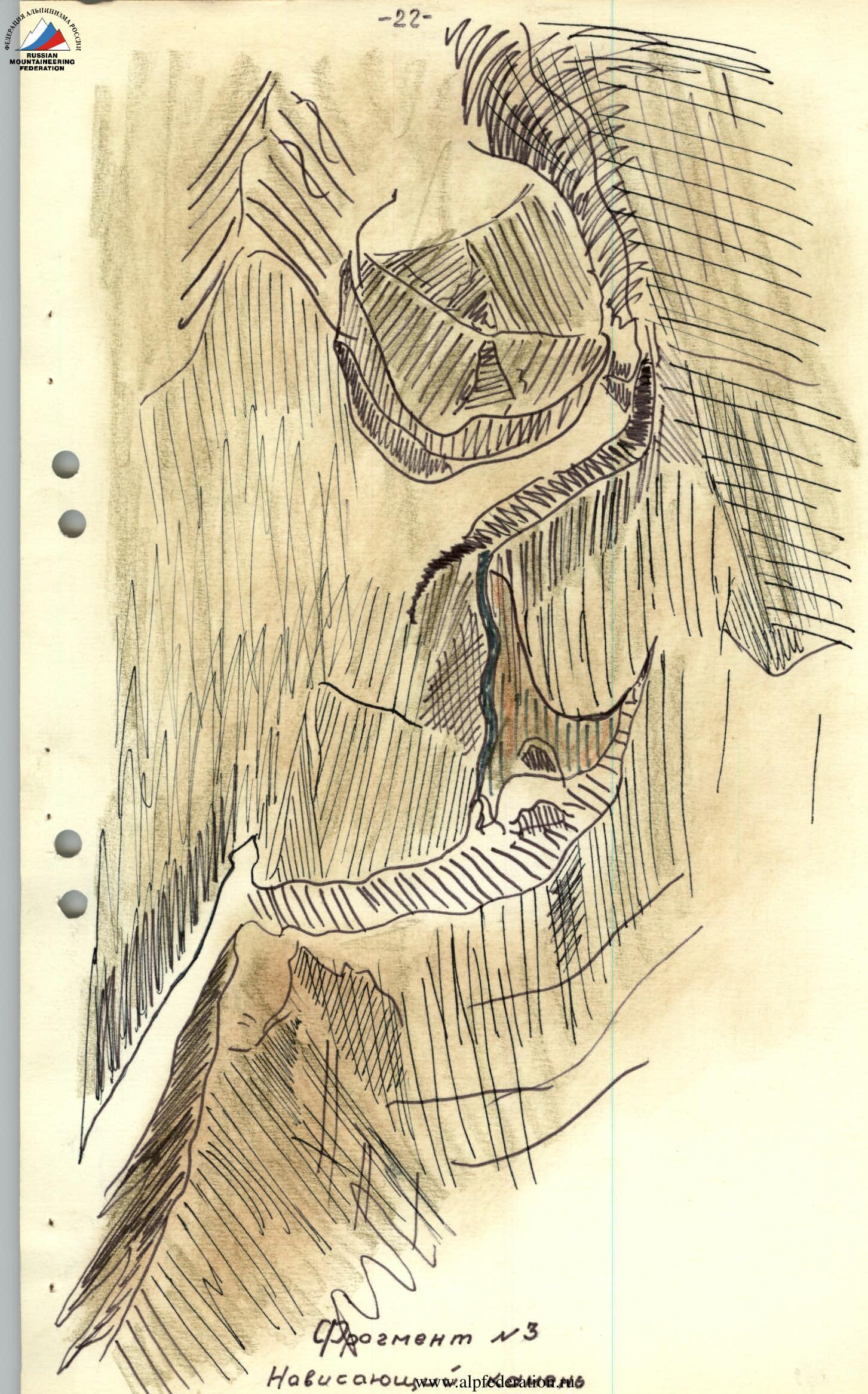
Fragment #3 Overhanging stone
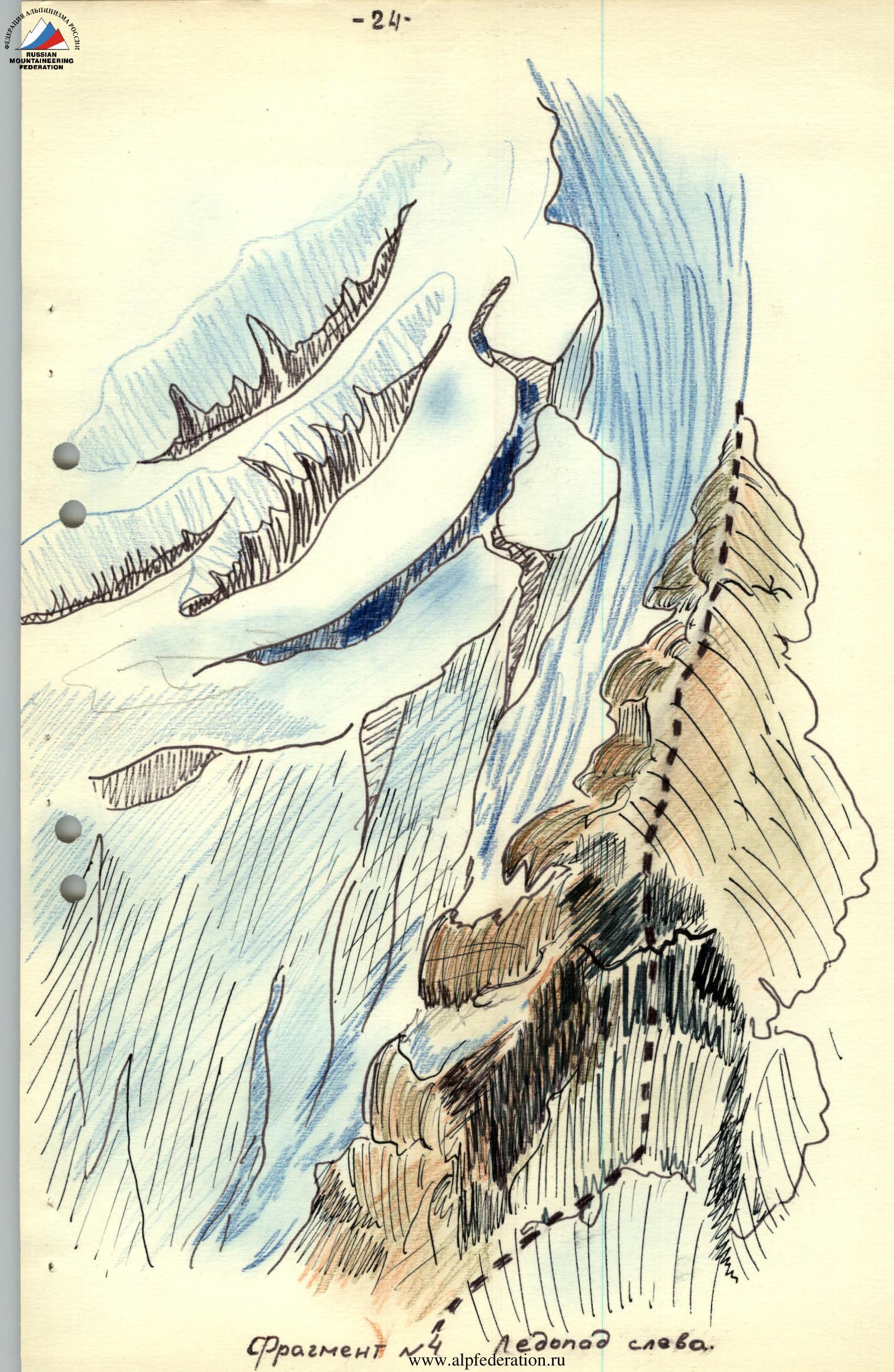
Fragment #4 Serac on the left

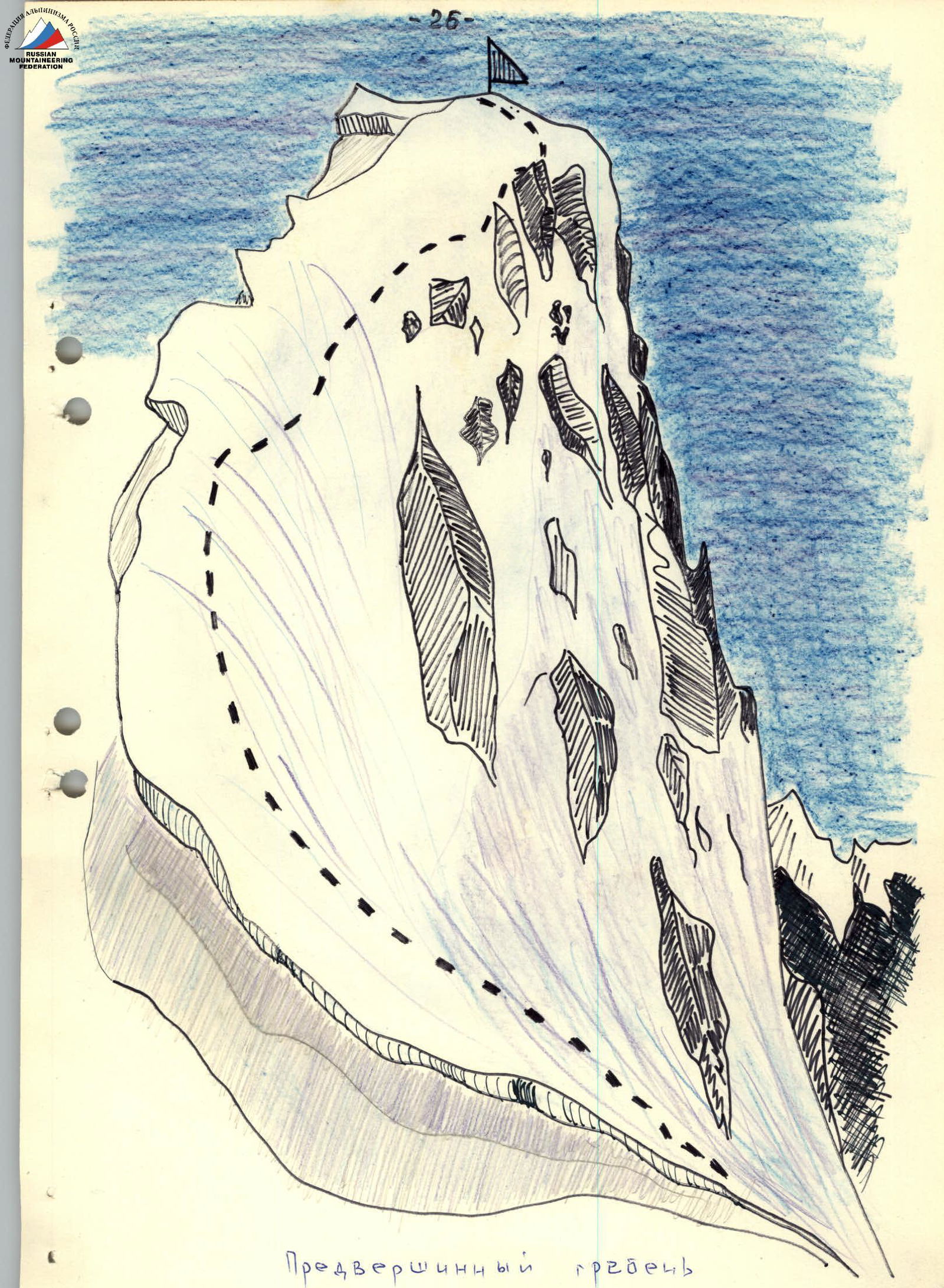
Pre-summit ridge