
Open Summer Championship of St. Petersburg on mountaineering 2004
Report
on the ascent to v. Galdor Main (4130 m) by the Southeast wall, 5B category of difficulty of the youth team of St. Petersburg on mountaineering
Head
Coach
Koltunov O. S.
Lobachev E. A.
2004
Contact Information:
188350, Gatchina, Leningrad region, 25 October Ave., 46, apt. 55, tel. 82137313452, lea@pnpi.spb.ru to Lobachev Evgeny Alexandrovich
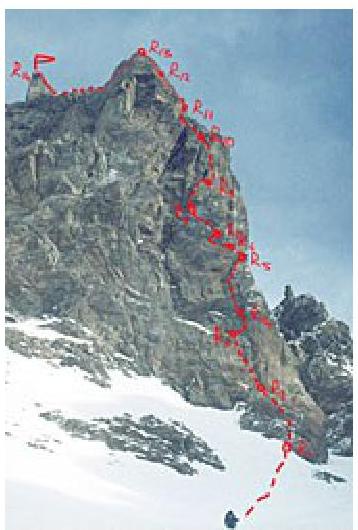
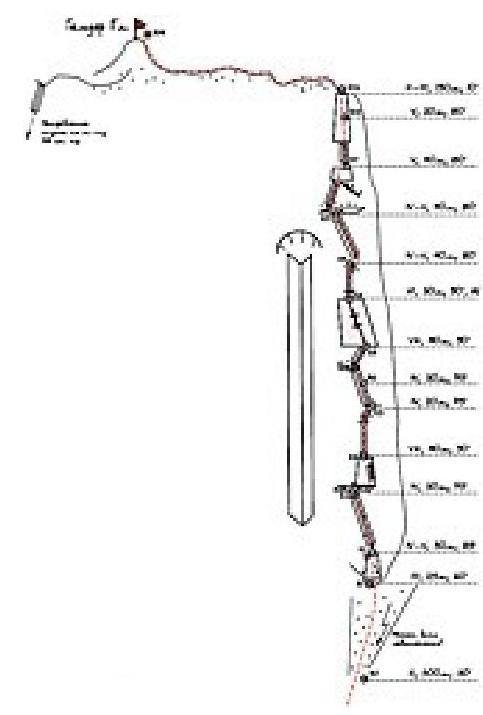
Ascent Passport
- Ascent class: technical
- Digoriya, eastern part of Central Caucasus
- Galdor Main peak (4130 m) by the Southeast wall, 5B category of difficulty
- Route characteristics
- Route height difference 1330 m.
- Route length 900 m.
- Wall section length 380 m.
- Length of sections IV–V cat. diff. 310 m.
- Length of sections VI cat. diff. 20 m.
- Average steepness of the route 68°.
- Pitons hammered: rock 3; ice 0; placements 58.
- Number of walking hours/days: 19 h/1
- Processing 6 h; overnight stay at camps under the route
- Leader — Koltunov Oleg Sergeevich 1st sports category
Participants:
-
Kochan Gennady Mikhailovich MS
-
Ziderer Oleg Vladimirovich 1st sports category
-
Batulov Alexander Vladimirovich 1st sports category
-
Viskov Igor Vladimirovich 1st sports category
-
Pushkareva Dina Arkadyevna 1st sports category
- Coach: Lobachev Evgeny Alexandrovich
11:02:08.2004 — route processing 03:08:2004 — departure on the route postponed due to bad weather 04:08:2004 — work on the route and descent to camps
Brief overview of the ascent area and arrival options
The object of the ascent — Galdor Main peak (4130 m) — is located in the Digoriya mountain region, in the eastern part of Central Caucasus, in the central part of the Sugansky ridge, between the peaks of p. Botkina and Tsukhgart. The area is well освоен by mountaineers (see A. F. Naumov, "Karaugom, Digoriya, Tsey").
Arrival to the ascent area is carried out as follows:
- from the cities of Vladikavkaz, Nalchik to the village of Sturdigora,
- then along the road up the gorge 4 km to the AOB "Digoriya" of the "Rostselmash" plant.
The approach to the route takes 6–7 hours of walking time:
- from the base camp up the road to its end (1.5 h),
- then along the trail to the fery (0.5 h),
- from the fery, climb up to a small plateau and move in the direction of the ridge of p. Botkina,
- cross the river and, crossing the ridge, climb to the lower Galdor camps.
From here, to the right up along the ridge in the direction of the large couloir descending from the saddle between the Middle and Small Galdor. The entire path from the fery to the upper Galdor camps takes 4 h.
Preparation for the ascent
In the autumn-winter period, the team trained on climbing walls in St. Petersburg and Gatchina, as well as on natural rock relief in Karelia. Participated in:
- cross-country running,
- ski racing,
- other rated competitions,
based on the results of which the youth team was formed.
Tactical actions of the team
The weather in the Digoriya gorge area is extremely unstable, so for a safer and more successful passage of the route, it is preferable to have some time reserve. The group developed a tactical plan involving preliminary processing of the route and one overnight stay on the mountain.
According to the plan:
- on August 2, 2004, the duo Ziderer — Pushkareva went to process the wall section of the route and hung two ropes.
- on August 3, 2004, the entire team's departure was planned, but due to a thunderstorm and rain that continued for almost a day, the group stayed in the camp.
On August 4, the weather improved in the morning, and at 4:00 the team departed for the ascent. The hung ropes were icy due to the worsened weather, and the participants' jumar slipped when moving along the perlines.
- The rocks were icy
- A strong wind was blowing
- The fog greatly limited visibility, which also hindered movement
Despite this, the processing allowed the team to pass the route without an overnight stay.
The most labor-intensive sections were the 3rd and 6th ropes, which were chimneys filled with ice.
The first to climb the entire route was Koltunov Oleg.
Clothing and equipment by sections:
- 3rd rope: climbed in crampons;
- the remaining 6 ropes to the ridge: in rock shoes;
- along the ridge: in boots.
The team of 6 people took 5 ropes, which allowed all participants to move on the wall section along the perlines with top rope protection. The perlines were fixed by the second participant in 2–3 intermediate points — the rope was less springy, and the other participants could move along one rope simultaneously on different sections of the perlines. The group's movement speed was determined by the first.
On the ridge, the group gathered together. On the last wall ropes, the bad weather worsened, and snowy grains fell. When exiting to the ridge, a thunderstorm began, and doubts arose about the advisability of continuing movement along the ridge: it was known to the participants from descriptions of the area that Galdor is often struck by lightning due to the high level of iron content in the rock. A possible safe overnight location was determined.
During the gathering of the group and a brief discussion of further actions, there were no arguments, and it was decided to continue moving, but for safety reasons, not along the ridge, but slightly lower. The relief and amount of ice forced the organization of movement along the perlines.
The team reached the summit on August 4, 1953, at 18:00. The descent was carried out according to the description along the route of 4a category of difficulty. The group descended to the saddle in the dark, but the path to the camp along the snowy couloir was known and easily feasible with the light of headlamps. The group approached the tents in full composition at 23:00.
During the passage of the route, there were no:
- work-related cripples
- injuries
- frostbite
Team nutrition: individual snacks (dried fruits, nuts, crackers, sausage, candies), in addition, the group had a stove, dishes, and products calculated for an overnight stay on the route.
The route is rockfall-prone, with many "live" stones, and due to the cold snap, the rocks were strongly icy, and when the first participant moved, ice fragments were dangerous for those below. Therefore, for safety reasons, the "thread" of the route was chosen so that it passed aside from the insurance point. Stations were usually on small ledges, and the last ones had to wait until they were freed.
The team used a VHF radio "SOVA", which worked on constant reception. The second radio was at the camps with the observer — coach E.A. Lobachev, who, in turn, communicated with the "Digoriya" camp using a HF radio "KARAT".
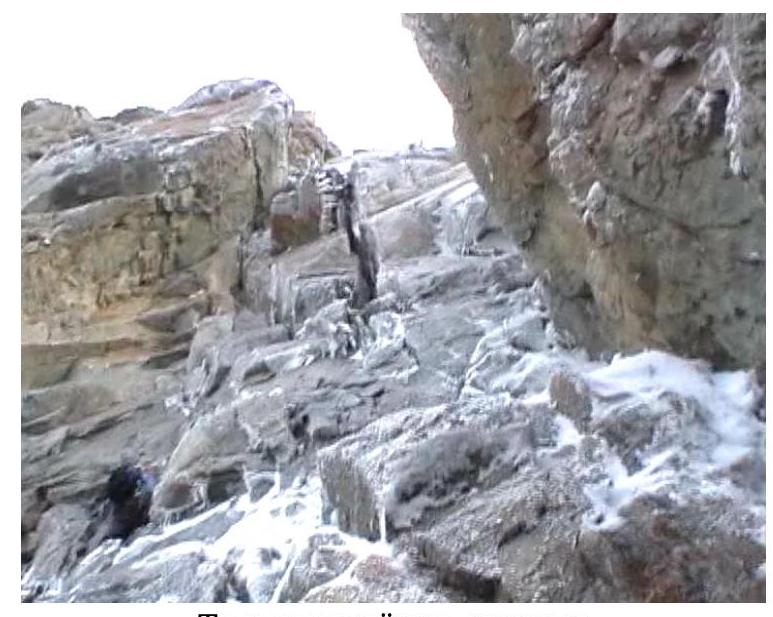
Third rope, start
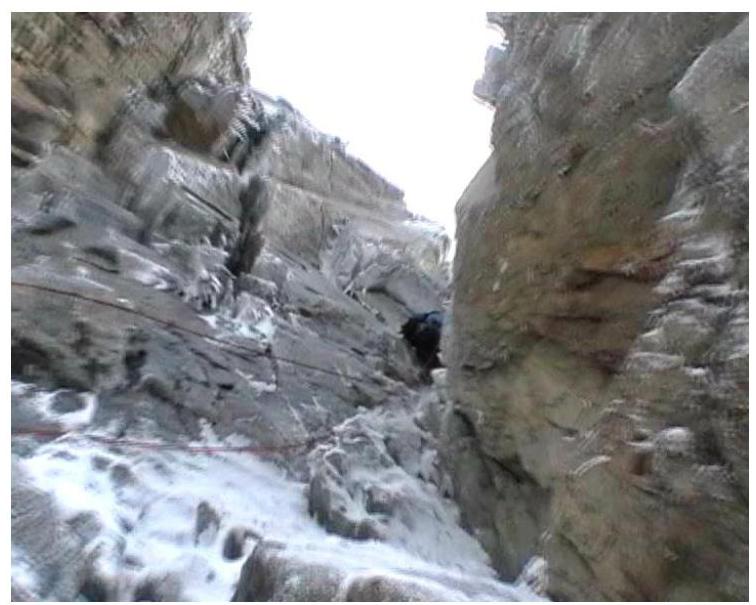
End of the third rope
Route description by sections
R0–R1 Snow-ice couloir. R1–R2 Snow-ice slope, approach to the start of the rock section. R2–R3 Section of medium difficulty (system of alternating ledges, rocks are highly destroyed).
3–4 Internal corner with nathewn ice and a small number of holds, insurance through placements, leads to a small ledge.
4–5 Steep complex wall with small holds, insurance through placements, move in the direction of two cracks.
5-6
Along the left crack straight up to its middle, here is a station, insurance through pitons.
6-7
Traverse left and straight up along a steep wall with small holds, insurance through pitons.
7-8
- Large ledge at the base of a large fault.
8-9
- Wall with a small number of holds, hanging station, insurance through pitons.
9–10 To the right, traverse into an internal corner, closed at the top by a plug. Good cracks for placements. Leads to a small ledge.
10–11 From the ledge, up a steep internal corner. Holds are good, but many "live" stones. Insurance through placements. Leads to a small ledge. Here is a good station.
11–12. Along a steep wall in the direction of a large internal corner. 12–13. Approach the internal corner along a small ledge and along the right part of the internal corner with a transition in the upper part to the left part — exit to a ledge, good station through a выступ. Insurance through placements.
13–15. Wall with the character of rocks "ram's foreheads", sloping holds, small placements are used for insurance.
Straight up in the direction of an overhanging chimney, and then:
- left traverse through a large crack,
- along a crack going left, climb up to the edge of a large fault.
Insurance through pitons and placements.
15–16 Along the wall, along an ice-filled crack straight up 15 m, and then go left to an overhang and straight up to a ledge. Key section of the route.
16–17 Internal corner with good holds.
17–18 System of ledges and internal corners with good holds.
Insurance through placements.
18–19 Large rock ledge.
19–20 Smoothed internal corner.
Insurance through large placements.
20–21 Wall with good holds. Organizing insurance points is difficult due to a lack of cracks. Insurance through pitons.
22–23. The same rock relief as on the previous section. Exit to the ridge. 23–24. Narrow rock ridge. Insurance through выступs.
Fourth rope — on perlines
Equipment table
| № | Name | Quantity | Weight | Total weight |
|---|---|---|---|---|
| 1 | Main rope | 5 | 3.0 | 15 |
| 2 | Rock hammer | 2 | 0.7 | 1.4 |
| 3 | Ice axe | 5 | 0.5 | 2.5 |
| 4 | Ice axe | 1 | 0.8 | 0.8 |
| 5 | Crampons | 6 | 0.5 | 3.0 |
| 6 | Rock pitons | 5 | 0,1 4 | 0.7 |
| 7 | Ice pitons | 2 | 0,1 5 | 0.3 |
| 8 | Placement elements | set. | 0.7 | 0.7 |
| 9 | Friends | set. | 1.5 | 1.5 |
| 1 0 | Loops | 20 | 1 | 1 |
| 1 1 | Harnesses | 6 | 0.3 | 1.8 |
| 1 2 | Climbing jumar | 10 | 0.2 | 2 |
| 1 3 | Brake device | 6 | 0.1 | 0.6 |
| 1 4 | Carabiners | 20 | 0.0 7 | 2.8 |
| 1 5 | Helmets | 6 | 0.6 | 3.6 |
| 1 6 | Tent | 1 | 3.0 | 3.0 |
| 1 7 | Stove | 1 | 0.5 | 0.5 |
| 1 8 | Gas | 2 | 0.2 5 | 0.5 |
| 1 9 | Headlamp | 5 | 0.1 | 0.5 |
| 2 0 | First-aid kit | 1 | 1 | 1 |
| 2 | Radio | 1 | 0.3 | 0.3 |
| :-- | :-- | :--: | :--: | :--: |
| 1 |
Total weight of equipment — 42.5 kg
Stenogram of the ascent discussion to Galdor Main peak by the SE wall, cat. diff. 5B
Present:
Levkovsky Yuri Vasilyevich, responsible for safety AUSB "KomyArt" Digoriya
Lobachev Evgeny Alexandrovich, head of UTS FASiL St. Petersburg, CMS, instructor II category
Kochan Gennady Mikhailovich, MS, instructor II category
Koltunov Oleg Sergeevich, 1st sports category, ascent leader
Ziderer Oleg Vladimirovich, 1st sports category, instructor-trainee
Batulov Alexander Vladimirovich, 1st sports category
Viskov Igor Vladimirovich, 1st sports category, instructor-trainee
Pushkareva Dina Arkadyevna, 1st sports category, instructor-trainee
Batulov: According to the developed plan, the duo Ziderer — Pushkareva departed on August 2, 2004, from the Nakhashbita glade to the Galdor camps with part of the base camp, on August 3, 2004, they climbed under the route and hung two ropes. We (I, Kochan, Koltunov, Viskov, Lobachev) arrived on August 3, 2004, with the remaining part of the camp. The departure on the route was scheduled for August 4, 2004, at 4:00. But at night, a thunderstorm broke out, it was raining, and the departure was postponed to the next day. On August 5, 2004, we got up at 3:00, departed at 4:00. The night was warm, so the snow did not freeze, and it was not possible to quickly climb the couloir in crampons. We approached the route at 8:00. The hung ropes were icy, and the jumar slipped.
- Koltunov climbed the third rope in crampons, as the rocks were covered with ice.
- On the fourth rope, he put on rock shoes.
- He led until exiting to the summit.
- It was necessary to move very carefully, as the route turned out to be extremely rockfall-prone.
The location of the control tour did not correspond to the description. In the tour, we found a note stating that the route was passed exactly three months ago, on May 4, 2004.
We gathered together when exiting to the ridge. By this time (17:00), a thunderstorm began. After a brief discussion, it was decided not to wait out the bad weather but to continue moving. Due to the thunderstorm danger, we did not exit to the ridge but moved slightly lower, hanging perlines.
After exiting to the summit at 18:00, we began descending along the route of 4B category of difficulty, hung 7 rappels to the saddle, and from it descended on foot to the couloir below the start of the route. During the descent, the weather improved, and we saw the base camp.
The ascent took 19 hours, not counting the processing time. The team carried a bivouac with them, as an overnight stay was planned based on the description. The tent was too cramped for six people, and this played a role in the decision to descend faster and not spend the night on the mountain.
Levkovsky: What was used during the passage of the route?
- pitons
- placements
Batulov: We used friends and placements, as well as pitons left on the route by previous teams.
Ziderer: When we were hanging the ropes, stones were falling from the left. A stream was flowing from the left along the wall, with water and ice falling.
Batulov: On the day of the ascent, everything froze, but due to the strong destruction of the rock, it was constantly necessary to remember about the stones.
Viskov: I was going last, removing all points, and did not see the first. The hung ropes were heavily icy. When moving up, especially on the third rope, snow, ice, and stones were falling from above, I was covered in snow and hid under carnières.
I was hanging all the ropes on the descent, as I was previously on the route we descended (category of difficulty 4B) and knew where the descent loops were located. I descended before it got completely dark, and the last one arrived when it was already dark. We descended from the saddle along the snow quite slowly due to the darkness.
Ziderer: On the route, I was not leading and almost rested for the first time. I was going third. I saw the route when we processed it, and in a day, the weather changed it a lot. It was almost a Crimean warm wall, but on the day of the ascent,
- It was heavily icy. Previously, when approaching the wall, it took 1.5–2 hours to climb the couloir on frozen snow, but after the bad weather and warm night, the snow became soggy and did not hold, and we climbed for about three hours. But no one wanted to spend the night, we worked harmoniously, each had their own responsibilities.
Levkovsky: What recommendations would you give: how many ropes should be hung?
Ziderer: Three are needed. Kochan: If the weather is good, processing is not required. Ziderer: Processing saved about two hours (in good weather). If we had to climb them, we would have to spend the night.
Pushkareva:
- On the day of processing, stones were falling from the right along the couloir, which can be dangerous;
- To the left of the start of the route, a stone or ice can fly from the stream. During the ascent, visibility was poor, and the route was not well observed.
Kochan: The ascent was enjoyable. The route corresponds to the declared category. But for us, it was not a rock route but a combined one, as there was a lot of snow and ice.
Leader:
- Led the entire wall as the first.
- Led calmly and unobtrusively.
- Leadership is counted.
- Chose the path competently.
- The correct choice of path was indicated by constantly encountered pitons and stations of previous groups.
Weather: comparable even to a winter ascent.
Group: worked normally, despite all weather conditions.
Koltunov: I was surprised that the route is classified as a rock route. When passing the third rope, I was confident that we would spend the night on the mountain. On the fourth rope, it became easier, and the pace increased. Sasha, the second, approached me quickly and did not let the third one to my station to ensure maximum speed and reliable insurance for me.
Kochan: The first climber should give away their backpack earlier. You only took it off in the ice couloir.
Levkovsky: Was ITO used? Koltunov: Yes, where there was ice. I rested and warmed my hands, hanging on placements. Or stood with my foot.
Levkovsky: Where was the ice? Koltunov: Mainly in the lower part, in some places. Ice was on:
- the third rope,
- the sixth rope (large fault, i.e., both camans).
Levkovsky: What was used to pass the ice?
Koltunov: The third rope — in crampons, with placements and friends. On the sixth rope, I was not sure about the choice of path, climbed in shoes, then understood that it was correct, and passed the key section in shoes.
Kochan: In general, the entire route is climbed without ITO, but the weather forced them to use it.
Koltunov: The team's actions pleased me. We worked harmoniously, like a mechanism. The last one did not restrain the movement. The equipment was passed on time.
Lobachev: If you were to go again, what would you change? Koltunov: If the weather were good, it would be possible to go without processing.
Lobachev: In the opinion of the coaching council, both the leadership and the ascent are counted.
Levkovsky: I believe that the group performed well and reliably. Congratulations to everyone on the ascent.