
Ascent
TO THE 3RD WESTERN SHKHELDA-TAU
Via the Northern Wall
The group consisted of:
- Koptev V. - leader
- Minin Yu. - participant
- Aleksashin L. - participant
- Bozhukov V. - participant
MOSCOW 1960
Brief Characteristics of the Ascent Object
The 3rd Western Shkhelda-Tau (Peak Aristova) is one of the peaks in the Shkhelda-Tau massif, located in the central part of the Main Caucasian Range. The most well-known routes to the summit are:
- the path from the south (category 4A)
- the path from the north - known as Shmaderer's path (category 5A)
In 1956, a new variant of the ascent route to the 3rd Western Shkhelda-Tau from the north was traversed - via the rocky outcrops of the northern wall, descending directly from the summit. The curved ridge of icy rocks, covered in snow, greatly resembles a silvery fish, hence the name of the route - to the 3rd Western "via the fish". This route:
- was claimed by groups from "Lokomotiv" and Bauman Moscow State Technical University (BMSTU) for the Union's primacy
- was traversed by these groups
- was rated as a route of the highest difficulty category
The groups traversed slightly different variants of the path: Yeliseev's group ("Lokomotiv") went through the middle part of the wall along the far left rocks of the "fish", while the BMSTU group - V. Ivanov and A. Osintsev - traversed to the right of the rocks via a steep icy slope, but both groups unanimously considered the route to be among their best ascents.
After 1956, no group traversed this route until August 1960 - four years after the first ascents - when a group from the "Djan-Tugan" alpine camp, consisting of Koptev V., Aleksashin L., Minin Yu., and Bozhukov V., set up camp at the foot of the wall. The group leader was Koptev.
The ascent was preceded by joint training in the camp area and training ascents to the peaks:
- Djan-Tugan
- Bashkaru
Before entering the mountains, the group members conducted regular training in Moscow.
Information about the Ascent Participants
| Name | Year of Birth | Category | Profession | Membership in Sports Society |
|---|---|---|---|---|
| Koptev V. | 1931 | 1st sports category | Engineer | NII "Trud" |
| Minin Yu. | 1931 | Master of Sports | Engineer | NII "Trud" |
| Aleksashin L. | 1931 | Master of Sports | Engineer | NII "Trud" |
| Bozhukov V. | 1933 | 1st sports category | Engineer | NII "Burevestnik" |
Brief Description of the Ascent
Day 1. June 30th, 15:00, after prolonged preparations, our group of four set out from the "Djan-Tugan" camp down to the Shkhelda valley. The backpacks, filled with equipment and a supply of food for 8 days, were very heavy, and the path to the overnight stay at the start of our route seemed long and difficult. Only in the twilight (or rather, in the dark) did we set up camp on the right orographic moraine of the glacier. We pitched a tent, had a light dinner, and went to sleep.
Day 2. Throughout the night and morning, we listened to the wall's activity to determine the safe passage time for certain parts of the route. From consultations with Ivanov, Suponitsky ("Lokomotiv"), and Yeliseev ("Spartak"), we knew that avalanches pass through the "fish tail" approximately from 10:00 to 14:00 when the sun heats the wall and illuminates the ice falls hanging on Shmaderer's ridge. However, no one had traversed this route for several years, and we wanted to know if time had made any changes to this schedule.
The night from June 30th to July 1st was clear and frosty. Neither at night nor in the morning, nor throughout the day, did we observe any avalanches or rockfalls in the area of our route. Only around noon, an ice collapse occurred on the neighboring Shmaderer's ridge, covering almost half of the entire ridge. Our observations only confirmed our assumptions that traversing any part of the route in the morning hours after a frosty night was completely safe. We decided to leave our movement plan unchanged. Here it is:
- August 1st - ascent to under the "fish tail", overnight stay
- August 2nd - early ascent, movement to the walls of the summit tower
- August 3rd - exit to the summit, overnight stay on the summit ridge
- August 4th - descent to the south and return to the camp
For the last time, we reviewed our equipment, checked the pitons, sharpened the crampons and tricouni nails. We spent a lot of time thinking about the food supply; our assortment was not very rich, and the overall weight was too great for a wall ascent. The final selection weighed 12 kg - slightly more than we needed for 3.5 days, but under favorable conditions, we planned to consume the excess on the first overnight stay. After checking the stove and cooking on dry alcohol, we chose alcohol - the fuel consumption by weight is the same, and it eliminates the need for a stove and flask.
We went to bed early - we had an early departure the next day to ascend to the beginning of the ridge on firm snow.
Day 3. August 1st, 1960.
We woke up early, and immediately, there was a problem - rain was pattering on the tent fabric. The departure was delayed, and it was only at 5:30 that our group left the moraine and, crossing the glacier, moved towards the wall.
The first rocky outcrop is bypassed via a snowfield to the right; crevices are overcome via bridges in the areas of avalanche gullies. The upper part of the snowfield is very steep, with ice under a thin layer of snow. We moved very carefully.
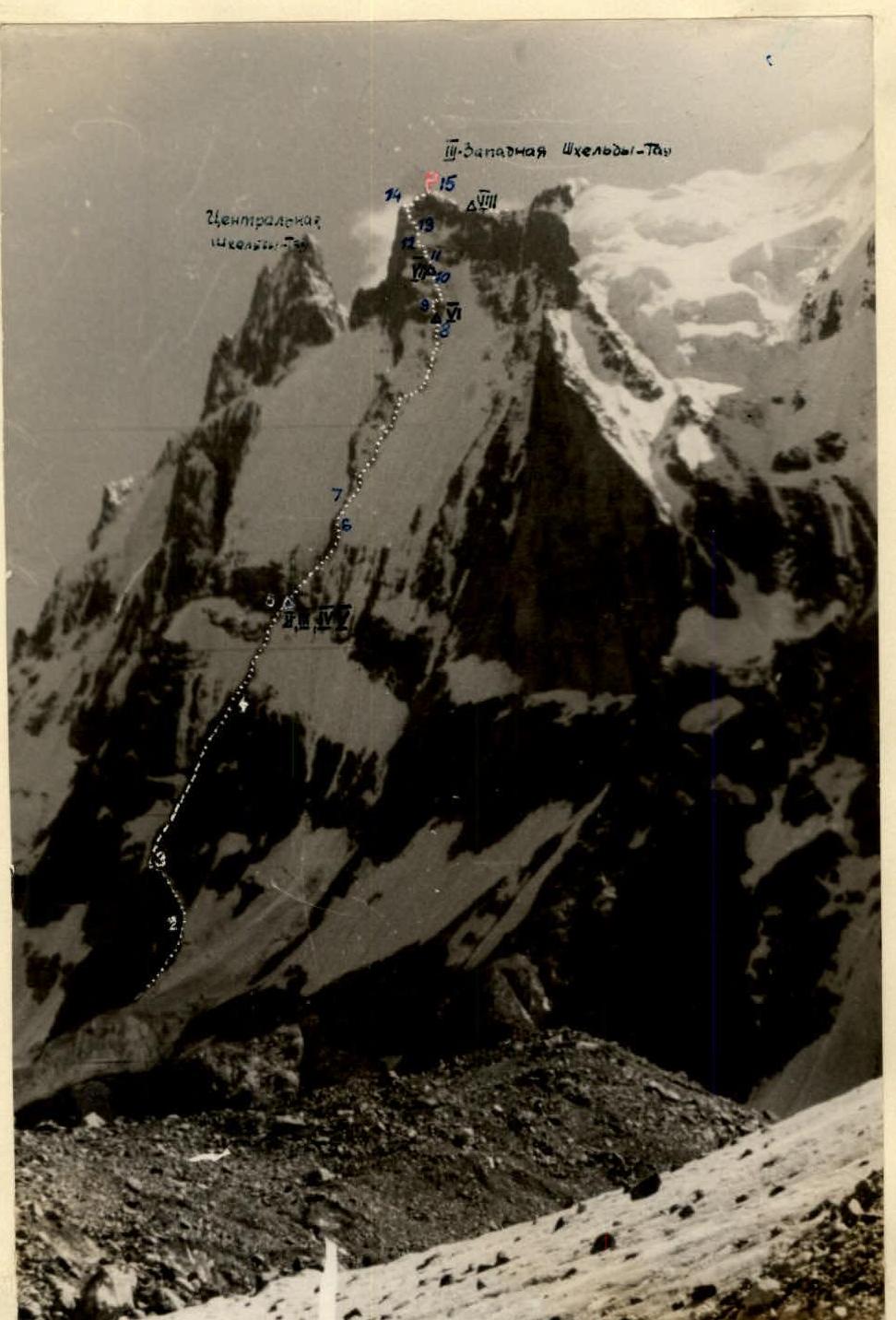
We gained height via a snowy ridge leading to the left (section R2–R3).
We exited onto rocks to the left of the path, then:
- with step cutting, we crossed the neck
- exited onto the rocks on the right side of the neck
Before exiting onto the rocks, we tied in. The rope teams were Koptev - Bozhukov and Aleksashin - Minin.
With piton protection, we exited onto a saddle via the rocks on the right side.
After resting on the saddle, we moved upwards. The rocks were very solid, and the climbing was of moderate difficulty. There were walls of 10–15 meters with small but reliable handholds.
The sun was shining now; Elbrus was fully visible, but unpleasant clouds were creeping up the valley. The weather was uncertain but not particularly alarming.
We climbed this wall (in our description, "frightening in appearance") for about 1.5, 2 hours. The movement was alternating with protection through outcrops; occasionally, we hammered in pitons. The second team often moved simultaneously and did not lag behind the first.
While traversing the wall, we stayed on its right side. The couloir passing to the left became very steep in its upper part, and it was not advisable to go through it. Above, the rocks became simpler - the wall turned into a ridge, along which we could mostly move with simultaneous protection, laying the rope over outcrops (section R4–R5).
To the left was a steep ice fall, where avalanches frequently roared down from the upper snowy slab of Central Shkhelda; to the right was a snowfield, where smaller avalanches ran down from Shmaderer's ridge. And today, the avalanches did not start very early: while we were traversing the lower part of the route, there were no avalanches.
After the final ascent of the ridge and beyond it, there was a small platform paved with slabs. The platform was small but protected by an overhanging rock from the fairly frequent flying icicles and stones. They whizzed to the left and right and diverged to both sides of the ridge we had traversed, leaving the lower part of the route safe.
On the platform, there was a cairn - with a can containing a note from Ivanov and Osintsev dated August 18th, 1956. For a moment, conversations ceased - we remembered our friends whose lives were cut short in the moments of struggle against the formidable forces of nature. We decided to dedicate our ascent to the memory of V. Buyanov and A. Osintsev.
We set up camp at 13:00, having spent an hour less on the first section of the route than Ivanov and Osintsev - we gained time, obviously, at the bottom, where we traversed easily and quickly through the snow.
Bad weather began - rain, sleet, and thunder rumbled somewhere. We spent about an hour improving the platform. We hammered in pitons, pitched a tent, and fetched water. Preparing soup and tea took 200g of dry alcohol. We often had to shake snow off the tent roof; it was falling very intensely. Over several hours, about 20–25 cm of snow accumulated around our tent. If it didn't freeze overnight, we couldn't ascend upwards the next day. The route above us, for 200 meters, was blocked by avalanches; we had seen a lot of them today:
- avalanches descended in the immediate vicinity of the route
- the number of descents was significant
- avalanche activity was constant
At 20:00, we lit a signal match, but received no response from the observers below; apparently, they couldn't see us. We fell asleep to the accompaniment of thunder and the roar of avalanches.
Day 4. August 2nd. Hiding out. It was snowing, warm, and the rocks were covered in wet, slushy snow. Throughout the night, morning, and day, avalanches descended to the right and left of us. We decided to stay put for now - our food supply turned out to be slightly more than planned; each of us had "absent-mindedly" taken something extra:
- a pack of concentrates
- a can of preserves
- some bread
Towards evening, it cleared up a bit, but snowfall resumed at night.
Day 5. August 3rd. Hiding out. In the morning, we had a long discussion - it was a shame to go down, and it wasn't safe either - all the avalanches descending from our starting point's left side (we had exited via a snowfield under Shmaderer's ridge). Our leader was in a fighting mood; he even suggested making a light reconnaissance upwards on a rope - two people - but after another large avalanche that brought down a "suitcase" that flew within 10 meters of us, this proposal was dropped. We spent the day:
- reading a magazine in German (this required effort from all group members)
- playing "sea battle"
- playing several versions of "balda"
Day 6. August 4th. Finally, the long-awaited frost came at night, and in the morning, the sky above us was blue and clear. We decided to move upwards. We quickly gathered our gear, drank hot coffee, and at 4:00, the first rope team exited onto the route. The rocks were cold, the snow was frozen, and this only pleased us - it meant:
- the avalanches would be silent
- the stones would stay in place
The rocks leading to the "fish tail" were not very steep and relatively simple, but there was a lot of snow and ice. We moved alternately, carefully protecting ourselves via outcrops. The "fish tail" saddle - ice with rocks protruding in places, smoothed by avalanches. The length of the saddle is about two rope lengths. The section is traversed with careful piton protection (both ice and rock pitons) and step cutting. The first rope team traversed this section without crampons; the second team wore crampons. Further movement went straight upwards. The route's character - rocks covered in snow, ice in places; the overall slope steepness increased. If on the saddle it reached 55°, then above it reached 65°. The rocks diverge in two rays from the saddle; the slabs in the couloir between the rocky sections are filled with snow. We decided to follow the right ray and stick to it for now. We moved with careful piton protection; the first rope team had to be especially careful - the second team was below, and the rocks were somewhat brittle in places.
The first wall, about 2 rope lengths long, was traversed. Although the route here was relatively safe, we tried to stick to sections protected from above by overhanging rocks, walls, and small ridges. Koptev, moving first, traversed under an overhanging wall where water dripped from numerous icicles and exited onto an icy slope onto a ridge where he received the second climber. Another 20 meters or so along the icy ridge, and a nasty-looking wall stood in our way. About a rope length long, dissected in its middle part by a smooth slab, it consisted of semi-destroyed rocks in its lower part, seemingly cemented only by ice. However, if the path below was clear - it required only extreme caution - then assessing the middle part from below was very difficult. We decided to orient ourselves on the spot and, having prepared a large set of pitons, Koptev began his ascent. The first section was traversed straight upwards, then a traverse to the left for about 7 meters, and from here, a section with tense climbing began. After receiving the second climber, Koptev moved further upwards, crossing the slab from left to right. Here, a small crevice, several cracks, and a narrow ledge were discovered. It was necessary to hammer in a piton for additional support. The second rope team followed exactly in the first team's footsteps.
The further path lay along an icy slope; we crossed it from left to right (about a rope length) and exited onto a rocky ridge where relatively simple climbing with protection via outcrops and pitons was possible. Our route led us to the right side of the "fish", although initially, we thought we would stick to the left part. Only the next day did we realize that, given the state of the route, the path via the left part would have been at least no easier. Moreover, to our left, snowy avalanches descended through the couloir, and moving along the left part of the "fish" implies exiting to the right afterwards. We moved without rest for 7 hours already - time flew by very quickly. Our ridge led us to a large rocky outcrop; it was time for us to rest and refuel. We snacked under the outcrop and moved forward. An attempt to exit onto the outcrop from the right was unsuccessful; Koptev had to return and move from the left - it was difficult but possible. A small section of simple climbing was traversed, and another wall, 15–20 meters high, appeared. Using a crack and an internal angle crossing the wall from left to right, Koptev exited onto the entire rope length, hammering in two intermediate pitons. The first climber from the second rope team traversed along the first rope team's rope, and the first rope team moved upwards again. Further, two walls of 3–4 meters led us to the base of a not clearly expressed icy ridge approaching the dark rocks of the summit tower. Somewhere there should have been a ledge under an overhanging rock and an overnight stay. Fatigue was already felt; it was getting colder, and sleet had been falling for a long time. The snow layer on the ice was very thin; stepping was unreliable, and we had to cut steps into the ice. Ice fragments flew directly onto the lower climbers; they had nowhere to hide, so we had to cut with small blows. Protection was via ice pitons; several dozen steps - and the first climber reached the tower's rocks. From below, it seemed there was a ledge, but here, there was a slope with a steepness of 40–45°. To the left, 12 meters away, a narrow ledge was visible under overhanging rocks. A narrow crevice led to it. Aleksashin tried to crawl through it but got stuck after a couple of meters and had to return. Meanwhile, Minin descended lower and traversed this section via the rocks. Climbing up to the ledge from below was very difficult; he had to remove his backpack. He reported encouraging news - three people could sit on the ledge. It was already getting dark, and even this was good for us. Another hour was spent transferring backpacks and the rest of the team to this ledge; several pitons were hammered in, and a complex insurance system was organized for the night.
The overnight stay was very uncomfortable; the tent was hung by its ridge and protected us from above, along with the overhanging rocks, from the continuing sleet. However, it lay on our shoulders and soon became wet inside, which affected us too. We somewhat expanded the ledge, but the cramped conditions were terrible; we sat almost on each other's knees. We managed to squeeze into our sleeping bags; Bozhukov, who didn't have a sleeping bag, wore his down suit. Here, we appreciated the advantage of dry alcohol:
- in the terrible cramped conditions, holding the cooking pot on our knees, we had hot soup within 35–40 minutes
- water was obtained from snow
- with a stove, it would have been significantly more complicated in such conditions
We fell asleep with vague concerns about the next day - it wasn't entirely clear how to proceed further; above us was an overhanging wall, and we hadn't managed to discern an acceptable path in the evening.
Day 7. August 5th. In the morning, we removed the tent from ourselves and realized that we had gotten quite wet overnight. We sadly noted that the wall faced north and wasn't favored by the sun even in good weather. Bozhukov managed to move a couple of meters to the right and prepared breakfast in a crevice; the others gathered their backpacks and examined the further path. It was decided to check the path to the left of the overnight stay. Minin, having minimized his load, began to climb upwards. Piton followed piton - the rocks were icy, and insurance had to be maximally reliable. Finally, he approached the overhanging section; here, even a light backpack was a significant hindrance. The backpack was hung on a driven piton; another piton was hammered in above for support, and after a while, a joyful cry from Yura was heard: "Piton!" This meant we were on the right path - others had passed here before (section R8–R9).
On this day, the rope teams switched roles; the Minin - Aleksashin team went first. Minin, having moved a few more meters, secured the rope for the first climber of the next rope team, and Koptev began his ascent up the wall. His backpack also hindered him significantly, and his backpack remained hanging under the overhanging part. Aleksashin climbed without a backpack and helped the upper climbers pull their backpacks up, and then the lower climbers' backpacks. Bozhukov went last; he removed all pitons, and his exit marked the end of traversing this section. It took us about 2 hours and 30 minutes.
The place we reached was:
- an overnight stay for one of the previous groups
- comfortable enough for two people to spend the night
We had planned to reach this point within the second day of work, but bad weather had complicated the route so much that we weren't meeting even the maximum deadlines.
The path from the ledge goes to the right via a horizontal traverse of 10–11 meters and then upwards to the left. Movement was again very slow - icy rocks and a thin layer of snow on ice at a steepness of about 60° made the path very inconvenient. We constantly cut steps and hammered in ice pitons. From above, sleet continued to fall in a continuous stream; it fell not only from the clouds but also from the surrounding slopes, getting into our sleeves and under our collars, making it impossible to warm up. Around 14:00, we decided to stop at the first available opportunity. After another hour, Aleksashin climbed under a rocky wall on a steep icy slope. Traversing the wall in such conditions was unthinkable; to the right of the wall was a steep couloir where sleet fell continuously. The couloir was icy, and traversing it under a stream of snow was a very challenging task. We decided to cut out a spot under the wall and stop here. There might not be a better spot above. For the day's work, we traversed only 150–200 meters, but we were satisfied - tomorrow, we would definitely reach the summit. We spent about two hours cutting out a platform; only two people could work at a time due to the limited space. The platform turned out to be very small, but we couldn't cut further; rocks appeared under a thin layer of ice. Essentially, this was a standing spot, but we managed to lay down our backpacks and, having hammered in several pitons, hang a rope to pull ourselves up. An attempt to prepare a hot meal ended at the stage of warm water; it was very inconvenient, and it consumed a lot of alcohol, which we needed to conserve. We froze all night in wet sleeping bags and held onto the ropes.
Day 8. August 6th. There was a frost at night, and everything was icy in the morning - the tent, ropes, gloves, and windproof jackets. We gathered with difficulty, and at 10:00, the first climber moved upwards - via the couloir to the right. We wore crampons - there was a lot of ice. With careful piton protection, we traversed a 10-meter couloir; ice and snow fell down, which we had to cut away, searching for cracks for pitons and outcrops for handholds. Ahead was a steep icy slope - 40 meters, with rocky outcrops visible in its upper part. Further, the path to the summit was visible - a narrow couloir, 30–35 meters long, ending in a wall, leading to the pre-summit ridge to the left of the summit. With step cutting and protection via ice pitons, we approached the rocky outcrops. To find a suitable spot for insurance, we had to clear large areas of rock. When moving upwards through the couloir, the first climber had to stand under the overhanging rocks on the left side of the couloir, protecting himself from the hail of ice fragments falling from above. Then, the rest of the participants traversed the couloir. The final wall was of moderate difficulty; there was a lot of snow and ice, and protection was always via pitons (section R13–R14).
At 14:30, the group exited onto the summit ridge. After a short rest, we traversed via easy rocks to the summit. With difficulty, we found a cairn under the snow. We left a note stating that the ascent was dedicated to the memory of our friends:
- Buyanov
- Osintsev
After taking final photos on the summit, we began our descent - to the west. On a snowy shoulder of the summit, before descending via a snowy couloir to the south (via route 4A category), we pitched a tent. The weather was satisfactory; the sun occasionally broke through the clouds, and we, having forgotten about its warmth during the ascent, gladly basked in its rays.
We used the last reserves of alcohol to boil tea. We ate almost all our food, leaving only "emergency rations" - a little chocolate. After the cramped overnight stays, we stretched out in the tent with pleasure; although our sleeping bags were wet, we had some comfort.
Day 9. August 7th, 1960. We left the overnight stay at 10:00 - waiting for the sun and some warming, as we were concerned about our feet and hands - everything was wet. We descended very cautiously, carefully protecting ourselves. By midday, it became hot - the snow softened, and our pace slowed. We reached the South Shkhelda glacier by 17:00; we would go to the camp via the Becho pass. At around midnight, we arrived at the foot of the pass, drank matsoni, ate cheese, and quickly pitched a tent.
Day 10. August 8th. Today, at 14:00, was the control deadline. At 2 am, two people set out for the pass without backpacks and, by 10:00, reported to the KSP and the camp that the group had successfully completed the ascent. The remaining two - Koptev and Aleksashin - returned to the alpine camp by evening on the same day.
Summarizing the ascent, the group members believe that, in terms of the combination of technical challenges and conditions, it can be considered one of the most serious ascents they have undertaken.
Group Leader: (Koptev V.)
Group Members: (Bozhukov V.) (Minin Yu.) (Aleksashin L.)
August 28th, 1960
Ascent route to the 3rd Western Shkhelda-Tau via the "fish".
Δ – bivouac locations
R2–R3, R3–R4, etc. – individual sections of the route
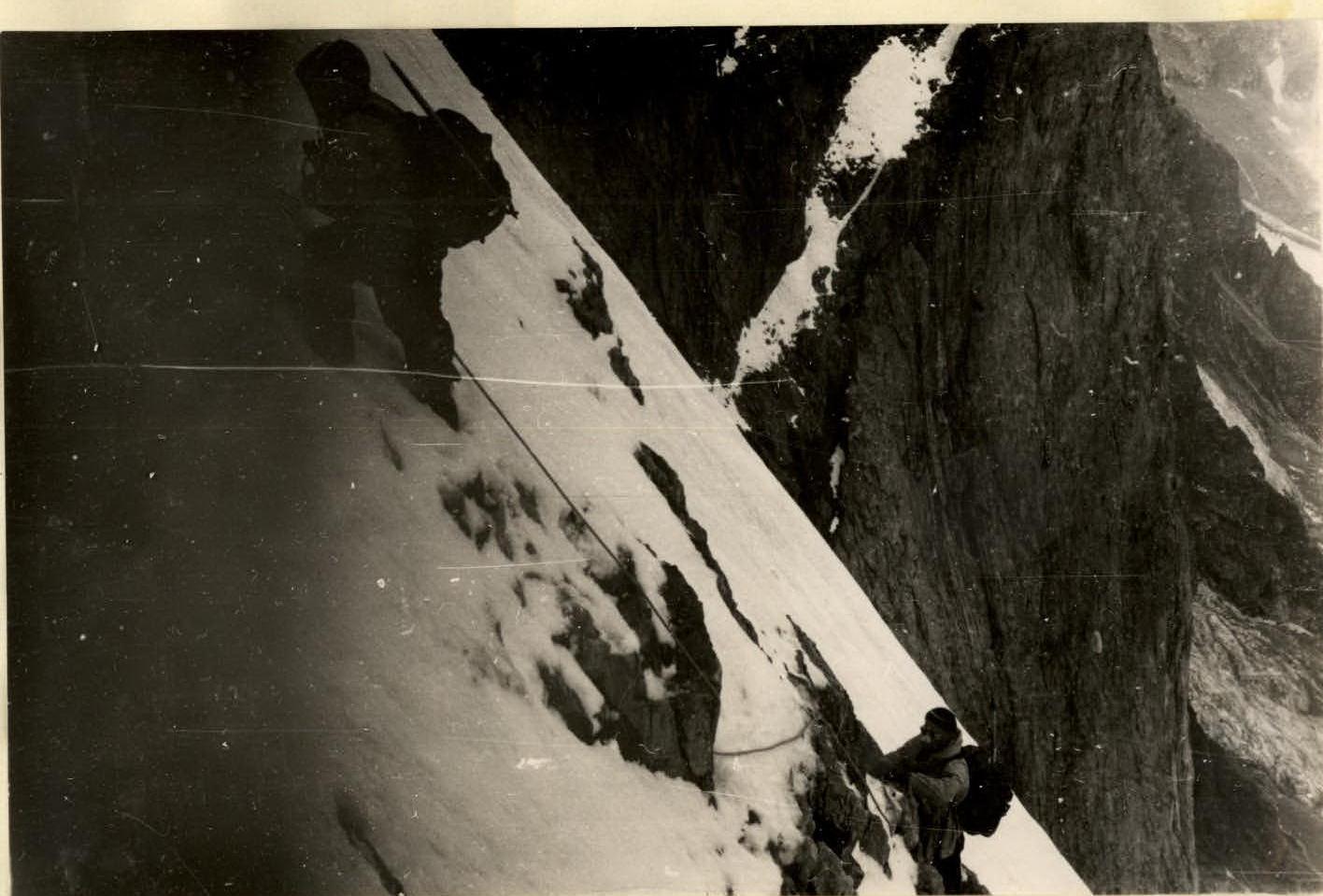
Passage of the saddle ("tail of the fish").
On the rocks of the "fish"
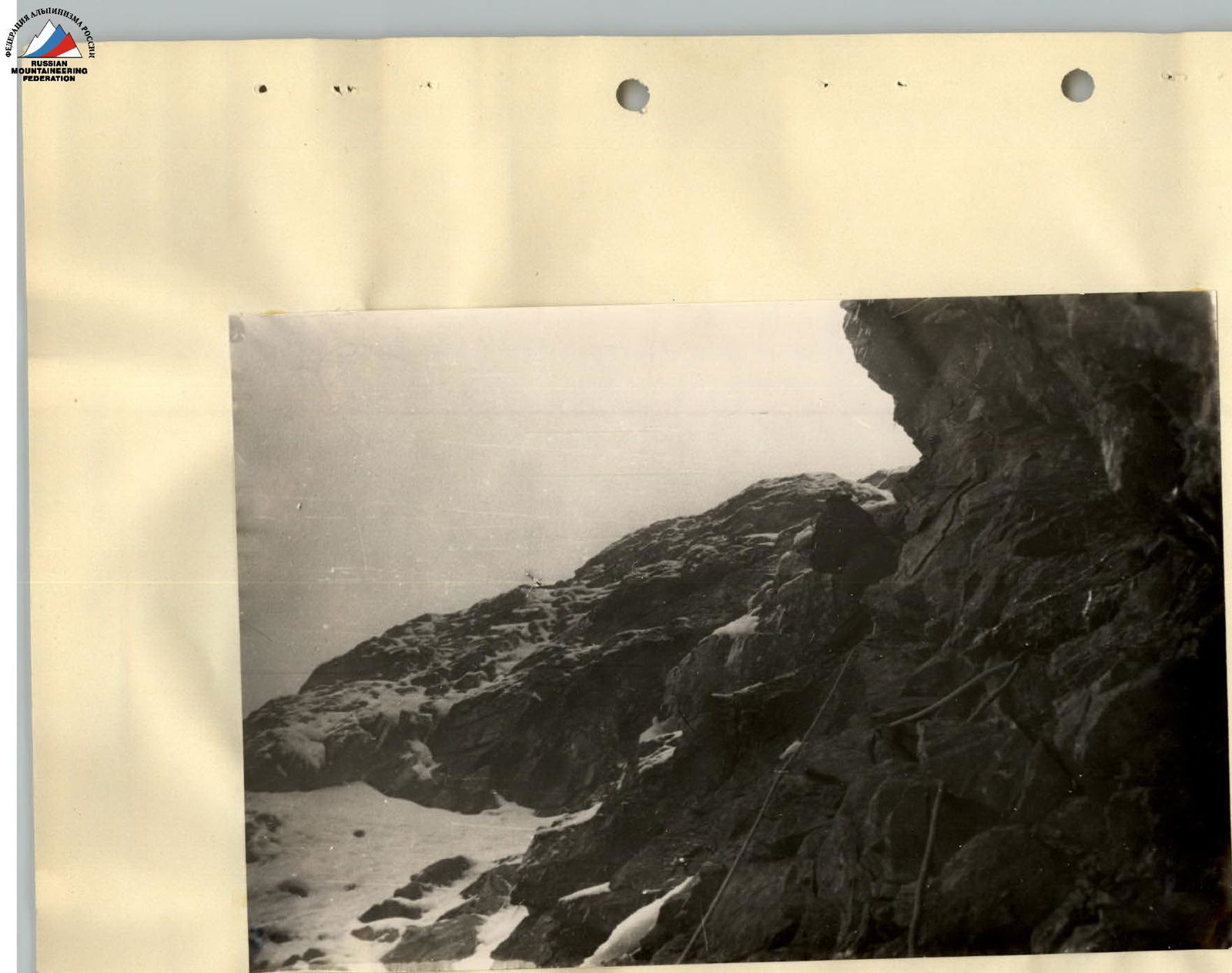
Rocky wall of section R8–R9.