Report
on the ascent to the summit of SHKELDA Second Western, 4310 m, via the southern wall, accomplished by the team from the Krasnodar Regional Council of the Burevestnik Sports Society:
- AKHTYRSKII O.A. — CMS USSR "Burevestnik" — team captain
- KOVALENKO Yu.I. — CMS USSR -"-
- KOVALEVSKII V.A. — CMS USSR -"-
- SALTYKOV V.M. — CMS USSR -"-
- SHKLYAEV E.V. — CMS USSR -"-


4310 m Shkhelda II West.
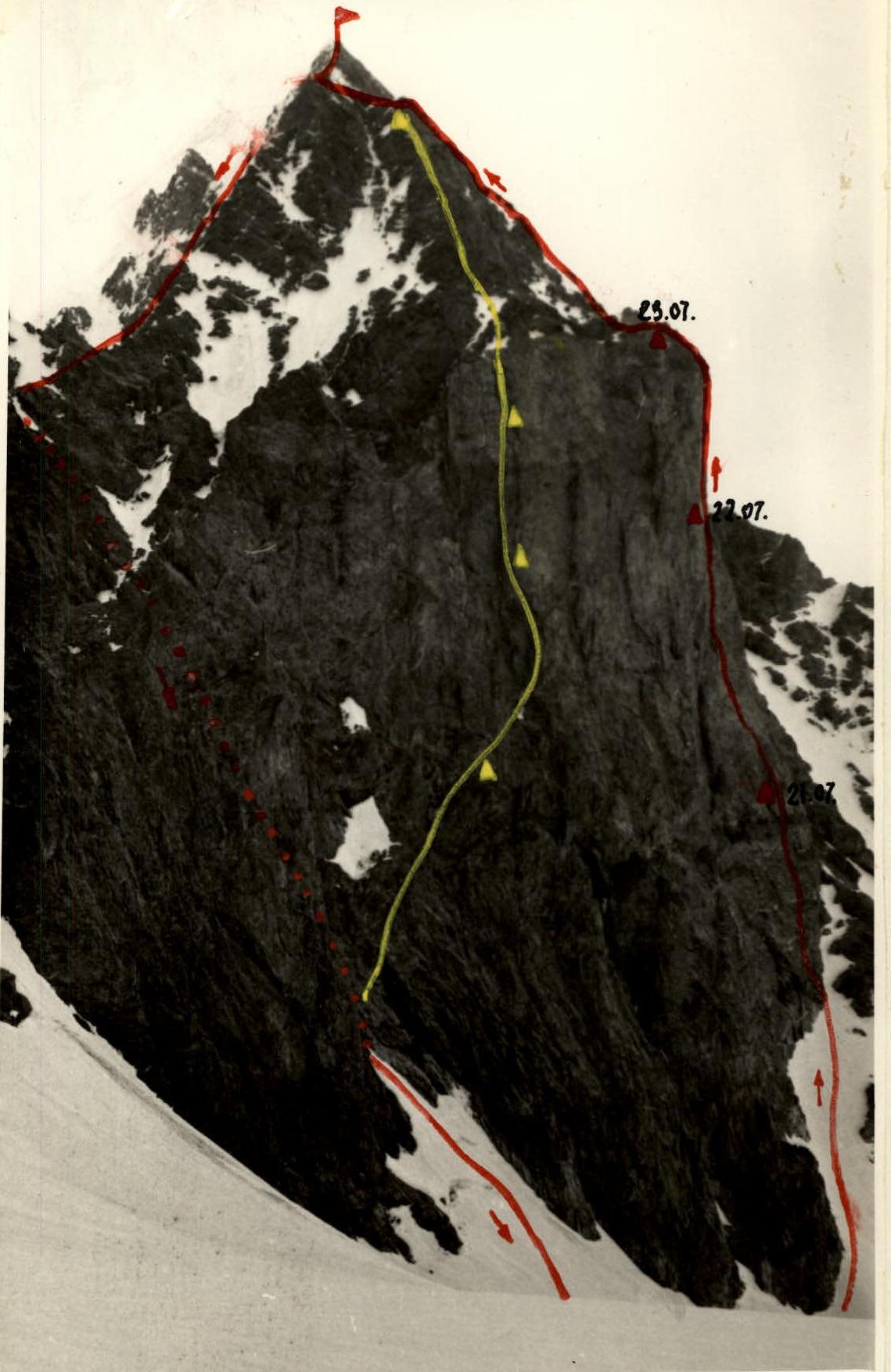 Route profile.
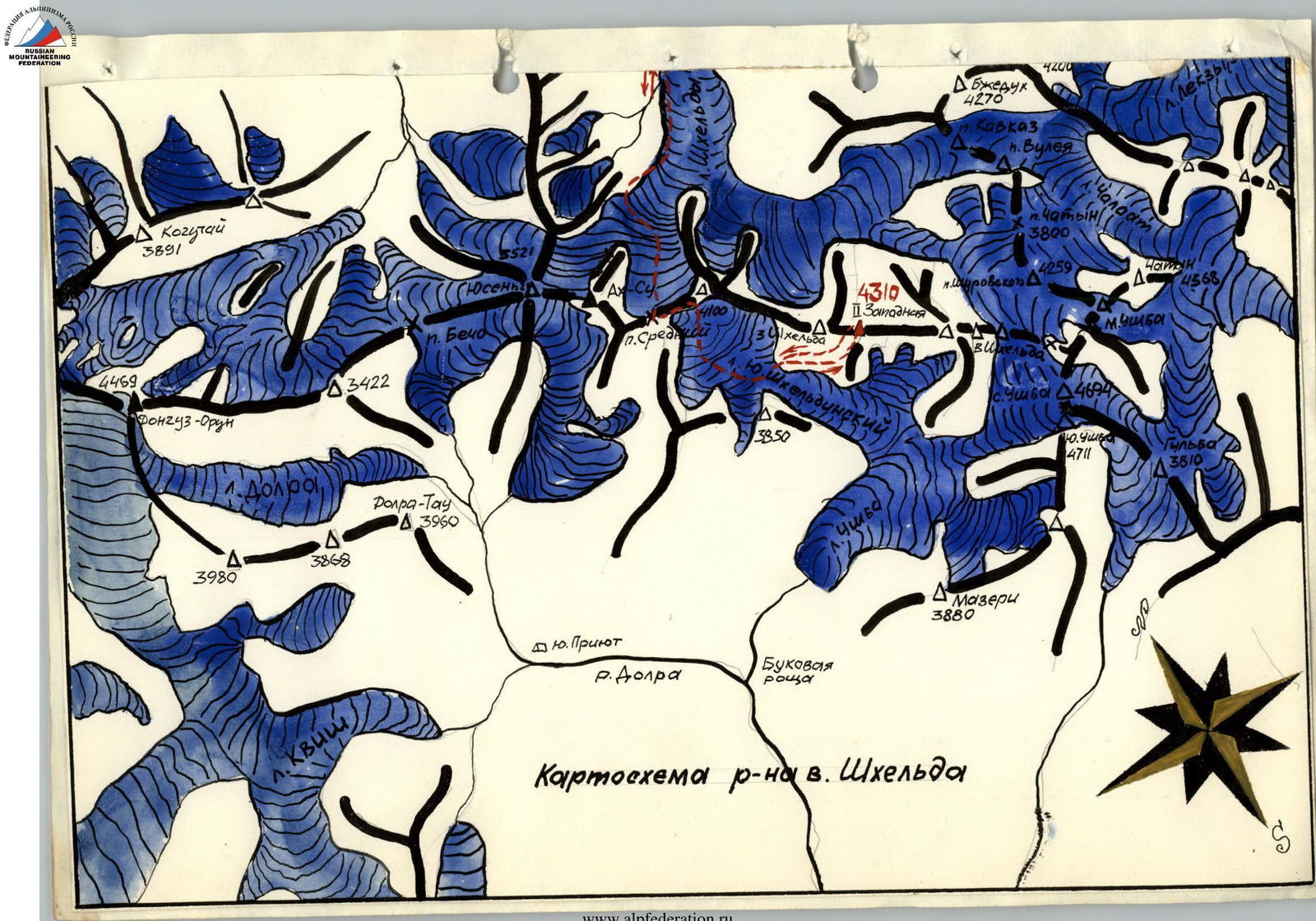 Area map of Shkhelda
the rope, Saltykov takes in Yuri and lets him continue. This section is somewhat easier, with walls alternating with not-so-steep, crumbling rocks where pitons hold well. Quickly gaining height, he approaches the rusty wall. There are still 45 m to go, and an intimidating crevice is visible ahead.
After replenishing the piton supply, Valera moves forward. He easily passes the 60-degree wall and starts tackling the crevice. It's sheer, but in the middle part, the micro-relief becomes richer, and there's a chance to hammer in a piton. Valera wedges his leg and arms, moves 5–6 meters, gets comfortable, hammers in a horizontal piton, uses it as a handhold and then as a foothold, and continues to wriggle through the crevice, which gradually turns into a narrow chimney with a plug. After examining the plug, he confidently climbs onto it. From here, he moves up and to the right, under a destroyed rock slab, hammering in horizontal channel pitons, and reaches a vertical wall, after which a ledge is expected. Here, this destroyed slab can be climbed, which Valera does. As he steps onto it with his feet, he examines the wall. Despite having a double rope, it's not easy to feed it through, so one must be particularly attentive. Several tiny handholds are spotted; the climb continues, and 10 meters of tense climbing lead to a ledge. It's short, but five people can fit here — with some effort. The handlers gather together and examine the wall above them. The abundance of slabs makes it seem impassable, but experience suggests it's climbable. Obviously, the first bivouac needs to be set up here. Unfortunately, there's no water, so they'll have to carry it. It's already 15:00, and the team starts descending, removing unnecessary pitons and organizing intermediate rope anchors. They reach the snow in 2 hours and 30 minutes, and by 17:00, they're back at the base camp. There's a lively exchange of impressions, and the tactical plan is refined. Tomorrow, they'll tackle the route!
On July 21, 1974, at 4:00 AM, the team leaves the base camp. The sky is cloudless, with Ushba shining brightly. Within an hour, they're under the wall and, using alternating belays, approach the rocks. Kovalevskii clips into a 90-meter rope and starts climbing via the fixed ropes. Shklyaev provides belay, in case something happens to the fixed ropes. This rope team moves lightly, as they need to quickly pass the processed section and climb as high as possible from the first bivouac.
After passing 2 ropes, Valya secures the 90-meter end, and Zhenya removes the "sorokopyatki" (45-meter ropes) and organizes an intermediate anchor for the long rope. They tie in on a 45-meter rope and quickly disappear from view.
The other team members, carrying heavy backpacks:
- pass the first rope,
- hang their backpacks on a "hanger",
- organize their extraction almost to the bivouac site, immediately on a 90-meter rope.
Their кулачковые зажимы (cam cleats) are very convenient and reliable, significantly easing the heavy work. Occasionally, a whistle is heard from above, and the captain retrieves the "Vitalka" (likely a communication device) — there's intense work going on above.
The bivouac ledge, reached by the handlers the previous day, is located under a smooth 10-meter wall. To the left, above it, a thin diagonal crack is visible, widening upwards. But it's at least 3–4 meters away. Using Kovalevskii's height, Shklyaev reaches it, hammers in a titanium petal piton, moves onto a ladder, installs another piton, and continues climbing via free climbing to a narrow ledge.
Along this ledge, he traverses 3 meters to the right to a widening crack, where he can wedge his palms and boot soles. 12 meters of acrobatic climbing lead him to a decent ledge; here, he can look around.
The wall above becomes less steep, around 65°, with visible good handholds. Zhenya exits the crevice, leaving it on the right, climbs 15 meters — here, he needs to set up a belay, as the rope is running out. It's a pity — 10 meters higher, he feels a decrease in steepness. Here, a stable belay can only be achieved by loading the self-belay. The lead climber changes. Valya retrieves a prepared set of pitons from his backpack and carefully examines the 10-meter wall.
- It's climbable, there are cracks.
- Above them, to the right, a narrow chimney is visible.
- He decides to climb towards it.
Valya smoothly passes the wall, then moves right — and there's a surprise. Instead of a chimney, an acute and shallow internal corner goes up. He finds "starting" handholds, and Kovalevskii disappears behind the wall's slab.
After 10–12 meters, the corner ends on a ledge, after which the climbing becomes easier — the steepness decreases to 60–65°.
Uncomplicated climbing up and to the left leads to a comfortable ledge — a belay stance. The daylight allows for more work, and Valya continues moving.
- First, 8 meters on destroyed but steep rocks;
- then on a short but interesting wall;
- exit to a chimney with loose rocks.
It's very hard to find a place for a fist, but the hammer tapping sounds, and the rope slowly creeps along the rock. Kovalevskii quickly passes the vertical upper part of the chimney and stops on a small ledge.
The spot is convenient, ideal for organizing a backpack extraction during team movement. He calls the captain and consults with him. He gets the green light for descent — the evening sun sees off the handlers rushing to the bivouac. July 22, 1974. Wake-up at 3:00 AM. Today, Saltykov and Kovalenko are working ahead. Within an hour, the rope team is ready to move. Their task is to pass the previously processed 2.5 ropes as quickly as possible and continue working until bivouac #2. The weather promises to be good. The mood is excellent. Kovalenko, using a cam cleat and a Prusik knot, passes the rope and clips into the second one. The command "Ropes are clear" are heard. The rested Saltykov easily moves upward. Here is the anchor point for the fixed ropes. From the 5-meter slack in the rope, they create a "hanger" for the backpacks. Saltykov steadily hammers a hole for a piton. This will be the backpack extraction point. He installs a block. Everything is ready! They radio this information down. The team has already dismantled the bivouac and started climbing. It's time for us to move.
Yuri Kovalenko passes the first meters. In the morning air, the ringing hammer blows carry far. Piton — ladder, another piton. The first 10 meters are passed with the help of a ladder and 2 pitons. The vaguely expressed internal corner allows for friction climbing. Handholds are minimal. Further, there's a ledge where one can stand on one leg. It's necessary to catch breath and examine the further path. It's climbable. From here, up and to the left, bypassing the overhanging section, another 30 meters. There's a good crack for hands. You can hammer "shvelers" (channel pitons) into it. But the feet — only on friction.
Three more pitons are hammered in, Kovalenko secures the ropes, and takes in Saltykov. To fit comfortably together, they need to hang a ladder.
The path ahead is visible:
- vertically up 5 meters,
- then to the right.
Yuri moves forward again. The first five meters are quick, but then he needs to go up and to the right. It's very difficult; he falls back. He hammers in a piton and, holding onto the carabiner, slowly swings, then slowly climbs up. Very difficult climbing. Thankfully, there are cracks for pitons.
Five more pitons are hammered in for belay, and the second rope is passed.
They decide to extract the backpacks through the overhang. They rest, prepare a station for extracting the backpacks.
Observers on the radio report that they're above the supposed bivouac #2 location.
Next, Saltykov prepares to move. Ahead, a logical exit is seen via a 10-meter "mirror" to a chimney, which ends with a jagged notch. There, a sitting bivouac can clearly be organized. On the "mirror", after the first two meters, a petal piton is managed to be hammered in, and a ladder is hung on it. Further, they want to hammer in a piton. Valera thinks for a moment, and then a short command: "More carefully!" Kovalenko feeds out the rope. It's hard to transition from the ladder to free climbing. But Saltykov finds something for his hands, steps on the piton holding the ladder, takes another step, two — and a cheerful voice: "It's free climbing all the way!" The "mirror" is passed via free climbing.
In the chimney, they also had to work hard. The upper part was overhanging. But now they're on the notch, having passed another 1.5 ropes. 15 pitons are hammered in. The time is 17:30. They start making a platform. Five people can sit comfortably here, and most importantly, there's ice. So, they'll drink their fill.
At 19:00, after extracting the backpacks, they gather on the jagged edge. Passing the plug in the chimney, even on fixed ropes, was very difficult, so they had to pull the guys up.
Already by the light of headlamps:
- they stretch half of the tent.
At 11:00 AM, after eating well and drinking plenty, they fall asleep.
Ahead — the overhanging part of the wall. July 23, 1974. Day IV. Today, they woke up at 6:00 AM. Akhtyrskii looked out of the tent. The stars are not visible, and the night was warm. The weather is clearly deteriorating. At 7:00, the Saltykov — Akhtyrskii rope team starts processing the most complex section — the exit to the "roof". The first rope doesn't overhang, but the climbing is extremely difficult.
Right from the tent:
- there's a 3-meter overhanging section.
- A platform is hung here from the evening.
Akhtyrskii steps onto it, hammers in a piton. The platform is removed, and then he moves right and up along a 10-meter internal corner. It leads to a vertical crevice. Along it, 20 meters up — and the crevice disappears. A rusty overhanging "feather" blocks the path. They need to use the platform again.
Sitting on it, Oleg hammers in a piton. A ladder is hung, then another platform, and he exits onto the right face of the rusty "feather". Here, 10 meters of virtuosic climbing lead to a ledge formed by the "feather's" apex. Having secured the rope, Akhtyrskii takes in Saltykov. Valera carries a light backpack with a set of pitons and a second platform. In 30 minutes, Saltykov also passes the first rope. Then Saltykov moves forward. The climbing is even more complex. Above the ledge — a small overhang.
Saltykov:
- stands on Akhtyrskii's shoulders,
- searches for a crack for a piton,
- can't reach.
"Stand on your head!" Akhtyrskii recommends. The healthiest among them, the team captain, grunting, holds 70 kg of "live weight" on his head. "Good thing it's not on tricouni boots" — he jokes. It works; he withstands — only his neck swells with blood. A piton is hammered in, and Valera exits the overhang. A 30-meter internal corner successfully cuts through the overhanging part. Valera passes it. Having set up a stance and getting comfortable, he takes in Akhtyrskii. Above — the "roof". The last rope of the wall remains — the "highlight" of the entire route. Meanwhile, the weather is catastrophically deteriorating. The morning forecast is confirmed. It's very cold, a piercing wind blows, and occasionally "krupa" (graupel) falls. After a 30-minute break and a snack:
- Valera hangs two ladders,
- starts processing the overhang.
Akhtyrskii provides belay, sitting on the stance. 10 meters are passed — all on artificial holds. They had to hammer in a piton, hang a stance on it to take in Akhtyrskii. It's already hard to feed the rope through. Then Valera moves on using free climbing, utilizing an oblique crack. He bypasses a protruding rock on the right and stands on it. Here, you can stand without holding onto the rock. Another 10 meters behind.
Again:
- ladder,
- stance,
- ladder,
and a triangular slab is reached, the apex of which exits onto the "roof". A strong wind indicates the proximity of the ridge. The slab is climbed in its right part — and here's the long-awaited "roof". Finally, you can take 2–3 steps on a practically flat surface.
The ropes are secured to a protrusion. Akhtyrskii moves along them. At 15:00, the assault duo congratulates themselves on passing the wall. Extraction remains, but that's no longer scary.
A smiling Valya Kovalevskii appears on the ropes. Pulling backpacks is more fun with three. Shklyaev and Kovalenko below are suspending the backpacks. Yuri works on the counter-pull. Zhenya is busy with photography.
At 18:00, the entire group ascends to the "roof" and extracts the backpacks. Finally, they can lay out a sufficient-sized platform. They'll sleep lying down! After setting up the tent, they retire at 22:00. The summit is ahead!
It's no big deal that Elbrus is hidden in clouds, and no improvement in weather is expected for tomorrow.
July 24, 1974. At 7:00 AM, they depart from the overnight stay. The weather is bad. Clouds are low from Svaneti, a strong wind blows, and snow falls. Ahead, a heavily destroyed ridge with small snowy sections is visible. Movement is simultaneous. After several days of work in галошах (galoshes), it's a bit unaccustomed to walk in high-altitude boots. A 15-meter ice slope is passed, updating the slushy steps. Two days ago, G. Agranovskii's team, traversing Shkhelda – Ushba – Mazeri, was supposed to be here.
At 10:00, they reach the summit. In the control log, they find Agranovskii's note and leave their own. The weather has finally worsened; it's snowing, and cold. It's a pity they can't enjoy the wonderful panorama of the Central Caucasus. They descend via the 3B category route.
They reach the base camp at Kurсантов (Kursantov) pass by 16:00.
Overall Assessment of the Team's Actions
The team in this composition has come a long way from novice to CMS (Candidate for Master of Sports) within the same Kraycouncil DSO "Burevestnik" collective, having undertaken many high-category ascents together. Therefore, the participants know each other well. Long-standing friendly relations helped them make quick, collective decisions in any difficult situations on the route.
Previous first ascents of 4–5 category complexity enriched the team with tactical and technical experience, which favorably affected the selection, preparation, and passage of the southern wall of Shkhelda's Second Western peak.
The atmosphere on the route was businesslike and calm. The actions of all participants were characterized by precision, high work capacity, and technical skill. Everyone worked as the lead climber on the route.
Physically, all team members are excellently prepared and felt good during the ascent.
Team captain CMS USSR O. Akhtyrskii Team coach MS USSR S. Kisel
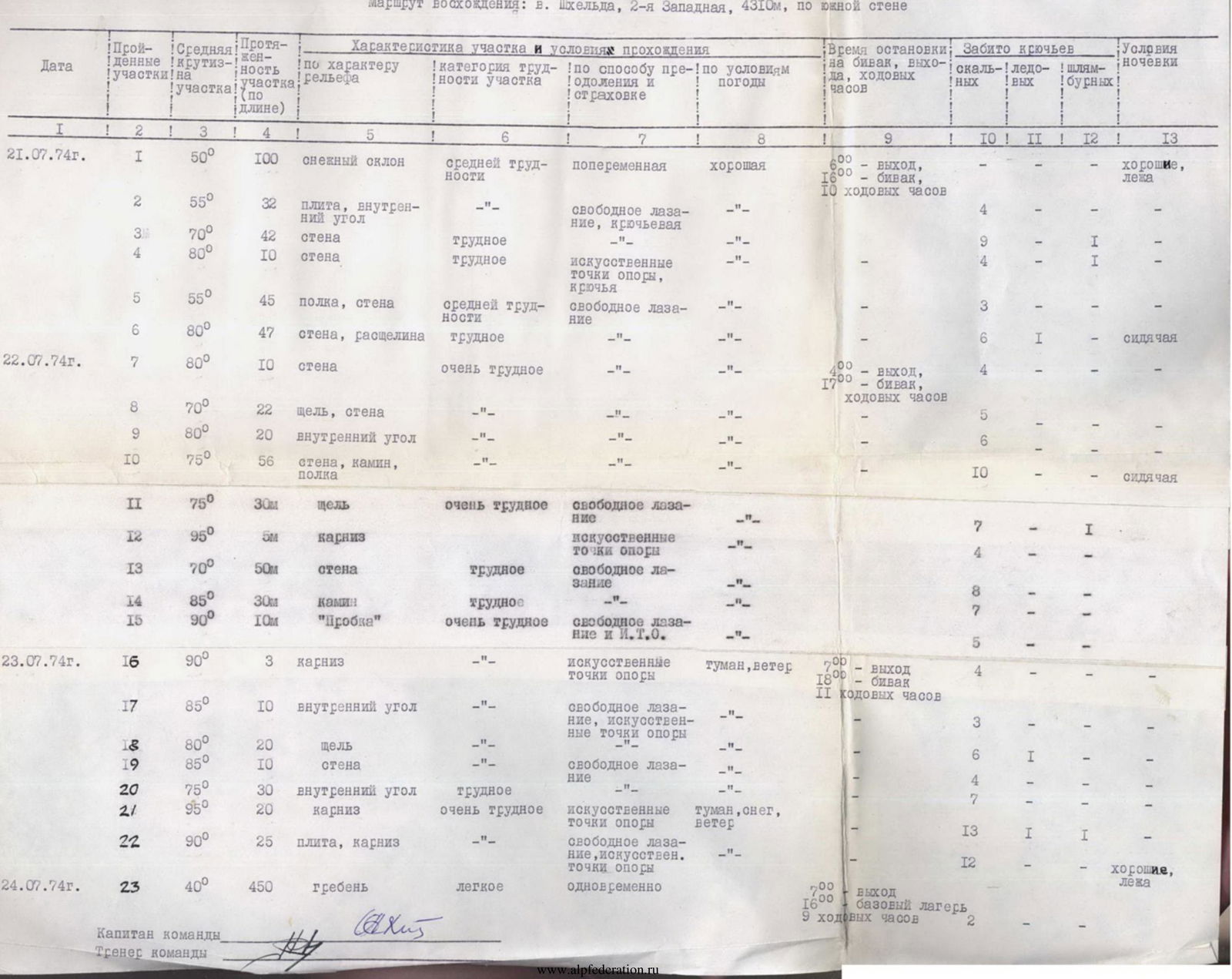
Table of Main Route Characteristics
Ascent route: v. Shkhelda, 2nd Western, 4310 m, via the southern wall
| Section # | Steepness, ° | Length, m | Relief | Difficulty Category | Method of Overcoming and Belaying | Weather Conditions | Time of Bivouac, Exit, Climbing Hours | Rock Pitons | Ice Pitons | Pitons, Shlyam | Bivouac Conditions |
|---|---|---|---|---|---|---|---|---|---|---|---|
| July 21, 1974 | |||||||||||
| R1 | 50 | 100 | snow slope | medium difficulty | alternating | good | Exit at 6:00, bivouac at 16:00, 10 climbing hours | good, lying down | |||
| R2 | 55 | 32 | slab, internal corner | medium difficulty | free climbing, pitons | -"- | 4 | ||||
| R3 | 70 | 42 | wall | difficult | free climbing, pitons | -"- | 9 | 1 | |||
| R4 | 80 | 10 | wall | difficult | artificial holds, pitons | -"- | 4 | 1 | |||
| R5 | 55 | 45 | ledge, wall | medium difficulty | free climbing | -"- | 3 | ||||
| R6 | 80 | 47 | wall, crevice | difficult | free climbing | -"- | 6 | 1 | sitting | ||
| July 22, 1974 | |||||||||||
| R7 | 80 | 10 | wall | very difficult | free climbing | -"- | Exit at 4:00, bivouac at 17:00, 4 climbing hours | 4 | |||
| R8 | 70 | 22 | crevice, wall | very difficult | free climbing | -"- | 5 | ||||
| R9 | 80 | 20 | internal corner | very difficult | free climbing | -"- | 6 | ||||
| R10 | 75 | 56 | wall, chimney, ledge | very difficult | free climbing | -"- | 10 | sitting | |||
| R11 | 75 | 30 | crevice | very difficult | free climbing | -"- | 7 | 1 | |||
| R12 | 95 | 5 | cornice | very difficult | artificial holds | -"- | 4 | ||||
| R13 | 70 | 50 | wall | difficult | free climbing | -"- | 8 | ||||
| R14 | 85 | 30 | chimney | difficult | free climbing | -"- | 7 | ||||
| R15 | 90 | 10 | "Plug" | very difficult | free climbing and artificial holds | -"- | 5 | ||||
| July 23, 1974 | |||||||||||
| R16 | 90 | 3 | cornice | very difficult | artificial holds | fog, wind | Exit at 18:00, bivouac, 11 climbing hours | 4 | |||
| R17 | 85 | 10 | internal corner | very difficult | free climbing, artificial holds | -"- | 3 | ||||
| R18 | 80 | 20 | crevice | very difficult | free climbing | -"- | 6 | 1 | |||
| R19 | 85 | 10 | wall | very difficult | free climbing | -"- | 4 | ||||
| R20 | 75 | 30 | internal corner | difficult | free climbing | -"- | 7 | ||||
| R21 | 95 | 20 | cornice | very difficult | artificial holds | fog, snow, wind | 13 | 1 | 1 | ||
| R22 | 90 | 25 | slab, cornice | very difficult | free climbing, artificial holds | -"- | 12 | good, lying down | |||
| July 24, 1974 | |||||||||||
| R23 | 40 | 450 | ridge | easy | simultaneous | -"- | Exit at 7:00, base camp at 16:00, 9 climbing hours |
 Elevation mark on the section.
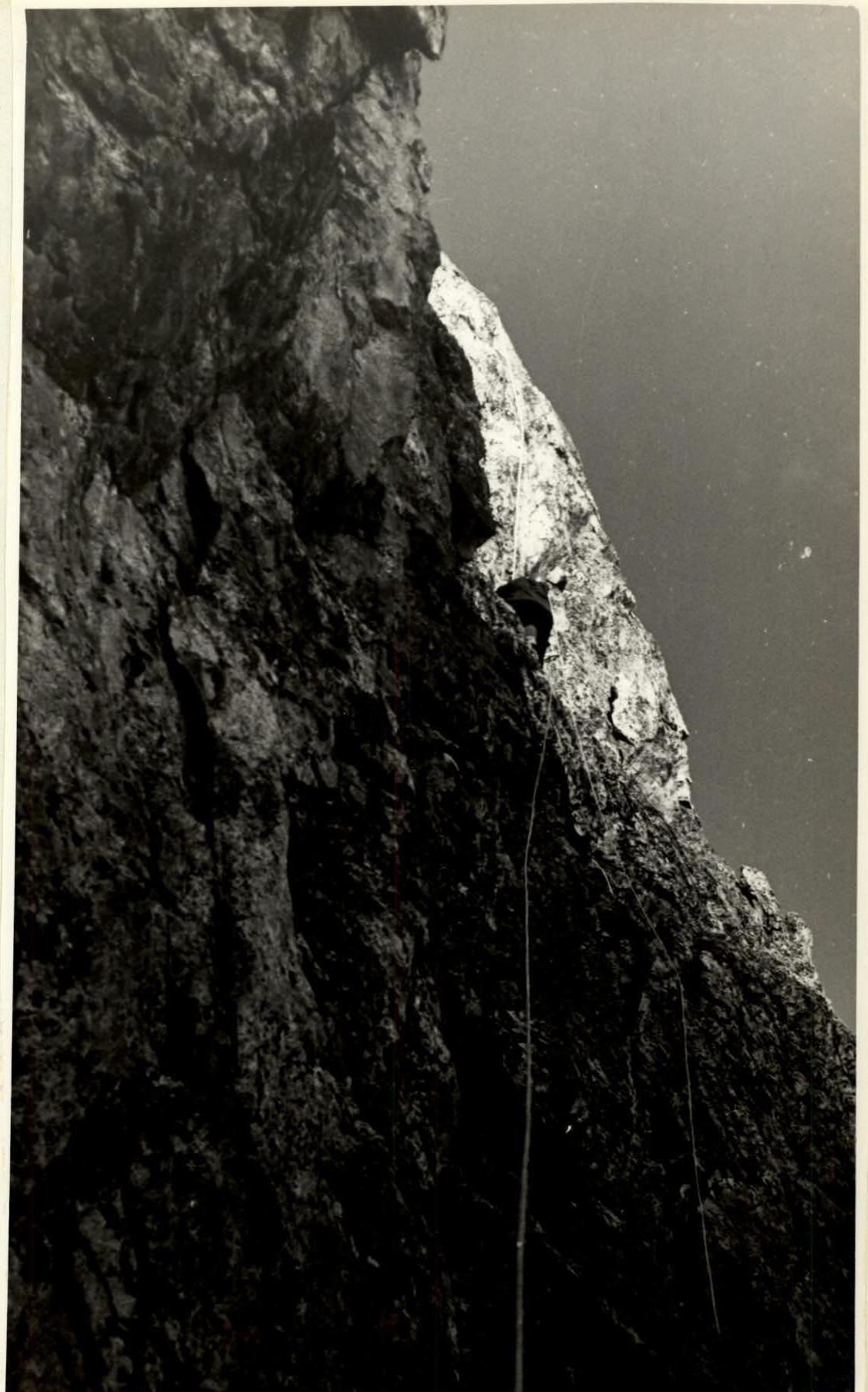
 Section 13.