
- Technical class.
- Central Caucasus
- Ushba South summit 4710 m via the center of the SW wall through the "Stolb" on Golubev's route.
- Category 5B, 2nd ascent of the "Golden" route of 1981.
- Elevation gain: 1460 m, length 2005 m.
Length of sections with category 5–6 difficulty: 1030 m. Average steepness of main sections is 72° (3490–4630 m). Of these, category 6 sections: 855 m - (3520–4110 m) 575 m at 80–81°; (4182–4400 m) 145 m at 68°; (4470–4630 m) 135 m at 80°.
- Pitons used:
| Rock | Bolt | Nuts | Ice |
|---|---|---|---|
| 134 | 0 | 144 | 10 |
| 45 | 0 | 71 | 0 |
- Team's total travel time: 78 hours and 7 days.
- Overnights: 1st-2nd on a rocky ledge; 3rd-4th - two in hammocks, three sitting on a ledge; 5th on a rocky ledge; 6th on a snowy ledge.
- Team leader: Galkin S.P. — CMS
Team members:
- Krasavin V.I. — CMS
- Simakov A.N. — CMS
- Tkachenko A.K. — CMS
- Kadtsin V.N. — CMS
Coach: Khramtsova G.K. — MS USSR
Departure to the route: August 23, 1982.
Summit: August 29, 1982.
Return to camp: August 30, 1982.
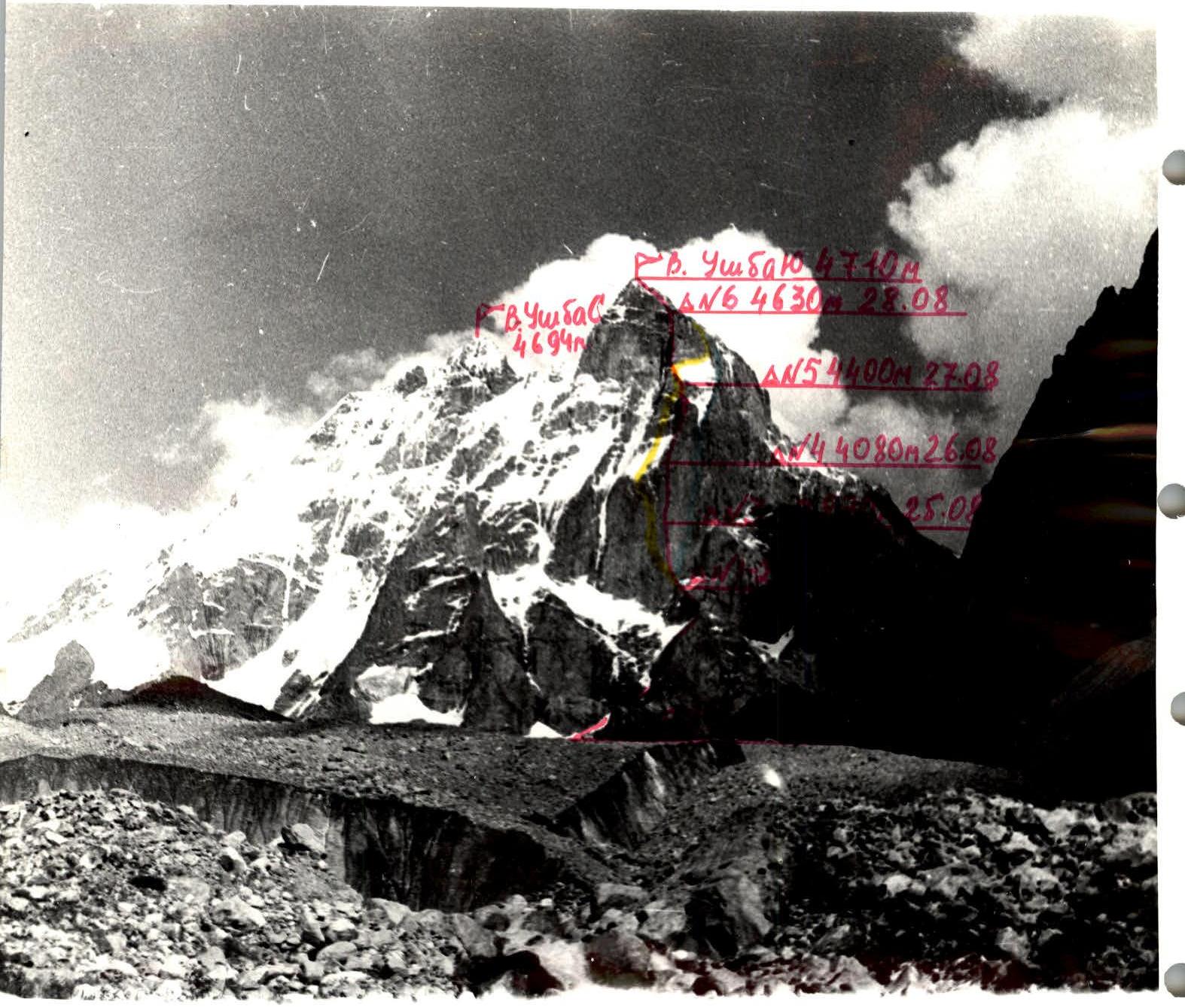
- Golubev's route.
- Myshlyaev's route.
- Kustovsky's route.
Photo taken on August 24, 1982 at 14:00, camera "Kristall", lens "Industar-50" 3.5/50, distance 4 km. Shooting point #8, altitude 2350 m.
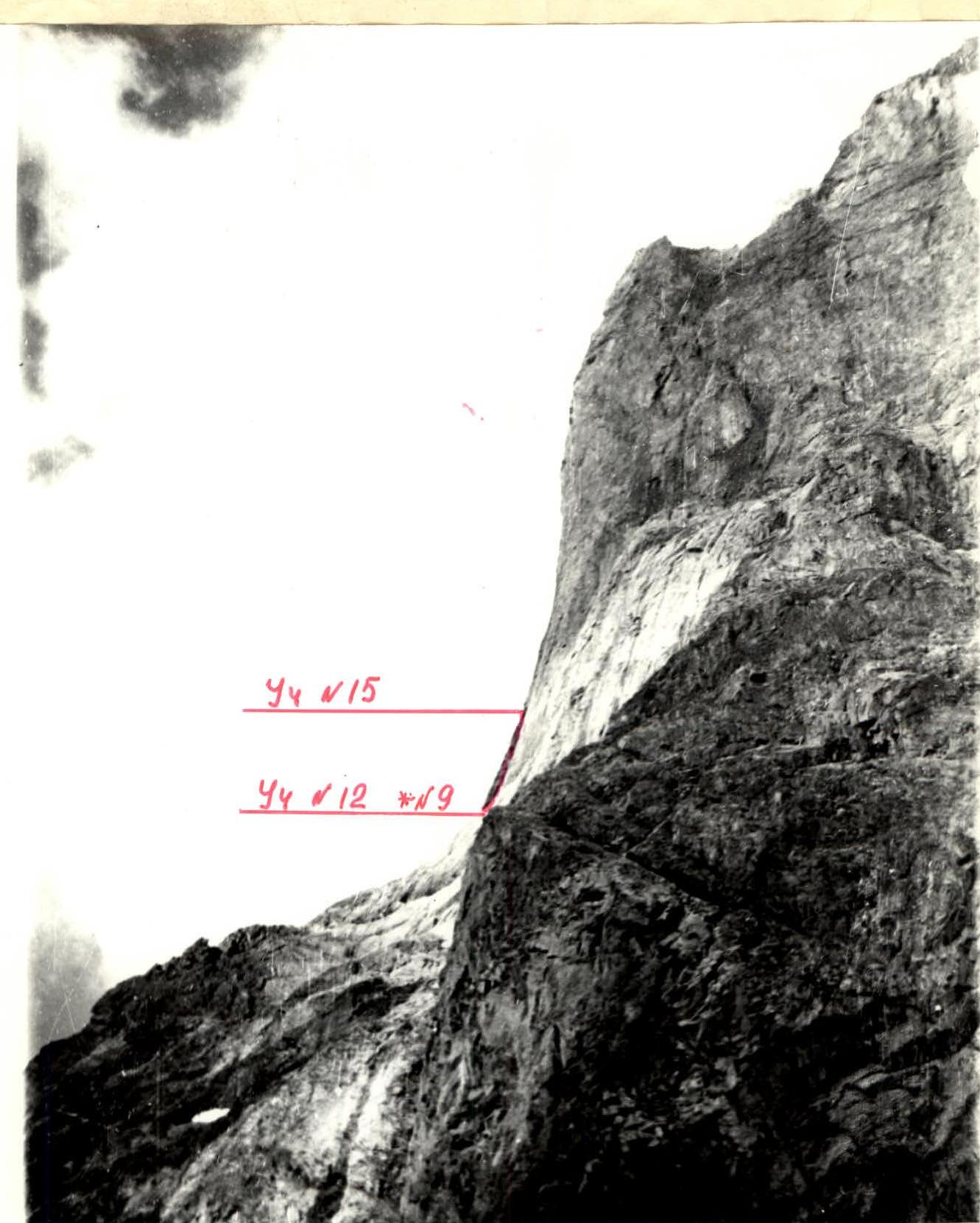
Profile of the right wall.
Sections 12–15 are shown in photo #9.
Profile taken on August 29, 1982, shooting point #7, altitude 3100 m, time 18:00. Camera "Smena-8", lens T-43 4/40, approximately 2–3 km to the "Stolb".
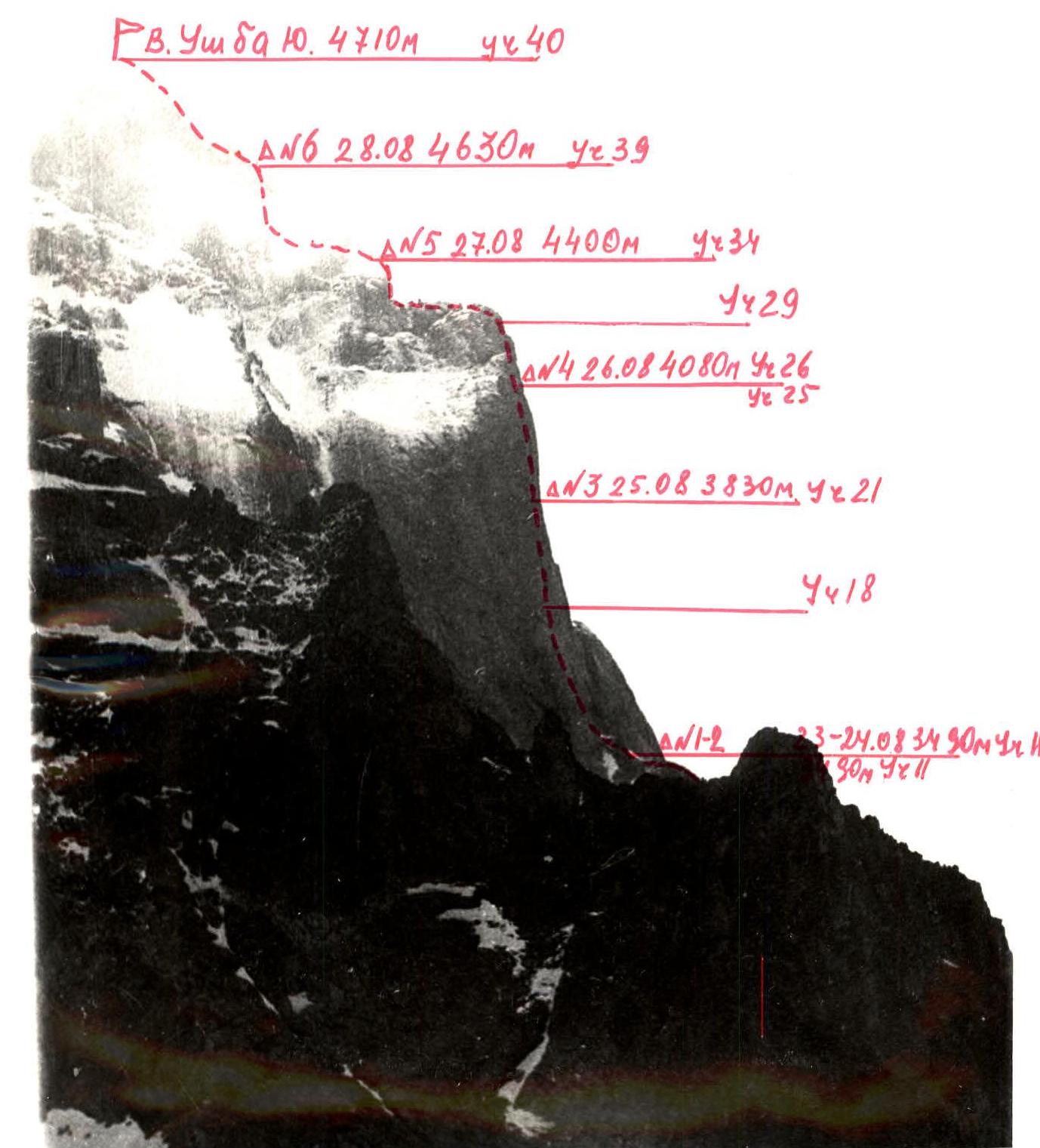
Profile of the left wall.
Profile taken on August 25, 1982 at 11:00. Camera "Kristall", lens Industar-50 3.5/50, distance 3 km. Shooting point #4, altitude 3180 m.
Team's Tactical Actions
According to the tactical plan, the ascent was to be completed between August 23 and August 30, 1982.
The passage of the main key section, the "Stolb", was planned for August 24 to August 28. Due to the good condition of the route in the lower part of the "Stolb" and good weather, the "Stolb" was passed one day ahead of schedule.
A deviation from the tactical plan was the descent from the ridge between Ushba and Mazeri towards the Ushba glacier to the observers. This was due to the excellent condition of the bergschrund and the ice slope, which was reliably covered with a dense layer of snow. The following rope teams were formed: Simakov — Galkin — Krasavin; Kadtsin — Tkachenko.
The first team of three worked continuously. The lead climber in the first rope team changed daily, and often changed during the working day. Changes occurred on sections 1, 11, 16, 23, 27. Preliminary processing of sections 11–20. Organization of fixed ropes on sections 0–39.
Movement along the route started at 7–8 am and continued until 12–13 pm. Rest time was 9–10 hours.
Overnight stays were organized in safe places away from rockfall — under overhangs (hanging and sitting) and on safe ledges in tents. On all complex sections, the first climber moved on a double rope using BEPУ-400 tape absorbers, and the second belayer used a "Shtikht" washer. The last climber moved along the fixed ropes with top-rope belay. On sections with overhangs, movement along the fixed ropes was also done with top-rope belay.
There were no falls or injuries on the route. Problematic tasks related to the high difficulty of the route, wet rocks, and verglas were solved by organizing reliable belays using a wide variety of rock pitons and nut placements with the use of aid climbing techniques, and were climbed with maximum focus and caution. In bad weather, when climbers got wet during both hanging bivouacs, everyone showed tolerance and a desire to quickly pass the complex section. The wet hanging bivouacs did not affect the quality of subsequent work.
New equipment samples, except for tape absorbers and the "Shtikht" washer, were not used.
Communication with observers was carried out regularly via the "Karat-M" radio station on a rod antenna at even hours. There were rare instances of missing one communication session, but observers could see the group with a 12x binoculars even then.
Photo numbers: 1–8. Within the group, communication was also established using two "Vitalok-M" devices to solve urgent tasks and coordinate the movement of the entire group.
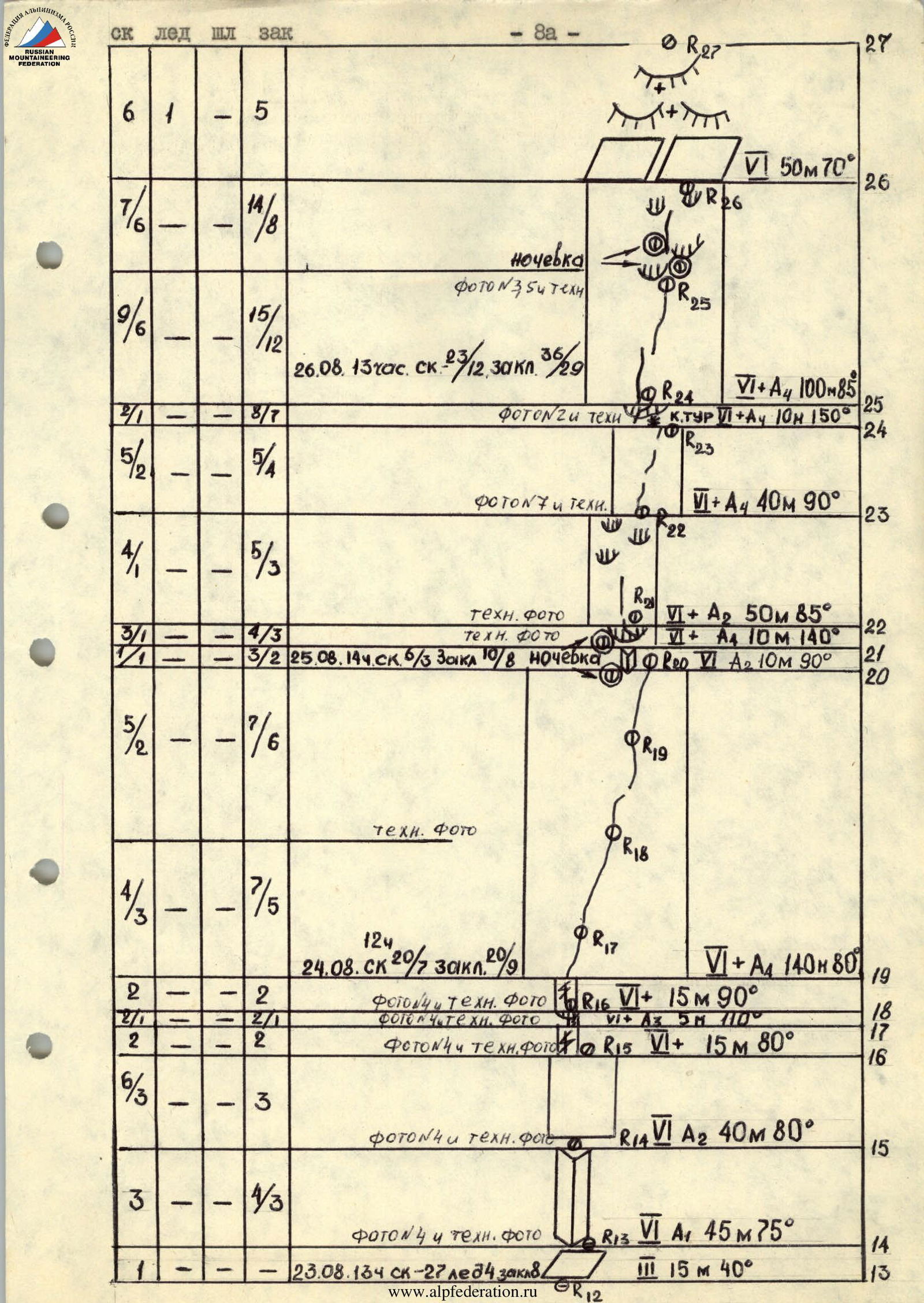
Route Description by Sections
The assault camp was located below the glacier of the SW wall of South Ushba at an altitude of 2850 m. The ascent was made along its left side, avoiding crevasses, to a depression and then to the bergschrund (1 hour). From here, at an altitude of 3250 m, the route begins along an ice board, which is partially covered with a thin layer of snow, and continues to the SW rocky ridge.
The route passes through three rocky belts:
-
1st rocky belt includes the steep part of the ridge, approximately 400 m long. The elevation gain of this belt is about 230 m. Route sections 0–11, category 3–5.
-
2nd rocky belt consists of the "Stolb" bastion, approximately 600 m long, and two walls above the "Stolb", approximately 150 m long. The total length of the 2nd belt is about 950 m with an elevation gain of 900 m. This is the most complex and difficult section. A large number of overhangs and reverse-facing holds on many sections, combined with its great steepness, make the passage of the "Stolb" extremely challenging. Sections 11–33.
-
3rd rocky belt represents the summit bastion "Nож" (Knife), 135 m long with an elevation gain of 120 m. This is a very steep rocky slope with a large amount of verglas and is typically climbed in bad weather. Sections 35–39.
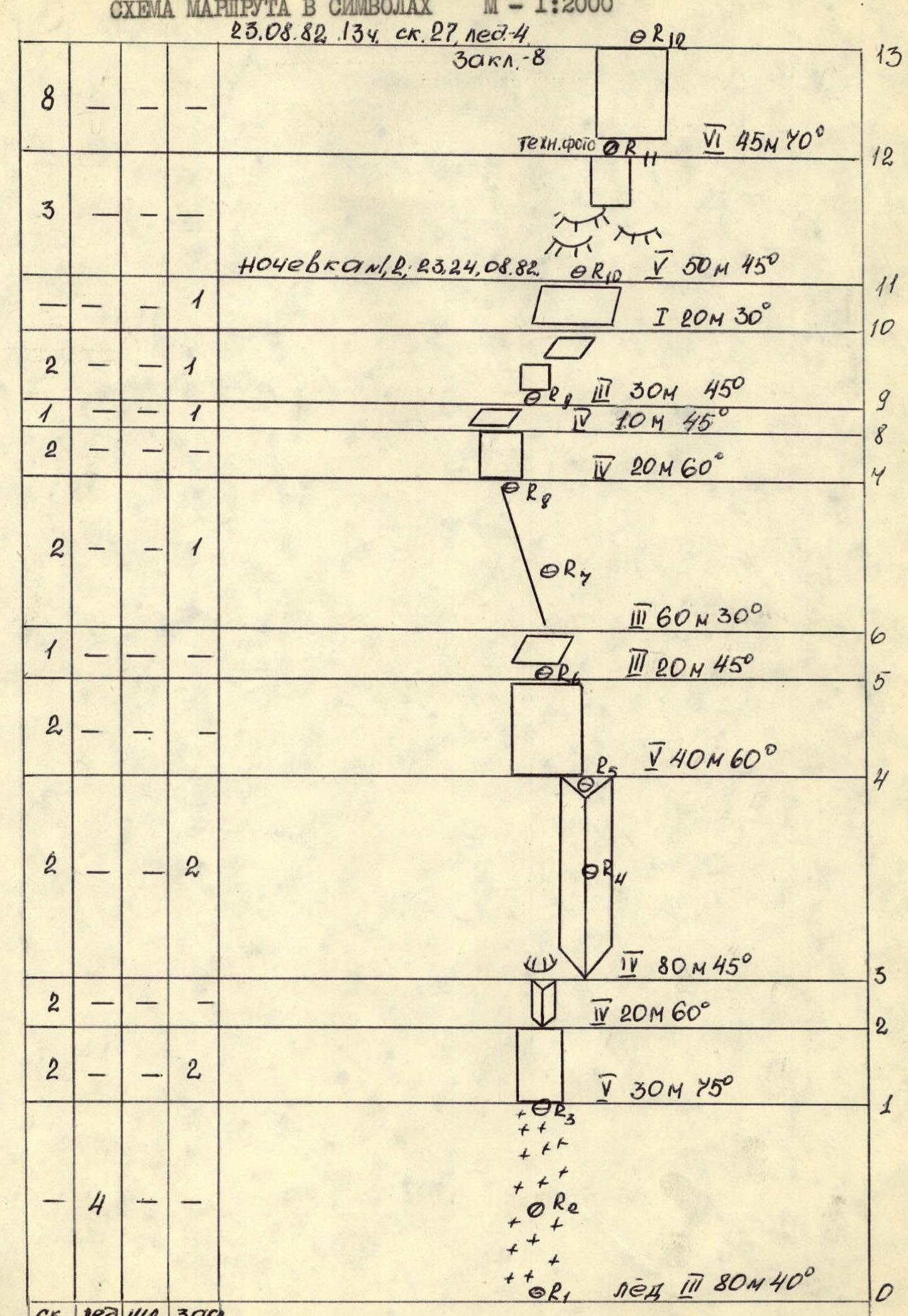
August 23 — Section 0–1. Steepness 40°, length 80 m. Ice. The first team to work is Galkin — Simakov. For belaying, titanium ice screws are used. Section 1–2 — steepness 75°, length 30 m. Change of lead. The first team to work is Simakov — Krasavin until section 11. Wall with good relief and a variety of cracks. Section 2–3 — steepness 60°, length 20 m. Inner corner, good ledges available. Section 3–4 — steepness 45°, length 80 m. Wide inner corner with many ledges, protrusions, and cracks. Section 4–5 — steepness 60°, length 40 m. Wall dissected by cracks, monolithic. Section 5–6 — steepness 45°, length 20 m. Slabs, ledges. Section 6–7 — steepness 30°, length 60 m. Sharp rocky ridge. Section 7–8 — steepness 60°, length 20 m. Wall with good cracks. Section 8–9 — steepness 45°, length 10 m. Smooth slabs.
Section 9–10 — steepness 45°, length 30 m. Ledges, slabs, broken rocks. Section 10–11 — steepness 30°, length 20 m. Ledge with an exit to a safe ledge, where a bivouac was organized on August 23–24. Change of lead. The first team to work is Galkin — Krasavin. Section 11–12 — steepness 45°, length 50 m. Slabs, "ram's foreheads" type, turning into a wall. Section 12–13 — steepness 70°, length 45 m. Monolith with small cracks and few holds, large sections are traversed on friction. Belay and self-belay organization is difficult. August 24 — 7:00 — Simakov — Galkin team starts processing the route and fixes 5 ropes. Section 13–14 — steepness 40°, length 15 m. Diagonal ledge with steps. A sitting bivouac can be organized. Section 14–15 — steepness 75°, length 45 m. Inner corner with slots for nuts and cams. Very complex climbing using aid techniques. Monolith, anchored rocks. Section 15–16 — steepness 80°, length 40 m. Wall with reverse-facing holds, climbed using aid techniques. Difficult to organize reliable belay, psychologically very challenging section. Section 16–17 — change of lead. Galkin leads. Steepness 80°, length 15 m. Good monolithic wall with a slot suitable for nuts and U-shaped pitons. Free climbing. Section 17–18 — 1st large overhang 110°, length 5 m. Made of blocks, has cracks and fissures, aid techniques used. Belay in hang. Very complex. Movement along fixed ropes with top-rope belay. Section 18–19 — steepness 90°, length 15 m. Wall with several small over height. Very complex free climbing. Belay in hang. Section 19–20 — steepness 80°, length 140 m. Wall with a slot. Monolith. Complex climbing, aid techniques used. Belay in hang. After climbing 60 m along this wall, the Galkin — Simakov team, having securely anchored the rope, descended to the tent. August 25 — 8:00 — The group ascends along the fixed ropes. After passing the fixed ropes, the Krasavin — Galkin team continues on section 19–20 and completes it. Section 20–21 — steepness 90°, length 10 m. Inner corner leading under an overhang. Very complex climbing using aid techniques, belay in hang. A hanging bivouac is organized: two in hammocks, three separately on ledges. In the evening, rain with snow, everyone got wet. August 26 — 8:00 — Krasavin — Galkin team begins work.
Section 21–22 — 2nd large overhang with a 2 m outreach, steepness 140°, length 10 m. Aid techniques used, climbed with the use of nuts, cams, and U-shaped pitons. Belay in hang. Very complex climbing. Movement along fixed ropes with top-rope belay. Section 22–23 — steepness 85°, length 50 m. Wall, in the lower part of which is a fissure, in the upper part — a series of small overhangs. Very complex climbing, aid techniques used. Nuts, cams, and cams used. Belay in hang. Change of lead, Galkin leads. Section 23–24 — steepness 90°, length 40 m. Wall with intermittent cracks. Very complex climbing, difficult to organize reliable belay. Often uses aid techniques. Entire arsenal of equipment used, except for bolt pitons. Difficult psychologically, belay in hang. Section 24–25 — steepness 150°, length 10 m. Overhang with a 3 m outreach, intersected by a fissure. Climbed on aid, under it on a piton is the main control cairn in a plastic bottle. Very complex climbing. Passage along fixed ropes with top-rope belay. Section 25–26 — steepness 85°, length 100 m. Wall, monolith with intermittent cracks and fissures. Series of small overhangs, reverse-facing holds. In the upper part, water flows along fissures, verglas in the morning. Complex climbing, aid techniques used. After climbing 60 m, the group stopped for a bivouac: two in hammocks, three — semi-hanging, sitting on an inclined ledge. In the evening, the weather worsened, everyone got wet. August 27 — 7:30 — Galkin — Simakov team starts work first. Section 25–26 is completed. In the morning, verglas in the upper part, aid techniques used. Section 26–27 — steepness 70°, length 50 m. Slabs and "ram's foreheads" covered with verglas. Complex climbing, belay in hang, ice screws and petal-shaped pitons used. Change of lead: Simakov leads. Section 27–28 — steepness 75°, length 20 m. Dissected ridge, good belay organization. Section 28–29 — steepness 70°, length 45 m. Wall with sections of verglas, complex climbing, aid techniques used. Section 29–30 — steepness 50°, length 40 m. Ridge with "ram's foreheads" type ledges, местами натёчный лёд (verglas in some places). Section 30–31 — steepness 80°, length 20 m. Wall, monolith, complex climbing, cracks filled with verglas. A 2nd control cairn is built above the wall.
Section 31–32 — steepness 40°, length 60 m. Ridge with heavily broken rocks. Section 32–33 — steepness 85°, length 80 m. "Grey wall" with small holds and cracks. Very complex climbing. Difficult to organize belay, belay in hang. Section 33–34 — steepness 45°, length 25 m. Counterfort with snow, in the upper part a good ledge. Bivouac in a tent on a rocky slope. August 28 — Simakov — Krasavin team works first. Section 34–35 — steepness 40°, length 100 m. Snow-ice slope. Bastion "Nож" (Knife) — 3rd rocky belt, 135 m long. Section 35–36 — steepness 80°, length 45 m. Wall with reverse-facing holds, sufficient number of cracks and fissures. Difficult climbing using aid techniques. Section 36–37 — steepness 85°, length 40 m. Chimney turning into an inner corner. Much verglas, complex climbing using aid techniques. No control cairn found on site. Belay in hang. Section 37–38 — steepness 75°, length 50 m. Wall with sufficient number of cracks and fissures, much verglas, reverse-facing holds. Very complex climbing, aid techniques used. Section 38–39 — steepness 65°, length 30 m. Counterfort with small walls, verglas, snow. Ends with a convenient snow ledge. Bivouac in a tent. From here, the summit ridge begins. August 29 — 9:00 — The group exits along the snowy ridge to the summit, at 10:00 (section 39–40), steepness 40°, length 400 m. Nasonov E.T.'s note is retrieved. Descent via the "Red Corner" on route 5A category to the ridge between Ushba South summit and Mazeri, at 17:00. From here, the group returns to the observers along the Ushba glacier by 18:30.
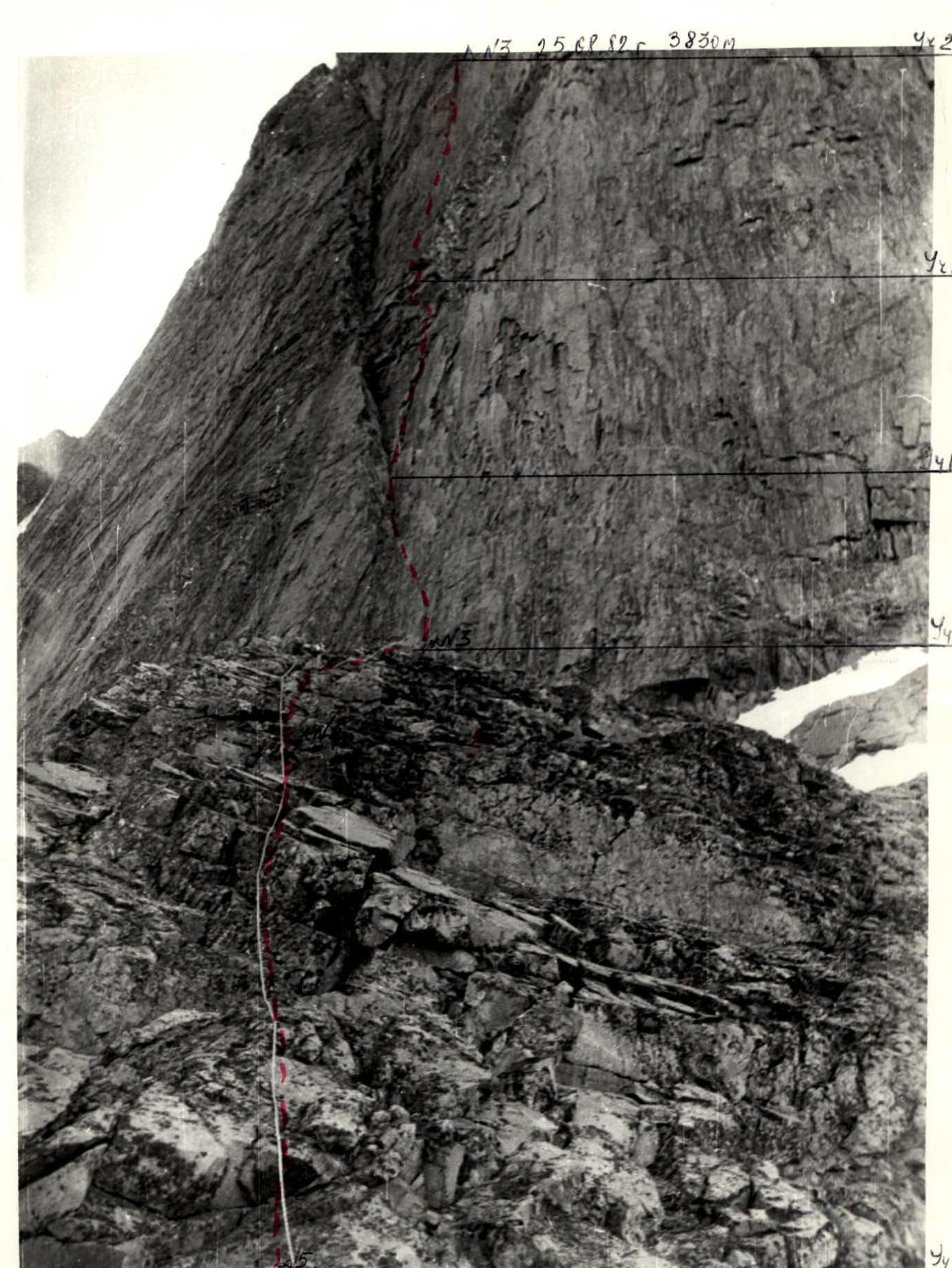
Technical photograph of the "Stolb".
Date taken: August 23, 1982. Time 17:00, camera "Smena-8", lens T-43 4/40. Altitude of shooting point 3490 m.

Technical photograph of the "Stolb".
Date taken: August 24, 1982. Time 13:00, camera "Smena-3", lens T-43 4/40. Altitude of shooting point 3490 m.
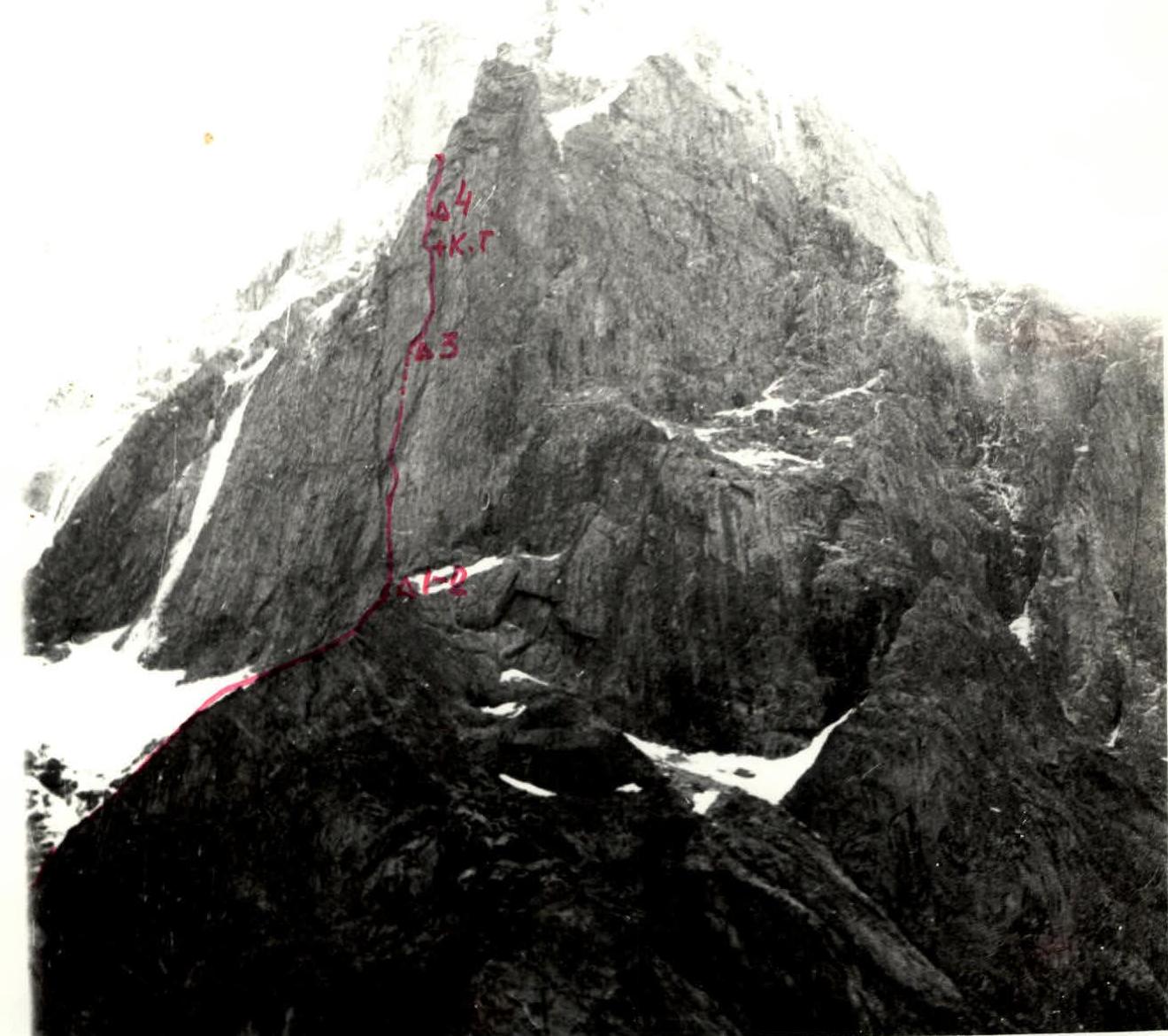
Photo #1.
Date taken: August 24, 1982. Time 11:00, camera "Kristall", lens Industar-50 3.5/50. Taken from a distance of 2.5 km. Shooting point #2, altitude 2720 m.
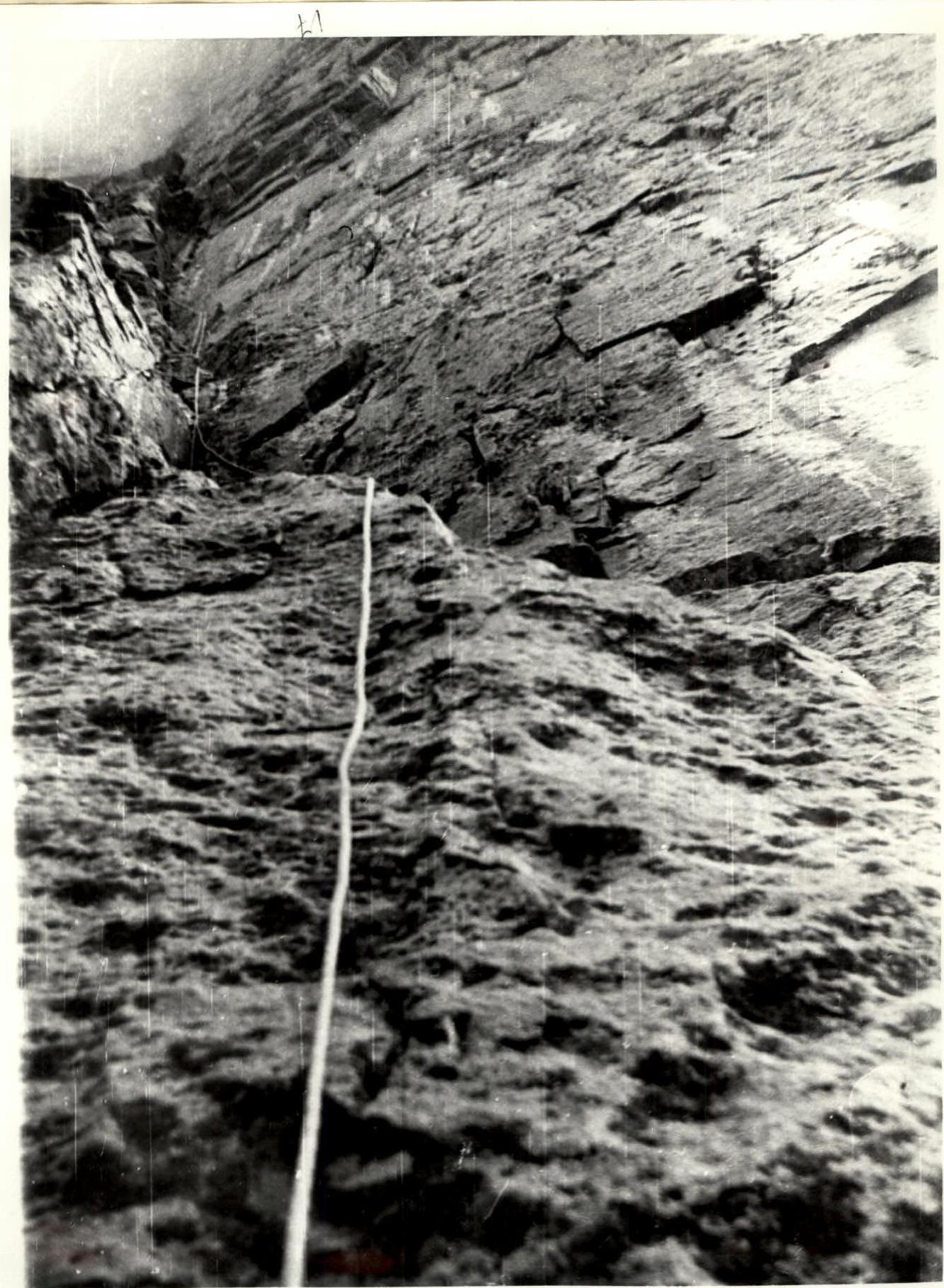
Photo #4. Sections 15–16 are shown.
Macro-relief of the wall 12–13 is reflected.

Photo #5. Sections 24–25 are shown (from below, from section 12).
Copy of the note from the 1st control cairn
Under the 3rd bastion of overhangs
Team of the Armed Forces of the USSR
July 27, 1981 10:00
A team of climbers from the Armed Forces of the USSR consisting of:
- Goluchev N.N. — team leader
- Nosov A.
- Lak V.
- Glushkov A.
- Egorov V.
Is making an ascent to the summit of K. Ushba via the edge of the Western wall through the "Stolb" (first ascent, category 6 difficulty). Departed from a bivouac located on the wall in a hang at 8:00.
Goluchev /signature/ Control-Makhishvili Copy is true