

COMMITTEE FOR PHYSICAL CULTURE AND SPORTS UNDER THE COUNCIL OF MINISTERS OF THE UKRAINIAN SSR
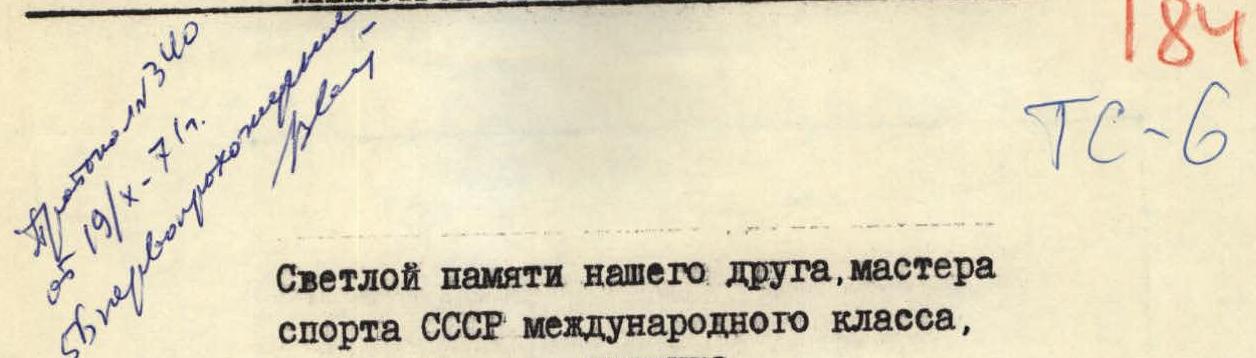
To the blessed memory of our friend, International Class Master of Sports of the USSR, Nikolai MASHCHENKO
ASCENT TO THE NORTH PEAK OF USHBA VIA THE CENTER OF THE EAST FACE
(report on the ascent)
Kiev — 1971
I. Sporting Characteristics of the East Face of North Ushba
Ushba is located in close proximity to the Main Caucasian Range and is situated in a spur branching off from the range near Shchurovsky Peak.
The western slopes of South Ushba and the eastern slopes of North Ushba are the most sheer and have considerable extent.
The east face of North Ushba starts from the Chalaat Glacier. The approach to the face is quite complex and takes about 2 hours from the alpinist camp. The face is sunlit from 6:00 to 11:00.
The east face has a varying profile of inclination. The left part of the face is the most gentle, but dangerous to climb due to frequent rockfalls and avalanches descending from the pre-summit slope. As one approaches the center of the east face, there are more sheer and overhanging rocks. The most complex and interesting section of the east face, in sporting terms, includes:
- a huge overhang with a steepness of 100–120°, divided in the upper part by a couloir gullet, periodically swept by avalanches and rockfalls;
- constantly cascading waterfalls from the upper couloir gullet;
- an overhanging section, one-third of the entire face, resembling a huge triangle with a base of 180–200 m.
The overhanging section of the face was formed as a result of the detachment and fall of soft rock formations on the overhang, and there are now many detached huge slabs somehow held on the face. This section of the face resembles a layered pie, and advancing through it requires special tactics.
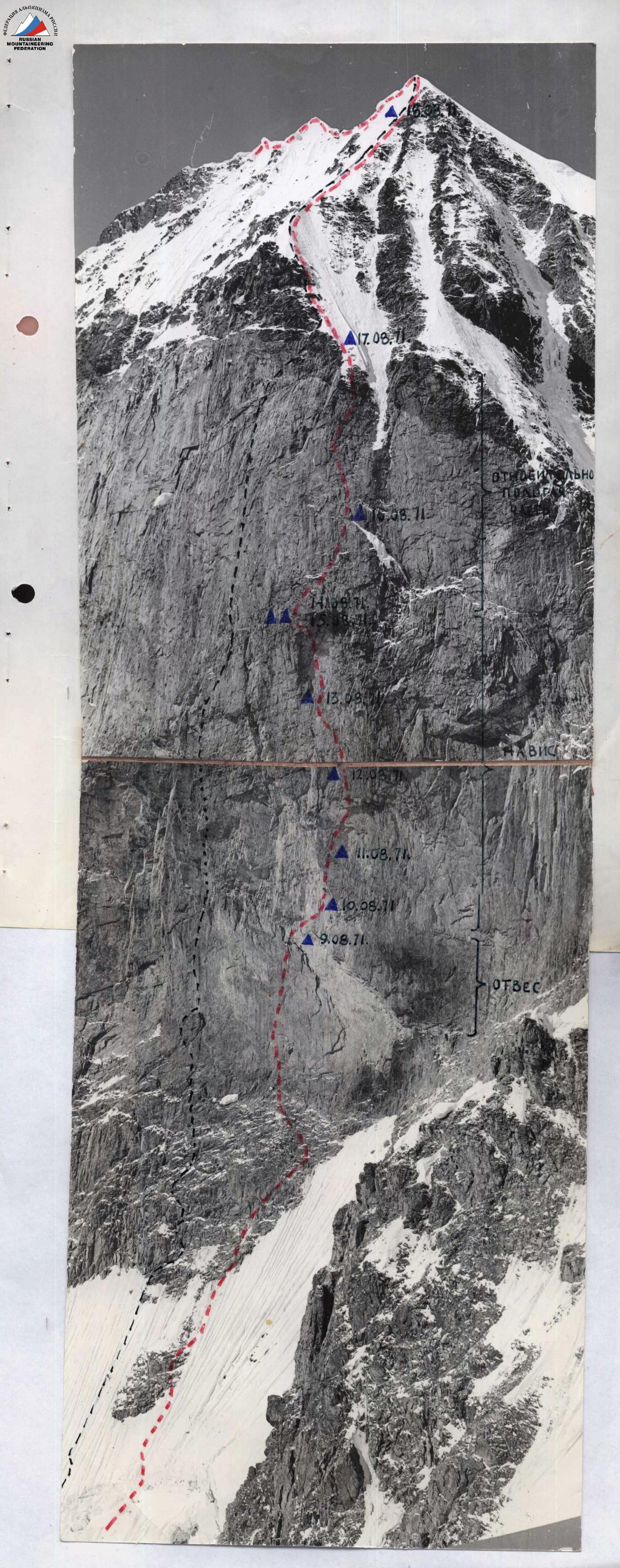
The first attempt to climb the east face was made by M. Khergiani's group in 1964. They climbed the face via the left slope. In 1971, alpinists from Czechoslovakia repeated the route taken by M. Khergiani's group.
In 1968, our team approached the center of the west face and managed to climb the route via the left edge of the overhanging wall, to the right of M. Khergiani's group's route.
The central part of the east face, with the passage of the overhanging rock section, remained unclimbed. This route, in our opinion, was of particular sporting interest, as it passed through a wall of considerable extent (about 300 m) with negative steepness (see photo). The entire face has many sheer sections, overcome by very complex free climbing.
2. Composition of the Assault Group
In accordance with the resolution of the Presidium of the USSR Alpine Federation (protocol No. 22/293 of May 11, 1971), an application was approved for participation in the 1971 USSR Alpine Championship in the class of technically complex ascents, submitted by the Committee for Physical Culture and Sports under the Council of Ministers of the Ukrainian SSR.
It should be noted that the Ukrainian Committee for the first time in 1971 financed the national team of the Ukrainian SSR.
According to the application, the main team consisted of leading alpinists from the Avangard sports society:
- V. Monogarov (captain and coach)
- M. Aleksyuk
- V. Goncharov
- O. Grippa
- N. Mashchenko
- D. Lavrinenko.
The reserve team included:
- V. Gromko
- V. Kozyavkin
- A. Shalygin.
The group that went on the ascent consisted of:
- V. Monogarov (team captain)
- M. Aleksyuk
- V. Goncharov
- D. Lavrinenko
- V. Kozyavkin
- V. Gromko.
The originally listed O. Grippa was unable to participate in the ascent due to having to take entrance exams for a higher school at that time, and N. Mashchenko tragically died while working as an instructor at the Elbrus alpine camp during an ascent to An dyrchi Peak (category 3B).
The main team was joined by:
- experienced alpinist-rock climber, Master of Sports of the USSR V. Kozyavkin, who had previously traversed Koshtan-Tau – Dykh-Tau with an ascent to Koshtan-Tau via the eastern counterfort from the Dumala valley and Chaty-Tau via the north face (category 6);
- young Candidate for Master of Sports of the USSR V. Gromko, multiple champion and prize-winner of the Ukrainian SSR in rock climbing, who had performed well during the ascent to Chaty-Tau via the north face (category 6) and ascents in the French Alps. The required data on the main group's composition is presented in the attached table.
3. Composition of the Observation Group. Organization of Communication and Action Plan for the Observation Group
The observation group included alpinist A.M. Chabanov (2nd category, leader) and N.T. Shoma (3rd category). In addition, the group included:
- radio operator-alpinist V.S. Vorobiev
- film operator-alpinist from the Kiev film studio "Kievnauchfilm" A.F. Vinogradov.
Communication with the climbers on the face was maintained visually from the Ushba plateau using the "Tair-33" optical system and "Vitalka" radio station.
| Surname, first name, and patronymic | Sports rank | Year of birth | Party affiliation | Nationality | Sports experience | Main profession | Place of residence |
|---|---|---|---|---|---|---|---|
| MONOGAROV Vladimir Dmitrievich | Honored Master of Sports | 1926 | CPSU member | Ukrainian | 1946 | Lecturer | Kiev-III, Saratovskaya, house 10-a, apt. 36 |
| ALEKSYUK Mikhail Mirovich | Master of Sports | 1932 | non-party | Russian | 1952 | Engineer | Kiev-121, Entuziastov, house 19/1, apt. 154 |
| GONCHAROV Vladlen Petrovich | Master of Sports of International Class, Candidate Master of Sports in rock climbing | 1938 | non-party | Russian | 1956 | Lecturer | Simferopol, Gogolya, house 54/15, apt. 11 |
| LAVRINENKO Dmitry Ivanovich | Master of Sports | 1933 | CPSU member | Ukrainian | 1953 | Lecturer | Kiev-125, Perova Boulevard, house 1/8, apt. 51 |
| KOZYAVKIN Viktor Vasilyevich | Master of Sports, Candidate Master of Sports in rock climbing | 1930 | non-party | Russian | 1950 | Engineer | Kharkov-102, Evpatoriyskiy proezd, house 5, apt. 15 |
| GROMKO Viktor Nikolayevich | Candidate for Master of Sports in alpinism and rock climbing | 1940 | non-party | Russian | 1964 | Welder | Feodosiya, Odesskaya street, 27, apt. 4 |
The length of the lower section of the route (sections R1–R4) is about 400 m, with a height difference of 280 m. The technical difficulty was represented by movement along the wall with a bergschrund and a soggy layer of snow on the ice base.
The middle, most complex section of the wall (sections R4–R9) can be divided into two parts:
- an overhanging section, 430 m long with a height difference of 410 m and a steepness of 100–125°;
- a relatively gentle section.
The passage through this section of the wall was complicated by four cornices, 1.2, 1.5, 1.5, and 12 m long.
The last cornice-overhang at the end of section 9 required a lot of effort to overcome.
Particular note should be made of the difficulty of overcoming the overhang with a steepness of 100–115° and a length of 240 m (see photo). The ascent was greatly complicated by the lack of stable weather. The climb was made during a thunderstorm, frost, and snowfall. The overhanging wall somehow protected the group from the bad weather, but descending 12, interrupting the ascent, was more complicated than ascending.
On the overhanging section of the wall, it was necessary to climb in a zigzag pattern to the right and left, searching for sections to hammer in rock pitons. Where rock pitons could not provide reliable protection, expansion bolts were used.
The relatively gentle section of the wall (sections R9–R11) had a length of 290 m and a height difference of 270 m, with an average steepness of 75°. This section of the wall had dissected rocks with ledges. However, its passage represented significant technical difficulty. The upper section of the wall, without the pre-summit ridge, 400 m long with a height difference of 280 m, was decided to be climbed at night, as a result of prolonged bad weather on August 10, 12, 13, 14, 15, and 16, a lot of snow had fallen, forming a snowy ridge on this section, which was better to traverse at night. This tactic fully justified itself. We climbed this relatively easy section in normal conditions when it got dark, illuminating our path with headlamps.
In conclusion, it should be noted that:
- the route we took, including the most complex rock sections, had never been climbed before;
- most sections of the wall with holds were overcome by free climbing. The length of these sections was 2/3 of the entire route, i.e., about, 1000 m;
- the use of special equipment (hammocks, platforms) made it possible to organize bivouacs on almost any section of the wall;
- on the sheer and overhanging sections of the wall, V. Monogarov, V. Goncharov, and V. Gromko blazed the trail, alternating every 30–40 m. On other sections, they climbed in pairs: V. Monogarov – V. Gromko, V. Goncharov – V. Kozyavkin, and M. Aleksyuk – D. Lavrinenko. The lead climbers periodically changed. On snow-ice sections, the pair M. Aleksyuk – D. Lavrinenko mostly led.
When climbing using free climbing on sections of the route, candidates for Master of Sports of the USSR in sport rock climbing from Crimea demonstrated their mastery:
-
V. Goncharov
-
V. Gromko
-
Weather conditions during the ascent were very poor — on August 10, 12, 13, 15, 16, 17, and 18, it snowed periodically, and a strong frosty wind blew. On August 14, the group was unable to move due to a snowstorm. Given that the group had already climbed part of the overhang on August 9 and 10 and was under its shelter from the snowfall, we continued to move upward even in bad weather. Moreover, after climbing the beginning of the overhang, descending on a rope was practically impossible, as the pitons on the route were mostly hammered in. After August 14, it was easier to continue upward than to descend, and we, despite the icing on the rocks, continued on our way. Particularly unfavorable weather conditions greatly complicated the already extremely challenging ascent.
The entire ascent to the wall to the summit took 89 hours of climbing time. The group reached the summit at 12:30 on August 18. It was not possible to find a note on the summit due to a large amount of freshly fallen snow.
Our team believes that the ascent to North Ushba via the center of the east face, in terms of technical complexity, is the most challenging of the routes we have previously taken to this peak, as well as the routes to Chaty-Tau via the north face (category 6), and to Petit Dru via the Bonatti and Magnone routes (category 6).
The team dedicated their ascent to our friend and comrade in joint ascents, Nikolai Mashchenko, who tragically died in the mountains this summer.
On behalf of the team TEAM CAPTAIN AND COACH V. MONOGAROV

Pulling up backpacks over the overhangs and cornices of the wall presented considerable difficulty. The steepness of the wall is 120°.
Table of Main Characteristics
Route of ascent to the north peak of Ushba via the center of the east face. Height difference of the route 1240 m, length 1520 m. Including the most complex sections:
- Cornices: first – 1.2 m; second – 1.5 m; third – 1.5 m; fourth cornice-overhang – 12 m.
- Overhanging rocks 100–125° – 290 m.
- Sheer rocks 90° – 95 m.
- Steepness 70–75° – 300 m. Average steepness of the wall: overhang – 110°; sheer section – 80°.
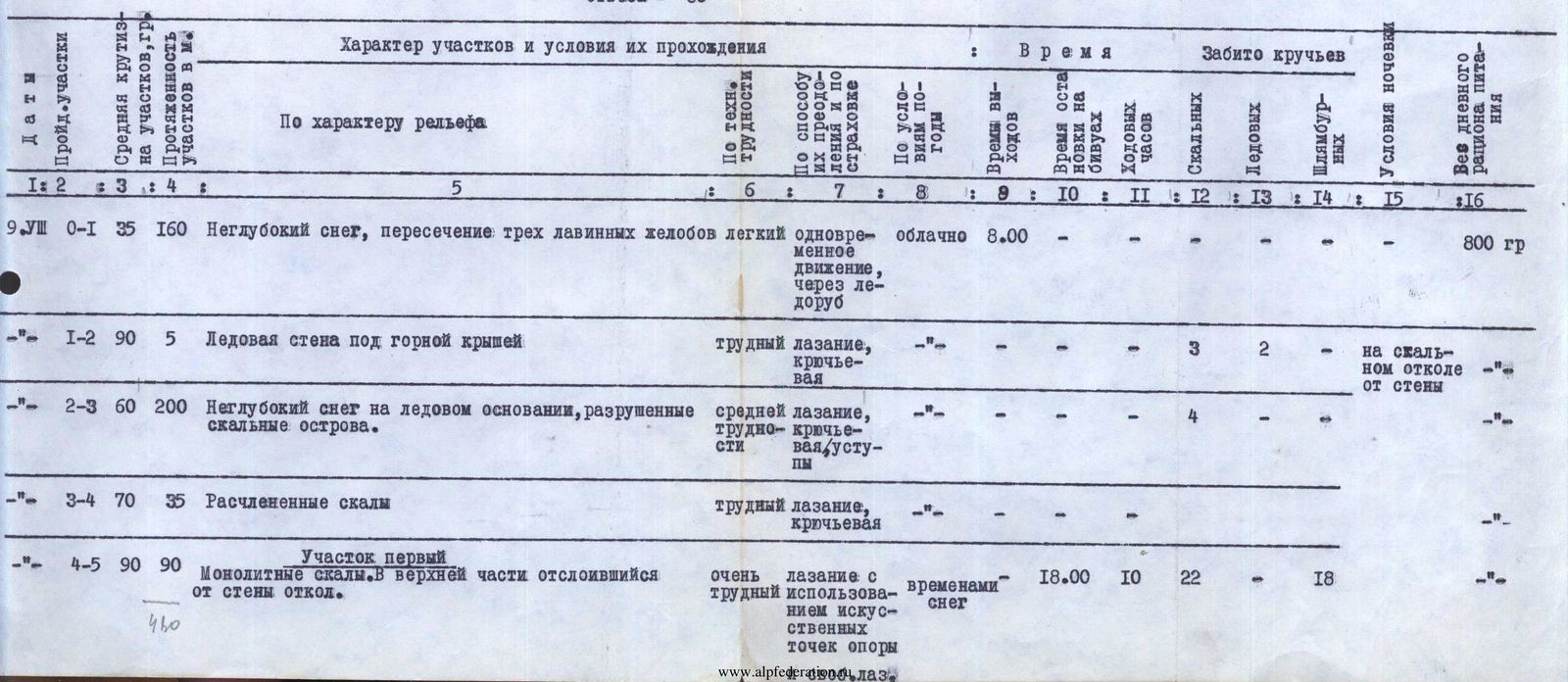
| Date | Sections climbed | Average steepness of sections, ° | Length of sections, m | Characteristics of sections and conditions of passage | Method of movement and belay | Weather | Time of departure | Time worked | Time of return | Rock pitons | Ice pitons | Expansion bolts | Total pitons | Conditions of overnight stay | Weight of daily ration, g |
|---|---|---|---|---|---|---|---|---|---|---|---|---|---|---|---|
| August 9 | R0–R1 | 35 | 160 | Shallow snow, crossing three avalanche gullies. | Easy simultaneous movement, via ice axe | Cloudy | 8:00 | 800 | |||||||
| August 9 | R1–R2 | 90 | 5 | Ice wall under a rock overhang | Difficult climbing, piton | 3 | 2 | On a rocky ledge | |||||||
| August 9 | R2–R3 | 60 | 200 | Shallow snow on an ice base, destroyed rocky islands. | Medium climbing, difficult-piton, ledges | 4 | |||||||||
| August 9 | R3–R4 | 70 | 35 | Dissected rocks | Difficult climbing, piton | ||||||||||
| August 9 | R4–R5 | 90 | 90 | Section one Monolithic rocks. In the upper part, a slab detached from the wall. | Very difficult climbing using artificial holds | Occasional snow | 18:00 | 10 | 22 | 18 | |||||
| August 10 | R5–R6 | 100 | 60 | Section two Overhanging rocks, with detached rocky fragments, two of which formed two cornices 1.2–1.5 m long. Traverse to the right upwards. | Very difficult ascent, complicated by upward movement | Snowfall at night and in the morning, fog | 7:00 | 18:00 | 11 | 26 | 15 | Sitting on platforms | |||
| August 11 | R6–R7 | 105 | 80 | Section three Overhanging dissected rocks. | Very difficult | Good in the morning, snowfall from 12:30 | 8:00 | 19:00 | 11 | 26 | 32 | Sitting on platforms and hammocks | |||
| August 12 | R7–R8 | 115 | 90 | Section four Overhanging dissected rocks. Overcome one 1.5-meter cornice. | Very difficult | Good in the morning, wind, snow, fog from 15:00 | 6:00 | 19:00 | 11 | 28 | 34 | Sitting on platforms and hammocks | |||
| August 13 | R8–R9 | 125 | 80 | Section five Overhanging rocks, ascent along a large 12-meter cornice-overhang. | Very difficult | Snow, cloudy | 6:00 | 20:00 | 14 | 29 | 48 | ||||
| August 14 | Severe weather, blizzard, waiting out the weather | On ledges, separately | |||||||||||||
| August 15 | R9–R10 | 75 | 140 | Section six Monolithic and dissected rocks. There are ledges. | Difficult free climbing, piton | Sunny in the morning, fog from 9:00 | 8:00 | 18:00 | 10 | 30 | |||||
| August 16 | R10–R11 | 75 | 150 | Section seven Dissected rocks, with ledges. | Difficult free climbing, piton | Snowfall at night, snow during the day | 8:00 | 18:00 | 10 | 35 | |||||
| August 17–18 | R11–R12 | 45 | 430 | Section eight Firn ridge. At the top, dissected rocks. Pre-summit ridge. | Medium difficulty, complicated by prolonged snowfalls | Hail at night, heavy snowfall | 17:00 | 2 AM | 6:00 | 4 | 5 | On an ice ridge | |||
| Total on the wall | 1520 | 89 | 207 | 87 | 147 |

| Date | Sections climbed | Average steepness of sections, ° | Length of sections, m | Characteristics of sections and conditions of passage | Method of movement and belay | Weather | Time of departure | Time worked | Time of return | Rock pitons | Ice pitons | Expansion bolts | Total pitons | Conditions of overnight stay | Weight of daily ration, g |
|---|---|---|---|---|---|---|---|---|---|---|---|---|---|---|---|
| August 18 | Descent from the summit Snowy ridge. Rocks of Nastenko. | Medium, piton, via ice axe | Snowfall, light fog, strong wind, frost | 13:00 | 18:00 | 5:00 | 5 | Rocks of Nastenko | |||||||
| August 19 | Descent to the Elbrus alpine camp Destroyed rocks, snow. | Medium difficulty, pitons, ice axe | Snowfall, frost, strong wind | 7:00 | 22:00 | 15:00 | 1 | a/l "Elbrus" | |||||||
| Total | 1 |
TEAM CAPTAIN AND COACH
V. MONOGAROV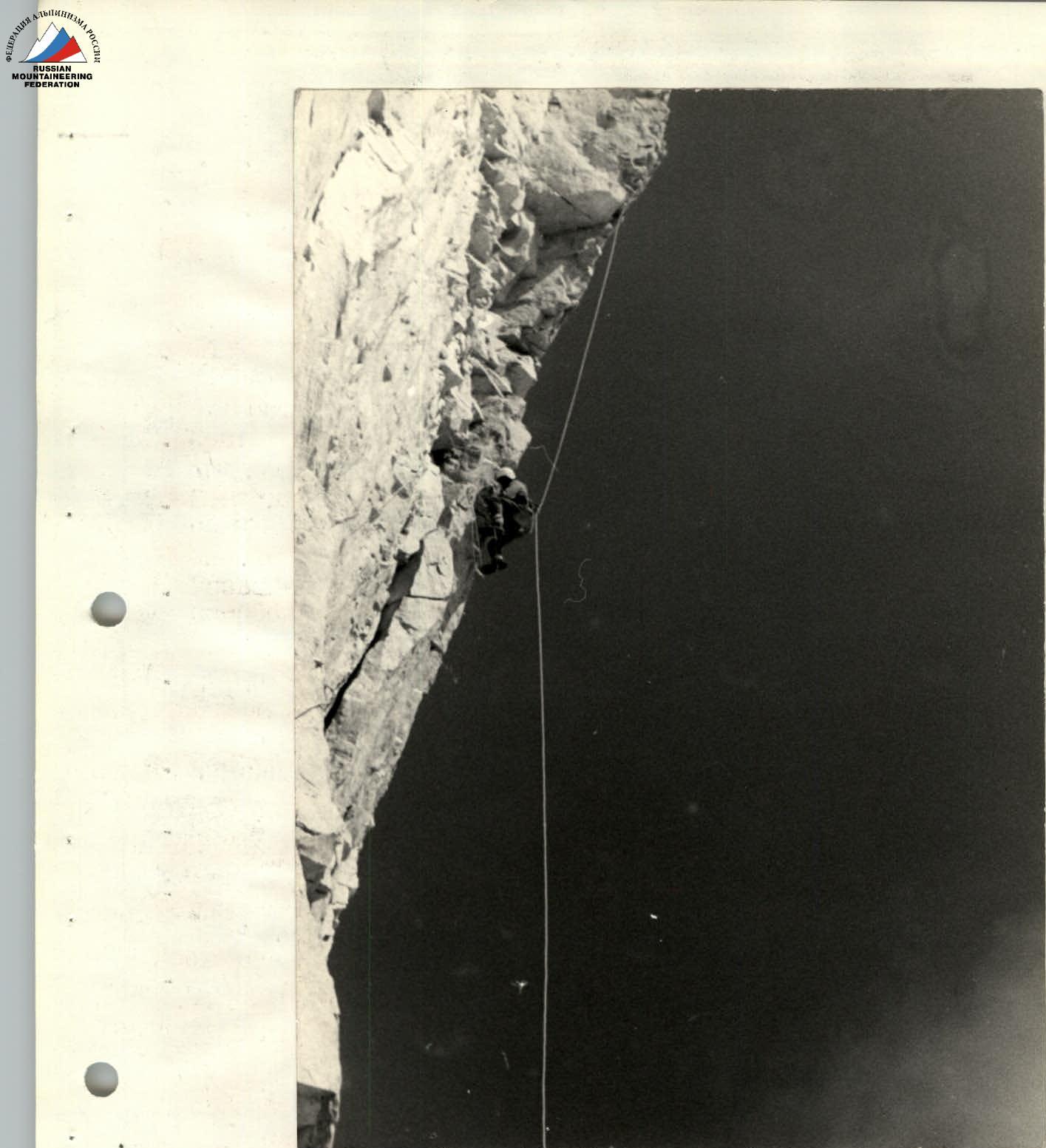
Climbing the overhanging section R7–R8 in its upper part was very complex climbing. The steepness of the wall is 110–115°.
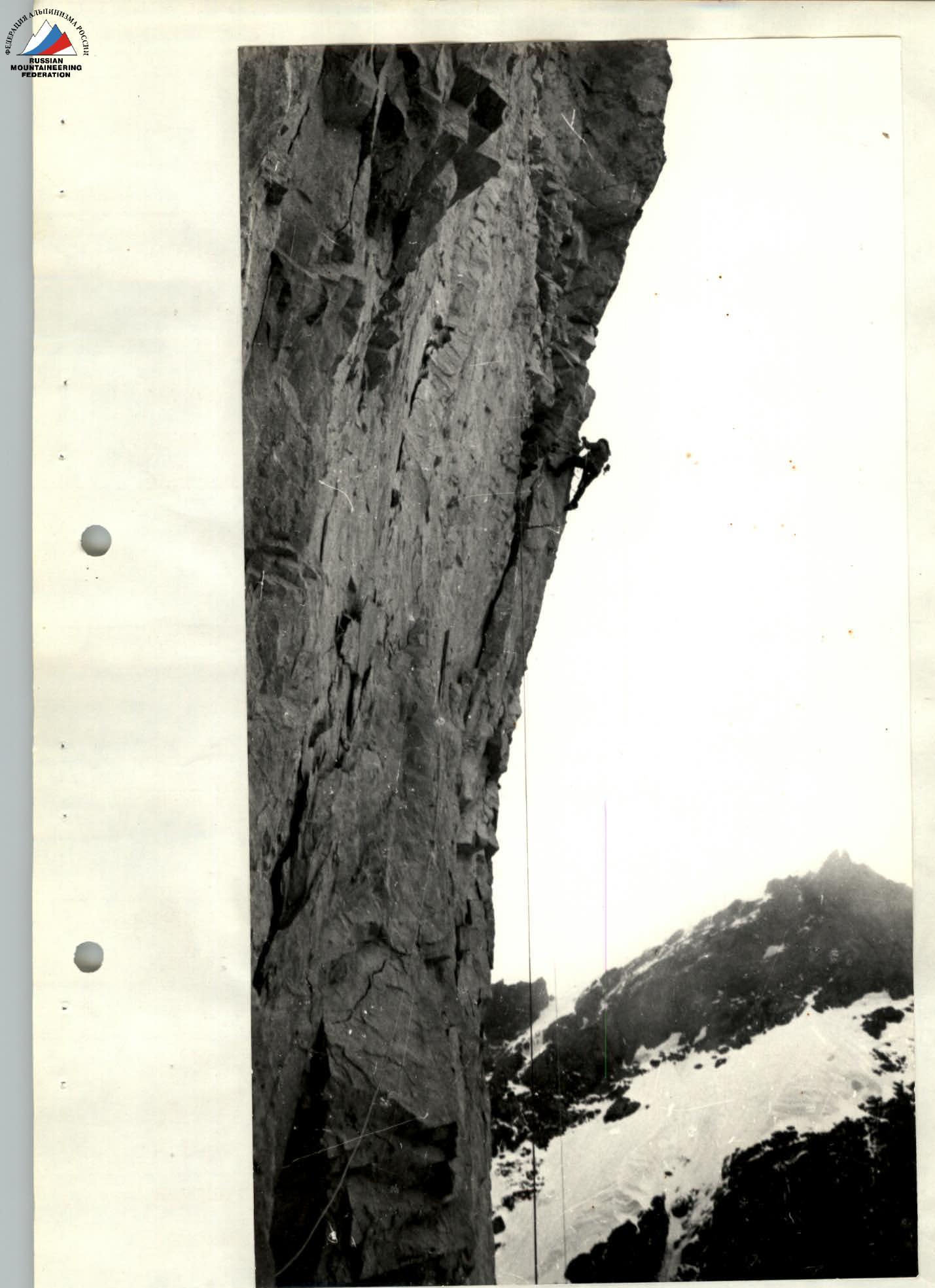
Climbing the overhanging section R7–R8, above the slab.
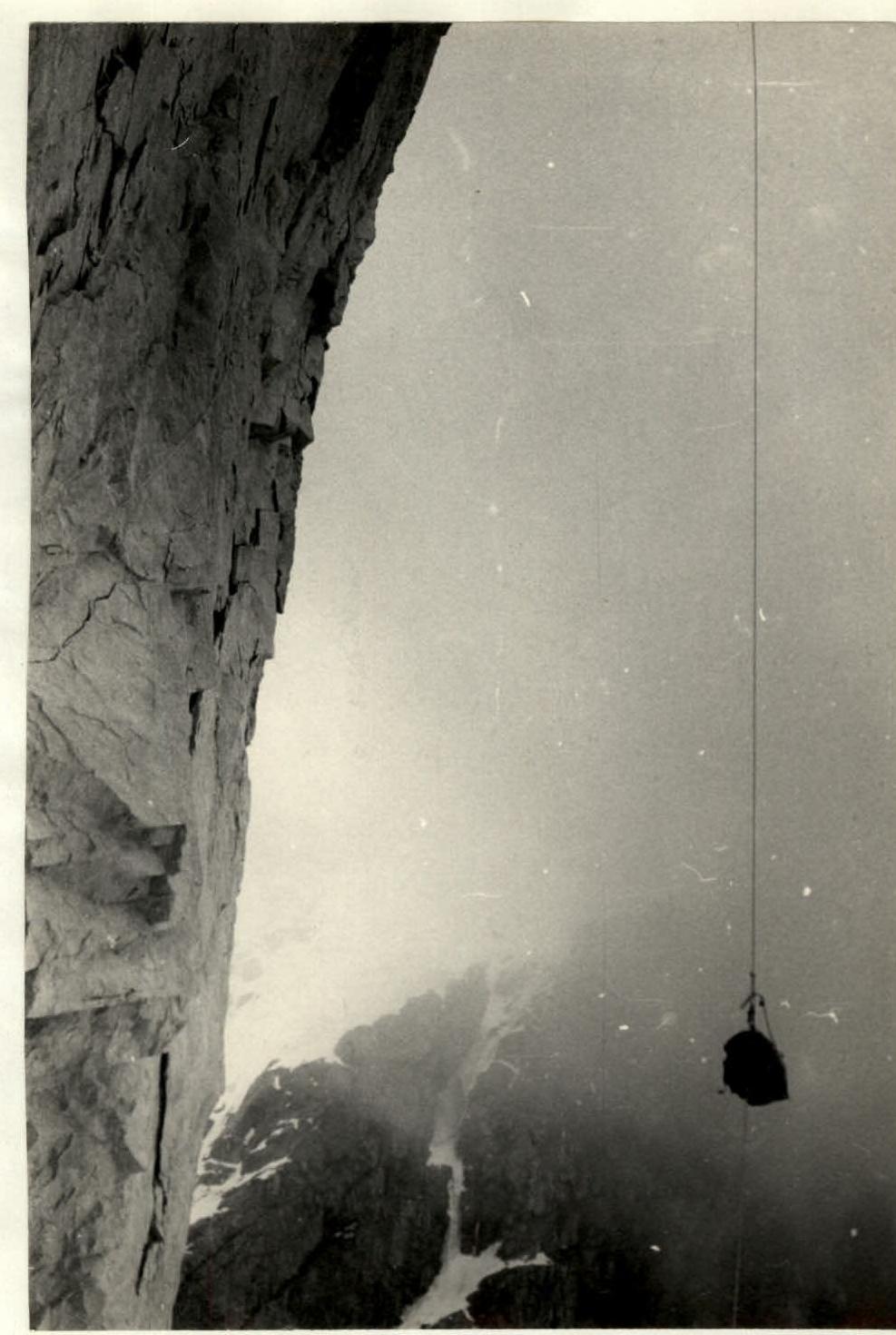
Pulling up a backpack along the overhanging wall. The steepness of the wall is 110°.