
Passport
-
Rock climbing category
-
Central Caucasus, Suaryk gorge.
-
Suaryk Eastern peak, via the center of the NE wall, 950 m.
-
Proposed category: 5B, first ascent.
-
Height difference: 625 m, route length 895 m.
Length of sections with 5–6 category difficulty is 380 m. Average slope of the route is 63°. Average slope of the wall section is 74°.
-
Pitons hammered in: rock — 92, bolt — 7, chocks — 58. Left behind: rock — 7, bolt — 1.
-
Team's total climbing hours: 16, days — 2.
-
Overnight stays — 1, lying down, comfortable.
-
Leader: Derevyanko Vladimir Fyodorovich, Candidate for Master of Sports. Participants: Fursov Valery Alexandrovich, Candidate for Master of Sports, Domrachev Sergey Ivanovich, Candidate for Master of Sports, Kruglovenko Alexander Vasilyevich, Candidate for Master of Sports.
-
Coach: Yakovina Viktor Antonovich, Master of Sports of the USSR.
-
Start of the route: August 8, 1987. Summit: August 10, 1987. Return: August 10, 1987.
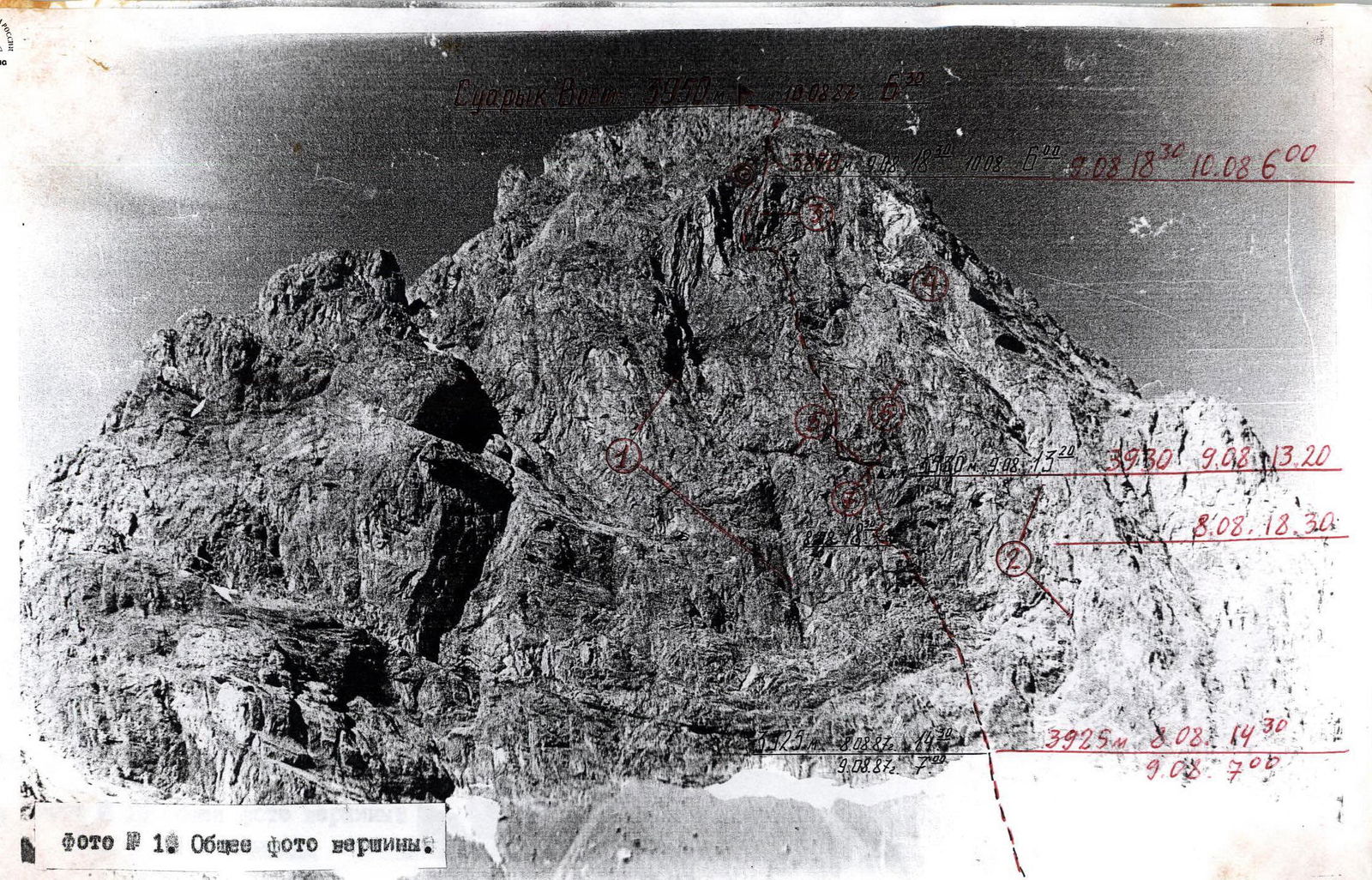
Suaryk Eastern 3950 m, August 10, 1987, 6:30 AM
Tactical Actions of the Team
Based on reconnaissance data, the following tactical plan for the ascent was developed:
- August 8, 1987. Observation of the wall. Preliminary processing of the lower part of the route.
- August 9, 1987. Start of the route. Passage of the bastion. Overnight stay.
- August 10, 1987. Exit to the "red" rock belt. Passage of the belt. Exit to the "roof". Overnight stay.
- August 11, 1987. Ascent to Suaryk Eastern peak.
The team saw the solution to the ascent challenge (passage of the NE wall bastion) in using modern rock climbing equipment combined with the team's good rock climbing skills. Considering the route's dry conditions, 10 liters of water were taken.
To ensure safety, each team member had a standard shock absorber and an individual first aid kit. During the wall section, they used rope protection. The number of ropes taken allowed each member to work on a double rope. To speed up the passage, the lower part of the wall was pre-processed by the Fursov-Derevyanko rope team. The actual ascent schedule was as follows:
- August 8, 1987. Observation of the wall. Processing of five ropes in the lower rock belt ("ram's foreheads" type rocks).
- August 9, 1987. Start of the route. Passage of the wall bastion and "red" belt rocks. Exit to the "roof". Overnight stay.
The overnight stay was organized on comfortable platforms in the Chogolisovn valley, protected by a rock ridge. The bivouac was comfortable, lying down, with a scenic view. August 10, 1987. Ascent to the summit. Descent via the 4A category route.
Thus, the route was completed in 16 climbing hours (including preliminary processing) with one overnight stay. Overall, the ascent was completed a day ahead of the tactical plan. This was due to the correctly chosen tactical scheme — the first climber working without a backpack and pulling up the remaining backpacks "American style". The good selection of equipment also contributed. Additionally:
- Section R13–R15, which was expected to require ITO and bolt work based on observations, was passed with free climbing.
On the route, the rope teams worked in the following composition:
- 1st rope team — Fursov — Derevyanko
- 2nd rope team — Kruglovenko — Domrachev
The team took 8.0 kg of food, calculated at 600 g per person per day. The food selection allowed for maintaining high performance. Hot meals were organized twice a day during the ascent, and each participant had a "pocket" ration.
Communication between the group and the base was established through an observation group using the following scheme:
- summit — observation group via "Lastochka" radio set
- observation group — base via "Karat" radio set
Communication schedule with observers: 7:40, 11:00, 15:00, 19:50, with additional sessions scheduled at even hours if necessary. Throughout the ascent, communication with the observation group was maintained regularly, with no missed sessions.

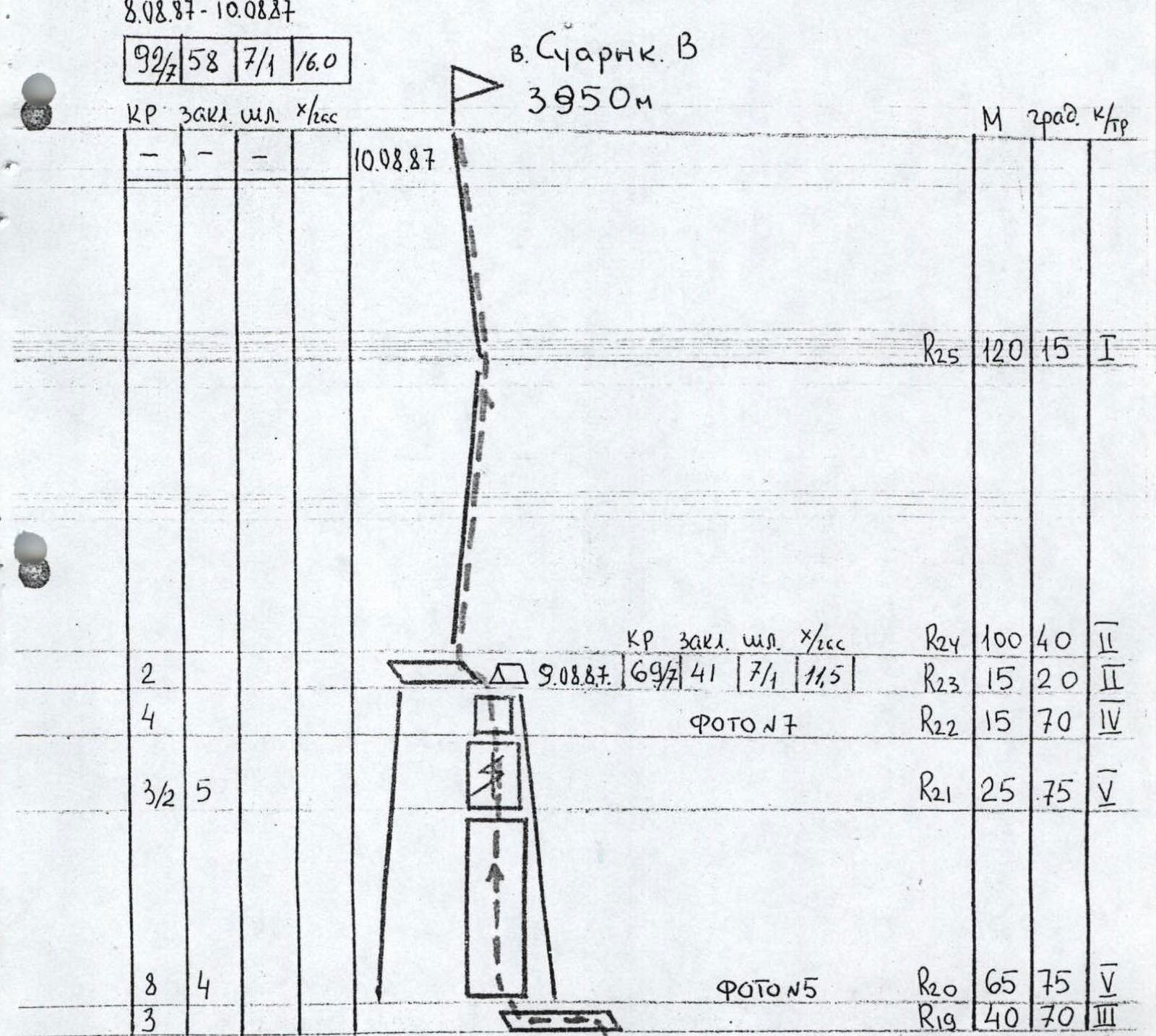
M 1:2000
 8.08.87–10.08.87
Route Description by Sections
R0–R8 Represents the throat of the right "red" couloir, exiting onto "ram's foreheads" type rocks. Climbing is not complicated, but there are few cracks for intermediate belays. There are narrow and blind cracks.
Section R0–R2 — may be exposed to rockfall from the "roof", and since the wall is dry, rockfall is less dependent on the time of day. It is recommended to pass during daylight hours.
R3–R5 Actually, section R3 marks the beginning of the "gray" bastion wall. Ascend a 5-meter wall onto a gray steep slab-step, then traverse left to a cleft. To the right is an overhanging rock. Good cracks for pitons and chocks. Further left along the cleft, which leads to a small platform (2–3 people). Convenient spot for setting up a belay station.
R6–R10 Key area of the gray "bastion". From the belay station, traverse left with a slight descent and exit to a sheer cleft-chimney, climbing 15 m upwards under an overhang, through which (bolt piton, ITO) exit right onto the bastion wall. Then directly upwards to the "nest". Very challenging free climbing on friction. Few cracks for intermediate belays.
R11 In the "nest" is a control cairn, from which traverse left to an internal corner along an inclined slab. The traverse is straightforward, but few cracks for intermediate belays.
R12–R13 Belay via bolt pitons. Up the right wall of the overhanging internal corner, climb vertically upwards, exiting onto the wall. Climbing is very challenging with limited holds.
R14 Up a 40-meter wall, climb with a general direction towards the left edge of the large internal corner-couloir. Climbing is challenging on friction; good grip with climbing shoes. Cracks are narrow and blind.
R15–R18 Up the left edge of the internal corner, climb vertically upwards to the base of the upper "red" rock belt. Challenging friction climbing with few holds, using sky hooks.
R19 From under the base of the "red" rock belt, traverse left 40 m to the left part of the bastion.
R20 Challenging climbing on the right wall of a huge couloir. Large chocks are useful.
R21–R22 Up a cleft-chimney, climb freely until its end, then left through a 15-meter wall onto a shoulder (bivouac spot). In the middle of the cleft, use ITO. Caution! Sections R21–R22 have many loose "live" rocks. Movement should start only after the entire group has passed section R20.
R23 A cascade of inclined shelves, on which a lying-down platform for 3 people can be set up.
R24–R25 Up a weakly defined edge, climb 100 m until exiting onto the pre-summit ridge, then to the summit.
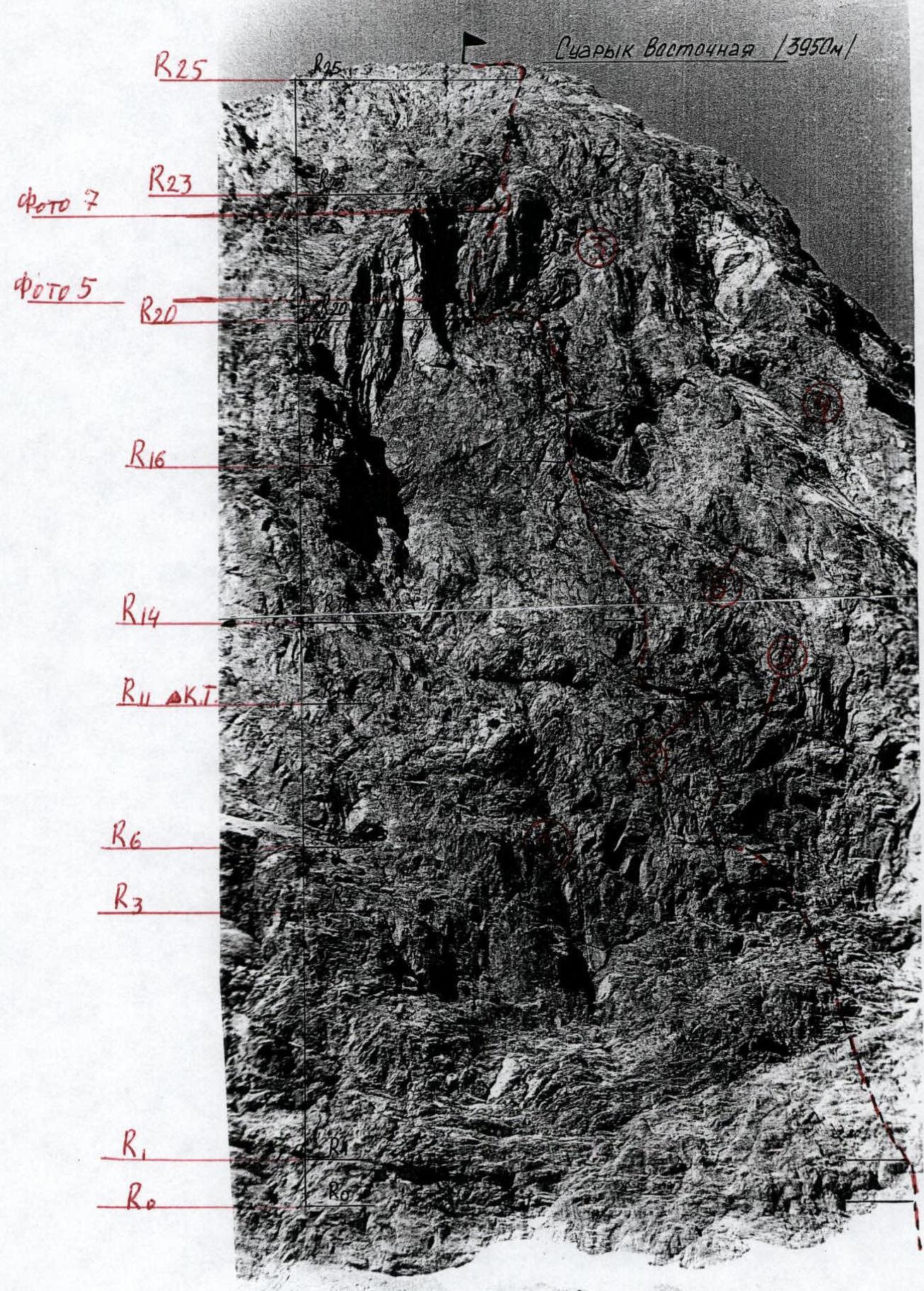
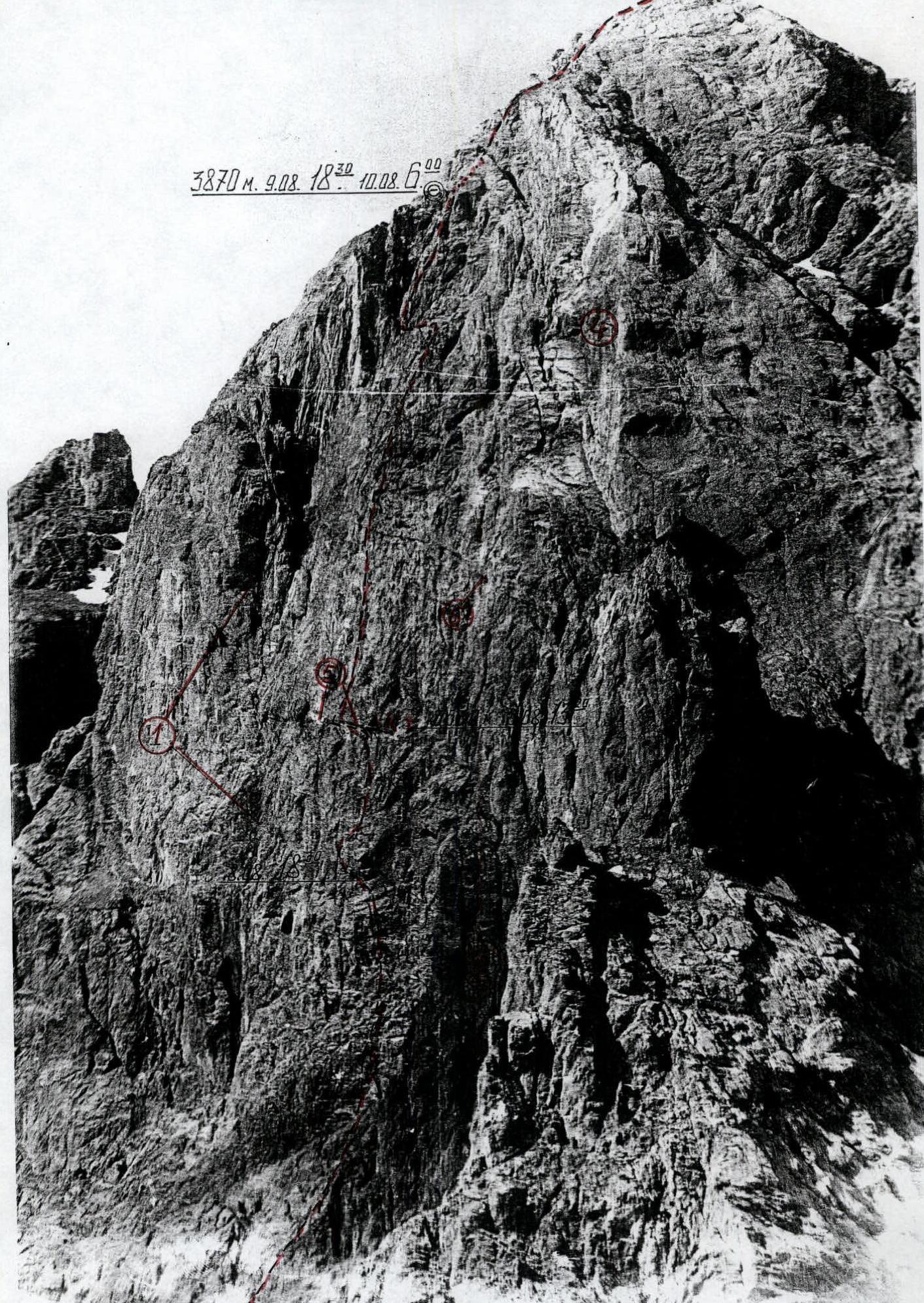
Photo No. 4. Technical photo of the route.
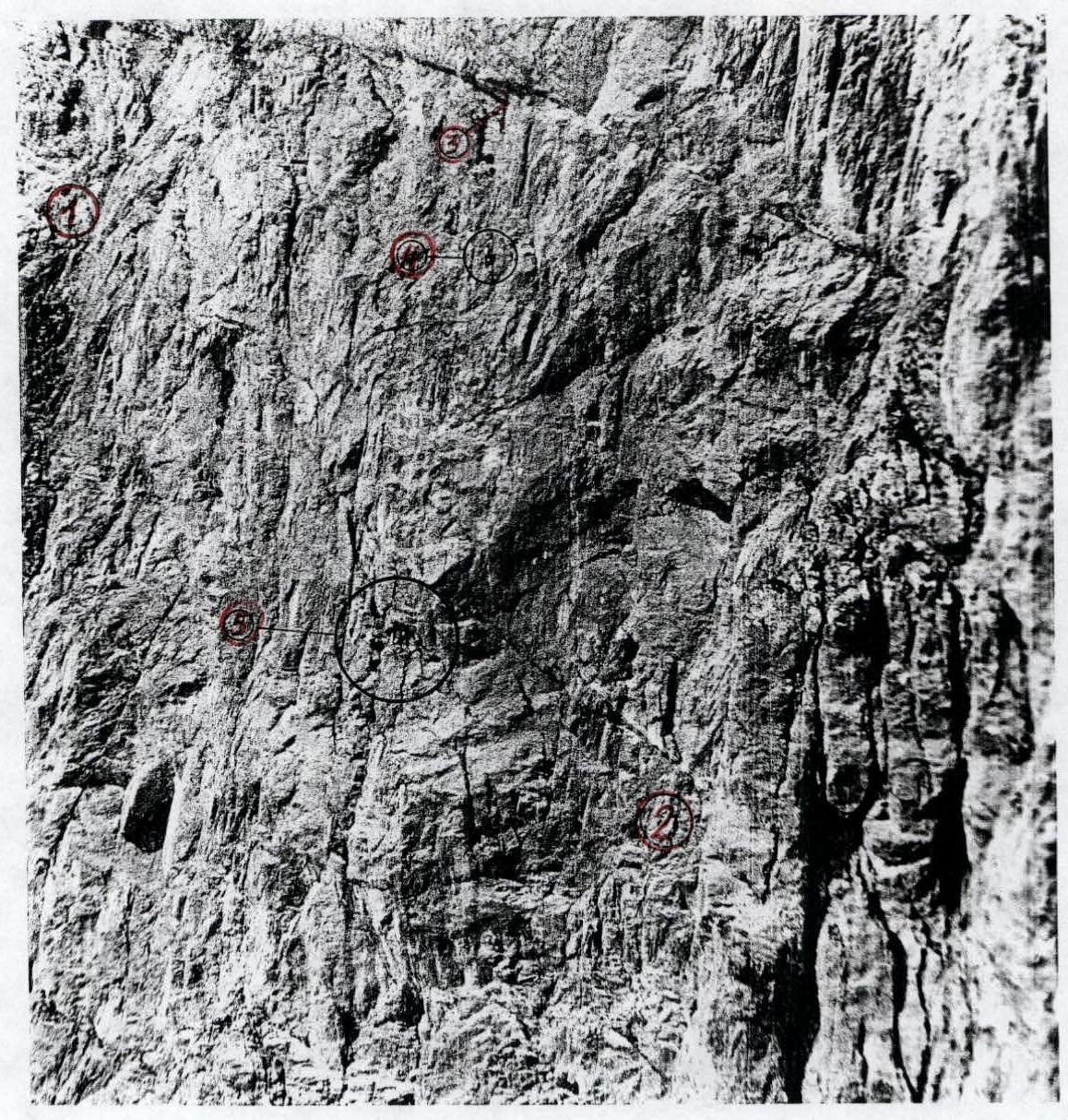
Photo No. 6. Passage of section R7–R10. Photo taken on August 9, 1987, at 10:50 AM. Camera "Zenit-EK", lens "Yupiter-37A", focal length 15 mm. Shooting point at an altitude of 3495 m, distance to the subject 600–700 m. Legend:
- 1 — "black couloir"
- 2 — "red couloir"
- 3 — "nest"
- 4 — Fursov, working as the first, is at the station, section R8
- 5 — group is at the station (section R7). Derevyanko starts moving along the fixed ropes.