First ascent of the right part of the NE wall of peak Suaryk V. 3950 m (rock climbing category)
Report on the First Ascent
On the first ascent to peak Suaryk via the right part of the NE wall, approximately category 5B difficulty, accomplished by the team from Baksan Alpine Training and Sports Base (AUSB "Baksan") from August 3, 1990, to August 5, 1990.
Coach: Drobot Stanislav Yuryevich Team Leader: Kruglovenko Alexander Vasilyevich
Alpine Training and Sports Base "Baksan" 361603, KB ASSR, postal office Elbrus, AUSB "Baksan" Drobot Stanislav Yuryevich
305000, Kursk, Katya Zelenko street, house 6-B, apartment 14. Kruglovenko Alexander Vasilyevich.
All heights mentioned in the report were determined using an altimeter.
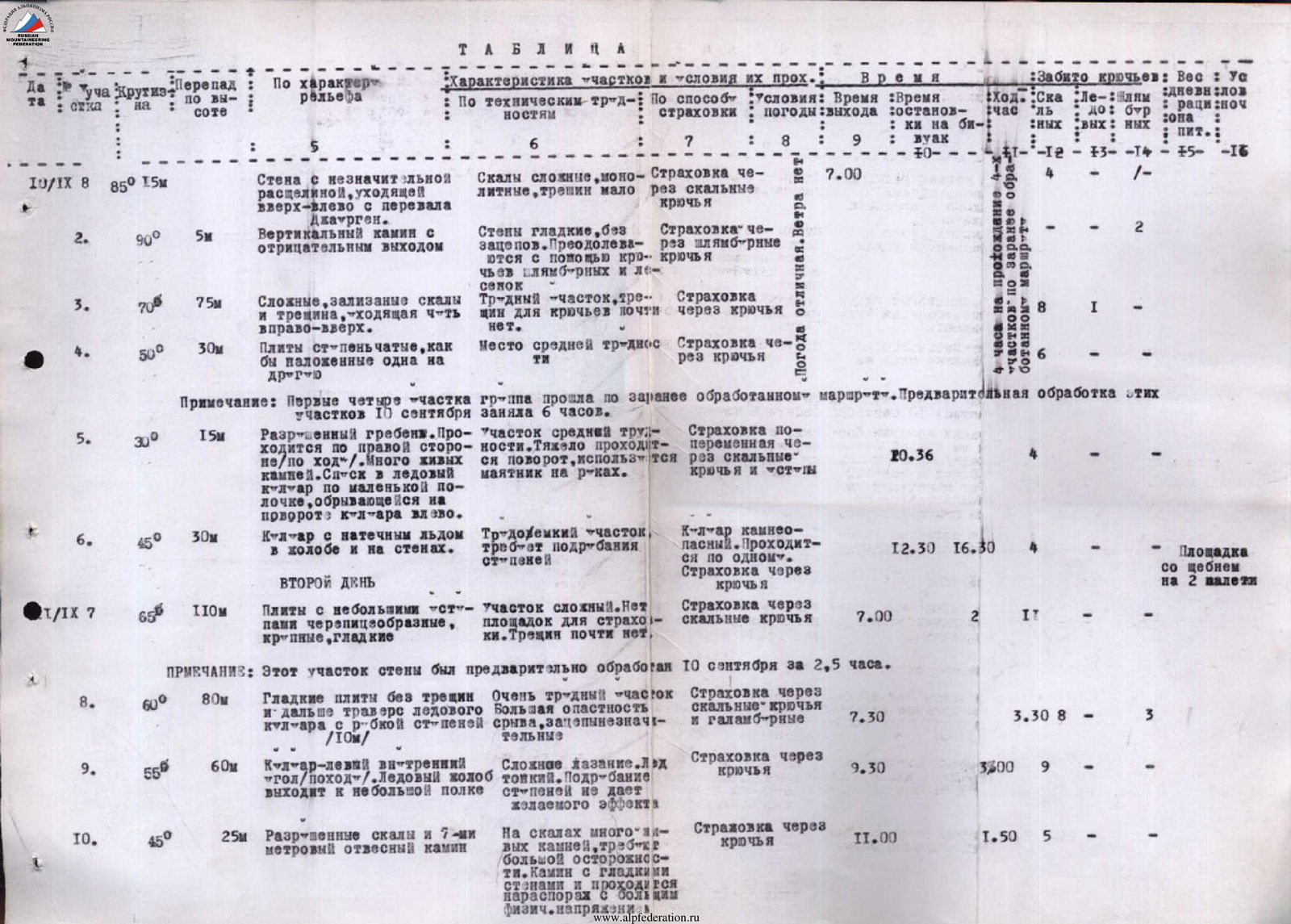
Table of Section Characteristics and Climbing Conditions
Section Characteristics (data from the table, page 2 PDF)
-
Entry № 1 (Date: 10/IX; Steepness: 85°; Height Difference on the Pitch: 15 m)
- Terrain Character: Wall with a minor crack going up-left from the Djaurgen pass.
- Technical Difficulty: Rocks are complex, monolithic, with few cracks.
- Protection Method: Protection via rock pitons.
-
Entry № 2 (Date: 2.; Steepness: 90°; Height Difference on the Pitch: 5 m)
- Terrain Character: Vertical chimney with a negative exit.
- Technical Difficulty: Walls are smooth, without holds. Overcome using pitons, bolts, and ladders.
- Protection Method: Protection via bolted pitons.
-
Entry № 3 (Date: 3.; Steepness: 70°; Height Difference on the Pitch: 75 m)
- Terrain Character: Complex, polished rocks and a crack going slightly right-up.
- Technical Difficulty: Difficult section, almost no cracks for pitons.
- Protection Method: Protection via pitons.
-
Entry № 4 (Date: 4.; Steepness: 50°; Height Difference on the Pitch: 30 m)
- Terrain Character: Stepped slabs, as if layered on top of each other.
- Technical Difficulty: Moderately difficult.
- Protection Method: Protection via pitons.
-
Entry № 5 (Date: 5.; Steepness: 30°; Height Difference on the Pitch: 15 m)
- Terrain Character: Destroyed ridge. Passed on the right side (by the route). Many loose rocks. Descent into the ice couloir via a small ledge that breaks off at the turn of the couloir to the left.
- Technical Difficulty: Moderately difficult section. Difficult to navigate the turn; a pendulum move is used on hands.
- Protection Method: Alternate protection via rock pitons and pillars.
-
Entry № 6 (Date: 6.; Steepness: 45°; Height Difference on the Pitch: 30 m)
- Terrain Character: Couloir with ice formations in the hollow and on the walls.
- Technical Difficulty: Labor-intensive section, requires step cutting.
- Protection Method: Couloir is rockfall-prone. Climbed one at a time. Protection via pitons.
Section Characteristics (data from the table, page 2 PDF, continued: Second Day)
-
Entry № 7 (Date: 1/IX 7; Steepness: 65°; Height Difference on the Pitch: 110 m)
- Terrain Character: Slabs with small, tile-like steps, large, smooth.
- Technical Difficulty: Complex section. No belay stances. Almost no cracks.
- Protection Method: Protection via rock pitons.
-
Entry № 8 (Date: 8.; Steepness: 60°; Height Difference on the Pitch: 80 m)
- Terrain Character: Smooth slabs without cracks and further traverse of the ice couloir with step cutting (10 m).
- Technical Difficulty: Very difficult section. High risk of falling; holds are minimal.
- Protection Method: Protection via rock and ice pitons.
-
Entry № 9 (Date: 9.; Steepness: 55°; Height Difference on the Pitch: 60 m)
- Terrain Character: Couloir – the left inner gully (by the route). Ice groove leads to a small ledge.
- Technical Difficulty: Complex climbing. Ice is thin. Step cutting does not yield desired results.
- Protection Method: Protection via pitons.
-
Entry № 10 (Date: 10.; Steepness: 45°; Height Difference on the Pitch: 25 m)
- Terrain Character: Destroyed rocks and a 7-meter sheer chimney.
- Technical Difficulty: Rocks have many loose stones, requiring great caution. Chimney has smooth walls, climbed using stem technique with significant physical effort.
- Protection Method: Protection via pitons.
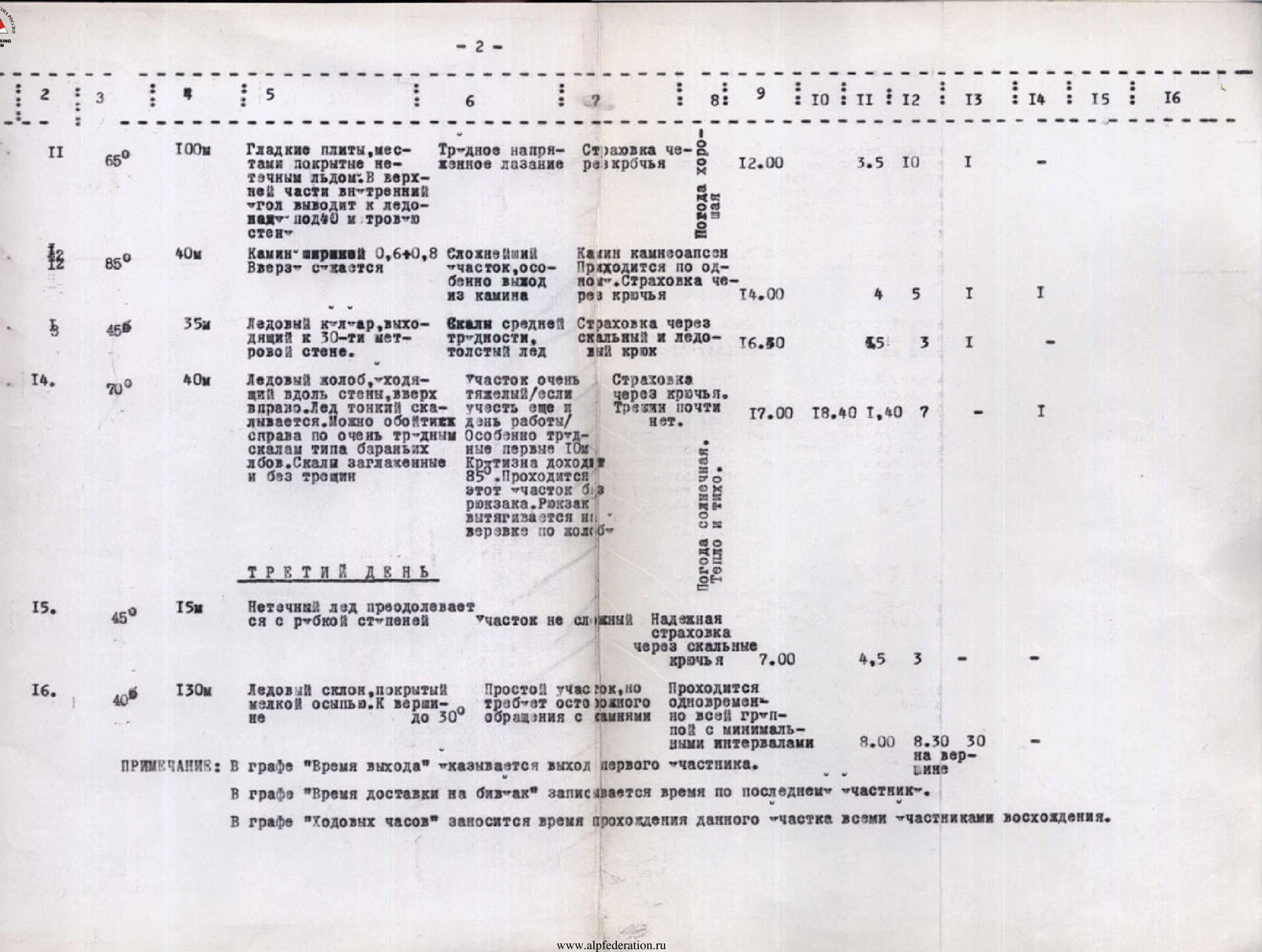
Section Characteristics (data from the table, page 4 PDF: Third Day)
-
Entry № 11 (Date: II; Steepness: 65°; Height Difference on the Pitch: 100 m)
- Terrain Character: Smooth slabs, partially covered with ice. In the upper part, the inner gully leads to ice overhanging a 40-meter wall.
- Technical Difficulty: Difficult, strenuous climbing.
- Protection Method: Protection via pitons.
-
Entry № 12 (Date: 2.; Steepness: 85°; Height Difference on the Pitch: 40 m)
- Terrain Character: Chimney 0.6–0.8 m wide. Inverted.
- Technical Difficulty: Extremely complex section, especially exiting the chimney.
- Protection Method: Chimney is rockfall-prone. Climbed one at a time. Protection via pitons.
-
Entry № 13 (Date: 3.; Steepness: 45°; Height Difference on the Pitch: 35 m)
- Terrain Character: Ice couloir leading to a 30-meter wall.
- Technical Difficulty: Rocks of moderate difficulty, thick ice.
- Protection Method: Protection via rock and ice screws.
-
Entry № 14 (Date: 14.; Steepness: 70°; Height Difference on the Pitch: 40 m)
- Terrain Character: Ice groove going along the wall, up to the right. Ice is thin, flaky. Can be bypassed on the right via very difficult rocks resembling "sheep's foreheads." Rocks are polished and without cracks.
- Technical Difficulty: Section is very challenging (considering the day's work). Especially difficult first 10 m. Steepness reaches 85°. This section is climbed without a backpack. Backpack is pulled up on a rope through the hollow.
- Protection Method: Protection via pitons. Almost no cracks.
-
Entry № 15 (Date: 15.; Steepness: 45°; Height Difference on the Pitch: 15 m)
- Terrain Character: Ice formations overcome with step cutting.
- Technical Difficulty: Section is not complex.
- Protection Method: Reliable protection via rock pitons.
-
Entry № 16 (Date: 16.; Steepness: 40°; Height Difference on the Pitch: 130 m)
- Terrain Character: Ice slope covered with small debris. To the summit, up to 30°.
- Technical Difficulty: Simple section but requires cautious handling of rocks.
- Protection Method: Climbed simultaneously by the entire group with minimal intervals.
Notes on the Table
- The first four sections were climbed on a pre-processed route. Preliminary processing of these sections on September 10 took 6 hours.
- The "Exit Time" column records the exit time of the first participant.
- The "Time to Bivouac" column records the time for the last participant.
- The "Climbing Hours" column records the time taken to climb the given section by all participants.
Tactical Actions of the Team
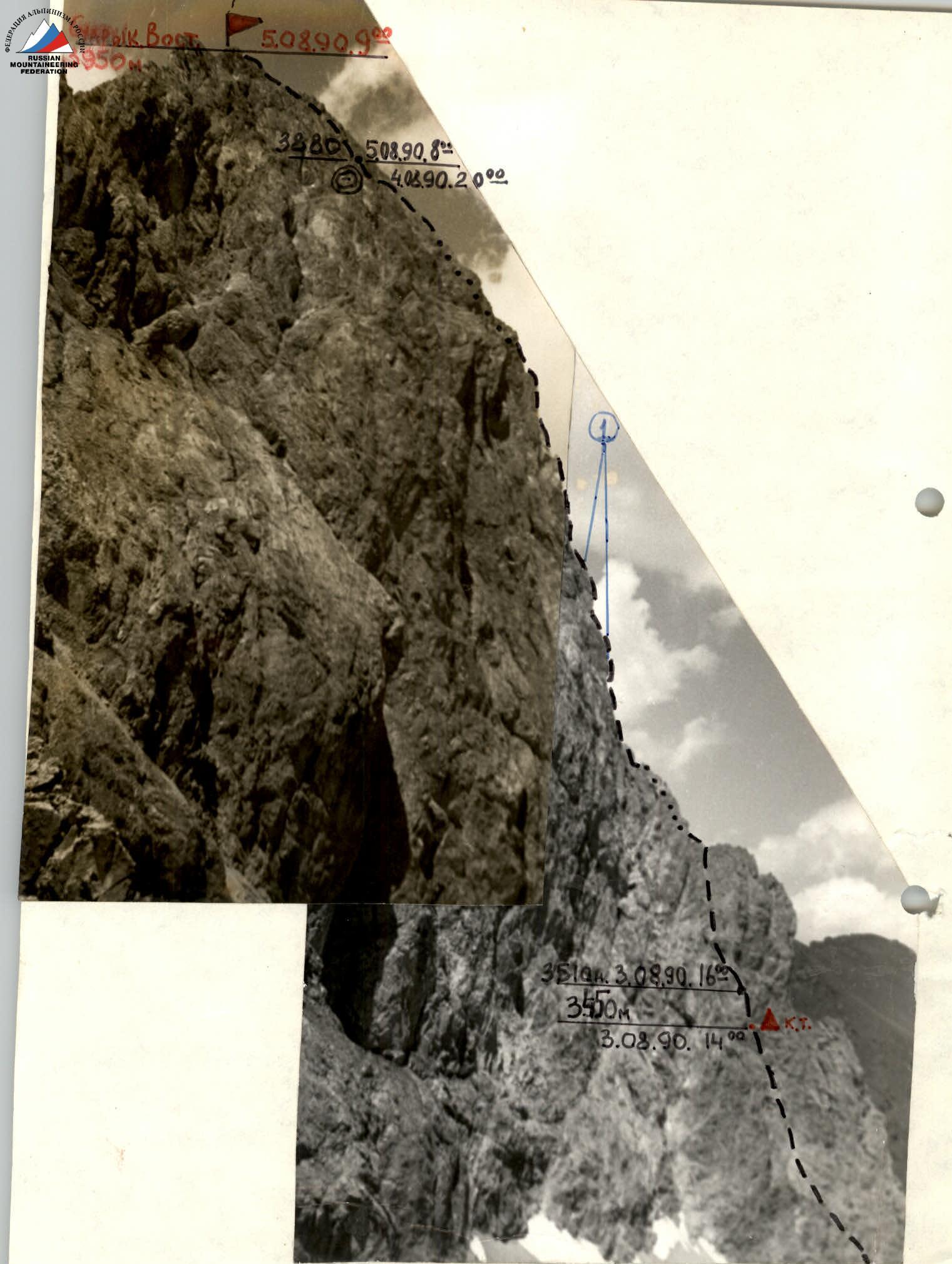 Photo №2. Route profile from the left. For the ascent, the following tactical plan was developed:
- August 2, 1990 — departure from AUSB "Baksan," observation of the wall, photographing the route.
- August 3, 1990 — processing the route.
- August 4, 1990 — ascent on the route, overnight stay on the summit tower.
- August 5, 1990 — ascent to the summit of Suaryk V., return to AUSB "Baksan".
During the ascent, there were no significant deviations from the tactical plan.
During the ascent, the team was divided into rope teams as follows:
- I rope team: Domrachev — Kruglovenko
- II rope team: Shilo — Maistrenko — Shcherbakov
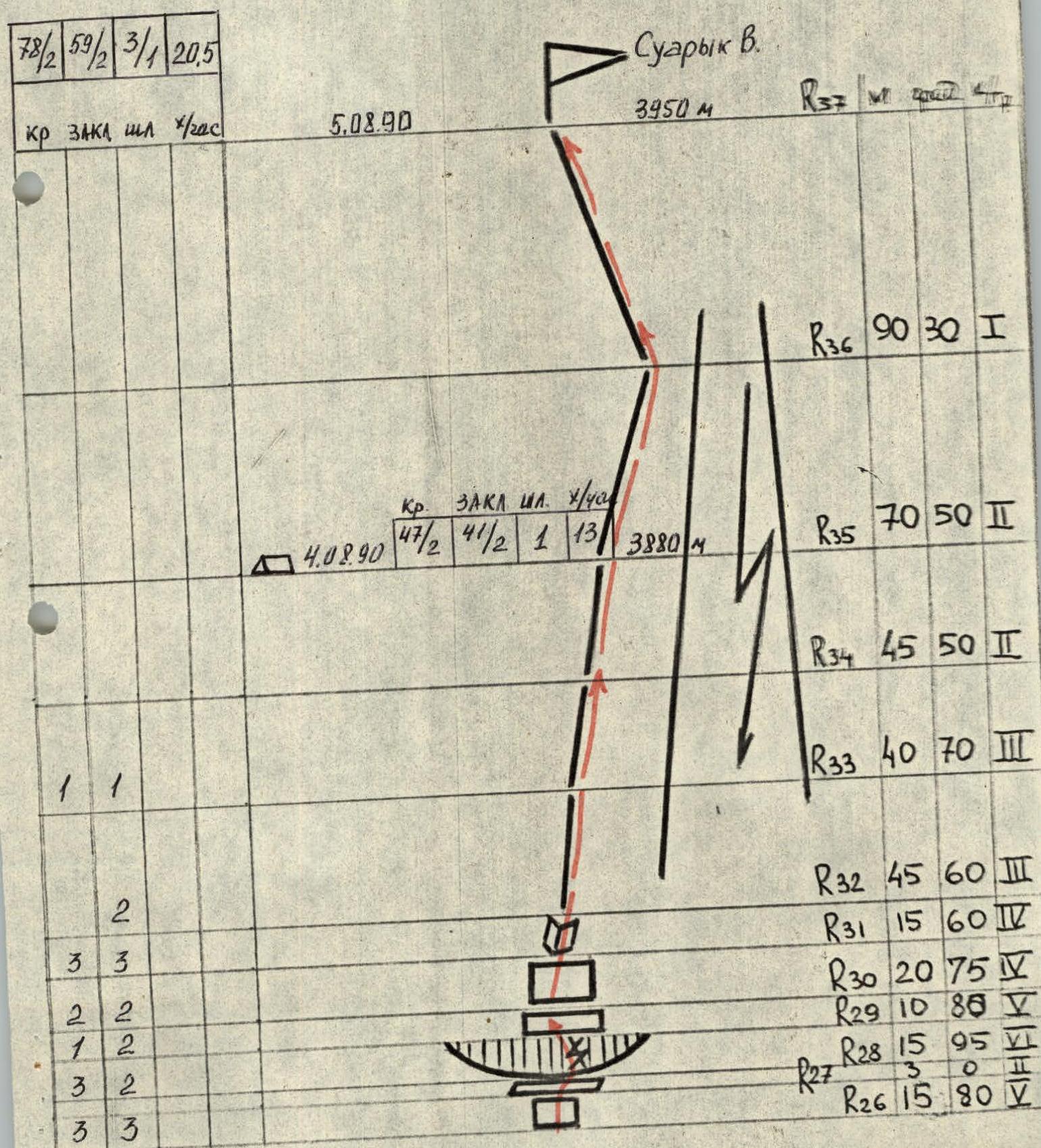
Route processing (sections R0–R9) was done by the rope team Domrachev — Kruglovenko, with Domrachev leading. On sections R10–R14, Kruglovenko led during processing. On August 4, 1990, Domrachev climbed sections R15–R26, and Kruglovenko climbed sections R27–R30. On sections R1–R14, R16–R30, fixed ropes were established for the team's movement. Sections R15 and R31–R36 were climbed simultaneously. On sections R11–R12, R22–R23, ladder-pitons were used. For creating belay points on sections R5 and R10, bolted pitons were used.
To ensure safety, the lead climber used a standard climbing shock absorber. The lead worked with a lightened backpack and without a backpack on sections R22–R28. Each team member had an individual first-aid kit. When moving on fixed ropes, everyone had top-rope insurance. The second rope team had a reserve of pitons.
For the ascent, 4.0 kg of food were taken, calculated at 400 g per person per day, and 7.0 liters of water — 700 ml per person per day. Hot meals were organized twice a day, and each member had an individual "pocket" ration pack. The overnight stay was on the summit tower. The bivouac was comfortable, lying down, safe, but without water.
During the ascent, there were no falls or injuries. The weather throughout the ascent was good. The physical and moral preparation of the team members provided a significant margin of safety during the climb.
Communication with AUSB "Baksan" during route processing was maintained from the bivouacs using a "Karat" radio set with a half-wave antenna, and during the ascent, a quarter-wave antenna was used. A rescue team was on standby at AUSB "Baksan". There were no missed radio communication sessions during the ascent.
Route Diagrams
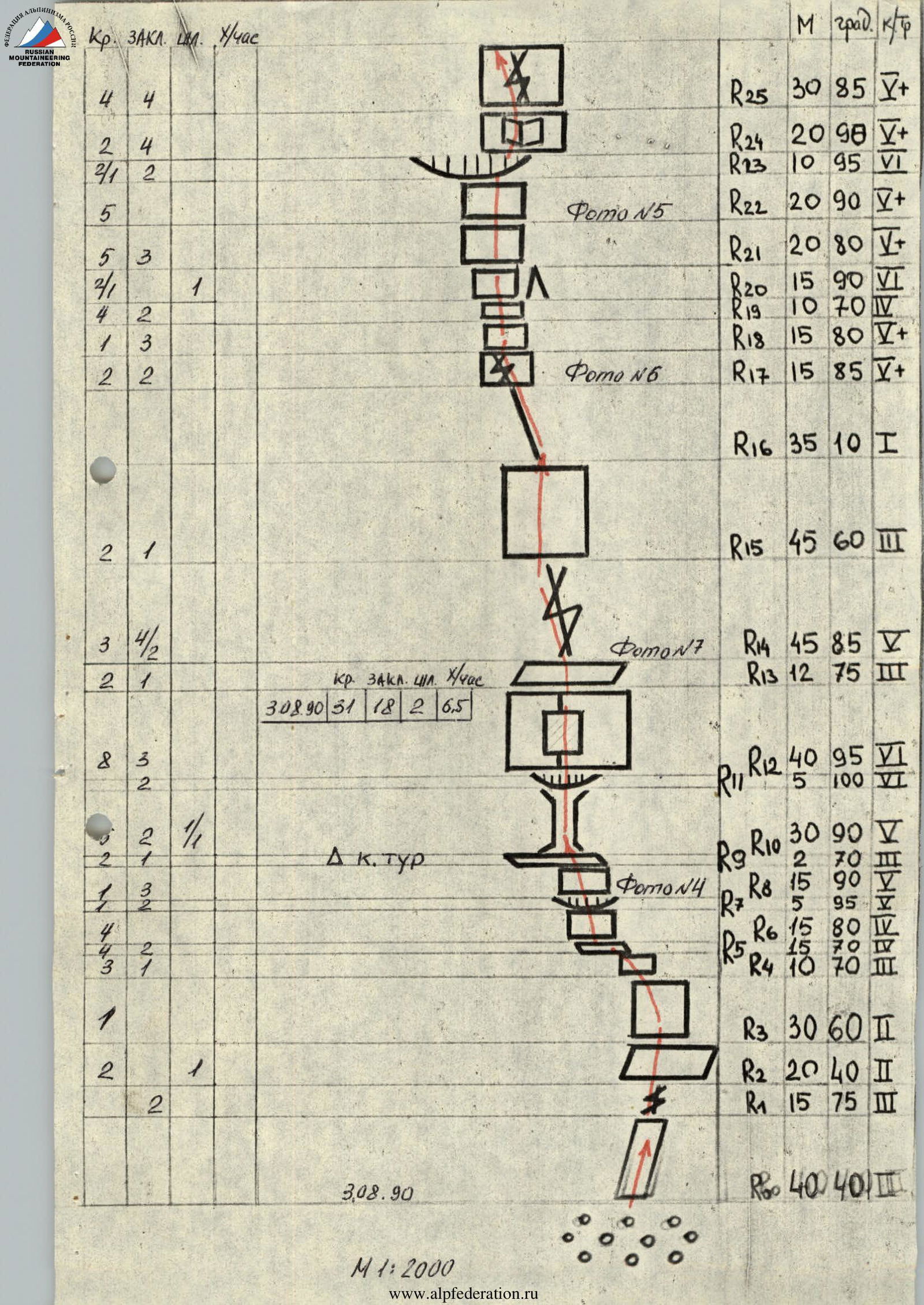
Route diagram in symbols.