The route of ascent to Кюкюртлю–Кол–Баши with a traverse of both peaks of Elbrus by the Kabardino-Balkarian alpine group. 106. The group consisted of: Naugolny V. - leader, participants - Zalikhanov M., Murzaev A., Amishokov A., and Kerimov A. Special attention was paid to the selection of pitons. Petal and other types of pitons are not very suitable for the tuff rocks of Кюкюртлю, so we had to replace them with ice and other related types of pitons, although this significantly increased the weight of our backpacks. From the CSK camp above the Хото-Тау pass, the group departed at 2 am. We descended to the foot of Кюкюртлю via easy, destroyed rocks. The approach to the wall is not difficult but has certain features. Continuous rockfalls, both day and night, pose a significant danger. The entire massif is riddled with numerous couloirs, making it very difficult to navigate and choose the correct safe path. A group without a detailed description or photographs of the entire wall cannot correctly approach the start of the route on the wall. By following the tracks left by rocks on the hard snow, we managed to avoid entering a dangerous couloir and reached easy rocks, about 32 k/tr, which led us to the wall. First, we overcame a 40°–60° wall, 35–40 m long. The rock is monolithic and reliable, with good hook placement and handholds. Next, there is a 60 m chimney. The chimney is very difficult and dangerous. There are no reliable handholds, and they break off easily in the form of slabs. Each group member must try not to lag behind, as the spacing is very risky due to the lack of good piton protection. It's also necessary to wear goggles due to the real risk of damage from falling rocks. The group spent about four hours on the chimney. After the chimney, there is a very complex 70°–75° wall, about 50 m high. The first person to climb this section should be the group's strongest rock climber. The rock is monolithic, and the protection is reliable. The group spent five hours on this section, including hauling backpacks. The upper part of the wall has a cone-shaped, more gentle form, with a slope of 40°–50°. Here, we followed the left part along ledges to reach the chimney. This section consists of very loose rocks, and the protection is organized with ice pitons.
The next day, we departed from the bivouac at 5 am. We climbed a chimney of medium difficulty and reached a very destroyed ridge. Here, it's impossible to organize reliable piton protection, and the ice pitons are not very reliable either. We had to be extremely cautious and use alternating protection. 200 m of ridge led us to the most technically complex section of the route - an 80 m wall with a slope of 60°–70°. There are cracks in this wall where we could place ice pitons. In the upper part, there is a 10–15 m chimney that requires caution. All participants must reach the chimney and wait in a safer zone before the first person starts climbing the chimney, which involves significant rockfall risk. Then, we followed a very narrow, destroyed ridge to a 10–15 m wall, which was climbed directly, and we reached the жандарм. The descent from the жандарм was done using a rappel and a very complex ridge, which led us to the second жандарм. It was climbed using a small ledge to the right of the ridge, and after passing the жандарм along very destroyed rocks of medium difficulty, we reached the summit. The further route follows a snow-covered, relatively gentle ridge to Elbrus.
Comments
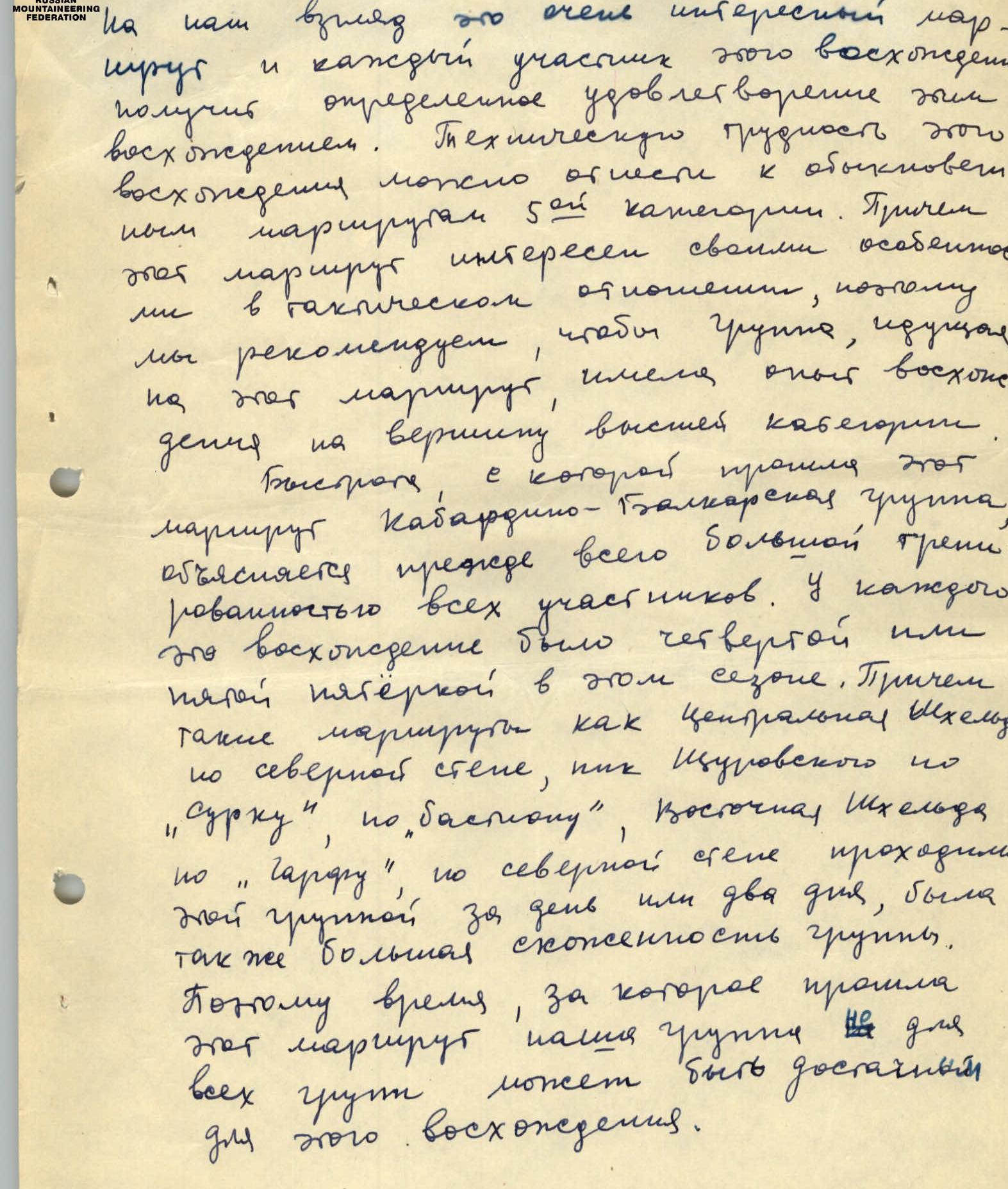
In our opinion, this is a very interesting route, and each participant will gain a certain satisfaction from the ascent. The technical difficulty of this ascent can be classified as an ordinary 5A category route. Moreover, this route is interesting due to its tactical features, so we recommend that groups attempting this route have experience with ascents of the highest category. The speed at which the Kabardino-Balkarian group completed this route is primarily due to the high level of training of all participants. Each participant had completed four or five ascents of similar difficulty in the same season. Routes such as the central Шхельди via the northern wall, пик Щуровского via the "bastion", and eastern Шхельда via the "Garoru" on the northern wall were completed by the group in one or two days, demonstrating their high level of cohesion. Therefore, the time taken by our group to complete this route may be sufficient for other groups.
Description compiled by M. Zalikhanov January 18, 1963












Ascent Passport
- Ascent class: technical
- Ascent area: Central Caucasus
- Ascent route with indication of peaks and their heights: Кюкюртлю 4623 m via the western wall
- Ascent characteristics: height difference 1600 m, average slope 65°, complex section length 900 m, 85°
- Pitons driven: rock 364, ice 65, bolt 12
- Number of climbing hours: 118 h
- Number of overnight stays and their characteristics - 11 overnight stays: 2 - in a tent, 9 - in hammocks and platforms
- Team name - Armed Forces of the USSR
- Surname, name, patronymic of the leader, participants, and their qualification
Leader - Master of Sports of the USSR Giutashvili R. I.
Participants:
- Master of Sports of the USSR Vardanyan G. G.
- Candidate for Master of Sports Zumba dz e G. Sh.
- Candidate for Master of Sports Starchik G. P.
- Candidate for Master of Sports Borovsky A. F.
- Team coach - Zumba dz e G. Sh.
- Dates of departure and return - July 31 - August 11, 1974
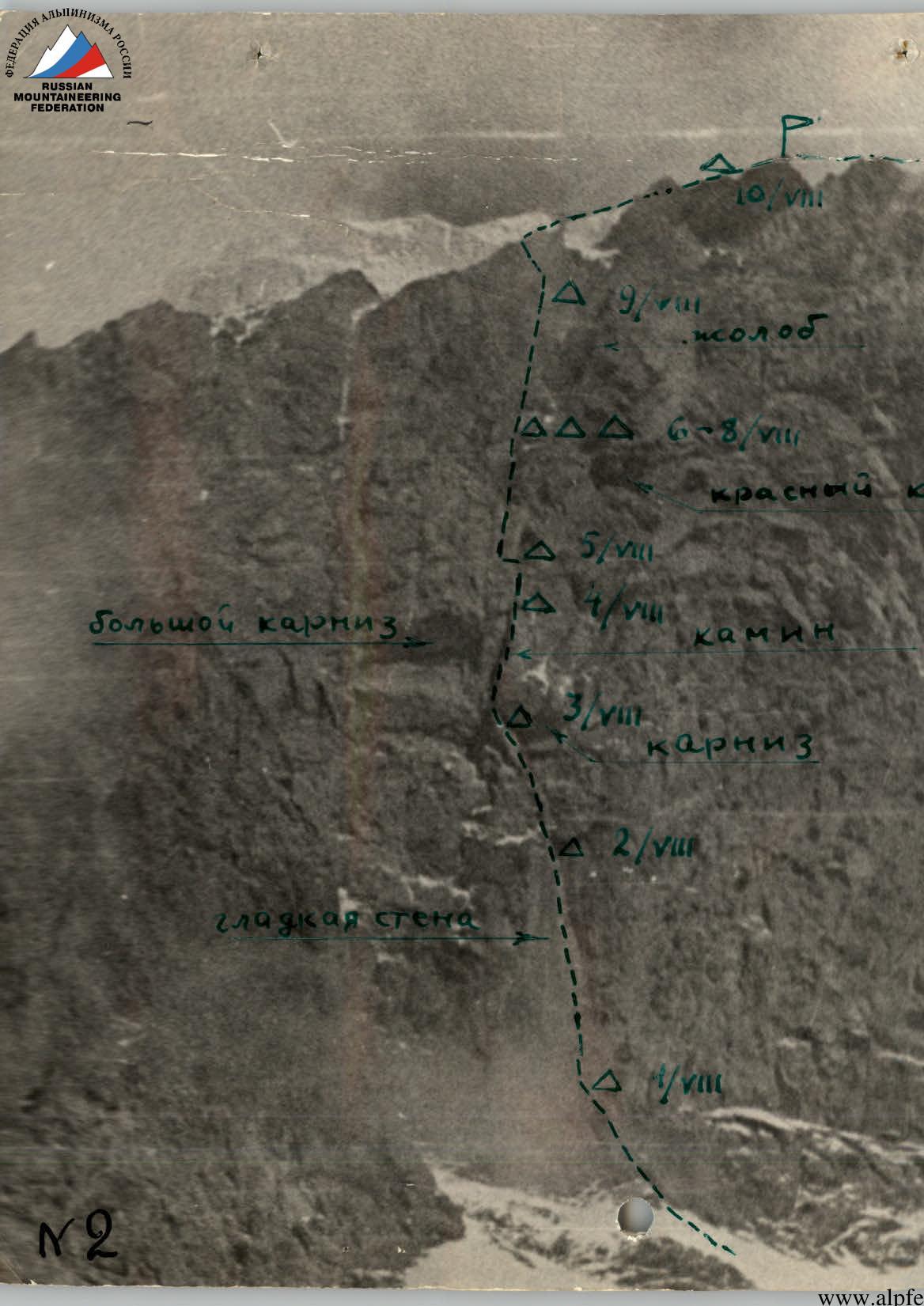
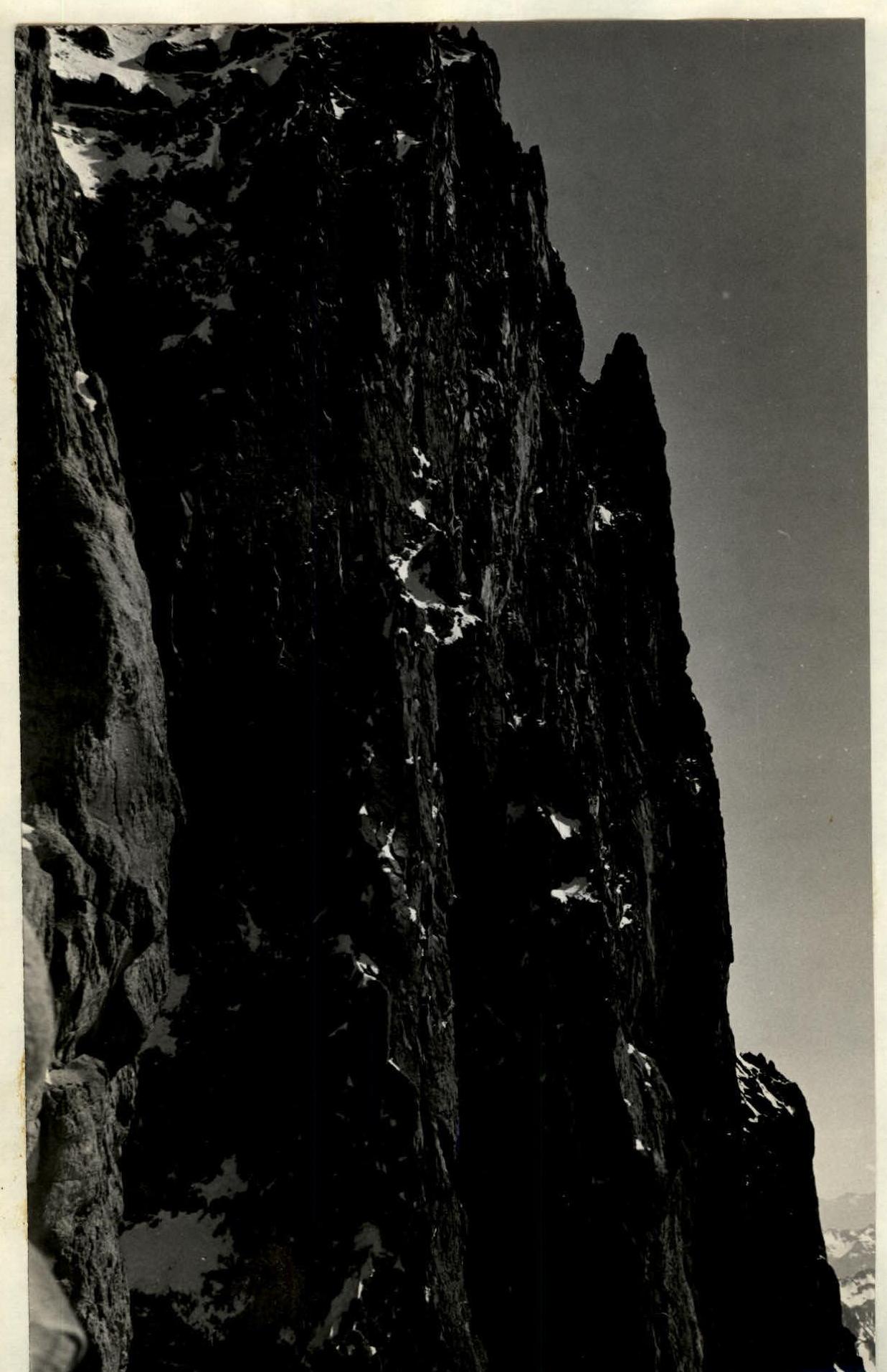
The Caucasus route - Start of the route on the cliffs
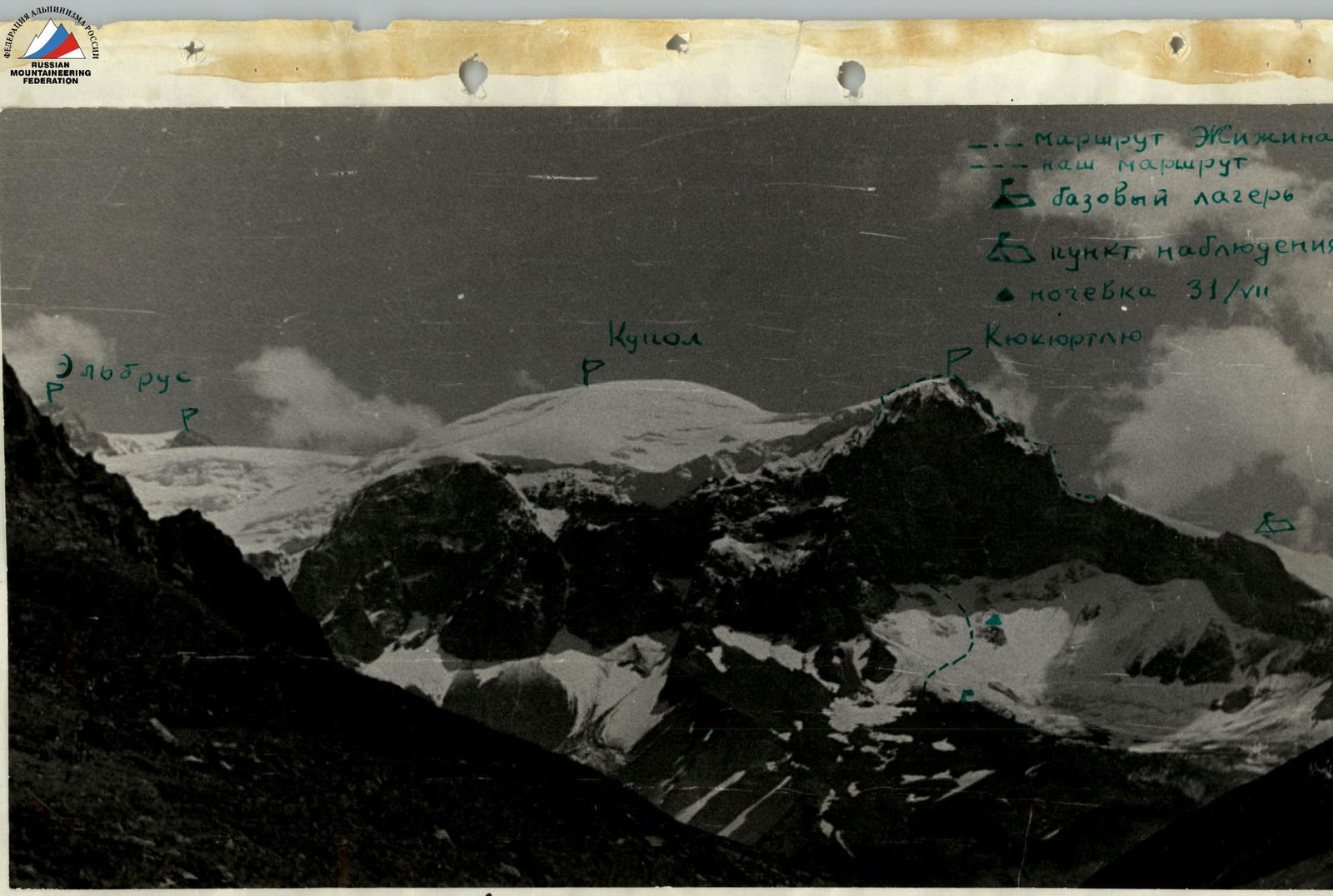
#1. Ascent area
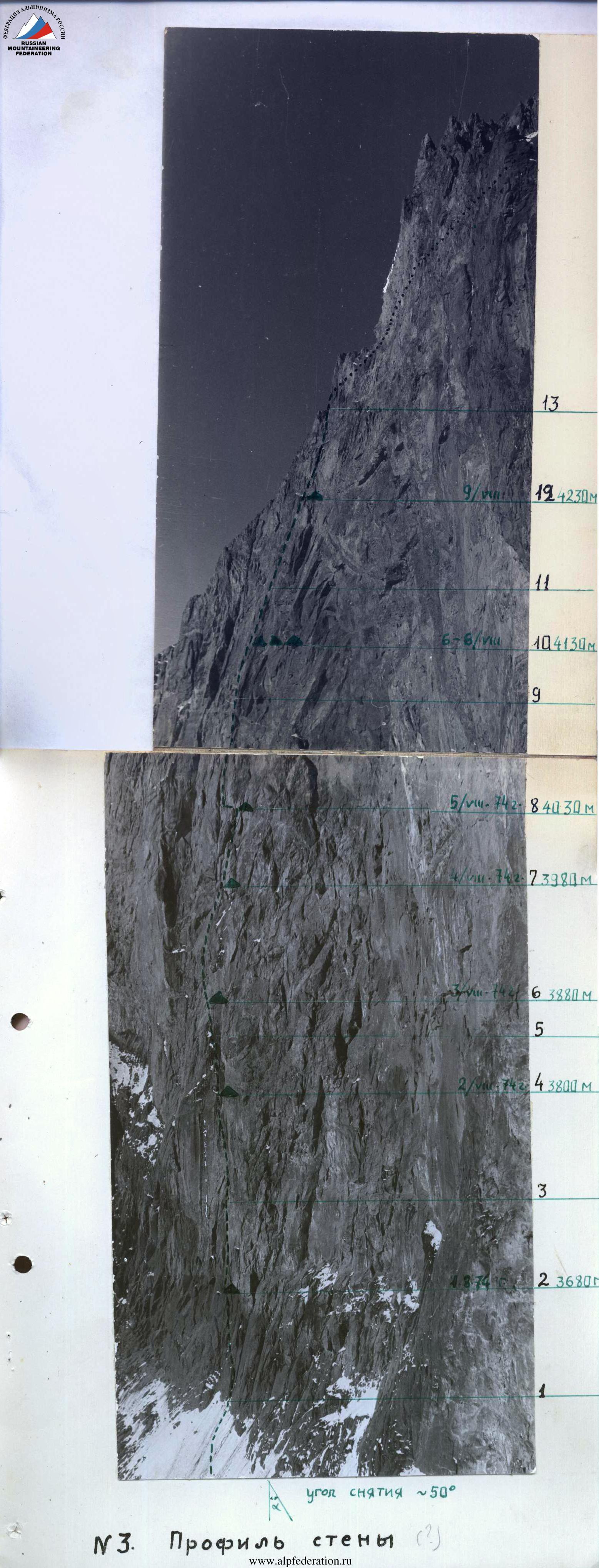
#3. Wall profile
Description of the route passage
July 31. The weather is good, we depart at 4:00 am. After clarifying the tasks to the observers and saying goodbye, we begin the ascent: first, along the average scree, and then along the ice slope, we approach a small bergschrund, and then the slope becomes steeper, we link up and put on crampons. The slope becomes steeper and steeper. The ice is covered with a thin layer of snow. Climbing such a slope with heavy backpacks on the front teeth is difficult; we have to cut steps and ascend with alternating protection via ice pitons. By 9:00 am, we reach the middle part of the counterfort. Reconnaissance conducted the day before showed that there is a convenient and safe bivouac site under the wall. After resting, the trio: Giutashvili - Borovsky - Starchik - takes the gear and some food and begins processing the further path, while the duo: Zumba dz e - Vardanyan - remains on the counterfort to organize the bivouac. Approaching the wall, the Giutashvili - Borovsky link begins processing the section (R2–R3), and Starchik organizes the suspension of the gear and food. Before us is a monolithic wall with a slope of 75°–80°, composed of solid rocks. The wall is climbed with complex climbing. After 40 m, Giutashvili takes Borovsky and releases him forward. After another 40 m of very complex climbing with careful piton protection, we manage to reach a small narrow ledge.
Next, the wall turns into an internal angle with small overhangs. The weather worsens, the wall is shrouded in fog, and it starts to sleet; further advancement is impossible. Having secured the 100-meter rope, the duo descends to the beginning of the wall, where Starchik awaits. After another 150 m along the perils hung on the ice slope and a further 200 m with piton protection along the steps cut during the ascent, the link descends to the counterfort at 19:00, where a tent is already set up and hot food is prepared. By evening, a strong cold wind begins to blow along the wall.
August 1. At 6:00 am, we begin the ascent along the ice slope. The weather is good. Approaching the wall, we climb the perils hung the day before onto a small narrow ledge and pull up the backpacks. At 10:30, the duo: Zumba dz e - Giutashvili - begins further processing of the wall (R3–R4), which is an internal angle with overhangs, with a slope of 90°–95°. Zumba dz e leads, the climbing is extremely complex, the rocks overhang, and often we have to overcome small overhangs using ladders.
August 2. The weather is good, but very cold, as a cold wind has been blowing along the wall all night and morning. At 7:00 am, we begin the ascent along the ropes processed the day before. While the Giutashvili - Zumba dz e duo continues processing the wall, the other participants climb the processed section and begin to pull up the backpacks.
...
| Date | Sections covered | Average slope of the section | Length of the section (along the length) | Type of relief | Category of difficulty | Method of overcoming and protection | Weather conditions | Time of departure, stop for bivouac, climbing hours | Number of pitons driven (rock) | Number of pitons driven (ice) | Number of pitons driven (bolt) | Bivouac conditions |
|---|---|---|---|---|---|---|---|---|---|---|---|---|
| 31/VII | R0–R1 | 40°–45° | 900 m | Scree, ice slope | 3 | Cutting steps, piton protection | Good | 4:00 | – | 38 | – | Lying in a tent |
| R1–R2 | 75°–80° | 80 m | Monolithic rocks | 5 | Complex climbing, piton protection | Fog, sleet | 19:00 | 28 | – | – | ||
| Descent to bivouac on the counterfort | Fog | 14 | ||||||||||
| 1/VIII | Passage of the processed section | Good | 6:00 | |||||||||
| R2–R3 | 90°–95° | 50 m | Internal angle with small overhangs | 6 | Extremely complex climbing with artificial aids | 20:00 | 27 | – | – | Sitting on platforms | ||
| ... | ... | ... | ... | ... | ... | ... | ... | ... | ... | ... | ... | ... |
| 11/VIII | Descent along the route 4A cat. sl. | Good weather | 6:00 | 22 | 8 | – | in a tent | |||||
| 12:30 | 6 h 30 min | |||||||||||
| TOTAL pitons driven: | 364 | 65 | 12 | |||||||||
| TOTAL climbing hours: | 118 | |||||||||||
| Team captain: | Giutashvili | |||||||||||
| Team coach: | Zumba dz e |
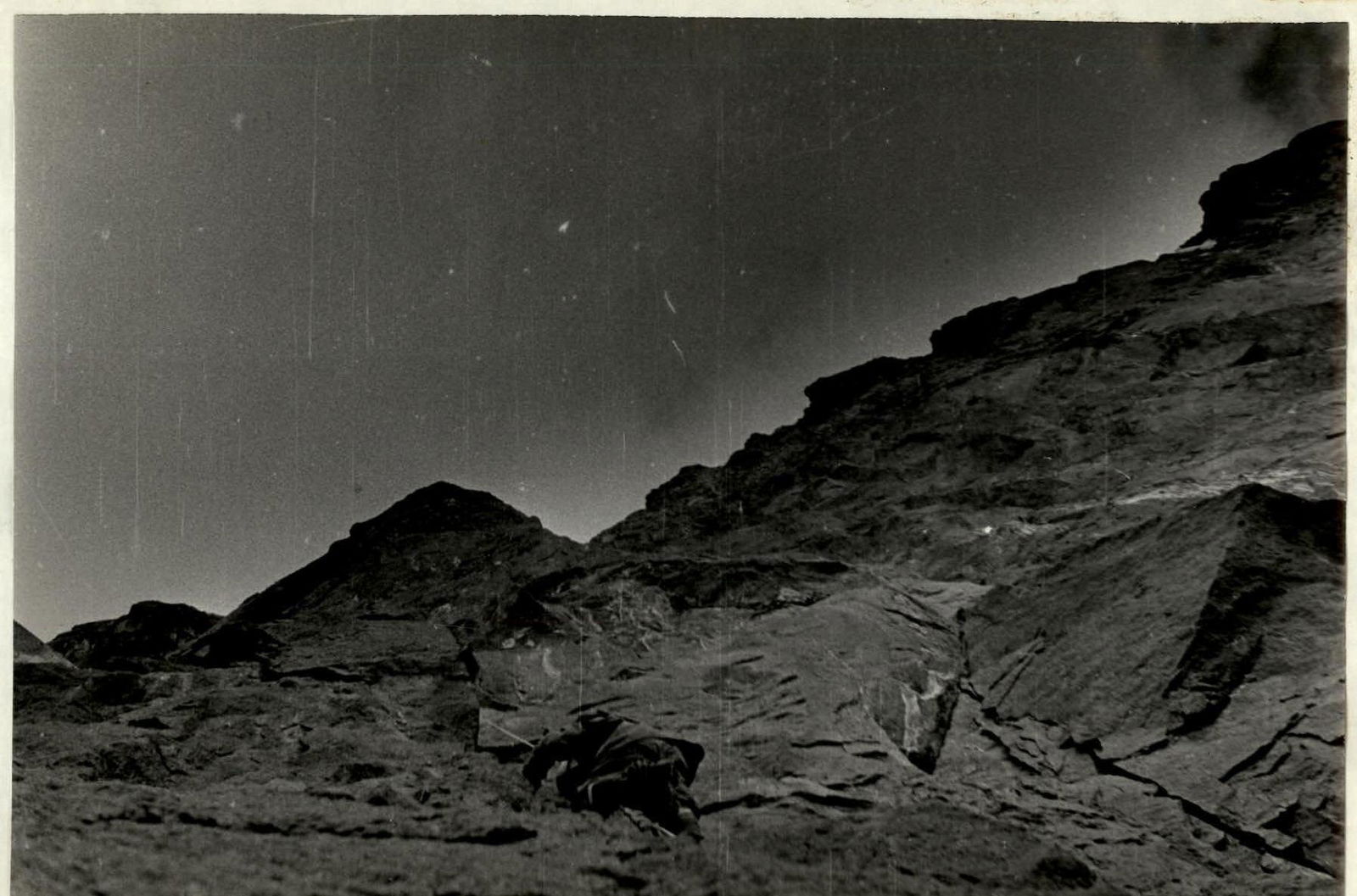
#4. Section R2–R3

#5. Section R3–R4
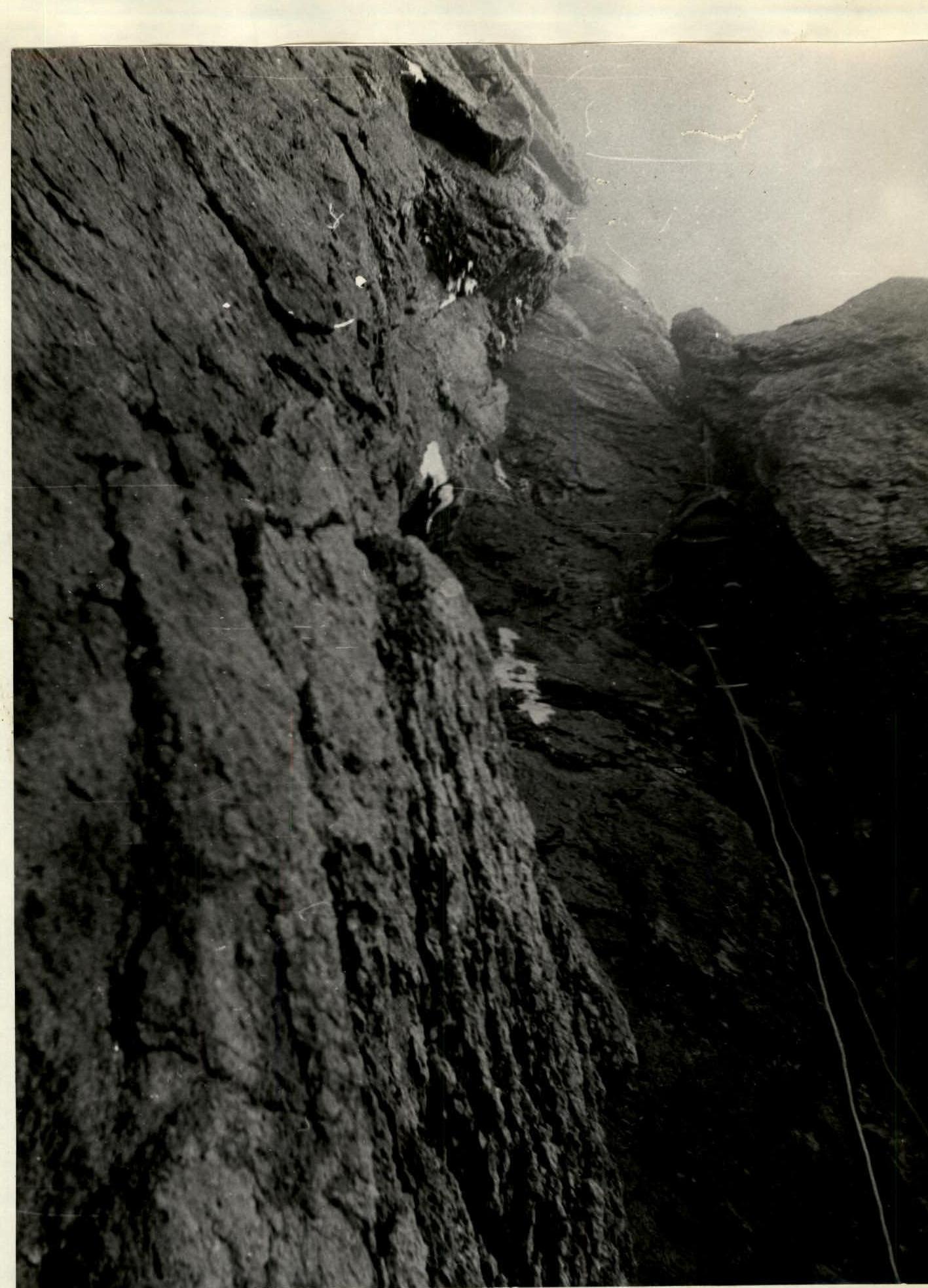
#10. Section R6–R7: Chimney
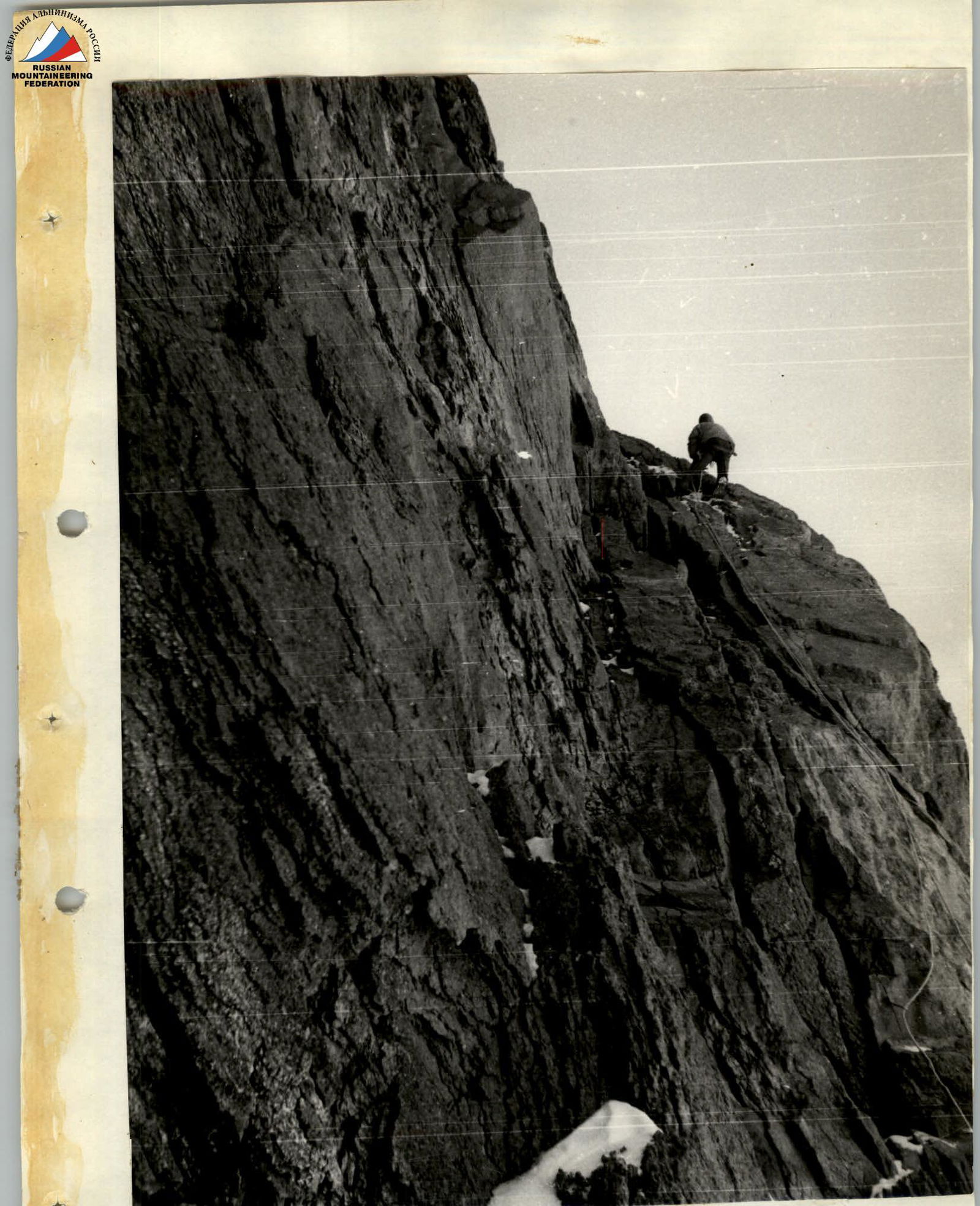
#13. Section R8–R9
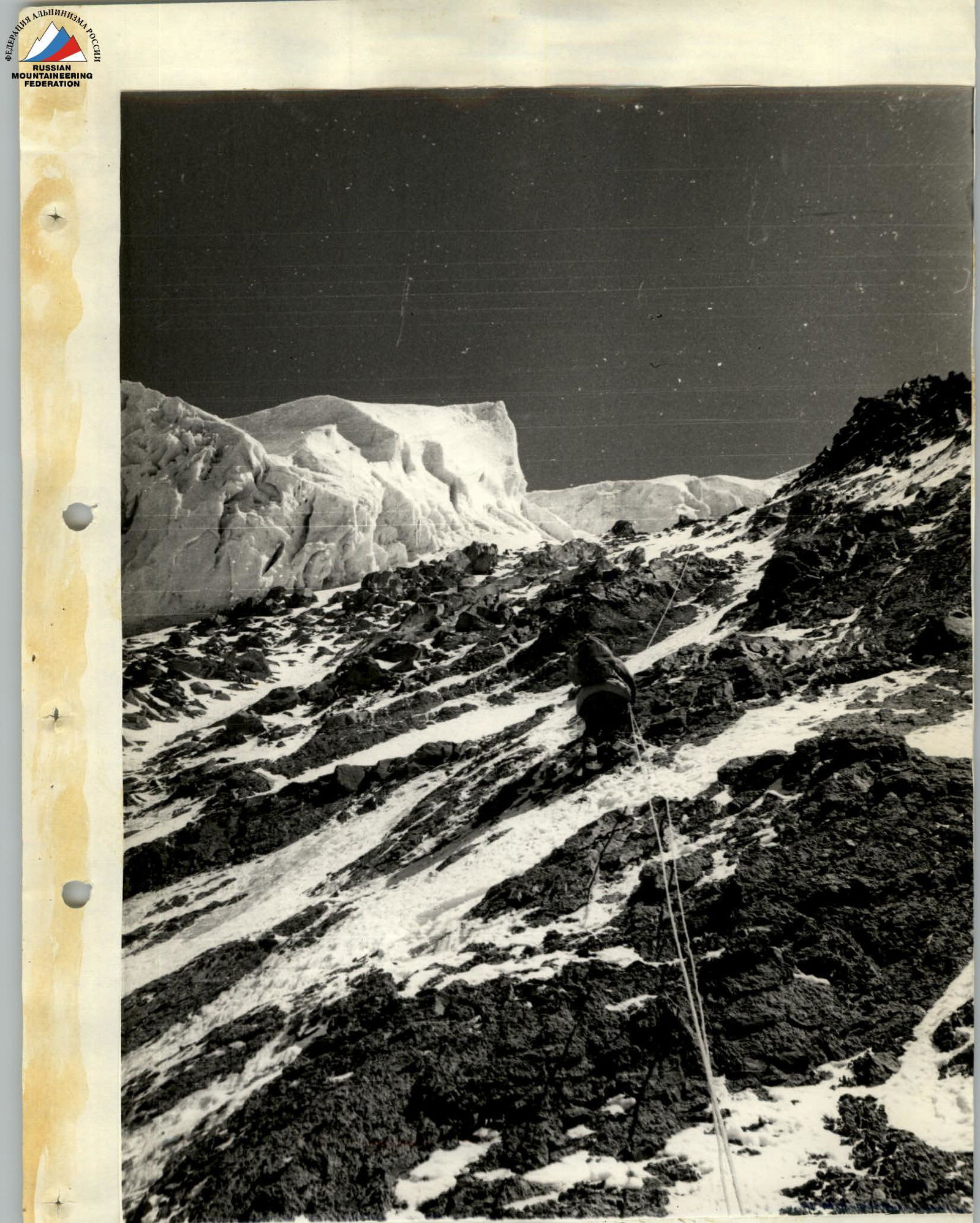
#21. Section R13–R14