
4
The Lesser Donguz-Orun is located in the smooth Zakavkazsky ridge between Lecho to the east and Donguz-Orun to the west.
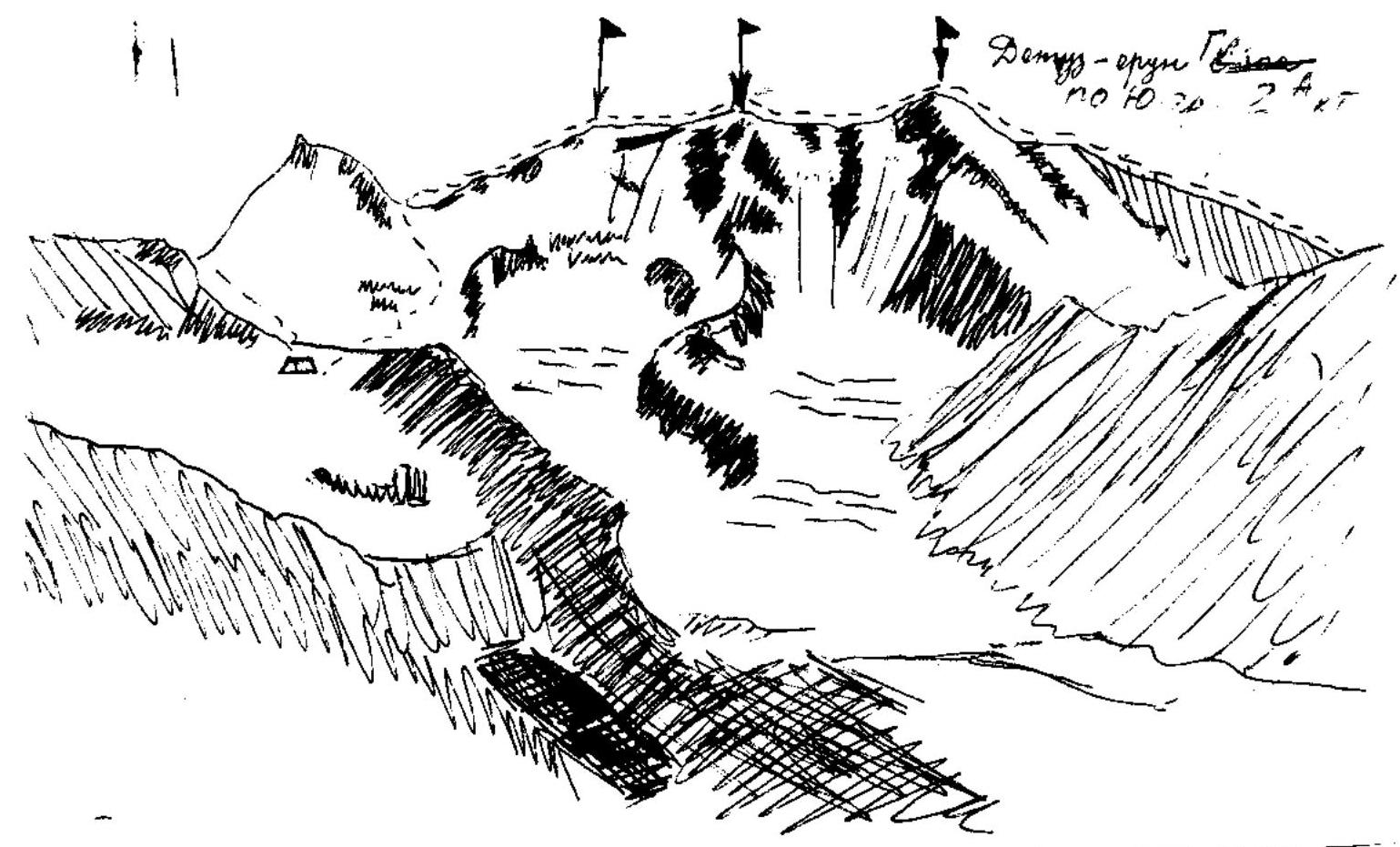
The height of the peak is 1468 m. To the northwest lies the middle peak of Donguz-Orun. From the middle peak of Donguz-Orun, a ridge branches off, which turns west and, through a saddle, forms a Makra-Tau pyramid (or May Donguz-Orun - 1440 meters). The western ridge, Nakra-Tau, steeply descends to the Donguz-Orun pass. This is the eastern ridge that runs from the Donguz-Orun peak along the Songi valley to the Becho pass. The third ridge branches off from the middle peak of Donguz-Orun in a northeasterly direction to the Kogu-Tau-Veti peak.
The northern wall of the peak is trapped by snow firn and drop-offs, feeding the left branch of the Isegi glacier. The western slope of the peak drops steeply to the Donguz-Orun glacier. On the wall, two cross-shaped narrow glaciers are clearly visible. At the peak, there is a huge firn field that feeds the Nakra, Kapp, and Dakra glaciers.
The approaches to the peak pass from the settlement of Tegenekli in two directions:
- the first is along the Baksan valley and the Isegi valley to the north Prict Becho;
- the second is along the Baksan valley and the Donguz-Orun valley to the north Prict under the Donguz-Orun pass;
- the third is from the settlement of Becho (Ovan’tia) along the Tsolry valley to the South Primt Becho.
From these three main locations, the ascent to the Donguz-Orun peak is made.
The first ascent of Donguz-Orun was made in 1888 by Mertzbacher, Purtchelov, Utterweger, and others via the northern ridge.
The first Soviet ascent was made in 1935 by a group led by Tychinin.
The first winter ascent was made in 1935 by V. Norzun. In addition, in 1938, groups led by Gusev and I. Tin made an ascent via the northern ridge. In 1937, a traverse of all the Donguz-Orun peaks, including Nakra-Tau, was made.
The climb up the western wall was made in 1938 by Markelov and Galaktenok.
The accessible route to Donguz-Orun can be considered the path from the northeast from the Shvenge glacier, with an exit to
今
今