
Ascent Passport
I. Ascent Class
- rock
- Ascent Area
- Western Caucasus, Gvandrinsky region
- Peak, Route
- Zamok — 3930 m, south-southeast wall, first ascent, 5B cat. diff.
- Route Characteristics:
- height difference to the summit — 850 m
- wall height difference — 550 m
- route length, wall part — 596 m
- length of sections with V category difficulty — 336 m
- length of sections with VI category difficulty — 260 m
- average wall steepness — 85°
- Pitons hammered: rock — 189, of which for ITO — 42 bolted — 38, of which for ITO — 37 used chocks — 51, of which for ITO — 9
- Number of travel days — 6
- Number of travel hours — 56
- Number of overnight stays and their characteristics: four semi-reclining without a tent in a niche-grotto; one in a tent on a convenient ledge — total 5
- Team name — team of instructors from the "Uzunkol" alpine camp
- Full name of the leader, participants and their qualifications: Khafizov A. F. — leader, CMS; Petrichenko N. N. — deputy leader, MS; Khairullin R. Sh. — participant, CMS; Rybalko K. P. — participant, 2nd sports category.
- Team coach — Master of Sports of the USSR Zakharov P. P.
- Date of departure on the route and return — July 9–15, 1981
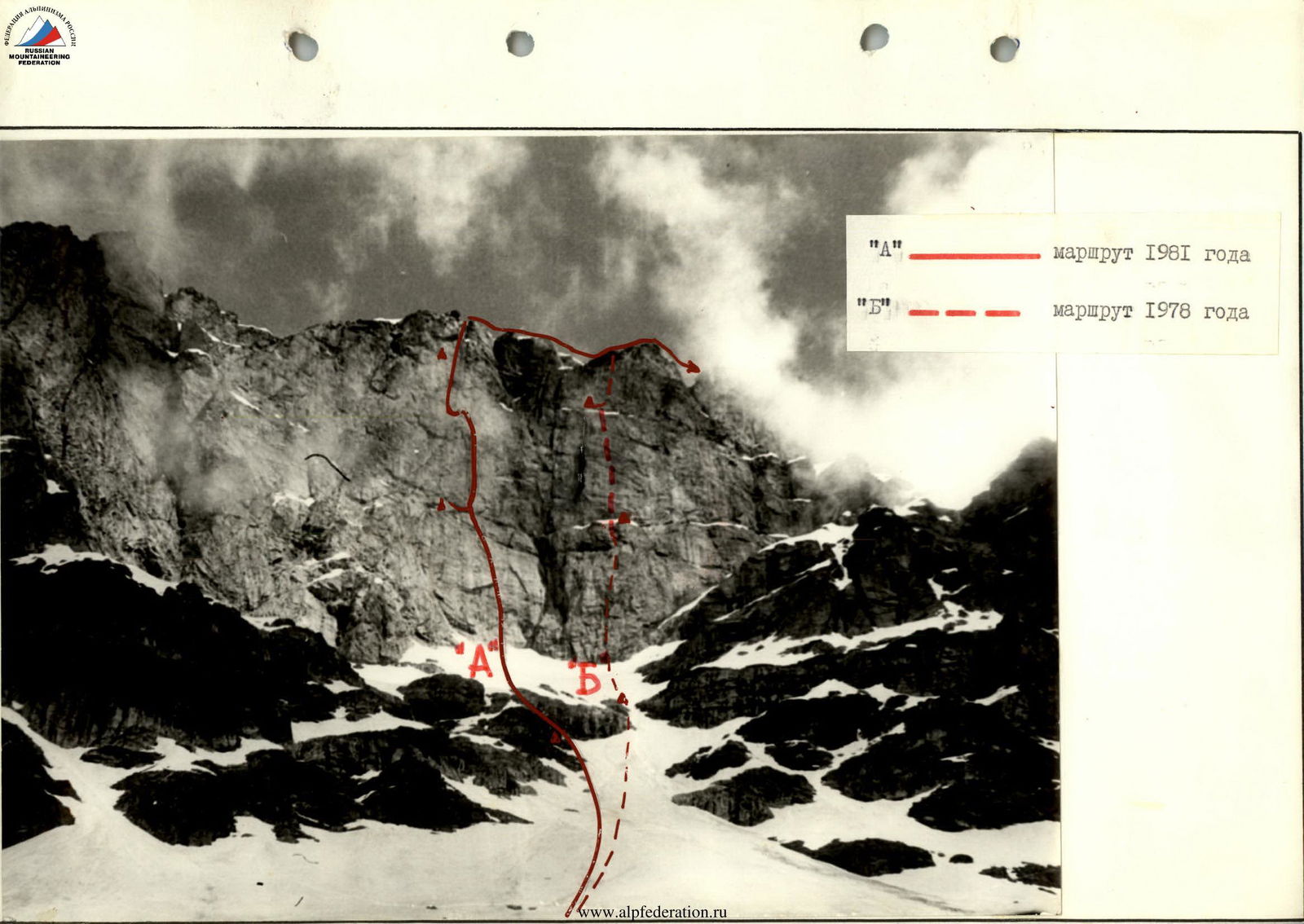
Description of Approaches to the Route
From the "Uzunkol" alpine camp along the Myrdy gorge to the Dalar pass (5 hours). From the pass, descend to the southern side and, traversing the southern snow-covered cirque of Dalar, to the saddle in the southwestern ridge of the Dvoynyshka peak (another 2 hours). From the saddle, descend into the southern cirque of Zamok (1.5 hours) and along the snowy couloir under the Zamok wall (1.5 hours).
The base bivouac can be set up:
- on a rocky island to the left of the rocky gate of the couloir — this is within 15–20 minutes walking distance from the wall;
- on the terraces of the cirque — but from here to the wall is 1–1.5 hours walking.
The ascent route to the wall passes to the left of the vertical rocky couloir separating the south-southeast from the south-southwest wall, and goes through the entire Zamok massif from the summit ridge to the base.
Route landmarks are:
- in the lower part — a rocky so-called "claw" and a large gray cornice;
- in the middle part — an 80-meter inclined internal angle;
- in the upper part of the wall — a wide chimney at the exit to the summit ridge.
The key sections of the route are:
- a large gray cornice and a sheer smooth slab beneath it (ladders and bolted pitons);
- a cornice and an overhanging smooth slab between the 1st ledge and the 80-meter internal angle (ladders, petal pitons, and bolted pitons);
- a traverse to the left after the 80-meter internal angle and above a 40-meter section of the wall with cornices (ladders, wedges, and bolted pitons).
In addition, it should be noted that the entire wall has many short but complex sections with overhangs and cornices.
There are no places for convenient bivouacs on the wall, except for:
- a grotto;
- a convenient site on the 2nd ledge.
Route Description
Through the center of the "claw" (40 m) and through wet black walls (2 × 25 m) to the sheer wall under the large gray cornice. Along this wall — 2 bolted pitons and through the cornice in its right part into the internal angle. Along the angle 35 m and the wall with flakes — another 35 m, exit to a ledge. Here is a control cairn. Overnight stay 40 m to the left of the exit to the ledge.
From the control cairn, right-up along the stepped wall of the internal angle 35 m under a cornice and an overhanging wall. Through the cornice and the overhanging wall (15 petal pitons and 13 bolted pitons) to the base of the 80-meter internal angle. Along its left slab and through three cornices in its middle part — to the upper part. Then another 25 m up along the crack on ladders under the next cornice, from where a pendulum to the left-down for 20 m. Again up, moving left:
- 20 m along rocks like sheer "ram's foreheads";
- another 40 m through walls and small cornices to the beginning of the internal angle.
Along the angle about 20 m, then right-up bypassing cornices and through a 5-meter chimney along sheer "ram's foreheads" exit to a large talus ledge. This is the 2nd ledge.
- Control cairn;
- Convenient site for a tent.
From the cairn up along the 60-meter wall of block structure and the 40-meter wide chimney filled with formed ice, exit to the summit ridge.
Along the ridge with 5A cat. diff. to the summit of Zamok.
Equipment and Food
Virtually all the equipment for the wall ascent was made by the team and tested on wall ascents in previous years.
The team had a wide range of titanium rock pitons, among which it is particularly necessary to note:
- several types of petal pitons;
- a pair of skyhooks for blind vertical cracks.
Several sizes of titanium profiled wedges (bent and milled) well complemented the set of pitons. For wide cracks, chock stones (hexes, stoppers, eccentrics) of sizes from 16 to 50 mm were taken.
The new experimental Kaliningrad rope performed well when organizing belays with the UIAA knot. However, it:
- excessively stretched under static load;
- absorbed significantly more moisture than a standard rope.
Piton removal was carried out with a hammer with a chain. This allowed:
- to extract pitons in a matter of seconds;
- to deform pitons less.
Bolts 8 mm in diameter made of AMG-6 had anchors with a head, which significantly strengthened the piton when cut and under axial load when used on cornices.
Each team member had:
- individually fitted harness and belay seat, sewn from parachute cord;
- lightweight rock backpacks made of avizent, sewn according to the "Cassina" model.
Two down-filled sets of their own manufacture were significantly lighter and more convenient than a standard down suit.
When selecting food, the group sought to have nutritious and high-calorie products that did not require a long time to prepare. On the route, they prepared:
- concentrated soups with the addition of meat or boiled pork;
- tea.
This allowed saving weight and eliminating unnecessary time expenditure.
During the movement along the route, each participant was given individual daily rations, which ensured normal three meals a day for the team on the route.
With a total weight of equipment and food of about 85 kg, the weight of each of the three backpacks on the route did not exceed 15 kg, since half of the load was constantly in use.
After passing the wall part of the route, equipment that was no longer needed was dropped down, and it was picked up by observers, with the load with equipment dropped from above falling on a snow patch no closer than 25 m from the base of the wall.
The list of equipment and the set of food products are given in separate appendices.
Organization of the Ascent and Order of Passage of the Route
The tactical plan, drawn up on the basis of:
- studying photographic materials;
- route reconnaissance;
- consultations, to a sufficient extent reflected the peculiarities of the ascent organization. In general, the plan was fully implemented with minimal adjustments made by the weather and the state of the rocks.
Despite the southern orientation of the wall, the sun appeared on the route for a short time only on the last day of the ascent.
Fog, dampness, rain, and episodic snowfalls somewhat hindered the ascent, and a powerful thunderstorm with intense snowfall completely disrupted the team's plans on July 8 and 11 and forced the use of reserve days.
The team abandoned the planned overnight stay in hammocks, as in bad weather conditions this seemed not only impractical but also unsafe.
July 7–8, 1981. By the time the team arrived at the observers' camp, the weather had noticeably deteriorated. They had barely managed to set up their tent when a thunderstorm with intense snowfall began.
Signs of improvement appeared only by 10:00 on July 8. There was no point in setting out on the route — the chances of passing the section of the wall to the 1st ledge in the remaining time were too small.
July 9, 1981. At 7:00, they began moving along the route. Fog, snow on the ledges, sleet. Climbing on wet and already complex rocks was difficult. However, the team entered the usual work rhythm from the first meters of the path.
- Rais Khairullin and Nikolai Petrichenko alternately led the way;
- Rybalko K. P. diligently dismantled the route;
- Captain A. F. Khafizov provided radio communication and dispatch service.
By 19:00, they had passed the "claw," series of sheer wet walls, a bolted slab, a large gray cornice, and much more, and reached the ledge — the supposed overnight stay. The ledge did not live up to expectations — it was only about a meter wide, and water dripped from above.
They moved along the ledge to the left for 40 m, to where they had previously spotted:
- a small grotto;
- a small snow patch.
The grotto was also not very suitable for a bivouac, but, as they say, it was habitable, even for sleeping, although in a semi-reclining position. It was dry, not dripping, and next to it was a cubic meter of snow.
The team was satisfied with the first day's work and the prospects for the next days, not yet guessing that they would spend more time in this "apartment" than planned.
July 10, 1981. At night, there was a light snowfall. Damp and cold. Rising at 7:00, the pair Petrichenko and Khairullin were already processing the cornice and overhanging wall by 8:00.
After 35 m of cascading wall, the most complex climbing with ITO begins, with petal and bolted pitons through the cornice and 100° smooth slab (R7 section). It takes more than 30 pitons to pass one incomplete rope length.
A light drizzle accompanied them throughout the entire path and bothered not so much the person leading (he was somewhat distracted by the work) as the belayer.
In 8 hours of work, the pair, having overcome the planned section of the route about 75 m long, reached the base of the internal angle.
July 11, 1981. Despite dense fog, the pair Khairullin and Khafizov set out at 9:00 to process the internal angle. They had barely entered the work rhythm when a severe thunderstorm began. For several hours, snowy sleet poured down the wall in a continuous stream, settling on the ledges and clogging all cracks and crevices.
For the day, they managed or were able to process only about 60 m and returned to the bivouac in the grotto. The path went along the steep left slab of the internal angle, which in several places was overlapped by cornices.
July 12, 1981. Cold. Fog. Rime ice on the rocks. All this was a consequence of the previous day's bad weather. The pair Rybalko and Khairullin went up along the fixed ropes. They needed to:
- "finish off" the internal angle;
- go left on traverse to vertical clefts;
- return back, since spending the night in hammocks in the continuing bad weather was simply unreasonable.
By 20:00, the guys returned to the bivouac in the grotto with disheartening news. They managed to pass only 80 m of the most complex wall. Using bolted pitons and a pendulum along vertical walls with microrelief on rocks like "ram's foreheads," they managed to go left on traverse. But above, a series of cornices was visible, and the supposed vertical clefts turned out to be just black stripes on a smooth wall.
July 13, 1981. Already at 6:00, Petrichenko and Rybalko, having picked up the lower rope of the fixed ropes with lightened backpacks, went up. Today was the decisive assault, as the end of the competition was approaching. At 8:00, the leading pair began to break through the cornices. The second pair at this time:
- removed ropes;
- transferred the main loads;
- sought to timely provide everything necessary to the comrades ahead.
Around 15:00, the связки connected. This happened after the first связка passed a 40-meter wall with cornices and began to need additional equipment.
Further, there was a 20-meter vertical angle with overhangs, then a 5-meter chimney, and 25 m of rocks like "ram's foreheads," behind which was a large talus ledge — the goal for the day's work.
At 21:00, the team gathered in full on the ledge, where a tent could be set up almost anywhere.
July 14, 1981. On this frosty morning, for the first time since starting the route, the team enjoyed the sun. They contacted the observers and agreed on a plan of action.
Prepared excess equipment for dropping it down. Since it was not possible to see the base of the wall from the ledge, they asked the observers to come closer to control the air evacuation.
The following items were dropped:
- four ropes;
- a bundle of pitons;
- other equipment, packed in a tight bundle.
The equipment, without touching the wall, landed safely on a snowy slope.
And the team went further on the ridge along a 60-meter wall of block structure and a wide ice-filled chimney. The further path along the ridge to the summit was well known to almost all participants, so the fog, periodically covering the ridge, did not interfere with movement and orientation.
At 19:00, they contacted the camp directly from the summit and began their descent towards the Burevestnik pass. They spent the night at the traditional place — on the black gendarme on the route 4A cat. diff.
July 15, 1981. Continued their descent to the Burevestnik pass and further to the Zamok plateau and through the Kichkinelkol pass arrived at the "Uzunkol" alpine camp by 17:00.
Evaluation of Participants' Actions
The passage of a technically complex and psychologically challenging route in bad weather conditions showed the excellent physical and technical preparation of the participants, their high moral and volitional qualities, and tactical maturity of each participant and the team as a whole.
The team proved to be a friendly, cohesive collective, united by a commonality of interests and complete mutual understanding.
With a high level of interchangeability of participants, the team skillfully used the peculiarities of their specialization.
- Khafizov A. F.
- Calm, restrained;
- Able to solve complex organizational issues with enviable ease;
- Did an excellent job as captain and leader of the ascent;
- Has excellent physical and technical preparation;
- Champion of the CS DSO "Zenit" in alpinism 1980 in the rock class.
-
Petrichenko N. N. Like Khairullin R. Sh., a good specialist in high-level rock technique. Freely orients himself on the route and quickly makes optimal decisions in a complex work environment as a leader in the group. As deputy captain, he did a lot of work on route reconnaissance and equipment preparation.
-
Khairullin R. Sh. An alpinist with outstanding physical abilities outstrips the rest. Technical preparation is excellent. Capable of leading on the most complex sections with free climbing with a high degree of reliability. Calm and taciturn. Distinguished by striking efficiency. Champion of the CS DSO "Zenit" in alpinism 1980 in the rock class.
-
Rybalko K. P.
- A strong, technically skilled alpinist;
- Cheerful and sociable person;
- In the team, did the main work on food supply;
- On the route, provided the main volume of heavy and labor-intensive work on removing pitons;
- Has good climbing experience, including two routes of 6B cat. diff.
Conclusion
The southern wall of the Zamok peak with a height difference of about 600 m has a steepness close to sheer, and is abundantly saturated with slabs of negative inclination and large rock cornices. With a minimal number of cracks and microrelief of "polished" granite walls, the route requires the alpinist not only exceptional physical preparation and excellent rock climbing technique but also a high level of proficiency with bolted equipment and the ability to work with ITO in the most complex conditions.
The route length together with the ridge section exceeds 1200 m. The technical complexity of the route is practically no different from the known routes along the northwest wall of Bolshoy Nakhar, the north wall of Zindon, the west wall of Badkhona, the northwest wall of Zamin Karor, and other wall routes that were in the team's repertoire.
The team unanimously believes that the route along the south-southeast wall of the Zamok peak meets all the requirements for routes of 6B category complexity.

Team Captain A. F. Khafizov Team Coach P. P. Zakharov August 15, 1981

