
27
USSR Climbing Federation
XXXIV USSR Climbing Championship, Rock Climbing Category













Report on the Ascent of Dalar Peak (3980 m) via the Right Part of the North Face (V. Shopin Route), Category 5B
Committee for Physical Culture and Sports under the Executive Committee of the Leningrad City Council of Workers' Deputies — Leningrad, 191065, Khalturina St., 22, tel. 215-39-84 (Kletsko K.B.).
Coach, team leader Honored Master of Sports of the USSR Shchedrin G.S. — Leningrad, 197341, Polikarpova Alley, 3, apt. 310, tel. 393-53-26.
The heights noted in the report were determined using a map and the VP altimeter No. 21985 with a scale division of 10 m.

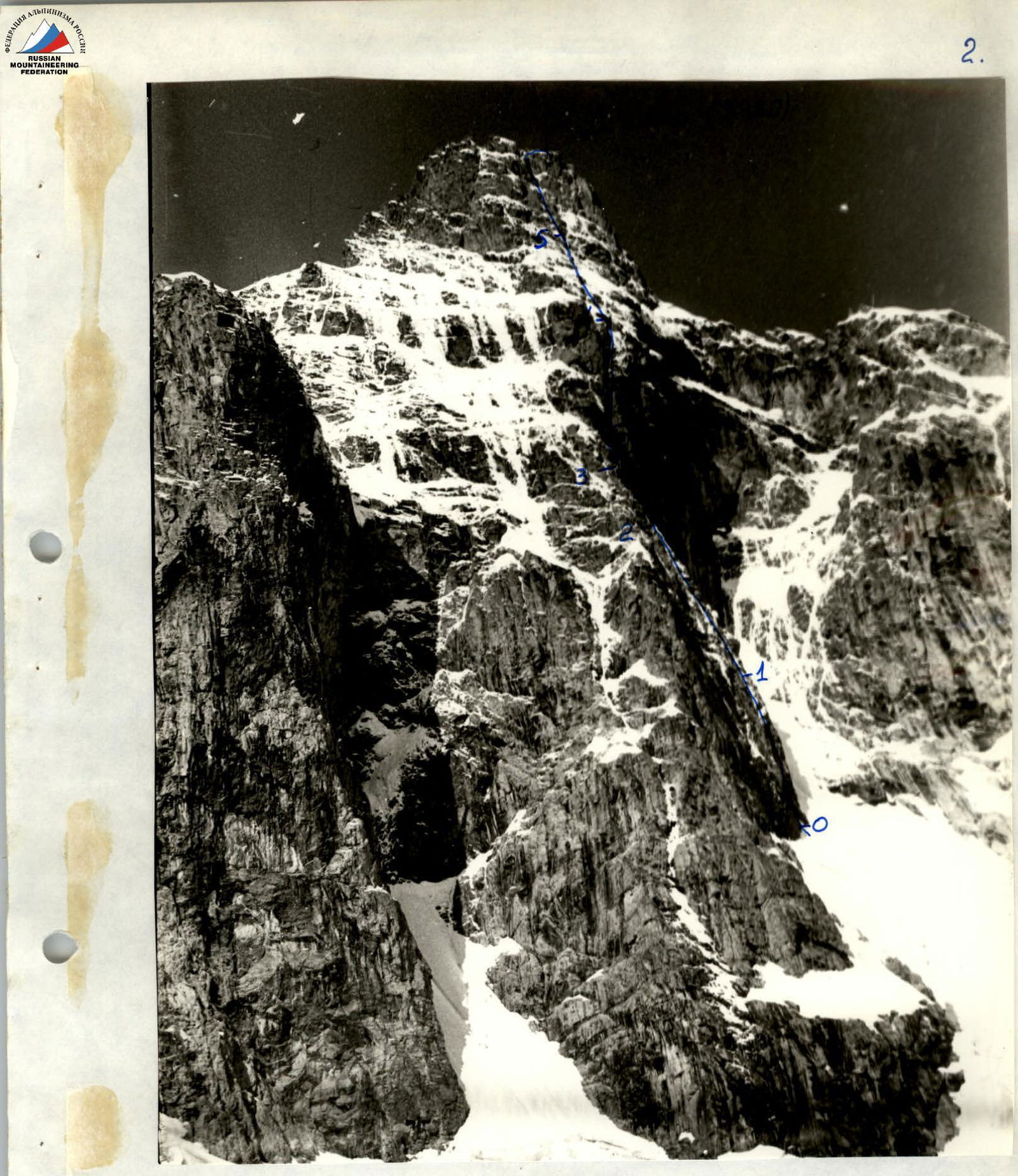
Photo 2. Photograph of the wall profile from the left. Time of shooting — 9:00, July 27, 1983. Lens F = 50 mm. Taken from a distance of ~1 km (point No. 2). Shooting height — 2820 m. (Profile of the R0–R2 section, see appendix, photo No. 5).
Tactical Actions of the Team
Overall, it can be noted that the tactical plan developed by the team to ascend V. Shopin route on the right part of the North face of Dalar Peak was executed. Starting the ascent (after preliminary processing of the two lower ropes on July 18) on July 20 at 4:30, the team reached the summit on July 21 at 18:00. The delay from the planned time was 4 hours.
The processing was done on July 18, but due to a strong thunderstorm in the morning and rain that lasted the whole day on July 19, the team postponed their departure by a day. The situation repeated itself as it was during the ascent via M. Varburton's route. On July 20, the movement schedule on the R0–R2 section was fully executed, and by 11:00 the group reached the "finger" (point 2, see photo 2). However, a sharp deterioration in the weather — fog, rain, and snow at 14:00 — significantly reduced the group's progress. The rocks became very slippery, requiring additional intermediate protection points and additional fixed anchors. Therefore, passing the key, very complex section R2–R3 (70 m, 6, 70 m, 5) took more time, and the group reached the base of the inclined internal corner (point 3) by 18:00 instead of 14:00. This 4-hour delay persisted until the summit.
The group moved in a single rope team on the approach to the wall, on the R4–R5 section — shelves under the tower, and on the summit ridge. On all other sections, group protection was carried out using fixed ropes. To maintain a high ascent tempo and reduce the fatigue of the lead climber, a planned change of lead was made:
- S. Koval — first on processing, section R3–R4;
- M. Khitrov — on section R1–R2;
- O. Klyunin — on sections R2–R3 and R5–R6.
Preliminary processing of the route allowed the group to quickly ascend the very complex two lower processed ropes on the first day of the ascent, still in twilight, and the participants warmed up, with the first ones starting to work on the next section of the terrain by 6:30.
The movement, rest, and nutrition regime on the route was typical for wall ascents:
- Hot breakfast in the morning;
- Pocket food during the day;
- Hot dinner in the evening.
At 20:30, the group organized a bivouac, not reaching the planned goal by about 2.5 rope lengths due to bad weather. A bivouac on a 1×1.5 m shelf for five people was extremely uncomfortable, with a seated position, in a suspended tent. Bivouacking in a tent at heights of around 3500 m is usually warm enough, so knowing this, the group set out on the route with only down jackets and mats for the bivouac. The taken "Pamirka" tent proved very useful.
The use of double ropes (especially domestic Ø 10 mm) is justified, as it guarantees reliable protection in case one of the ropes is damaged by a rock. It is also possible to abrade a loaded rope on the terrain while moving, for example, in a pendulum fall. There were no falls or injuries during the ascent.
In addition to double ropes during the ascent, as on Varburton's bastion, for safety purposes, the following were used:
- A tape shock absorber;
- A protection device designed by Koshevnik.
When working on steep terrain, the first climber found "croconogs" with ring ladders very useful.
Each passage of the key section of the route was almost always accompanied by deteriorating weather. However, careful preliminary study of the route allowed the team to move even in bad weather, knowing what to expect ahead. Thorough reconnaissance was the key to fulfilling a fairly strict but realistic tactical plan.
The team's communication with observers was stable (see observation diary in the appendix). An agreement was made that in addition to scheduled radio sessions, observers should be ready to establish communication:
- At any hour;
- By a visual signal given by the team.
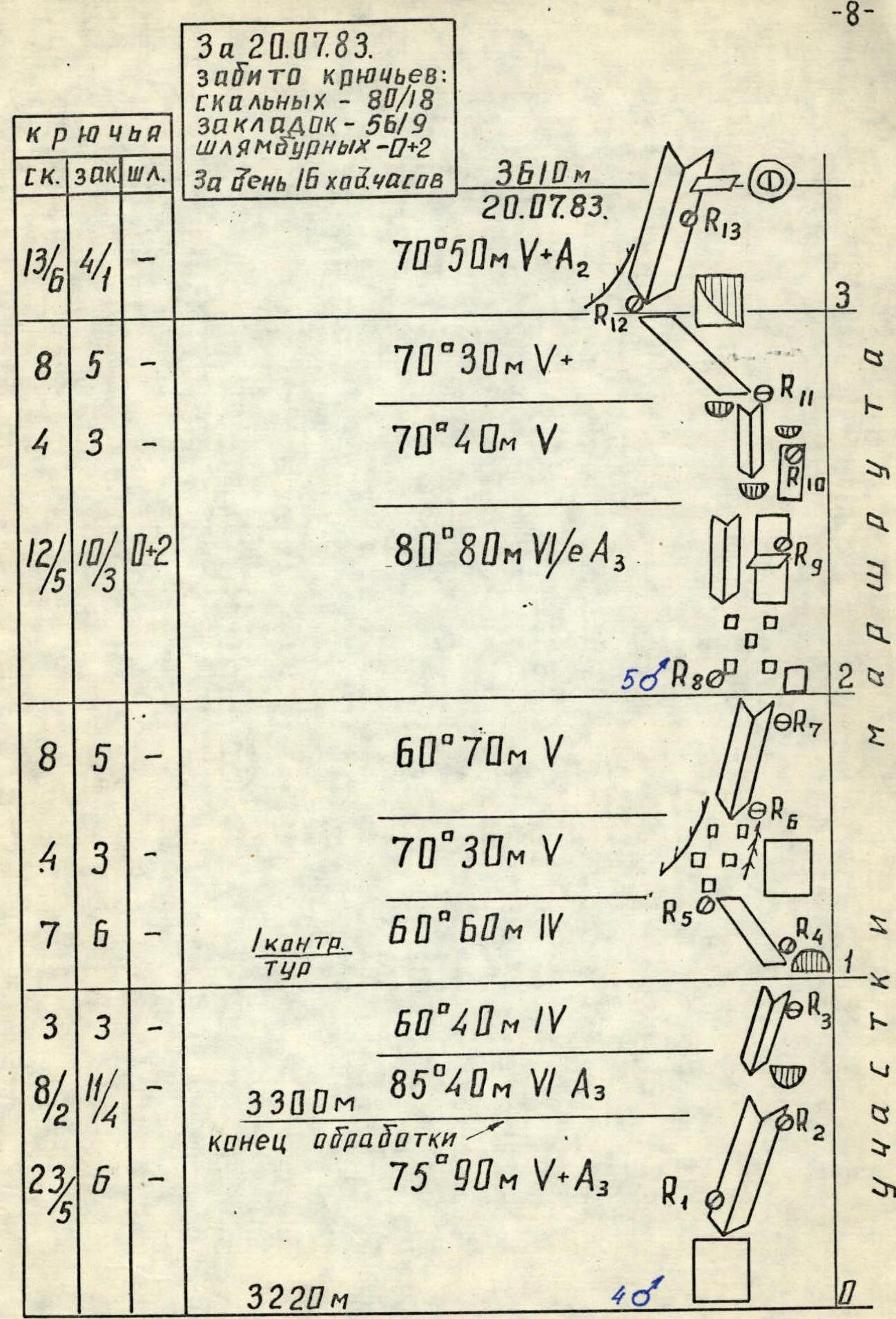
Route scheme in UIAA notation. Scale 1:2000. Altimeter VP No. 21985. The ascent took 28 hours. One seated bivouac. Total number of pitons:
- Rock pitons — 149/24;
- Nuts — 87/11;
- Bolt pitons — 0+7.
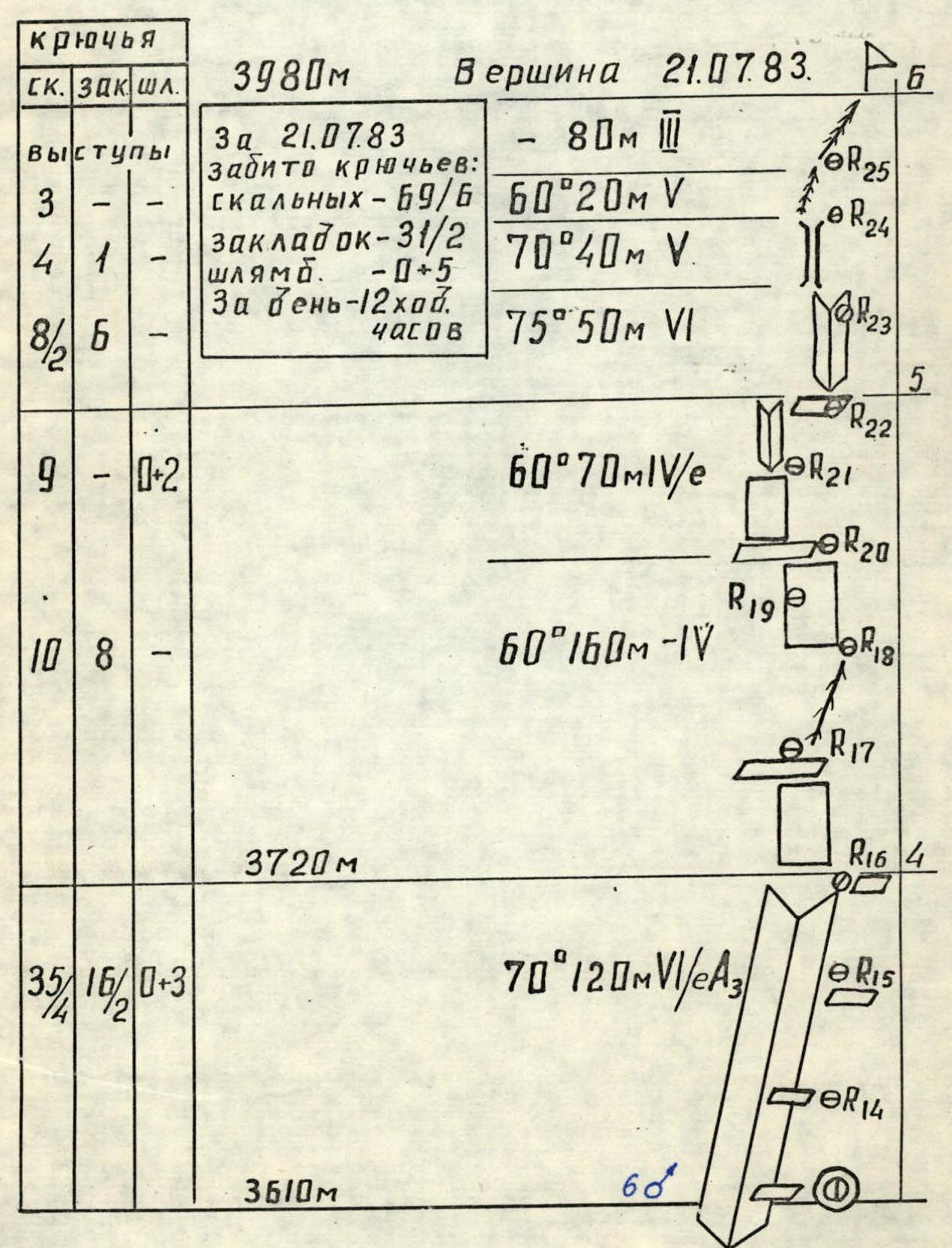
Continuation of the route scheme
Description of the Route by Sections
On July 18 at 5:00, the group set out in full to process the route. Already on the approach via the glacier, it was noted that the glacier had almost completely opened up, and it was necessary to fix ropes in the lower part. The bergschrund was bypassed on the left, and by 7:00 they reached the start of the route. Koval, Khitrov, and Klyunin remained to process the lower ropes of the wall, while Polishchuk and Shchedrin began to descend, making their way to the right of the bergschrund, where the approach was somewhat easier. By 14:00, all processors returned to the assault camp. The next day was planned for the ascent.
On July 19 at 1:00 AM, it started raining, which continued with interruptions throughout the day. The situation repeated itself as during the ascent on Varburton's bastion. The ascent was postponed by a day. But it was felt that the good weather period was ending, and they needed to hurry.
July 20 — wake-up at 3:00, the weather was still quite decent. At 4:30, the group left the assault camp, and by 6:30, Khitrov and Shchedrin had already started working above the end of the processed section. After the rain the previous day, the fixed ropes were very wet. The rocks were also wet.
- The first rope starts with a section of 6 — overcoming a cornice with a throw of about two meters.
- The cornice is bypassed on the left, climbing is very tense.
- The next 100 m are somewhat easier, and we reach the 1st control cairn.
Section R1–R2. A long traverse along an inclined shelf to the left, and then an ascent. Climbing is not very difficult but unpleasant — there are many loose rocks. One has to be very attentive. The weather starts to deteriorate, fog, but there is no rain yet. By 11:00, the group reaches the "finger" — the top of the lower control cairn. The 2nd control cairn was not found; it is under a massive block of ice.
Section R2–R3. A very complex piece. Practically vertical, not clearly defined internal corner with a crack is passed on the right wall, ending in a cornice. Several old pitons were encountered, including two bolt pitons. Ladders are often used.
The next rope is somewhat easier, but two cornices were encountered. We reached a sloping shelf leading to the base of an inclined internal corner. The shelf is partially covered in ice, which has to be chopped off.
On this section, O. Klyunin works as the first. The passage of this and the next section is complicated by deteriorating weather. At 12:00, a drizzle started, and from 14:00 to 15:00, it snowed. Rocks, ropes, and equipment got wet almost instantly, and it became very cold, especially when standing on a belay for a long time. It's slippery.
Galoshes on the terrain do not work as effectively as in dry weather; besides, they are significantly colder than vibram shoes. The first climber puts on vibram shoes.
Section R3–R4. It's already 18:00. We are 4 hours behind the planned schedule. The drizzle continues, rocks are falling from the "roof," but they fly over us. S. Koval is working ahead. The inclined internal corner is very steep and of the highest complexity — 6.
It's the end of the day; it's time to think about a bivouac, but it's well known that there's no decent shelf for a bivouac until the end of the internal corner. We move forward; the rain has eased a bit, there's fog, dampness, and a breeze that's chilling to the bone.
At 20:00, the first climber reported that there's a shelf for a bivouac. By 20:30, the whole group is on the shelf. The shelf is only 1×1.5 m in size, but it's better than hanging separately. A tent is quickly set up. All five climb inside. It immediately became warmer, although it's damp.
In the morning — sunshine. At 6:00, we start working again. After an uncomfortable bivouac, the movement is very slow at first because we haven't warmed up, and besides, it froze a bit at night, and the rocks are icy. But the sun, which shines into the internal corner only until 7:30, gradually does its job.
The movement is extremely difficult; three more old bolt pitons were encountered. By 11:00, the group finished passing the wall.
Section R4–R5. We move in a single rope team with simultaneous belay. The weather is still good; the slabs and rocks have dried out a bit. We cancel the observation on the route via radio, as we've reached the base of the internal corner on the tower — the last key point on the route.
Here, apparently, was the bivouac of the first ascenders — two bolt pitons and an ice piton driven into the rocks were found.
Section R5–R6. O. Klyunin is ahead. Very difficult climbing, many loose rocks and blocks.
The weather sharply deteriorates again; it starts snowing. After the internal corner — a chimney leading to the ridge of the tower:
- The bottom of the chimney is covered in ice.
- One has to go in opposition.
- Choosing drier places.
It continues to snow.
By 17:20, the group is on the summit ridge. The weather has improved; the snow has stopped; there's fog with breaks. At 18:00, the group is on the summit. At 18:10, we began the well-known descent.
By 19:30, the group is already at the beginning of the descent couloir. By 21:00, the group is on the Dalar Pass. At 1:00 AM, due to not wanting another wet bivouac, in a very heavy downpour, the group returned to the base camp. The ascent ended successfully.
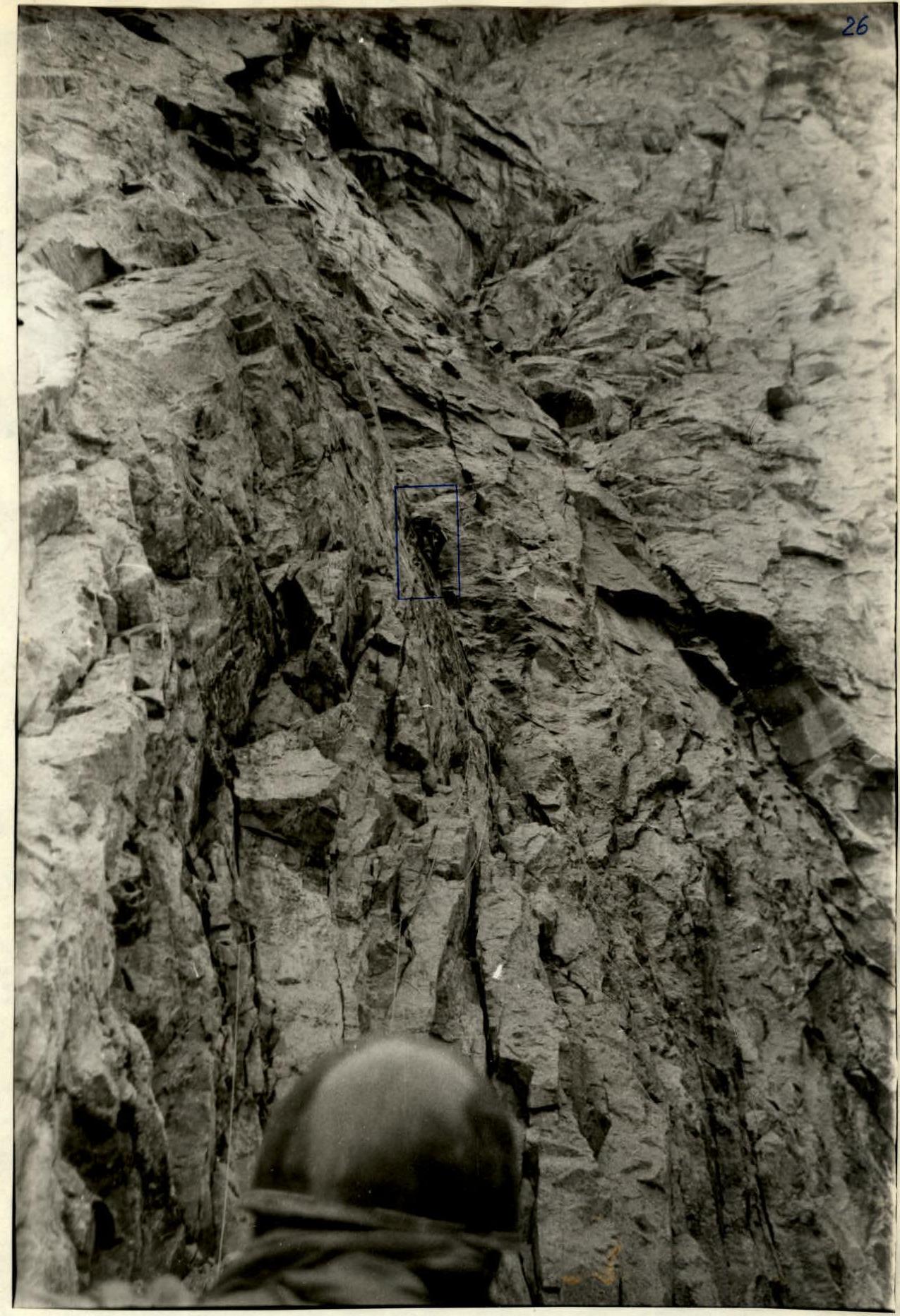
Photo 1. O. Klyunin approaches the end of the first rope on section R2–R3, 6. July 20, 1983. Shooting point No. 5.