
ASCENT LOG
- Ascent class: rock
- Ascent area: Western Caucasus, Krasnodar Krai, up to Marukh pass
- Peak, its height and ascent route: [гора] Фишт, 2867 m from M. Fishkinsky glacier
- Expected difficulty category: 2B
- Route characteristics: a) height difference – 1367 m; b) average steepness – 40°; c) length of sections: I – 1300 m, II – 240 m, III – 220 m, IV – none, V – none, VI – none.
- Pitons hammered: for belaying: Rock – 3 Ice – 0 Bolt – 0 Chocks – 2 for creating artificial anchors: Rock – 0 Ice – 0 Bolt – 0 Chocks – 0
- Number of climbing hours – 10.
- Number of nights and their characteristics – none
- Group composition:
- Taranenko Vladimir Ivanovich – CMS – leader
- Krivov Vasily Nikolaevich – CMS – participant
- Volkovsky Viktor Zakharovich – CMS – participant
- Getmansky Anatoly Dmitrievich – 1st sports category – participant
- Fukulov Alexander Vadimovich – 1st sports category – participant
- Vinogradov Alexander Alexandrovich – 1st sports category – participant
- Team coaches: Pogosyan Fedor Liparitovich, Yakovlev Sergey Efimovich
- Date of departure on the route: May 3, 1984
- Date of return: May 3, 1984
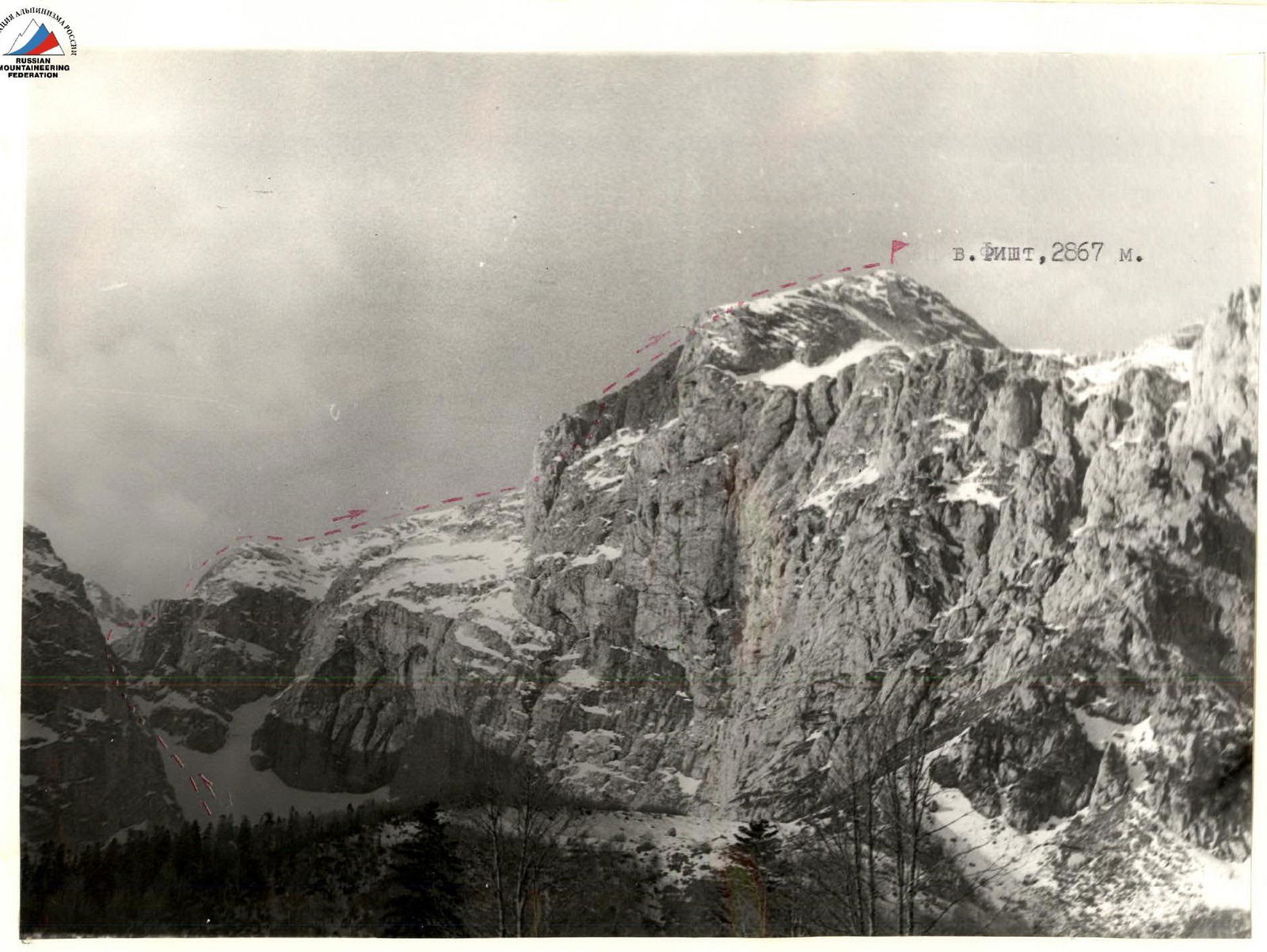
BRIEF DESCRIPTION OF THE Fisht MASSIF AREA.
A group of high massifs — [горы] Фишт, Оштен, Пшеха-Су adjoin the Lagonaki plateau and merge with it. The Lagonaki plateau is part of a system of rocky mountains. The entire system of rocky mountains is composed of Jurassic limestones. Although the rocky mountains are considered a cuesta, their formation involved not only erosional processes but also tectonic factors that caused faults and vertical displacements.
In Krasnodar Krai, the entire strip of rocky mountains is 170 km long and 30–50 km wide. Within this fairly vast area, there are quite significant differences in relief, climate, and vegetation, allowing the Western (Krasnodar Krai) mountain region to be subdivided into two sub-regions: Lagonaksky and Belorechensko-Urupsky. Each sub-region has several localities.
The Lagonaksky sub-region is located from the upper reaches of the Pshekha River to the middle reaches of the Belaya River; it includes the Lagonaki plateau with the massifs of [горы] Фишт, Оштен, and Пшеха-Су, the northern edge, southern edge, and western edge of Lagonaki.
The height of the peaks: [гора] Фишт — 2867 m, [гора] Оштен — 2804 m, [гора] Пшеха-Су — 2744 m. The foundation of the massifs is composed of Paleozoic and Precambrian rocks. In the flat depression of [гора] Пшеха-Су ([гора] Чуб) lies Lake Psenodakh. At the foot of [гора] Фишт is the shelter of the 30th All-Union tourist route. In the area of these massifs are the passes:
Гузерипльский – 1600 m, Армянский – 1640 m, Белореченский – 1890 m, Черкесский – 1700 m, Фиштинский – 2350 m, Фишт-Оштеновский – 1850 m.
The "Fisht" shelter is located at an altitude of 1500 m. Above the shelter are beech krummholz, fir sparse forest, and alpine meadows.
There are two glaciers on [горе] Фишт. The lower, smaller one lies at an altitude of 2157 m; the other glacier is located higher at 2200 m. The surface has crevasses of various widths, covered with snow. When the weather is good at the foot of [горы] Фишт, there can be fog, rain, and strong winds on the upper glacier.
The Belaya River originates in the area of [горы] Фишт. On the southern slopes and at the foot of the massif, 540 plant species grow, of which 120 species are endemics.
[гора] Фишт is one of the westernmost peaks of the Caucasus of the Alpine type, reaching the boundary of eternal snows and glaciers. Due to the humid air from the south, the snowline of [горы] Фишт is at an altitude of 2650 m, which is lower than in the rest of the Caucasus (2850–3800 m). This mark is lower than in the Alps (2700–2800 m).
On the northern slopes of the Lagonaki plateau, snow remains even in July.