

Report
on the first ascent of the route
To the top of Mshatka-Kaya 650 m
Republic of Crimea, Foros area
"Halapeno" Route
on the southern wall (between Filatova's Crack and Ear routes) proposed category 4B (rock climbing) May 25, 2023
Participants:
Temerev Ivan Mikhailovich, Master of Sports; Leonkin Sergey Sergeevich, Candidate Master of Sports
I. Ascent Passport
| № | 1. General Information | |
|---|---|---|
| 1.1 | Full name, sports rank of the team leader | Temerev Ivan Mikhailovich, Master of Sports |
| 1.2 | Full name, sports rank of the participants | Leonkin Sergey Sergeevich, Candidate Master of Sports |
| 1.3 | Full name of the coach | Temerev Ivan Mikhailovich, Master of Sports |
| 1.4 | Organization | Tomsk Regional Public Organization "Tomsk Alpine Federation" and Moscow Power Engineering Institute |
| 2. Characteristics of the Climbing Object | ||
| 2.1 | Region | Crimea, Foros |
| 2.2 | Ridge | Southern coast of Crimea |
| 2.3 | Section number according to the 2020 classification table | 1. CRIMEA |
| 2.4 | Name and height of the peak | Mshatka-Kaya, 650 m |
| 2.5 | Geographical coordinates of the peak (latitude/longitude), GPS coordinates | 44.406707, 33.811186 |
| 3. Route Characteristics | ||
| 3.1 | Route name | "Halapeno" route |
| 3.2 | Proposed category of difficulty | 4B |
| 3.3 | Degree of route exploration | First ascent |
| 3.4 | Relief characteristics of the route | Combined |
| 3.5 | Height difference of the route (according to GPS data) | 262 m |
| 3.6 | Route length (in meters) | 301 m |
| 3.7 | Technical elements of the route (total length of sections of various difficulty categories with indication of relief type (ice-snow, rock)) | Entirely rock relief: category 1 - 15 m, category 2 - 10 m, category 3 - 130 m, category 4 - 65 m, category 5 - 86 m |
| 3.8 | Descent from the summit | Along the trail on the yayla towards the road to Baydarskie Vorota |
| 3.9 | Additional route characteristics | Preparation: Ivan Temerev and German Saraev. Thanks to Tomsk Regional Public Organization "Tomsk Alpine Federation" for the belay points and to Vasily Terekhin for the equipment. |
| 3.10 | Equipment used | 10 rock anchors, set of cams, set of nuts, 12-15 quickdraws. Highly recommended to belay with two ropes. |
| 4. Characteristics of the Team's Actions | ||
| 4.1 | Time of movement (team's walking hours) | 5 hours |
| 4.2 | Overnights | - |
| 4.3 | Start of the route | 8:30 - start of work on the route |
| 4.4 | Reaching the summit | 13:30 |
| 4.5 | Return to the base camp | 15:00 |
| 5. Person responsible for the report | ||
| 5.1 | Full name, e-mail | Temerev I.M., [email protected] |
II. Ascent Description
1. Characteristics of the Climbing Object
1.1. General Photo of the Peak
Photo №1
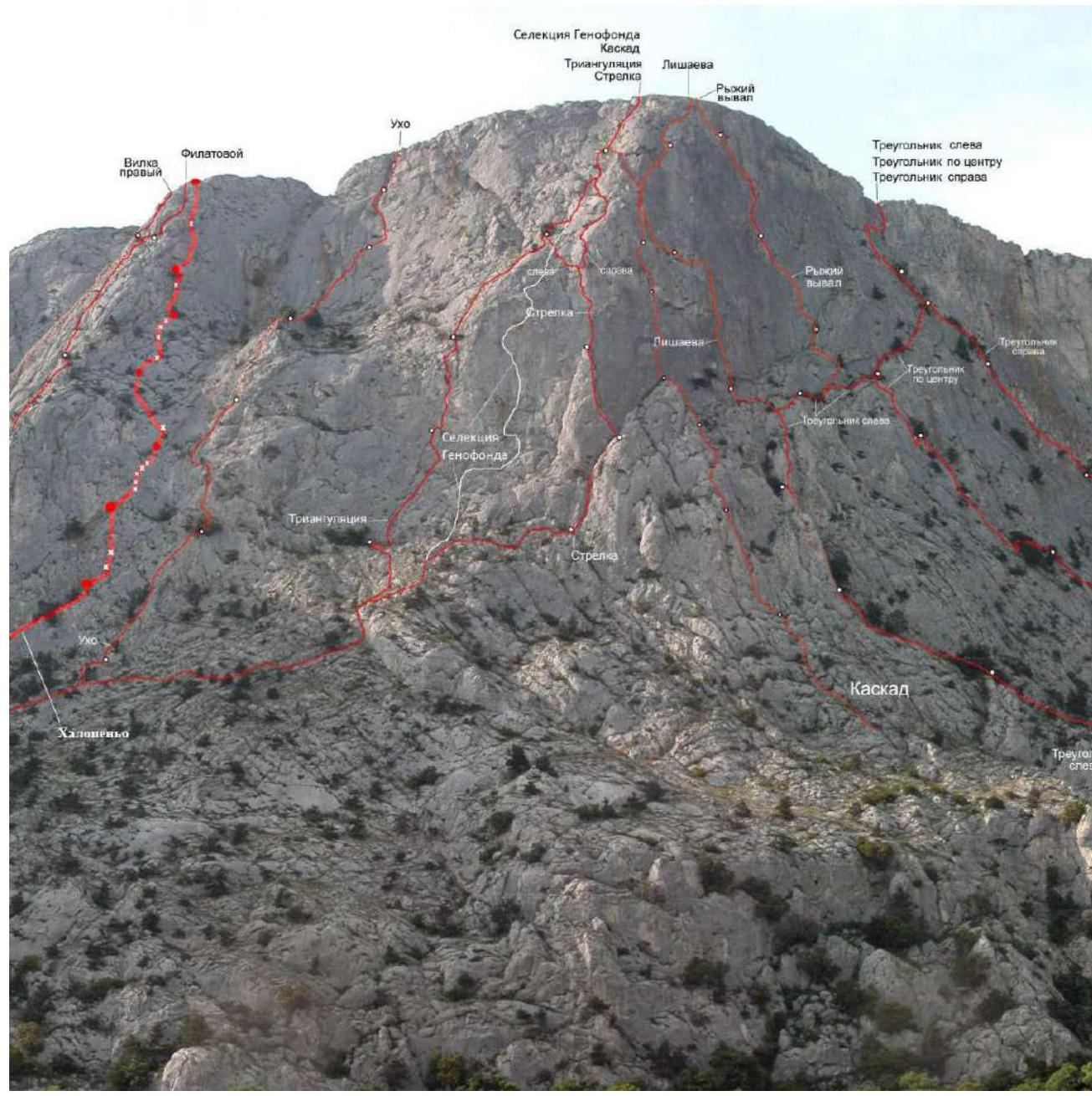
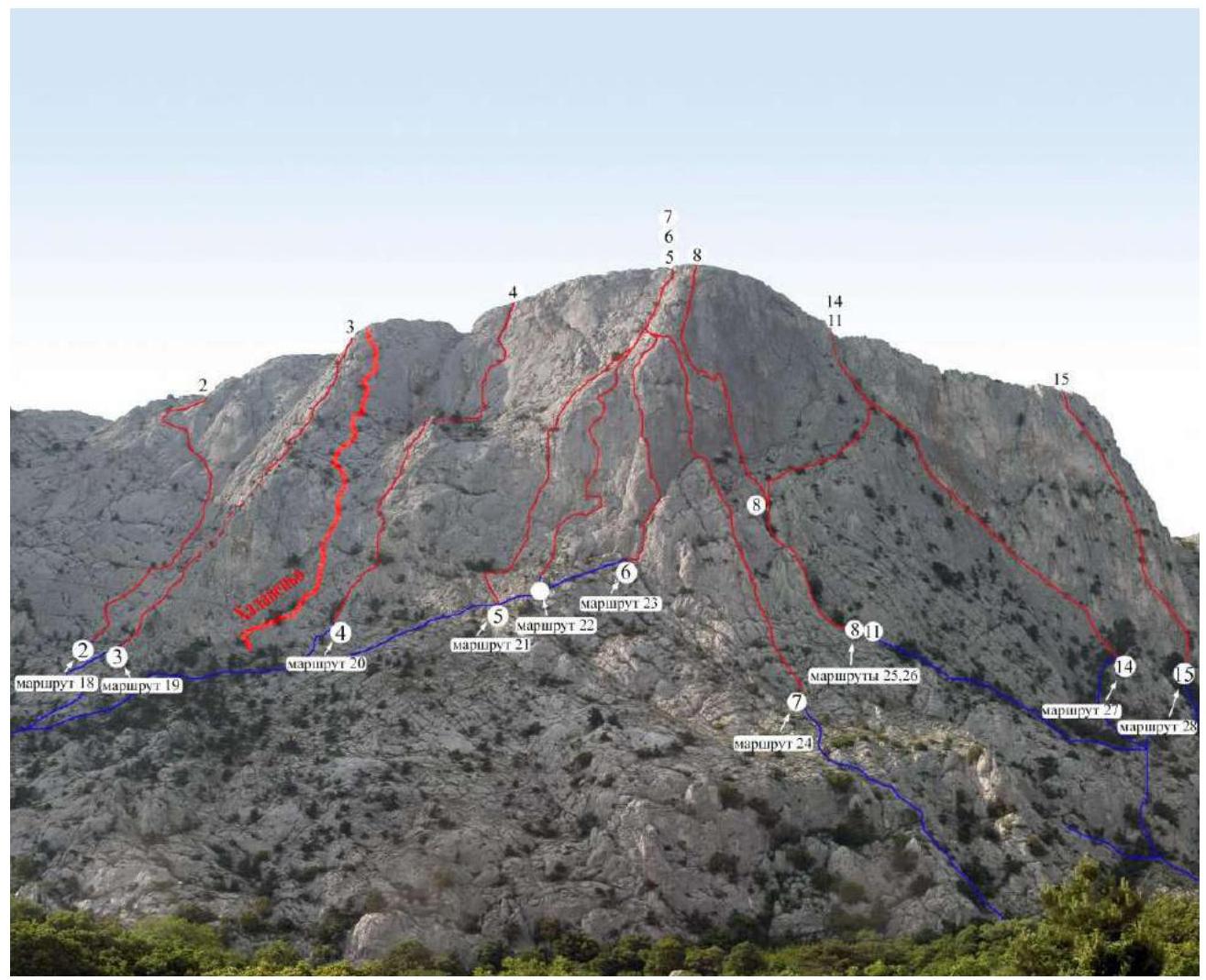
Photo №2
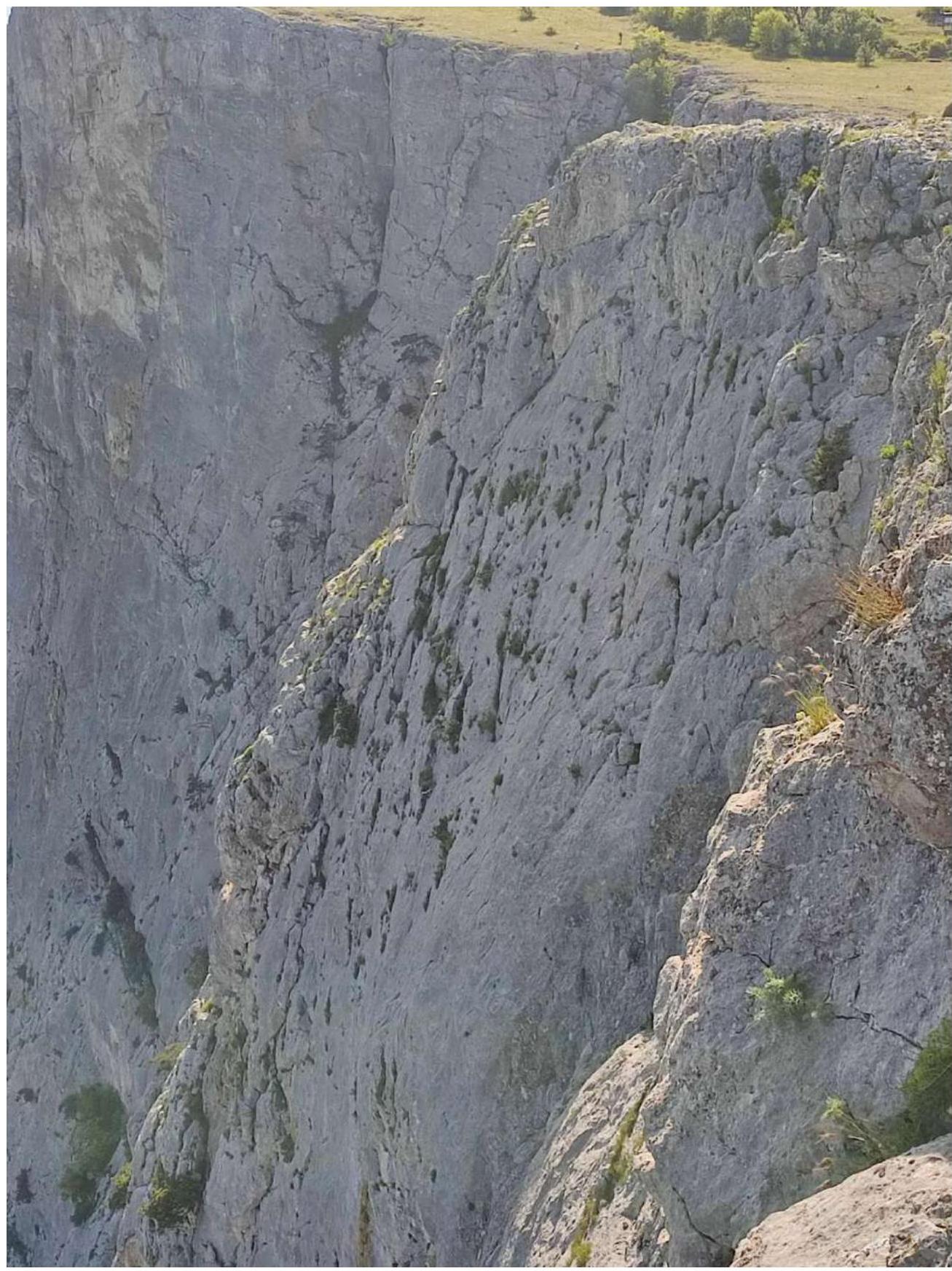
1.2. Photo of the Route Profile
Photo №1. View from the Ear route
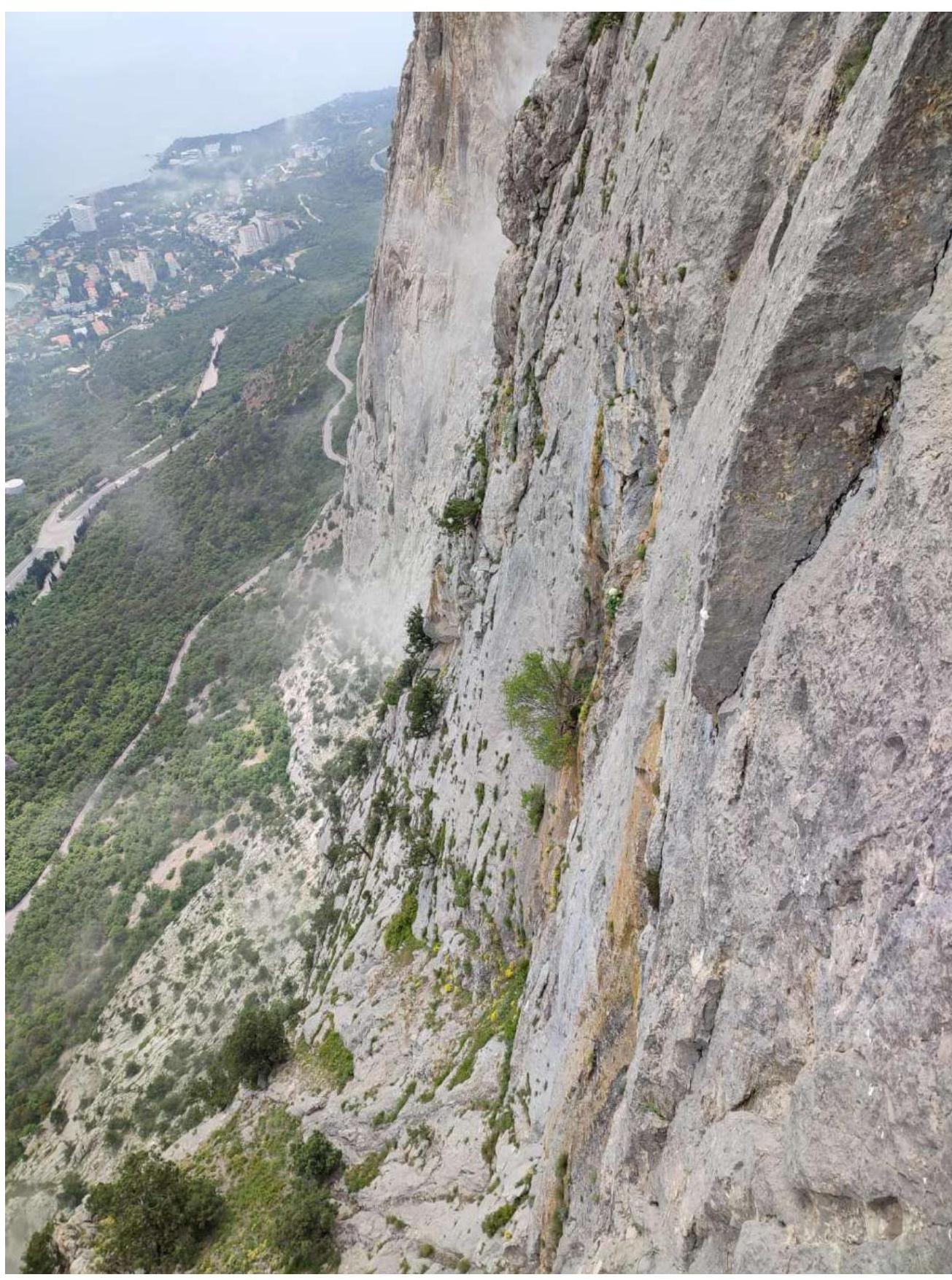
Photo №2. View from the yayla at the exit of the Ear route
1.3. Drawn Route Profile
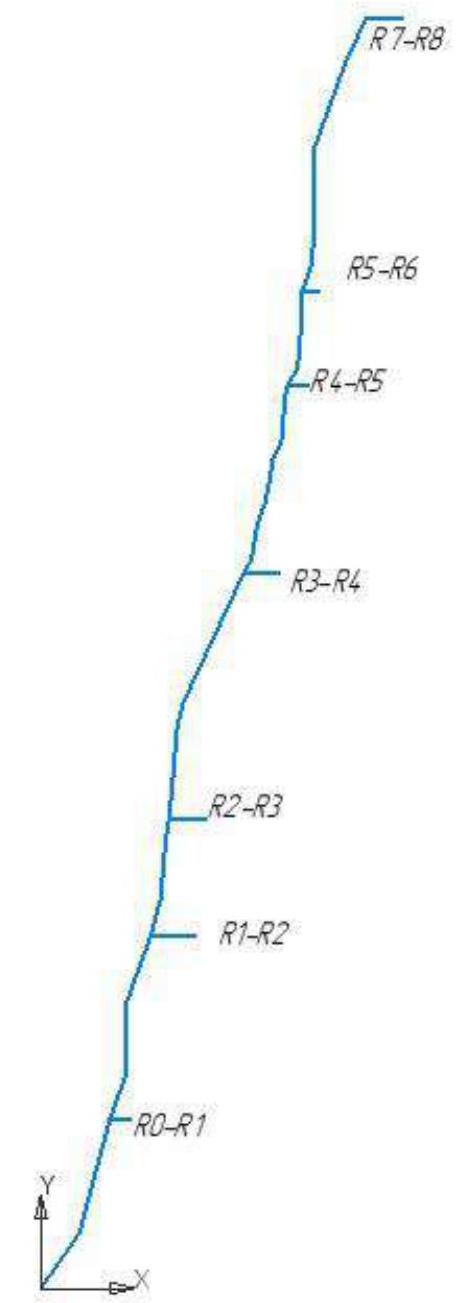
2. Route Characteristics
2.1. Technical Photograph of the Route
White "X" marks approximate locations of anchors and bolted anchors on the sections. Photo №1
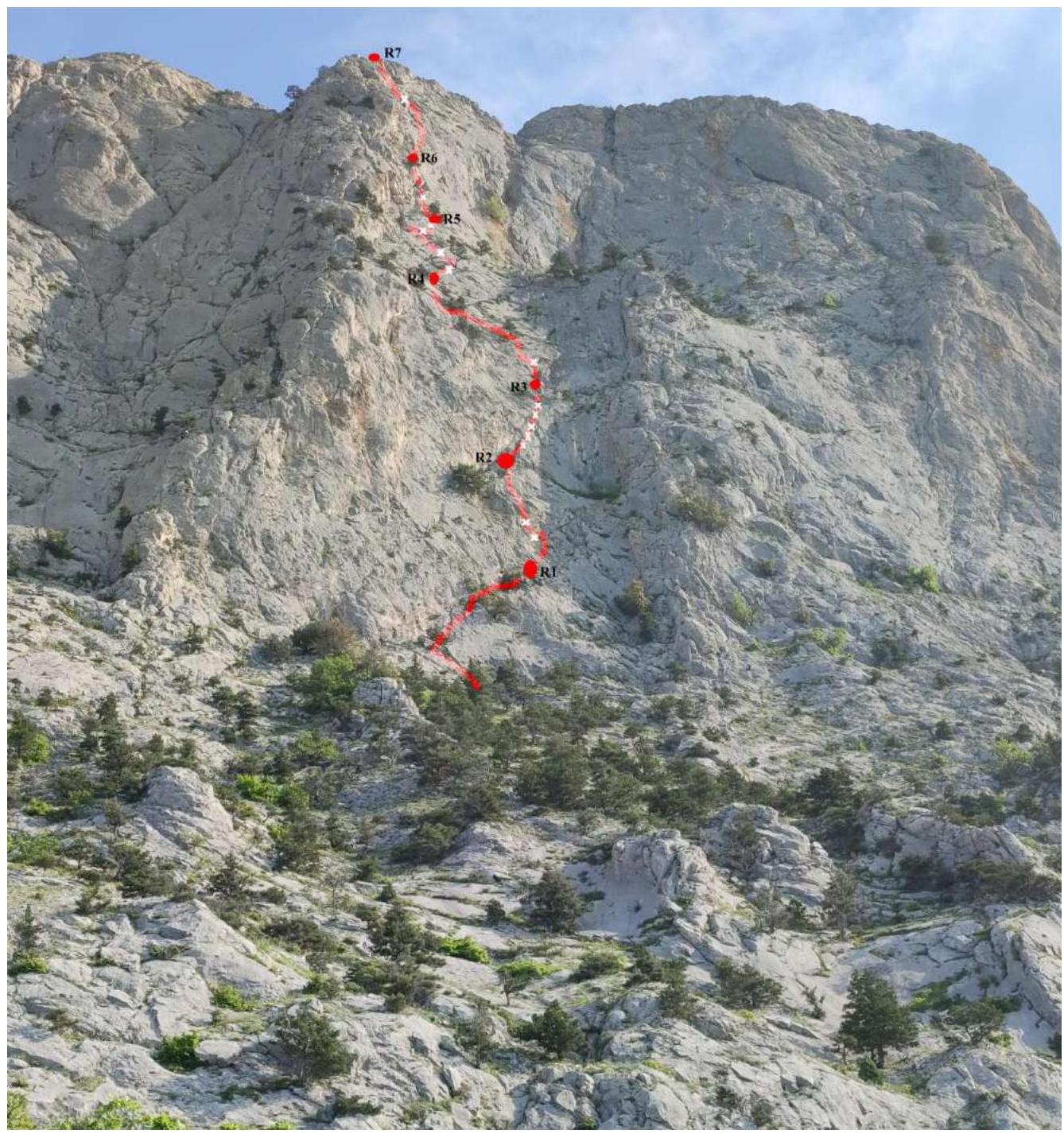
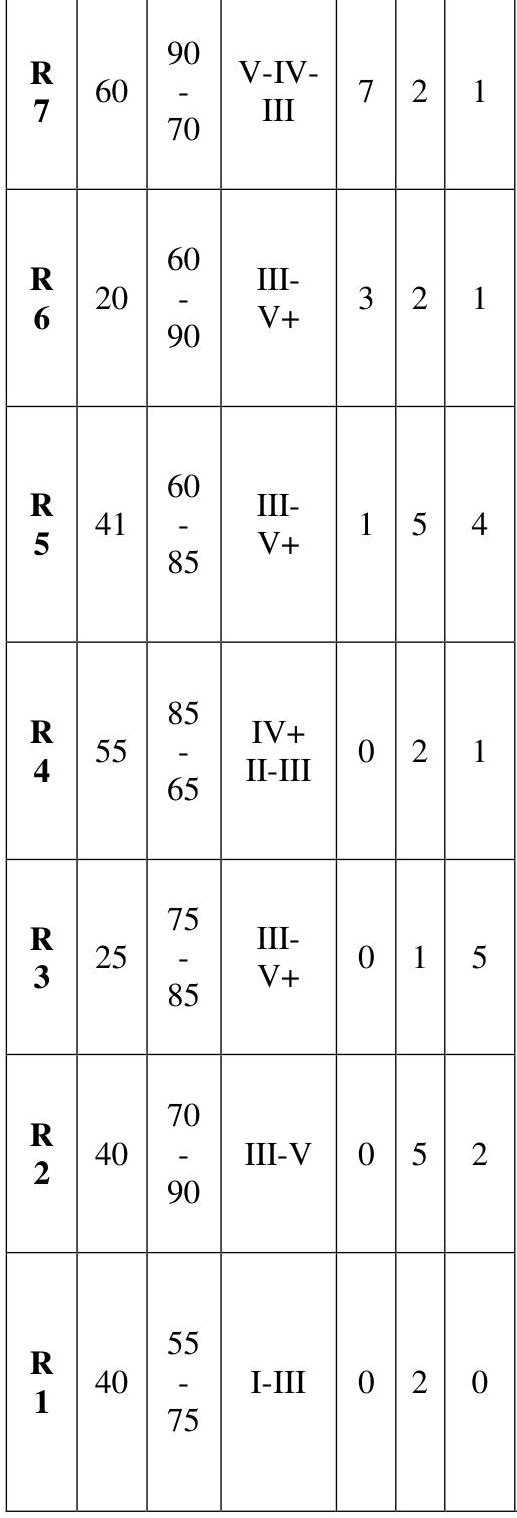
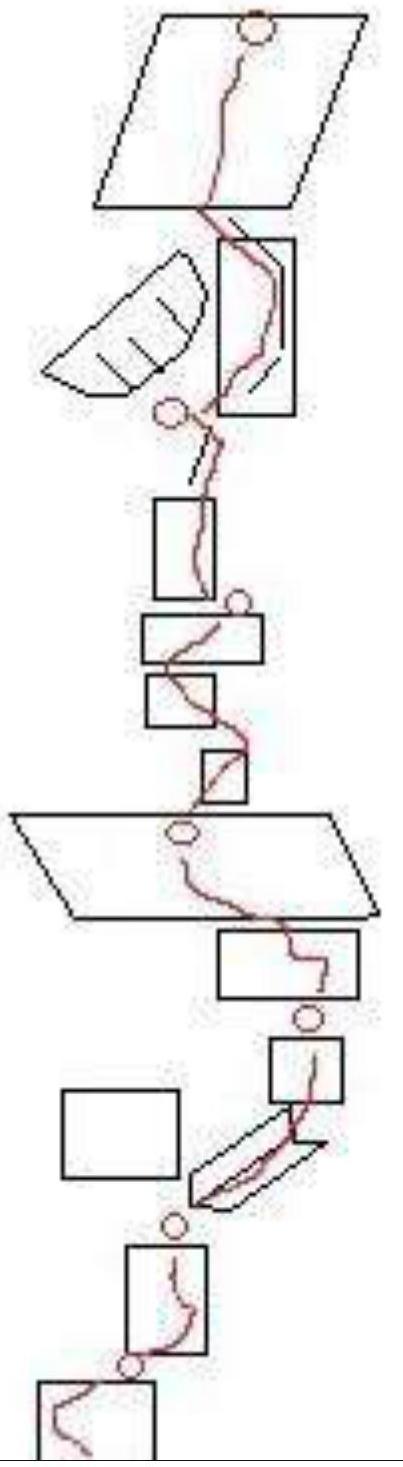
2.2. Route Diagram in UIAA Symbols
| Section № | length | steepness | category | nuts | anchors | bolts |
|---|---|---|---|---|---|---|
| R7 | 60 | 90–70 | 5–4–3 | 7 | 2 | 1 |
| R6 | 20 | 60–90 | 3–5+ | 3 | 2 | 1 |
| R5 | 41 | 60–85 | 3–5+ | 1 | 5 | 4 |
| R4 | 55 | 85–65 | 4+–2–3 | 0 | 2 | 1 |
| R3 | 25 | 75–85 | 3–5+ | 0 | 1 | 5 |
| R2 | 40 | 70–90 | 3–5 | 0 | 5 | 2 |
| R1 | 40 | 55–75 | 1–3 | 0 | 2 | 0 |
3. Characteristics of the Team's Actions
3.1. Brief Description of the Route Ascent.
Accompanied by photo illustrations (at least 4):
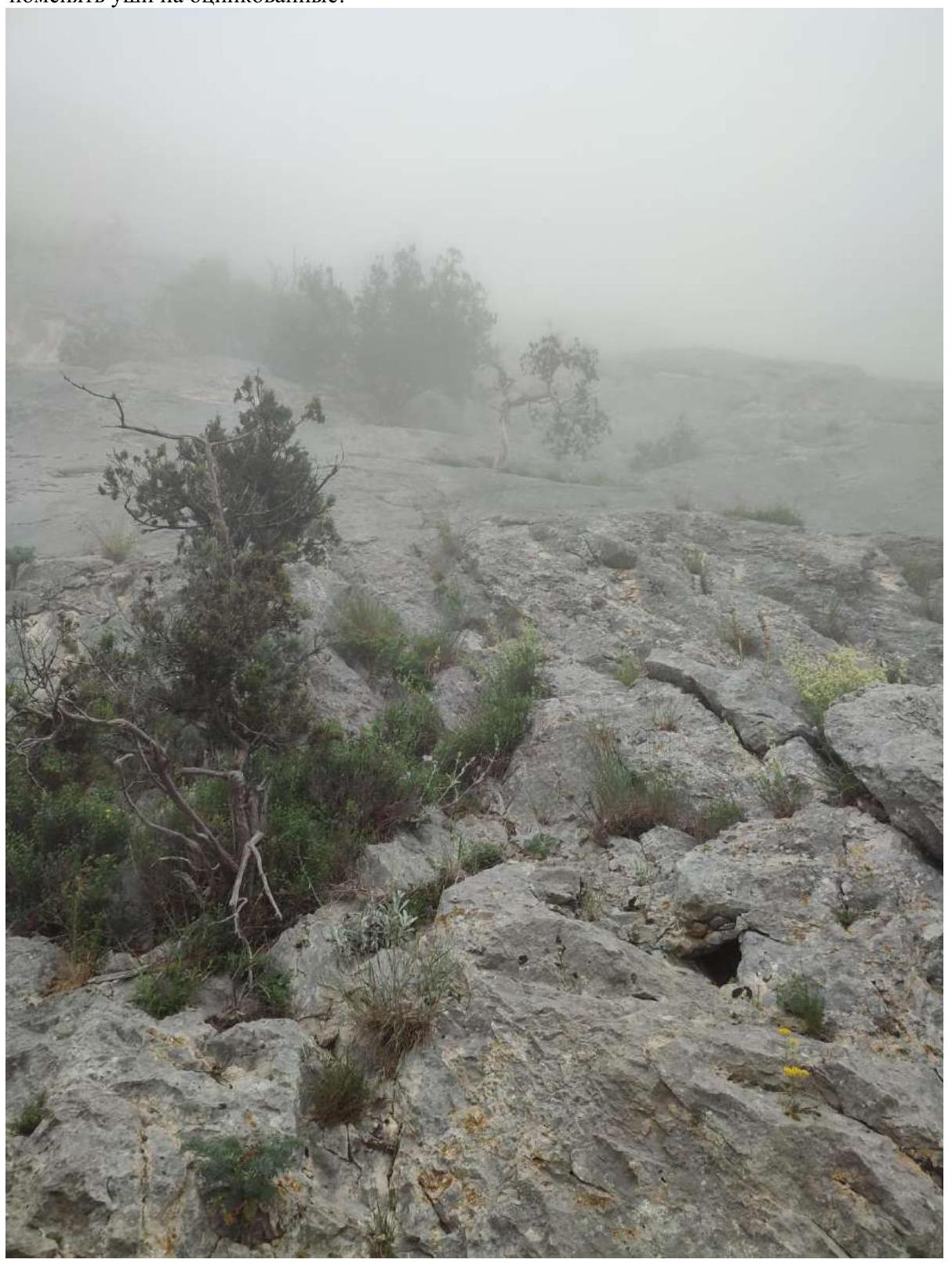
R0–R1
40 m — 15 m category 1, 55°, 25 m category 3, 75°
Move left to right along the tree to the inclined fault of the wall. Through it, right to the " бесстыдница": 2 anchors. Through it (in a intricate way) right to the inclined shelf past the juniper. After the bush, a station on two bolts. Two galvanized M10 anchors without nuts and ears were sticking out of the rock. I placed two stainless steel ears and nuts on the galvanized anchors. The ears should be replaced with galvanized ones!
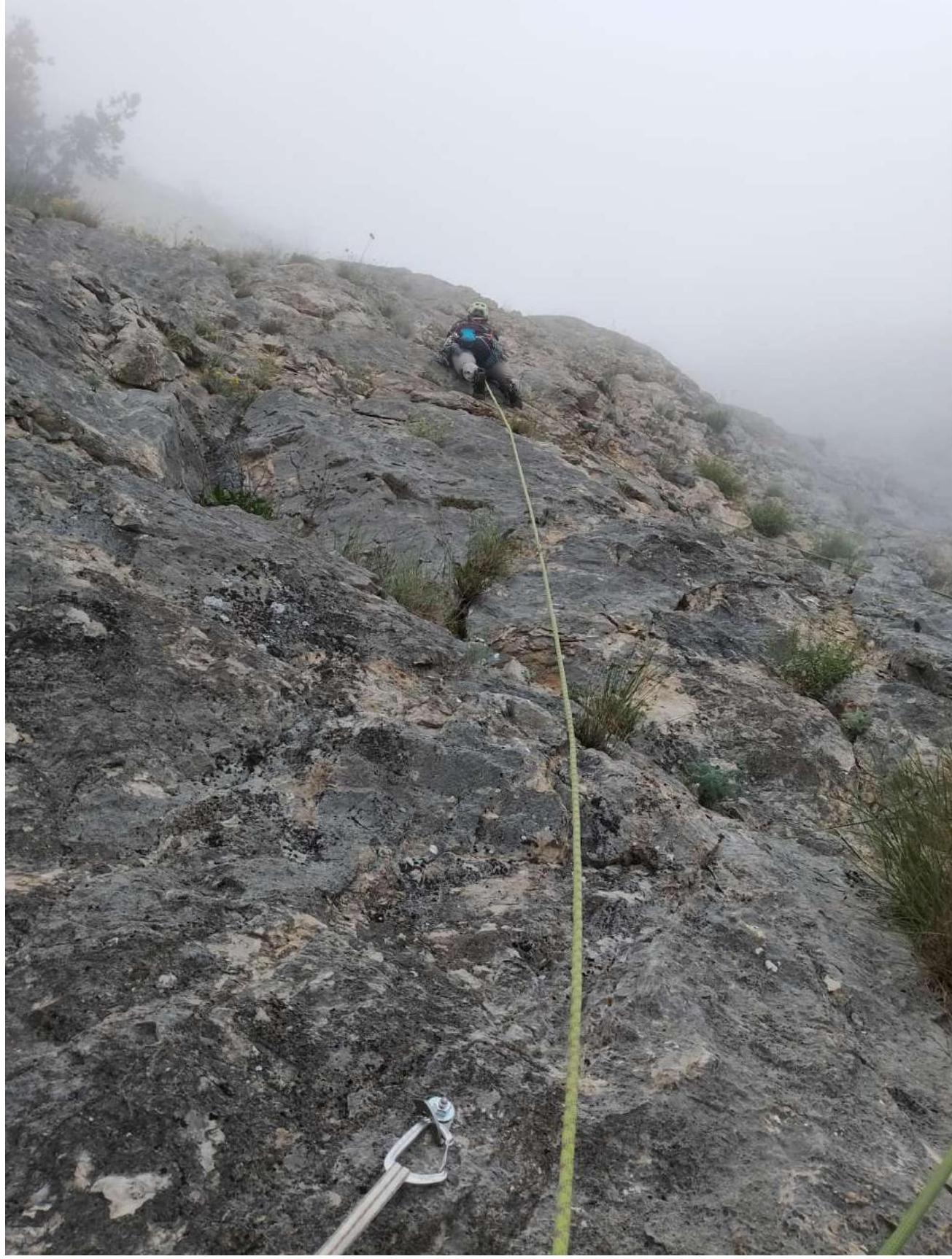
R1–R2
40 m — 10 m category 3, 70°, 15 m category 5, 90° (5c/6a fr.), 15 m category 3, 70°. 5 anchors, 2 bolts.
From the station, right and up, a bolt is visible (stainless steel M12 with an ear). Approach it from right to left. On the vertical wall, be careful — the relief is rich, but not monolithic. Holds sometimes break off in small blocks. Climbing 5c/6a fr. The most psychologically challenging section. There is another bolt (stainless steel M12 with an ear). Station on two bolts at the beginning of a rock mulde (station on M10 galvanized anchors — Vekprom multipitch).
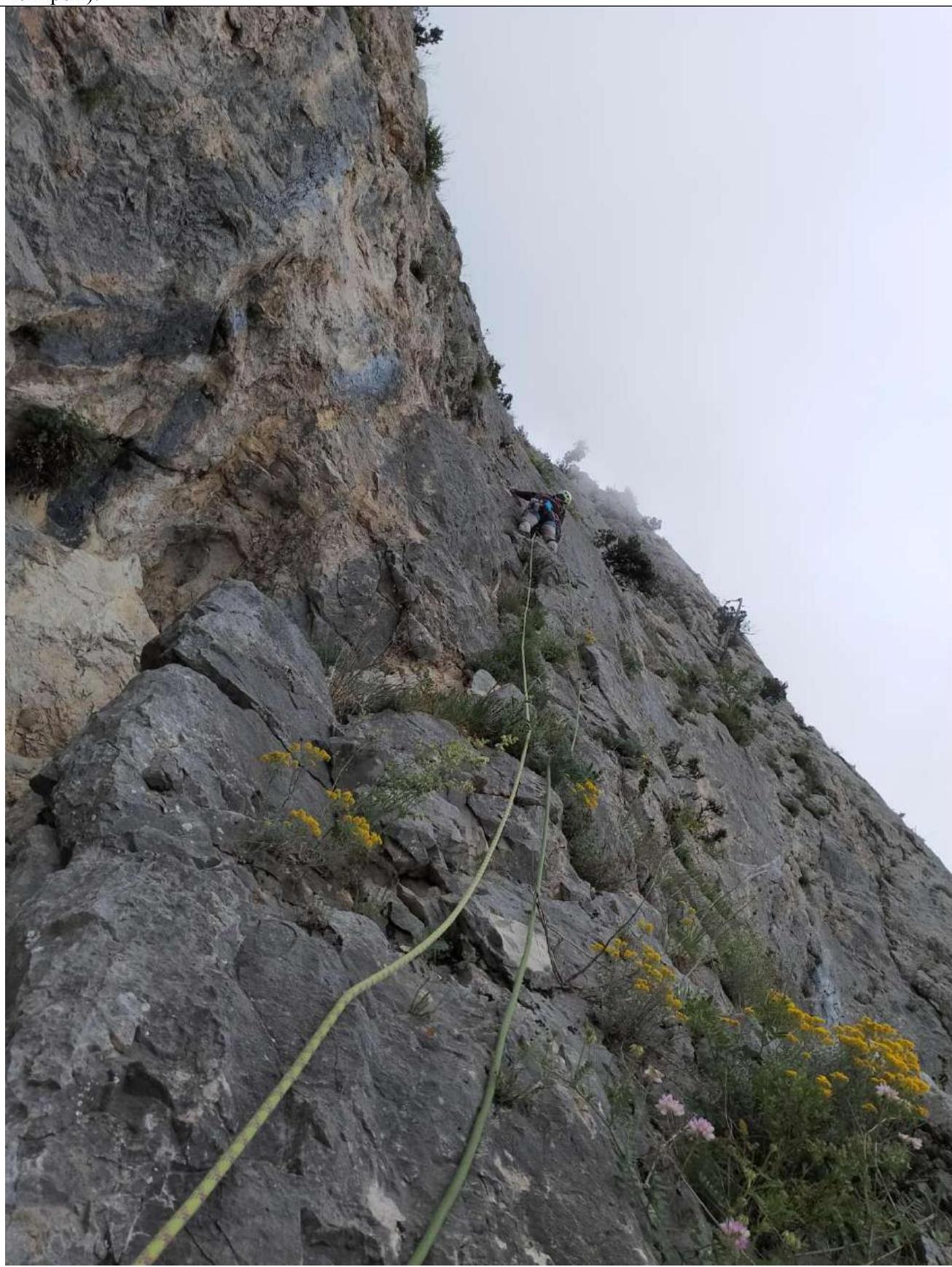
R2–R3
25 m — 8 m category 3, 13 m category 5+, 85° (6a/6b+ fr.), 4 m category 4, 75–85°.
25 m category 5, 75–85°. Movement right and up. In this part of the wall, the only crack system is present, and it coincides with the section of the Vekprom multipitch.
Approach to the monolithic section without natural protection:
- 8 m category 3, 1 anchor, 75°.
- On the crux of the rope, 5 bolts (galvanized Vekprom multipitch): 13 m 6B+ fr. (without glued holds, with them 6A fr.) category 5, 85°.
- 4 m category 4, 80°.
Station on two bolts on a small ledge (on M10 galvanized anchors — Vekprom multipitch).
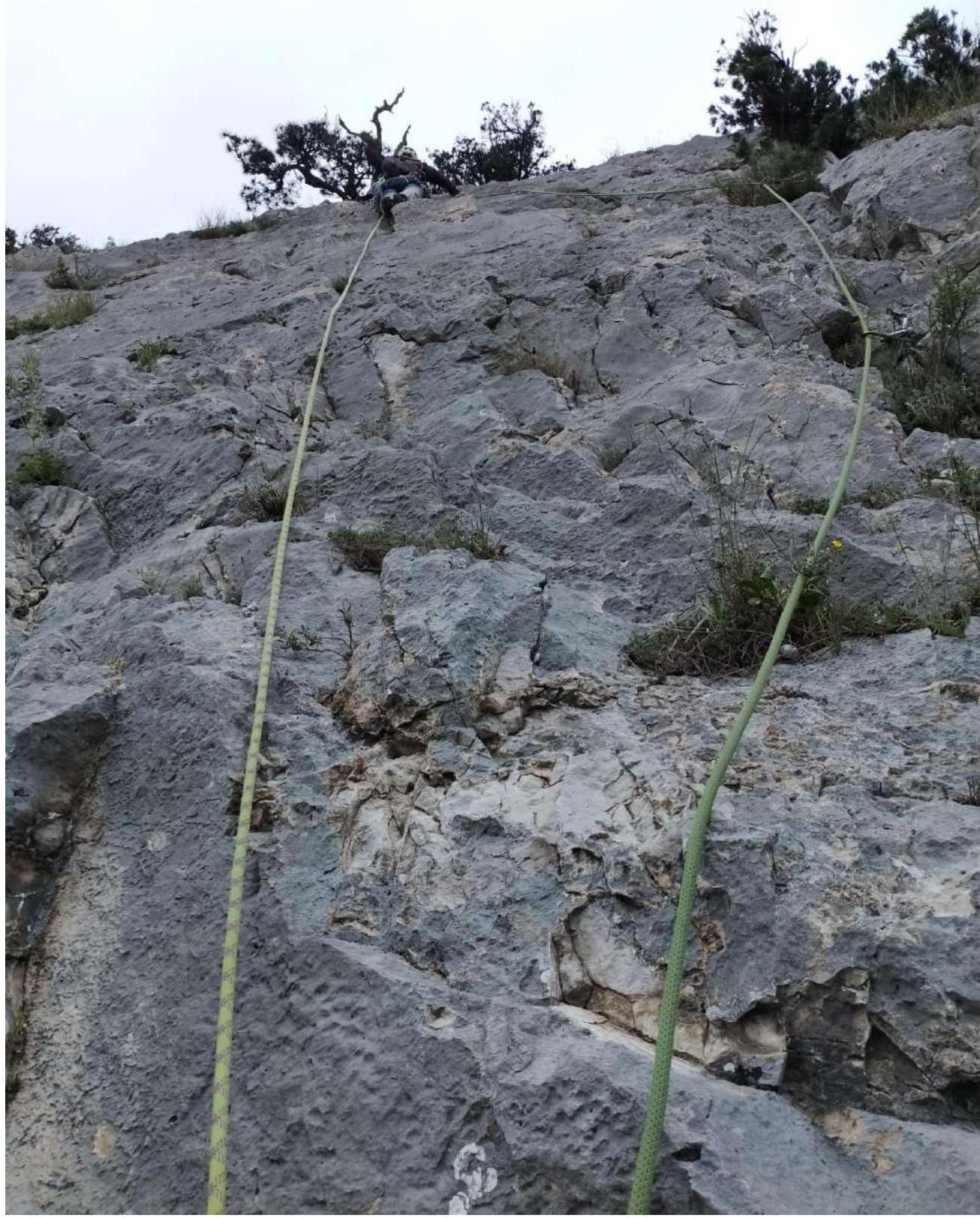
R3–R4
55 m — 20 m category 4+ (5c fr.) 85°, 5 m category 4, 75°, 30 m category 2–3, 65°. A meter to the right, then up to a juniper bush (1 anchor). Along the bush, left and up, exit to a bolt (stainless steel M12 with an ear). From it, a careful traverse left 2.5 m — bypassing a loose block 1×1 m, very carefully!!! Behind it, up towards the juniper (1 anchor). Under the tree, left, then movement up and left to a group of junipers. Under them, there is also a live block, be careful! Bypass it from below and move left and up to a slab, left of which is a juniper bush. Station on a bolt (stainless steel M12 with an ear) and own anchor. Underfoot, inclined shelves.
R4–R5
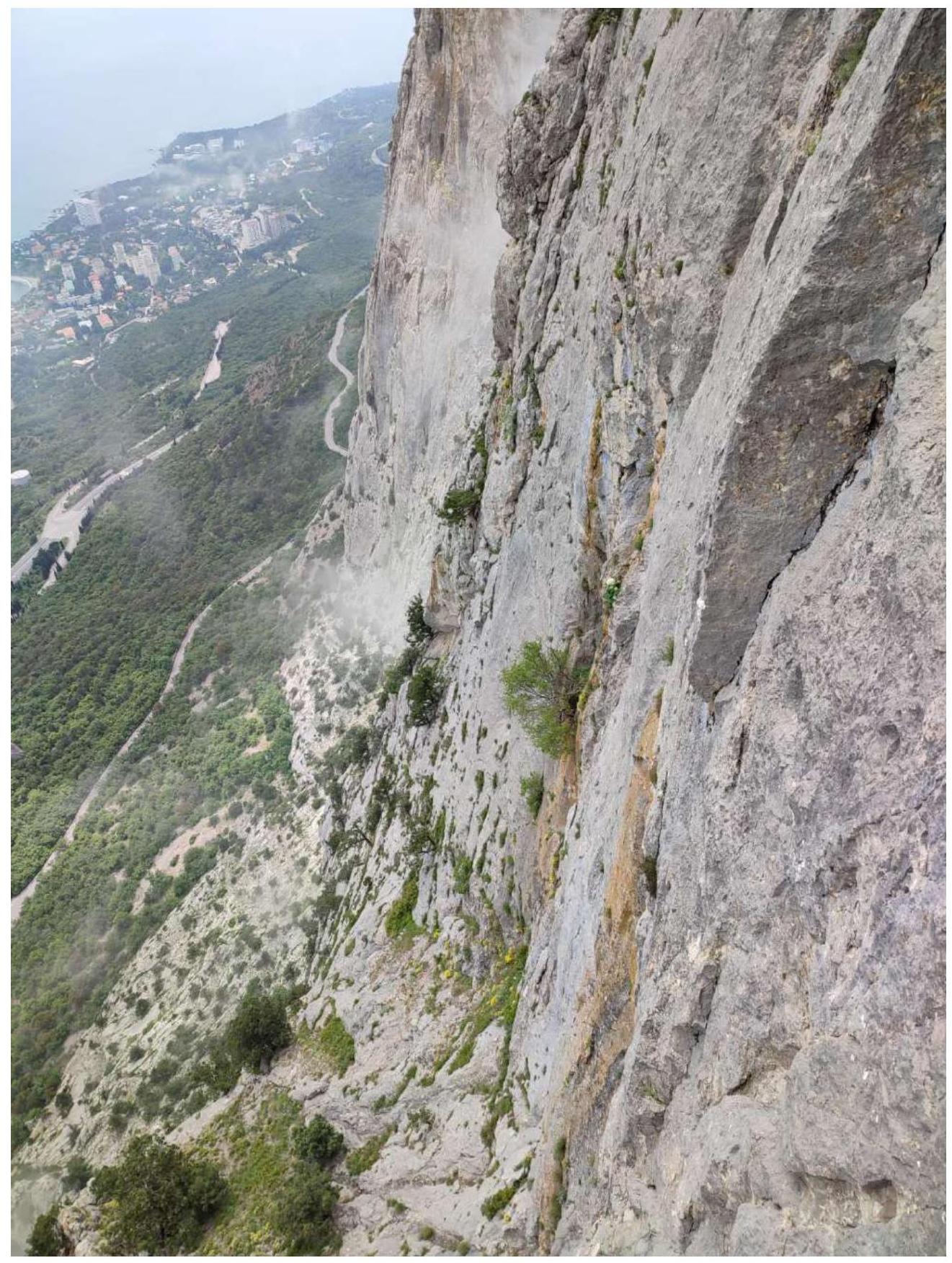
41 m — 3 m category 3, 60°, 8 m category 5+, 80° (6A+ fr.), 5 m category 3, 70°, 9 m category 5+, 80° (6A fr.), 4 m category 3, 65°, 10 m category 5+, 85° (6A fr.), 2 m category 4, 75°.
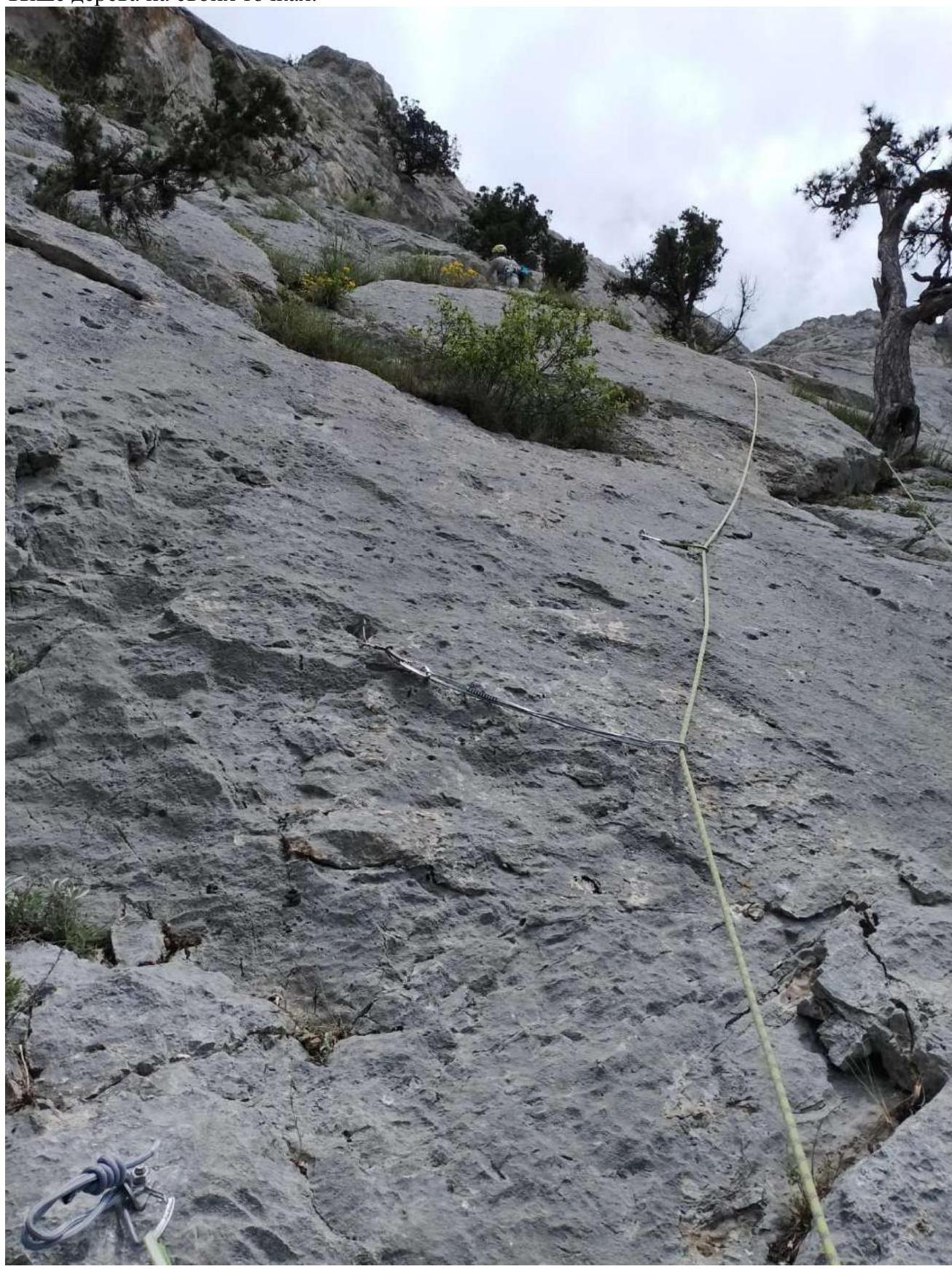
From the station, in the direction of the tree, right and up: 3 m category 3. Anchor. On the slab12 bolts are present (stainless steel M12 with an ear). Feet are poor. Slab 8 m 6A+ fr.
From the tree, left and up: 5 m category 3. Anchor. Slab 9 m 6A fr. Anchor and cam. On the crux of the slab, a bolt (stainless steel M12 with an ear).
Up and left under the next slab: 4 m category 3. On the slab, two bolts (stainless steel M12 with an ear). 10 m 6A fr. anchor. When it becomes easier — right to the juniper bush 2 m. On it is a station. You can go a bit higher than the tree on your own points.
R5–R6
20 m 60–90°. Category 5. From the tree, left and up along the wall with a crack in the direction of a large tree.
- 4 m 60°. Category 3, anchor.
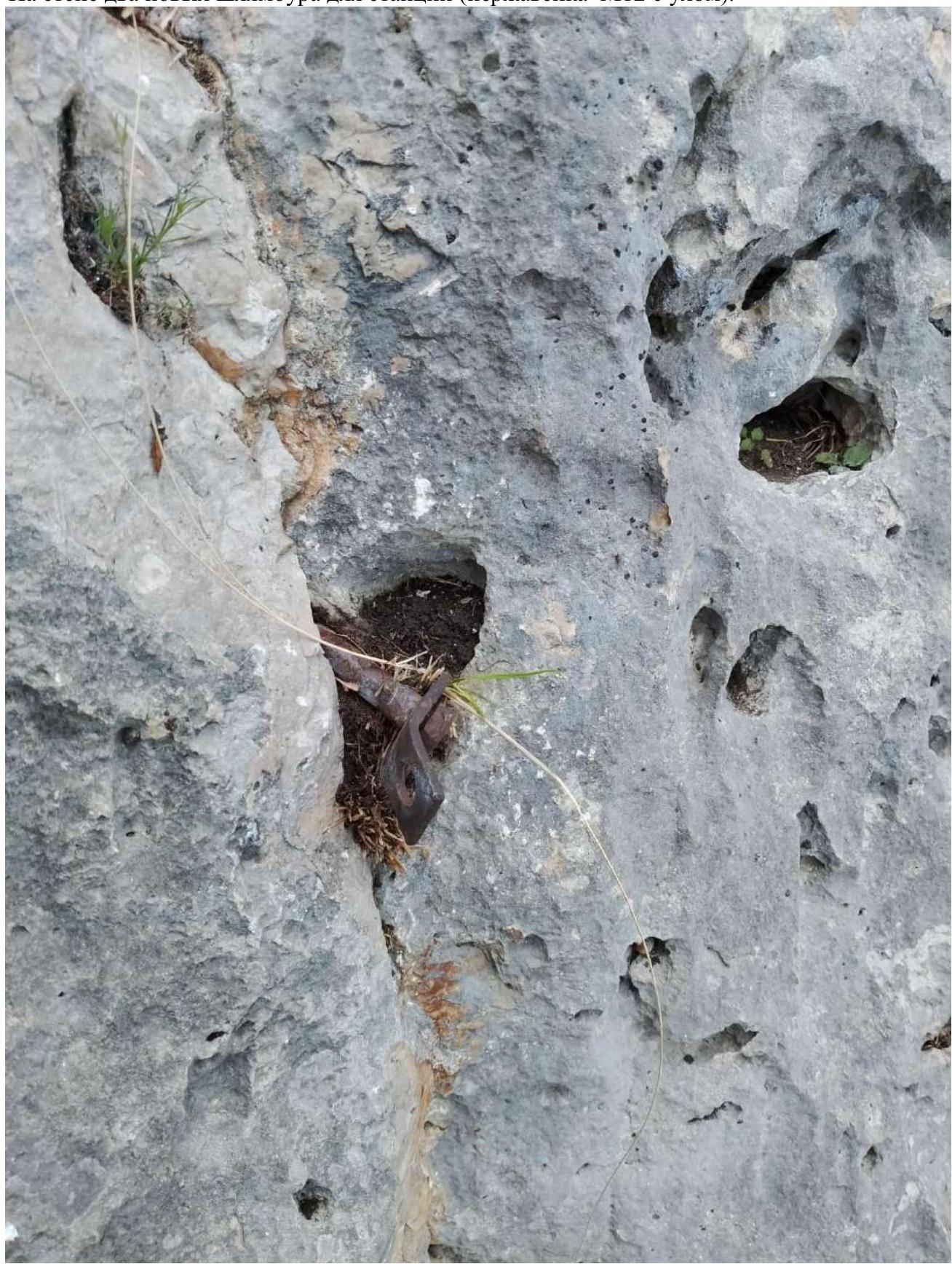
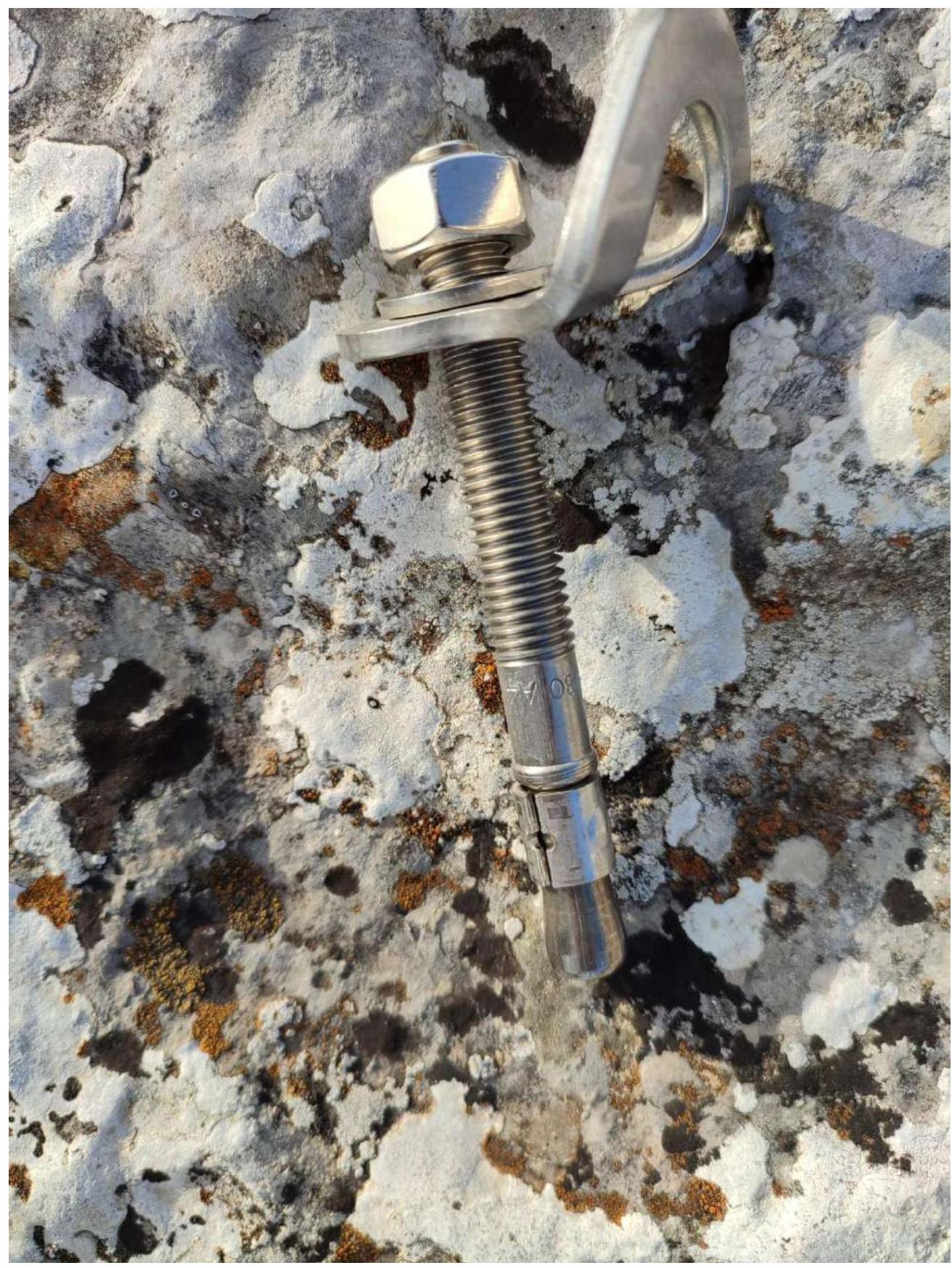
- 10 m 85°. Category 4+, anchors. There is a Soviet rusty anchor and a fresh bolt (stainless steel M12 with an ear).
- Not reaching the tree, right into the overhanging crack. Cams. Transition 6A+/6B fr.
- 6 m 90°. Category 5+. To the tree and to the shelf immediately above it.
- On the wall, two new bolts for the station (stainless steel M12 with an ear).
R6–R7
60 m 90–70°. Category 5–4–3. Cams work very well.
Above the station, a slanting crack is visible in an overhang with rubble. We don't need to go there (whew)!
Climb right and up (direction "2 o'clock") towards the crack at the block (under them, a scrawny tree):
- 6 m category 3, 70°, cam.
- Along the block to the right: 4 m category 4, 85°.
- Behind the bend, a steep crack up: 15 m category 4+, 90° (5c/6a fr.), cams.
- Further, left and up: 5 m along large relief category 4 to a transition up behind the bend. Cams.
On the transition, there is a bolt (stainless steel M12 with an ear), an intermediate station can be made (30 m).
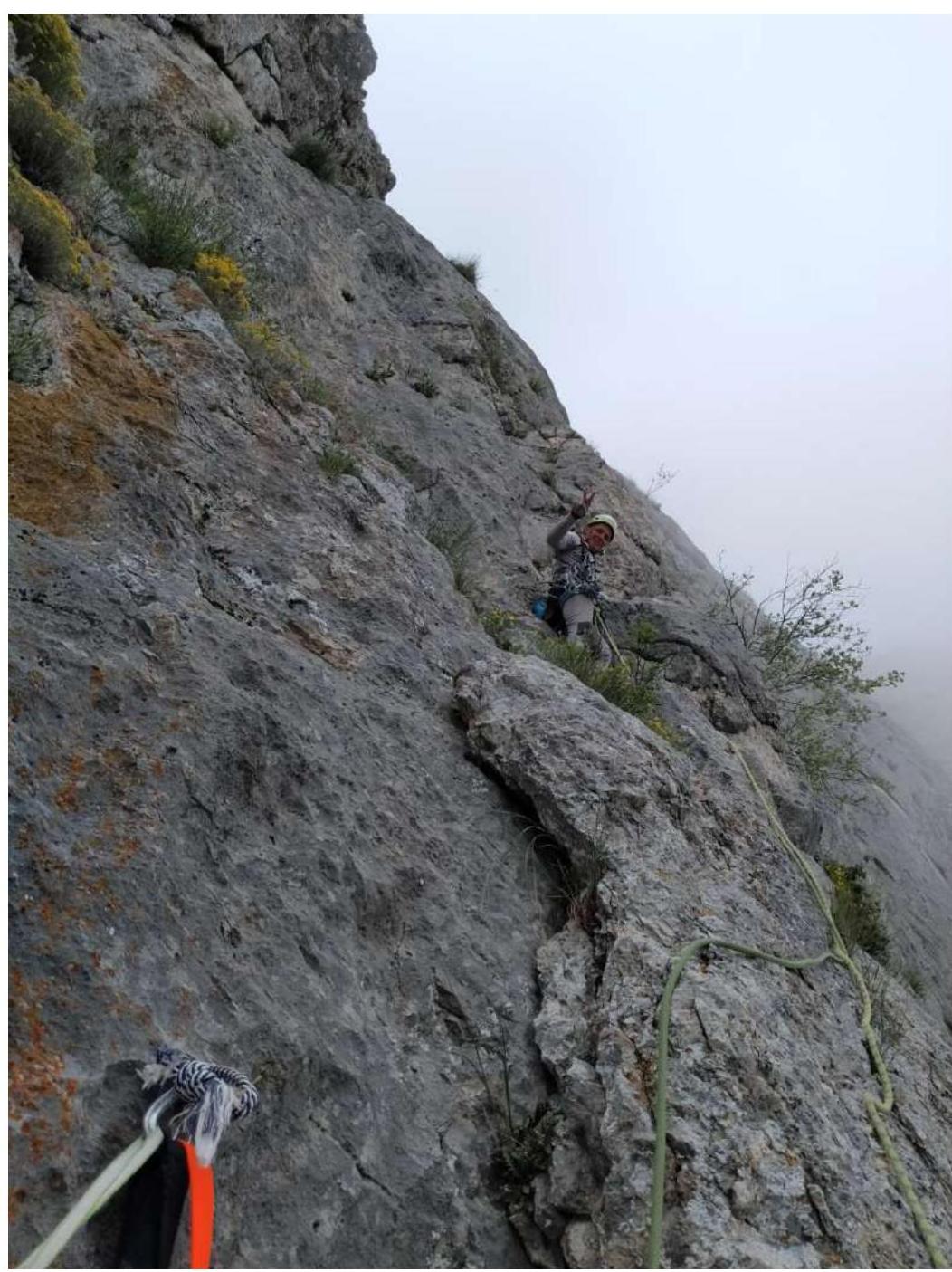
Then it becomes easier. 20 m category 3, 70°, cam, anchor. 10 m category 2, 65°. Exit to a shelf before the yayla. On the bend, two bolts for the station. If they are removed, then three meters from the edge, there is a glued anchor. One of the anchors is a local galvanized M12. I placed a stainless steel ear and nut on it. The galvanized ear and nut should be replaced!
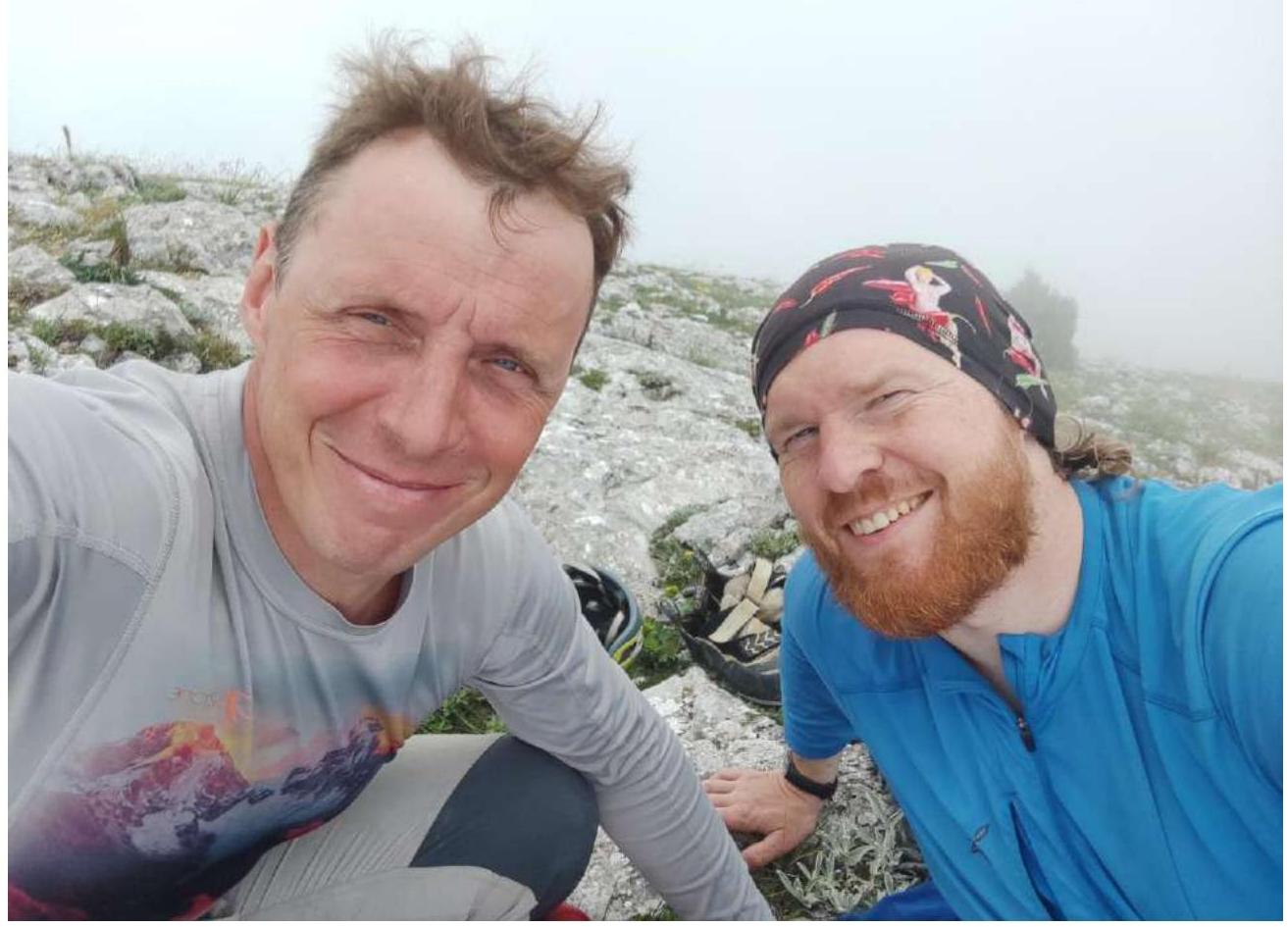
3.2. Photo of the Team on the yayla after the Ascent:
3.3.1. Safety Assessment of the Route.
The route is fairly safe. The leader should pay attention to R2 — holds may break off.
On R4, be very careful when traversing left from the bolt!!! Do not touch the block. It is free-standing. Ideally, it should be knocked off by the last person, but you need to block the road below for 5 minutes — rocks can reach the asphalt.
3.3.2. Conclusion on the Preliminary Assessment of the Route in Comparison with Classified Routes of the Same Category of Difficulty in the Climbers' Experience.
We have climbed 4A "Parabola" on Kush-Kaya, 4A "Ear" on Mshatka — the "Halapeno" route is more difficult than both.
We also have experience climbing: 4B "Mitten" on Kush-Kaya, 4B "Triangulation" on Mshatka, 4B on the left side of the Kant on Foros Kant, 5A "Comma" on Sokol.
"Halapeno" is comparable to 4B "Mitten" and 5A "Comma". It is slightly more difficult than 4B "Triangulation" and 4B on the left side of Kant.
Below is a comparative table of the complexity of classic routes located nearby on the same massif with established time categories. Characteristics are taken from the published book "Rock Routes" edited by Yu. Krogov and A. Lavrenenko:
| Route Name and Difficulty Category | Ear 4A | Triangulation 4B | Halapeno 4B | Arrow 5A |
|---|---|---|---|---|
| Length | 7 sections | 6 sections | 8 sections | 7 sections |
| Sections of category 4 | 145 m | 0 m | 65 m | 30 m |
| Sections of category 5 | 0 m | 55 m | 86 m | 105 m |
The climbed route clearly exceeds neighboring routes in length and level of difficulty of sections.
At the same time, the route is more monolithic than the neighboring "Triangulation 4B", not cluttered with unreliable old "hardware", unlike "Arrow 5A". It is also passable with free climbing.

Comments
Sign in to leave a comment