

Eastern summit of Ai-Petri. Description of the "New Moon" route
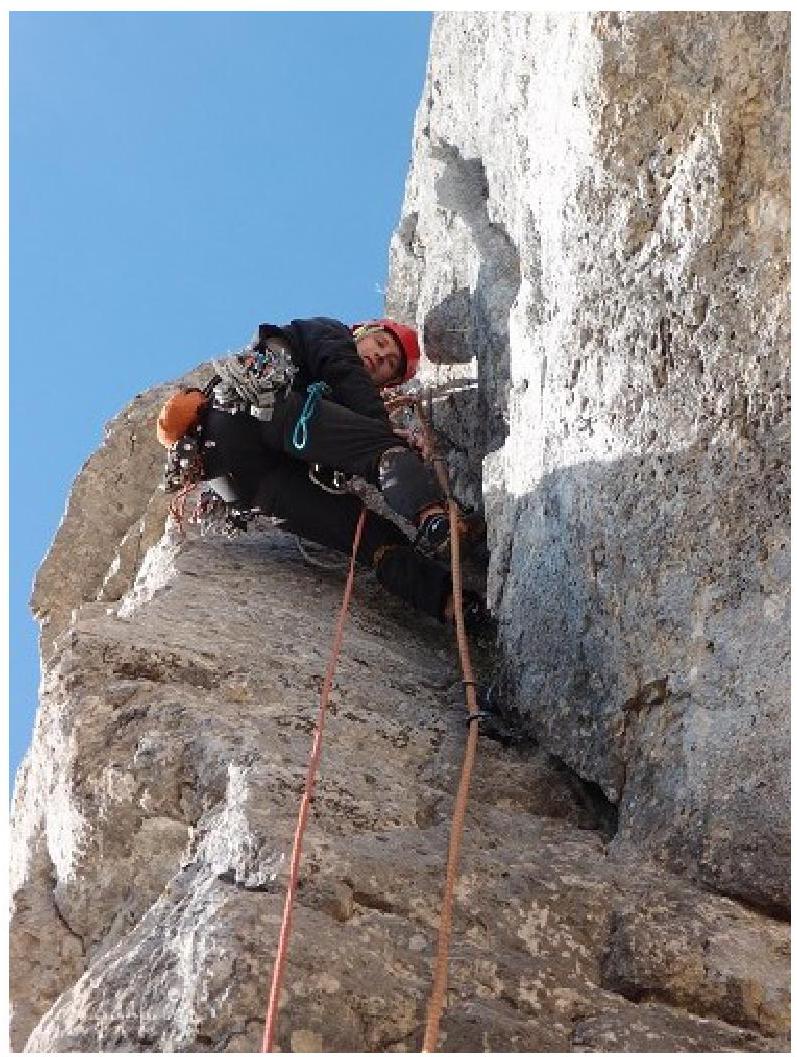 S.
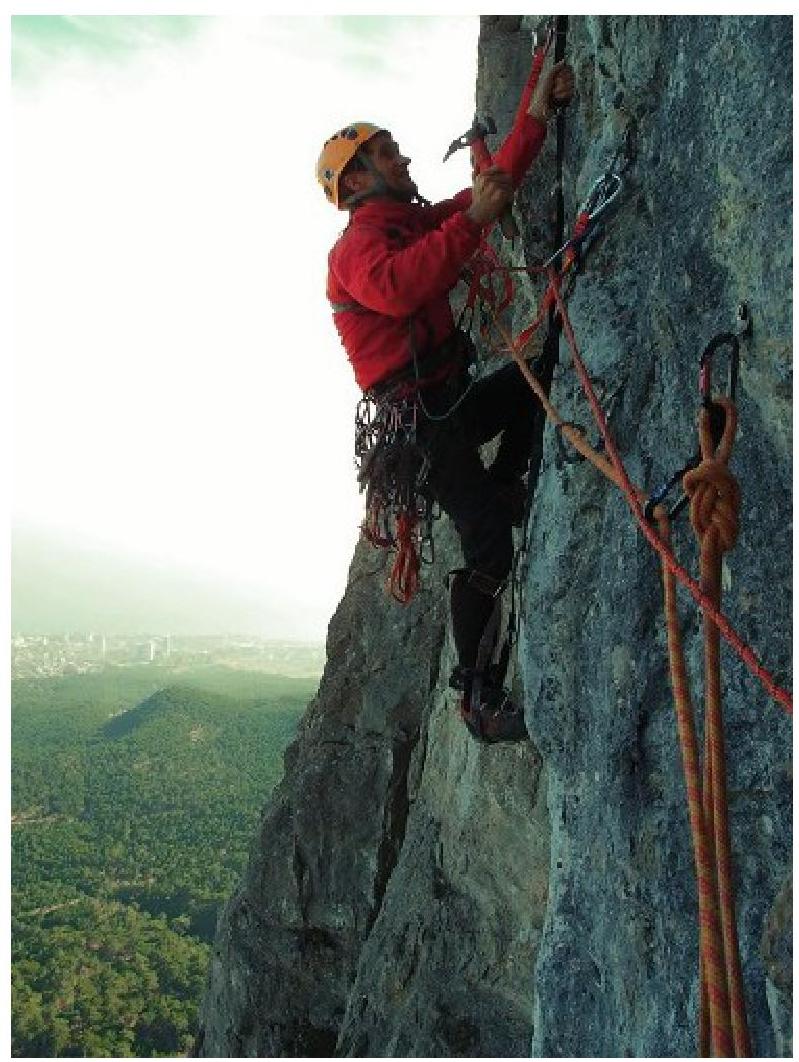
Cheterik on the R4–R5 section
S.
Cheterik on the R4–R5 section
First ascent impressions of "New Moon".
Early November, and it's warm outside — warm, you can even bask in the sun. But that's not the point. The purpose of the trip to Crimea was to make a first ascent on Ai-Petri. The organizer of all the ideas was Sergey Pugachev. For him, doing a first ascent is, in my opinion, a usual thing))), but for me it's a MEGa adventure! Five years ago, I dreamed of taking gear and climbing somewhere where no one had been before. The dream came true!
The route starts to the left of the "grottos". To the right, under the beginning of the grottos, there's a good trail. Later, during the approach for processing, it's very beautiful to watch the sunrise from it. The beginning of the route is partially crumbling, some parts are climbed very well. I, of course, jumarred most of the route, but I got scared enough))). I want to climb it again, but this time all by myself, to feel what it was like for Sergey. So — see you on "New Moon".
Chetyrnik
Stanislav.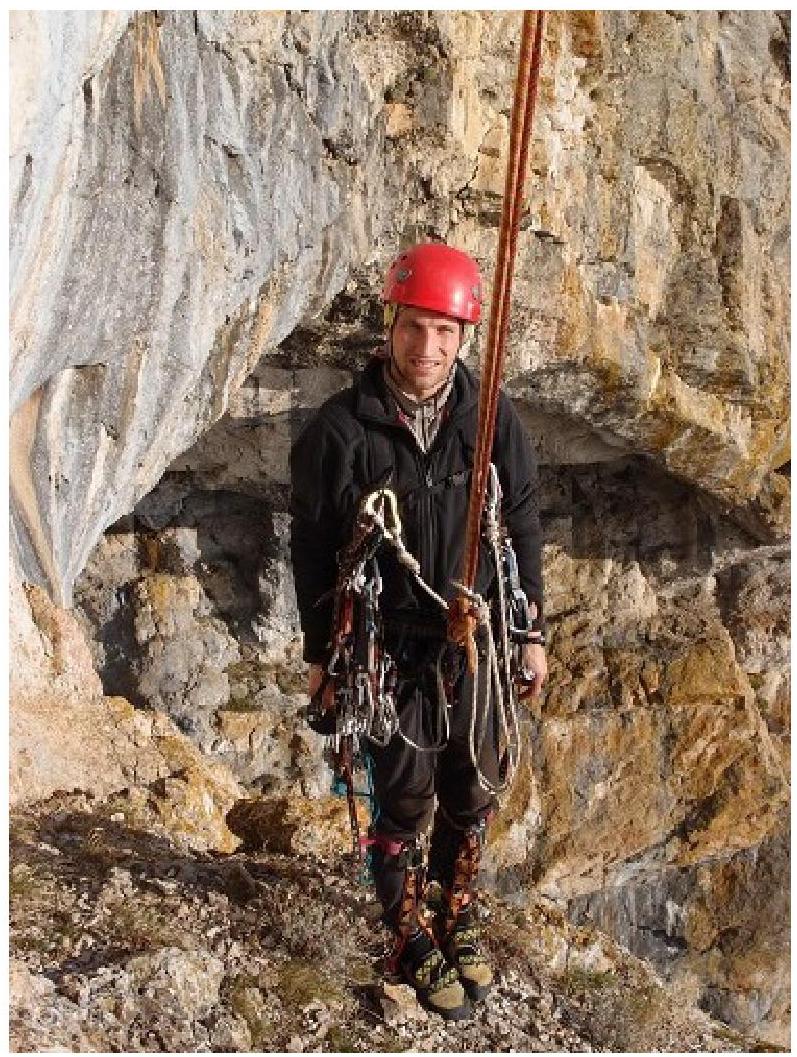
Sergey Pugachev: I must say that "doing a first ascent" is not entirely an ordinary matter, although it has become familiar. There are two types of attitudes towards first ascents:
- do it for yourself; or do it faster, because it's a competition.
- do it so that others can follow.
Lately, I've been choosing the second option. And the biggest joy for me is when my routes are repeated. And the anticipation of a nightmare is when someone gets injured on them. Although, so far, there have been no nightmares, only repetitions.
Therefore:
- We thoroughly clean the route of all loose rocks and flakes. If not on the first ascent, then during the repeat ascent in the process of processing.
- Sometimes we install more reliable bolts (i.e., more reliable than the standard 20 mm VTsSPS ones), so that we can return with minimal losses, both technical and emotional.
That is — routes like "Anomalous September" and "New Moon" are transitional from training to master routes. And what can you surprise a master with? And why? But everyone will have enough adventures!
As for personal impressions of "New Moon" — it's a rare and unique vacation. For four nights (five days) under the wall, we didn't meet a single person. Not a word, not a voice, not even a stray mushroom picker's "Hello!" The weather was enviable, the complete opposite of "September". The original name of the route was supposed to be "Cry of the Owl". They and other small creatures woke us up at night. And when we returned from the ascent, we slept for 11 hours and didn't hear anything at night.
And in the morning, we went to Krasnokamenka to restore our lost rock climbing skills.
Have interesting adventures. And don't be afraid of the cry of the owl!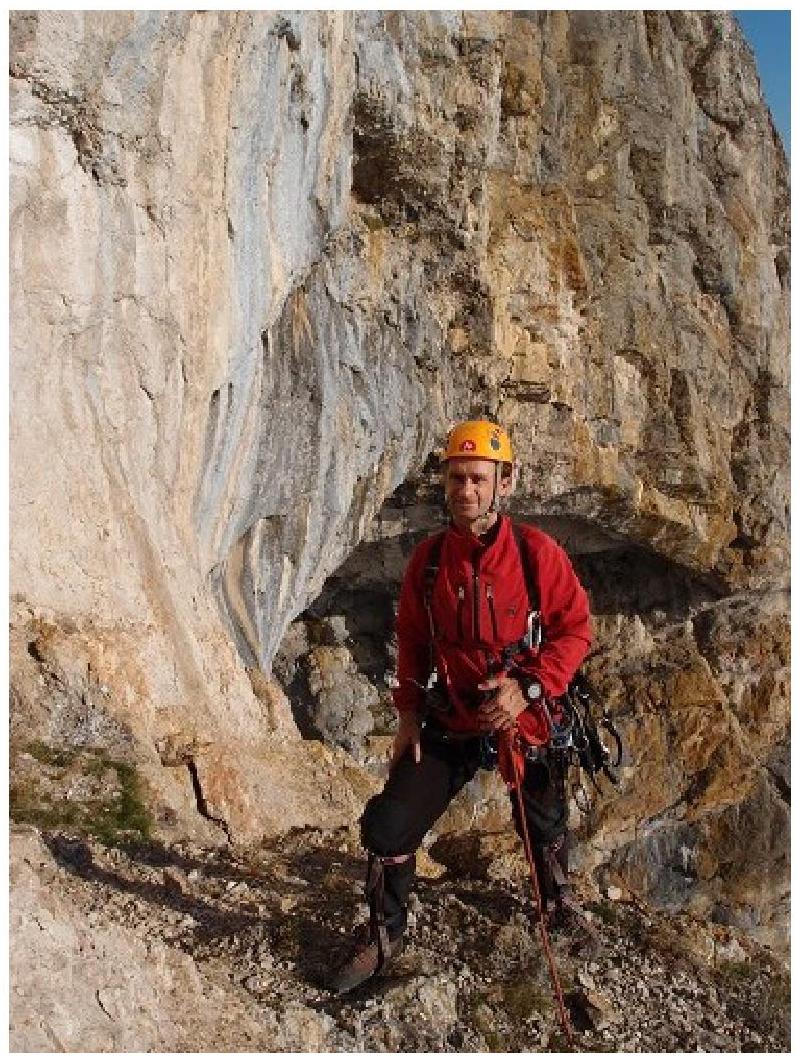
Ai-Petri East, new route "New Moon",
5B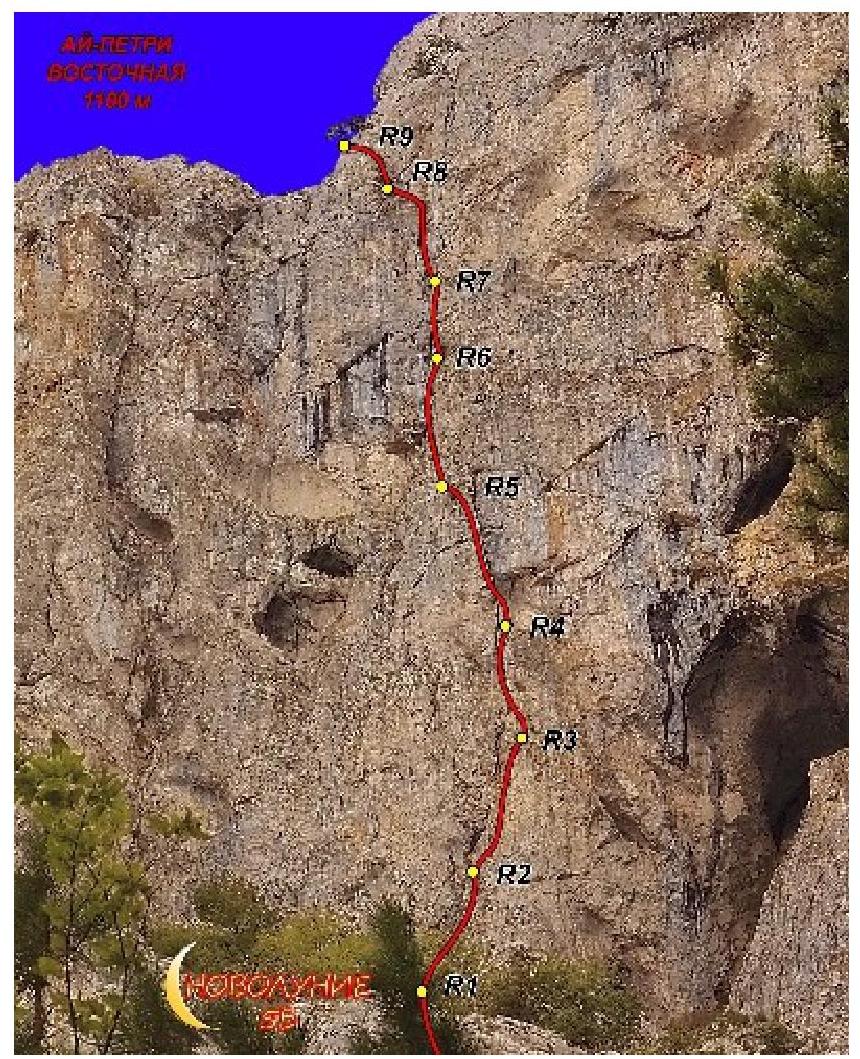
Ai-Petri East, route "New Moon", 5B
Route characteristics
- Total route length: 460 m.
- Length of sections with 5–6 category of difficulty: 228 m.
- Number of bolts installed: 8 (4 of them on stations).
- Drill holes: none
- Equipment left behind: none
Route description
Note: Some transitions within sections are significantly easier, but in most cases, movement from a station starts with a "ladder". Exceptions are for those who can belay from climbing at 6c+ and above.
R0–R1: 150 m, from n/k to II, 50°;
The route starts in the right part of the couloir, going up to the right — onto a sloping terrace. Above, in the middle of the wall, the lower triangular Miskhor grotto is visible. Move up to the left — onto the next grassy ledge. Exit under the upper bastion via sloping rocky-grassy ledges, alternating with small walls. Station — near a large tree. To the left of the grotto.
R1–R2: 32 m, V+, A1, 75
From the station on the tree, climb up simple rocks, slightly to the right of the tree, growing 10 m above the ground, to an overhanging slab. Through it and further along the destroyed slope in the direction of the niche. Station to the right of the niche, made on personal equipment. Further direction is up to the right.
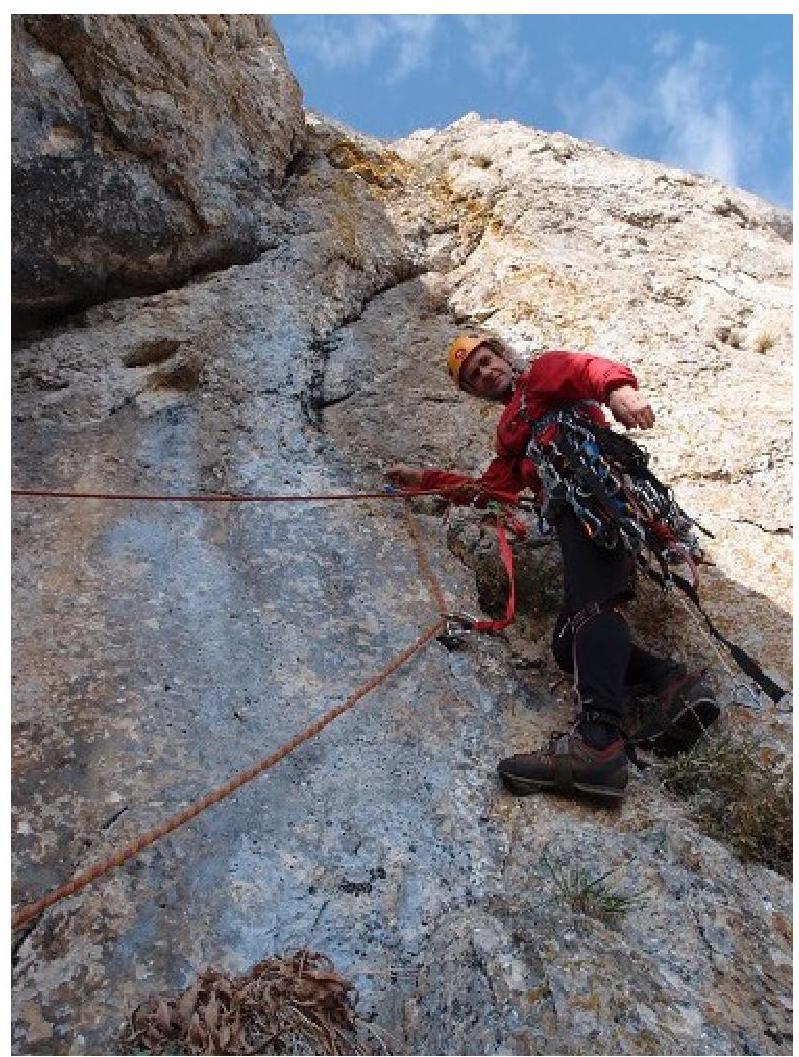
R2–R3: 25 m, V+, A1, 85
From the station, complex climbing on the slab with subsequent movement to the right with easily organized belay towards the pine tree. From it, climb up to a ledge under a vertical slab. Station on 2 bolts.
R3–R4: 26 m, VI*, A1–A2, 95° (in the middle); From the station, move up to the left (bolt). After the bolt, use artificial aids on the monolithic slab (anchors, relief skyhooks) to move in the direction of an overhanging crack (everything is cleaned). Station on a grassy ledge. To the right, you can see the ceiling of the lower grotto. Impressive!
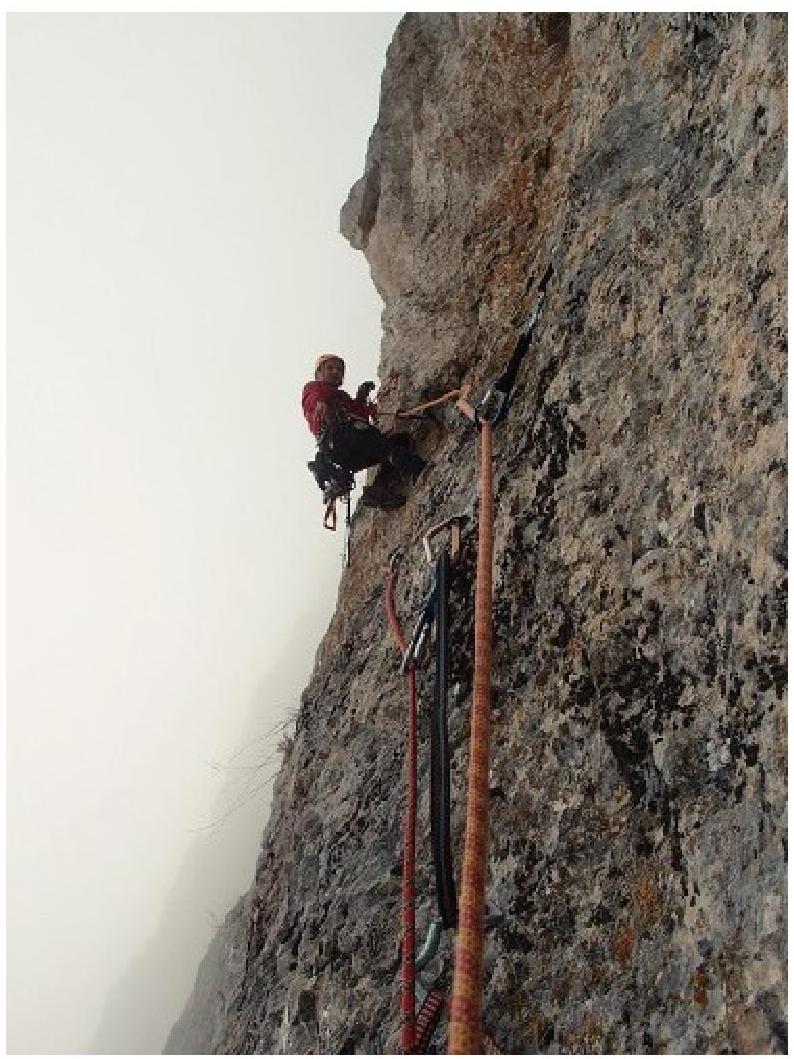
R4–R5: 32 m, VI, A1, e–1 pc, 100° (at the beginning); From the station, climb up under the overhanging inner corner for 12 meters to a bolt. Then up to the left along the wall in the direction of the fold. Further along the sloping inclined slab to a ledge. Station is personal.
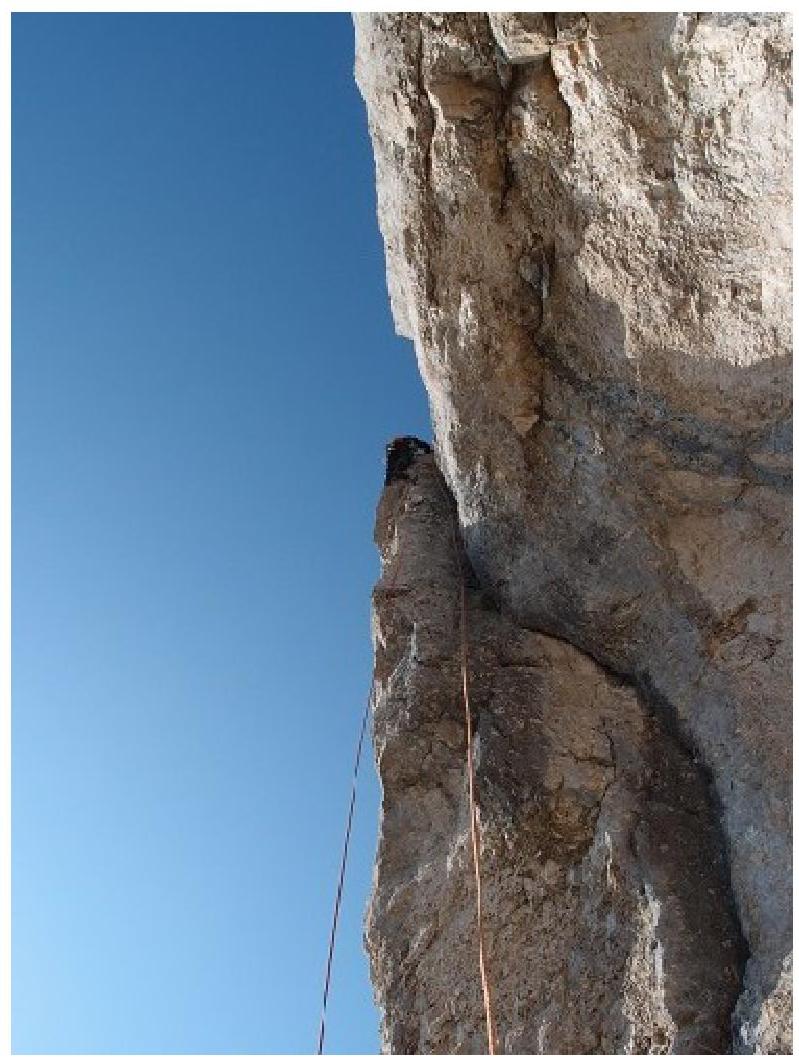
R5–R6: 38 m, VI+, A1–A2, e–1 pc, 100° (in the middle);
From the station, climb up vertical slabs — to the left under an overhanging chimney. Then to the right — up along a subtle small inner corner. Through an overhanging crack to a bolt on the station.
Belay:
- anchors
- stoppers
- large camalots
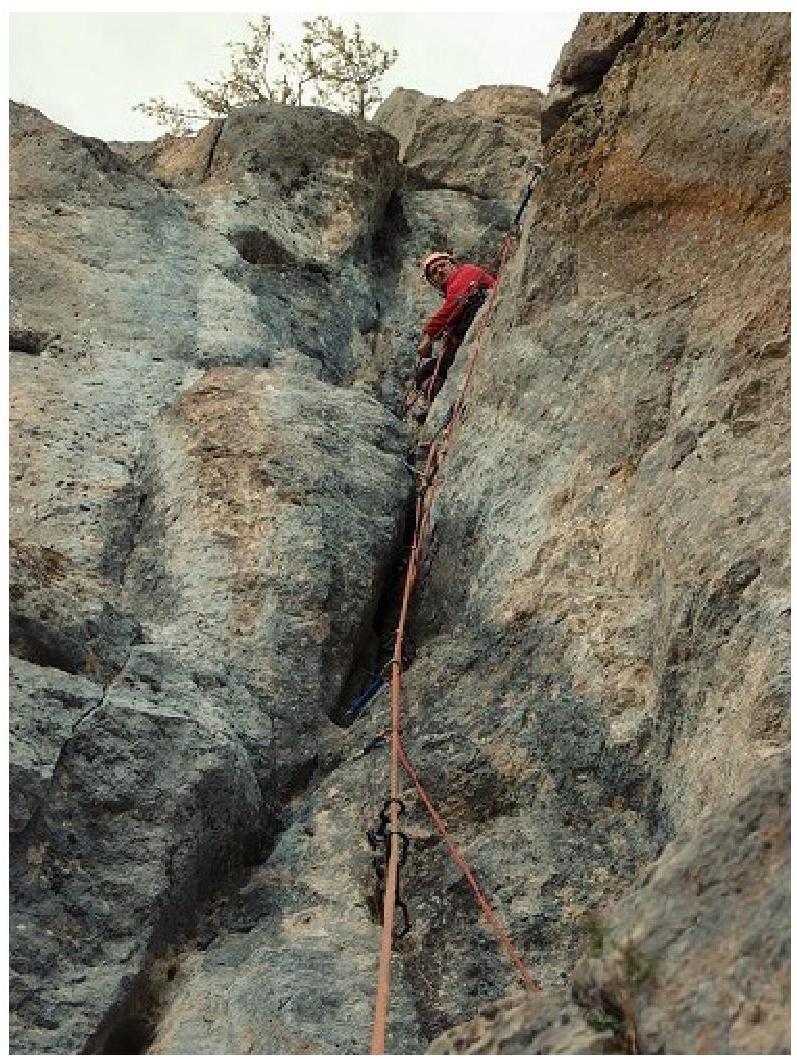
R6–R7: 25 m, VI+, A2, 95° (at the beginning); From R6, move up along an inclined crack under a vertical slab. After an overhanging and then vertical slit — in the direction of a small pine tree (this is some unknown coniferous tree). Station — not reaching the pine tree, on personal equipment. (On the pine tree, it's scary. Not a single needle. And only large red berries. Birds eat them with pleasure. It's visible. We didn't dare.)
R7–R8: 28 m, VI+, A2, 95° e-2 pc; 12 m V, 75°; After the station, climb (or cautious artificial aid) to the pine tree. After the pine tree — to the left up along the slabs in the direction of a destroyed corner. Along an overhanging corner-groove to a large inclined ledge with small holds. Station is personal in a niche under an overhanging slit.
R8–R9: 10 m, V, 105°; 40 m, I; After the station — up along an overhanging crack. Exit onto the top of a large spall. Further in the direction of a large pine tree. Station is higher on the pine tree.
R9–R10: 60 m, n/k and 12 m, IV; From the pine tree, to the left on foot. Look for the nearest exit to the "roof". It's not very straightforward.
(Don't relax. Gear will be needed).
After exiting onto the yayla:
- Station on a large tree.
- Relax.
- Pack up.
- And, contemplating, down.
To the camp, to the sea and wine on the Miskhor trail, which descends to the Yalta–Sevastopol highway: 1.5 hours.
Recommended for the route:
Use a double rope, hammers for both participants, relief skyhooks of medium sizes — will facilitate passage, hooks:
- vertical,
- horizontal,
- anchor,
- U-shaped; stoppers of different sizes, camalots up to 4th size inclusive (but can be обойтись). Possibly use extension cords for hooks. Drill skyhooks were not used.
Stations are either entirely personal or on bolts 45 and 30 mm long, 10 mm diameter. It's more convenient to supplement with:
- anchors
- hooks
Recommendations for climbers: A good original fifth category route with many "sixth" category sections, requiring participants to perform a large amount of mountaineering work. Fully corresponds to the "spirit of adventure" on all segments (from the approach to the review of Miskhor grottos). Recommended for well-prepared teams who can use the entire arsenal of mountaineering equipment. Desirable to climb during long daylight hours.
Have a successful (accident-free) adventure, climbers! Sergey Pugachev, http://www.vertimir.com.ua/
Comments
Sign in to leave a comment