
Report
On the ascent of the Takhtarvumchorr ridge, via the center of the Belts Wall. Estimated category of difficulty — 5B.
For classification. (First ascent: Andreev A.B., 2004)
Khibiny mountain range, Takhtarvumchorr ridge, Classification table section number: 8.6.
Team coaches:
- Kurdiy A.A.
- Pochivalov S.S. Team leader: Druzhkin A.S.
I. Ascent Passport
1. General Information
| 1.1 | Full name, sports rank of the team leader | Druzhkin Andrey Sergeevich, 1st sports rank |
|---|---|---|
| 1.2 | Full name, sports rank of the participants | Struin Vasiliy Sergeevich, 1st sports rank |
| 1.3 | Full name of the coach | Kurdiy Alla Andreevna, CMS; Pochivalov Sergey Sergeevich, CMS |
| 1.4 | Organization | Irbis Alpine and Rock Climbing Club, Murmansk |
2. Characteristics of the Ascent Object
| 2.1 | Region | Kola Peninsula, Khibiny mountain range |
|---|---|---|
| 2.2 | Valley | Takhtarvumchorr ridge |
| 2.3 | Classification table section number | 8.6 |
| 2.4 | Name and height of the peak | Takhtarvumchorr ridge, 1143 m |
| 2.5 | Geographical coordinates of the peak (latitude/longitude), GPS coordinates | Latitude: 67°68′34.189″; Longitude: 33°52′85.568″ |
3. Characteristics of the Route
| 3.1 | Route name | Via the center of the Belts Wall |
|---|---|---|
| 3.2 | Estimated category of difficulty | Winter: 5B; Summer: 5B |
| 3.3 | Degree of route development | Route not developed. The team made the third ascent. |
| 3.4 | Relief characteristics of the route | Winter: combined; Summer: rock |
| 3.5 | Height difference of the route (altimeter or GPS data) | 350 m |
| 3.6 | Route length (in meters) | 400 m |
| 3.7 | Technical elements of the route (total length of sections of different categories of difficulty with indication of relief type) | V category of difficulty — 120 m, VI category of difficulty — 160 m |
| 3.8 | Average steepness of the route | 88.5° |
| :--: | :--: | :--: |
| 3.9 | Average steepness of the main part | 83° |
| 3.10 | Descent from the summit | 1. Via the northern spur of the Takhtarvumchorr ridge (no mountaineering equipment required) 2. Through the Geografov Pass (no mountaineering equipment required for descent via options 1 and 2) 3. Through the Akvalang Pass. 4. Via the ascent route. (Mountaineering equipment required for descent via options 3 and 4) |
| 3.11 | Additional route characteristics | Compared to similar routes in the Khibiny Mountains, this route is the most challenging. Compared to a similar route by Murin E., category 5A, in the Belts cirque, the team's route is more complex and has fewer opportunities for free climbing on rock sections, except for the third belt. The route is significantly more complex and technically demanding than the "Lestnitsa" and "Stena otkola" routes. In winter, the route may be complicated by ice forming on the rock, hiding the micro-relief, and a large snow cornice on the plateau (from December to May). In summer, precipitation can fall from overhanging cornices even in clear weather. The route has 2 control cairns, including the summit one. |
4. Tactical Actions of the Team
| 4.1 | Time of movement (team's walking hours, in days) | 19 hours 2 minutes, 2 days |
|---|---|---|
| 4.2 | Route preparation time | No preparation |
| :-- | :-- | :-- |
| 4.3 | Departure for the ascent with an overnight stay by the lake in the Vudyavr valley | 8:00, August 21, 2019 |
| 4.4 | Start of the ascent on the route | 10:00, August 21, 2019 |
| 4.5 | Reach the summit | 13:30, August 22, 2019 |
| 4.6 | Completed descent from the summit | 17:00, August 22, 2019 |
5. Technical Actions of the Team
| 5.1 | Hooks left on the route | 1 removable |
|---|---|---|
| 5.2 | Hooks used on the route: | |
| - stationary bolt hammers | 1 | |
| - removable bolt hammers | 1 | |
| - for ITO | More than 80 points | |
| 5.3 | Used protection points: | |
| - rock hooks, including anchors, "fifis" | about 30 | |
| - chocks | about 20 | |
| - camalots | more than 40 |
6. Weather Conditions
| 6.1 | Temperature, °C | 8–10 °C |
|---|---|---|
| 6.2 | Wind speed, m/s | 2–3 m/s |
| 6.3 | Precipitation | none |
| 6.4 | Visibility, m | Good |
7. Person Responsible for the Report
| 7.1 | Full name, e-mail | Druzhkin A.S., dalar08@mail.ru |
|---|
II. Description of the Ascent Area
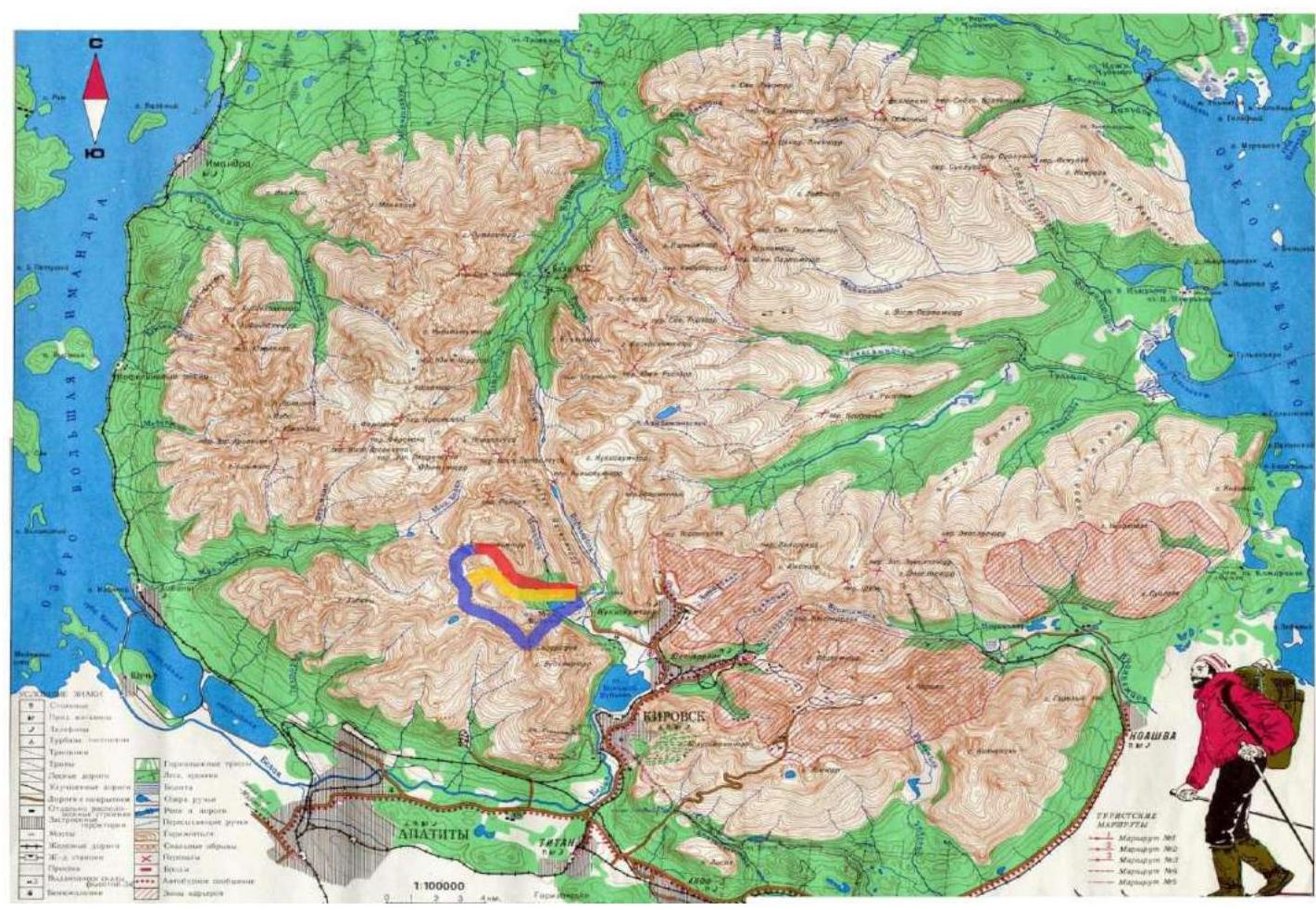
Fig. 1. Map of the area. Scale 1:100 000. The first approach option is shown in red (part of the path may be passable by a high-clearance vehicle). The descent route through the Geografov Pass is shown in blue. The descent option through the Akvalang Pass is shown in yellow.
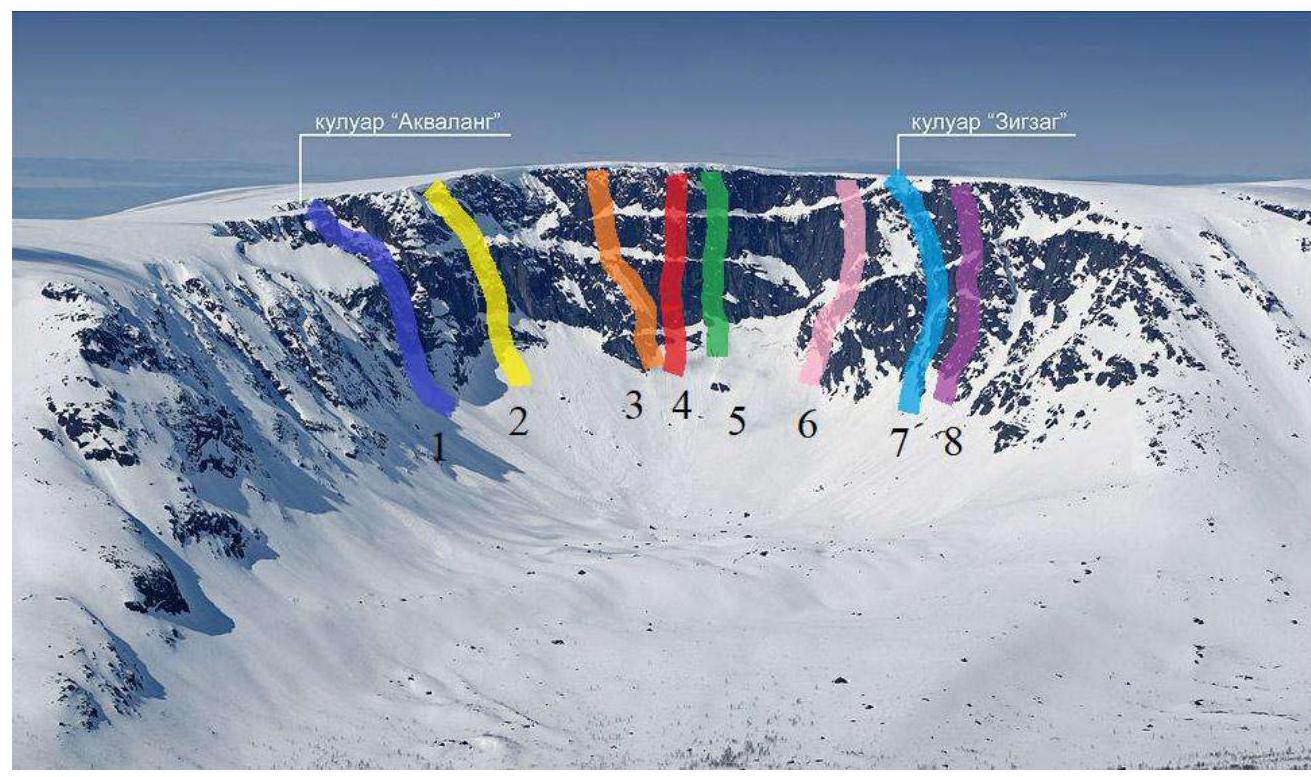
Fig. 2. Panorama of the area with lines of existing routes (winter photo).
- "Golfstrim", 4B, A. Yurkin.
- "Burovoy", 4A (2012), Koksharov I. (exclusively ice route, not always icy. Not submitted for classification)
- Via the left part of the central wall of the belts, Andreev A., 4B (no information on second and subsequent ascents)
- "Via the center of the Belts Wall", 5A, Andreev A.
- "Via the internal corners of the Belts Wall", 5A, Murin E.
- Via the northeastern buttress of the eastern wall of the central cirque, 2B (no information on second and subsequent ascents)
- "Zigzag", 2A.
- "Zubastik", 3A, Pochivalov S.
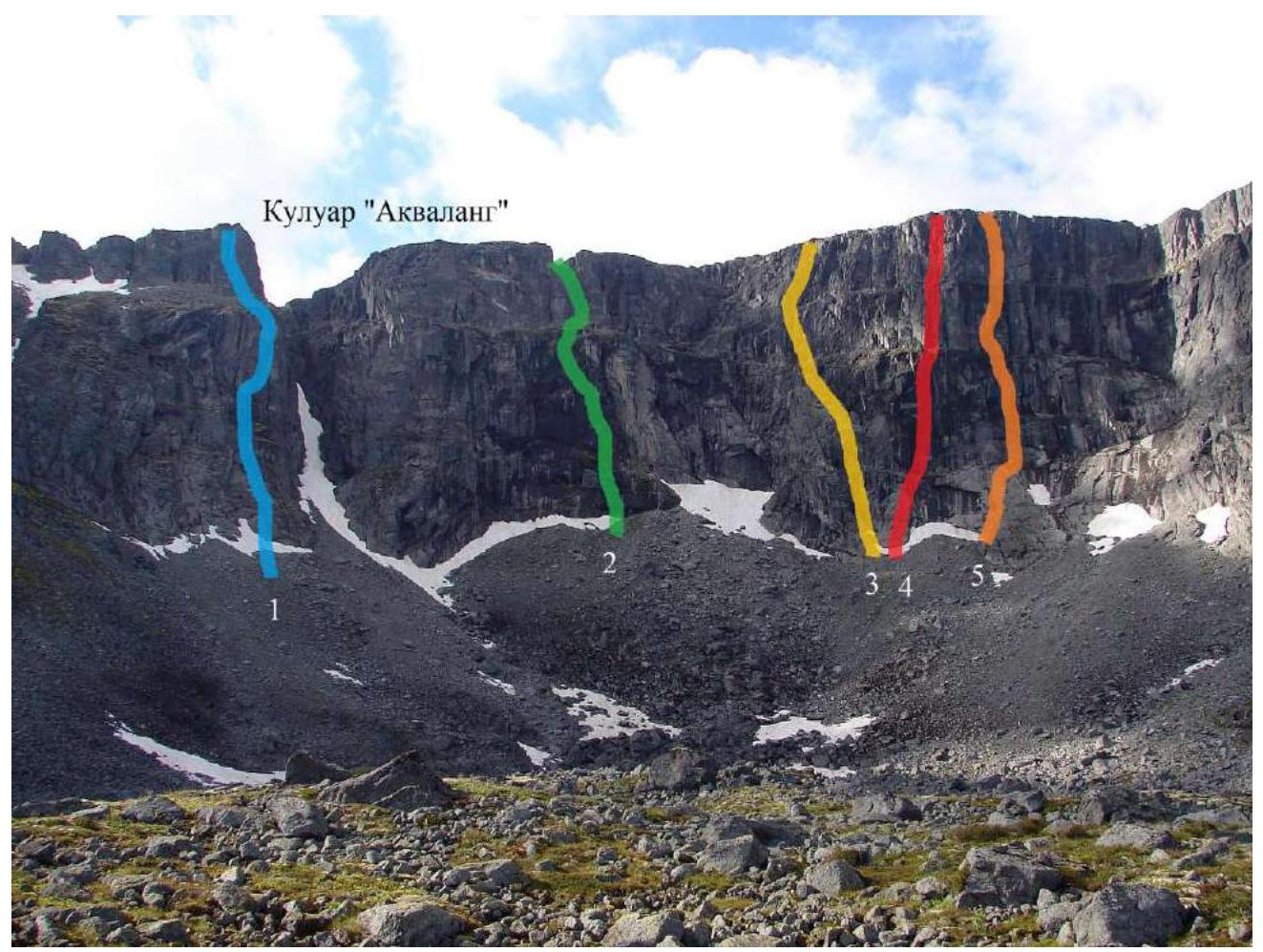
Fig. 2. Panorama of the area with lines of existing routes (summer photo, different angle).
- "Golfstrim", 4B, A. Yurkin.
- "Burovoy", 4A (2012), Koksharov I. (exclusively ice route, not always icy. Not submitted for classification)
- Via the left part of the central wall of the belts, Andreev A., 4B (no information on second and subsequent ascents)
- "Via the center of the Belts Wall", 5A, Andreev A.
- "Via the internal corners of the Belts Wall", 5A, Murin E.
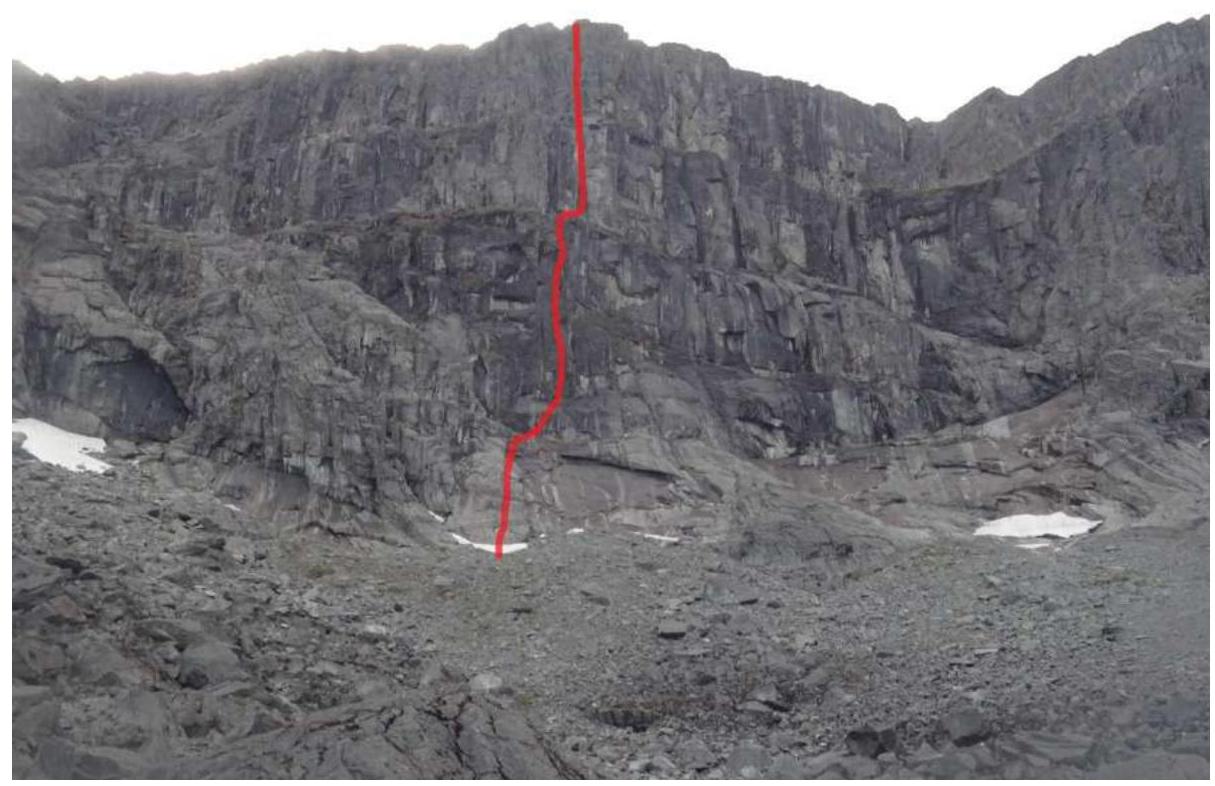
Fig. 3. Panorama of the ascent area with the route line (summer photo, August 21, 2019).
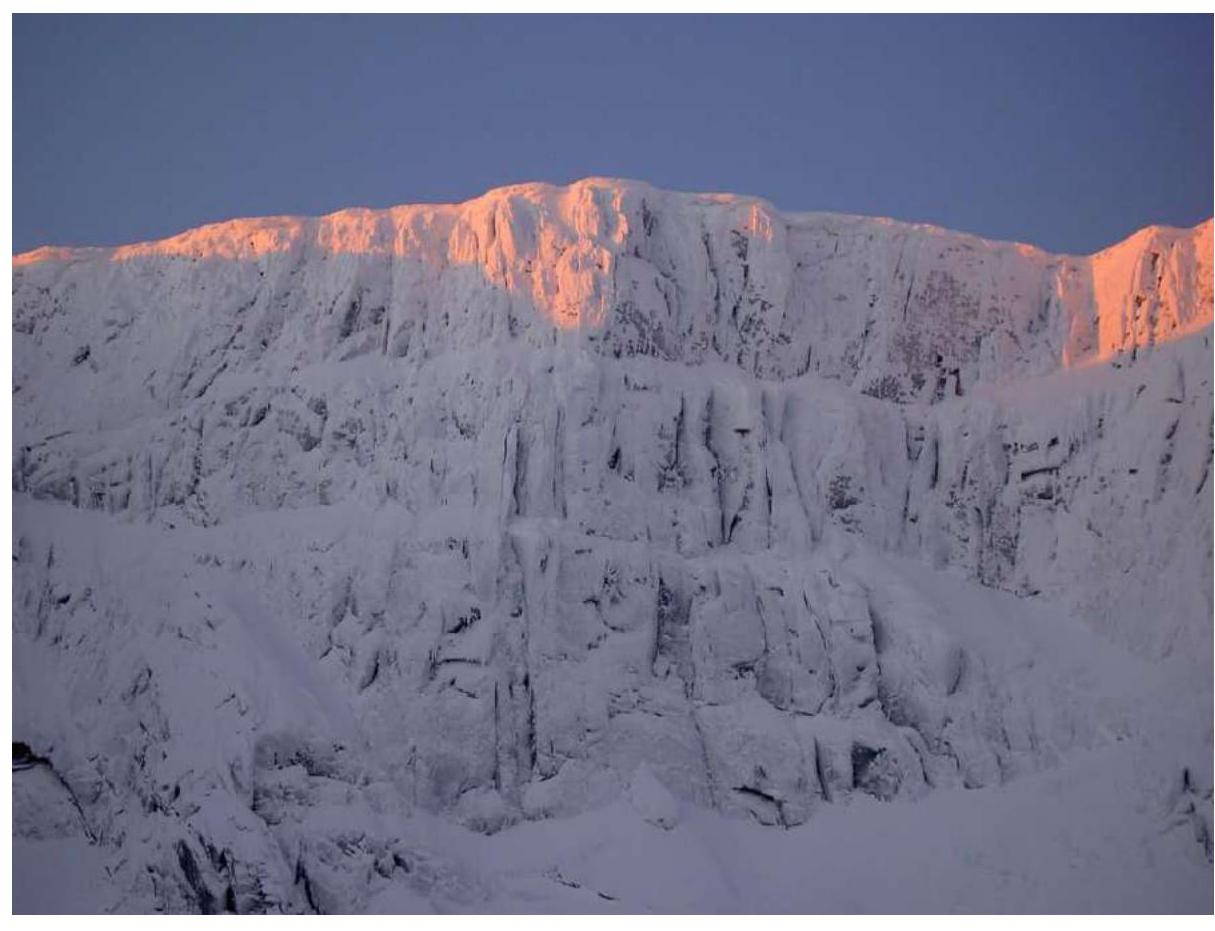
Fig. 4. The Belts Wall in winter.
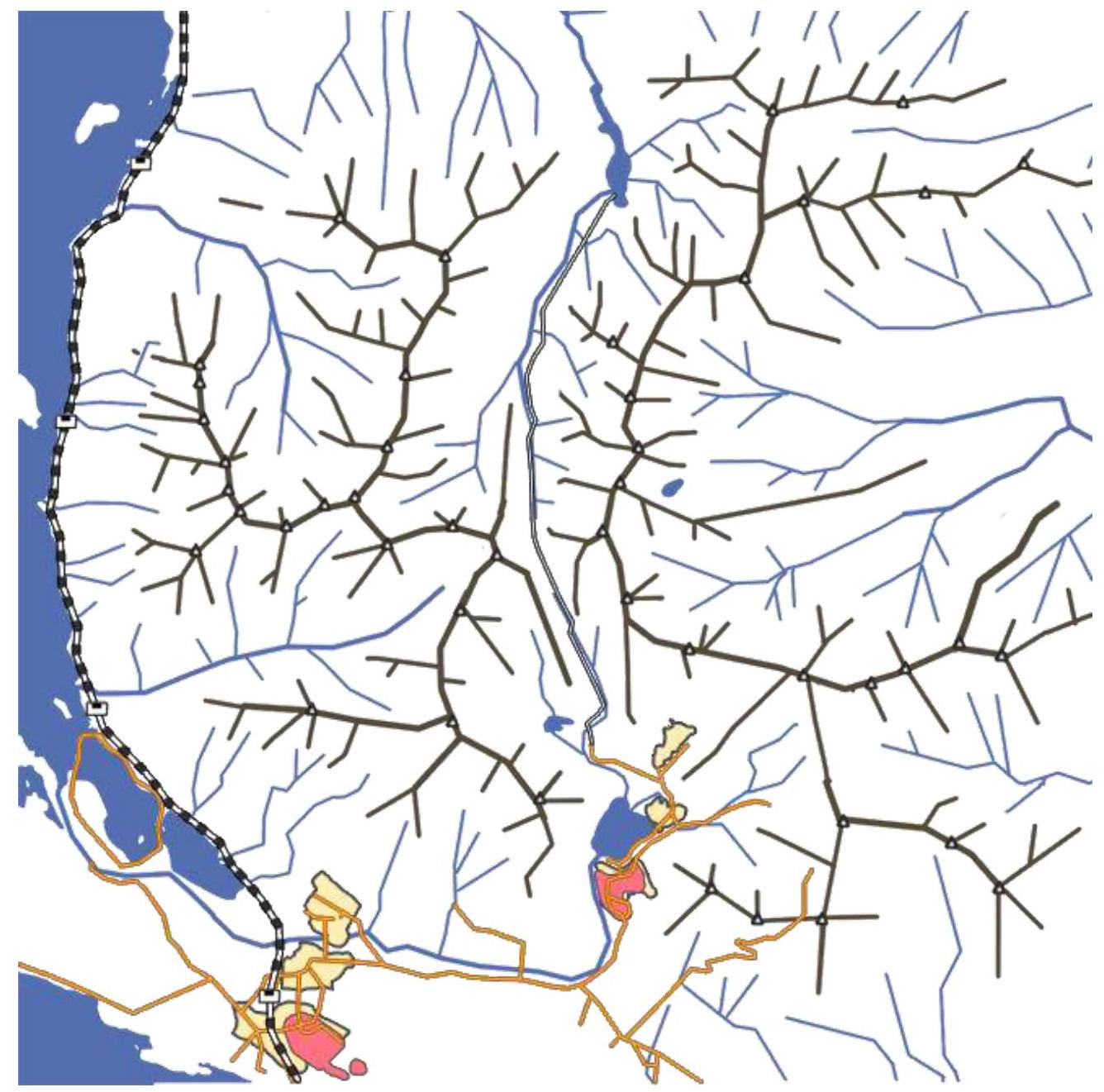
Fig. 5. Orographic scheme of the Khibiny Mountains.
III. Route Description.
By the team, 2019
1. Route Profile
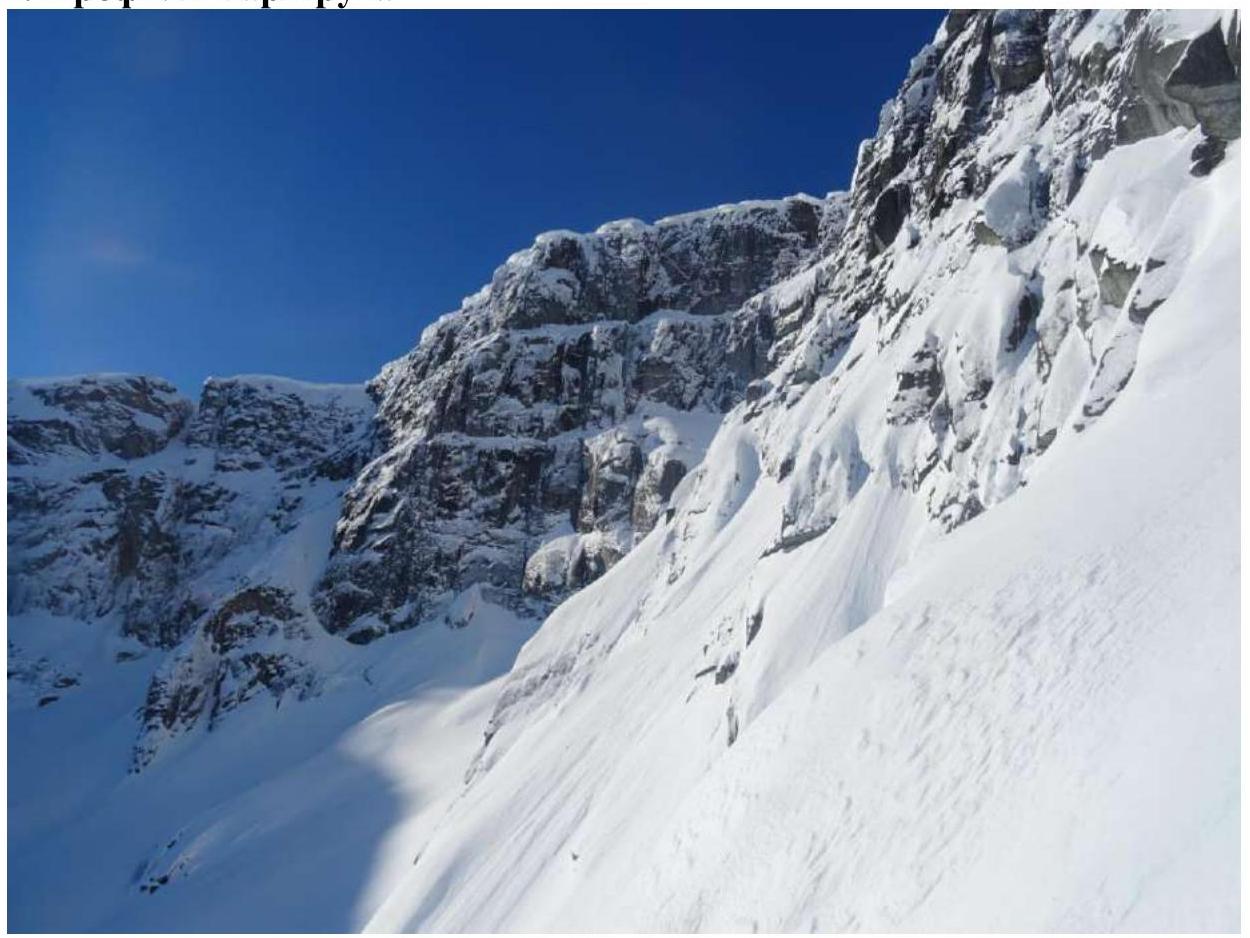
Fig. 6. Route profile and line. Photo taken in February 2018.
2. Technical Photograph of the Route
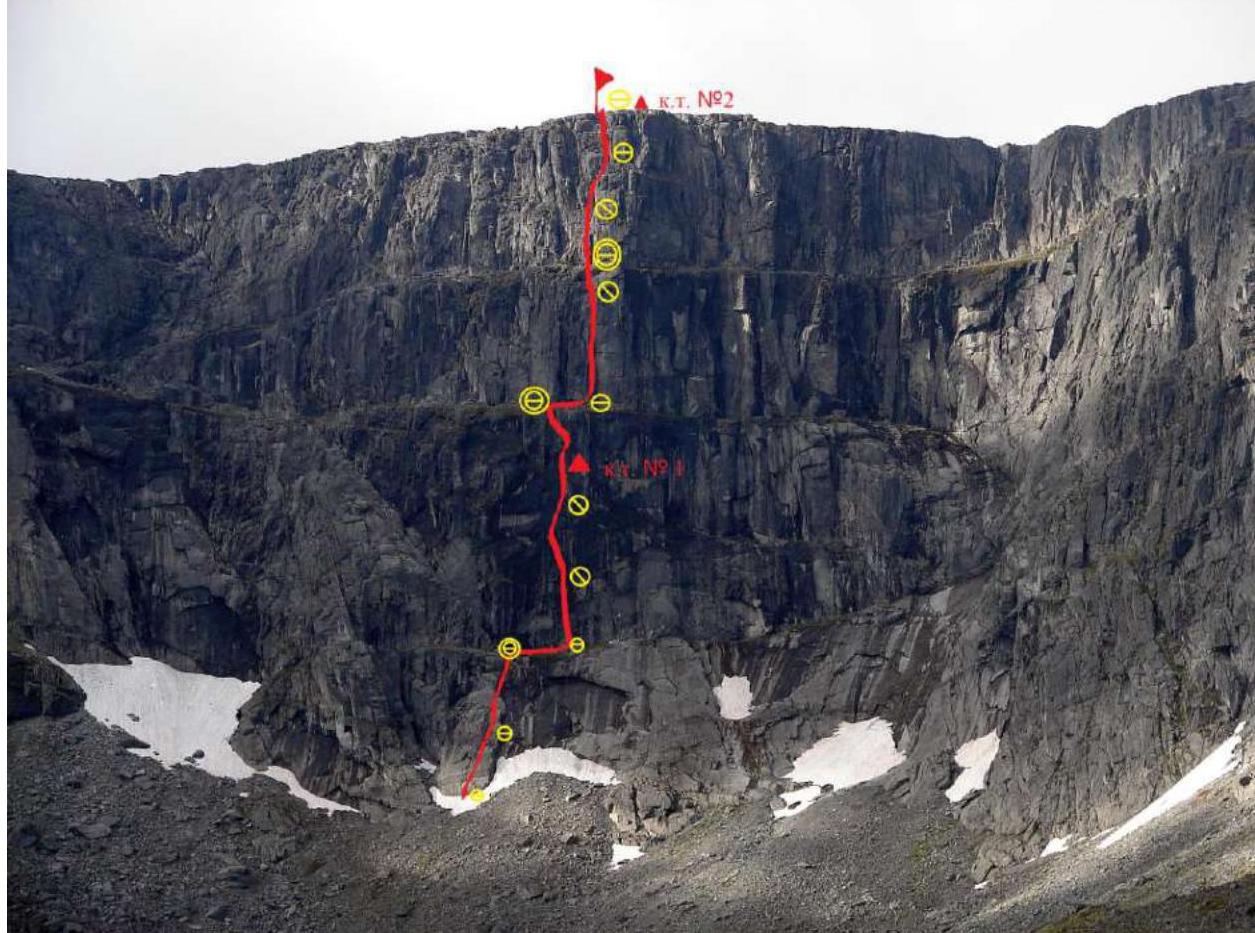
Fig. 7. Technical photo of the route
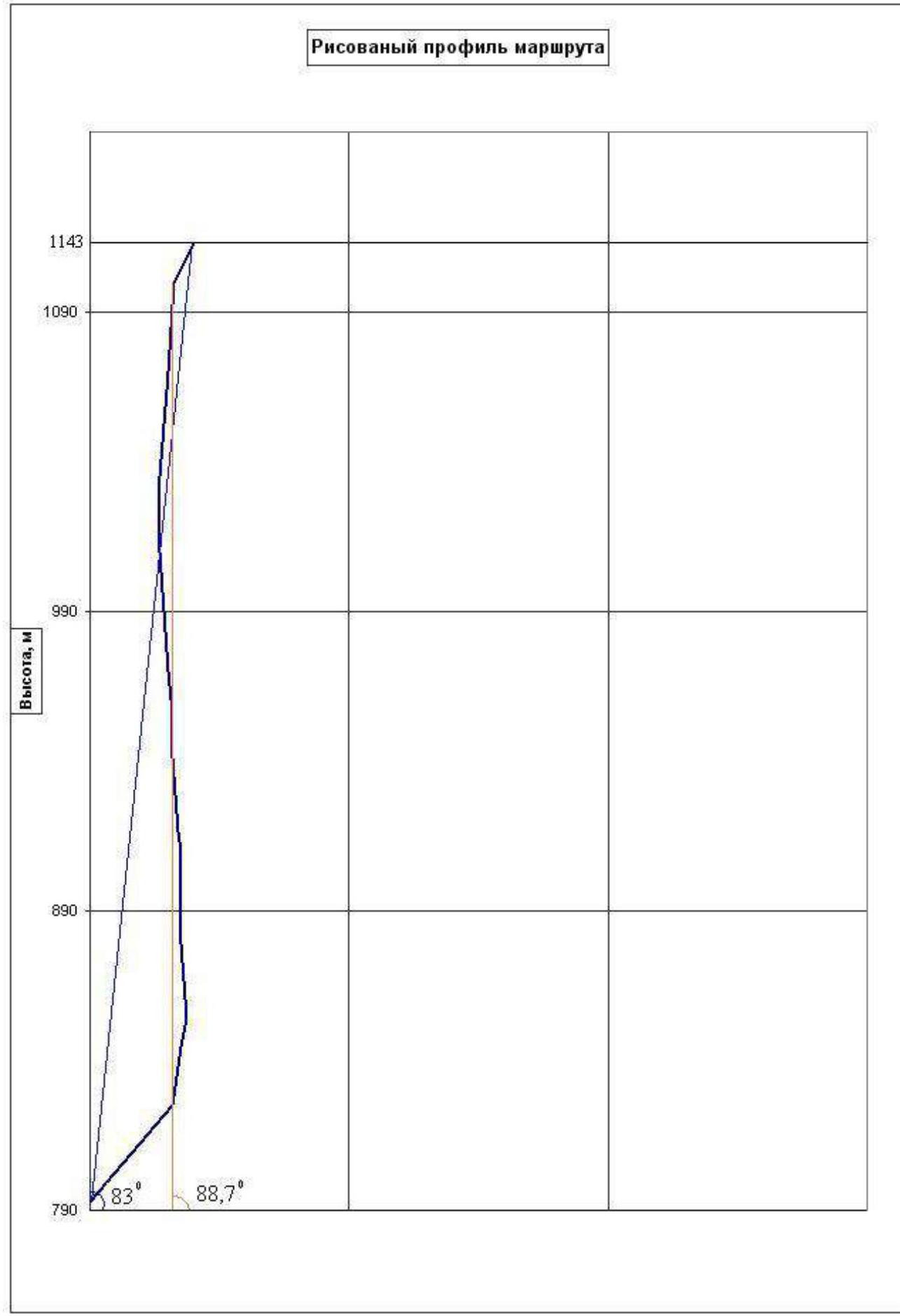
Fig. 8. Drawn profile of the route.
3. Route Diagram in UIAA Symbols
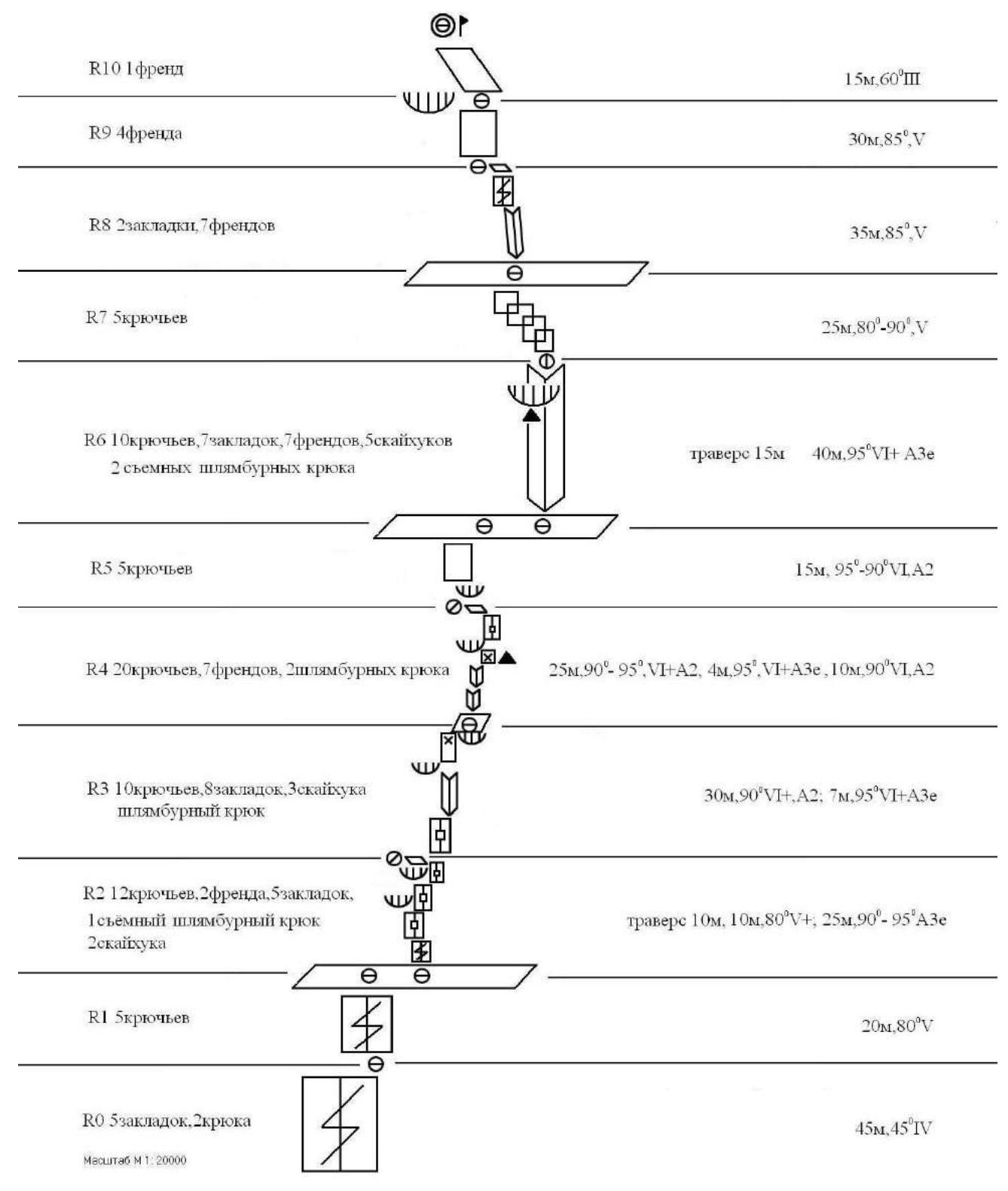
4. Route Description by Sections
The provided UIAA diagram is taken from Andreev A.B.'s description from 2003. It accurately describes the route line. The lengths of the sections correspond to the description. However, due to heavy precipitation, the three existing cornices affected the group's pace, resulting in:
- some sections being intentionally extended by 10 to 15 m,
- this did not affect the logic and beauty of the route line. The description is based on the group's movement and technical photos. The route starts on a snowfield (in summer, the snow is hard and compacted, with ice in some places).
R0–R1: Across a slab, left of a wet cornice, upwards 45 m, 45°, IV category of difficulty. R1–R2: Up a wall with a crack, to the first "belt". 20 m, 80°, V category of difficulty. Station. R2–R3: Traverse right 30 m. R3–R4: Crack (10 m, 80°, V+), followed by a series of walls with deep cracks. 30 m, 90°–95°, VI+ category of difficulty, A3e. Skyhooks. (Slab with a deep crack about 10 m, lacking protection possibilities). Bypass the cornice on the right via an overhanging wall 10 m, 95° (anchors, "fifis"). Uncomfortable station on a micro-ledge. R4–R5: Via internal corners under a large, sharp cornice. 30 m, 90°, VI+ category of difficulty, A2, then via an overhanging wall onto the cornice. Stationary bolt hammer. 7 m, 95°, VI+ category of difficulty, A2e. Skyhooks. Up a slab 10 m, 80°, landmark — internal corner on the right. Station on a small ledge ("Spit"). R5–R6: Via internal corners upwards under a large cornice 25 m, 90°–95°, VI+ category of difficulty, A2. Under the cornice, an overhanging wall 4 m, 95°, VI+ category of difficulty, A3e. Stationary bolt hammer, control cairn #1. Bypass the cornice on the right and exit onto a wall to a sloping ledge. 10 m, 90°, VI+ category of difficulty, A2. Exit onto a more gradual slope 10 m, 75°–80°. Then upwards left through an overhanging wall 5 m, 90°–95°, VI category of difficulty, A2, reach the second "belt". Good station location. (From station R5 to the second "belt", a 60-meter rope was just enough "in tension". This section is better divided into 2 pitches of 30–35 m — to the cornice and after). R6–R7: Traverse right 15 m. II category of difficulty. To a huge internal corner. Under the cornice, control cairn #2 is visible (cairn was missing). R7–R8: Up the internal corner 40 m, 95°, VI+ category of difficulty, A2. After a more gradual section, up a wall 15 m, V category of difficulty. Station. R9–R10: Up a series of walls to the third "belt". 15 m, 80°–90°, V category of difficulty. Good station location on a ledge. R10–R11: Up an internal corner and wall. 35 m, 85°, V category of difficulty. R11–R12: Up a wall with a series of cracks 30 m, 85°, V category of difficulty, A1 — 5 m. R12–R13: Via destroyed rocks, exit to the summit. 15 m, 60°, III category of difficulty.
5. Route Recommendations and Safety Assessment
The route represents a logical, well-defined line tied to internal corners on the wall. The route's angle is about 85°–90°, with poor relief and constantly wet rocks, greatly limiting free climbing. The ITO level A2–A3 requires the use of a full arsenal of modern mountaineering equipment, including relief skyhooks and "fifis".
Orientation on the route is not difficult, tied to natural relief and fully corresponding to the route description.
Organizing protection on the route is sometimes challenging due to the relief featuring deep cracks without micro-relief. All protection stations on the route are located in safe areas.
The first belt, spanning 4 rope lengths, presents the greatest difficulty. The rocks are wet, with deep cracks, moss in crevices, etc.
During the ascent, the weather was cloudy, with rain over the two days, resulting in constant "showering" from the cornices along the first belt. This affected the group's pace (increased section lengths).
Stationary bolt hammers were only encountered under the cornice at R5–R6. Some areas had holes for skyhooks (possibly removable bolt hammers).
At the time of the ascent, the team made the third ascent of the route. The second ascent was made in winter 2005 by Dashkevich S. and Borich M. Source: http://www.alpklubspb.ru/ass/a136.htm↗.
Route ascents:
- Third — the team's ascent
- Second — winter 2005, Dashkevich S. and Borich M.
For a winter ascent, a pair of tools, a snow brush, and crampons for all participants are recommended.
Lead climber's readiness to work on "poor" relief is essential.
In polar day conditions (summer), the route can be ascended by a pair in alpine style.
There is no water on the route.
Descent from the summit without mountaineering equipment.
Emergency exit from the route: via the ascent path.
IV. Technical Photographs from the Route.
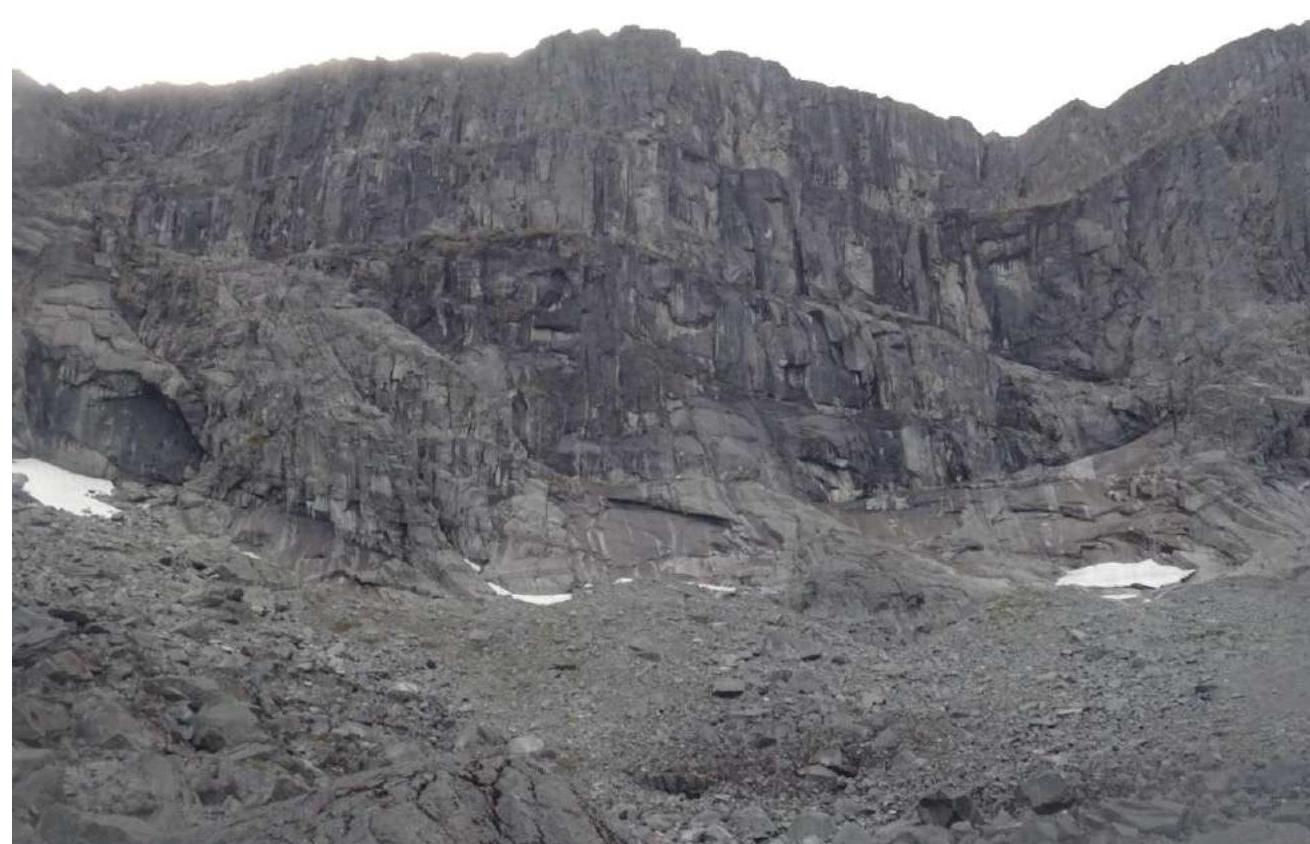
Photo 1. General view of the wall.
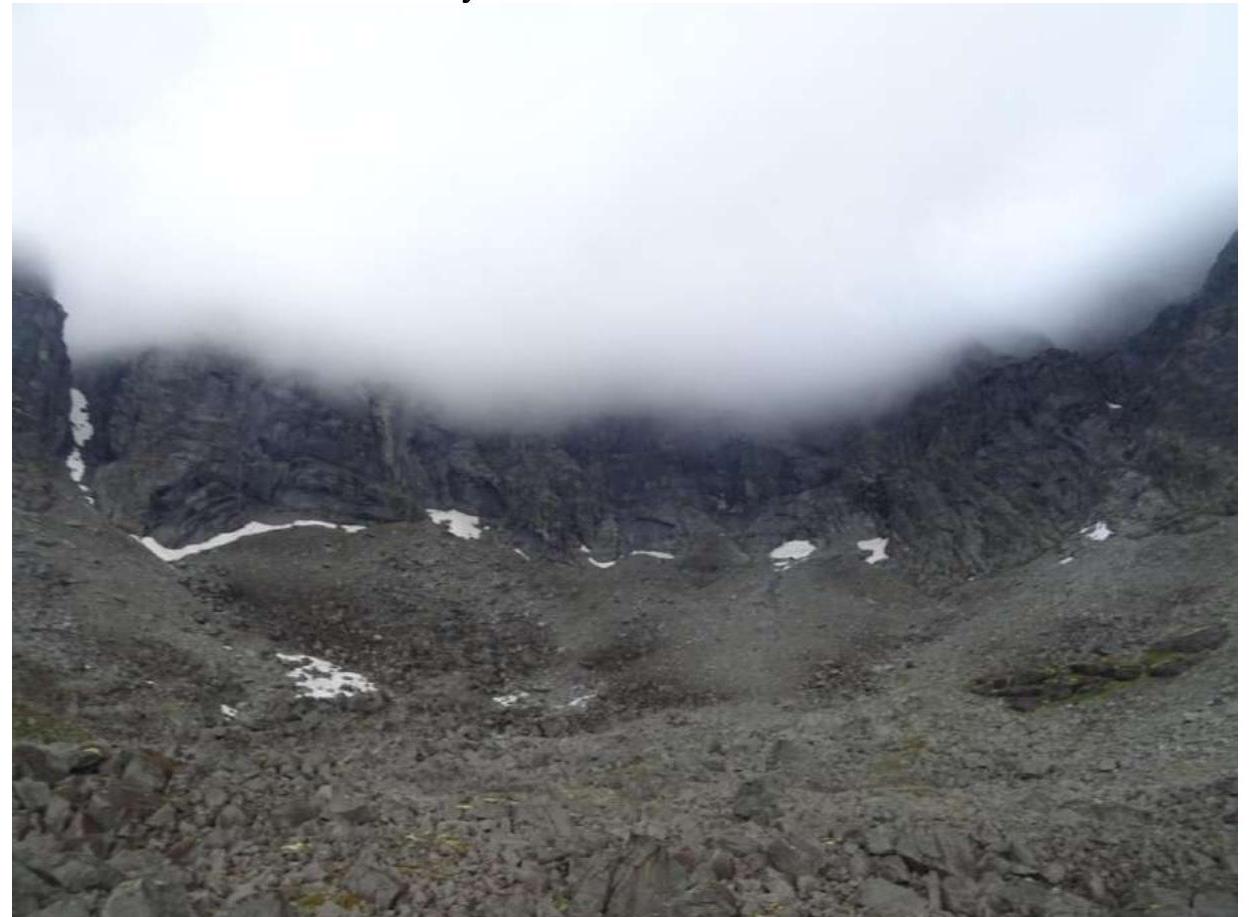
Photo 2. Low cloud cover — a frequent occurrence in the Khibiny.
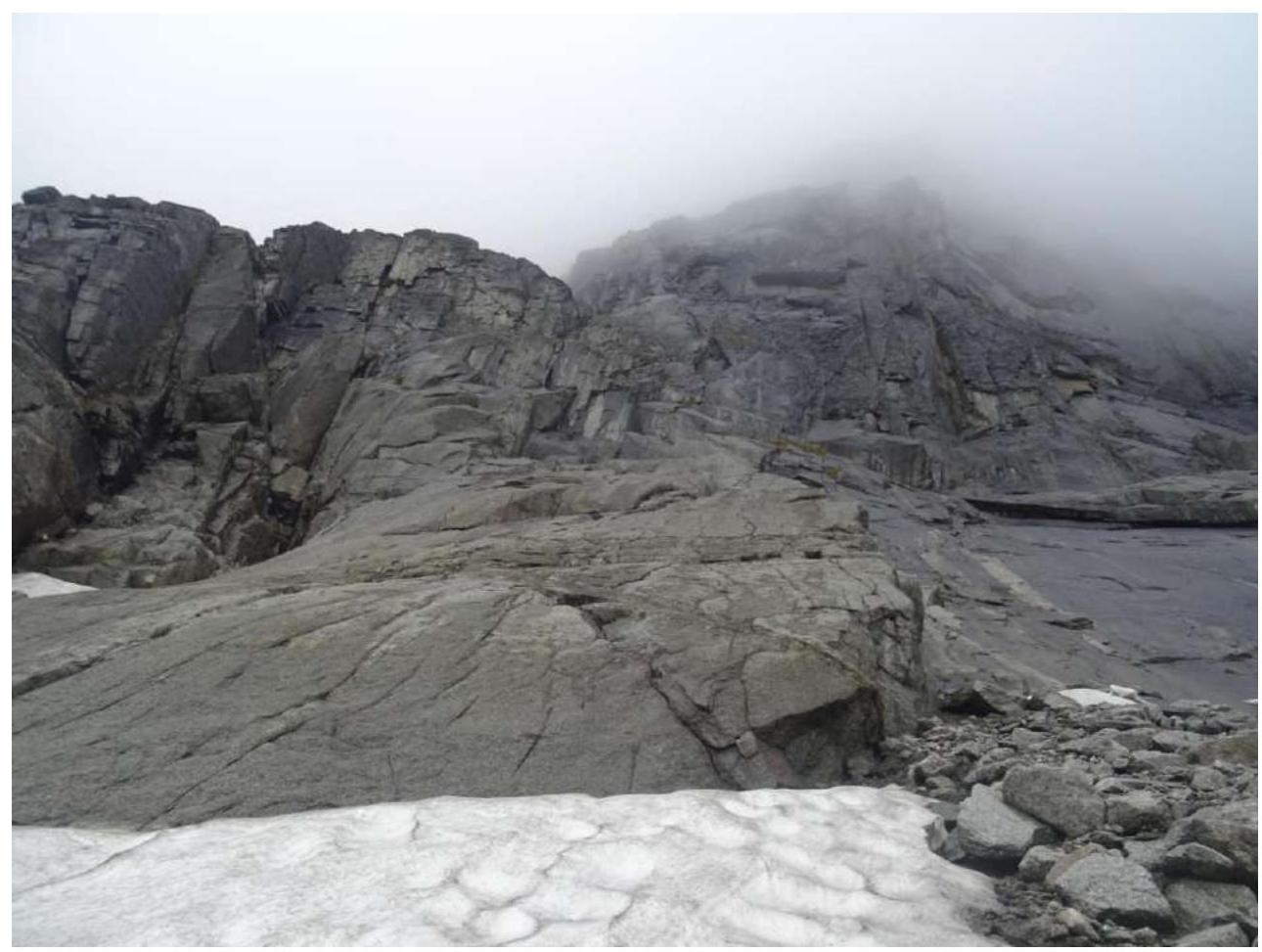
Photo 3. General view of R0–R2.
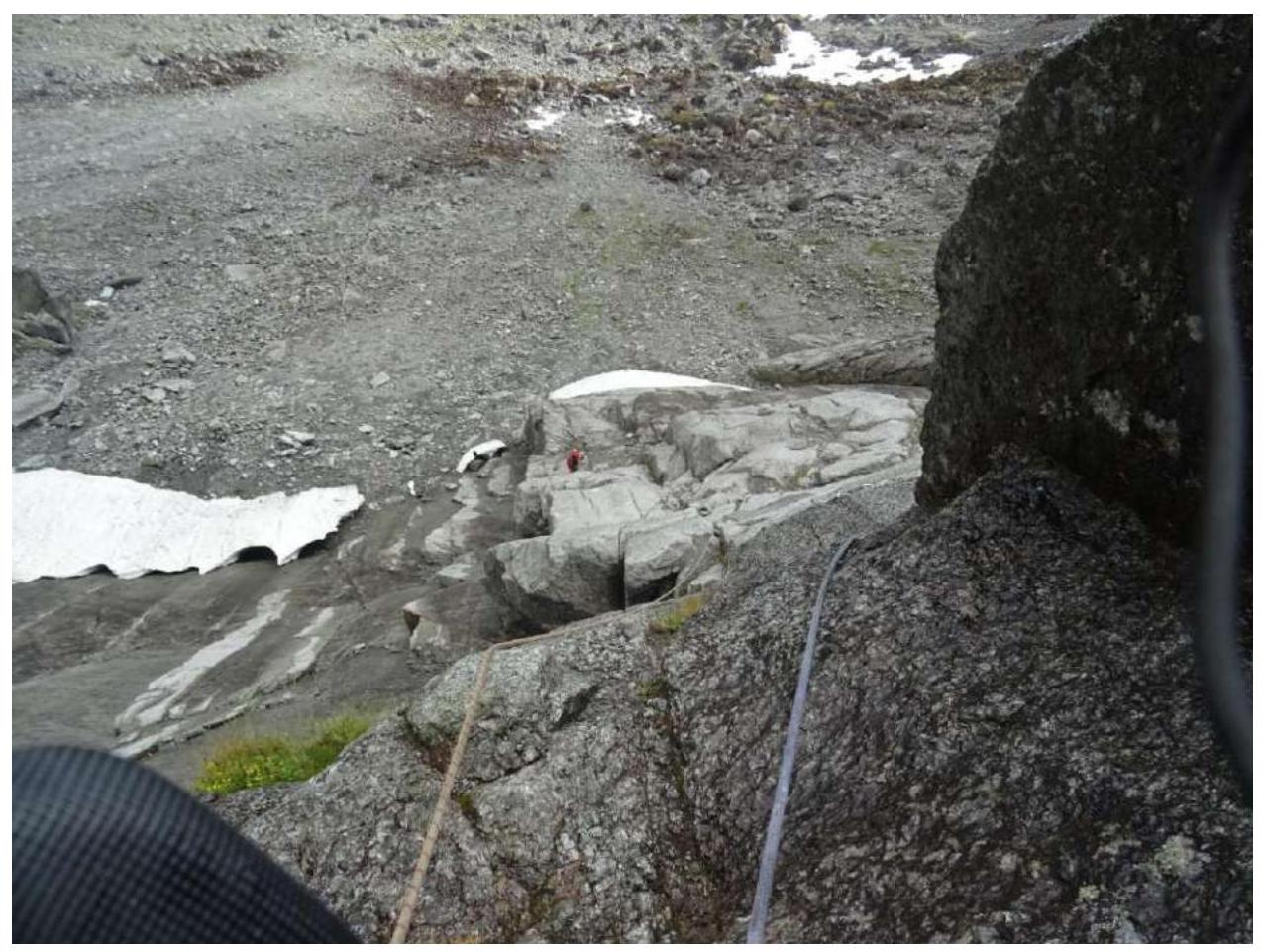
Photo 4. View from R2 before starting the 1st belt.
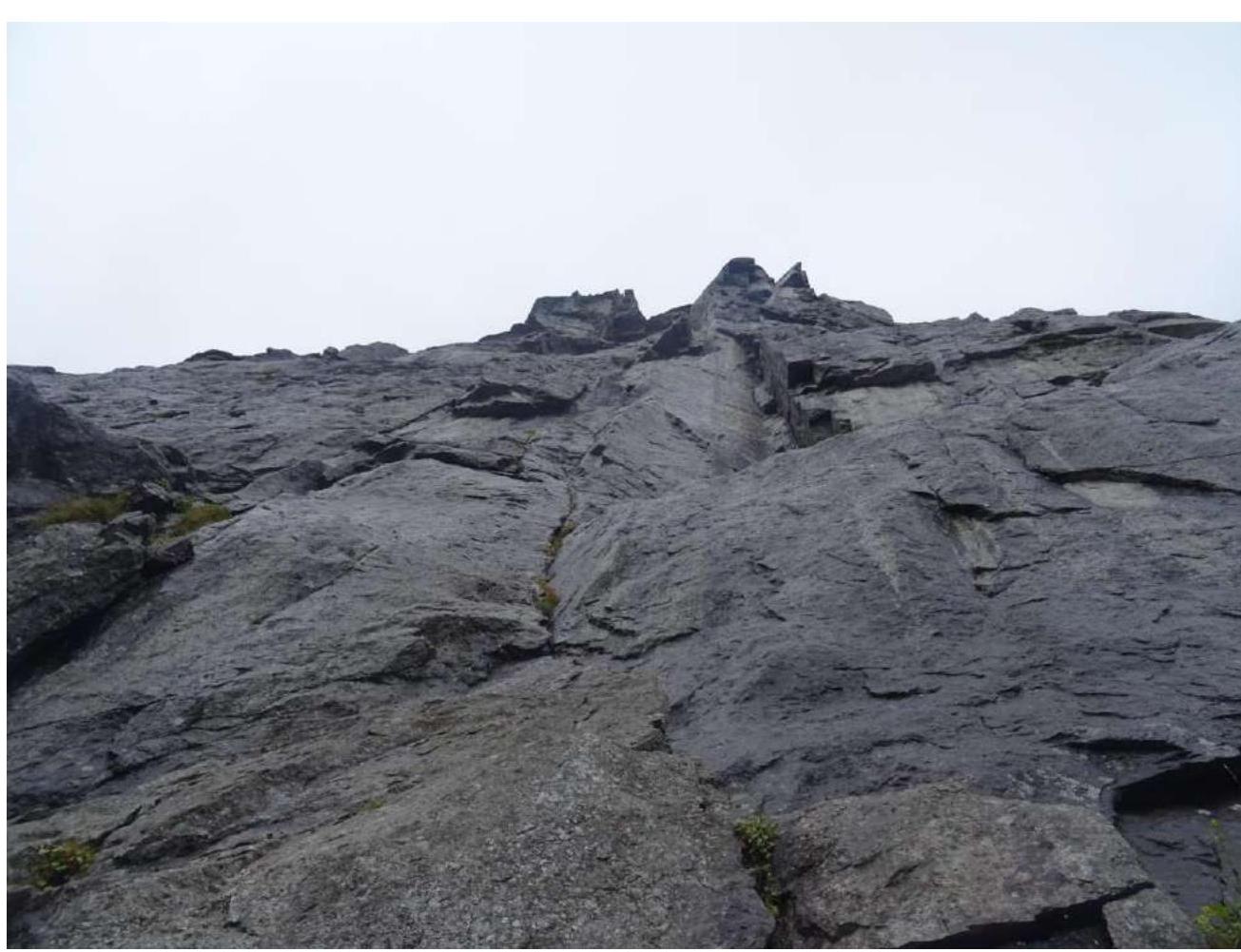
Photo 5. General view of the 1st belt, sections R3–R5.
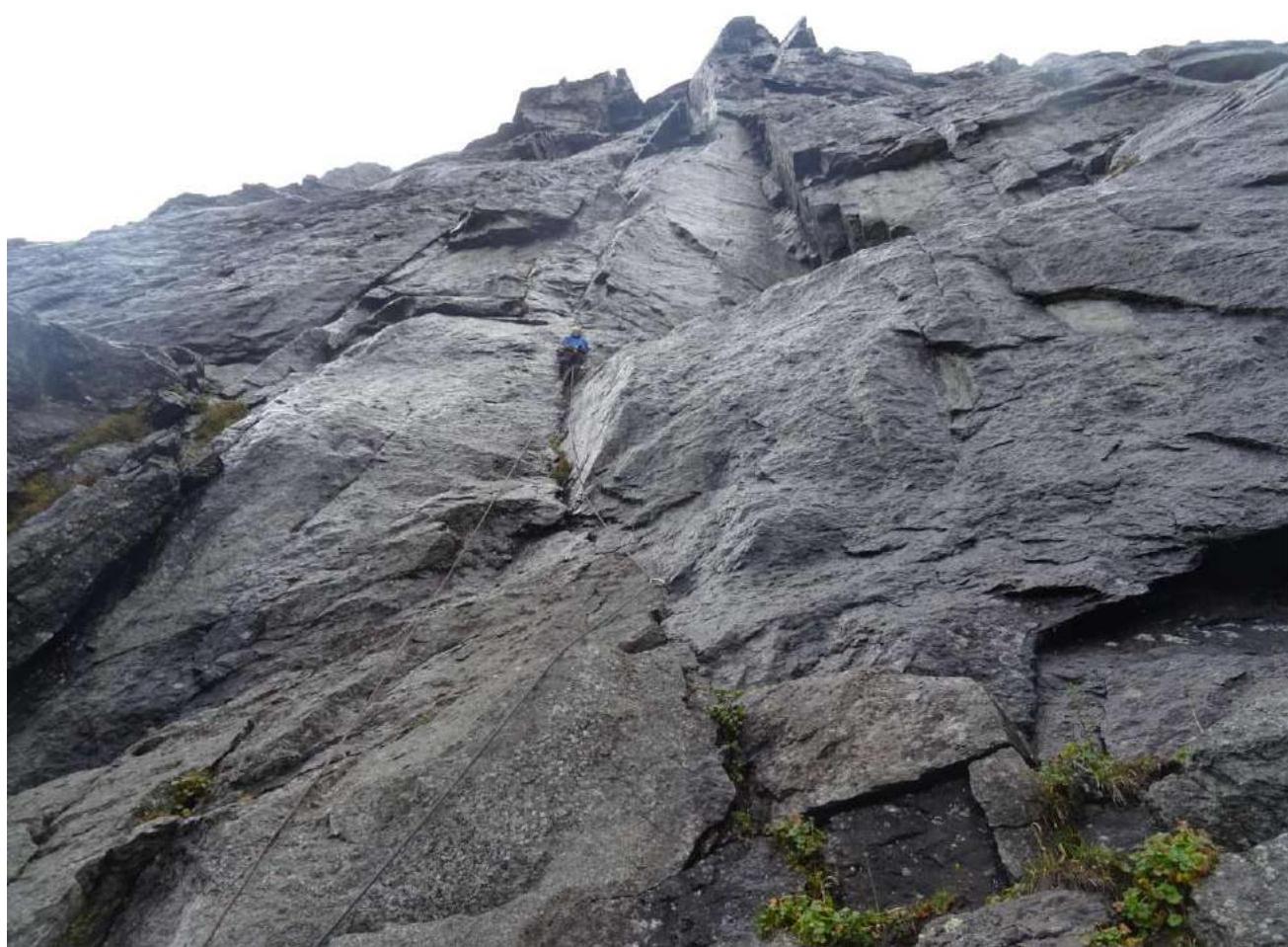
Photo 6. Section R3–R4.
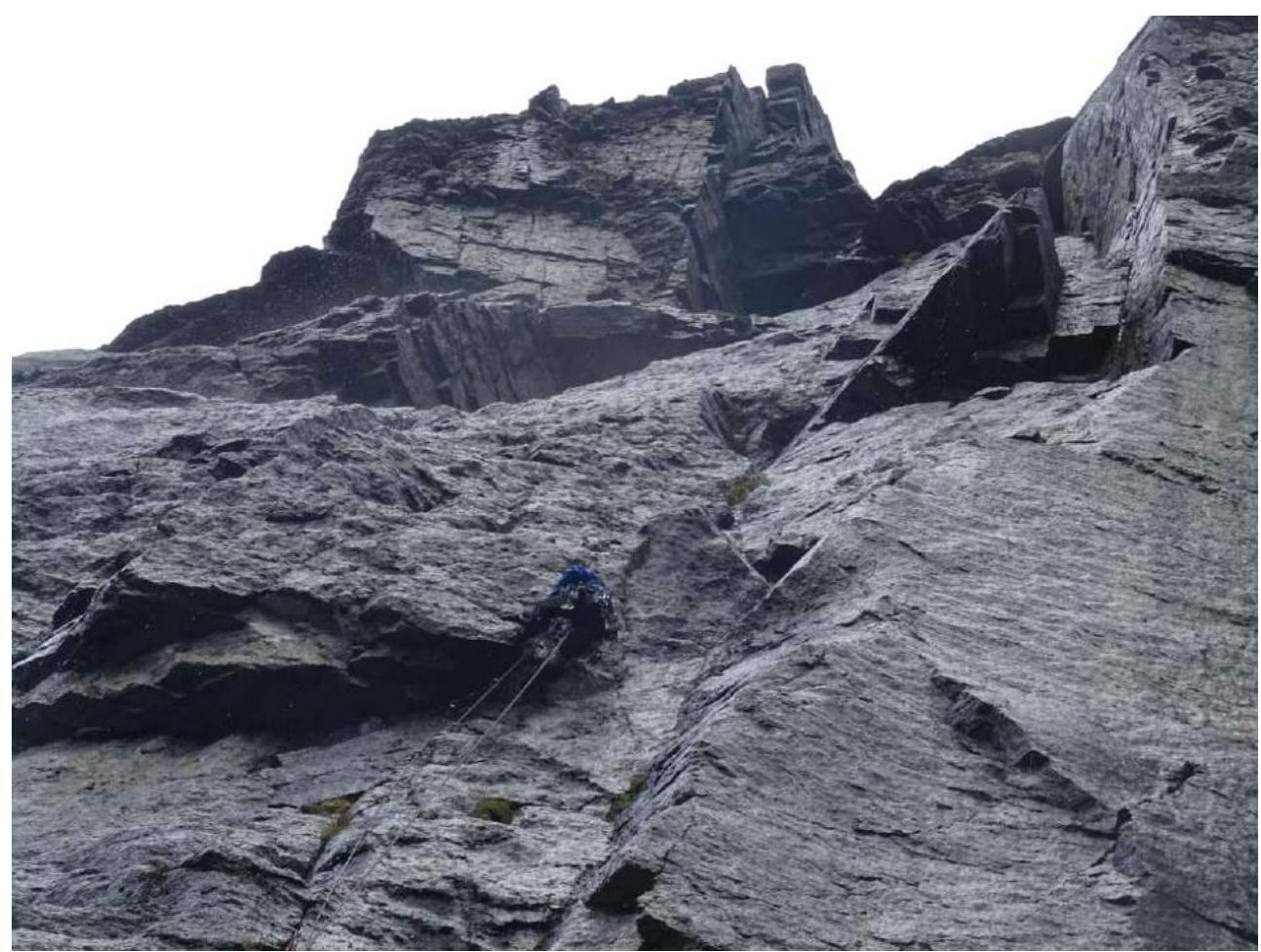
Photo 7. Section R4–R5. Exit to the 1st cornice.
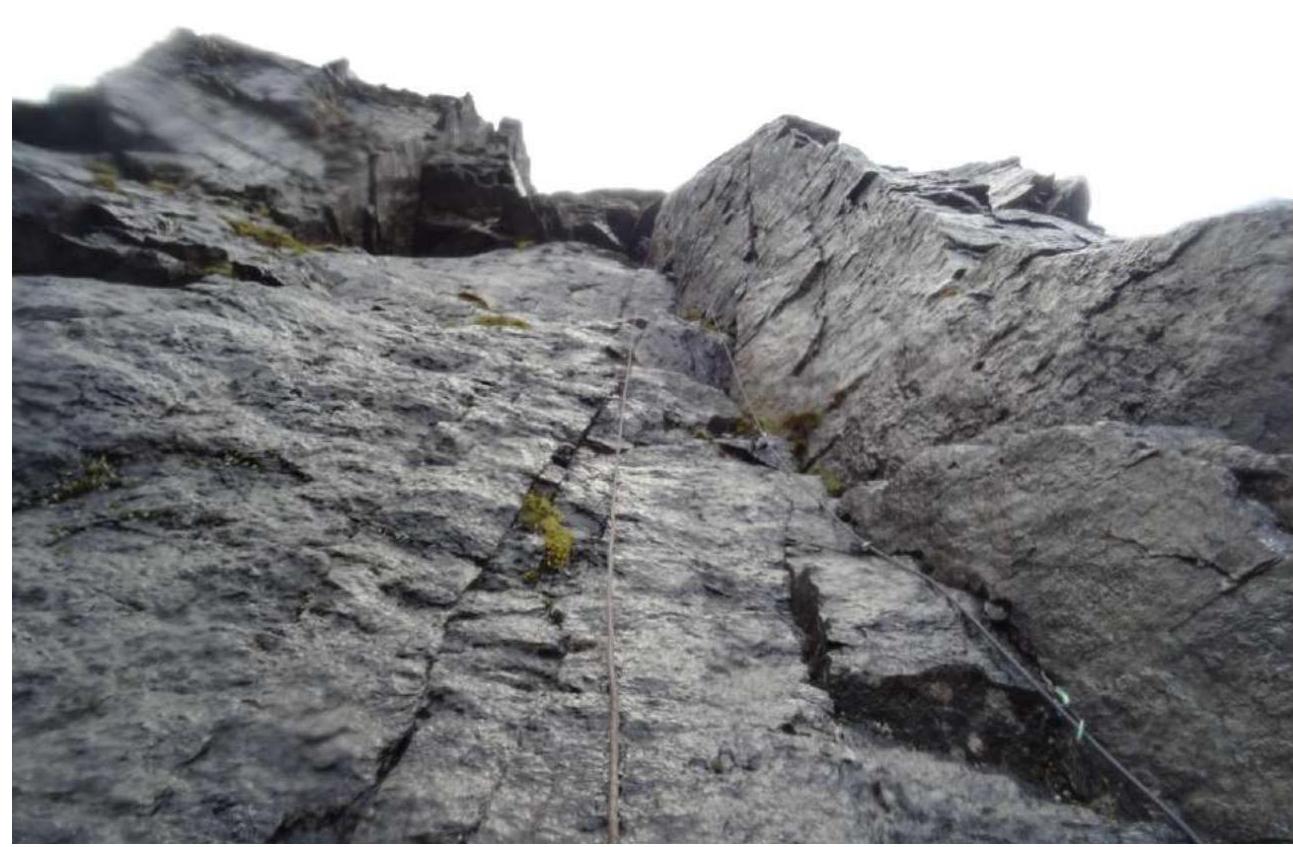
Photo 8. Section R5–R6. Work under the 3rd cornice (Control cairn #1).
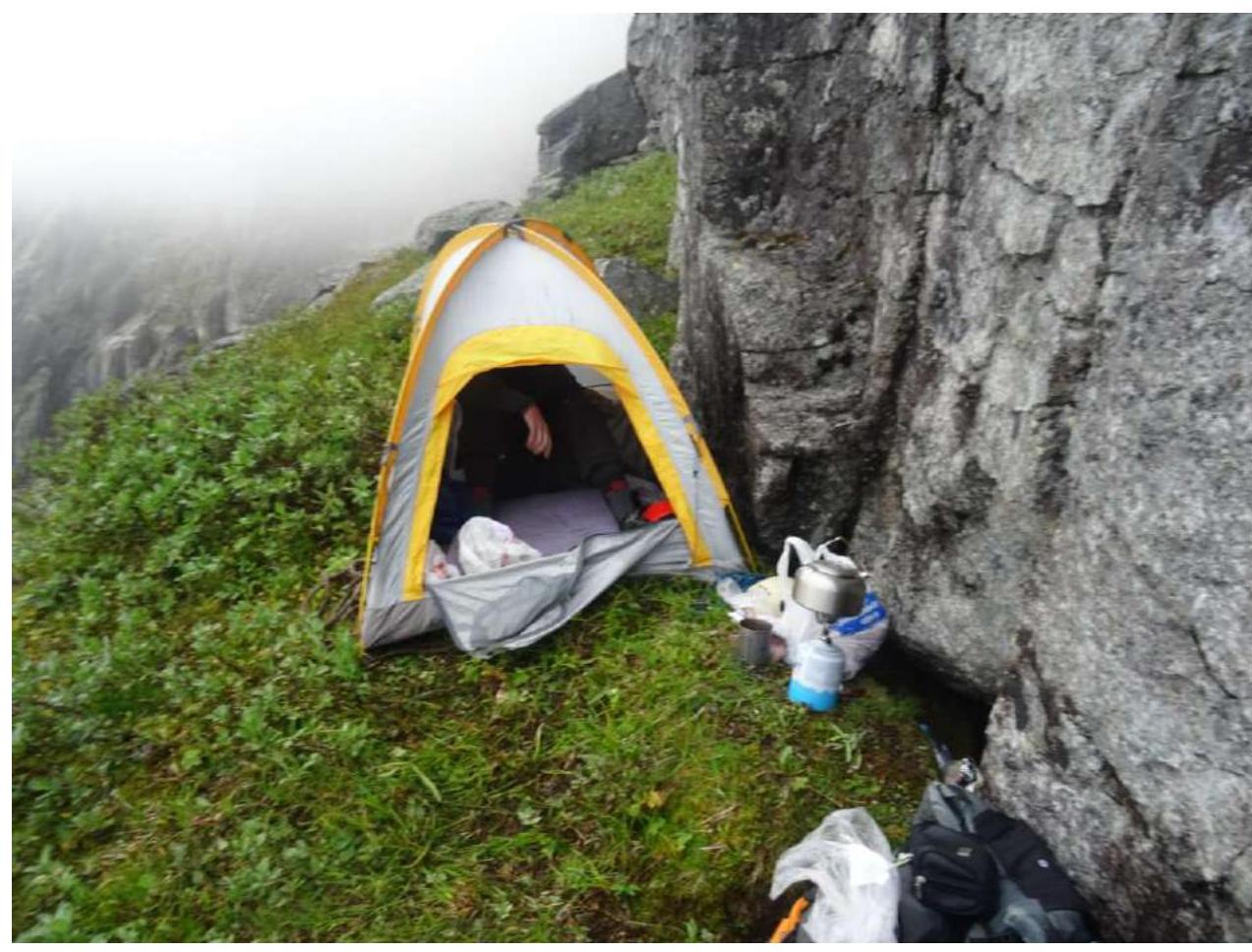
Photo 9. Overnight stay on the 2nd belt (R6).
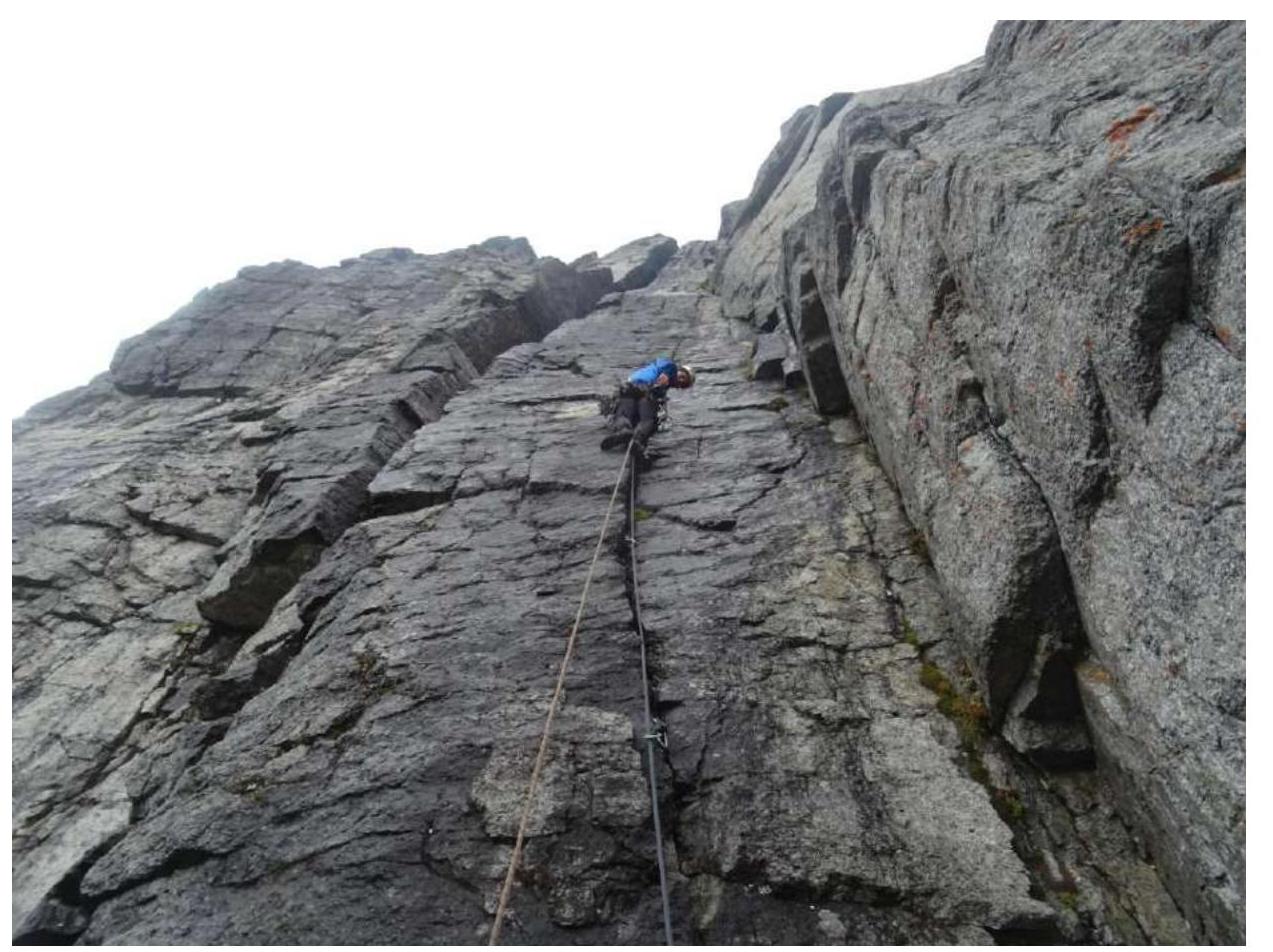
Photo 10. Section R7–R8.

Photo 11. Section R7–R8.
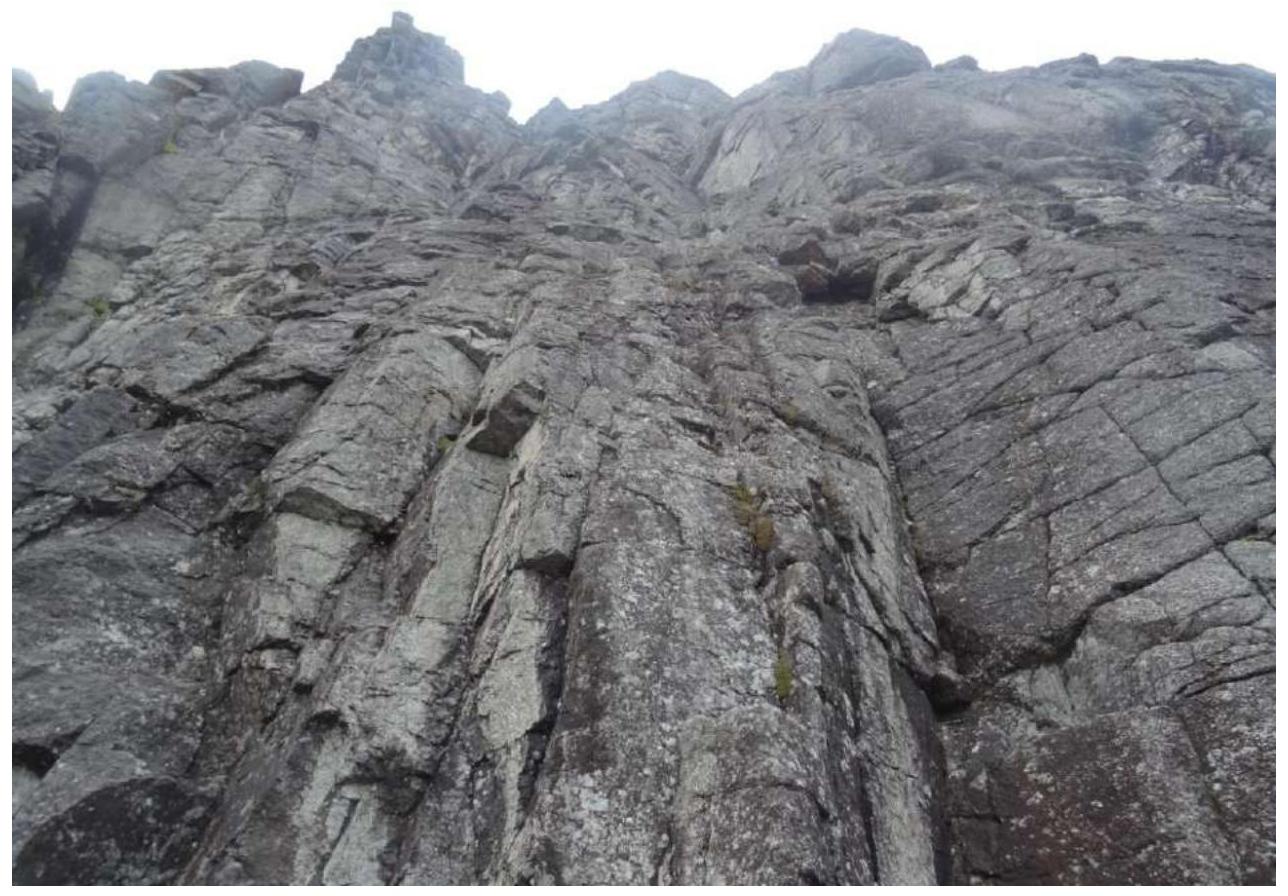
Photo 12. General view of the 3rd belt, sections R9–R11.
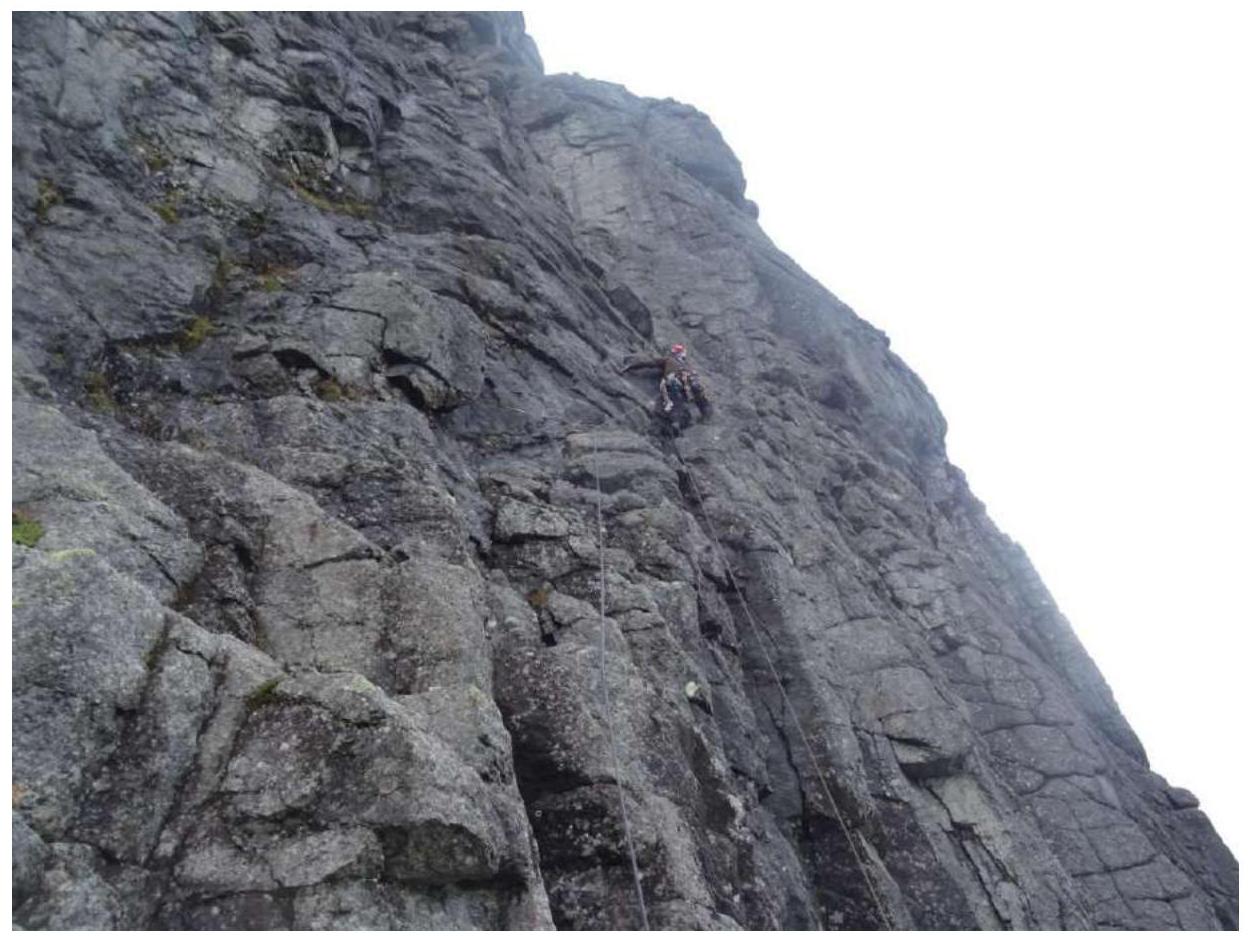
Photo 13. Section R9–R10.
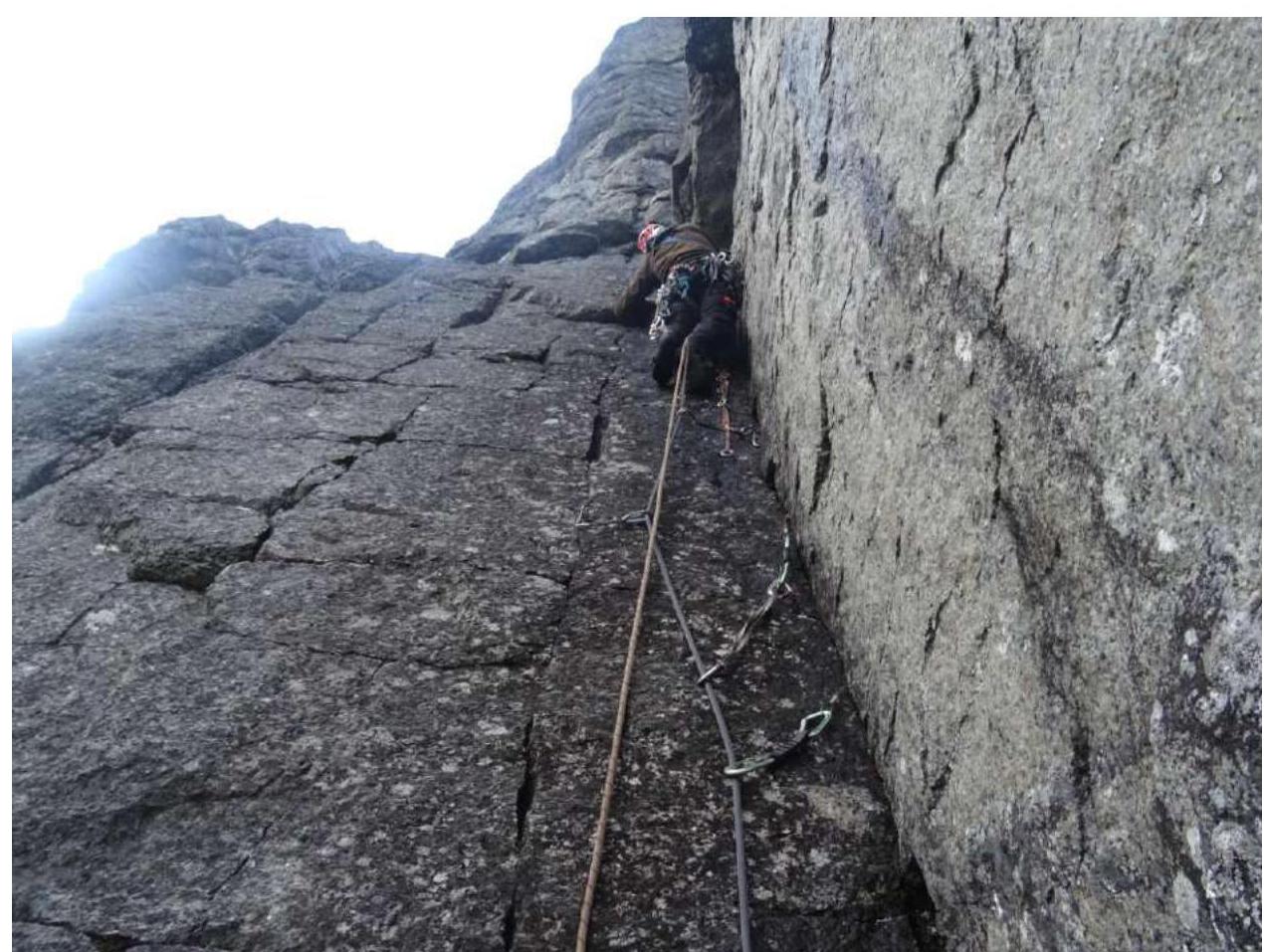
Photo 14. Sections R11–R12.
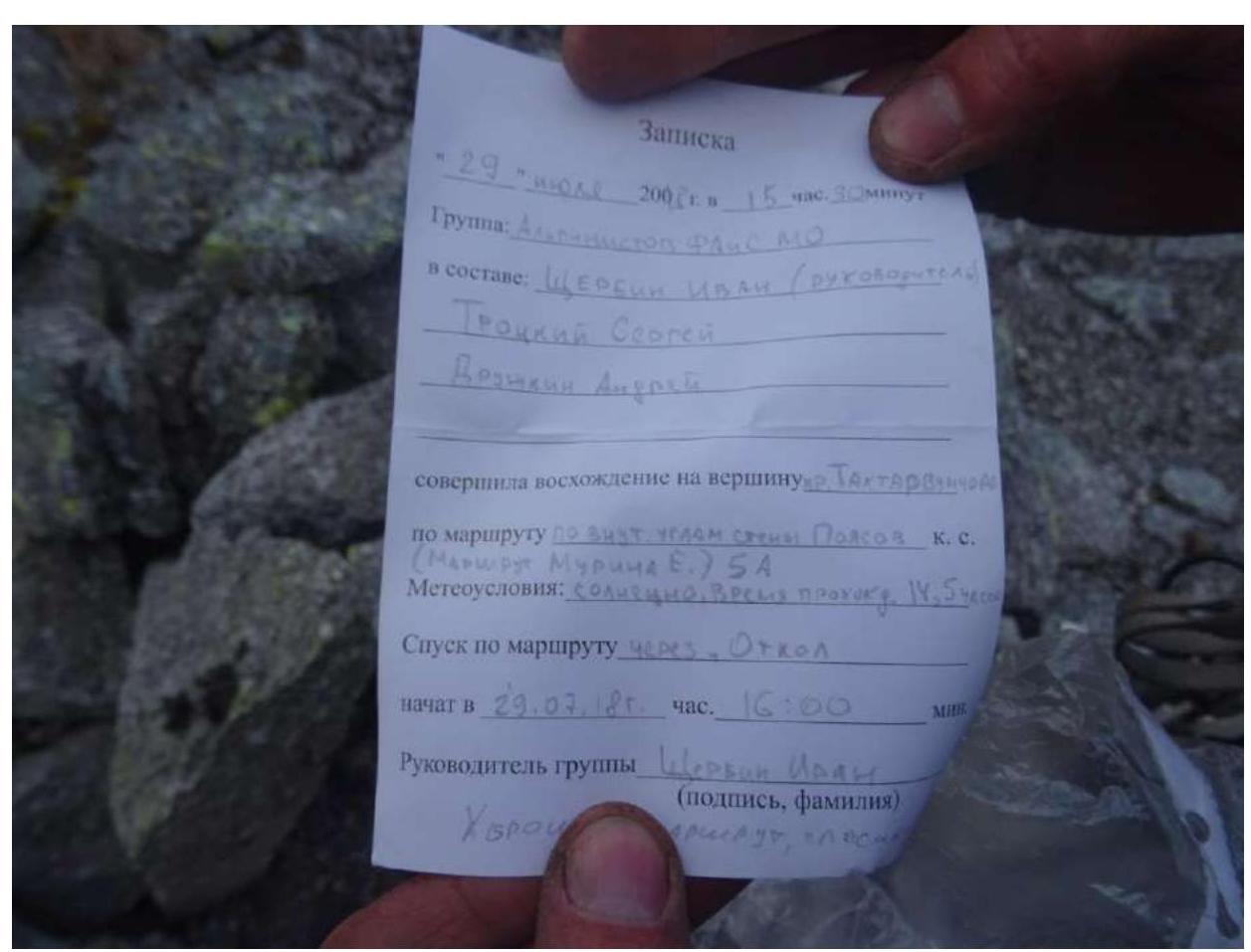
Photo 15. Note from the summit cairn.
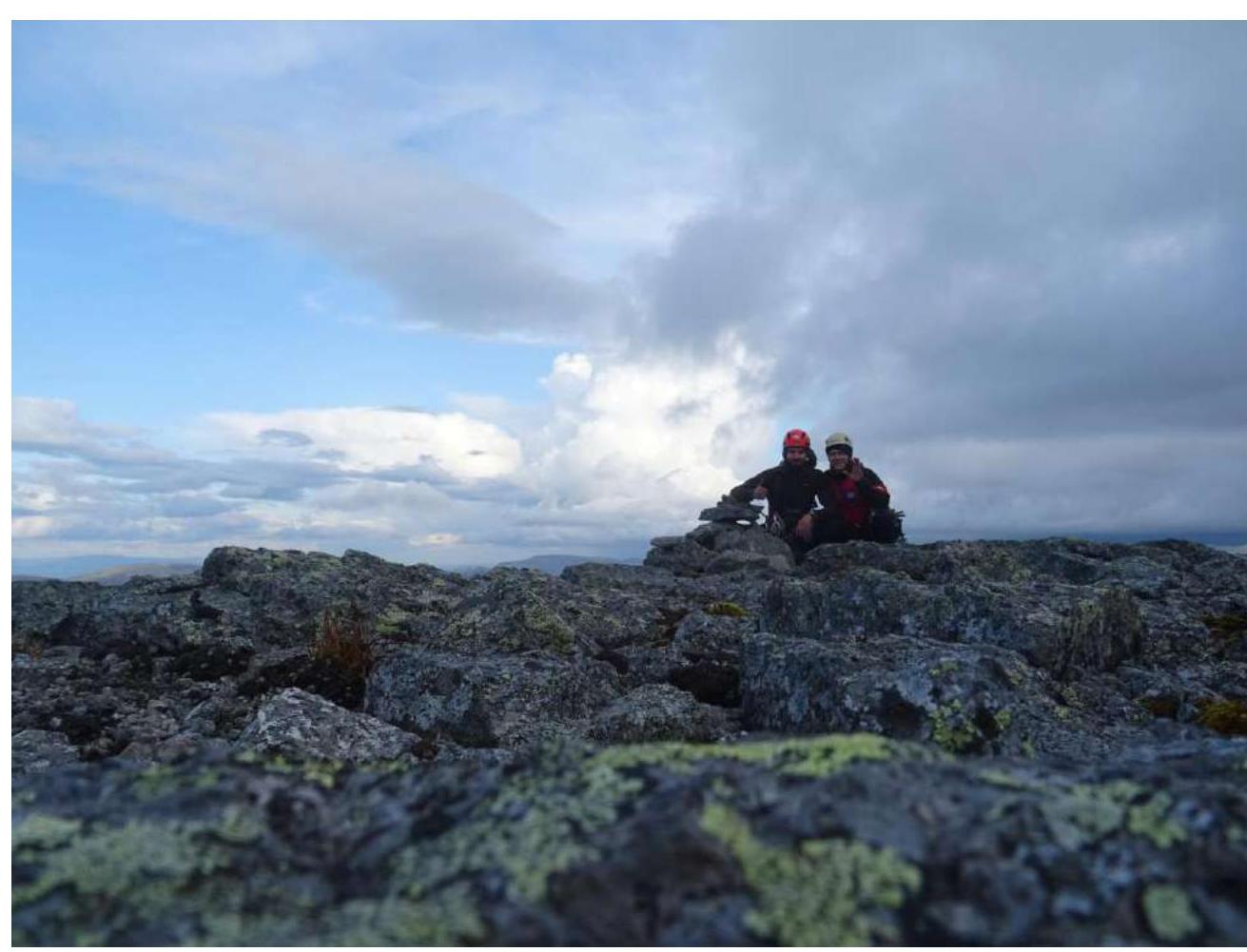
Photo 16. Team photo at the summit (left — Struin V.S., right — Druzhkin A.S.).


