

Passport
-
Technical class
-
North America, Sierra Nevada, Yosemite National Park.
-
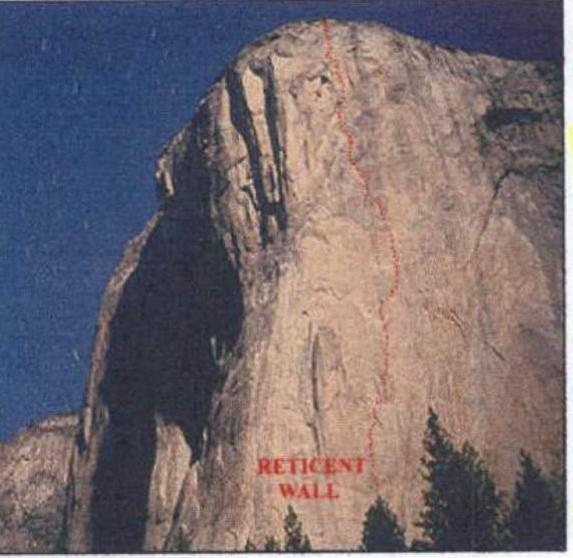
El Capitan summit via Reticent Wall route. Southeastern part of the wall.
-
Approximate complexity category 6B (American classification VI, 5.9, A5)
-
Route length of walled part — 1085 m.
-
Length of sections with 6th category of complexity — 1015 m.
-
Heights:
Height of the beginning of the walled part (above sea level) — 2120 m. Height of the end of the walled part (above sea level) — 2189 m. Height difference of the walled part — 909 m.
-
Average steepness — 90°.
-
Equipment used: (description of big wall equipment with decoding of names — pp. 10, 11, 12) Friends — 372 pcs. Stopper (protection gear) — 320 pcs. Rock pitons — 248 pcs. BICs — 71 pcs. RURP — 7 pcs. Copperhead — 127 pcs. Skyhook — 135 pcs. Cam hook — 70 pcs. Rivet hangers — 135 pcs. Stationary bolts on monolithic sections — 135 pcs. Stationary pitons at belay points — 77 pcs.
-
Days worked on the route — 9.5. Working hours — 134 hrs.
-
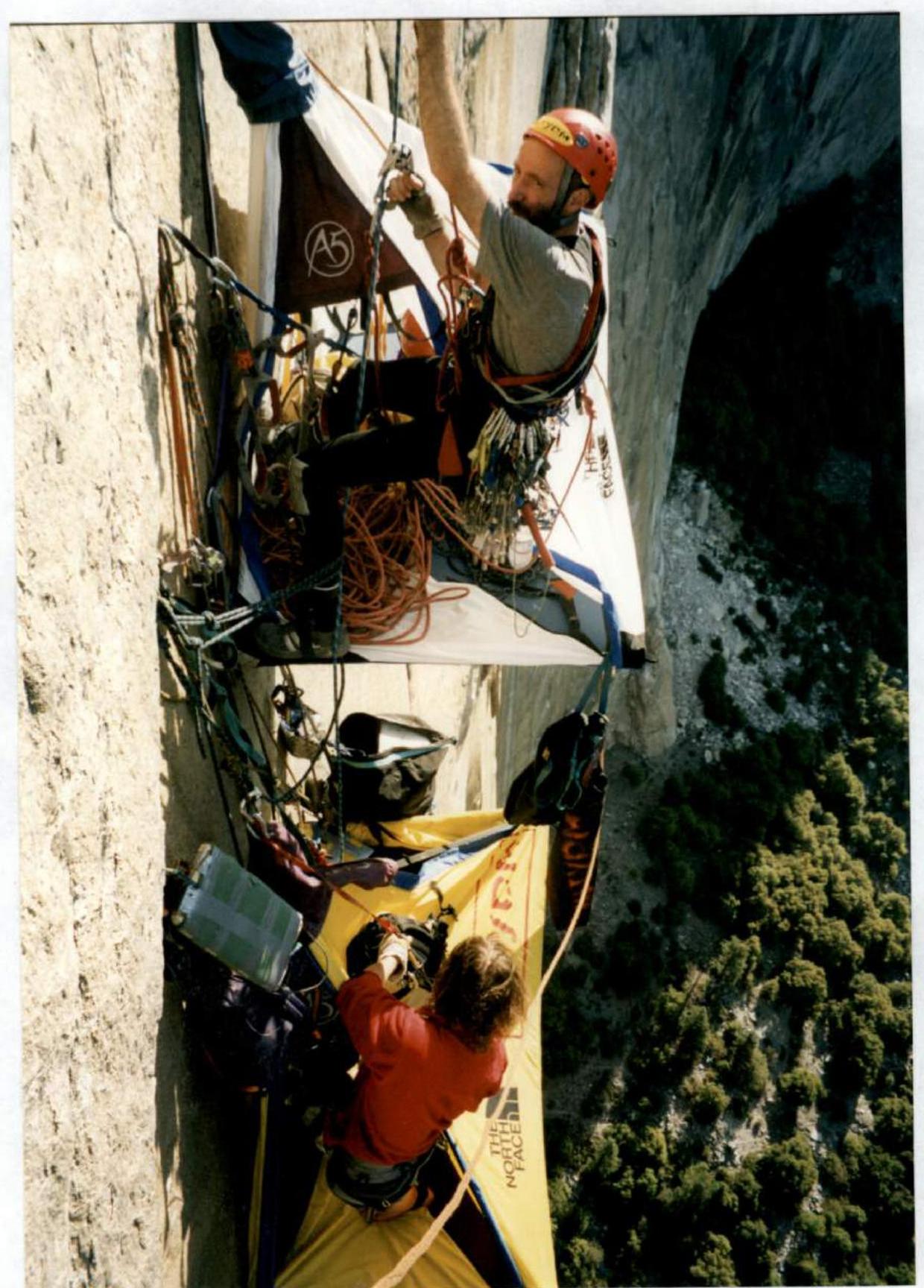
Hanging nights on platforms — 7.
-
Team leader: Lastochkin Alexander Nikolayevich — Master of Sports
-
Team members: Seregin Arkady Borisovich — Candidate for Master of Sports Akhmedkhanov Timur Kamilyevich — Master of Sports Sorokatyi Sergey Viktorovich — Candidate for Master of Sports
-
Coach: Abramov Alexander Viktorovich, Master of Sports
-
Route processing start date: May 12, 2001. Departure on the route: May 14, 2001. Reaching the summit: May 21, 2001. Return to base camp: May 21, 2001.
-
Moscow City Federation of Mountaineering and Rock Climbing.
Certificate
The team attempted to climb one of the world's most technically challenging routes on El Capitan's wall.
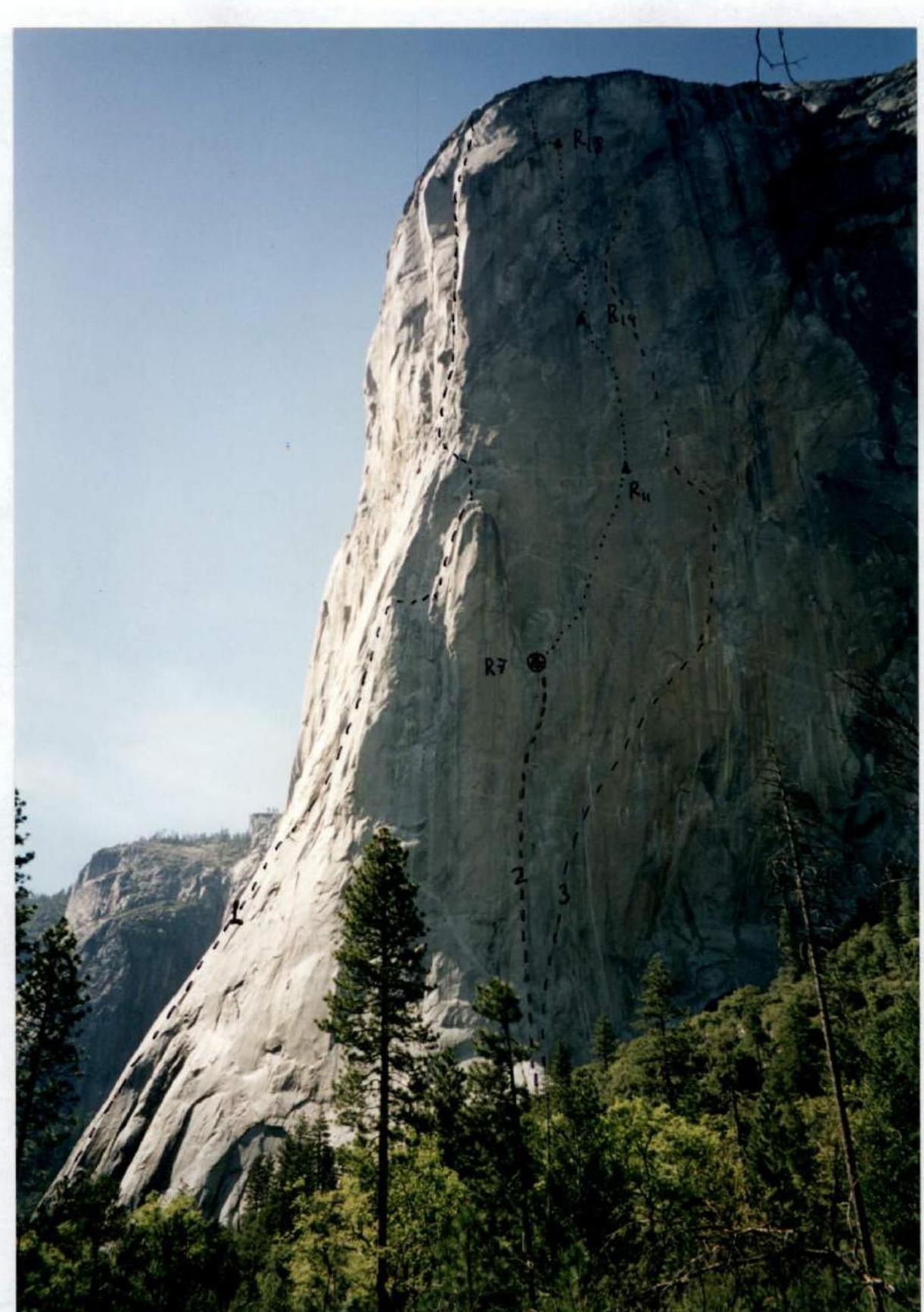
The Reticent Wall route was first ascended by Americans Steve Gerberding, Scott Stowe, and Lori Reddel in 1995, with an assigned complexity rating of A5. The route is located in the longest and steepest part of El Capitan's southeastern wall, slightly left of the Mescalito route and right of the New Dawn route. The second ascent was made by a team led by American Mark Sinnott in May 1997 (a year and a half later!). The third ascent was a solo climb by Slovenian Tomaž Humar on Reticent Wall in October 1998 (a year and a half after the second ascent!). There is also a recorded ascent by Chris McNamara, author of "Big Walls. Supertopos," in 1998.
According to Climbing magazine and online sources, Reticent Wall was considered the world's most technically challenging route until 1999 (http://magbag.com/reticent.htm ↗).
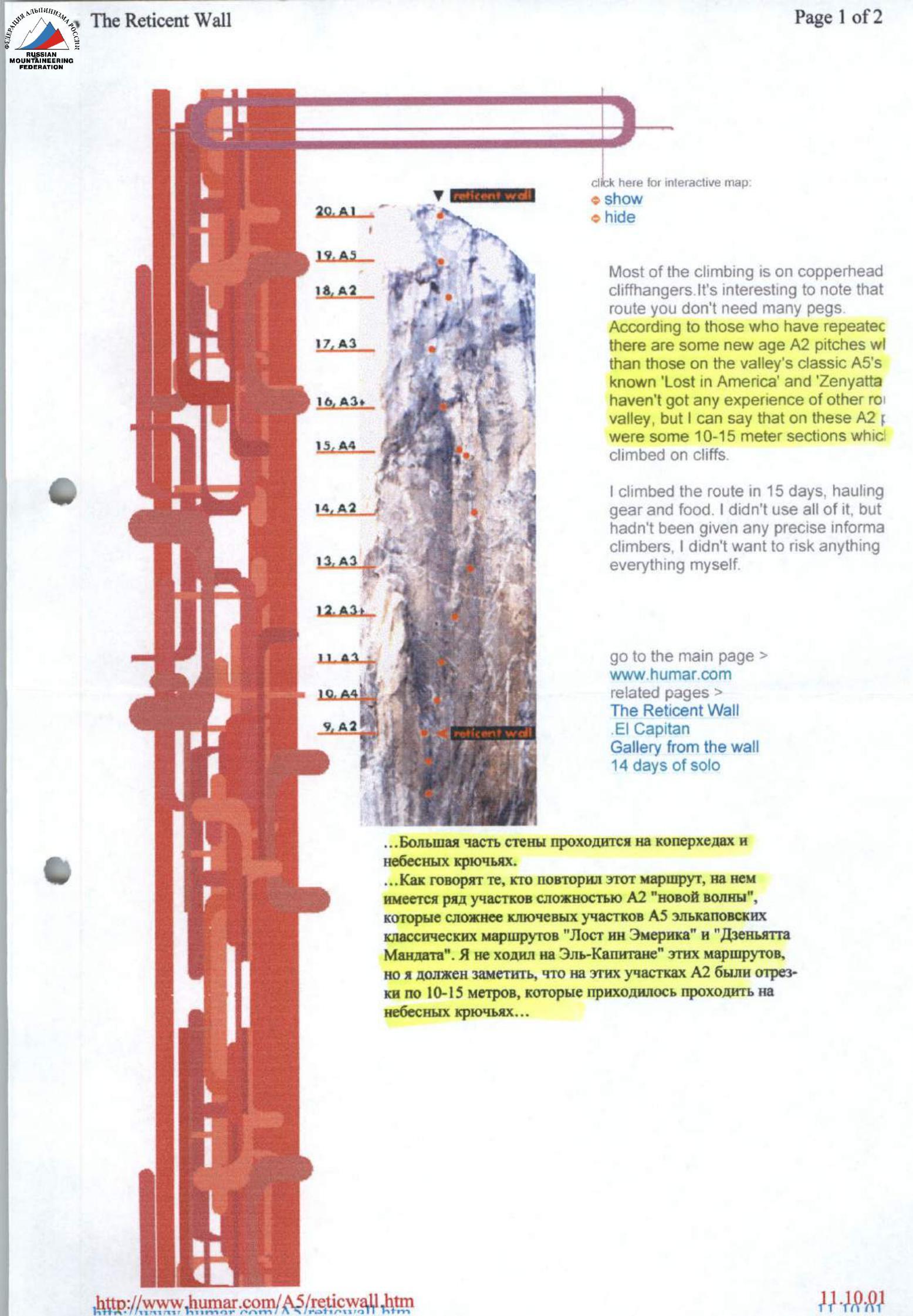
The original ascenders' assigned complexity rating for certain sections of the Reticent Wall route was often significantly underestimated. For example, section #13 was rated A2, as noted in the team's report. However, according to Mark Sinnott and Tomaž Humar, who repeated the route, this section is much more challenging than key sections with A4 complexity on other super-complex routes on El Capitan: "We expected problems on A4 and A5 sections," says Mark Sinnott, "but the A2 sections on this route were much harder than any others on Lost in America and Zenyatta Mondatta routes." (Climbing Magazine, August-September 1997, p. 19).
"Soloing Reticent Wall is definitely the most challenging climb of my life. The route has many 60-65 meter sections between belay stations with a potential fall of 130 meters... Almost the entire wall is climbed using copperheads and skyhooks. Those who have climbed Reticent claim that the A2 sections are much harder than classic A5 sections on Lost in America and Zenyatta Mondatta. I find it hard to compare since I haven't climbed other routes in Yosemite, but I must note that Reticent has many A2 sections where you have to climb 10-15 meters solely on skyhooks," — Tomaž Humar (http://www.humar.com/A5/reticover.htm ↗).
"Reticent Wall is incredibly dense with A3+ and harder sections. It is significantly harder than El Capitan's Sea of Dreams or Wyoming Sheep Ranch," writes Chris McNamara in "Yosemite Big Walls. Supertopos, 1999."
P.S. The Wyoming Sheep Ranch route, considered one of the most challenging on El Capitan's wall with an A4 rating (or 6A by Russian classification), is mentioned alongside the Nose route, which is the easiest route on the wall with an American complexity rating of A2.
When creating the topo scheme of the route, the team had to use the American system of graphically representing the route, as the UIAA symbols, in their opinion, were not suitable for reflecting the specifics of the Reticent Wall route due to the extremely poor relief of the wall.
When compiling the ascent report, the American technical difficulty rating system was used to more fully reflect the complexity of the sections climbed using artificial climbing techniques (ACT).
From "Big Walls" (John Long & John Middendorf, 1994)
From the chapter "Subtleties of the Decimal Aid Rating System":
A2. Moderate artificial climbing. Mostly reliable protection, but sometimes awkward placements for protection gear (friends, stoppers, hexes...). Possibility of two consecutive unreliable protection points above a reliable one with minimal risk of a fall.
A2+. Same as A2, but with the possibility of several unreliable protection points above a reliable one. Risk of a 7-10 meter fall without significant consequences.
A3. Difficult artificial climbing. Requires testing of protection points before loading. Within the pitch, reliable protection points can be found that will withstand a fall. Possible fall of 15-17 meters with the potential to pull out 6-8 protection points. Climbing such a section requires several hours due to the difficulty of placing protection.
A3+. Same as A3, but with a risk of a serious fall. Unreliable protection points follow a series of points that hold body weight but not a fall. Risk of injury in case of a fall if the belayer doesn't act correctly. Typically, climbing such sections takes over three hours for experienced climbers.
A4. Very difficult artificial climbing. Significant risk of a 20-35 meter fall with uncertain consequences.
A4+. More serious than A4. Climbing such sections requires many hours, with constant uncertainty and fear. Often requires delicate movements to avoid pulling out unreliable protection points.
A5. Extremely difficult climbing. No protection points capable of stopping a fall throughout the entire pitch. No bolted protection.
Historically, the A5 rating was assigned to extremely difficult sections. According to new standards, such sections can be rated as A2 or A3. For example:
- Former A5 sections on North American Wall are now rated A3+
- They have a risk of a relatively safe fall of 30-35 meters without landing on a ledge
- Possible pendulum swing into an internal corner
According to new standards, A5 implies a risk of death in case of a fall because:
- The falling climber will inevitably pull out all protection points
- Will inevitably land on a ledge
- Or be swung into an internal corner
Some Route Features
- The first 7 pitches of the route coincide with the New Dawn route.
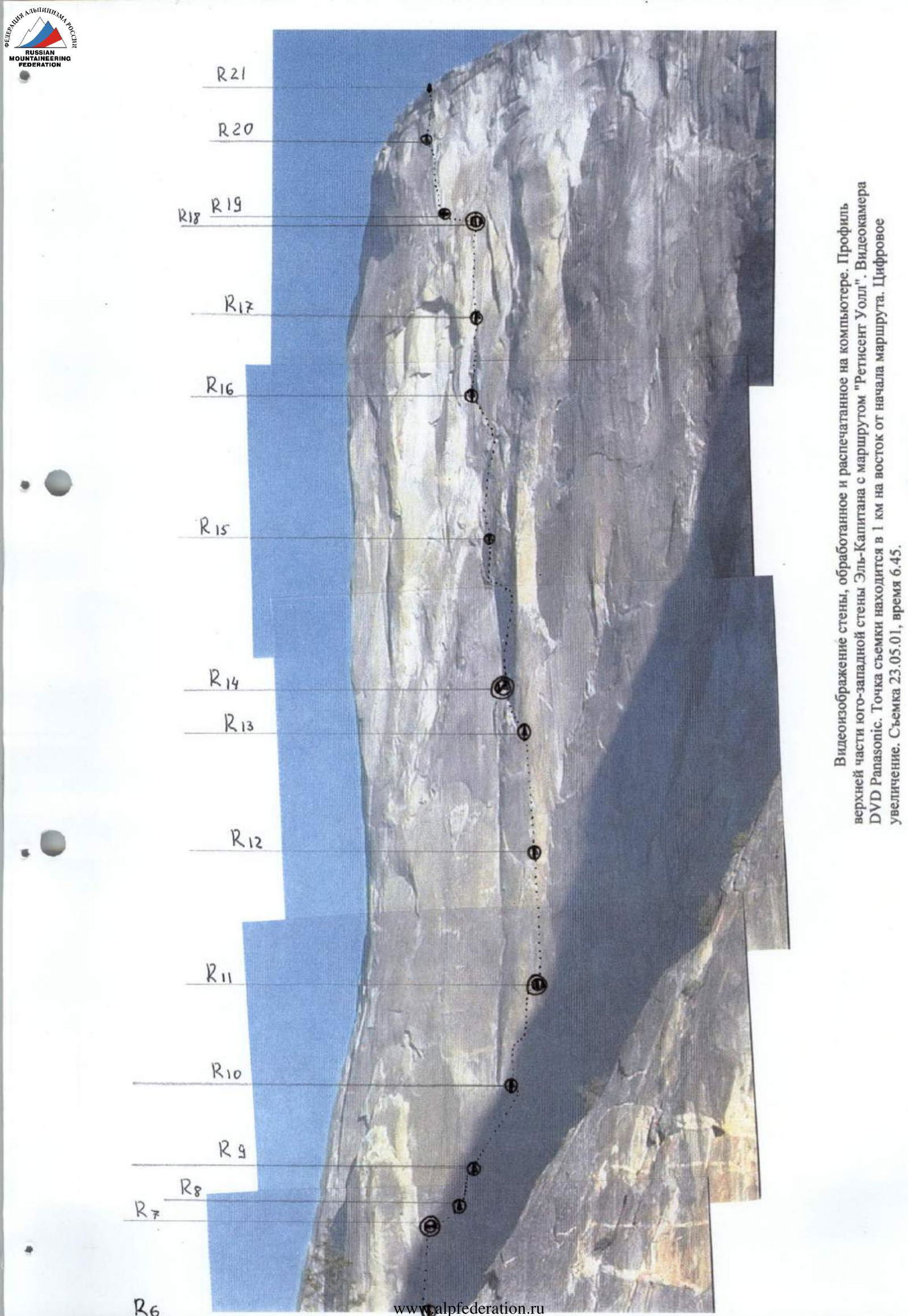
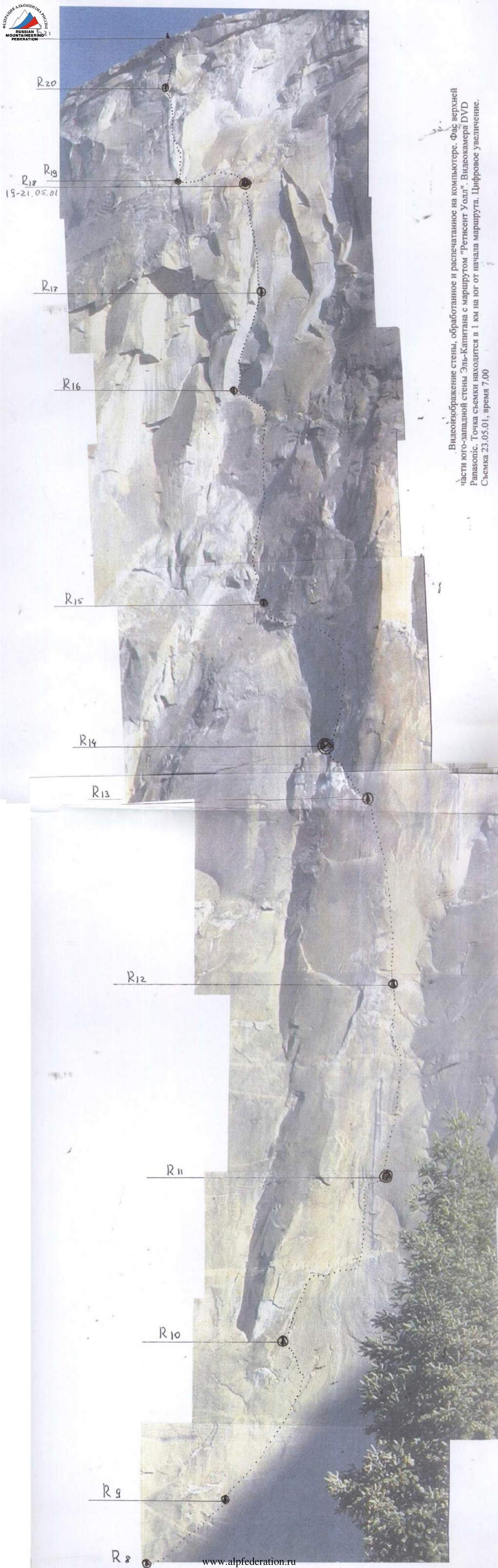
- The Reticent Wall route is characterized by long sections between belay stations, often over 60 meters (sections #10, #12, #13, #15, #16, #17, and #18). Belay stations consist of 3-5 stationary pitons. In Chris McNamara's guidebook, a recommended rope length of 60 meters is suggested (with a comment on long sections: "stretching"). The extended length of the sections, combined with the extreme technical difficulty of the route, forced the leader to carry a significant amount of equipment, which greatly complicated their work.
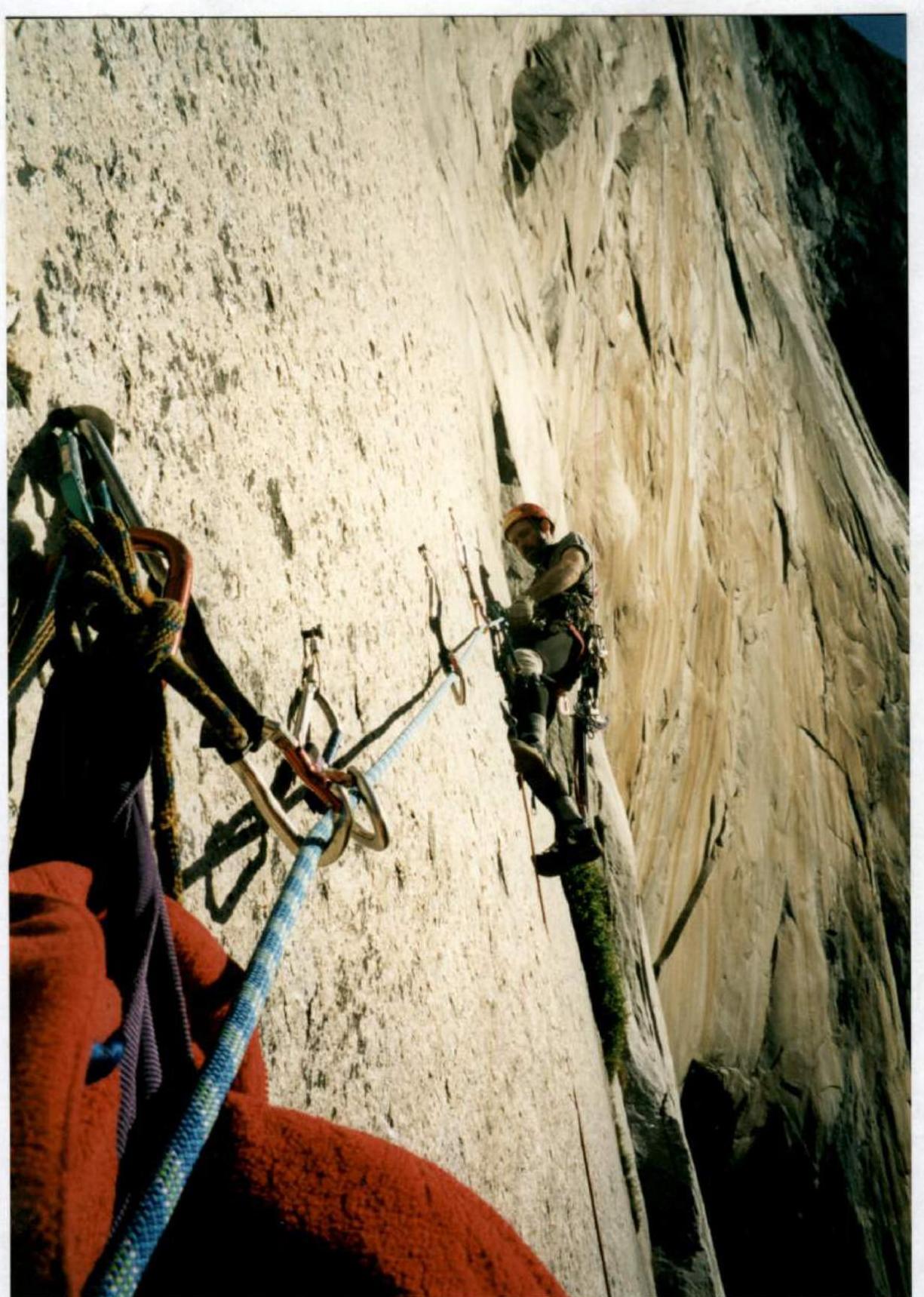
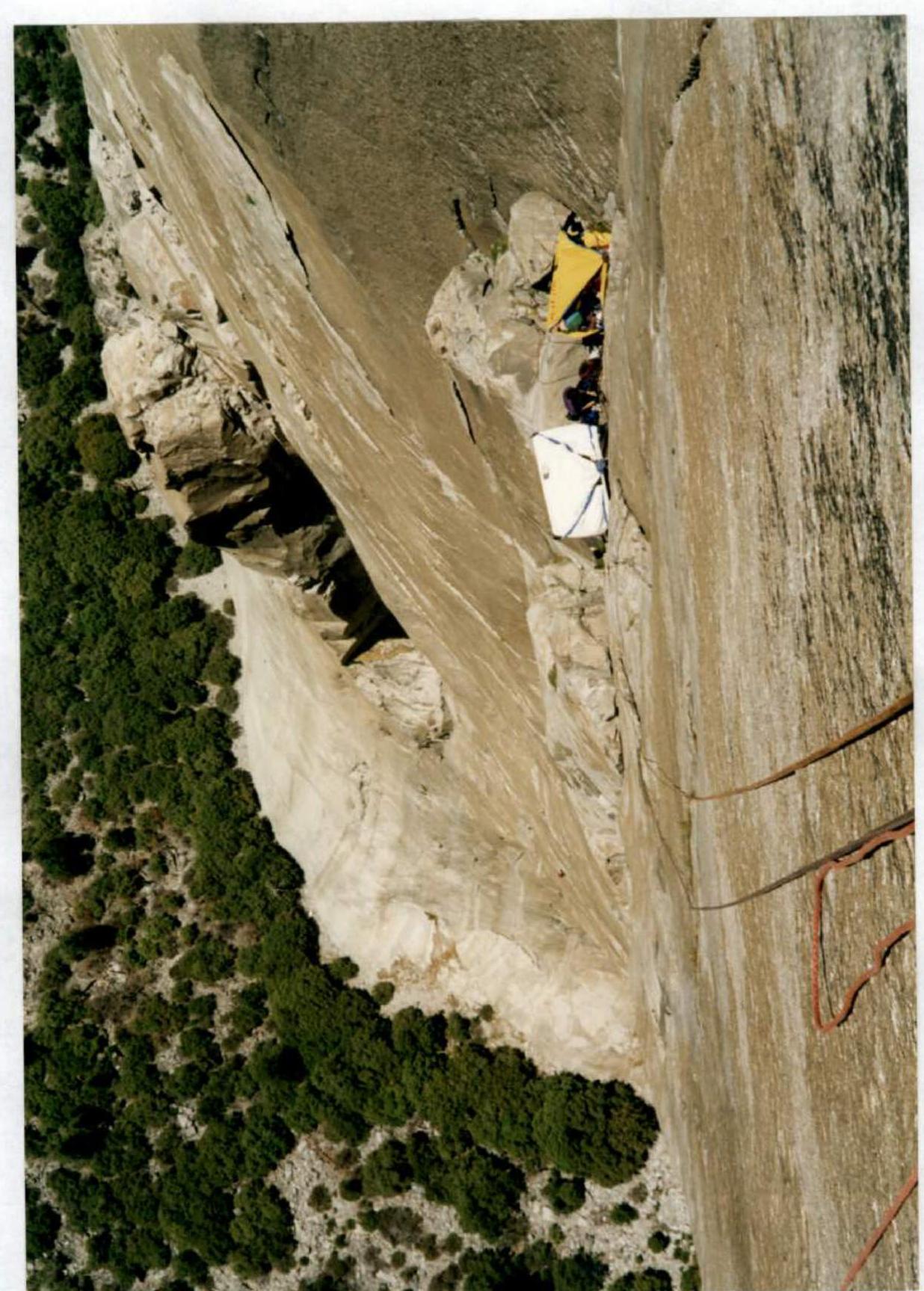
- On monolithic sections of the route, the original ascenders installed bolts with unusually large spacing (the route description warns against climbers of short stature!). To climb these sections, rivet hangers are used, which are hooked onto the bolt heads and then attached to a carabiner (photo #8). The team encountered difficulties on these sections as the tallest team member, using the maximum length of their hook, was still 20-30 cm short of reaching the next bolt!
- The team carried 140 liters of water, approximately 5 liters per person per day. The daytime temperature reached 40°C. It is worth noting that May 2001 was unusually hot in California. (A cassette left on a car dashboard near El Capitan melted.)
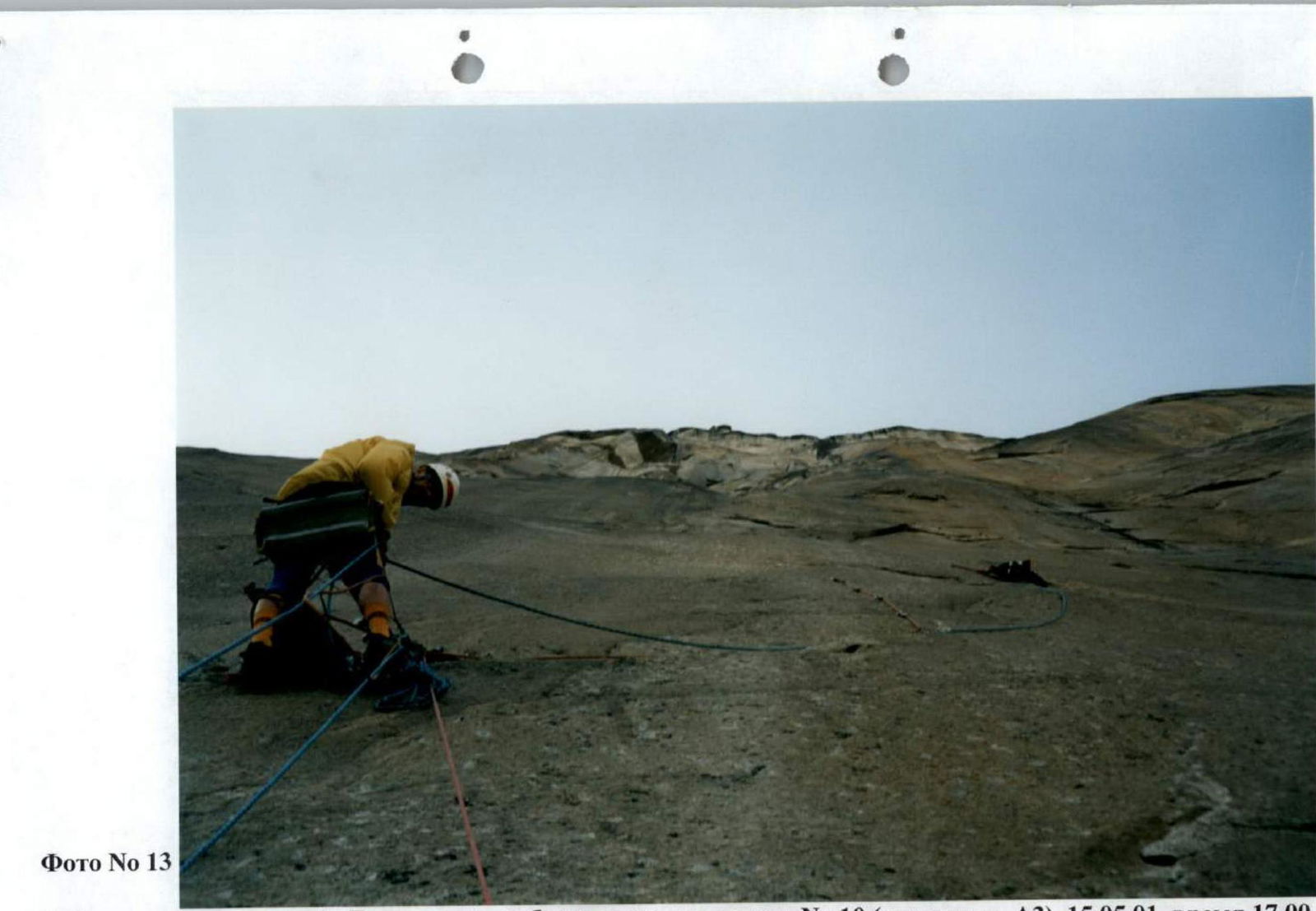
- The key section (section #20) is a monolithic wall with an average steepness of 95° and extremely poor relief. The team spent 10 hours climbing 58 meters; the leader was changed three times. Copperheads and skyhooks were used to climb this section. There are no bolted protection points on the entire section, and their installation is prohibited. The team carried a drill and removable pitons in case of an emergency, but they were not used (to avoid damaging their reputation). A fall by the leader would have resulted in the failure of all protection points and a fall either onto a ledge at the base of the key section or a 100-meter drop. At the point of leader change, an improvised belay station was set up using double or triple copperheads, which could withstand a fall with an amplitude of 20-30 cm.
- According to Yosemite climbing regulations, the team had to carry a container (a 100 mm diameter, 1200 mm long plastic pipe) to store human waste (photo #23). The container was to be emptied into a special container at the base camp.
- The team used specialized "big wall" equipment, some of which was originally developed by American climbers for extremely challenging routes on El Capitan. This equipment is now widely used in other mountainous regions.
Equipment List
- Rope 9 mm × 60 m — 4 pcs. Rope 10.5 mm × 60 m — 3 pcs.
- Disposable carabiners — 140 pcs.
- Friends "Metolius", "Black Diamond" — 35 pcs.
- Friends "Eliens" — 12 pcs.
- Asymmetric Friends "Eliens" — 6 pcs.
- Stoppers — 40 pcs.
- BICs — 18 pcs.
- RURPs — 8 pcs.
- Rivet hangers — 50 pcs.
- Copperheads — 70 pcs.
- Rock pitons — 75 pcs.
- "Petzl" pulley — 2 pcs.
- Rock hammer — 2 pcs.
- Cam hooks — 10 pcs.
- Drill — 1 pc.
- Removable pitons — 4 pcs.
- "Gri-Gri" belay device — 2 pcs.
- Descender washers — 4 pcs.
- "Primus" wall-mounted gas stove — 1 pc.
- "The North Face" two-person platform — 2 pcs.
- "Black Diamond" ladders — 4 pcs.
- Hook extensions — 3 pcs.
- Skyhooks — 12 pcs.
- First aid kit — 1 pc.
- "Panasonic" video camera — 1 pc.
- "Pentax" camera — 1 pc.
- "The North Face" 250-liter transport bag — 1 pc.
- "Red Fox" 100-liter transport bag — 2 pcs.
- Water in 1-5 liter plastic bottles — 140 liters.
- Food — 25 kg.
- Sleeping bag — 4 pcs.
- Personal items — 4 kg.
- Helmet — 4 pcs.
- Headlamp — 4 pcs.
- Portable toilet — 1 pc.
- Chisel for copperhead placement — 2 pcs.
- Center punch for copperhead placement — 1 pc.
- Extension loops — 40 pcs.
"Big Wall" Equipment
- RURP — Realized Ultimate Reality Piton. A piton with a 15 mm × 5 mm blade and a sling. Used exclusively for climbing.
- BIC — Bird Beak. A piton with a 25 mm × 10 mm blade, resembling a bird's beak. Can be used for belaying.
- Rivet hanger — a sling used for climbing bolted sections by hooking onto bolt heads. In Yosemite, bolts without hangers are used (see photo #8).
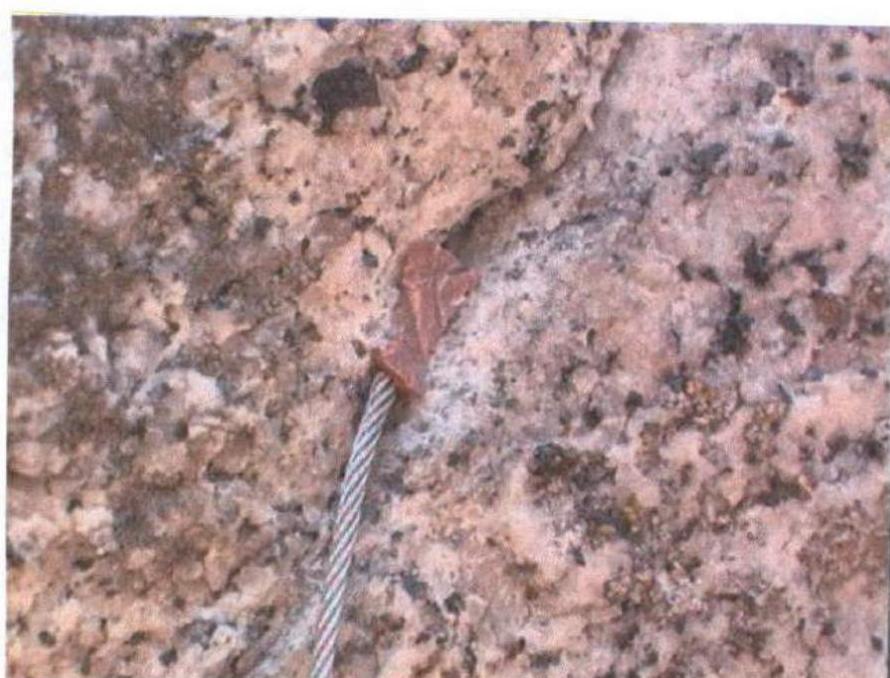
- Copperhead — a sling with a cylindrical tip made of copper or aluminum. The cylinder is hammered into granite folds. When loaded, it must be tested for reliability. Used exclusively for climbing. Copperheads come in ring form (5) for placement in horizontal folds.
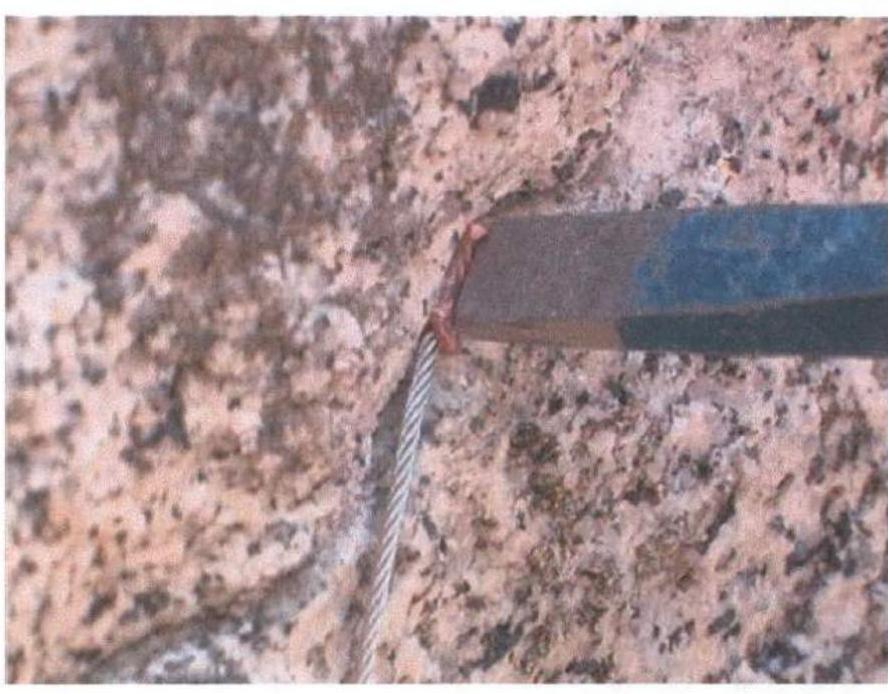
Copperhead placement scheme. With careful placement, copperheads can be reused.
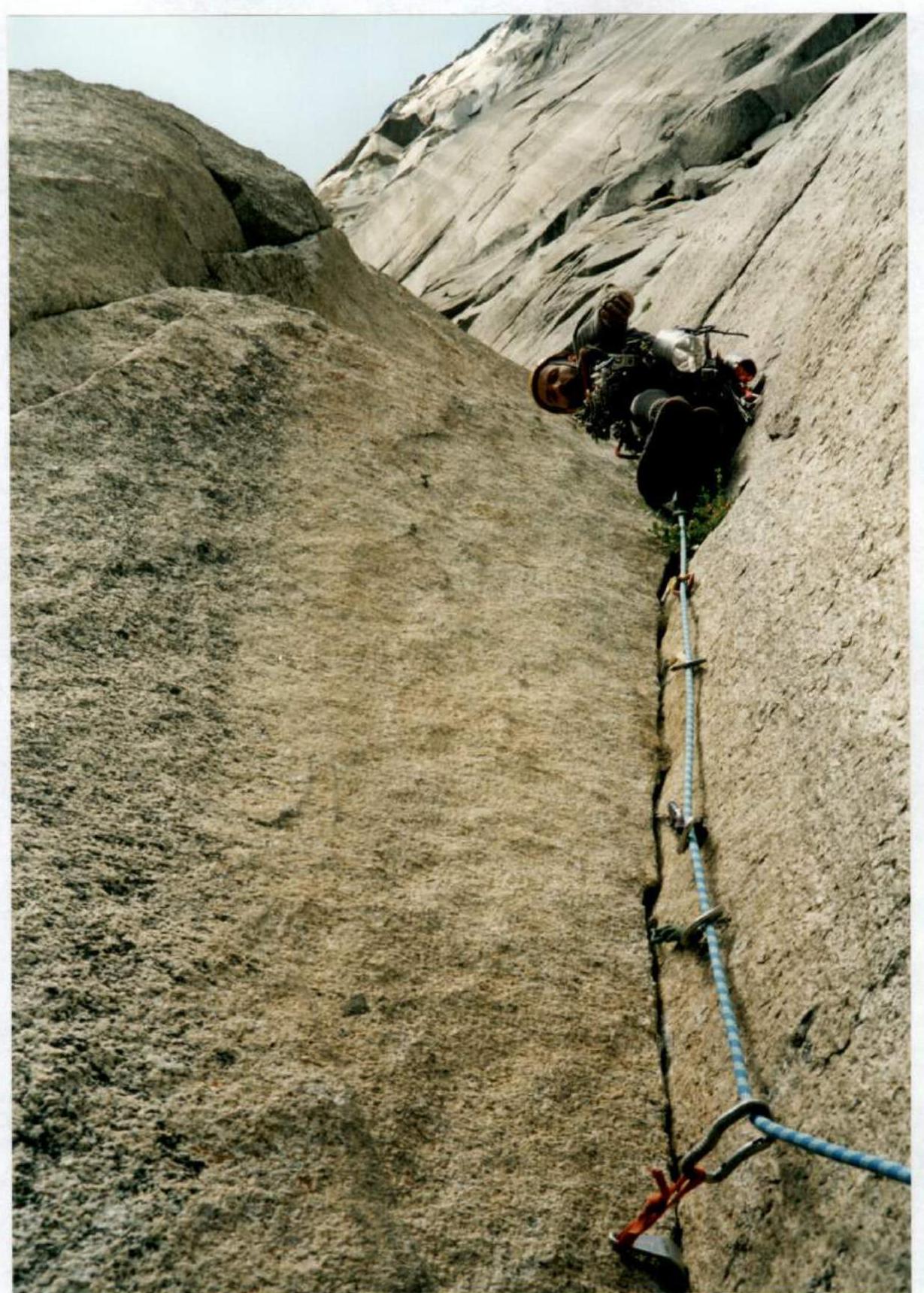
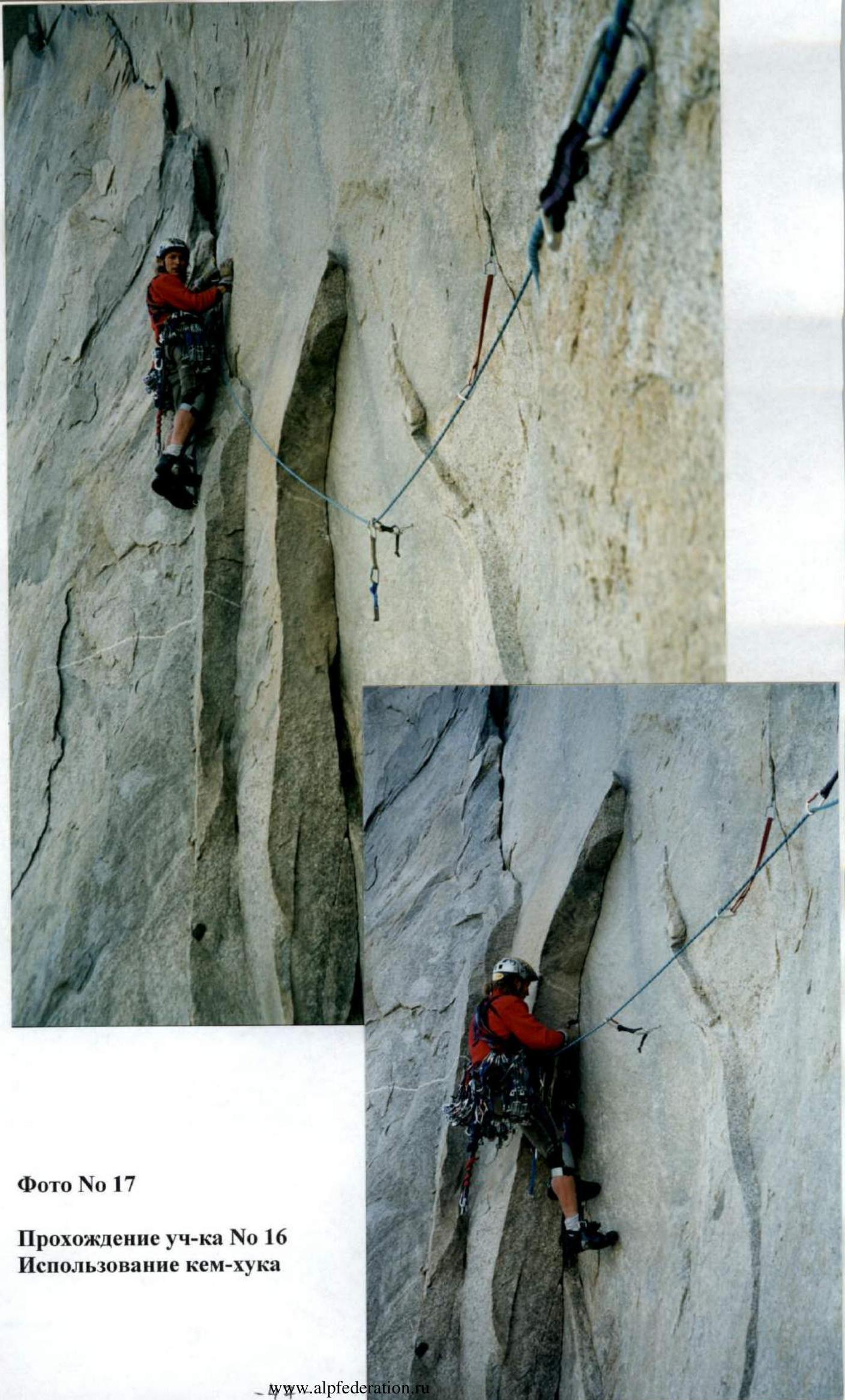
- Cam hook — a 85° angled plate. Used for climbing cracks by wedging, effective only under load (see photo #17).
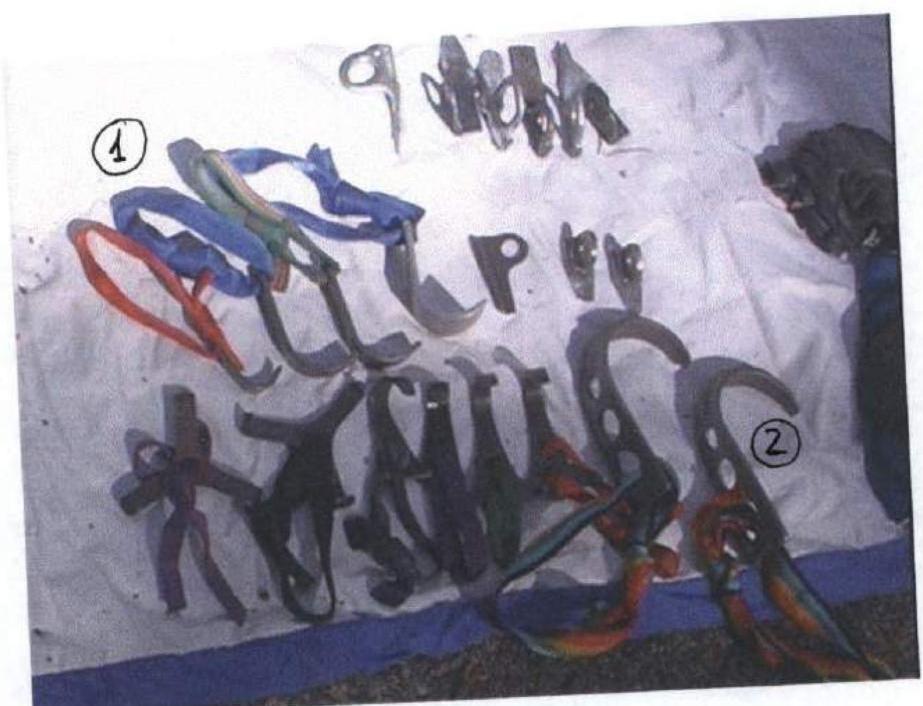
- Skyhooks — various shapes and sizes.
Tactical Actions of the Team
The Reticent Wall route was chosen in the fall of 2000 during participation in the Yosemite rock climbing competition. Until 1999, Reticent Wall was considered the world's most technically challenging route. By the time the ascent was planned, the Akhmedkhanov-Lastochkin duo had climbed two routes on El Capitan: "Flying Albatross" (A4) and "Atlantic Ocean Wall" (A4). Seregin, with German partners, had climbed routes: "Nose" (A2), "Larkin Fears" (A3), "Zodiac" (A3), "Sunkist" (A4), and "Atlantic Ocean Wall" (A4) in pairs; and "Salati" (A2) as a team leader.
During the winter and spring of 2001, the team trained on a Moscow climbing wall and in Crimea.
Upon arrival in Yosemite National Park, the team made a training ascent of "The Prow" (V, 5.10, A2) on Washington Column.
Route processing was done on May 12 and 13. One duo processed the route while the other transported gear to the maximum possible height. The first seven pitches of the New Dawn route were processed in two days. The complexity of these sections corresponds to standard Yosemite ratings.
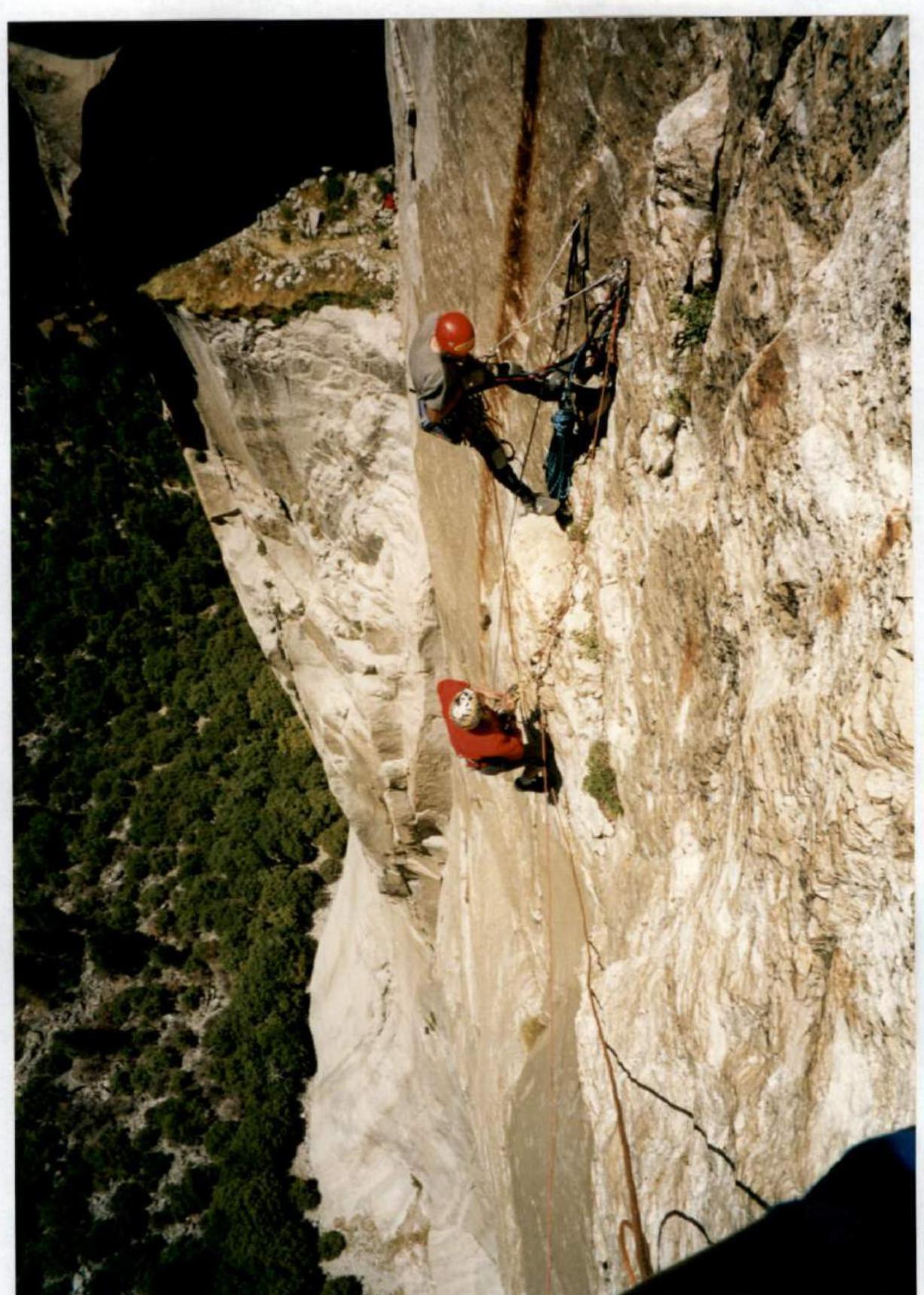
On May 14, the Akhmedkhanov-Lastochkin duo processed the eighth pitch, while Seregin-Sorokatyi transported gear and set up two platforms above the "Lay Lady Ledge" ledge.
Due to extreme heat (up to 40°C), the team had to carry 140 liters of water. On May 14, they processed only 1.5 pitches (sections #8 and half of #9, rated A4).
The complexity of the route increased significantly, causing concern among the team members.
On May 15, the Akhmedkhanov-Lastochkin duo completed section #9, and then Lastochkin-Seregin processed section #10.
On May 16, the Seregin-Akhmedkhanov duo processed sections #11 and #12, while Lastochkin-Sorokatyi transported gear.
The team realized that the route's complexity dictated a slow pace: one person could process about one pitch per day.
On May 17, the Lastochkin-Sorokatyi duo processed sections #13 and #14. The team encountered another challenge: sections rated A2 were actually much harder, requiring the use of skyhooks and copperheads.
On May 18, the Akhmedkhanov-Seregin duo processed sections #15 and #16.
On May 19, the Akhmedkhanov-Lastochkin duo processed sections #17 and #18.
On May 20, the team processed the key section #19 (A5) in 10 hours, with three leader changes.
On May 21, the Akhmedkhanov-Seregin duo completed the route, reaching the summit at 11:45 and descending to base camp the same day.
The team carried a cell phone and a first aid kit, and all participants were insured by PECCOgarantiya.
Route Description by Pitch
R0–R1. Monolithic wall with a rivet traverse. Complexity A2.
R1–R2. Crack leading to an internal corner, then back to a crack. Complexity A2.
R2–R3. Blind crack. Copperheads used. Complexity A3.
R3–R4. Rivet traverse on a monolithic wall, then a crack. Complexity A2.
R4–R5. Internal corner with an overhang. Complexity A3.
R5–R6. Continuation of the internal corner. Pendulum swing to a vertical crack. Complexity A3.
R6–R7. Internal corner. Free climbing (5.9) for the upper 10 meters. Complexity A1.
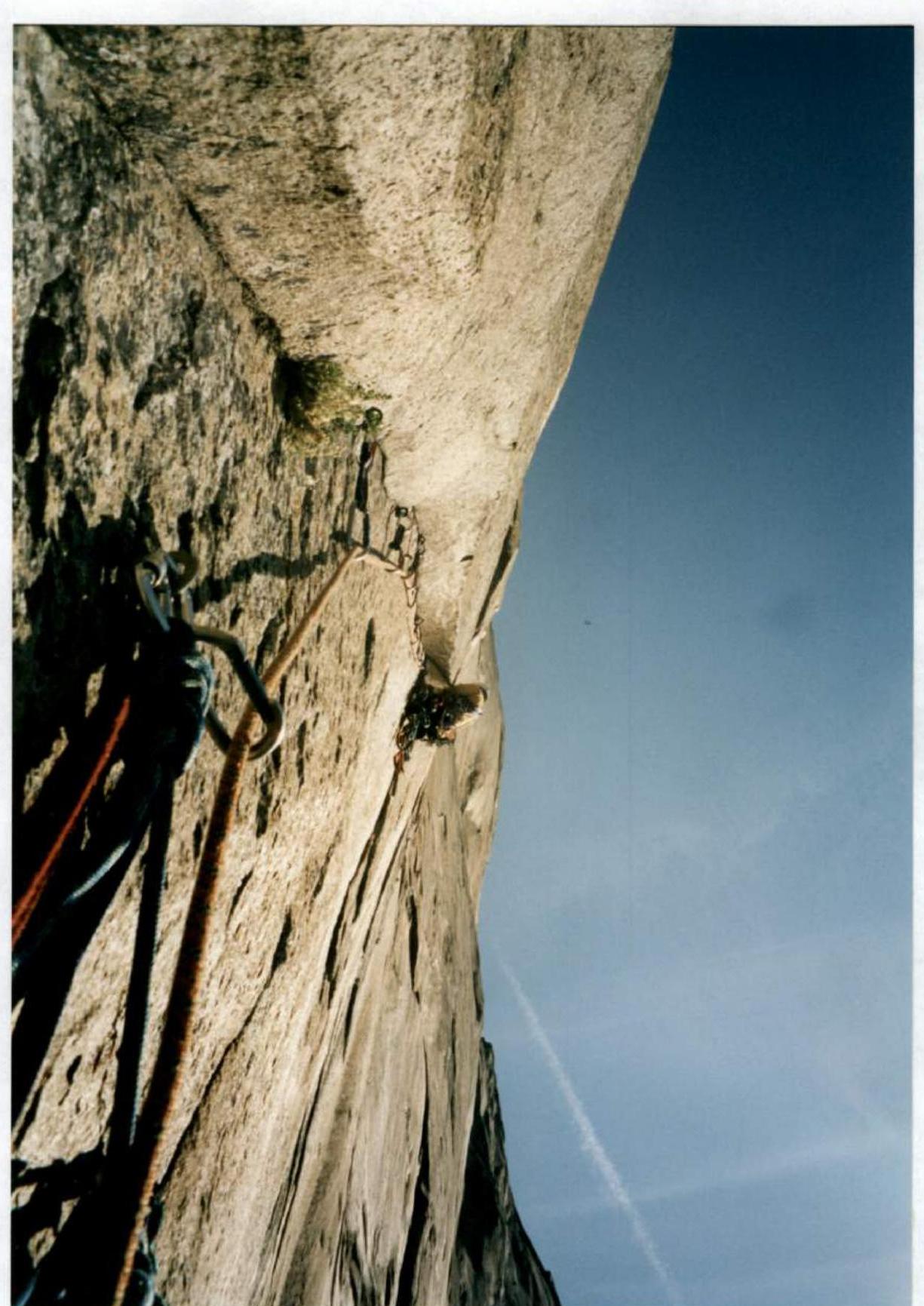
R7–R8. Traverse right on skyhooks. Complexity A3.
R8–R9. Granite wall with poor relief. Complexity A4.
R9–R10. Monolithic relief with rivet traverses. Complexity A3.
R10–R11. Overhanging internal corner. Complexity A4.
R11–R12. Rivet traverse leading to a large "fragile flake." Complexity A3+.
R12–R13. Complexity A2 (as per original ascenders). However, the team found it much harder, using numerous skyhooks and copperheads.
R13–R14. Series of internal corners. Complexity A1.
R14–R15. Narrow crack under a car. Complexity A4.
R15–R16. Left under the car, then vertically up an internal corner. Complexity A3.
R16–R17. Overhanging internal corner with two carns. Complexity A3.
R17–R18. Continuation of the overhanging internal corner. Complexity A3.
R18–R19. Vertical crack. Complexity A2.
R19–R20. Key section "The Natural" (A5). Overhanging wall with an average steepness of 95°. 58 meters long.
R20–R21. Vertical climb to an internal corner, then a traverse left under a car. Complexity A2.
Route Diagram and Characteristics
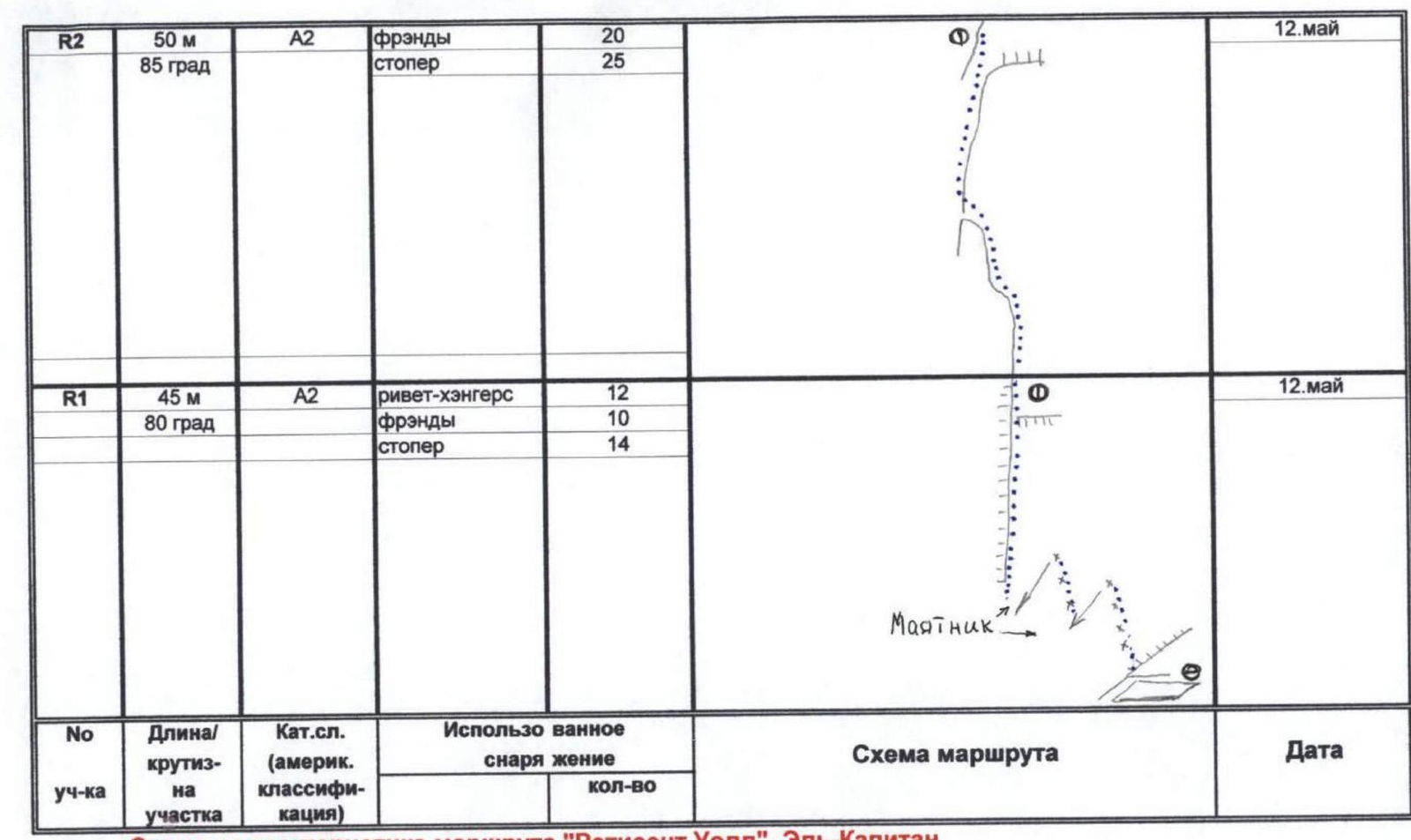
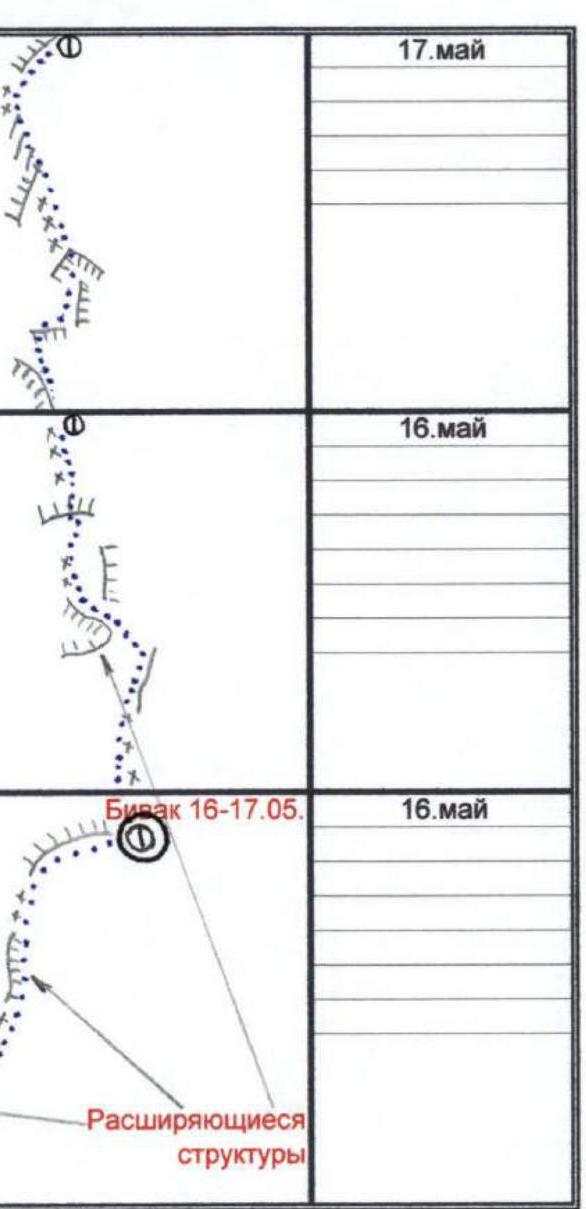
| Pitch # | Length/Steepness | Category (American Classification) | Equipment Used | Quantity | Comment | Date |
|---|---|---|---|---|---|---|
| R1 | 45 m / 80° | A2 | Rivet hangers | 12 | May 12 | |
| Friends | 10 | |||||
| Stoppers | 14 | |||||
| ... | ... | ... | ... | ... | ... | ... |
Reticent Wall Sees Second Ascent...
On May 4, 1997, big wall adventurists Kevin Thaw, Mark Synnott and Chris Kalous began the second ascent of the Reticent Wall — VI 5.9 A5 on El Capitan, Yosemite, CA.
Widely recognized as having probably the most difficult aid pitch anywhere, the Reticent Wall is no small feat. A total of 21 pitches, this extended route begins on New Dawn and continues to the top of "The Captain". The climbing is sustained and intricate throughout this relatively new line and the pitch above "Wino Tower" is no casual affair. "Master Corner" will tax your spirit some, as the climbers were all too aware. "It's 120ft of «body weight» to the first rivet" said Synnott. The crux pitch, "The Natural", waits atop the stone. This seemingly endless granite void is 175ft of unenhanced, "body weight" placements — a true testament to the big wall mastery of first ascentionist, Steve Gerberding. The pitch is said to be the only "true A5" known to exist at this time.
"It's the most technically difficult thing I've ever done" says Synnott of the "new wave" A5 route. "All I want to say about the Reticent is that Kevin is one sick fucker to lead that A5 pitch. That is one of the only times I have watched someone truly risk their life. I was scared just belaying. I feel sorry for the next chump that tries to step up."
It took the team 7 days to reach the top.
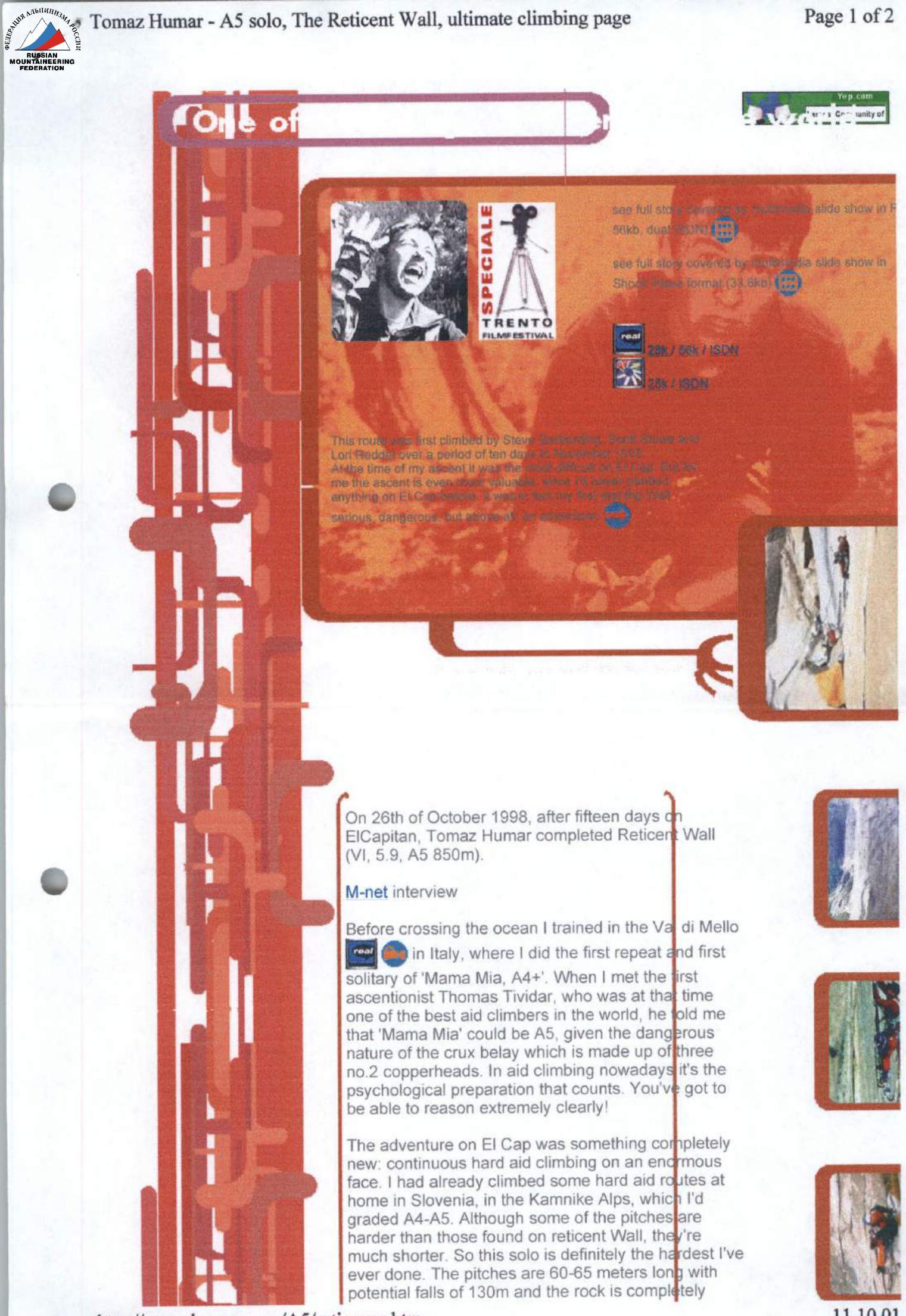
From an interview with Tomaž Humar about his solo ascent of Reticent Wall (started on October 26, 1998):
…The El Capitan climb was something new for me: long, very difficult aid climbing on a huge wall. I have experience with A5 pitches in Slovenia, and they were even harder than Reticent Wall, but they were much shorter. I consider this ascent the most challenging of my life... Pitches are 60-65 meters long with potential falls of 130 meters...
On October 26, 1998, after fifteen days on El Capitan, Tomaž Humar completed the Reticent Wall route (VI, 5.9, A5, 850 m).


Comments
Sign in to leave a comment