
Moscow Alpine Championship 2011. Technical Climbing Category
Climbing Report
Report on the ascent of Picu Urriellu (Naranjo de Bulnes) 2519 m by the team from the MPEI Alpine Club and Climbing School via the Northwest Wall, category 6B, route "Sueños de Invierno" (Winter Dreams) by José Luis García Gallego and Miguel Ángel Díaz, March 1 – May 8, 1983 (69 days)
October 5, 2011
Climbing Details
- Cantabrian Mountains, Picos de Europa region, Spain.
- Picu Urriellu 2519 m, (Naranjo de Bulnes) via Northwest Wall (route "Sueños de Invierno")
- Proposed category: 6B
- Route type: rock climbing
- Height difference: 470 m
- Route length: 515 m, including 460 m of 6B category, with 340 m of artificial climbing (AID)
- Average slope:
- up to the ridge: 87°
- overhanging sections: 115°
- Number of pitons left on the route —
- Number of pitons used on the route —
- Pitons hammered:
- rock pitons – 72
- chocks – 24
- friends – 45
- lead placings (Pb) – 54
- Climbing time: 51 hours, 6 days (including 4 days for processing)
- Team leader: Korochkov Alexey Semenovich, Candidate Master of Sports
Team members:
- Nilov Sergey Alekseevich, Master of Sports
- Lange Alexander Sergeevich, Candidate Master of Sports
- Coach: Korochkov Alexey Semenovich, Candidate Master of Sports, Instructor III category Started the route: 15:00, September 30, 2011 Reached the summit: 14:00, October 5, 2011 Returned to Vega Urriellu camp: 16:20, October 5, 2011
- Night bivouacs:
- 1st (lying) on a platform at R3, according to the attached diagram
- 2nd (lying) on a small ledge at R11, according to the attached diagram
Technical photo of the Northwest Wall of P"Urrieylu" with route lines.

Taken on October 2, 2011, from the slope of Neverón del Urriellu peak, distance 1 km.


Schematic of the Northwest Wall routes of "Urriellu" Naranjo de Bulnes cara O
- Zumbelt A3+6a
- Pilar del Cantábrico A2+6a (8a+)
- Tramuntana A4+7a+
- Sueños de Invierno A5+6c
- Marejada Fuerza 6 A4+6a
- Principado de Asturias A4+6a
- Mediterráneo A3+6b
- Vivencias en Solitario A3+V
- Murciana A1+6a (7c+)
- Opera Vertical A3+6c
- Directisima A1+6a (75+)
- Soy un hombre nuevo 7b+
- Revelación A3+6a
- Tiempos modernos A3+6b
- Sólo al viento A47a
- Rabadá-Navarro A2V(6c+)
- Almirante A1+6b (7a)
- Excalibur
- Cuelebre 6c+A1+
- V Imperio 7b+A0
- Sagitario 6b
- Leiva V+A2(7a+)
- Cherokee Way 6aA1 (7a)
Panoramic View of the Area
P"Urrieylu" 2519 m
La Morra 2553 m
Morra del Carrizoso 2118 m
Base camp 1957 m
View from the slope of Neverón del Urriellu peak
Map of the Area
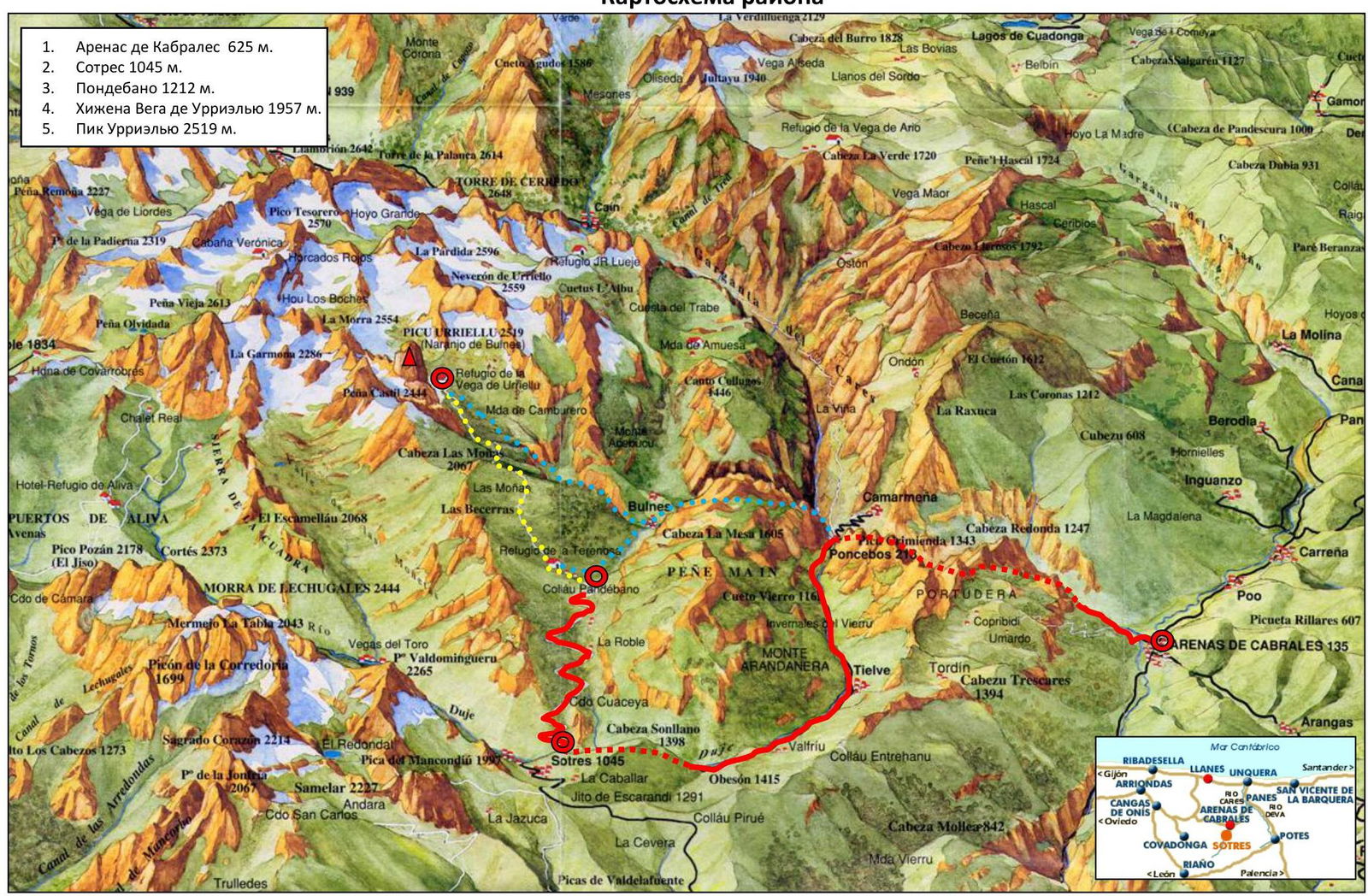
- Arenas de Cabrales 625 m.
- Sotres 1045 m.
- Poncebano 1212 m.
- Vega de Urriellu hut 1957 m.
- P"Urrieylu" 2519 m.
Ascent Graph

Route Profile
Hand-drawn profile of the "Winter Dreams" route on P"Urrieylu" (Naranjo de Bulnes)
R16 2519 m. R15 R14 R13 R12 R11 2421 m. R10 R9 R8 R7 R6 R5 R4 R3 2150 m. R2 R1 R0 2050 m.
Average angle of the route 74°. Average angle of the wall section 87°. Angle of the overhanging section 115°.
UIAA Route Diagram
| Pitch № | Pitons | UIAA Diagram | Difficulty | Length | Angle | Photo | ||||
|---|---|---|---|---|---|---|---|---|---|---|
| r | p | chock | bolt | fr | M | deg | ||||
| 15 | - | - | 4 | - | 4 |  | III | 200 | 10° | |
| 14 | - | - | 4 | - | 5 | VI+ | 35 | 75° 702 | ||
| 13 | - | - | 3 | - | 5 | V+ | 45 | 80° | ||
| 12 | - | - | 4 | - | 4 | V+ | 30 | 85° | ||
| 11 | 2 | - | 2 | - | 3 | V+ Ao | 35 | 85° | ||
| 10 | 3 | - | - | - | 3 | V+ | 10 | 45° | ||
| 9 | 3 | - | - | - | 3 | V+ | 45 | 75° | ||
| 8 | 3 | - | 3 | - | 4 | IV+ A1 | 45 | 80° | ||
| 7 | 4 | 7 | 2 | - | - | A3 VI+ | 20 | 80° | ||
| 6 | 8 | 7 | - | - | - | A4 | 30 | 85° | ||
| 5 | 3 | 17 | - | - | - | A4+ | 30 | 85° | ||
| 4 | 4 | 12 | - | - | - | A4+ | 50 | 90° | ||
| 3 | 11 | 11 | - | 1 | - | A4 | 45 | 90° | ||
| 2 | 7 | - | - | - | 3 | A3 | 35 | 115° | ||
| 1 | 16 | - | 2 | 2 | 10 | A3 | 40 | 115° | ||
| 0 | 11 | - | - | - | 4 | A2 | 30 | 115° |
Route Description by Pitch
R0 From a small rock ledge 5 m to the right is the start of the route. The first three meters are free climbing on a wall with small horizontal holds, the wall's inclination is about 85°. Then the vertical wall turns into an overhang at 115° and is climbed using AID with camalots, anchors, and rock pitons. There's one old, unreliable protection point via "hourglass" 25 m from the start. Pitch length 30 m. Belay station on two new, quality bolts and one old, less reliable bolt. On the pitch, 3 banana pitons, 8 anchor pitons, and 4 friends were used. Rock features were mainly used as skyhooks. Standing on the station for a long time is uncomfortable!
R1. From the first station, traverse left and up using AID. On the pitch, there are two rusty bolts under an eyelet that were used with a cord. Pitch length 40 m.
For protection:
- medium-sized chocks – 2 pcs.
- friends – 10 pcs.
- anchor pitons – 12 pcs.
- rock pitons – 4 pcs.
For AID, rock features were used. Protection points and AID placements are of low reliability. Station on two new bolts, with two old bolts to the left in the direction of the next pitch. Standing on the station for a long time is uncomfortable!
R2 A3. Pitch length 35 m. First 7 m up and left under the overhang, then through the overhang up 10 m and again left and up on a vertical slab to the station.
On the pitch:
- two pitons with torn ears (can be loaded with extreme caution);
- lead placings (Pb) with torn cords are found.
Protection:
- through anchors and friends;
- rock features for AID.
Equipment on the pitch:
- anchors – 7;
- friends – 3.
R3 A4. Pitch length 45 m. Hanging station and subsequent platform setup. Uncomfortable belay stance, station on two bolts, one good and one anchor piton.
Then straight up using Pb placings, anchor pitons. Protection points are highly unreliable. One bolt 8 m above the station allows avoiding unacceptable risk in further ascent.
Used:
- anchors – 8
- Pb placings – 11
- old wooden stakes – 2
- hourglass – 1 pc.
- rock pitons – 3 pcs.
- skyhook for AID – 12 times
- rock feature for AID – 8 times
R4 A4.
Pitch length 50 m.
- Hanging station on two bolts.
- From the station up along a diagonal crack leading right onto a slab.
- Traverse right on the slab for 5 m.
- Then up the slab for 20 m to the end of the relief.
- Traverse right into an internal corner to an hourglass.
- From the hourglass left and up onto the slab for 7 m via large "pockets".
- Protection points are unreliable.
- AID on the relief using skyhooks, old Pb placings.
For protection: * banana pitons – 4 pcs. * Pb placings – 12 pcs. * anchor pitons – 8 pcs.
R5 A4+ (A5?). Pitch length 30 m. Hanging station. From the station up and slightly left to a station under an overhang. Station on 3 bolts. Relief is very poor. AID using Pb placings, anchor pitons, wooden stakes, and one surviving rock feature.
R6 A4. Pitch length 30 m. Hanging station. From the station up through a small ledge for 20 m. For protection, there are artificial hourglasses. Then traverse left with height gain.
For AID:
- banana pitons – 3 pcs.
- anchor pitons – 5 pcs.
- rock feature
- Pb placings – 7 pcs.
R7 A3. Pitch length 20 m. Hanging station. From the station up for 10 m and 10 m diagonally up and left.
List:
- Pb placings 7 pcs.
- anchor pitons 4 pcs.
- 2 chockstones
- rock feature for AID
R8 A1. Pitch length 45 m. Hanging station on 4 old bolts. From the station up, then right into an internal corner using camalots as AID, then up using anchors onto a diagonal ledge. Along a simple ledge right to a station on two bolts.
R9–R10 V+. Pitch length 45 m. Easy climbing in a chimney with an exit left onto a 3–4 m wide ledge.
The station needs to be moved left by 10 m under the overhang. Station: 3 old pitons + hourglass.
Bivouac.
R11 A0 V+. Pitch length 35 m.
Climbing:
- From the ledge up
- Then through a niche left
- Then up to the base of an internal corner
- Up the corner left and up onto a ledge
On the pitch, there are two old pitons.
R12 V+. Comfortable station on bolts. Pitch length 30 m. Left, up easy climbing to the next station of three stationary pitons. 4 camalots, 4 chocks.
R13 V+. Pitch length 45 m. From a comfortable station of 3 stationary pitons, move up via free climbing, protecting through chockstones to a stationary station of 2 bolts. 4 chocks, 5 camalots.
R14 VI+. Pitch length 35 m. Up a slab, protecting through chocks, approach a complex internal corner. Through the internal corner, bypassing an overhang, exit onto a simple pre-summit ridge:
- 5 chocks
- 4 camalots.
R15 III. Along a simple ridge for 200 m to the summit. Movement is done simultaneously.
Descent via easy climbing on a ridge for 150 m, then 4 rappels to the trail. Enough rope length is 50 m. Then 1 hour on the trail to the bivouac.
Technical photograph of the route.

Taken on October 5, 2011.
Tactical Actions of the Team
The ascent was planned for the autumn season, considered the most favorable time. The team arrived in Spain by plane to Barcelona, then by car to Sotres. Due to restrictions on luggage transport and further transportation, the team of three climbers and one observer used limited but sufficient gear and supplies for comfortable and safe travel.
The team was fortunate to meet Miguel Ángel Mora, a knowledgeable local guide who spoke English and shared valuable insights about the route.
The team, being pre-acclimatized, used regular supermarket products and only needed to purchase camping mats.
Communication was maintained via phone, which worked on the wall and within a 100 m radius from the start of the route.
On the route, the following equipment was used:
- static ropes – 4 pcs. of 50 m each;
- dynamic rope – 1 pc. of 50 m;
- "Metolius" platform – for two people.
The chosen amount of gear allowed for a fast, relatively safe ascent without excessive haste.
Initially, the wall seemed deceptively easy. Observations revealed:
- The sun doesn't hit the route
- The entire day would be spent in shade
September 30, 2011
The duo Korochkov – Nilov started late in the afternoon, just to "feel" the rock and warm up, and climbed the first pitch and another 10 m. Lange – Gordeev went down to fetch remaining gear and supplies from Poncebano.
October 1, 2011
The next day, after breakfast, the Korochkov – Lange duo continued upward. They completed pitch R2 and another 7 m of R3. Nikolai Totmianin once said about this route:
"On a normal 6B route: one rope, another, third... — and so all day. On 'Winter Dreams': one meter, second, third... — and so all day."
October 2–3, 2011
On October 2, Sergey Nilov started leading, with Korochkov belaying. They completed pitch R3, reached a gentler slope, and climbed another rope length using AID A4. Alexander Lange climbed a nearby minor peak and took photos of the Northwest Wall for the report.
October 3, 2011
The Nilov – Korochkov duo tackled the most difficult section, rated A5 in Spanish descriptions, taking the whole day (already the 4th day of processing). Movement was mostly on Pb placings, with occasional anchor pitons for added safety. Anchor pitons are unfamiliar to Spanish climbers.
The third team member, Alexander Lange, used a fixed 100 m rope to haul:
- a platform,
- water,
- food
to pitch R3, deemed the most suitable for evacuation in case of retreat.
This tactic allowed for maximum output from participants and a reasonable pace. Psychological and informational support from the base camp was provided by Vasily Gordeev. The lead climber always worked on a double rope and didn't experience shortages or surpluses in gear.
After a tense day and processing the most difficult pitch, the Nilov – Korochkov duo descended to the prepared platform on R3 and bivouacked. Alexander Lange descended to the camp to ascend the next day with necessary gear and supplies.
October 4, 2011
On October 4, the third team member, Alexander Lange, ascended to the platform and began evacuating the platform and excess bivouac gear and ropes down to the base of the route. The descent was done using a special 50 m disposable cordelette and one main rope.
The wall started to "lie down," and the speed on the route increased. By the evening of October 4, the group gathered on a ledge at station R11 for the night. The bivouac location is under a ledge, providing additional protection from unfavorable conditions.
For the bivouac, the following gear was used:
- two sleeping bags weighing 2 kg total
- two camping mats
- two warm jackets
- coils of rope as pillows
For the belayer, a seat was made from a board and a cordelette. Water and food supplies ran out at the summit; provisions could have been stretched for another day.
Due to the high physical and psychological complexity of the route, participants:
- slept well
- had unhurried breakfasts
- had hearty dinners
- made only well-thought-out actions
The team managed to avoid:
- falls
- dangerous pendulum swings
- loss of gear
- unpredictable rockfall
Objectively assessing the technical difficulty of the route, it can be said that the route has a full range of technical challenges and requires climbers to have:
- advanced rock climbing skills
- ability to work with AID on overhanging rock with sparse features, transitioning to free climbing and back
- diverse means of organizing protection
- physical and psychological endurance
The number of 6th category pitches corresponds to a 6B category.
Compiled by Alexey Korochkov (badlieutenant@mail.ru)
Photo Illustrations
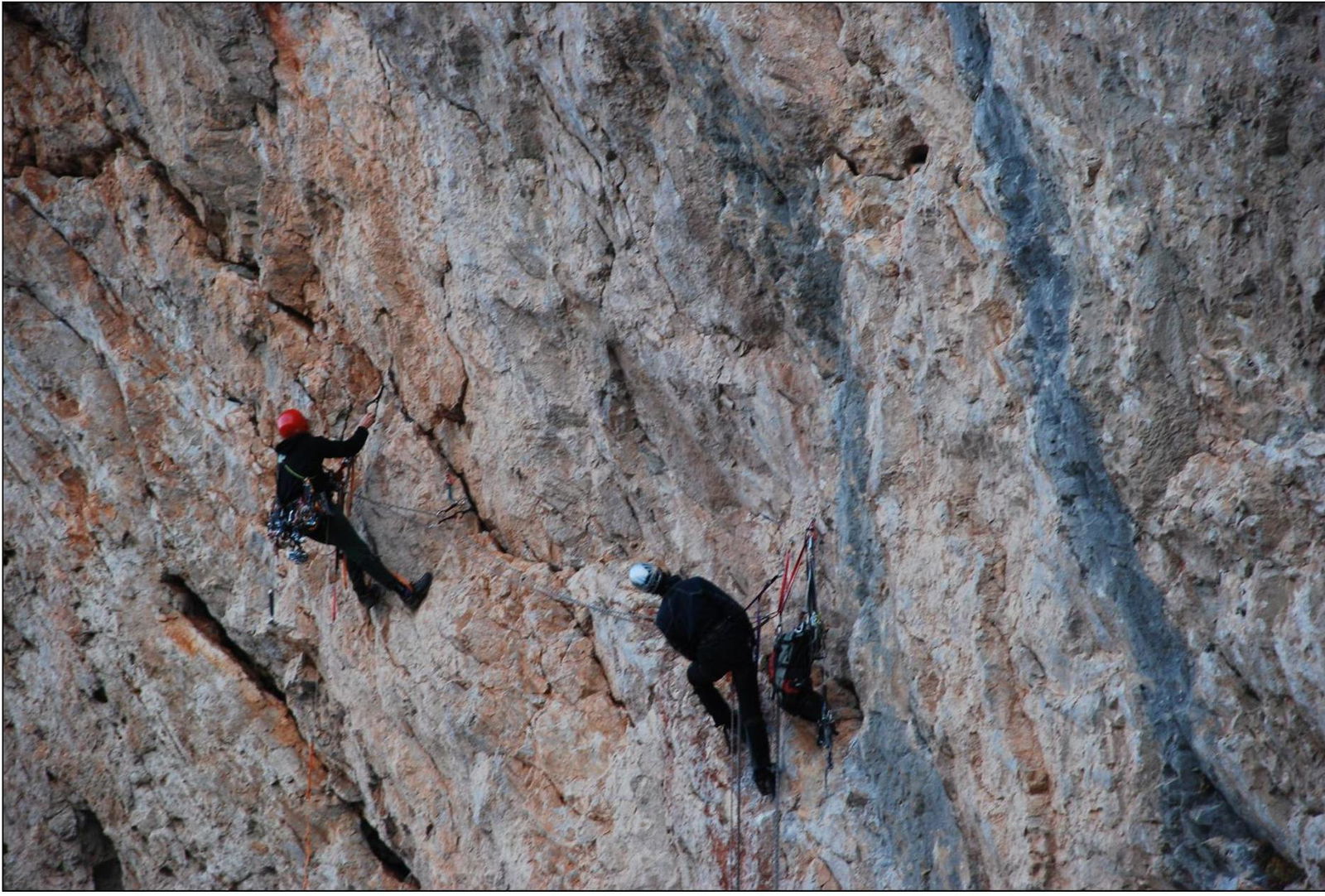
Photo #1 — Pitch R1–R2
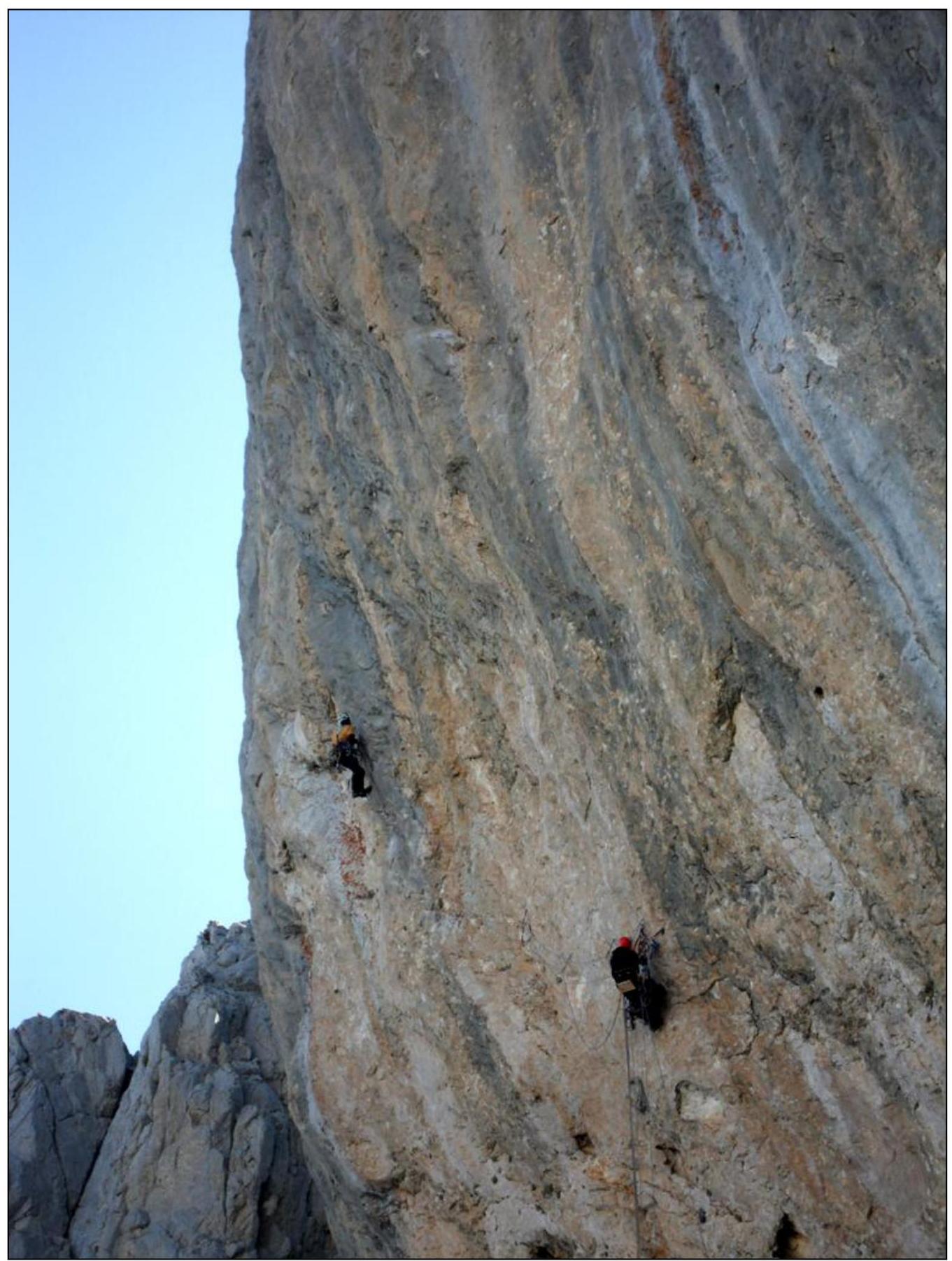
Photo #2 — Pitch R2–R3

Photo #3 — Pitch R3–R4
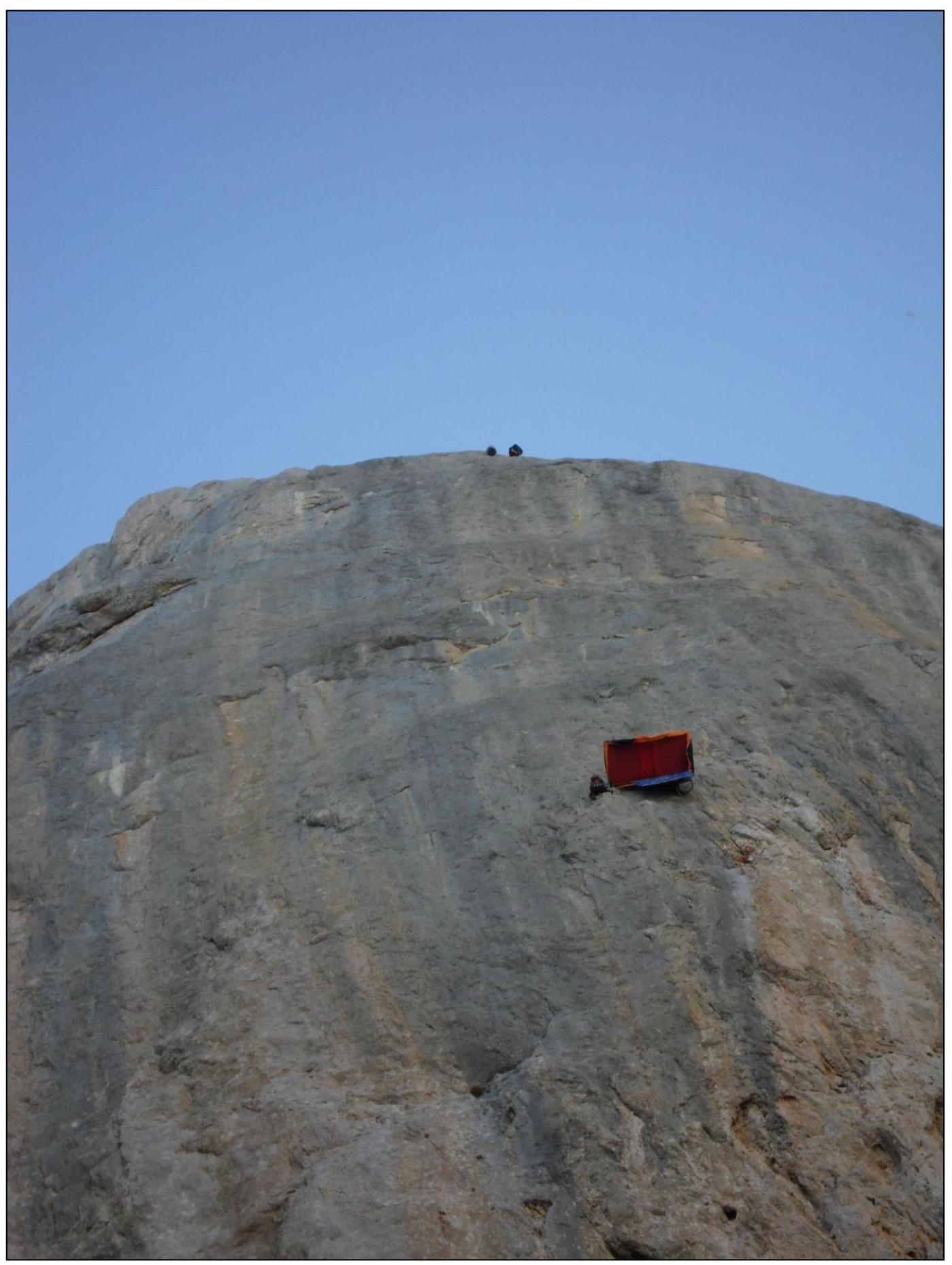
Photo #4 — Pitch R3–R4

Photo #5 — Pitch R5–R6, A4–A5 terrain

Photo #6 — Pitch R6–R7

Photo #7 — Pitch R7

On the summit of P"Urrieylu" 2519 m, October 5, 2011 — Sergey Nilov, Alexey Korochkov, Alexander Lange

Comments
Sign in to leave a comment